Rape is allowed because most people don’t know what it is: Anonymous

Guest post by ANONYMOUS

Rape is allowed because most people don’t know what it is.

To say that victims understand it is assuming too much. The immediate affect will be a deep, invisible wound. After years of counselling it will still hurt and terrorise. All the strength in the world, at the individual and existential levels, will fall short. Very often the crime will remain unreported. Rather than empowering women, the legal system will manage so few convictions that it will itself be the greatest perpetrator.

The perpetrators, as in the actual rapists, know as much or as little as the victims. They will go unarrested, unnoticed, unashamed, and this will fuel their psychopathy. They may or may not realise that rape is not about sex but power.

Continue reading Rape is allowed because most people don’t know what it is: Anonymous

Sexual Violence and Sexuality Education – The Missing Link: Ketaki Chowkhani

Guest post by KETAKI CHOWKHANI

Over the last few days there seems to be sudden explosion in talking about sexual violence and other forms of violence on women. A huge discourse is being created around what rape cultures are and how we are part of these cultures which produce and construct these very acts of violence. Sexual violence has been linked to sexist, misogynist attitudes, remarks and behaviour, and ranging from scriptural affirmations to popular songs. The rape cultures are discussed as existing within the spaces of homes, streets, offices, courts, police stations, public transport, universities and so on. Continue reading Sexual Violence and Sexuality Education – The Missing Link: Ketaki Chowkhani

Misogyny, Politics and Zombiedom: From Sonia Gandhi to Botsa Satyanarayana

After Sushma Swaraj called a rape survivor a zombie – ‘Zinda Laash’,  it is now the Congress Party’s turn to field its prime misogynists and women haters. If the stalwarts of the BJP have unleased their righteous blood-lust by calling for capital punishment (which they do routinely for many things)  how can the good men and women of the Congress party allow themselves to be left behind in the competition for civilised discourse?

The Times of India has a report which I am quoting below that spells out Andhra Pradesh Congress Chief Botsa Satyanarayana’s thoughts on women’s safety.

“Andhra Pradesh Congress chief Botsa Satyanarayana on Monday opened his mouth to put his foot right in, saying women are asking for trouble if they venture out at night. Worse, he described the assault on the physiotherapy student as a “minor incident” for which party president Sonia Gandhi had reached out to agitating people. Continue reading Misogyny, Politics and Zombiedom: From Sonia Gandhi to Botsa Satyanarayana

How the God of Death Changed His Mind: Images from the Protest Against Rape at Jantar Mantar

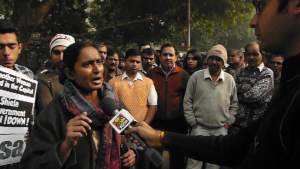
Kavita Krishnan, AIPWA speaking at Jantar Mantar
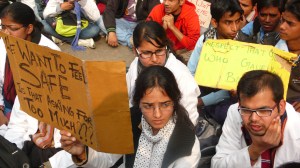
Wanting Safety
Wanting Safety

Protests against sexual violence continued for the third day in Delhi. The venue had shifted from the India Gate-Rajpath environs to Jantar Mantar. Despite the fact that the government had closed metro stops in central New Delhi (from Rajiv Chowk to Khan Market) so that Vladimir Putin was spared the embarrassment of having to encounter protestors against rape, even as he sold gas and guns, a motley crowd of mostly young women and men were able to make their way to Jantar Mantar. Here are a few images and vignettes from this afternoon. Continue reading How the God of Death Changed His Mind: Images from the Protest Against Rape at Jantar Mantar

This is to clarify a small misunderstanding: Anusha Rizvi

Guest post by ANUSHA RIZVI

To,
Ms. Shiela Dixit, Chief Minister Delhi NCR
Mr. Sushil Kumar Shinde, Home Minister, India
Mr. Tejendar Khanna, Lt. Governor, Delhi NCR

This is to clarify a small misunderstanding. I know a part of the protests made you believe that women in Delhi are asking to take policemen away from their VIP duties and put them on Delhi streets. This is incorrect. Many of the protestors are too young to understand
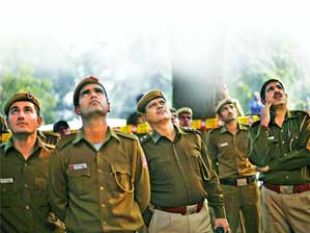
Ma’am and Sirs, the roads are unsafe enough. All Delhi women know – when you see a Delhi policeman, you run. This is what our mothers taught us. This is what we teach our children. I sincerely request you to increase VIP duties for all cops in the Delhi National Capital Region. Please don’t waste your time and energy transferring or suspending any of these gentlemen. All you have to do is ensure no cops are given non-VIP duties. Continue reading This is to clarify a small misunderstanding: Anusha Rizvi

How not to think about violence against women: Noopur Tiwari

Guest post by NOOPUR TIWARI

Photo: AFP
Photo: AFP

I woke up in Paris last weekend to the news of the Delhi protests. I felt relieved. People are not just watching or suffering quietly anymore, I thought to myself. I wanted to be there too, out in the streets of Delhi. For all those times I had to suffer sexual harassment in Delhi, I want to be part of this churning for change now.

My Parisian friends asked me what was going on. And I told them about the new “national outrage” and the stories that had been stoking the anger. That’s when I realised I needed to make a list. What was informing my idea of what’s going on? These stories making it to the headlines, do they have something in common?

Yes, they do have one very obvious thing in common. They are all “sensational” news items. They are either:

Continue reading How not to think about violence against women: Noopur Tiwari

Statement by women’s and progressive groups and individuals condemning sexual violence and opposing death penalty

On 16 December, 2012, a 23-year old woman and her friend hailed a bus at a crossing in South Delhi. In the bus, they were both brutally attacked by a group of men who claimed to be out on a ‘joy-ride’. The woman was gang raped and the man beaten up; after several hours, they were both stripped and dumped on the road. While the young woman is still in hospital, bravely battling for her life, her friend has been discharged and is helping identify the men responsible for the heinous crime.

We, the undersigned, women’s, students’ and progressive groups and concerned citizens from around the country, are outraged at this incident and, in very strong terms, condemn her gang rape and the physical and sexual assault.

As our protests spill over to the streets all across the country, our demands for justice are strengthened by knowing that there are countless others who share this anger. We assert that rape and other forms of sexual violence are not just a women’s issue, but a political one that should concern every citizen. We strongly demand that justice is done in this and all other cases and the perpetrators are punished.  Continue reading Statement by women’s and progressive groups and individuals condemning sexual violence and opposing death penalty

To the Young Women and Men of Delhi: Thinking about Rape from India Gate

Dear young women and men of Delhi,

Thank you for the courage and the honour you have brought to Rajpath, the most dishonorable street in our city. You changed Delhi yesterday, and you are changing it today. Your presence, of all twelve thousand of you, yesterday, on Rajpath, that street that climbs down from the presidential palace on Raisina Hill to India Gate, getting soiled by the excreta of the tanks and missiles on Republic Day each year, was for me a kind of purificatory ritual. It made a claim to the central vista of ‘Lutyen’s Delhi’ as a space for democratic assertion in contravention of the completely draconian, elitist and undemocratic prohibitory orders that make the heart of this republic, a zone of the death, not the life and sustenance, of democracy.

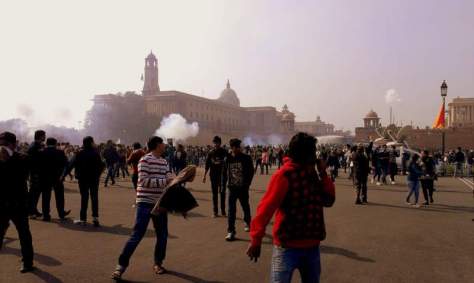
From now onwards, consider the heart of Delhi to be a space that belongs, first of all, to its citizens. Yesterday, when thousands of you gathered peacefully, intending to march up Raisina Hill to the president’s palace, you were charged with batons, tear gas and subjected to jets from water cannons. The violence began, not when protestors threw stones, but when the police started attacking people. Stones were thrown in retaliation. The television cameras that recorded what happened show us the exact chronology. The police were clearly under orders not to let people up Raisina Hill. Why? What is so sacred about Raisina Hill? Why can a group of unarmed, peaceful young people not walk to the gates of the president’s palace? So, lets be clear. Violence began when the state acted. Of course, the protest got hijacked by hooligans. But of course it had to be. When hooligans in uniform are let loose on an unarmed crowed, there can be no possibility of averting the possibility that hooligans out of uniform will respond in kind. Continue reading To the Young Women and Men of Delhi: Thinking about Rape from India Gate

A Government in Hiding

Protestors from Raisina Hill began to be forcibly removed late last night. The police action continued in the foggy cold of this December morning. Aghast at the violence on a completely peaceful gathering of students – some of them just school children – many of us too felt compelled to join the demonstrations. A number of left-wing student groups who have been part of the protests had called for collecting at the Neel Gumbaz at Nizamuddin. At 11 am, we all started collecting there – many of us older folk going there in solidarity with what has been one of the most unprecedented student-youth mobilizations in the city. Yesterday, there had been repeated rounds of  water cannons, tear-gas and brutal lathi-charge by the police of a government that has gone into hiding.

Finally, some 600-700 of us began moving in a procession from Nizamuddin to India Gate. When we reached there, we discovered that already large numbers of people had begun recongregating at ‘Rajpath’ – the Power Avenue where every January the Republic displays its military might to the world. The numbers were continuously swelling. A group of supporters of Arvind Kejriwal’s AAP – inclduing Kejriwal and other leaders – were squatting on one side, towards Hyderabad House. This was virtually on the margins of the area where the main crowds were. Apart from the group of people we had come with, there were hundreds who seemed to us to be completely unaffiliated ordinary students, contrary to some claims floating around in Facebook that these were ‘RSS crowds’. At one end a human chain had been erected and slogan shouting for justice continued. Around the Amar Jawan Jyoti, there were processsions of students still coming in. We were there till about 2 pm and there was no question of any violence at all – except for three unprovoked tear gas shells that had been lobbed by the police into the crowd. There had been some minor commotion as the police occassionally tried to push back students with a lathi charge of sorts.

By this time, however, it was apparent that the police was preparing for the offensive. Police briefings were taking place in different groups and gradually the crowd was being surrounded from all sides. And yet, till about 2.50 pm, despite twenty rounds of tear gas being fired by the police, as well as periodic lathi charges  – they did not manage to provoke violence from the crowd to justify a crackdown. But the crackdown had to take place. And lo and behold, the justifications for it materialized, suspiciously, very soon. Continue reading A Government in Hiding

Rape Cultures in India: Pratiksha Baxi

Guest post by PRATIKSHA BAXI

Delhi has tolerated intolerable forms of sexual violence on women from all backgrounds in public spaces for decades. It is a public secret that women are targetted in streets, neighbourhoods, transport and workplaces routinely. There have been countless campaigns and appeals to all agencies concerned to think of safety of women as an issue of governance, planning and prevention. However, prevention of sexual violence is not something, which features in the planning and administration of the city. It is not seen as an issue for governance that extinguishes the social, economic, and political rights of all women.

 It is a public secret that rape of women in moving vehicles is popularly seen as a sport. The sexualisation of women’s bodies accompanies the projection of cars as objects of danger and adventure. Private buses now participate in this sexualisation of moving vehicles as a site of enacting pornographic violence. In this sense, safety is not seen as a commodity that can be bought, purchased or exchanged. Men consume images of a city tolerant of intolerable violence. City planners enable rapists to execute a rape schedule. Streetlights do not work. Pavements and hoarding obstruct flight. Techniques of surveillance and policing target women’s behaviour, movement, and clothing, rather than policing what men do. The city belongs to heterosexist men after all. Continue reading Rape Cultures in India: Pratiksha Baxi

A Day at Raisina Hill: Nilanjana Roy

Guest post by NILANJANA ROY

“We want justice! We want justice!”

I went to the protests at Raisina Hill expecting very little. Despite the anger over the recent, brutal gang-rape of a 23-year-old by a group of six men, who also beat up her male friend, protests over women’s violence in the Capital have been relatively small.

But the crowds walking up the Hill, towards the government offices of North and South Block, from India Gate are unusual. It’s a young crowd—students, young men and women in their twenties, a smattering of slightly older women there to show their solidarity, and it’s a large crowd, about a thousand strong at the Hill itself. There are two small knots representing student’s politicial organisations, but otherwise, many of the people here today are drawn together only by their anger. Continue reading A Day at Raisina Hill: Nilanjana Roy

Passage of Amendments to UAPA – Further erosion of Constitutional Rights: JTSA

This release was put out today by the JAMIA TEACHERS’ SOLIDARITY ASSOCIATION

The pushing through of the amendments to Unlawful Activities Prevention Act (UAPA) in the Rajya Sabha, despite protests and calls for further discussion and deferment, indicates the consensus between Congress and BJP on the issue of civil rights. The passage of the amendments, which now bring economic offences under terrorism, and broaden the definition of person to an extent that will criminalize all forms of associations, will provide sweeping powers to the police and security agencies, and create a regime of suspicion.

False Claims of the Government:

Responding to the debate in the RS, Minister of State for Home stated that, “The Act does not give sweeping powers to the police and there are checks and balances that will prevent misuse of the Act.” He further assured the House that the law was “religion neutral” and would not target any particular community.

This is patently false. Continue reading Passage of Amendments to UAPA – Further erosion of Constitutional Rights: JTSA

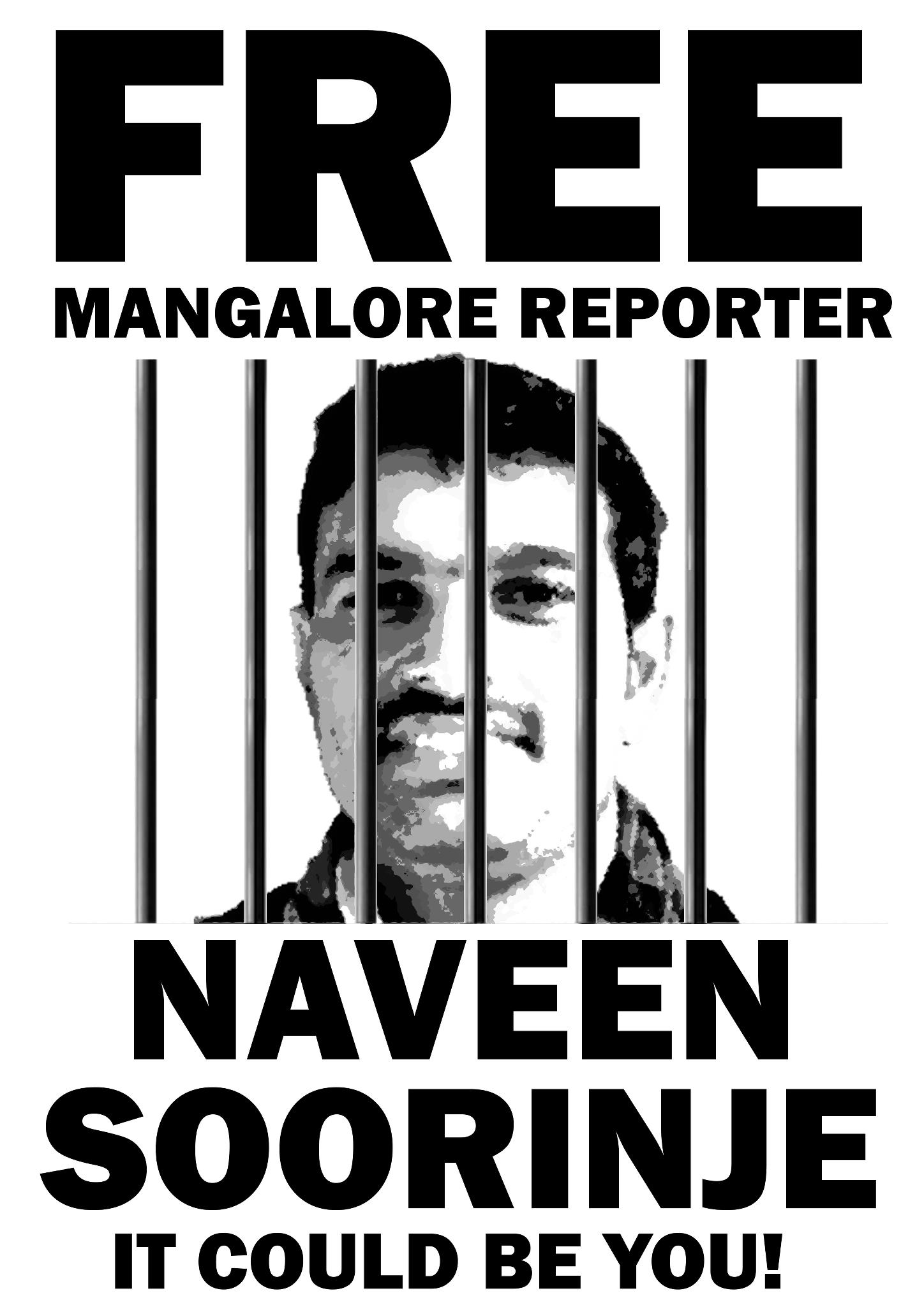
Free Naveen Soorinje

333487_10152333238225258_544394853_o

It is a matter of shame that instead of being celebrated, Naveen Soorinje, who followed journalism’s best traditions in reporting the attack by Hindutva vigilantes in Mangalore earlier this year, is now languishing in jail.

“Being South African, it felt like walking into another apartheid ambush”

The 3 Wise Men blocked by Israels Apartheid Wall

The Three Wise Men blocked by Israel’s Apartheid Wall

A delegation of South African Christian Church leaders has just returned from a one-week solidarity visit to the holy cities of Bethlehem and Jerusalem in Palestine-Israel. On their return, they released this joint statement [extracts]:

“Being South African, it felt like walking into another apartheid ambush. We witnessed violations of international law on so many levels – the multiple Israeli house demolitions, the discriminatory Israeli legal system, the daily intimidation of Palestinians by the Israeli Defence Forces, the Israeli Apartheid Wall and its associated regime of restrictions on movement and access for Palestinians, the imprisonment of a large percentage of Palestinians (including children), the ongoing confiscation of Palestinian water and land, the closure of previously bustling Palestinian streets and businesses, separate pavements for Israelis and Palestinians…”

Continue reading “Being South African, it felt like walking into another apartheid ambush”

Appeal to Dalit Groups for Solidarity with Laxmipet Dalit Victims: Hyderabad Political Economy Group

Statement issued by the HYDERABAD POLITICAL ECONOMY GROUP, received via RAVICHANDRAN BATHRAN

It is necessary for all of us to look beyond whatever we do. The killing of Laxmipet Dalits on 12th June 2012 and subsequent events indicate that divided houses of Andhra Pradesh Dalit Mahasabha must re-examine the nature of political divisions that have long since afflicted it leading to numerous splinter dalit groups and the formation of two major groups, the Mala Mahanadu demanding status-quo and the Madiga Dandora claiming for categorisation in reservation policy. There are three major issues emerging over the last six months after Laxmipet events unfolded which is why we appeal to both political groups of Dalits to show support and solidarity with each other.

First, time has now come for these Dalit organisations to realise how their persistent bickering has divided them and has weakened their struggle for justice.  The Dalit organisations, especially the Mala Mahanadu and the Madiga Dandora, must realise that a full-fledged reservation system in Laxmipet, ensuring representation of  Dalits in administration and politics, have failed to protect  Dalits from atrocities committed by dominant castes over land issues.  Continue reading Appeal to Dalit Groups for Solidarity with Laxmipet Dalit Victims: Hyderabad Political Economy Group

A song for snow: Arif Ayaz Parrey

Guest post by ARIF AYAZ PARREY

The beloved is like snow after a chilly wind. The beloved is a bright sun after snowfall. The lover is like the cinders in a kãger that refuse to die. The lover is the immortal heat of ashes.

     In the 2008 Hindi movie Oye Lucky! Lucky Oye! the playing out of virtues of theft in a world of (corrupt) systems is not the only delicious element. As a matter of fact, even more lovable is the song Tu raja ki raj dulari which echoes Shiv’s plea to Parvati after she has hopelessly fallen in love with him, and chosen a path of austerity competing with his asceticism. Tu raja ki raj dulari mein sirf langoti aala sun, bhaang ragd ke piya karoun mein kunde sote aala sun.  He tells her. “You are a king’s royal darling, I possess only a loincloth (Will tiger-cloth be a more helpful description here?), I drink ashes which I grind on a pistil and mortar.” Now there are several ways of looking at this parable. At the surface, and then again at its very core, it is a narration of one of the major themes of storytelling: An independent, beautiful and strong woman poignantly falling for a clumsy, reclusive and basically loser-type man, against better advice and to much heart-ache all around. But this characterisation holds only at the surface, the patriarchy of this theme works through the neat device of depth, the woman is strong, but only on the outside, quite literally when you know that Parvati once shed her outer mantle which became a powerful warrior-goddess in its own right, but in depth and beyond the obvious, she is a woman after all, while the man, clumsy, reclusive, scrawny on the surface, has an inner strength which can gulp Halahal (funnily enough called zahr-e-Hilal or ‘poison of the crescent-moon’ in Kashmiri) without much ado or do the Tandav when he feels like it. Continue reading A song for snow: Arif Ayaz Parrey

An open letter to the President of India: G. Ananthapadmanabhan

Sri Pranab Mukherjee
President of India
Rashtrapati Bhavan
New Delhi – 110 004.
India

12 December 2012

Subject: Open letter regarding the resumption of executions in India

Dear President,

I am writing on behalf of Amnesty International regarding the recent resumption of executions in India after eight years, to urge the Indian authorities to immediately establish a moratorium on executions with a view to abolishing the death penalty. Continue reading An open letter to the President of India: G. Ananthapadmanabhan

Aam Aadmi party learns from aam mahila

This release was put out yesterday by the RIGHT TO FOOD CAMPAIGN

On the second day of the “Right to Food dharna” convened by the Right to Food Campaign, hundreds of poor women from across the country braved the morning cold and rain to assemble at Jantar Mantar and voice their concerns,  including the demand for a universal PDS, universalization with quality of ICDS, universal maternity entitlements, universal pensions for single women, and crèche facilities at the workplace.


Women living in urban slums, on the streets, working on construction sites, agricultural workers, single women, women with young children from different states shared their experiences of struggle for food security and access to the Public Distribution System and other food-related programmes. Continue reading Aam Aadmi party learns from aam mahila

Free the innocent undertrials and Jharkhand’s jails won’t be overcrowded: Stan Swamy

Guest post by STAN SWAMY

A Controller and Auditor General (CAG) report tabled recently in Jharkhand  Assembly says most of Jharkhand  jails are housing prisoners beyond their capacity by the end of 2010. Significantly, the most crowded jails are in Garwa, Latehar and Simdega districts where anti-naxalite operations by police and para-military forces are on. The basic question to ask is: are Jharkhandi adivasis & moolvasis increasingly taking to crimes or is the society labeling them criminals.
There are three basis on which young rural adivasi men & women are arrested: Continue reading Free the innocent undertrials and Jharkhand’s jails won’t be overcrowded: Stan Swamy

*hit still happens

“Approximately 13000 trains run daily out of which 9000 are Passenger trains and 13 million passengers traveling every day. As per Nanda report the railways have cited several reasons for the delay, including prohibitive costs, with one estimate pegging the amount required for bio-toilets at Rs.1,600 crore. Continue reading *hit still happens

Mowgli meets the Maoists: Satya Sagar

Guest post by SATYA SAGAR

Hello folks! I need your help and hence this appeal to all of you!

I have been a journalist for a long time but never managed to write a full book on my own all these days. One reputed publisher has now approached me to write a book about the Maoists and I am very excited about it. The publisher thinks that the Maoists are a very ‘sexy’ topic and I should write about them because as a veteran journalist I am qualified to write on anything under the sun.

Let me give you some background. Basically publishers have figured out there seems to be lots of money in printing anything penned by an Indian writer. Novels, plays, travelogues, diaries, memoirs, collections of old essays, homework notes from school, whatever- because the entire world is willing to read anything written by Indians. It seems people around the planet had assumed all these decadesthat Indians were completely illiterate and now that has been finally proven untrue they want to read EVERYTHING they write. Continue reading Mowgli meets the Maoists: Satya Sagar

DISSENT, DEBATE, CREATE