കേരളത്തിൽ ഇരുപതാം നൂറ്റാണ്ടിൽ രൂപമെടുത്ത ബ്രാഹ്മണിക പിതൃമേധാവിത്വത്തിന് സവിശേഷസ്വഭാവങ്ങളുണ്ടായിരുന്നു. ഇരുപതാം നൂറ്റാണ്ടിൽ ഉയർന്നുവന്ന നവവരേണ്യസമുദായങ്ങളെ — നവോത്ഥാന വ്യവഹാരത്തിൻറെ വാഹകങ്ങളെ — പണിതെടുത്ത അടിസ്ഥാന അധികാര-കൂടങ്ങളിൽ ഒന്നായിരുന്നു നവബ്രാഹ്മണിക പിതൃമേധാവിത്വം.
കേരളത്തിലിന്ന് രാഷ്ട്രീയരംഗത്തും ഭരണരംഗത്തും (ഉദ്യോഗസ്ഥകളല്ലാത്ത) സ്ത്രീകളുടെ പ്രാതിനിധ്യവും അധികാരവും ഇടതുഭരണത്തിനു കീഴിൽപോലും കുറവാണ്. ഇടതുരാഷ്ട്രീയക്കാരികൾക്കു പോലും സ്വന്തമായ രാഷ്ട്രീയസ്വാധീനവലയം ഉണ്ടാക്കാൻ അനുവാദം ഇല്ലെന്നതിന് തെളിവ് ഇപ്പോഴത്തെ സർക്കാർ തന്നെ തന്നിട്ടുമുണ്ട് — ശൈലജ ടീച്ചറെ മാറ്റി സർക്കാരിലെ ആൺ അധികാരികളെ തികച്ചും ആശ്രയിച്ചു മാത്രം നിലനില്പുള്ള മറ്റൊരു സ്ത്രീയെ അവരുടെ സ്ഥാനത്ത് പ്രതിഷ്ഠിച്ചതോടെ. പാർട്ടി അധികാരശ്രേണികളിൽ സ്ത്രീകൾ കുറയുകയും കീഴ്ത്തല-കാലാളുകളുടെ കൂട്ടത്തിൽ അവരുടെ സാന്നിദ്ധ്യം ഉയരുകയും ചെയ്യുന്നുണ്ട്. പൊതുവെ ഭരണനയതലത്തിൽ ഫെമിനിസ്റ്റ് സ്വാധീനം കുറഞ്ഞിട്ടുമുണ്ട് (മഹിളാ സമഖ്യയിലും കുടുംബശ്രീയിലും ഇതു പ്രകടമാണ്). എങ്കിലും സ്ത്രീശാക്തീകരണ സർക്കാരെന്ന പ്രതിച്ഛായ നിലനിർത്താൻ ഇപ്പോഴത്തെ സോഷ്യലിസ്റ്റ്- അനന്തര ദുഷ്പ്രഭുത്വത്തിൻറെ വാഹനമായ സിപിഎമ്മിനും അവർ നയിക്കുന്ന സർക്കാരിനും കഴിഞ്ഞിട്ടുണ്ട്.
ദണ്ഡനീതി ഫെമിനിസം (Carceral feminism) എന്ന സങ്കല്പനം ഇന്ന് ലോകഫെമിനിസ്റ്റ് ചർച്ചകളിൽ സുപരിചിതമാണ്. പോലീസ്, കോടതി, ശിക്ഷ, തടവ് മുതലാവയുൾപ്പെടുന്ന ഭരണകൂടശാഖയെ മുഖ്യമായും ആശ്രയിച്ചുകൊണ്ട് സ്ത്രീകൾക്കെതിരെയുള്ള എല്ലാത്തരം ഹിംസയും പരിഹരിക്കാമെന്ന വിശ്വാസത്തിൽ ഊന്നിനിൽക്കുന്ന ഫെമിനിസ്റ്റ് പ്രയോഗങ്ങളെയും ചിന്തയെയുമാണ് അത് സൂചിപ്പിക്കുന്നത്. പാശ്ചാത്യ ഫെമിനിസത്തിൽ ഏറെ പഴക്കമുണ്ടെങ്കിലും അത് 1980-90 ദശകങ്ങളിൽ അമേരിക്കൻ ഫെമിനിസത്തിലെ പ്രമുഖ ധാരയായി ഉയർന്നുവന്നു. ലൈംഗികത്തൊഴിലിനെപ്പറ്റിയുള്ള ചർച്ചകളിലാണ് സമീപകാലത്ത് അതിൻറെ പുനരുജ്ജീവിതരൂപം പ്രത്യക്ഷമായത്.
കേരളത്തിൽ ഫെമിനിസത്തിൻറെ രാഷ്ട്രീയപരിണാമത്തെ മാറുന്ന ഭരണകൂടത്തിൻറെ പശ്ചാത്തലത്തിൽ മനസ്സിലാക്കാനൊരു ശ്രമമാണ് ഈ എഴുത്ത്. ഫെമിനിസം എന്ന പേര് സ്വയം അവകാശപ്പെടുന്ന രാഷ്ട്രീയം ഇവിടെ 1980കളിലാണ് പൂർണമായ അർത്ഥത്തിൽ പ്രത്യക്ഷമാകുന്നത്.
Dr Vinod Mubayi, Public Intellectual, Scientist and Activist will be delivering the 20 th Lecture in the Democracy Dialogues Series, organised by New Socialist Initiative on Sunday, 30 th October at 7 PM (IST)
He will be speaking on
Partition Split Us Up: Can We Live in Peace as Neighbors?
Partition Split Us Up: Can We Live in Peace as Neighbors?
Future Challenges and Reflections
75 years have passed since Partition and the prospects of peace between the two largest countries of the region, India and Pakistan, whose conflict impacts the entire South Asia region look dimmer than ever. The reasons and justifications offered by the protagonists for the separation, such as the two-nation theory, have been discussed at length in various forums and while the past is commonly understood to be prologue to the future it behooves us to imagine a future without all the baggage of the past.
This talk will refer at times to the past and the misdeeds of the present but focus mostly on possibilities for the future. A good amount of experience has shown that despite the most fraught and tense relations between governments, common people of south Asian countries, whether in the diaspora or while visiting each other’s countries, are able to establish bonds and friendships very quickly and easily. Perhaps 75 years cannot easily extinguish long standing cultural and linguistic bonds established over millennia. Dialectics also teaches us that opposing and contradictory views and ideas can co-exist within a society or group and which will prevail depends on the context in which the opposites interact.
Groups such as South Asia Peace Action Network (SAPAN), whose founding charter states that its minimum common agenda is reclaiming South Asia, have attracted members from all South Asian countries. SAPAN calls for soft borders and visa free travel between countries in the region in addition to demands for human rights, peace and justice. The talk will discuss possibilities of expanding the activities of people-to-people groups that can create civil society pressures for peace and prosperity as well as joint actions to counter existential threats like climate change.
About the Speaker :
Dr Vinod Mubayi is a reputed American Physicist of Indian origin.
PhD in Physics from Brandeis University, taught at Cornell University and was a research fellow at TIFR, Mumbai before joining Brookhaven National Laboratory, New York.
A member of the American Nuclear Society, the American Physical Society and the American Association for the Advancement of Science, he was also a Consultant to agencies of the United Nations on Energy Issues ( 1981-1985)
He joined INSAF bulletin as co-editor in 2004. A keen observer of socio-political events in India, Mubayi has been close to progressive groups, espousing human rights issues and the cause of the downtrodden
His book ‘Where is India Headed ? – An Historical Critique ( 2021, Media House) which chronicles the contemporary Indian History during the last few decades has also been translated into Hindi
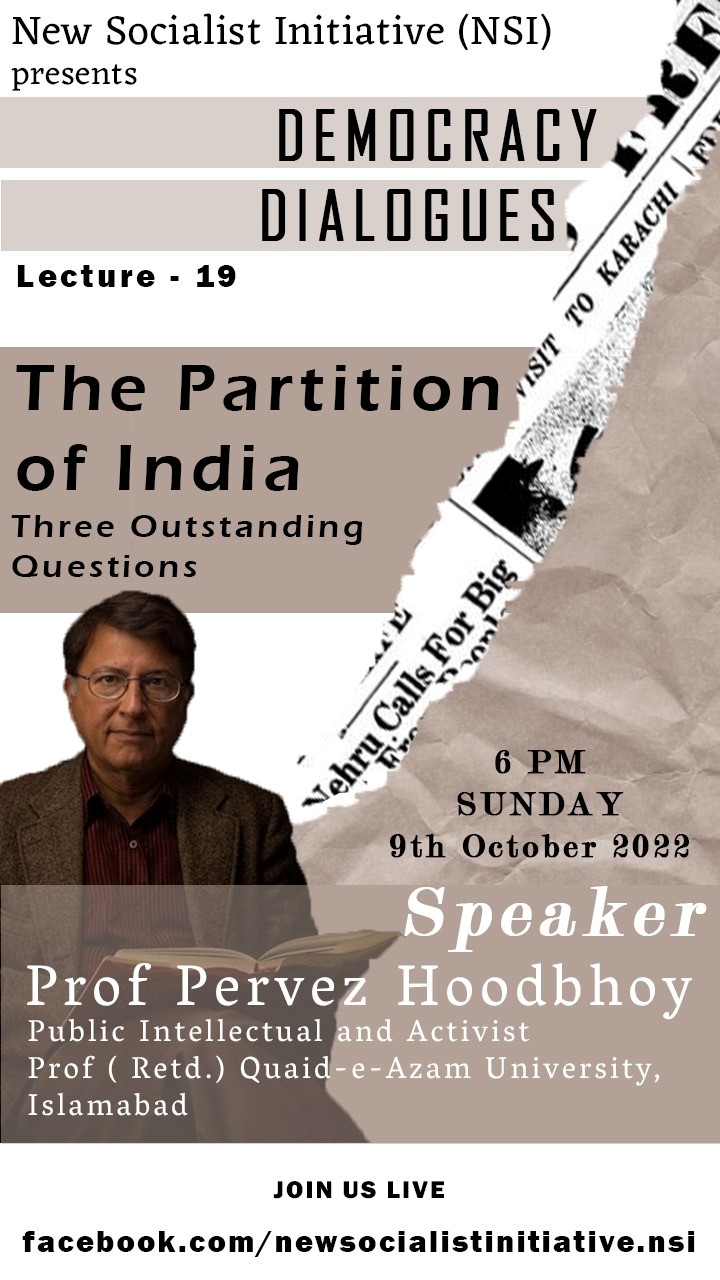
Professor Pervez Hoodbhoy, eminent physicist, author, public intellectual and a forceful voice for reason, science and democracy will be delivering the 19th Democracy Dialogues lecture on Sunday, October 9th, 2022 at 6 PM (IST)
The Partition of India: Three Outstanding Questions
Seventy five years after the communal storm of 1947 countless important questions still remain. From among them I will concentrate upon three which are particularly important in understanding the past but which, in addition, continue to influence current trajectories.
How, when, and why did the two-nation theory emerge?
Why is Pakistan a praetorian state but India is not?
Was Partition preventable and had it not happened what might have been the consequences?
Speaker:
Pervez Hoodbhoy is a nuclear physicist, a frequent commentator on Pakistani television channels, founder-director of The Black Hole in Islamabad, and an author. He received his undergraduate and graduate degrees from MIT and taught physics at Quaid-e-Azam University for 47 years.
The lecture will be held on zoom and for security reasons the link will be shared individually only closer to the event. Please write to us at democracydialogues@gmail.com if you want to join the lecture online.
The following letter, signed by over 300 individuals from different national and regional organisations was handed over at the Iranian Consulate in Mumbai by six representatives on September 29, 2022. It was received politely and acknowledged.
Mr. Abolfazi Mohammad Alikhani
Consul General,
Iran Consulate, Mumbai.
Sir,
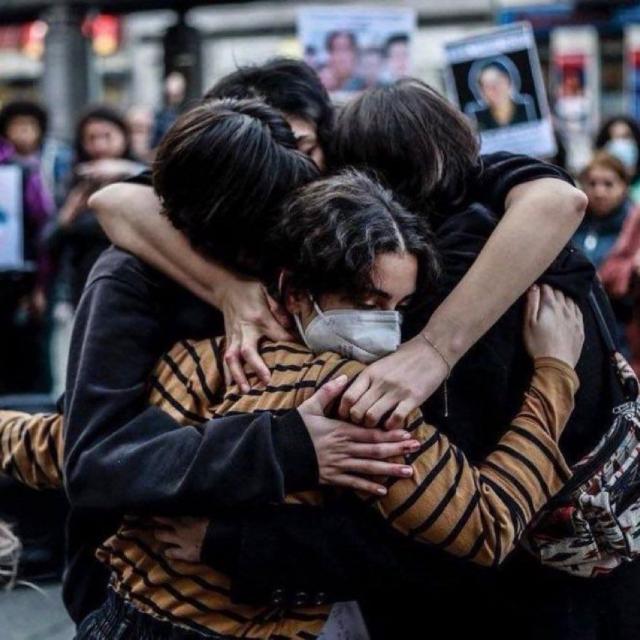
We, women and women’s organization from India, are writing this letter to register our horror at the brutal attacks on the women and citizens of Iran as they protest the killing of Mahsa Amini at the hands of the Gasht-e-Ershad. These brutal attacks have resulted in and continue to result in further deaths and imprisonments.
These brave women of Iran are demanding freedom from the Morality Police and the State imposing upon them what they must or must not wear and how to wear it; what they must and must not do, or act, or behave. They are rejecting this control. The men of Iran are giving full support and putting their bodies on the line alongside them. The resulting violent repression is heinous and inhuman.
This post is jointly written by AYESHA KIDWAI AND NIVEDITA MENON
On this international day of solidarity with the Iranian people, two feminists from India send you our greetings, in complete awe of your courage, your creativity, your solidarity with one another, your relentless resistance in the face of cruel and brutal repression.
Watching the panel discussion on Jadaliyya on the ongoing struggle of the Iranian people against the authoritarian regime, we were struck by the complexity of the arguments being made. The struggle is not against Islam, and it is not about hijab everywhere and at all times. What we are witnessing in Iran is reflected all over the world wherever there is resistance to the gendered ways in which all states control populations – whether by compulsory conscription in wars the people have no interest in, or by making the hijab central to the reason of state – in Iran by compulsory veiling, in France and in India by compulsory unveiling of the Muslim woman; or in the USA by denying autonomy over their bodies to women by criminalizing abortion. Continue reading In solidarity with the Iranian people fighting for democracy and justice: Ayesha Kidwai & Nivedita Menon→
Did you even know this? That there have been no admissions this academic session so far, to any Central University, as the results of the new UGC mandated centralized Common Universities Entrance Test (CUET) are yet to be announced as late as September 2022, when the academic session was to have begun in July/August. The UGC Chairperson M Jagadesh Kumar (who ran JNU to the ground in his extended tenure) has tweeted that results for the Undergraduate courses will be announced latest by September 15th. The exams for Postgraduate courses were conducted only this month!
And I dare you to find a single news item that reports the CUET as the large scale massive failure it is. At best you get bland information such as that undergraduate admissions are about to begin in Deli University this month and that classes are expected to begin on October 20th. No questioning of why there has been a three month delay already and even now everything is only “expected”!
And again earlier this month, as late as September 2022, the National Testing Agency informed Central Universities it will be unable to conduct the Common Test for the Ph.D programme, and the universities will, at this point, START the process of conducting these exams themselves.
The first time in India admissions to universities were severely delayed was due to the Covid virus in 2020-21, but different universities had different processes and could accomplish admissions by the end of the year. In the last year too there was delay, but as universities were still holding different entrance text exams, universities differed in when they managed to complete admissions in 2021. This academic year, however, when there are no pandemic induced closure of any university, the situation is the worst ever, due entirely to a targeted human endeavour to destroy India’s public university system, by imposing an unmanageable, centralised examination that lakhs and lakhs of students all over the country must take for admission into universities.
That this disaster for public universities and for two generations of students is not making the news, let alone the headlines, says much about the state of the media in India today. That nobody will be held accountable for this national disaster is almost unbelievable except that we have had to to believe so many unbelievable developments in our unfortunate country since 2014, that perhaps the destruction of public universities seems minor in comparison?
Please take a look at the detailed critique provided by the JNUTA.
Prof Fransesca Orisini, who has taught Hindi and Indian literature at SOAS, London, will be delivering the Seventh Lecture in the Sandhan Vyakhyanmala Series on Sunday, 18 th September, 6 PM ( IST).
She will be speaking on हिंदी में अंतर्राष्ट्रीयवाद – साहित्य और शीत युद्ध ( Hindi Internationalism – Literature and Cold War
Organised by :NEW SOCIALIST INITIATIVE ( NSI) Hindi Pradesh
संधान व्याख्यानमाला : सातवां वक्तव्य विषय : हिंदी में अंतर्राष्ट्रीयवाद – साहित्य और शीतयुद्ध
आज़ादी के बाद के दो दशक पत्रकारिता के लिए स्वर्णिम युग माना जाता है – हिंदी और दूसरी भाषाओं में । ये वे दशक भी थे जब उपनिवेशवाद को खतम करने वाली हवा ज़ोरों से चलने लगी थी, और साथ साथ शीत युद्ध का प्रभाव भी दुनिया के हर कोने में महसूस होने लगा। तब साहित्य को बड़ी गम्भीरता से लिया जाता था। एक ख़ास क़िस्म के साहित्य के प्रचार, प्रसार और अनुवाद में बड़े पैमाने के प्रोग्राम स्थापित करके बहुत बड़ी रक़म खर्च की गयी । मोनिका पोपेस्कु की हाल की किताब का शीर्षक लिया जाए तो शीतयुद्ध और उपनिवेशवाद से आज़ादी पाने के संघर्ष कलम की नोक पर (At Penpoint, २०२०) चलाए गए। साहित्य पर शीतयुद्ध के प्रभाव को लेकर ज़्यादातर काम अमेरिका, सोवियत रूस और साम्यवादी चीन के प्रचार-प्रसार योजनाओं पर हुआ है । मेरा ध्यान हिंदी पत्रकारिता पर रहेगा, और विशेष तौर पर हिंदी की कहानी पत्रकारिता, जिनका पाठक-वर्ग न केवल साहित्यिक बिरादरी थी बल्कि सामान्य पाठक भी उसमें शामिल थे । क्या १९५० और १९६० के दशकों की हिंदी पत्रिकाओं में कोई अंतर्राष्ट्रीय चेतना नज़र आती है? क्या कहानी और सारिका जैसी लोकप्रिय पत्रिकाएँ भी शीतयुद्ध में भाग लेते दिखाई देती हैं ? क्या उनमें शीतयुद्ध और उपनिवेशवाद से मुक्ति पाने के संघर्षों की झलक मिलती है ? कहानी-पत्रिकाएँ पाठकों के मन में दुनिया की कल्पना कैसे गढ़ती हैं ? (एक ऐसी कल्पना, जो राजनीति से जुड़ी हो पर सिर्फ़ राजनीति से नहीं ।) और जो दुनिया पत्रिकाएँ–जो हर हफ़्ते या हर महीने सिलसिलेवार छपती तो हैं मगर जिनको पढ़ने के बाद रद्दी के हवाले किया जाता है—गढ़ती हैं, वह दुनिया पाठकों के मन में कहाँ तक अंकित रहती है? क्या पत्रिकाएँ भी अंतर्राष्ट्रीय सम्बन्धों को बनाने में सक्रिय होती हैं ? इन सवालों का जवाब देने की कोशिश करते हुए यह प्रस्तुति हिंदी के एक कम जाने माने पहलू पर रोशनी डालेगी।
फ़्रंचेस्का ओर्सीनी SOAS, लंदन विश्वविद्यालय में हिंदी और भारतीय साहित्य की प्रोफ़ेसर रही है। उनकी लिखी हुई और सम्पादित किताबों में हिंदी का लोकवृत्त (The Hindi Public Sphere: Language and literature in the age of nationalism, 1920-1940, 2002), Love in South Asia (2006), Print and Pleasure (2009), Before the Divide (2010), After Timur Left (2014, with Samira Sheikh), Tellings and Texts(2015, with Katherine Schofield), Hinglish Live (2022, with Ravikant) और The Form of Ideology and the Ideology of Form: Cold War, Decolonisation, and Third World Print Cultures, with Neelam Srivastava and Laetitia Zecchini) शामिल हैं।
Statement released by feminists from Sri Lanka, Bangladesh, Pakistan, Fiji, Malaysia and India, August 27, 2022
We are a group of feminists writing to call urgent attention to the extra-constitutional attempts of the Government of Sri Lanka (GoSL) to suppress dissent. Lacking a popular mandate, hunting down student protestors and activists, including a LGBTIQ activist has become a central strategy of the political élite to retain power. The latest move by the GoSL is to brand three student leaders and the student union they represent, the Inter University Student Federation (IUSF), as ‘terrorists’.
Wasantha Mudalige, Convenor of IUSF, Galwewa Siridhamma thero, Convenor of the Inter-University Bhikkhu Federation, and Hashan Jeewantha, a student activist, were among the 20 arrested on August 18, 2022, for participating in a peaceful protest led by the student movement. All three of them are prominent student leaders who have been at the forefront of struggles for socio-economic justice in Sri Lanka, particularly against numerous ongoing attempts to dismantle free education. Continue reading SL Govt – Stop Labeling Student Protestors and Activists as Terrorists! South Asian Feminists→
AYESHA KIDWAI reflects on the injustice done to Bilkis Bano on the 75th anniversary of India’s independence, by the release of the 11 convicted rapists (who raped her during the Gujarat carnage of 2002, and killed her 3 year-old daughter), by way of her translation of Krishn Chander’s short story written in 1948, entitled Ek Tawaif ka Khat,
Our readers would remember that Ayesha has had translations posted here on Kafila earlier, some into Hindustani from English. Now you can visit her site to read all of her translations as and when she posts them there.
Here we publish her preface and an extract from the translation. The whole story may be read on her site.
PREFACE BY AYESHA KIDWAI
There have been many in India and Pakistan (and what eventually became Bangladesh) who have always remembered the Partition of 1947. They remembered it as it the long Partition of India drew out, because they bore the marks of it on their bodies and in their families, they remembered it as they were in Parliament trying to build a state that would never face such a terrible event of rupture ever again; they remembered it even when they apparently appeared to forget it, because the only way to not let the events of terrifying trauma — of the looting, abduction, sexual violence, exile and murder— overshadow the present and the futures that had to be built. At every stage in the last 75 years, there have been people in both countries who have taken instruction from the horrors of the long Partition to interrogate what must not be done, what was must be changed, what must be erased.
Eminent scholar of Modern Indian History Prof Aditya Mukherjee, ( Retd.) Centre for Historical Studies, JNU who is also editor of the ‘Sage Series in Modern Indian History’ will deliver the next (18 th) Lecture in the Democracy Dialogues series organised by New Socialist Initiative.
He will be speaking on ‘Where Are We : 75 Years After Independence.’ on Sunday, 28 th August 2022 at 6 PM (IST).
“As we celebrate 75 Years of India’s independence, it is time to reflect on the extent to which the Indian nation-state has lived up to the vision of the Indian national movement and the spirit of the new Constitution. The core ideas behind this vision envisaged that Independent India would be sovereign, democratic, secular republic that will have a pro-poor orientation and would be based on reason rather than blind faith and obscurantism.
With the recent changes in the governmental power at the Centre and in many states where forces following precepts of the Right – forces which had remained outside the spectrum of the national movement – have become dominant resulting in a grave threat to the core components of the Idea of India. There is a reason why the world is no longer accepting India as a full democracy and is, instead, being variously describing it as a “partially free democracy”, a “flawed democracy” and even as an “electoral autocracy”.
In this lecture we will trace the course of developments that has led India to this predicament and will outline future prospects for overcoming the challenges.”
About the Speaker :
Prof Aditya Mukherjee has been associated with Centre for Historical Studies, JNU for the last more than four decades. He has been Editor of the Series, ‘Sage Series in Modern Indian History’ published by SAGE publications, and a member of Scientific Committee, International Review of Sociology, Rome, since 2011 and Regional Editor, International Journal of AsianStudies, Tokyo (Cambridge University Press) He has been Visiting Professor at Duke University, USA ; was a Visiting Fellow at Institute of Advanced Study, Lancaster University, UK ; Fellow at Institute of Advanced Study, Nantes, France ; Visiting Fellow , Institute of Advanced Study, Sao Paulo, Brazil ; Visiting Professor, La Sapienza, University of Rome at various periods during his long career. He is author / co-author of many books : India’s Struggle for Independence, which has gone into 80 reprints ; India After Independence, 1947 – 2000 ; Imperialism, Nationalism and the Making of the Indian Capitalist Class 1927-1947 ; India Since Independence, Penguin, More than 35 reprints till 2016.7 ; RSS, School Texts and The Murder of Mahatma Gandhi: The Hindu Communal Project , (co-author),
The internet frenzy over the Civic Chandran case has reached a new zenith over the two highly problematic — deeply elitist, sexist, logically and empirically flawed — anticipatory bail orders issued to the accused by the Sessions Court. There was a strange silence about the first one which was stuffed with elitist statements, and an even stranger pause over the blatantly sexist and conservative order before the active condemnation of the latter began to be voiced over the internet. Even stranger, because there is far more tolerance of elitism among the internet woke-folk than of conservative sexist understandings of the appropriate clothing for women’s bodies in Kerala. The three-day break from expressions of outrage did not, and still does not make sense.
A few months back, an impressive essay in one of the leading newspapers cited macro data to argue that the rapid decline of women’s labour force participation stemmed from their disproportionate household responsibilities. Widely shared on social media, intellectuals and activists lamented Indian men’s lack of participation in social reproduction and care work, which compelled women to drop out of the labour market. However, gender blind methodology or macro scale data collection often leads to ironing out of nuances. Thus, what the authors missed (or the data collectors), was patriarchy in the public sphere, which more often than not, pushed women back into their homes: lack of opportunities and occupational mobility, gender-based occupational segregation, gender wage gap, lack of infrastructure (access to creche, toilets), sexual harassment, and the incredible policing of women’s bodies and lives.
The controversial garlanding of the recently released 11 individuals, by members allegedly belonging to the VHP on August 16, 2022, raises a pertinent question: why were these individuals released? Obviously, the fact that they had been in prison for well over the mandatory 14 years made them eligible for availing the remission policy of the state government.
It is a settled principle within remission policy that the pre-mature release of convicted prisoners must fulfil the goals of rehabilitative or reformative justice. For this reason, remission is not an automatic process available to all convicts who have served 14 years; instead, there are clear criteria for eligibility. While the report prepared by the state government’s committee formed after the Supreme Court’s judgment of May 2022 is not available, it is reasonable to ask how the 11 individuals fulfilled the criteria. Continue reading The Gujarat Politics of Remission: People’s Union for Democratic rights→
न्याय के लिए बिलकिस बानो के 20 साल के संघर्ष में हम उसके समर्थन में एकजुट हैं
हम मांग करते हैं कि सामूहिक बलात्कार और हत्या के 11 दोषियों की समय से पहले रिहाई को तुरंत रद्द किया जाए!
न्याय के लिए संघर्ष कर रहे सभी बलात्कार पीड़ितों पर इसका अत्यघिक नकारात्मक और बुरा असर पड़ेगा !
हम भारत के सर्वोच्च न्यायलय से इस फैसले को जो कि न्याय पर एक गंभीर आघात है, को पलटने की मांग करते हैं
हम भारत के सभी नागरिकों को अपील करते हैं कि वे इस अन्याय के खिलाफ और बलात्कार पीड़ितों के समर्थन में खड़े हो
15 अगस्त 2022 की सुबह, 75वें स्वतंत्रता दिवस पर राष्ट्र को संबोधित करते हुए भारत के प्रधानमंत्री ने महिला अधिकार, गौरव और नारी-शक्ति के बारे में बात की। उसी दिन दोपहर में ‘बिलकिस बानो’, एक महिला जो उसी ‘नारी – शक्ति ’ की मिसाल के रुप में पिछले 17 साल से न्याय की लम्बी लड़ाई लड़ रही है, को पता चलता है कि वे लोग जिन्होंने उसके परिवार के लोगों को मार डाला, उसकी 3 साल की मासूम बच्ची का कत्ल किया, उसके साथ सामूहिक बलात्कार किया और फिर उसे मरने के लिए छोड़ दिया, वो सभी जेल से बाहर आ गए हैं और आज़ाद हो गए हैं। किसी ने उससे उसके विचार नहीं पूछे या उसकी सुरक्षा के बारे में जानने की कोशिश नहीं की। किसी ने उसे नोटिस भी नहीं भेजा, किसी ने नहीं पूछा कि एक सामूहिक बलात्कार की पीड़ा से निकली महिला को अपने बलात्कारियों की रिहाई के बारे में सुनकर कैसा मेहसूस हुआ। Continue reading गुजरात में हुए सामूहिक बलात्कार और हत्याओं के 11 दोषियों की समय से पहले रिहाई को तुरंत रद्द किया जाए!→
20 years after horrific gang-rape and mass murders in Gujarat, about 6000 citizens speak out in support of Bilkis Bano’s continuing struggle for justice!
Demand the revocation of the premature release of 11 gang-rapists and mass murderers in Gujarat.
Appeal to the Supreme Court of India to undo this grave miscarriage of justice. Call upon citizens to stand with all victims of rape against such an injustice.
Coming together to express their shock and horror at the pre-mature release of 11 men convicted of gang-rape and mass murder, about 6000 ordinary citizens, grassroots workers, movements and organizations working for the rights of women, for human rights, peace, secularism, against caste oppression, for disability and queer rights and other peoples’ movements, activists, eminent writers, historians, scholars, filmmakers, journalists and former bureaucrats and many more, came together to say:
“On the morning of August 15, 2022, in his Independence Day address to the nation the Prime Minister of India spoke of women’s rights, dignity and Nari Shakti. That very afternoon Bilkis Bano, a woman who embodied that ‘Nari Shakti’ in her long and daunting struggle for justice, learnt that the perpetrators who killed her family, murdered her 3 year old daughter, gang-raped and left her to die, had walked free.”
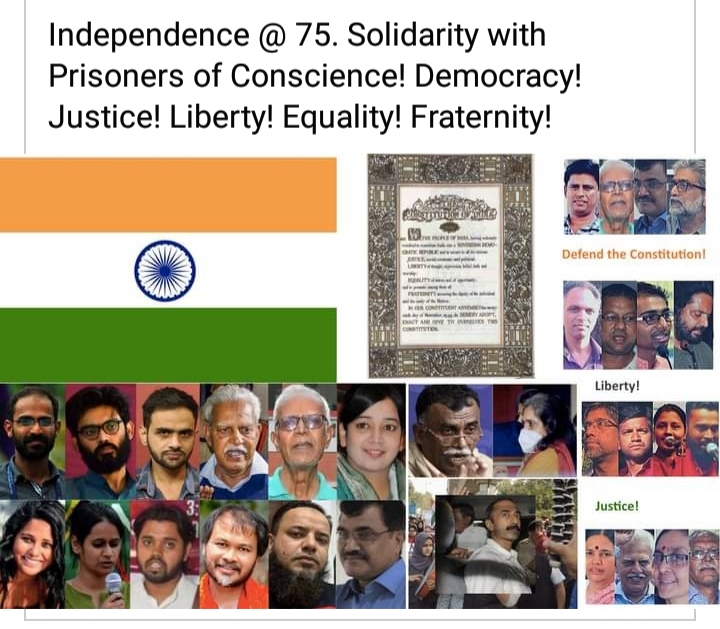
Students, journalists, writers, poets in jail on trumped up, false charges
Three potent symbols – the Azadi slogan, the Constitution and the National Flag – have formed the core of the battle against Hindu Rashtra and capitalist expropriation over the last decade. Continue reading The flag is ours! Azadi bhi!→
[This article is based on the discussions with activists of the Janatha Aragalaya and concerned Sri Lankan citizens. It is a humble contribution towards ongoing debates within the movement. As the French proverb goes: “De choc des opinions jaillit la vérité” – Truth arises from a conflict of opinions. – MJ]
With the deepening crisis of the world capitalist system, we see social upheavals erupting in one country after another. Most recently, Sri Lanka, a relatively small island country in South Asia that is enveloped by a staged debt crisis, has amply revealed circumstances which are infused with revolutionary possibilities. Resembling dark clouds that announce the gathering of a storm, Sri Lanka has shown how rapidly a revolutionary situation can develop.
Heading the floundering ruling establishment, and harbouring perpetual dismissiveness of the swelling discontent, the ruling family of Rajapaksas expectedly attracted massive public ire. Fighting hunger, spiralling inflation, long queues for fuel and rations, crumbling medical facilities, loss of employment, frequent and long power outages, angered citizens came to see the Rajapaksas as well as other mainstream politicians as creators and perpetuators of the grave crisis. Importantly, the distrust of the people has not been limited to individual politicians and ruling cliques whose moral right to govern is being openly challenged, but is a latent distrust for the system itself. At present, majority of the public rightfully views all established parties with deep suspicion and hostility. The majority perceives the rise to power of President Ranil Wickremesinghe as an epitome of the rot in the political system. They see his government as an illegitimate one.





 KAFILA - COLLECTIVE EXPLORATIONS SINCE 2006