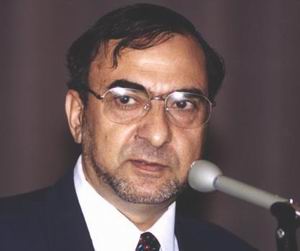
Why Devender Pal Singh Bhullar should not be hanged

This public statement was issued by AMNESTY INTERNATIONAL in June

India: Amnesty International calls for death sentence on Devender Pal Singh not to be carried out

AI Index ASA 20/033/2011

Amnesty International calls on the Government of India not to carry out the death sentence imposed on Devender Pal Singh in 2001 after his conviction in an unfair trial. Under international law, the execution of a person convicted and sentenced to death in an unfair trial is a violation of the right to life. Continue reading Why Devender Pal Singh Bhullar should not be hanged

Parliamentary Sovereignty or an Active Citizenry? V. Krishna Ananth

Guest post by V. KRISHNA ANANTH*

The political class, cutting across the spectrum, is now being haunted by a spectre. Anna Hazare has captured the imagination of a cross section of the people and his campaign is certainly gathering support. It remains to be seen if this support translates into a movement on the streets and more so against the state machinery that is threatening to pull all the stops. The people have shown such courage in the past. That is another matter.

Team Anna’s decision to go ahead with protests against the draft Lok Pal Bill, as approved by the Union cabinet, has spurred a debate. The proponents of the draft bill as well as sections in the political arena who claim to oppose the Government are united against another round of fast by Anna Hazare; they call it blackmail and an attempt to usurp Parliament’s power to legislate. They also claim that the principles of democracy shall not be sacrificed.

A number of them are on record that the draft proposals are subject to amendments and that the power to propose amendments and decide on them shall rest with the elected representatives of the people. It is another matter that the Prime Minister, who heads the cabinet, qualifies as a representative of the people only because membership of the Rajya Sabha is considered as good as being a member of the Lok Sabha to remain a minister under Article 75(5) of the Constitution. In any case, the fact is that Dr. Manmohan Singh has claimed, in an affidavit, that he is ordinarily a resident of Assam! We all know the truth but that too is besides the point.

Continue reading Parliamentary Sovereignty or an Active Citizenry? V. Krishna Ananth

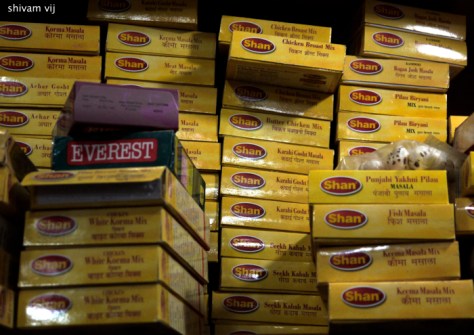
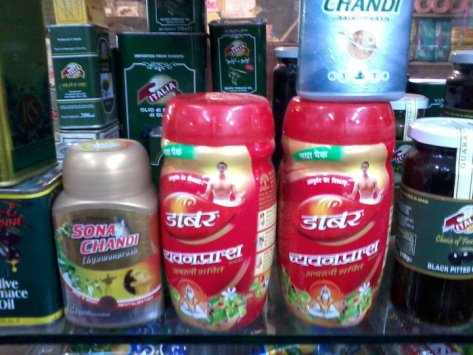
India and Pakistan: A Matter of Taste

Imported from Karachi, Shan masalas are a hit in Delhi. They make sure anyone can make good Biryani or Korma. Photo taken at a grocery store in south Delhi by Shivam Vij
Dabur Chawanprash at a grocery store in Lahore. The Devnagiri script on the pack would be a rarity in Pakistan! Photo credit: Shiraz Hassan

Democracy, Populism and the ‘Middle Class’: The Return of ‘Anna Hazare’

[This is a considerably expanded version of an article that was published in Himal May 2011. It is being re-published, elaborated and updated, in the context of the farcical draft of the Lokpal Bill roduced by parliament and the threatened round 2 of the movement. – AN]

Corruption – a Systemic Affair?

Let me start with an ’emperor’s new clothes’ kind of question: What is a systemic understanding of ‘corruption’? What is a political understanding about corruption as opposed to say, a touchy-feely ‘moral’ problem? Yes, some of these phrases are straight from Arundhati Roy’s ‘When Corruption is Viewed Fuzzily’, published in the Indian Express on 30 April. But my question is not directed only at her. She represents – at least on this issue – a much wider consensus among sections of the radical intelligentsia.

Roy herself has left nothing to the imagination as to what she means:

“Among the millions of understandably furious people who thronged to Jantar Mantar to support Anna Hazare and his team, corruption was presented as a moral issue, not a political one, or a systemic one — not as a symptom of the disease but the disease itself. There were no calls to change or dismantle a system that was causing the corruption. Perhaps this was not surprising because many of those middle-class people who flocked to Jantar Mantar and much of the corporate-sponsored media who broadcast the gathering, calling it a “revolution” — India’s Tahrir Square — had benefited greatly from the economic reforms that have led to corruption on this scale.”

To her, the system that lies at the root of corruption is embodied in the ‘economic reforms’, which have led to corruption on this scale. I have no way of measuring the scale – though I might be inclined to agree with her that in my living memory, I have not seen so much compressed into such little time-space – from CWG to l’affaire Niira Radia to Adarsh Housing scam and the Bellary brothers – not to speak of the daily corruption in land acquisitions that dot the landscape of the country. Nonetheless, I do remember that something like the Bofors scandal or the ‘irresistible rise’ of Dhirubhai Ambani – all predate the ‘economic reforms’. And of course, I will not even try to mention the innumerable cases of corruption from Nagarwala onwards – including political corruption that led to big mass movements in Gujarat and Bihar in the 1970s. Those were the days when Mrs G proclaimed that ‘corruption is a global phenomenon’. To me saying corruption is systemic and must be analyzed ‘politically’ (whatever that means), sounds pretty much the same.  So, if neo-liberalism is responsible for corruption, how do we explain the instances mentioned above? How do we understand the great socialist states which secreted corruption from every pore? What does a ‘systemic analysis’ of corruption really tell us?

However, Arundhati Roy was making this point, it seems to me, not in order to analyze the phenomenon of corruption but to comment on the Anna Hazare movement and its ‘character’:

“When corruption is viewed fuzzily, as just a touchy-feely “moral” problem then everybody can happily rally to the cause — fascists, democrats, anarchists, god-squadders, day-trippers, the right, the left and even the deeply corrupt, who are usually the most enthusiastic demonstrators.”

Continue reading Democracy, Populism and the ‘Middle Class’: The Return of ‘Anna Hazare’

Deconstructing The NAC : Ruchi Gupta

Guest post by RUCHI GUPTA

The past couple of months have seen a renewed attack on the National Advisory Council (NAC). The NAC has been decried as an unconstitutional, undemocratic, “super-cabinet” where unaccountable “jholawalas” hatch harebrained schemes guaranteed to run the government aground. Another line of criticism has focused on the process of the formation of the NAC, its space within the Indian Constitution, and its capacity to influence policy. The two criticisms merge with the demand to disband the NAC on the count that the NAC does not have to face the outcome of its recommendations, and by virtue of it being chaired by the head of the ruling Alliance, can arbitrarily force the implementation of its recommendations.

There is however, a need to examine how the NAC has functioned, what it has done, as well as understand the space it occupies in the policy-making paradigm of the country. While the concerns about the legitimacy of the NAC relate to important issues of Constitutionality, the criticism about the nature of its policy recommendations is motivated by ideology and is of much less relevance to its impact on democratic processes.

It is true that the NAC is an entity created to give the leader of the ruling alliance a role in policy making. Nevertheless, partly through the kind of members chosen, and the norms of functioning it has evolved, it has opened up the otherwise closed and secretive processes of formulation of law and policy, beyond its own membership to citizens groups and people with expertise. It can, in fact with some effort become a platform to further a more just and participative democracy. In this essay, we deconstruct the NAC and situate it in its political context to understand both its pitfalls and potential.

Continue reading Deconstructing The NAC : Ruchi Gupta

यहाँ से शहर को देखो …..

[यह लेख “बस्ती तो बसते बसती है” शीर्षक से आउटलुक हिंदी  के  स्वाधीनता विशेषांक में छपा है.]

अब जबके हर तरफ यह एलान हो चुका है के दिल्ली १०० बरस की हो गयी है और चारों ओर नई दिल्ली के कुछ पुराने होने का ज़िक्र भी होने लगा है, इन दावों के साथ साथ कि “दिल्ली तो सदा जवान रहती” है और “देखिये ना अभी कामनवेल्थ खेलों के दौरान यह एक बार फिर दुल्हन बनी थी”, वगेरह वगेरह, तो हमने सोचा के क्यों न इन सभी एलाननामों की सत्यता पर एक नजर डाल ली जाए, और इसी बहाने उस दिल्लीवाले से भी मिल लिया जाए जो इस अति प्राचीन/ मध्यकालीन/ आधुनिक नगरी का नागरिक होते हुए भी वैशवीकरण के झांसे में इतना आ चुका है के वो अपने आप को २१वीं शताब्दी के पूर्वार्द्ध में आने वाले आर्थिक संकट को पछाड देने वाले चमचमाते भारत देश की राजधानी का शहरी  होने का भरम पाले हुए है.

अब सब से पहले तो यह फैसला कर लिया जाए के नई दिल्ली है किस चिड़िया का नाम? पाकिस्तान के मशहूर व्यंग कार इब्न-ए–इंशा ने अपनी विख्यात पुस्तक उर्दू की आखरी किताब में एक अध्याय लाहौर के बारे में लिखा है.  इस अध्याय में इंशा कहते हैं “ किसी ज़माने में लाहौर का एक हुदूद-ए–अरबा (विस्तार) हुआ करता था अब तो लाहौर के चारों तरफ लाहौर ही लाहौर वाके (स्थित) है और हर दिन वाके-तर  हो रहा है”

एक फर्क है, इब्न-ए-इंशा के लाहौर में पुराना लाहौर और नया लाहौर दो अलग अलग चीज़ें नहीं हैं मगर दिल्ली के मामले में ऐसा नहीं है, एक समय था के नई दिल्ली में बाबू बसा करते थे और नई दिल्ली के पास शाहजहानाबाद था जो शहर था, अब नई दिल्ली वालों के हिसाब से पुराना शहर सिर्फ शादी के कार्ड, आचार मुरब्बे और हार्डवेअर खरीदने की जगह है, या उसे इस लिए बनाया गया है के उनकी पार्टियों के लिए बिरयानी, चाट, कुल्फी वगेरह मुहैया करवाए और जब उनके विदेशी मित्र या एन आर आई सम्बन्धी यहाँ आयें तो उन्हें इस जीते जागते संघ्राल्य के दर्शन करवा सकें. मुसलमान और सिख वहाँ धार्मिक कारणों से भी जाते हैं, मगर उनकी बात अलग है वो तो अल्प संख्यक हैं हम तो आम लोगों की बात कर रहे हैं.

Continue reading यहाँ से शहर को देखो …..

A Messiah for our Moderate Liberatti – Guest Post by Brinda Bose and Prasanta Chakravarty

The Indian liberal establishment has found a new hero in Kumar Sangakkara. For his now-famous Cowdrey lecture at the MCC on the ‘Spirit of Cricket’ is not just about remedying corruption and decay in cricket (and by extension, in modern sports), but also crucially a rumination on pluralism and integration in postcolonial societies like Sri Lanka. In his speech he had referred to the1983 July riots, the JVP-led insurgency, LTTE terrorism and the heavy price paid by the military to defeat the LTTE. The Sri Lankan Defence Secretary, Gotabhaya Rajapaksa, had a word of praise for Sangakkara for solidly backing the country’s successful war effort against the LTTE, at a time when a section of the international community is seeking accountability from the Sri Lankan military establishment for its questionable practices during the last few decades.

The speech has also stirred the reformer-liberals of New India, who are not only enthralled by Sangakkara’s refined, rhetorical eloquence but also by his civic, character-building arguments. Mukul Kesavan calls Sangakkara’s first-person-narrative at once a cricketer’s prescription and a citizen’s creed. V. Anantha Nageswaran finds in the speech the unfolding of a triad of competence, integrity and conscience, a ‘lesson’ for our political-reformers. Others rave about how his outstanding legal mind subtly seeks administrative transparency and good governance.

Continue reading A Messiah for our Moderate Liberatti – Guest Post by Brinda Bose and Prasanta Chakravarty

The terrorist and the madman: Nandagopal R. Menon

Guest post by Nandagopal R. Menon

Scepticism is warranted only when patterns are broken. Normally, prejudice alone will suffice. So if there is a bomb blast in a Western capital, it can only be an Islamist “terror plot”. The motivations could be chosen from a short list of grievances of a peculiarly “Islamic” nature –  anger against illegal occupation of “Muslim lands” being the most favourite among them.

In the immediate aftermath of the July 22 terrorist attacks in the government quarters of Oslo, there was no room for doubt. All that was left to be done was to identify the exact name of the “jihadi” group involved (Ansar al-Jihad al-Alami, The New York Times concluded after a swift investigation); and the specific motive that propelled the attack (first choice: presence of Norwegian troops in Afghanistan; second: publication of the infamous Danish cartoons in the Norwegian press; and a distant third: Colonel Gaddafi’s retaliatory attack for Norway’s participation in bombing Libya). Whatever the motive or the group, it was indisputable that it was a “terrorist” attack.

Continue reading The terrorist and the madman: Nandagopal R. Menon

Tagore in film


That is a clip from The Postmaster (the first story in Teen Kanya, directed by Satyajit Ray).

Trisha Gupta on Tagore’s characters, seen better in films than in English translation:

In film after film, we see events through the eyes of the educated Bengali man trying to deal with a world that has either changed too much—or too little. The protagonist is often a young man from the city who arrives at a small provincial outpost, armed with a modern Western education and little else, his head full of glimpses of another world that seem only to succeed in cutting him off from everything around him. Continue reading Tagore in film

Every time there is a bomb blast in India

Jyoti Punwani writes:

Expectedly, the questions were the same. What were you doing on the day of the blasts? Had you gone to Cheetah Camp? Do you know anyone from the Indian Mujahideen? How many times have you been to Pakistan? Why does only your information come to us? Get your house documents.

Amanullah was ready with the answers and documents… [Must Read]

From Kafila archives:
What does it mean to be a Muslim in India today?

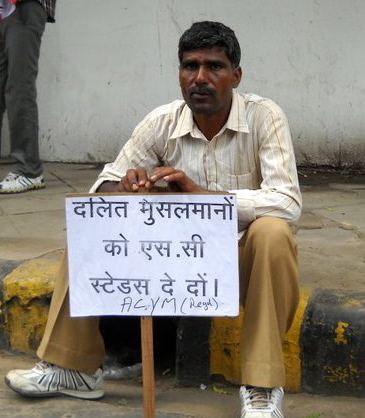
The Unending Struggle of Dalit Christians and Dalit Muslims for Equality: S. Japhet and Y. Moses

On the sidelines of a protest at Delhi's Jantar Mantar today

Guest post by S. JAPHET and Y. MOSES

Religious minorities, both Christians and Muslims from different parts of the country have converged in Delhi to demand reservations for Dalit Christians and Dalit Muslims. This is part of a long standing struggle demanding the Government to introduce a bill to amend the constitution to include Dalit Christians and Dalit Muslims in the scheduled Castes list. The Christian community has been agitating since the promulgation of the Presidential Order Government of India 1950 that effectively prevents those professing religions other than Hinduism from being considered as Scheduled Castes. It has been argued that the 1950 Order violates Article 15 that prohibits discrimination on grounds of religion, race or caste and Article 25 that gives the right to all citizens to profess and practise any religion according to his or her choice. The demand is that affirmative action or positive discrimination of dalits, providing reservations in government jobs, educational institutions and representation in Parliament and state legislatures should be extended to all dalits irrespective of whatever religion they may profess and practise. Continue reading The Unending Struggle of Dalit Christians and Dalit Muslims for Equality: S. Japhet and Y. Moses

Half Widow, Half Wife? Responding to Gendered Violence in Kashmir: APDP

This is a press release from the ASSOCIATION OF PARENTS OF DISAPPEARED PERSONS, The Bund Amira Kadal, Srinagar, 190001. It is about a new report, which you can download in .pdf format at the end of this press release.

Srinagar, July 28, 2011 – The Association of Parents of Disappeared Persons (APDP) today released the report Half Widow, Half Wife? Responding to Gendered Violence in Kashmir. It examines the situation of women in Indian-administered Kashmir whose husbands have ‘disappeared,’ but not yet been declared deceased. Members of APDP who are themselves half widows released this report at SK Municipal Park, Srinagar. Continue reading Half Widow, Half Wife? Responding to Gendered Violence in Kashmir: APDP

Few Hearts to Live for

This slideshow requires JavaScript.

Photographs by Amruta Mehta

Just when Shantuben held her meditative poise at a Vipassana camp at Igatpuri on the morning of January 26, 2001, her dream turned to rubble back home in Bhuj. When she reached home, her labour of love of the last 5 years was gone, razed to the ground. It all had to start afresh. Continue reading Few Hearts to Live for

Statement of Indian Women’s Rights Activists in Solidarity with Women in Sri Lanka

It’s been more than two years since the supposed end of the war in Sri Lanka. The issues of concern are many, particularly with regard to the period after the end of direct combat. The Sri Lankan government has been abysmal in acknowledging the range of human rights violations that have been committed by the armed forces, which has been documented without a kernel of doubt by the United Nations report as well as the Channel 4 documentary. This documentation has been made in spite of circumstances where any neutral observation of the last stages of the conflict was made impossible by the Sri Lankan government and its army.

Continue reading Statement of Indian Women’s Rights Activists in Solidarity with Women in Sri Lanka

“I never knew this before, but now I know I am a human being”: A despatch by Caelainn Hogan from a new country

This guest post for Kafila comes from CAELAINN HOGAN, an Irish journalist who was in Juba for South Sudan’s independence day, 9 July 2011

This slideshow requires JavaScript.


All photos by Caelainn Hogan

At midnight on the eve of independence, the birth of the Republic of South Sudan was heralded with an outburst of celebrations. In Juba, the capital city, people ran through the streets singing and ululating, in the delirium of a moment they never though would come to be. In a local church the congregation sang happy birthday to the new nation. The next day at the official declaration ceremony thousands gathered to witness the new flag raised high and to sing the national anthem together. Many broke down in tears, thinking of loved ones who had fought or struggled and never got to see this day. The declaration brought an end to a long history of conflict; one that many believed could now be relegated to the past. Others still found inspiration and strength in the past, singing the old revolutionary song, “We will never surrender”. Continue reading “I never knew this before, but now I know I am a human being”: A despatch by Caelainn Hogan from a new country

The question we are not asking about Fai, Tramboo and Shawl

GN Fai

(Please see two updates at the end of this post.)

‘Gotcha!’ That is the sound I hear in the Indian media and amongst patriotic fellow-Indians in response to the arrest of Syed Ghulam Nabi Fai, an American citizen of Indian origin, by the Unites States Federal Bureau of Investigation.

Most analyses of the Fai arrest say it’s part of the ongojng tussle between the American CIA and the Pakistani ISI but some in India think it’s part of the American reward to India for opening up its nuclear energy and other markets to American corporations, thus creating jobs for Americans. This may have some truth in it, considering that the Americans asked their ambassador to take a flight to Srinagar four months ago to pat Omar Abdullah on the back for successfully presiding over the killing of 120 Kashmiris the previous summer, and for halting the killings when President Obama was in Delhi, so that the media attention on the President’s visit is not diluted. (And then Americans wonder why ‘Muslims hate us’). Continue reading The question we are not asking about Fai, Tramboo and Shawl

Dear Manmohan Singh: BPL households don’t think cash transfers will be better than the PDS

Given below is the text of a letter written by research scholars and student volunteers to the Prime Minister of India. Given below the letter is a table listing the findings of the survey that the letter speaks about.

21 July 2011

Dr. Manmohan Singh
Prime Minister of India

Respected Prime Minister,

We are a group of research scholars and student volunteers who have just spent three weeks surveying the Public Distribution System (PDS) around the country. We are writing to share a few thoughts on the National Food Security Act in the light of this experience.  Continue reading Dear Manmohan Singh: BPL households don’t think cash transfers will be better than the PDS

A rape in Kulgam; the dishonouring of India continues

Imagine there had been a rape in Delhi. Imagine the headlines in the papers. They would have been loud and angry. As they are, and as they must be. Do you think any of the papers would have said that the woman in question has ‘accused’ or ‘alleged’ who the perpetrator was? But there has been a rape in Kashmir and your media wants you to know that a woman has ‘accused’ an army jawan of having done so. Journalistic restrain and caution are good things when they are useful. After all, let an inquiry establish this is the truth.

Continue reading A rape in Kulgam; the dishonouring of India continues

New Phase in Struggle for Release of Political Prisoners in West Bengal: Biswajit Roy

Guest post by BISWAJIT ROY

Civil society, including human rights groups, in Bengal are now divided on Mamata Banerjee government’s ‘open and hidden’ conditions regarding the release of political prisoners who have been jailed during the Left front rule as well as talks with Maoists and Maoist-backed Peoples Committee against Police Atrocities in Bengal’s tribal hinterland, known as Junglemahal.

Mamata and her ministers have rejected the demands for unconditional release of all political prisoners, immediate withdrawal of joint forces from Junglemahal and public announcement on non-enforcement of the draconian central law, the Unlawful Activities Prevention Act. Maoists and PCPA have accused Mamata of eating up her pre-poll words on those demands. A large section in the human rights movement including the intellectuals and activists who actively joined the Mamata-led campaign for regime-change now supported these demands. But some of their fellow travellers have differed on political and legal grounds.

The differences revealed contradictions between the pre-poll and post-poll positions of Mamata as well as chinks in the armour of human rights groups on the attitude to the new government, Maoists and PCPA. Tension among all the stakeholders in the process— Mamata, Maoists, human rights groups and individuals— was well-known within the concerned circles for quite some time. But none of the stakeholders dwelt on it in public before the assembly polls when they had made common cause against the CPM, particularly, the atrocities by CPM-joint forces combine.

I would like to dwell on post-poll dilemmas and fissures in the pro-Paribartan civil society in Bengal later. But this piece is primarily aimed at reporting the increasing manifestations of the hitherto latent tension.

Continue reading New Phase in Struggle for Release of Political Prisoners in West Bengal: Biswajit Roy

Delhi Police solve Mumbai blasts case

The Times of India reported today that Delhi Police intercepted a call immediately after the Mumbai blasts on Wednesday, which has given them crucial clues to solving this case.

Read the full report here

Basically, immediately after the blasts,  the ever alert Delhi police intercepted a call from  Mumbai  to the NCR to ask the person in the NCR if  ‘the work had been done’ and whether ‘Sharif” had been informed. On getting the answer ‘yes’, the caller hung up, and not just hung up, but ‘immediately’ hung up. The call lasted for about a minute.

This brief call was not too brief for the Delhi Police’s keen forensic skills.

Continue reading Delhi Police solve Mumbai blasts case

A note of protest to Aditya Sinha, editor, DNA

To: asinha at dnaindia dot net

Aditya Sinha,
Editor,
DNA, Mumbai.

Dear Sir,

I have long been a fan of your column, tweets and have admired The New Indian Express and DNA under your editorship. I am, however, saddened to se that you chose to publish Subramanian Swamy’s column that is Islamophobic in the extreme, presumes the people behind the Mumbai blasts were Muslims without evidence, and in hardly veiled terms calls for violence against Muslims. Continue reading A note of protest to Aditya Sinha, editor, DNA

DISSENT, DEBATE, CREATE