The Union Budget 2018-19 makes tall claims, with no clear road map for the health sector, one that is sensitive to the needs of the poor and the vulnerable population of India.
The allocations for Ministry of Health and Family Welfare (MoHFW) (including for AYUSH) have increased from Budget Estimate of Rs. 50,281 crore in 2017-18 Rs. 56,226 crore in 2018-19.
However, from 2017-18 (Revised Estimate) the increase is much lower, a mere Rs. 1374 crore, or just about 2.5 percent. This is a decline in real terms if we account for inflation, and Union Budget allocations for the health sector have stagnated at 0.3 percent of Gross Domestic Product (GDP). The 2017 target of National Health Policy (NHP) is 2.5 percent of GDP as health expenditure by the Government (both Centre and States) by 2025. However, with central allocations stagnating at the current 0.3 percent of GDP, it would not be possible to achieve this target.
Happy International Mother Language Day. This day, declared by UNESCO, is straight up South Asia’s alley as it celebrates linguistic diversity and multilingualism. In other words, it celebrates each Indian.
Here’s what you can do from now on to celebrate it:
1. Resist Hindi imposition. An official language is not the national language. Persian was the language of administration for close to three hundred years, Sanskrit has been the language of knowledge for close to two thousand years, but neither were the only languages in the room. And we know what happened to those languages over time.
2. Defend diversity: Understand that, as in nature, numerical strength is not might (e.g., there may be more cockroaches in the world than humans), so if you belong to a large group of people, then this doesn’t mean that your language is better and more representative of the ‘heart and soul’ of ‘Indianness’. In India, literally hundreds of languages with populations ranging between 500 to 10,000 have flourished (many reported over all the Census) because
SEE UPDATE AT END OF POST, ADDED ON FEBRUARY 20, 2018
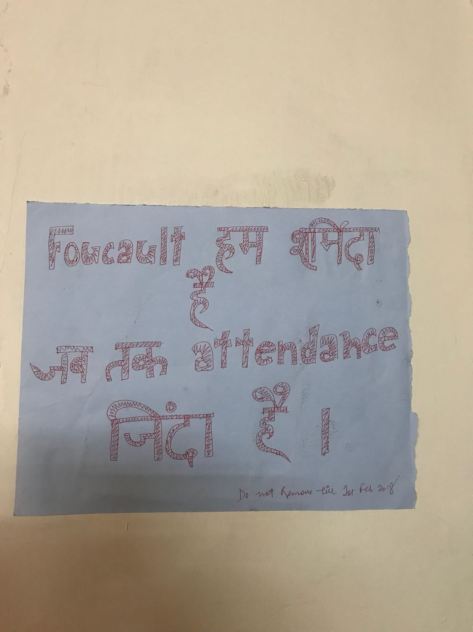
Student poster displaying a clear understanding of Foucault and surveillance. Compulsory attendance is really not needed at JNU!
Let us begin with a basic fact. The diktat on compulsory attendance in JNU is only a symptom of the larger, continuing crisis created by the utterly dictatorial style of functioning of this Vice Chancellor.
Professor Mamidala Jagadesh Kumar has, since his taking over in January 2016:
openly flouted every statute and regulation of the university
shut down admissions almost entirely for the 2017 academic year
violated the law of the land, that is, constitutional provision for reservations
failed to implement JNU’s Deprivation Point system that attempts to bring about representation for students from a diversity of class, regional and caste backgrounds
shut down the country’s oldest functioning Committee on Sexual Harassment (GSCASH)
brazenly cooked up and manipulated Minutes of meeting after meeting of the Academic Council and
treated faculty and students of JNU as his enemies to be defeated by the naked use of authoritarian power.
I have been working for the past 16 years with a small organisation called India Foundation for the Arts (IFA) that attempts to support arts and culture projects across the country. In these years I have been fortunate enough to travel across the country to big cities and small ones, towns and villages where arts practitioners and scholars work intensely, passionately, with almost no economic resources or social acknowledgements. The percentage of our total national budget outlay to the arts and culture is negligible as is the amount that finally gets spent on it. The state of our national arts and culture institutions is abysmal and much has been written by eminent experts critiquing the vision, mandates, policies and mechanisms of funding or the lack of any of these prerequisites to support the sector with an imagination that attempts to build a robust, vibrant ecology for the arts.
We live in strange times. A judge in the country’s Supreme Court believes anyone challenging the government’s decision to impose Aadhar-based surveillance regime is following an “NGO line.” Another judge wonders in the court whether “one nation one identity” is not the necessary path forward. Soon, one wonders, if any opposition to surveillance, and any resistance to being spied upon by the state, will be deemed anti-national not only by the government but also by our top judiciary.
Since the hearings on the various anti-Aadhar pleas are being heard in the Supreme Court, and since such inconsiderate observations are being made regularly, let us look at a few problematic aspects of the biometry-based Aadhar idea itself—not only the technical glitches and possible misuses (of which there are many), but the central philosophy that underlines the state’s eagerness to bring every citizen under one biometric identity.
T T Sreekumar, an important commentator on contemporary politics in Kerala — a public intellectual who now qualifies to be an irritant in the eyes of the Kerala police, now that he has openly declared his allegiance to the dalit people fighting injustice and Vadayambady and inaugurated a protest-event there — writes about the issue and its historical origins:
When I visited Vadayambady the other day to express my solidarity with the cause of the agitation, what I witnessed there was an atmosphere of utmost fear and police terror. A big task force of police was stationed at the location. The team that included the special branch officers, had created a situation of terror at the peaceful site. Activists mentioned that a particular police officer continuously hurled abuses, including caste abuses, at the protesters that included Dalit women and children. When the protest began to draw national attention, the ruling dispensation of CPIM that had hitherto remained unconcerned has started to take up some damage control measures. However, when they finally arrived at the site of the agitation almost after a year since the agitation began, the CPIM leaders allegedly refused to address the caste question involved. Dalit activists, including women activists, surrounded them and raised several objections to this attitude pointing to their sheer hypocrisy and lack of integrity.
Stephen Greenblatt has struck upon a sheer and stupendous idea: to retell the tale of the first couple of the Christian world, Adam and Eve. The Rise and Fall of Adam and Eve is a sweeping work with a remarkably ranging scholarship, galloping through centuries in minutes. The tone and the expanse of the book successfully hide the vertical depth of laborious research that has gone into bringing such an ambitious endeavour into culmination. This is also a book of reliving an ancient art: the bare act of telling a story, holding up the full panoply of its rich narrative contours. The book jauntily speculates as much as it reveals. The very subject matter allows Greenblatt to do so. But there is yet another dimension to this project— a life-long, intense personal engagement with the idea of how conscious human intervention may have altered man’s relationship with whatever is cosmic, mythical and animistic. To that end it is also an ideological book that tells the story of Adam and Eve as it tries to grapple with our modern condition.
The almost insoluble task is to let neither the power of others, not our own powerlessness, stupefy us.
Adorno.
As frightening spectres of untouchability and unseeability hover around the festering sore of the ‘caste-wall’ at Vadayambady in Kerala, as the so-called mainstream left-led government here continues to pour its energy and resources into aiding and abetting caste devils there, as most mainstream media turns a blind eye, as the Kerala police continues its mad-dog-left-loose act, many friends ask me: why have you not yet written about the struggle there of dalit people fighting of the demon of caste now completely, shamelessly ,in the public once more? Continue reading Malayali Feminism 2018: In the Light of Vadayambady and Hadiya’s Struggle→
On 30 January 2018, retired civil servants and veterans of the armed forces jointly organised a conclave on ‘Hinduism and Hindutva’ at the Indian Social Institute, New Delhi. The conclave attended by over hundred participants, emphasized the need to rescue both Hinduism and the Indian Constitution from the clutches of the political project that calls itself Hindutva, and which has nothing to do with religion as such. The participants at the conclave sought to make a plea for saving Hinduism without making any concessions to the monstrosity of caste oppression, which in the spirit of many earlier reformers, they rejected.
This conclave followed an earlier one on ‘A Fractured Polity: The
Relevance of Gandhi Today’ organised on 10 October 2017, which had been
addressed by Justice A P Shah, Mrinal Pande and Ramachandra Guha. The
speeches are available on YouTube (Justice A.P. Shah, Mrinal Pande,
Ramachandra Guha). These civil servants and veterans have also raised severe
concerns about the present situation in a series of open letters over the last few
months: on vigilantism and hyper-nationalism; the suspicious death of Justice
Loya; and violence and discrimination against minorities in India. (See: Retired
Civil Servants open letter – 10 June 2017, Armed Forces Veterans open letter –
30 July 2017, Retired Civil Servants Letter 02 December 2017 – Enquiry into
Judge Loya’s death, Armed Forces Veterans letter to Supreme Court & Bombay
High Court on Judge Loya’s death, Retired Civil Servants open letter – 28 January
2018). Continue reading Defend Constitutional Values, Save Hinduism from Hindtuva: For Civil Servants and Armed Forces Veterans→
पूरे हिंदी क्षेत्र में और विशेषकर उत्तरप्रदेश में ऐसे बडे, छोटे और मंझोले किस्म के नेताओं की बड़ी फौज पैदा हो गई है जिसकी नेतागिरी केवल सांप्रदायिक नारे लगाने और समाज में सांप्रदायिकता फैलाने पर टिकी है। सार्वजनिक जीवन पर इन संकीर्ण सोच वाले हिंदुत्व नेताओं की निरंतर मजबूत होती पकड़ ने सांप्रदायिक हिंसा को ‘न्यू नार्मल’ के रूप में मान्यता दिला दी है। हिंदू धर्म को कलंकित करने में इस नए जमाने के हिंदुत्व की क्या भूमिका है, यह अब किसी से छिपा नहीं है। एक समय था जब समाज पर समाजवादी और गांधीवादी विचारों के प्रभाव के कारण सांप्रदायिकता का सामना करना अपेक्षाकृत कम मुश्किल काम था। पर इन विचारधाराओं का प्रभाव कम हो जाने से सांप्रदायिक नेताओं-समूहों का तेजी से विस्तार हो रहा है। एबीवीपी, विहिप, हिंदू युवावाहिनी और बजरंग दल जैसे संगठन सामाजिक-राजनीतिक जीवन के पूरे परिदृश्य पर हावी हो चुके हैं।अक्सर साधारण परिवारों के युवक इन संगठनों की चपेट में इसलिए आ जाते हैं क्योंकि सांप्रदायिक संगठन समाज सेवा के मुखौटे के भीतर रहकर अपना काम करते हैं। वे दिखावे के तौर पर ब्लड डोनेशन या स्वच्छता मिशन या फिर शहीदों के सम्मान जैसी गतिविधियां करते हैं पर उनका असल मकसद समाज में सांप्रदायिकता का विचारधारा का विस्तार करना होता है। मुस्लिमों में भी सांप्रदायिकता है, पर वे उस प्रकार से संगठित सांप्रदायिकता को व्यक्त नहीं कर रहे हैं। Continue reading कासगंज हिंसा- तिरंगे को हड़प जाएगा भगवा? वैभव सिंह→
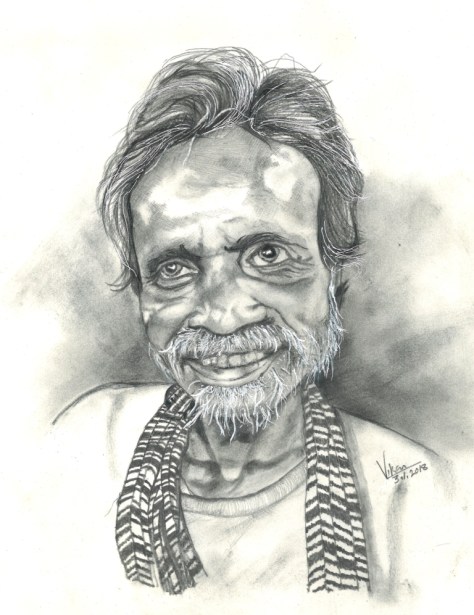
My search for Mr Bhoi, whose sketch I present above, had started on the 1st of January 2017. It culminated sometime around the middle of May 2017 in Puri while on my sojourn to the state of Odisha for conduct of Jawaharlal Nehru University’s entrance exam. Between these two points in time I shall try to weave a tiny story, albeit a true one, of the hundreds of millions of our country’s women and men who live by the sweat of their brow but are expected to remain content with the brow beatings they get in return. Mr Bhoi to me emerges as emblematic of this goings on.
In the last week of December 2016 our ‘twosome awesome’ daughters – Moozna and Amaira, my wife and I had been on a vacation to Meghalaya. On our return back home we decided to have a teat-a-tea with the rhinos at the Kaziranga National Park. Kaziranga in itself was a tame affair and is not relevant to the narrative I attempt to weave here. Rather your attention is solicited for something that transpired on our way back to Guwahati from Kaziranga.
Ghalib has fascinated generations of people and they have tried to understand/ interpret his poetry in their own way. For any such individual it is really difficult to recollect when and how Ghalib entered her/ his life and ensconced himself comfortably in one’s heart.
This wanderer still faintly remembers how many of Ghalib’s shers were part of common parlance even in an area whose lingua franca is not Hindustani. His andaaz-e-bayaan, his hazaron khwahishein, his making fun of the priest etc. could be discerned in people’s exchanges – without most of them even knowing that they were quoting the great poet.
To be very frank, to me, it is bewildering that a poet – who died over 150 years back – looks so contemporary or at times even a little ahead of our own times. Is it because, he talks about primacy of human being, at times philosophising about life, and on occasions talking about rebelling against the existing taboos in very many ways? But then have not many other great poets have dealt with the same subjects/ topics? Continue reading ‘Why Ghalib appears so contemporary even today ?’ : Interview with Hasan Abdullah→
रक्स करना है तो पॉंव की ज़ंजीर न देख – मजरूह सुल्तानपुरी
Look – beyond the the prison walls, the brilliance of flowers, the vitality of spring
If you must dance, ignore the chains that bind your feet – Majrooh Sultanpuri
Today, the scared Republic that has imprisoned its young idealistic fighter son, Chandrashekhar, is on trial. The Republic, scared of its own offspring, stands in the dock. This Republic Day, we must all answer how it came to pass that a gang of adventurers and marauders simply took it over, submitted it to their command, while all the elderly, wise men and women, watched. Today, when the Republic bondage we must seek answers from all those who watched helplessly – or self-righteously – as marauders took it over.
It is official now. A radiogram from the Deputy Secretary, Home, Govt of Uttar Pradesh to the Superintendent, Saharanpur District Jail, dated 23 January 2018, confirms the slapping of charges under the National Security Act, on Bhim Army founder, Chandrashekhar Azad ‘Ravan’. Pradeep Narwal, Coordinator, Committee for the Defence of Bhim Army, who met Chandrashekhar in jail yesterday, underlined how the Karni Sena activists attacking school buses and vandalizing schools were being allowed the freedom to do so while Chandrashekhar, responsible for setting up and running of schools (see the video below), is being held in jail for months and has now been slapped with charges under NSA. “Karni Sena are apparently deshbhakts and Shekher bhai and Bhim Army are ‘terrorists’ in the perverted logic of this government,” he said.
In conversations with friends and sympathizers who have been meeting him over the past months, including Pradeep Narwal, Chandrashekhar ‘Ravan’ has been expressing a fear that many of us have also had, independently, for some time now: that the government wants to actually get rid of him – just as judge Loya was, it now transpires. Continue reading A Revolution Called Chandrashekhar Azad ‘Ravan’ – the Republic on Trial→
ജൈവ വൈവിധ്യ സംരക്ഷണത്തിന്റെയും വനസംരക്ഷണത്തിന്റെയും ഭാഗമായി വനം വകുപ്പ് ട്രക്കിംഗുകളും പരിസ്ഥിതി ക്യാമ്പുകളും ലോകത്താകമാനം സംഘടിപ്പിക്കാറുണ്ട്. എന്നാൽ അവിടെയൊന്നുമില്ലാത്ത വിലക്കാണ് കേരള സർക്കാരും വനം വകുപ്പും അഗസ്ത്യാർ കൂടം ട്രക്കിംഗിൽ സ്ത്രീകൾക്ക് ഏർപ്പെടുത്തിയിരിക്കുന്നത്.
The recent reference to how the distribution of food in Malayali homes is often skewed against women by the actor Rima Kallingal in a recent talk has sparked off yet another round of attacks against feminists in Kerala. It is interesting to see how this seems to have brought together men of all political stripes and colours (may I say, from pro- and anti-Hadiya camps!). The attacks range from mild smirking to outright abuse, but are equally revealing of the fear of women’s feminist self-assertion. So even those men who supported Hadiya’s decision to choose her faith and community find it hard to swallow when women start laying bare the injustices of the ubiquitous patriarchal family, fearing that there may be an implicit choice in this criticism, to move away from the patriarchal family, and indeed, craft other non-patriarchal forms of intimate connection and commitment. After all, whatever be the community, the patriarchal family is acknowledged by patriarchal authorities everywhere as the foundation Continue reading From Nangeli to Rima Kallingal: Who are fit to claim Nangeli’s Legacy?→
(To be published in the special issue of ‘Janata’)
The spectacle of what is called religion, or at any rate organised religion, in India and elsewhere, has filled me with horror and I have frequently condemned it and wished to make a clean sweep of it. Almost always it seemed to stand for blind belief and reaction, dogma and bigotry, superstition, exploitation and the preservation of vested interests.
– Toward Freedom: The Autobiography of Jawaharlal Nehru (1936), pp. 240–241.
If Hindu Raj does become a fact, it will no doubt, be the greatest calamity for this country. No matter what the Hindus say, Hinduism is a menace to liberty, equality and fraternity. On that account it is incompatible with democracy. Hindu Raj must be prevented at any cost.
– Ambedkar, ‘Pakistan or Partition of India’, p. 358.
Introduction
India’s slow ushering into a majoritarian democracy is a matter of concern for every such individual who still believes in pluralism, democracy, equality and a clear separation of religion and politics. The way people are being hounded for raising dissenting opinions, for eating food of their choice or entering into relationships of their own liking or celebrating festivals according to their own faith is unprecedented. The situation has reached such extremes that one can even be publicly lynched for belonging to one of the minority religions or for engaging in an activity which is considered to be ‘suspicious’ by the majority community.
No doubt there is no direct harm to the basic structure of the Constitution, its formal structure remains intact, de jure India does remain a democracy as well as a republic, but de facto democracy has slowly metamorphosed into majoritarianism and the sine qua non of a republic—that its citizens are supreme—is being watered down fast. It does not need underlining that this process has received tremendous boost with the ascent of Hindutva supremacist forces at the centrestage of Indian politics. Continue reading Nehru, Ambedkar and Challenge of Majoritarianism→
I went to Maharashtra as I along with other activists and intellectuals were invited to come there. I along with others was a guest there. And I would remember fondly the love and support that I received in Pune and Mumbai. I would remember the resilience and enthusiasm of the people I met and their resoluteness to fight Manuvaad and centuries old casteist tyranny. I would remember the immense inspiration that I felt, when we paid homage to Jyotiba Phule and Savitribai Phule in Phule-wada, Pune. And, No I will not let two days of media trials by a few TV anchors, who are more of professional howlers, spoil these wonderful memories. I will not let their criminal cacophony and mindless vilification of me, Jignesh & others shadow my beautiful memories of Maharashtra.
The state of Maharashtra as well as the rest of the country is at a critical juncture today. On the one hand are forces in power who want to push our country back to many centuries and on the other are people who are resisting this Neo-Peshwahi, the casteist-communal-fascist regime of BJP-RSS. In my speech at Elgar Parishaad on 31st December 2017, I had said that the year 2018 is going to be a very challenging one. The last 3 and half years of the Modi Sarkar has exposed the BJP’s jumlas of Ache Din and Vikas as hollow, bitter and brutal lies.
As the General Elections of 2019 approach, BJP/RSS will now resort to creating civil strife amongst the people, polarising them on the basis of caste and religion and unleashing attacks on muslims and Dalits. The developments over the last few days vindicate me, a little too soon. Several regions of Maharashtra are in the midst of an acute agrarian distress. Both Marathas and Dalits are victims of this agrarian crisis that has been precipitated by the policies of both Modi and Fadnavis. The BJP/RSS regime has no resolution to offer to the farmers of Maharashtra. Therefore, unleashing attacks on Dalits through their hoodlums and portraying it as a caste clash between Dalits & Marathas will remain their only strategy. Continue reading Statement about the attacks on Dalits in Bhima Koregaon & the Subsequent developments in Maharashtra : Umar Khalid→
[A shorter version of this article was published in The Wire on 18 December. I thank K. Satyanarayana, P. Sanal Mohan and Jangam Chinnaiah for their very helpful comments on it, which have helped me to clarify and elaborate on certain points.]
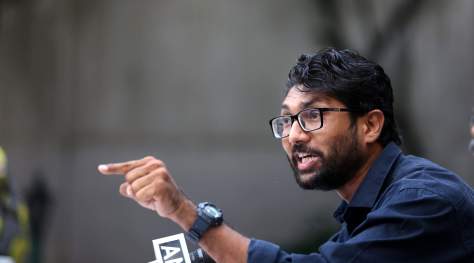
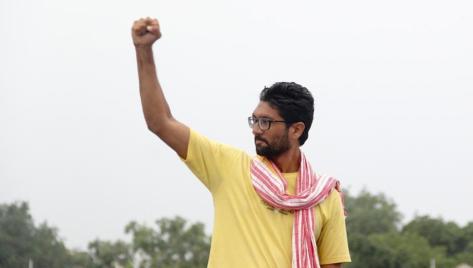
Jignesh Mevani, image courtesy New Indian Express
The rise of Jignesh Mevani constitutes a significant landmark in the political configuration in which the Congress has risen, despite itself, from a state of utter disarray to become the point of articulation for a possible political realignment in the near future. The process of political reconfiguration had already begun as a very significant section of the powerful patidar community, long understood to be the bedrock of the BJP’s social base in the state, had broken away from it. But alongside this, the rise of the young leaders Hardik Patel, Alpesh Thakore and Jignesh Mevani together produced the new young face of emergent Gujarat.
There is no doubt that the vacuum that characterized the space where the opposition should have been, no longer exists. The masthead of a new opposition formation is evident on the horizon. This turnaround in the fortunes of the Congress would not have been possible without the re-alignments in the non-electoral arena, facilitated in no small measure by the rise of this young leadership.
[ This post is based on updates posted by me on my Facebook wall ]
Jignesh Mevani. Photograph by Siddharaj Solanki, HT (Hindustan Times) File Photo, accessed from the HT website
A great kerfuffle has ensued ever since the recently elected independent MLA from Vadgam, Gujarat and Rashtriya Dalit Adhikar Manch activist Jignesh Mevani gave an interview in which he had some choice things to say about the Prime Minister and BJP leader Narendra Modi. Mr. Mevani made some positive and gentle suggestions, to the effect that because Mr. Modi has stopped being relevant, has not delivered on even one of the promises made by him, he should retire, proceed towards the Himalayas, and in the phrase that has caused the greatest commotion, ‘melt his bones’.
#JigneshInsultsPM | Series of abuses after winning his debut poll, is this Jignesh's arrogance or immaturity? Fire in your views using the hashtag and let us know! pic.twitter.com/N6H6yr8oTA
Predictably, Mr. Modi’s personal broadcasting service, known as Republic TV has kicked up the greatest fuss. Arnab Goswami has been especially indignant, and he was joined in his rage by BJP spokesperson, the orotund television commentator and historical photo-shop scam artist, Mr. Sambit Patra. Mr. Mevani offered a robust and dignified refusal to apologize for what he said about Mr. Modi, when Republic TV demanded that he do so. Continue reading Jignesh Mevani, The Meltdown of Modi-Men and Dadhichi’s Bones→
Development is back in focus after the endless noise about cow protection, nationalism, Hindu-Muslim, janeus, Shiv Bhakti, Gorakhpur governance, casteism, love jihad, enemy nation and the rest. Why this talk about development now? Perhaps the dissent and protests on the ground by various sections in Gujarat in the last few years have compelled even the diehards to acknowledge (Mr. Amit Shah recently said ‘It is not my point that the issues raised in those agitations are not an issue’), that something is deeply problematic about the “Gujarat Model of Development”. The ASHA workers have taken to the streets demanding a living wage, regularized working hours and social security; dalits are no longer silent about the violence, indignity and intimidation heaped upon them; displaced families from Sardar Sarovar Dams have occupied streets seeking rehabilitation; farmers are demanding reprieve from a crisis to which they have had no hand in creating; tribals and evicted farmers are protesting against showpiece infrastructure projects which have meant their displacement and destruction of human habitations; and the youth from cultivating castes are seeking guarantee for jobs. The list is continuing.
Twenty five years ago, on 6 December 1992, the structure of Babri Masjid was brought down by a mob of vandals, presided over by the top leadership of the BJP/RSS/VHP, as the Congress government led by prime minister Narasimha Rao looked on benignly. As did the Supreme Court before which a commitment was made by the Kalyan Singh (BJP) government in Uttar Pradesh – to the effect that nothing would be allowed to happen to the structure of the mosque.
Journalist Sajeda Momin, covering the demolition, recalls the scene thus,
I can still see the thousands of saffron-clad ‘kar sevaks’ clambering atop the 16th century mosque and pounding it with shovels, iron rods, pickaxes and anything they could lay their hands on. I can hear the screeching of Sadhvi Uma Bharti egging them on shouting “ek dhakka aur do, Babri Masjid tod do” through the microphones from atop the specially-built watchtower for the BJP/RSS/VHP leadership. I can visualize the three domes of the mosque collapsing inwards one by one at intervals of roughly an hour on that cold, wintery Sunday afternoon.
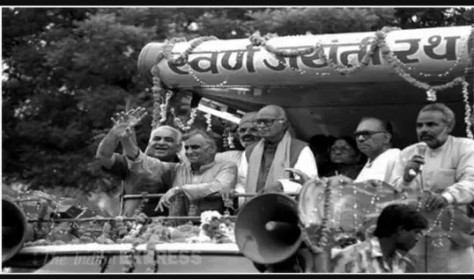
Everyone knew who were the dramatis personae at each level – and practically every bit of evidence that would ever have been required exists, captured in videos and photographs. Our present prime minister was said to be one of the key organizers of the of the Rath Yatra that led up to the demolition and can be seen holding the microphone in his hands in the photograph below.
Rath Yatra – precursor to the demolition, image courtesy Quora.com
Worse was to follow the demolition. The demolition of the structure of the mosque was over that day but the process of the demolition of the Indian Constitution that had begun with what was called the ‘Ram janmabhoomi movement’ continued. By ‘Constitution’ I do not simply mean the book that embodies the law of the land but rather the very weave that came to constitute Indian society as a result of the new contract that the document called the Constitution embodied. Constitution, therefore in a triple sense. The document called the Constitution too was not merely a book of laws; it was rather, the only existing, largely agreed upon, vision of a modern India. It was a vision which was put in place through the long process of struggles, debates and contestations over the long decades of the anticolonial movement and finally given shape in, in the Constituent Assembly. There was nothing benign or innocuous about it – every bit of it had to be achieved through a fight. And yet, in the end, that was the document that embodied the vision of modern India. The only political current that stood far away from both the anticolonial struggle and had no role in the creation of this vision is the political force that rules India today.
The RSS and its numerous offshoots were neither fighting the British nor joining in the anti-caste and anti-untouchability struggles through the period since they came into existence in the mid-1920s. No wonder leaders of the Sangh combine think the anti-colonial/ national struggle was about cow-protection. That they neither subscribed to the anti-British agenda nor to the anti-caste agenda around which struggles of that period took shape, is not just a matter of historical record but is also visible in the way its leaders and ranks conduct their politics today. Every single step taken by the Sangh leaders is a step out of sync with the vision of the future spelt out by the social contract of modern India. That the Sangh attributes this vision to the Congress is an expression of its own illiteracy about the diverse forces in struggle throughout that period.
Even though it is conducted in the name of Hindus, there is nothing ‘Hindu’ about its agenda. Sangh and Sanghism is the name of a malignant political machine that seeks to destroy the very body of society in the name of an ancient past. That is the political machine we confront today. That is the political machine that we must fight today with all our vigour.






 KAFILA - COLLECTIVE EXPLORATIONS SINCE 2006