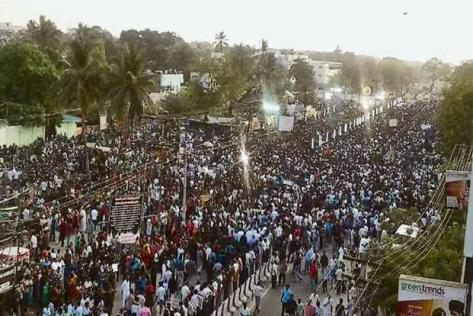
लोग अब समझने लगे हैं कि अपने संकीर्ण एजेंडे को आगे बढ़ाने के लिए सत्ताधारी जमातें भले डॉ आंबेडकर की मूर्तियां लगवा दें, मगर तहेदिल से वह मनु की ही अनुयायी हैं.
एससी/एसटी एक्ट को कमज़ोर करने के ख़िलाफ़ बुलाए गए भारत बंद का दृश्य. (फोटो: पीटीआई)
2 अप्रैल का ऐतिहासिक भारत बंद लंबे समय तक याद किया जाएगा. जब बिना किसी बड़ी पार्टी के आह्वान के लाखों लाख दलित एवं वंचित भारत की सड़कों पर उतरें और उन्होंने अपने संघर्ष एवं अपने जज्बे से एक नई नजीर कायम की.
आजादी के सत्तर सालों में यह पहला मौका था कि किसी अदालती आदेश ने ऐसी व्यापक प्रतिक्रिया को जन्म दिया था. ध्यान रहे कि इस आंदोलन के दौरान हिंसा हुई और चंद निरपराधों की जानें गईं, उसे कहीं से भी उचित नहीं कहा जा सकता!
मगर क्या इसी वजह से व्यापक जनाक्रोश की इस अभिव्यक्ति ने उजागर किए सवालों की अहमियत कम हो जाती है? निश्चित ही नहीं!
The following statement has been signed by students and faculty from universities across the world. You may sign on by adding your name in the comments section.
In solidarity with the School of Arts and Aesthetics, JNU
We, the undersigned students and faculty members in art history, cinema studies, and other concerned academic departments across the world, are writing in protest against the recent removal of Prof. Kavita Singh from her position as Dean of the School of Arts and Aesthetics (SAA) at Jawaharlal Nehru University (JNU) in New Delhi. This represents a serious attack on academic freedom, a blatant disregard for due process, and a worrying precedent being set by the University’s Vice Chancellor to silence and repress reasoned, principled dissent and disagreement. As students and scholars who have learned a great deal from Prof. Singh’s scholarship and benefited from the cutting-edge research fostered at SAA, we stand in solidarity with its students and faculty as they strike to protect the school’s autonomy from the brazenly undemocratic acts being carried out by the current Vice Chancellor.
Every once in a while, it dawns on an Indian citizen that, among the list of provinces of British India thoughtfully provided by Tagore in our national anthem, Sindh is an anomaly.
Sindh was a fairly significant part of the British Empire ever since it was absentmindedly conquered by General Napier in the 1840s. (He is believed to sent his superiors a brief message on the conquest, Peccavi, Latin for ‘I have sinned’, which is to say, Sindh. The man was an insufferable nerd).
However, the Partition of 1947 placed Sindh on the wrong side of the Indian border, and its continued presence in the national anthem does not sit well with some Indians. “Why Sindh?” they ask plaintively. “Why not Rajasthan or Jammu & Kashmir? What about the North East States? Isn’t it time we rewrote Jana Gana Mana to reflect our current political realities, etc?”
Passing lightly over the fact that replacing ‘Sindh’ with ‘the North East States and Sikkim’ would play hell with the scansion of the disputed line, there are apparently very good arguments for not tinkering with Jana Gana Mana as it has stood from 1911. I have only the haziest notion of what these arguments are, but among other things, we are told it would “disregard its existence as a poem by Rabindranath Tagore and an associated ethic that you do not take other people’s poetry and make changes to them.” Continue reading On Not Having Sindh – Reflections on an Irredentist Anthem: Sajan Venniyoor→
The ancient Indian parable of blind men and the elephant, popularized in modern times by John Godfrey Saxe’s nineteenth century poem, has often been deployed in philosophical discourses about the nature of reality and its relationship to sense perception. It has served as a useful metaphor in many an argument about empiricist epistemology, moral relativism, cultural plurality, even religious tolerance. No such usage is intended here. My purpose in starting out with the parable is mostly methodological – how does one put together a vision of the beast based on necessarily partial observations of it. Continue reading To Gain a View of the Elephant – India, History, Modernity, and Marx : Ravi Sinha→
हाल के वर्षों में हुई दो घटनायें उल्लेख के लायक हैं। पहली एक कॉलेज में पढ़ने वाली छात्रा ने मुखौटा लगाकर भीड़ के सामने अपनी कहानी बयान की, जिसमें उसने बताया कि किस तरह से उसे कॉलेज की पढ़ाई के लिए, लिए गए कर्ज को उतारने में देह फरोख्ती का सहारा लेना पड़ा। दूसरी घटना मे लगभग एक लाख विद्यार्थी सड़कों पर उतर आए क्योंकि उन्हें मंजूर नहीं था कि उनके देश की सरकार परा-स्नातक की पढ़ाई के लिए भी ट्यूशन फीस ले। पहली घटना अमेरिका में हुई और दूसरी जर्मनी में। दोनों घटनाएं विचारधारा सम्मत हैं: पहली पूंजीवाद का फल है और दूसरी लुप्त होते सामाजिक लोकतंत्र की निशानी।
भारत की वर्तमान सरकार ने अमेरिका वाला रास्ता अपना लिया है। इसका एक पुख्ता उदाहरण है जवाहर नवोदय विद्यालय में फीस वृद्धि। जवाहर नवोदय विद्यालय की स्थापना करना एक विशिष्ट व आदर्शोन्मुख कदम था। यह कदम, तब जब राजीव गांधी प्रधान मन्त्री थे और पी.वी नरसिम्हा राव मानव संसाधन विकास मन्त्री, 1986 की राष्ट्रीय शिक्षा नीति के तहत लिया गया। इस नीति के तहत, अन्य कदमों के अतिरिक्त, देश के हर जिले में नवोदय विद्यालय होगा जिसमें छठी कक्षा में 80 सीटों पर दाखिला होगा; दाखिले के लिए पांचवीं स्तर से कठिन व मेधा मापने वाली प्रतियोगी परीक्षा होगी जिसमें कम से कम 75 प्रतिशत सीटें ग्रामीण क्षेत्र के विद्यार्थियों और बाकी शहरी क्षेत्र के विद्यार्थियों के लिए आरक्षित होगीं। एक तिहाई लड़कियों के लिए और अनुसूचित जाति व जनजाति के लिए सरकारी प्रावधान के अनुसार। अन्य पिछड़ा वर्ग का आरक्षण अभी भी लागू नहीं है। हालांकि यह कहना आवश्यक है कि उस वक्त जब नवोदय विद्यालय की शुरूआत हुई थी तब कहीं पर भी यह आरक्षण नहीं था। विद्यालय आवासीय सुविधाएं देगा और सारा खर्च केन्द्र सरकार वहन करेगी।
We, the undersigned teachers of Jawaharlal Nehru University, are deeply distressed to read about extremely grave allegations of moral turpitude against Prof. Atul Johri, amounting to charges of sexual harassment, academic dishonesty, and financial misappropriation. We now hear that seven women have made police complaints. Coming on the heels of recent media stories that Prof. Johri was involved in the forgery of assent by leading scientists in a signature campaign, we are appalled by the university’s silence about an individual that it has vested with so many offices. Prof. Atul Johri is the Director of the University’s Internal Quality Assurance Cell, the Director of the Human Resource Development Cell, a warden, and the Vice-Chancellor’s favourite nominee on several committees.
We demand that Prof. Johri be immediately removed from all these positions, as the allegations against him bring great disrepute to the university. We expect the university to take all the requisite measures to investigate the charges that may be brought against Prof. Johri and to pursue them to their logical conclusion.
As faculty who have fought for and long supported the GSCASH, which this administration has shut down, we are distraught that complainants have had to take charges that should have been pursued within the institution to the police, because of a lack of faith in the university’s internal complaints committee nominated by the Vice Chancellor. We support the complainants’ exercise of their rights to approach the police, but rue the fact that the illegal and immoral dissolution of GSCASH has resulted in a situation in which no aggrieved person seems to have any faith in the delivery of justice within the institution on matters of sexual harassment. This is the second such case when allegations about sexual harassment have been filed under the IPC, because complainants do not have faith in the autonomy, impartiality, and commitment to complete confidentiality of the JNU ICC. We would like to emphasise the complainants’ rights to approach the police with their complaints must be respected and protected, and that the complainants must be given full protection against victimisation and full cooperation by the university authorities in pursuing their complaints. Continue reading JNU Faculty Stand With The Women Students Of SLS→
This post is not a statement from the Kafila collective, but my individual response to the news about the Ambedkar University report having found Lawrence Liang guilty of sexual harassment. This response will also address some of the comments that were posted on the Kafila statement posted yesterday.
We learnt from media reports that a duly constituted committee of AUD has found Lawrence Liang guilty of sexual harassment. We did not know about this earlier, as some characteristically self-righteous and ill informed twitterati assume we did. Those whose social concern and activism is limited to busy fingertips obviously have no idea about the processes that have been carefully put in place in sexual harassment policies in universities, which protect confidentiality primarily to protect the complainant. So the first we heard of the leaked AUD report was from the media. Lawrence’s own statement was then issued that says that he plans to appeal this decision. This statement too we saw in the media.
From enquiry to report to appealing the decision (which can be done by complainant or accused) – these are all established stages of due process that feminists have worked for decades to establish, from the Vishakha judgement of 1997 onwards. That judgement itself was a result of feminist intervention. I do not understand ‘due process’ as a technicality alone, nor do feminists in general who have worked with women and men complainants on this complicated issue, especially in a context of power in academic contexts. Continue reading In the wake of the AUD report→
Reports in the media indicate that Lawrence Liang, a member of the Kafila collective, has been found guilty of sexual harassment by an internal committee set up by Ambedkar University, Delhi, through due process. He will no longer be writing on Kafila.
The raging controversy over the cover of a breastfeeding woman looking up with no shame about her exposed breast has, quite expectedly, sent conservative fools in Kerala into a raving frenzy. The case against the model and the conservative breast-beating going on now must be dismissed summarily as useless bullshit.
However, I must say that I had very mixed feelings about the cover and the defense offered for it by many. For many arguing in its defense seem to be saying that all one needs is gratefulness for the effort to open up the issue and the space gained, and all else raised isn’t really worth the trouble. Even this intelligent piece in the Ladies Finger slides into such complacency.
If you ask me, this cover is not of a woman breastfeeding, but of one who is declaring her determination to be comfortable while breastfeeding, thereby reinforcing her commitment to breastfeed her baby. I think this difference is important. Breastfeeding is a very intimate act; it is highly physical. If the mother and child are well, happy, and don’t have issues that may make this feel like a chore or hard to do, then it is very highly pleasurable too. As a woman who has breastfed continuously for 9 years with just a short break of a few months during my second pregnancy, I can say this: breastfeeding is also ‘breastfeeling’, so your attention is on the act, and you really don’t want to focus on anything else, especially irritating stares. It is as pleasurable as lovemaking. Many years later (my daughters are 25 and 20 this year), when I remember the act, my nipples rise, tingling. Breastfeeding was also play time, when the little one played with her mum’s breast with her tiny fingers feeling and squeezing it; and my younger one was especially playful, twisting her tiny body in sheer pleasure, and sometimes, remaining still and then naughtily sinking her little tooth into the nipple, rolling her eyes up to check the reaction from her mum! So when we traveled, I always carried a big, opaque duppatta with which I made a ‘tent’ over our heads that covered us completely. We would be sitting in a corner seat in the train, and having fun, she sitting on my lap (and later the tent would be big enough for the three of us, myself, my six-year-old, and one-year-old, the former listening to a story, and the latter happily suckling). We would sing, tickle, do what not. Demanding the freedom to breastfeed without being too bothered about modesty and in public without anyone staring, for me, then, is demanding the right to such intimate pleasure in public. In that sense, this should have been one of the afterlives of Kerala’s Kiss of Love protests.
I don’t have the image of me breastfeeling happily, but here is the picture of my little one after one of our sessions. Does anyone doubt anymore, that it is indeed breastfeeling, not just breatfeeding. Here is she, looking ecstatic, the milk still in her little mouth!
However, the sartorial codes of the model make me feel very disconcerted. Sharanya Gopinathan, in the above piece, argues that Grihalakshmi caters to largely savarna women probably. But no, savarna women are not the demographic majority, and they are possibly not the dominant section in the magazine’s readership. But savarna culture is pervasive in Kerala, cutting across caste and faith, and the cover clearly panders to it. The model’s huge sindoor — mark you, wearing the sindoor is a very recent import from the north to Kerala, the demure-looking sari, and the girl-next-door look was probably calculated to make up for the exposure of the breast. So we have a young woman who announces through her sindoor that she is married — legally and customarily penetrated, to adopt a Foucaldian way with words — and modestly dressed, that she belongs to the elite, evident in her professionally-groomed looks, and also tells the world that she is determined to breastfeed no matter how much the lechs stare. Intended or not, it brings to the mind too readily the dream-girl of the Hindutva modernist vanguard: the educated woman, maybe even a corporate professional, with looks that fit that environment, who is determined to mother well and indeed stay close to her biological ‘essence’, and of course whose maternity has not been allowed to affect her slim body and maidenly-looking breasts. The idea, I think, was to say that such a woman can and should be brave enough to fend off irritating stares — but it backfired with the conservatives, apparently, who are not ready to concede any quarter. Breastfeed she must, remember her womanhood, she must, look pretty and stay slim she must — and demand no open breastfeeding.
When will we see the image of a woman you see in the bus stops every day in Kerala, harried, sweaty, with her budget-beauty parlour looks and less-than-chic sartorial choices sitting in a bus shelter perhaps and immersed in feeding her infant, her not-perfect breasts bulging out un-prettily, caring nothing at all for what the world thinks? She can of course be imagined as staring back defiantly, but the glow of pleasure is what should animate her being and fill her with courage. Normination to be a good biological woman and mother. Not the developmentalist commitment to produce healthy babies. What ultimately counts is the space of intimacy between a mother and her child, which is physical, which involves pleasure — and we need to demand that women should be able to create it everywhere.
And why on earth are we waiting for Grihalakshmi to lead? Thankfully, third wave feminism in Kerala is devoid of prudishness and values pleasure — and among our third gen we have a great many artists — poets, painters, photographers, of many genders! We should be able to assert that what is at stake is breastfeeling, not just breastfeeding. Let us reduce ourselves to neither those who sneak in a litany to biological motherhood through their seemingly radical cover, nor with those who want to see nothing but physical nourishment in breastfeeding.
The aborted move of giving the Emigration Check Required (ECR) passports a distinct look by orange-jacketing them was arguably driven by reasons of administrative expediency. Though unexplained officially, the aim was to ensure discreet and dedicated handling of the large number of ECR passport-holders emigrating from India for overseas work. Had the colour code been carried through, the orange passport holders would have been relegated practically to an inferior citizenship not just at overseas but also through the multiple stages of emigration at home and in transit. The ill-thought colour-bracketing would also have nearly stigmatized the most vulnerable section of Indian passport-holders through contravening ‘special’ treatment at multifarious levels. Continue reading ECR Devoid of Orange is Still a Deterring Passport: V J Varghese→
This is a guest post by TANNISTHA SAMAMTHA andMUKTA GUNDI
With the success of “PadMan”, Akshay Kumar has established himself to be a bleeding-heart ‘feminist’. News channels are pouring praises for a film that introduces a ‘bold’ topic while regurgitating the crucial link between safe menstrual practices and women’s health. While the message is old (and important), the euphoria around it is new. Continue reading PadMan, Patriarchy and the Poor Man’s Innovation: Tannistha Samantha and Mukta Gundi→
It is often advised that civil disobedience in the form of breaking a law must not be practiced under a democracy. It is because democracy by giving the space for open discussion prevents a situation wherein people are compelled to think of civil disobedience. Moreover, if citizens develop faith in civil disobedience then that only undermines the rule of law. Such an act doesn’t strengthen democracy but rather helps in diminishing its ethos. People must be discouraged to break laws because in a democracy, it is they who elect their representatives through free and fair elections. These representatives then make laws to which open disobedience must not be practiced. Citizens can also vote for change of leadership in the subsequent election cycle, if they feel their representatives have been incompetent. However, while these provisions fulfil the conditions of a well functioning procedural democracy, what recourse do citizens have, when their representatives don’t act in the interest of the governed continuously but function in an autocratic manner? What if laws are made without following the spirit of democracy? Does that really result in making a substantive democracy?
It may, at first glance, seem odd that students of the Jawaharlal Nehru University, New Delhi, are pouring out in the thousands in angry protest against the administration’s move to enforce compuslory attendance. A leading national daily even misrepresents the boycott of this move by students and faculty as a struggle for the ‘right to not attend classes’, suggesting that they are angry over a triviality, which it is not. It is yet another assault by the present University admnistration against proven academic practices that choose not to infantilise students, and rely more on active learning and participation than on mere physical presence. It has been one among other important practices that has set this university apart. The nuances, therefore, of the anger among the students and faculty of JNU need to be fleshed out.
The Union Budget 2018-19 makes tall claims, with no clear road map for the health sector, one that is sensitive to the needs of the poor and the vulnerable population of India.
The allocations for Ministry of Health and Family Welfare (MoHFW) (including for AYUSH) have increased from Budget Estimate of Rs. 50,281 crore in 2017-18 Rs. 56,226 crore in 2018-19.
However, from 2017-18 (Revised Estimate) the increase is much lower, a mere Rs. 1374 crore, or just about 2.5 percent. This is a decline in real terms if we account for inflation, and Union Budget allocations for the health sector have stagnated at 0.3 percent of Gross Domestic Product (GDP). The 2017 target of National Health Policy (NHP) is 2.5 percent of GDP as health expenditure by the Government (both Centre and States) by 2025. However, with central allocations stagnating at the current 0.3 percent of GDP, it would not be possible to achieve this target.
Happy International Mother Language Day. This day, declared by UNESCO, is straight up South Asia’s alley as it celebrates linguistic diversity and multilingualism. In other words, it celebrates each Indian.
Here’s what you can do from now on to celebrate it:
1. Resist Hindi imposition. An official language is not the national language. Persian was the language of administration for close to three hundred years, Sanskrit has been the language of knowledge for close to two thousand years, but neither were the only languages in the room. And we know what happened to those languages over time.
2. Defend diversity: Understand that, as in nature, numerical strength is not might (e.g., there may be more cockroaches in the world than humans), so if you belong to a large group of people, then this doesn’t mean that your language is better and more representative of the ‘heart and soul’ of ‘Indianness’. In India, literally hundreds of languages with populations ranging between 500 to 10,000 have flourished (many reported over all the Census) because
SEE UPDATE AT END OF POST, ADDED ON FEBRUARY 20, 2018
Student poster displaying a clear understanding of Foucault and surveillance. Compulsory attendance is really not needed at JNU!
Let us begin with a basic fact. The diktat on compulsory attendance in JNU is only a symptom of the larger, continuing crisis created by the utterly dictatorial style of functioning of this Vice Chancellor.
Professor Mamidala Jagadesh Kumar has, since his taking over in January 2016:
openly flouted every statute and regulation of the university
shut down admissions almost entirely for the 2017 academic year
violated the law of the land, that is, constitutional provision for reservations
failed to implement JNU’s Deprivation Point system that attempts to bring about representation for students from a diversity of class, regional and caste backgrounds
shut down the country’s oldest functioning Committee on Sexual Harassment (GSCASH)
brazenly cooked up and manipulated Minutes of meeting after meeting of the Academic Council and
treated faculty and students of JNU as his enemies to be defeated by the naked use of authoritarian power.
I have been working for the past 16 years with a small organisation called India Foundation for the Arts (IFA) that attempts to support arts and culture projects across the country. In these years I have been fortunate enough to travel across the country to big cities and small ones, towns and villages where arts practitioners and scholars work intensely, passionately, with almost no economic resources or social acknowledgements. The percentage of our total national budget outlay to the arts and culture is negligible as is the amount that finally gets spent on it. The state of our national arts and culture institutions is abysmal and much has been written by eminent experts critiquing the vision, mandates, policies and mechanisms of funding or the lack of any of these prerequisites to support the sector with an imagination that attempts to build a robust, vibrant ecology for the arts.
We live in strange times. A judge in the country’s Supreme Court believes anyone challenging the government’s decision to impose Aadhar-based surveillance regime is following an “NGO line.” Another judge wonders in the court whether “one nation one identity” is not the necessary path forward. Soon, one wonders, if any opposition to surveillance, and any resistance to being spied upon by the state, will be deemed anti-national not only by the government but also by our top judiciary.
Since the hearings on the various anti-Aadhar pleas are being heard in the Supreme Court, and since such inconsiderate observations are being made regularly, let us look at a few problematic aspects of the biometry-based Aadhar idea itself—not only the technical glitches and possible misuses (of which there are many), but the central philosophy that underlines the state’s eagerness to bring every citizen under one biometric identity.
T T Sreekumar, an important commentator on contemporary politics in Kerala — a public intellectual who now qualifies to be an irritant in the eyes of the Kerala police, now that he has openly declared his allegiance to the dalit people fighting injustice and Vadayambady and inaugurated a protest-event there — writes about the issue and its historical origins:
When I visited Vadayambady the other day to express my solidarity with the cause of the agitation, what I witnessed there was an atmosphere of utmost fear and police terror. A big task force of police was stationed at the location. The team that included the special branch officers, had created a situation of terror at the peaceful site. Activists mentioned that a particular police officer continuously hurled abuses, including caste abuses, at the protesters that included Dalit women and children. When the protest began to draw national attention, the ruling dispensation of CPIM that had hitherto remained unconcerned has started to take up some damage control measures. However, when they finally arrived at the site of the agitation almost after a year since the agitation began, the CPIM leaders allegedly refused to address the caste question involved. Dalit activists, including women activists, surrounded them and raised several objections to this attitude pointing to their sheer hypocrisy and lack of integrity.
Stephen Greenblatt has struck upon a sheer and stupendous idea: to retell the tale of the first couple of the Christian world, Adam and Eve. The Rise and Fall of Adam and Eve is a sweeping work with a remarkably ranging scholarship, galloping through centuries in minutes. The tone and the expanse of the book successfully hide the vertical depth of laborious research that has gone into bringing such an ambitious endeavour into culmination. This is also a book of reliving an ancient art: the bare act of telling a story, holding up the full panoply of its rich narrative contours. The book jauntily speculates as much as it reveals. The very subject matter allows Greenblatt to do so. But there is yet another dimension to this project— a life-long, intense personal engagement with the idea of how conscious human intervention may have altered man’s relationship with whatever is cosmic, mythical and animistic. To that end it is also an ideological book that tells the story of Adam and Eve as it tries to grapple with our modern condition.
The almost insoluble task is to let neither the power of others, not our own powerlessness, stupefy us.
Adorno.
As frightening spectres of untouchability and unseeability hover around the festering sore of the ‘caste-wall’ at Vadayambady in Kerala, as the so-called mainstream left-led government here continues to pour its energy and resources into aiding and abetting caste devils there, as most mainstream media turns a blind eye, as the Kerala police continues its mad-dog-left-loose act, many friends ask me: why have you not yet written about the struggle there of dalit people fighting of the demon of caste now completely, shamelessly ,in the public once more? Continue reading Malayali Feminism 2018: In the Light of Vadayambady and Hadiya’s Struggle→