JNUTA statement on HRD Minister’s Observations

JNUTA is disappointed at the statement by the Minister of Human Resource Development regarding the number of research scholars working with each faculty in JNU, and considers his remarks as unbefitting of the Minister of Human Resource Development.

First of all, the claim that there are JNU teachers guiding more than 20/25 registered students is simply false, as this suppresses the important fact that JNU like other universities across India, has a provision that allows students to deregister from the university. This provision has proved very beneficial, as it enables students to take up employment and slow-track their PhDs until their life circumstances allow them to return to their jobs.  It is only when deregistered students over a decade are included that some professors can have a reasonably large number.

Continue reading JNUTA statement on HRD Minister’s Observations

Free the Maruti Workers: Maruti Suzuki Workers Union


Guest Post by Maruti Suzuki Workers’ Union

[This is a statement and an appeal by the Maruti Suzuki Workers Union condemning the unjust handing down of a life sentence to 13 workers of the Maruti Suzuki Manesar Factory for a ‘murder’ (of an HR Manager) that the prosecution could not prove that they had committed. Here too, the prosecution, and the judgement, relies on a chimera, ‘the reputation of make-in-india’ to justify a harsh punishment. Those who have watched this space will recognize that this recourse to figures of speech in the absence of evidence is a familiar move. It has happened before – to satisfy the hunger of a ‘collective conscience’ when a so-called ‘temple of democracy’ was attacked. This time it has been invoked to defend the ‘fake-in-India temple that houses the deity of a rising GDP’, which would of course otherwise be besieged by insurgent workers.

This text contains a hyperlink to a detailed reading and rebuttal of the prosecution’s arguments, which demonstrates how money and muscle power can always be an adequate replacement for legal acumen in the State of Haryana. Please do follow that link. For the further edification of our readers, we append a short video interview by Aman Sethi of the Hindustan Times of the special public prosecutor, which spins some imaginative legal theory and also radically updates our sense of class struggle. Please do have the patience to view that video. We promise that this will be rewarded. – Kafila Admin.]

Continue reading Free the Maruti Workers: Maruti Suzuki Workers Union

A leaf from the illustrious life of the CM designate of Uttar Pradesh

Account of a ten year old story : Helps you understand the CM designate of UP

What happened in the eastern Uttar Pradesh town was not a conflict but violence unleashed by MP Yogi Adityanath and his henchmen 

If one tries to understand the developments in Gorakhpur and its neighbouring areas of eastern Uttar Pradesh (Poorvanchal) from January 26 to 31, 2007 through the eyes of the print and electronic media, one moves further away from the truth. It is a sordid story of a highly communalised media conjuring up a riot, collaborating with BJP MP Yogi Adityanath, a Bal Thackeray clone and heir to the Gorakhnath Peeth operating from the Gorakhnath temple. Adityanath is a BJP MP for ‘technical’ reasons and cares a damn for the niceties of party discipline because he knows that the party cannot dissociate itself from him. Though he mocked the party by holding a Vishwa Hindu Maha Sammelan at the same time as the BJP’s National Council meet in Lucknow, the party did not mind. It had earlier swallowed the defeat of its candidate in the Assembly election by Adityanath’s candidate. One should know that he is a Thakur; and a Thakur heads the BJP now . The Thakur spread across party lines ensures that Adityanath is allowed to have his own way in his fiefdom, i.e. Poorvanchal. He makes it a point to give calls for a Gorakhpur bandh whenever the chief minister visits the town. Continue reading A leaf from the illustrious life of the CM designate of Uttar Pradesh

Hail the Students’ Struggle for its Victory in the Battle against Corporate Publishers : New Socialist Initiative

Guest Post by New Socialist Initiative (Delhi Chapter)

On 9 March 2017 three well-established academic corporate publishing houses, Oxford University Press, Cambridge University Press and Taylor and Francis withdrew their copyright suit filed in the High Court against Delhi University and Rameshwari Photocopy Shop, a shop stationed at the Delhi School of Economics campus in Delhi University licensed by the University to carry out photocopying work. The suit that was filed in August 2012 on the grounds that photocopying material from books published by the above three publishers by university students, particularly in the compilation of coursepacks, constituted copyright infringement and revenue loss to the publishers. Right from the beginning it was clear this case was treated as a test case to instate a licensing regime, much like one that exists in the US and other First World countries.
Being the absolute primary constituency to be impacted by such a case and its possible outcomes, students of Delhi University were amongst the first to take up the battle against some of the most powerful publishing houses in academia. The ‘Campaign to Save D.School Photocopy Shop’ soon became the ‘Association of Students for Equitable Access to Knowledge’ (ASEAK), reflecting the growing politicisation of the student community on the issue of the knowledge commons in order to resist an increasing attempt across the world to create a market out of it where it didn’t as yet exist. This can be seen in the case of Costa Rica as well where there was an attempt to make photocopying illegal, a move that was successfully opposed on a massive scale by students.
The students of Delhi University, organised as ASEAK, opposed the move through a range of mechanisms, mobilising students from class to class, organising public meetings, taking out protest rallies, campaigning against these publishers at the annual World Book Fair held in New Delhi, influencing public opinion through writing in newspapers, and last but not the least, taking up the legal battle in the courts. NSI hails the struggle of the students that brought to the centre of the debate questions of equity and justice within the arena of production and distribution of knowledge resources, challenging the private property regime sought to be implemented in the sphere of knowledge production by these big academic corporate publishing houses. 
For the last few years the primary site of the battle has been in the High Court at New Delhi. The publishers have received repeated blow after blow in this process as well, leading to their final withdrawal of the suit altogether. The win is a big victory and testament to the struggle of the students, backed by a legal team that has been seminal to the victory, along with support from the academic community. The case, that attempted to strike a ‘balance’ between private profits of the publishers and the rights of students to access materials in the pursuit of their education, has dealt a blow to precisely such a misconception that the two ‘interests’ are in fact of equal concern.
Along with students, who assert their right over the materials they access as part of their fundamental right to education, scholars, often the authors of these materials, have equally come out to state that there is no better reward for their work as intellectuals, as to be read by as many students as can get hold of their work, photocopied or otherwise. The emphasis of the corporate publishers in asserting absolute ownership over the works they publish, in a rare instance where the labour of writing a book is provided at no cost to the publishers, borne by universities, students’ fees and taxpayers’ money instead, is shameful and needs to be rejected at all cost.
NSI congratulates the students, lawyers, academics and concerned citizens who persisted in their resistance against the bullying tactics of big academic corporate publishing houses and calls on the academic community to engage with new ways of producing and sharing knowledge so as to create equitable, just and democratic structures of knowledge production.
EDUCATION OVER COPYRIGHT! KNOWLEDGE OVER PROFIT!

Deendayal in Government Schools : Neglecting Education, Indoctrinating Exclusion

चित्र परिणाम

(Photo courtesy : livehindustan.com, From left to right – Golwalkar, Deendayal Upadhyay and Atal Bihari Vajpayee, . Photo taken in Mathura during Goraksha/Cow Protection movement, 1965)

“DEENDAYAL UPADHYAYA is to the BJP [Bharatiya Janata Party] what Mohandas Karamchand Gandhi was to Congress” opined R. Balashankar, former editor of the Rashtriya Swayamsewak Sangh’s (RSS) organ Organiser and now a member of the BJP’s central committee, on Prasikhshan Maha Abhiyan

(The Indian Express,; September 24, 2016).

Cows inhale, exhale oxygen, says Rajasthan education minister Vasudev Devnani

(http://timesofindia.indiatimes.com/city/jaipur/cows-inhale-exhale-oxygen-says-rajasthan-education-minister-vasudev-devnani/articleshow/56612529.cms)

Rajaram (name changed) Principal of a school near Jaipur, Rajasthan is a worried man.

An honest teacher all his life, is not able to comprehend the rationale behind the recent order by the state education ministry asking every secondary and senior secondary school to purchase collected works of Deendayal Upadhyay Continue reading Deendayal in Government Schools : Neglecting Education, Indoctrinating Exclusion

In the face of election results, Nazim Hikmet on life and living

Nazim Hikmet was a Turkish poet and writer. A communist revolutionary, he was repeatedly arrested for his political beliefs and spent much of his adult life in prison or in exile.

Living is no laughing matter:
you must live with great seriousness
like a squirrel, for example–
I mean without looking for something beyond and above living,
I mean living must be your whole occupation.
Living is no laughing matter:
you must take it seriously,
so much so and to such a degree
that, for example, your hands tied behind your back,
your back to the wall,
or else in a laboratory
in your white coat and safety glasses,
you can die for people–
even for people whose faces you’ve never seen,
even though you know living
is the most real, the most beautiful thing.
I mean, you must take living so seriously
that even at seventy, for example, you’ll plant olive trees–
and not for your children, either,
but because although you fear death you don’t believe it,
because living, I mean, weighs heavier…

Translated by Randy Blasing and Mutlu Konuk

Read the whole poem here.

UAPA – A Video Dossier: Media Collective, Arun Ferreira &Vernon Gonsalves

Video by Media Collective, Article by Arun Ferreira and Vernon Fernandes

Fifty Years of Unreasonable Restrictions

Arun Ferreira & Vernon Gonsalves 

Soon after its adoption, the Constitution of India was amended in 1951. At the time several progressive judgements[i] by the Judiciary held that laws which curb fundamental rights are essentially unconstitutional and fundamental freedoms could only be curbed in the most extreme of cases. The First Amendment, countered this by amending Article 19 to add the word ‘reasonable’ before restrictions and to add ‘public order’ as being one more ground for abridging Fundamental Rights.

The evolution of UAPA[ii] has to be seen in the background of this gradual but steady constriction of Article 19 which guarantees the fundamental freedoms of expression, assembly, association, etc. Continue reading UAPA – A Video Dossier: Media Collective, Arun Ferreira &Vernon Gonsalves

Radhika Vemula on Bhim Auto

radhika vemula के लिए चित्र परिणाम

(Photo Courtesy : indiatoday.intoday.in, Photo Illustration by Saurabh Singh)

..The value of a man was reduced to his immediate identity and nearest possibility. To a vote.  To a number. To a thing. Never was a man treated as a mind. As a glorious thing made up of star dust.  In every field, in studies, in streets, in politics, and in dying and living.

..My birth is my fatal accident. I can never recover from my childhood loneliness. The unappreciated child from my past.

(Excerpts from Rohith Vemula’s suicide note)


The middle of this month would witness a different type of Yatra on the streets of Telangana and Andhra Pradesh. Neither it would be led by high profile leaders – who have the aura of Z plus security with them – nor it would be undertaken in an ultramodern bus – fitted with latest facilities and which could even be used as podium for a public meeting.

It would be taken out on a blue pickup truck renamed Bhim Auto and would be led by a fifty year old woman Radhika Vemula  along with her son Raja demanding justice for her elder son Rohith. During this Yatra Radhika intends to visit one Velivada ( Dalit hamlet) after other in these two states to tell people how castiest forces are hell bent upon denying dalits their due rights and how justice is still being denied to her son who committed suicide because of the machinations of such people. (http://nsi-delhi.blogspot.in/search/?q=rohith+vemula). She would also communicate to them that not only the ruling dispensation at the centre led by BJP but the state governments in Andhra Pradesh and Telangana have been callous towards the plight of the Dalits and have joined hands to deny justice to her son. Not some time ago the government of Andhra Pradesh had made outrageous statements about Rohith not being dalit and earlier in February had demanded that Radhika ‘prove’ that she is Dalit in 15 days. Continue reading Radhika Vemula on Bhim Auto

Looking ‘Right’, Talking ‘Liberal’ – The Twists and Turns of Makarand Paranjape: Anirban Bhattacharya

Guest Post by ANIRBAN BHATTACHARYA

[This missive to Makarand Paranjape, who is a professor at Jawaharlal Nehru University, comes in response to his recent op-ed piece in the Indian Express where he comments on the events at Ramjas College, Delhi University on the 21st of February and in their wake, in Delhi University, on the 22nd of February]

Mr. Makarand Paranjape. In your analysis of the post-Ramjas fallout in Delhi University in Indian Express on the 4th of March, one can see that you have donned a “liberal” cloak. But there were way too many holes in that cloak to go without a counter and hence this response.

Continue reading Looking ‘Right’, Talking ‘Liberal’ – The Twists and Turns of Makarand Paranjape: Anirban Bhattacharya

Sterilization Death Camps in Bilaspur: An Open Letter to the Chhattisgarh Chief Minister by Concerned Citizens

[ This is a letter addressed to Raman Singh, the Chief Minister of Chhattisgarh by several concerned individuals and organizations regarding the impunity with which medical guidelines are put aside by professionals who enjoy the patronage and protection of the state government.]

We, the 138 undersigned individuals and organizations working across the country on health and women’s rights are shocked and dismayed that the case against surgeon Dr. R. K. Gupta has been dismissed by the Hon’ble High Court on grounds that “the alleged act committed by the petitioner was while acting in discharge of his official duty and admittedly no previous sanction was obtained before initiating prosecution case against him”.

The Anita Jha Judicial Enquiry Commission report has clearly pointed out that “It is evident from the facts that in the camps organized on 8.11.2014 and 10.11.2014 there was a breach in the important necessities hence the standard operating procedure were not followed. As a result of which the symptoms of infections were found in post operative female beneficiaries“. It further states that “On the background of deliberation of investigation point number 1 to 3, investigation committee has found following persons Guilty/responsible, functionary, during 08 and 10 November, 2014:- 4.1 For not following standard procedures and for medical negligence by immediate functionary Block Medical Officer, Takhatpur…………….and surgeon who conducted surgery in tubectomy camp at Sakri and Gaurella ( Surgeries were completed by the same surgeon in the both camps)”.

Continue reading Sterilization Death Camps in Bilaspur: An Open Letter to the Chhattisgarh Chief Minister by Concerned Citizens

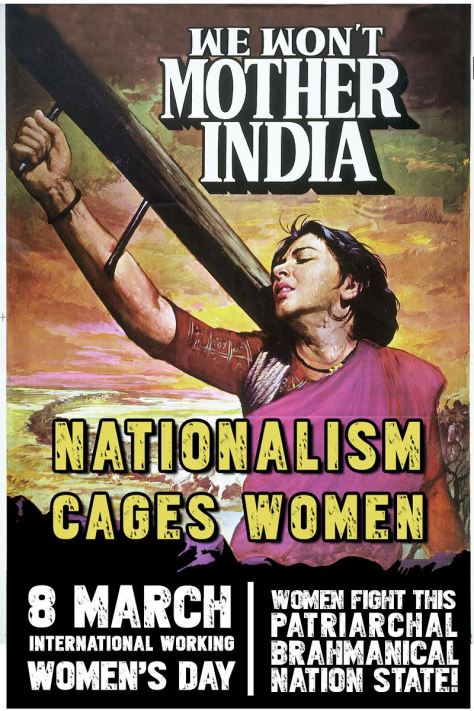
Our “hormonal outbursts” will be your nightmare! Pinjra Tod

Statement and image by Pinjra Tod

On the eve of International Working Women’s Day, Maneka Gandhi has given a deeply patriarchal, casteist and classist statement to a media channel saying that hostel curfews are necessary as “laxman rekha” for controlling women’s “hormonal outbursts”, that the question of “women’s safety in colleges cannot be solved with just two Bihari guards with dandas”, that there should be separate days for men and women to go to the library at night.

Its clear to us that she has said this today in response to the fact that women students across the country from Benaras to Mumbai, Delhi to Patiala, Lucknow to Hyderabad, Chennai to Ludhiana, Roorkie to Cuttack have come out strongly to assert their presence in the university space and claim over public resources.

Continue reading Our “hormonal outbursts” will be your nightmare! Pinjra Tod

From Cucumber Juice to Mutton Soup, A Culinary Healing Journey: Anitha S

This is a Guest Post by ANITHA S

I

As a nature lover and then an ecologist, my tryst with the living world has been fascinating, exciting, scary and at time dangerous. The most recent of this interaction was with a jackfruit tree in my backyard that has the uncanny capacity to produce fruits all the year round…juicy, sweet and delicious fruits that one cannot even imagine throwing away. I developed a balance of sharing the  fruits with the bats, squirrels, crows, tree pies, woodpeckers and koels that would inhabit my garden whenever the fruit ripens and spreads its fragrance around. Continue reading From Cucumber Juice to Mutton Soup, A Culinary Healing Journey: Anitha S

Statements of Solidarity for Ramjas and DU: A Collation

Please find below a collation of statements of solidarity received by Kafila over the past fortnight since the shameful incidents of violence by the ABVP occurred on the 21st and 22nd of February 2017. These are from: Ramjas Alumna, Ambedkar University Delhi Faculty Association, O.P Jindal Teachers: Students and Durham University Politics and International Relations Society, U.S.A; and students and faculty at the University of Minnesota, U.S.A.

UMN STANDS WITH DU
University of Minnesota Students and Faculty

The statements are preceded by a short write-up on what Ramjas College has meant to its alumna, by ANUBHAV PRADHAN.

Nostalgia is made of more than just happiness. It is sulphurous too.

To many who spent three or more years of their life in Ramjas College, visuals of violence in and around it on 21 and 22 February 2017 have been a source of deep, personal shock. The footpath and the areas adjoining the college gate were often sites of lingering conversations between friends, offering moments of respite from studies, tensions accruing from impending exams, or relief to those who had just accomplished a hectic ECA festival and were there catching up their breath or exhaling smoke.

The ABVP struck twice, once attacking the college Seminar Room and then coming back the second day to attack students. In the hundredth year of Ramjas’ establishment, a college founded at a time when protest was an active ideal for most Indians, this singular episode of planned, institutional violence against students and teachers is a grim reminder of the brute silencing of interrogation, peaceful protest, dialogue and dissent being normalised across our colleges and universities, and in our society at large. The audacity with which these perpetrators and their ideologues brand entire institutions and diverse communities of students and academics as anti-national—and therefore fit recipients for their brute censure—also gives the lie to the intellectual and affective bankruptcy of a rapidly emergent cultural orientation premised on simplistic binaries of good and bad, right and wrong, national and anti-national. In a society—and nation—whose ideals are peace, dialogue, and inclusion, these attacks on students and teachers point to the deep ideological rot in the perpetrators’ conception of nation, nationality and nationalism.

As an alumnus of Ramjas College, I cherish the right to self-determination and open debate. I feel outraged that the students’ and faculties’ right to decide what discussion to hold and whom to invite for it within college premises was usurped in this manner. It is disturbing that this violence rippled across the campus as it were, with students being followed, identified and harassed in their personal spaces for having asserted their right to listen to discussions on Bastar and for not bowing down to bodily attacks perpetrated through stones and fisticuffs by members of the ABVP and their affiliates.

Most alumni like me are invested in our respective professions, but the foundations of study and work were laid for us by Ramjas’ teachers and the college’s vibrant culture of extra-curricular instruction. This experience has proved fundamental to our engagement with our immediate workspaces, surroundings, power structures, and our nation. Denying current and future students their right to freely and openly debate issues of their choice in fora of their choice is tantamount to denial of a basic academic right. Threatening and manhandling academicians guided by the spirit of enquiry towards generation of dialogue will prove detrimental to the quality of collegiate education in our nation. We collectively issue the following statement of solidarity with Ramjas’ students and teachers in this moment of crisis:

Statement by Ramjas Alumna

Continue reading Statements of Solidarity for Ramjas and DU: A Collation

“Karenge politics, karenge pyar” – New slogan and new politics: Baidik Bhattacharya

Guest post by BAIDIK BHATTACHARYA

[While the media worked overtime to present the developments in Ramjas College and Delhi University as a clash between two student organizations and two political formations, Baidik Bhattacharya here reflects on the new kinds of politics, rooted in the everyday and in love, that found expression in the University.- AN]

On 28 February, 2017, thousands of students and teachers of Delhi University and other academic institutions of the NCR region marched across the North Campus, protesting against the recent acts of vandalism and violence at Ramjas College. As the march progressed through the winding roads, touching various colleges and departments of the university, feisty students raised several slogans to oppose the perpetrators of such violence, the student organization of the RSS—the Akhil Bharatiya Vidyarthi Parishad or ABVP. Some of these slogans were well-known, some predictable, but some were really creative. I want to briefly discuss one such creative slogan, and its implications: “Karenge politics karenge pyar, ABVP hoshiyar.” Chanted primarily by groups of women and queer activists, this innovative rendering of one’s rights across the university campuses captured some of the pressing issues that have surfaced in the last couple of years in student politics.

Continue reading “Karenge politics, karenge pyar” – New slogan and new politics: Baidik Bhattacharya

Longing for the Future – Two Days with Penkoottu and AMTU at Kozhikode, Kerala

Kozhikode, Hotel Alakapuri, 4-5 March, 2017.

Kozhikode has always upturned my feelings about the male gaze. It is of course a cheerful, bustling, place, full of fabulously good-looking people of all genders. The cheeriness has a certain effortlessly defiant quality – already evident when you look out of the window as the train from the south pulls into the railway station, and see bright, healthy, merrily-swaying wild flowers raise their heads undefeated by the ferocious summer sun– wild sunflowers in hundreds, magnificent vines of kulamariyan flowers ( literally, ‘over-the-top’ flowers, but known here also, interestingly enough, as Antigone vines), creepers happily, constantly, and untiringly winding over  little piles of rubbish and covering them with short-lived if emphatic trumpets of mauve, lavender, red, yellow, and white.  You pass this eternal artwork-in-progress of the flowers and vines and city trash and enter Kozhikode, but realise that it actually tells you a bit about the men there only when you meet them. Continue reading Longing for the Future – Two Days with Penkoottu and AMTU at Kozhikode, Kerala

A Tale of Two and a Half Marches – Two for Azadi and a Half for Ghulami.

[Videos of song by Shehla Rashid and of speeches by Nivedita Menon, Kavita Krishnan, Umar Khalid and Jignesh Mevani, courtesy, Samim Asgor Ali]

February gives way to March and spring returns to Delhi. And what a spring it is. The right wing thugs of the ABVP choose the wrong time to attack, once again. They must really get themselves a better astrologer, or at least a better class of charlatan who can tell them if there ever is a right time to stage their goon show. I suspect there isn’t.

Spring in DU - Fight Back DU
Spring in DU – Fight Back DU

Continue reading A Tale of Two and a Half Marches – Two for Azadi and a Half for Ghulami.

March 10th Chalo Nagpur! Women against Manuvaad and Hindutva: Manjula Pradeep

MANJULA PRADEEP on Dalit Camera

Hard Ways of Lucidity – Thinking About the Crisis in the University: Prasanta Chakravarty

Guest Post by Prasanta Chakravarty

As I see it, university spaces are being assaulted at least from two sides; though it seems as if the two sides are antagonistic to each other, in practice they come dangerously close to each other. How and why is this happening, and what can be done about it?

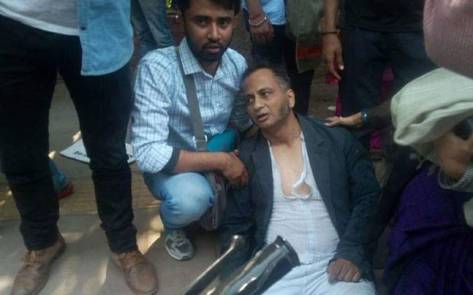
Prasanta Chakravarty, immediately after being assaulted on February 22nd. Image from the India Today Website.

Continue reading Hard Ways of Lucidity – Thinking About the Crisis in the University: Prasanta Chakravarty

Are Students at their Work? Prashant Kumar

Guest Post by PRASHANT KUMAR

Students who are protesting across the country are being charged that they are not doing what they are supposed to do. What I understand this charge say is that they are not doing their “duties” or fulfilling their “responsibilities” as a student. I seriously doubt thislimited understanding of being a “student”. To say this, I feel an intellectual burden to explicate what it means to be a student. I will argue that these students are also the one who, contrary to the charge, does their “duties” and carries out their “responsibilities”.

Generally speaking, anyone who tries to learn and reflect upon what he learnt can be considered as a student. However, one becomes a student technically when he does this job within an academic institution. In this sense, studentship is a job to get mature with the help of institutional academic training(s) as well as reflecting back on these. Maturity, as I discern, is nothing but to understand the real meaning of a world, and act according to this apprehension. In this sense, understanding and acting go together. Lack of one will categorically destruct the purpose of a student.

There is one more aspect of this maturity with relation to, what Kant terms, enlightenment. Continue reading Are Students at their Work? Prashant Kumar

A Small Matter of Security – Holding the Guilty Accountable for What Happened in Ramjas College on the 22nd of February: Shafey Danish

This is a guest post by SHAFEY DANISH

imag0406
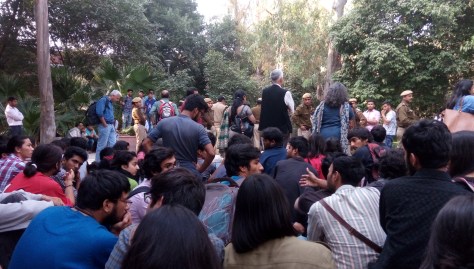
Ramjas students and faculty held hostage inside campus by ABVP cadre

The violence that gripped Ramjas College on the 21st and 22nd of this month is now national news. We heard belligerent slogans by ABVP members of ‘chappal maro saalon ko’ (beat them with slippers), we saw students being chased on the campus, and we saw students being beaten up. All this culminated in a situation where students and teachers were held captive for over five hours within the campus premises. Let me emphasize that this violence was completely unprovoked.

On the 22nd of February, some of the students who were simply sitting with their friends were attacked. The police came and formed a cordon around them. Others joined the students in a gesture of solidarity. Teachers joined them to ensure that the students were not assaulted. The police cordon became their prison for the next five hours. And even then they were not safe.

They were repeatedly assaulted, threatened, and abused. All of this happened in front of their teachers and, more importantly, in front of the police, who, as is well known by now, did not do anything substantial. They could have maintained the cordon around the protesters, arrested those who were repeatedly carrying out the assaults, or – at the very least – prevented the attackers from coming back in (they had left for some time to attack the protest going on outside). But they did not. Whether this was because they were under pressure or because they were complicit is besides the point. The point is that students and teachers remained at the mercy of their attackers for over five hours.

But on the same day something far more ominous was also going on.

Continue reading A Small Matter of Security – Holding the Guilty Accountable for What Happened in Ramjas College on the 22nd of February: Shafey Danish

DISSENT, DEBATE, CREATE