जेनयू की सफाई पर स्मृति ईरानी की सफाई: नियति शर्मा

Guest post by NIYATI SHARMA

लोकसभा में स्मृति ईरानी जी की सफाई उर्फ़ भाषण बहुत भावुक, मनोरंजक और प्रभावशाली था। लोग उन्हें ‘आयरन लेडी’ का खिताब दे रहे हैं- यह उनके तर्क के लिए या उनके तेवर के लिए, या फिर उनके यह कहने के लिए की वो अपना सर काट के मायावती जी के चरणों में रख देंगी, पता लगाना थोड़ा मुश्किल है । सोचा था स्मृति जी कुछ सवालों का जवाब देंगी पर असल में मिली एक लम्बी, मेलोड्रामाटिक सफाई जिससे उन्होंने अपनी सरकार की सारी गलतियों पे पर्दा डाल दिया।ऐसी स्तिथि में हम मजबूर हो गए हैं की स्मृति जी से जो सवाल पूछे जाएँ वो तथ्य-सम्बंधित होने के साथ साथ अति भावनात्मक भी हों।

स्मृति जी के अभिनय के सारे सालों का अनुभव उनके भाषण में साफ़ दिखाए दिया। लोकसभा में स्मृति जी के हाव भाव से आक्रोश टपक रहा था पर क्या उन्हें इतना क्रोधित होने का हक़ है? स्मृति जी का यह मानना है की उनके ऊपर काफी बेबुनियादी आरोप लगे हैं, पर यह मामला स्मृति ईरानी जी के बारे में नहीं है, यह मामला उन मासूम छात्रों के बारे में है जिनकी ज़िन्दगी को उन्होंने दांव पर लगा दिया है। आखिर उन ‘बच्चों’ का क्या जिनके ऊपर उन्होंने और उनकी सरकार ने पिछले कुछ दिनों में अनगिनत आरोप लगाये हैं? स्मृति ईरानी जी तो मंत्री हैं, अगर आरोप लगे भी, तो उनकी ज़िन्दगी बर्बाद नहीं होगी, पर जिस क्रूरता से सरकार और मीडिया ने छात्रों का चरित्र-हनन किया, वह कभी भी इससे उभर नहीं पाएंगे। कन्हैया, उमर और अनिर्बान न ही मंत्री हैं जिनके पास कोई राजनैतिक सहारा है और न ही उनके परिवार इतने धनी हैं की वह अपना जीवन, अपनी इज़्ज़त पुननिर्मित कर पाएं। स्मृति जी, आप तो सिर्फ अपने बारे में सोच रही थीं की आप पर और आपकी परफॉरमेंस पर क्या क्या सवाल उठाये गए, क्या आपने एक बार भी सोचा की इन छात्रों के पास आगे ज़िन्दगी में सफाई देने का कोई मौका नहीं होगा? क्या आपने, माँ होने के नाते, यह सोचा की यह छात्र अब कभी भी साधारण जीवन नहीं जी पाएंगे?

Continue reading जेनयू की सफाई पर स्मृति ईरानी की सफाई: नियति शर्मा

Left, Hindutva and Indian nationalism: Pritam Singh

Guest Post by PRITAM SINGH

Triggered by the recent events at JNU, it is inspiring that the Left and genuine liberal voices in India are standing up to the Hindutva fascist onslaught. However, I find it very disappointing that the current Left leadership and some left intellectuals and sympathisers (especially belonging to the CPI and CPM) are succumbing to the pressure of chauvinist Indian nationalism. One would be shirking one’s responsibility if one were not to criticise that misguided and seemingly scared Left for its pitiable practice of for ever chanting mantra of ‘unity and integrity of the country’ in a self-defeating game of competitive Indian nationalism. The Left is beating its breast and going to the town chanting that we are ‘desh bhagats’ in a foolish retaliation against Sanghi’s charges of left being desh dirohi. Tomorrow, the Sanghis will say that you are ‘Ram dirohi’ when you oppose the building of the Ram Mandir. Would you then start saying: we are Ram Bhatkas? Let us not succumb to Sanghi’s brow beating tactics. Let us openly proclaim that India is not one nation but a historically determined territorial space of many nations, nationalities and emerging/potential nations and nationalities. As capitalism expands in India and the regional diversity of India flowers further, new voices of national self-determination would start becoming more articulated.

Continue reading Left, Hindutva and Indian nationalism: Pritam Singh

Does the Indian Constitution Speak for a Nation? Arvind Elangovan

Guest post by ARVIND ELANGOVAN

Like many others, I too have been anguished about the recent developments in JNU. Not only because the institution is my alma mater, but also because there has been a concerted effort now to frame the discourse in terms of nationalism and anti-nationalism. Sadly, in responding to the charge of anti-nationalism, defenders of free speech and other associated values of the integrity of the university are also participating in this discourse and arguing why dissent is not anti-national. While I agree with this latter point of view, I would like to join those voices that argue that the question of nationalism is irrelevant to the functioning of the state. The unity and integrity of India, understood in its territorial sense, is not strengthened by ideas of nationalism nor is it weakened by expressions of antinationalism.

In the context of the current debate about nations, nationalism, and anti-nationalism, an oft-evoked ally is the Indian constitution. Commentators across the board have praised the Indian constitution for either embodying an ‘idea of India,’ one that is noble and worthy, or praised the institutions that are sanctioned by the constitution, such as the Honorable High Courts and the Supreme Court. Strangely, across the ideological divides, it has become a commonplace perception that the nation as embodied in the Indian constitution has been violated, or at the very least not respected. Conversely, at the other end of the spectrum, it is believed that the Indian constitution expressly provides provisions to persecute individuals or groups for espousing ‘anti-national’ views. The belief among the latter group is that the constitution protects the idea of the nation, however it may be defined. This remarkable unity in such a divisive moment in Indian politics today is both a reason for pause and an invitation to at least cursorily reexamine the text and the history of this important document called the Indian constitution. Continue reading Does the Indian Constitution Speak for a Nation? Arvind Elangovan

Jat Quota Stir and Violence in Haryana: Satendra Kumar

This is a guest post by SATENDRA KUMAR


jaat-protest--_647_022016112612
IMAGE COURTESY: INDIA TODAY

There is an uncanny academic public silence over the Jat quota stir and the unjustified violence enacted during the stir in Haryana. The scale of violence and destruction is such that it competes for the worst instance of caste violence in Haryana’s post-Independence history. So far 30 people have lost their lives while over 200 people were injured in the nine-day violent Jat agitation demanding job quotas in Haryana. There is anger, fear and helplessness among those who lost their kin, homes, businesses and properties.At least 10 Haryana districts were severely affected by the violence. After such a huge loss, as if it was a routine, matter the Union Home Minister announced that a committee led by M Venkaiah Naidu will examine the demand by Jats for reservation in central government jobs.

In Haryana, the BJP’s government in the state has promised to bring a Bill granting OBC status to Jats in the upcoming assembly session. The Jats’ demand for reservations in the central OBC list is not new. Since 1995, Jats in Haryana have been demanding an OBC (Other Backward Class) status, which will help them secure the 27 per cent reservation in government jobs. Earlier in 1997, the Jats in Haryana, Uttar Pradesh and Madhya Pradesh had demanded themselves to be included in the central OBC list. It was rejected by the National Commission for Backward Classes. Subsequently UPA government’s decision to include Jats from 9 states in the OBC list was also rejected by the Supreme Court in March 2015. Despite all this, political parties such as Congress and BJP continue promising quota to Jats during election campaigns. These promises have encouraged the Jats to organize and agitate for quotas. However, their agitations for reservations have not been so violent. That is why the most pressing and important question that needs analyses is why has the current agitation by Jats been so violent? Perhaps three factors will help us to understand this severe violence and loss of property worth crores of rupees.

Continue reading Jat Quota Stir and Violence in Haryana: Satendra Kumar

Bahujan Discourse Puts JNU In The Crosshairs: Pramod Ranjan

PRAMOD RANJAN writes in Forward Press

It is essential to find out how this university, created in 1966 by a special Act of Parliament, became a leftist bastion. The answer lies in its unique reservation system. In this university, from the very outset, aspirants from backward districts, women and other weaker sections were given preference in enrolment. Kashmiri migrants and wards and widows of defence personnel killed in action also get preference (see box). The nature of the questions in the admission tests of the university is such that only the ability to answer multiple-choice questions related to one’s discipline is not enough to see one through. Only those students who have, apart from command over their own subject, analytical skills and reasoning power get admission here. The undergraduate courses of foreign languages are an exception in this regard. But even here, once they have a bachelor’s degree, they can join an MA or an MPhil course only if they have the aforementioned skills. Thus, for years, JNU has been home to the finest and most fertile minds from economically and socially deprived sections of society. And when they analyze the hows and whys of their socio-economic background, they get drawn to Marxism.

This fully residential university, spread over 1000 acres and nestled in the lush green Aravalli Range, never attracted the elite class. The hostels serve plain food and residents drink from jugs – instead of glasses. Estimates suggest that at least 70 per cent students of the university come from either poor or lower-middle-class families…

After the enrolments last year, the percentage of students in JNU from SC, ST and OBC has gone up to 55. A large number of Muslims are enrolled in Arabic, Persian and other language courses in JNU. Data on them is not available. But if, along with them, the number of Ashraf Muslims and other minorities is added, it can be safely presumed that at least 70 per cent of the students in the university are non-Dwij. Note that the number of OBC students in JNU has gone from 288 in 2006 to 2434 in 2015, ie a tenfold increase in nine years. The number of women students has also gone up substantially (see chart)…

This article also points out uncanny similarities between the police report of February 2016 on the controversial cultural event at JNU  and a Panchjanya editorial of 2015.

Read the rest of the article here.


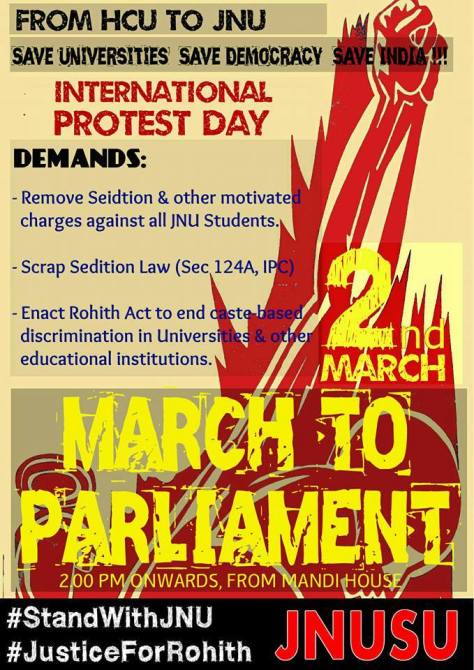
JNUSU Statement of Thanks for Global Support and Call for International Day of Protest and Action in Solidarity with Students in India on 2nd March 2016 : Shehla & Rama Naga (JNUSU)

Guest Post by Shehla (Vice-President, JNUSU) and Rama Naga (General Secretary, JNUSU)

To all Friends (in Delhi, India and the World) who have Supported the Struggle of JNU students and students elsewhere in India  in the past few weeks.

Thank you for your message of solidarity. In this hour of unprecedented attack on us, what has been a source of great strength are messages like these, which we have pasted all over the Administration Building. We have not been able to respond to each message because of being extremely overburdened. However, we are writing back today, in order to update you regarding the status of the struggle, and with a call to action on the 2nd of March, 2016 in your city.

Call for Global Day of Protest and March to Parliament for JNU - March 2nd, 2016
Call for Global Day of Protest and March to Parliament for JNU – March 2nd, 2016

Continue reading JNUSU Statement of Thanks for Global Support and Call for International Day of Protest and Action in Solidarity with Students in India on 2nd March 2016 : Shehla & Rama Naga (JNUSU)

Statement by JNU Faculty on Bar Council of India Report on Patiala House events of February 15 and 17, 2016.

In a shockingly partisan statement that blatantly misrepresents events, the Bar Council of India has issued a report that justifies the well documented attacks by a mob of lawyers on JNU students, teachers and media at Patiala House Courts over two days (February 15 and 17, 2016) as ‘a reaction to the incidents, which are grave in nature and very dangerous for the country’. BCI Joint Secretary Ashok Kumar Pandey claimed that a large number of JNU teachers and students and others had arrived at the court in three to four buses and raised slogans and used ‘provocative words’. This led to the untoward incident in which ‘both the sides took part,’ said the report, adding that ‘any true citizen or a lawyer of India’ was supposed to react strongly to the ‘anti-India’ slogans.

We, the undersigned faculty members of Jawaharlal Nehru University, wish to set the record straight. Nine of us reached Patiala House Court No 4 between 1 and 1.15 pm on 15th February 2016 to attend the hearing on Kanhaiya Kumar’s bail plea. The sole objective of our presence there was that when Kanhaiya Kumar was produced he would see the faces of his teachers in the courtroom. At that time, a few students and other teachers of JNU, and some members of CPI, the parent organization of Kanhaiya’s student group, were already waiting silently outside, similarly wanting him to see friendly and familiar faces when he was produced. There were about 15 to 20 of them, hardly enough to fill 4 cars, let alone one bus.

Continue reading Statement by JNU Faculty on Bar Council of India Report on Patiala House events of February 15 and 17, 2016.

A Review of Purifying the Land of the Pure – Pakistan’s Religious Minorities : Guest Post by Karthik Venkatesh

Guest Post by Karthik Venkatesh

Pakistan was created as a homeland for the sub-continent’s Muslims and yet, even before it had formally taken birth, its founder in a famous speech delivered on August 11, 1947 stated his intention to establish a secular nation where religion would be relegated to the private sphere and the public discourse would be given to pressing development issues. Jinnah’s first cabinet consisted of an Ahmadi (considered by orthodox Muslims as a heretical sect), Sir Zafarullah Khan and Jogendranath Manadal, a Hindu from East Pakistan. Jinnah himself was a Shia while the majority of Pakistan’s Muslims were Sunnis. Roughly one-quarter of Pakistan was non-Muslim at the time of independence and secularism seemed a realistic option. Also, Jinnah’s actions appeared to imply that it would actually be practised. But events proved otherwise.

During Jinnah’s time itself, as Ispahani adeptly documents, an unhealthy nexus had begun to develop between politicians and extremist religious groups. His death in 1948 merely served to accentuate this process. In March 1949, PM Liaquat Ali Khan moved the Objectives Resolution in the Constituent Assembly which set the tone for the Islamisation of Pakistan. Continue reading A Review of Purifying the Land of the Pure – Pakistan’s Religious Minorities : Guest Post by Karthik Venkatesh

Offer truth and hope, not drama: Faculty of University of Hyderabad to Smriti Irani

Dear Ms Irani,

Thanks to your stunning performance, we, many faculty members from the University of Hyderabad, are compelled to do what we should have done in the last one month or so, but could not bring ourselves to – write, write about Rohith, write about our other students, write about the state of academics, write about ourselves and write about society at large.

Our first acknowledgement to this therefore goes to you for revealing yourself and for bringing us back from grief, from reflection, from teaching and from various other mundane things we do as part of our job.

As we watched you in disbelief on our TV screens on 24th February 2016, you, in a voice choked with emotion, again and again referred to the “child” whose death has been used as a political weapon. We were left bewildered.

At what precise point, Madam Minister, did this sinister, anti-national, casteist, Dalit student of the University of Hyderabad transform into a child for you? Definitely not in those five rejoinders from MHRD (the ministry of human resource development) between 03-09-2015 and 19-11- 2015 with the subject line “anti-national activities in Hyderabad Central University Campus”? Definitely not when you chose to overlook and endorse what can only be read as extraordinarily aggressive and unfounded allegations by a minister in your own government, Mr Bandaru Dattatreya?

Read the rest of the letter in The Telegraph

Petition to stop the global crackdown on academic freedom – Turkey, India, Egypt

The undersigned are university teachers and students concerned over recent events that point to a serious reversal of gains in democracy and academic freedom achieved over the last decades in many countries.

Three cases have been most prominent in that regard since the beginning of 2016: the crackdown by Turkish authorities on the more than 1200 signatories in Turkey of the petition by “Academics for Peace” criticizing the anti-Kurdish war drive launched by the Turkish government; the crackdown by Indian authorities on students involved in a non-violent campus protest against the death penalty at Jawaharlal Nehru University and Hyderabad University; and in Egypt an attempt to shoot and kill a professor by groups affiliated to the ruling party; and the savage torture and assassination in Cairo of Italian research student Giulio Regeni.

When they are not tacitly approving it, governments of countries where academic freedoms are better respected and which include most global powers have turned a blind eye and a deaf ear to calls on them to protest against this repression. The worst attitude has been displayed in Italy where the government kept stressing the importance of its economic ties with Egypt while a gutter press accused Giulio Regeni’s supervisors of letting him gather dangerous information, thus resorting to an old worn-out paranoid argument of all dictatorships and tacitly making the student himself responsible for his own atrocious death.

Academic freedoms are a key indicator of the overall status of political freedom and democracy. The acceleration of privatisation across the public higher education system is undermining these freedoms on a global scale. The events described above point to a much deeper and sweeping onslaught on democratic freedoms, which must be halted immediately lest it leads to increasingly tragic events and a most nefarious consolidation and extension of the authoritarian turn in global politics.

We call on the global community of teachers and students to join us in protesting against this most dangerous trend by signing, translating and circulating this statement, and organizing protest meetings in all universities.

To sign, please go to this link. 

स्मृति ईरानी को एक जे-एन-यू के छात्र की चिट्ठि: अनन्त प्रकाश नारायण

Guest Post by Anant Prakash Narayan

सेवा में,

श्रीमती स्मृति ईरानी जी

“राष्ट्रभक्त” मानव संसाधन विकास मंत्री,

भारत सरकार

संसद में दिए गए आपके भाषण को सुना. इससे पहले की मै अपनी बात रखूँ , यह स्पष्ट कर दूं की यह पत्र किसी “बच्चे” का किसी “ममतामयी” मंत्री के नाम नहीं है बल्कि यह पत्र एक खास विचारधारा की राजनीति करने वाले व्यक्ति का पत्र दूसरे राजनैतिक व्यक्ति को है. सबसे पहले मै यह स्पष्ट कर दूं कि मै किसी भी व्यक्ति की योग्यता का आकलन उसकी शैक्षणिक योग्यता के आधार पर नहीं करता हूँ बल्कि साफ़ साफ़ कहूं तो मै “योग्यता”(मेरिट) के पूरे कांसेप्ट को खारिज करता हूँ.

मानव संसाधन मंत्रालय का पद भार लेने के साथ ही यह अपेक्षा की जाती है कि आप इस देश के केंद्रीय विश्वविद्यालयों में उनकी ऑटोनोमी का सम्मान करते हुए उसके लिए उत्तरदायी होंगी. रोहित वेमुला के मामले में आपने क्या किया यह सबके सामने है कि किस तरह से वहाँ के प्रशासन पर आपने दबाव डाला जिसका नतीजा रोहित के institutional मर्डर के रूप में हमारे सामने आया. लेकिन मै इन सारी चीजो पर अभी बात नही करना चाहता. आप बार बार अपनी औरत होने की पहचान (आइडेंटिटी) को assert करतीं हैं और इसको करना भी चाहिए क्यूंकि नारी जाति उन ढेर सारे हाशिये पर किए गए लोगों में एक है जिनको सदियों से शोषित किया गया है. मै आपसे यह पूछना चाहता हूँ कि एक दलित स्त्री जो कि हर तकलीफ उठाते हुए अकेले अपने दम पर जब अपने बेटे बेटियों को इस समाज में एक सम्मानपूर्ण जगह देने के लिए संघर्ष कर रही थी तब एक नारी होने के कारण आप की क्या जिम्मेदारी बनती थी ? क्या आपको उस महिला के जज्बे को सलाम करते हुए उसकी बहादुरी के आगे सर झुकाते हुए उसके साथ नहीं खड़ा होना चाहिए था? हाँ, मै रोहित की माँ के बारे में बात कर रहा हूँ. जो महिला इस ब्रहामणवादी व पितृसत्तात्मक समाज से लड़ी जा रही थी, अपने बच्चों को अपने पहचान से जोड़ रही थी, उस महिला को आप व आपकी सरकार उसके पति की पहचान से क्यूँ जोड़ रहे थे? आपको भी अच्छा लगता होगा की आपकी अपनी एक स्वतंत्र पहचान है. लेकिन यह अधिकार आप उस महिला से क्यूँ छीन  रहीं थीं? क्या आप भी पितृसत्तात्मक व ब्रहामणवादी समाज के पक्ष में खड़ी होती हैं? अपना पूरा नाम बताते हुए अपनी जाति के बारे में आपने सवाल पूछा और आपका भाषण खत्म होने के पहले ही लोगों ने आपकी जाति निकाल दी. मै आपकी जाति के बारे में कोई दिलचस्पी नहीं रखता हूँ और मै यह बिलकुल नहीं मानता हूँ की अगर आप उच्च जाति के होते हैं तो आप जातिवादी ही होंगे लेकिन आपके विभाग/मंत्रालय के तरफ से जो चिट्ठियाँ लिखी गई उसमे रोहित और उसके साथियों को जातिवादी /caste-ist बताया. मैडम क्या आप caste-ism और  caste assertion का अन्तर समझती हैं? मै समझता हूँ की आप ये अन्तर भली – भाँति समझती हैं क्यूंकि आर एस एस जो आपकी सरकार और मंत्रालय को चलाता है, वह वर्ण व्यवस्था के नाम पर जाति व्यस्वस्था को भारतीय समाज की आत्मा समझता है और आर-एस-एस के एजेंडे को लागू करवाने की राजनैतिक दृढ़ता हमने समय समय पर आप में देखी हैं.

Continue reading स्मृति ईरानी को एक जे-एन-यू के छात्र की चिट्ठि: अनन्त प्रकाश नारायण

Chalo Dilli! Report on 23 Feb Protest March for Rohith Vemula: Saagar Tewari

This is a guest post by SAAGAR TEWARI

Rohith Protest 3

rohith-vemula-protest 4
IMAGES COURTESY: INDIAN EXPRESS

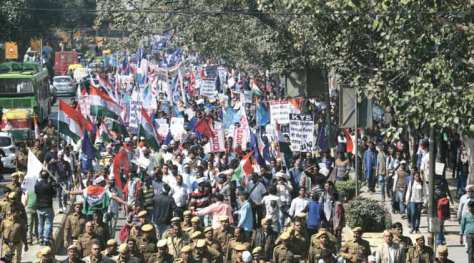
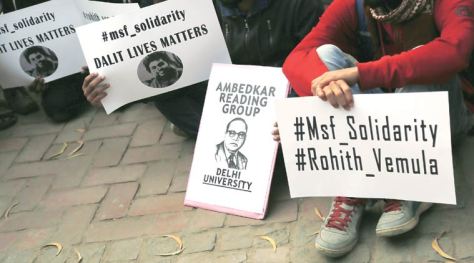
The call for a protest rally by the Joint Action Committee for Social Justice, constituted in the aftermath of Hyderabad Central University research student Rohith Vemula’s suicide galvanised large number of students and activists on 23rd February. On a bright sunny day, thousands descended on the streets of central Delhi marching from Ambedkar Bhawan to Jantar Mantar. The attendance was perhaps lower and the organization less cohesive than the JNU protest rally of 18th February. However, it trumped its predecessor in terms of attracting a far-wider political cross-section of the voices openly choosing to dissent against the current ruling establishment. The protestors proudly displayed anti-Brahmanism banners, flags, badges (featuring excerpts of Rohith’s suicide note) and even a radical inversion of Modi-style masks (featuring Rohith Vemula’s smiling face) thereby signaling that the same youth-brigade which was instrumental in BJP’s rise to political power in 2014 has started turning against it.

Continue reading Chalo Dilli! Report on 23 Feb Protest March for Rohith Vemula: Saagar Tewari

Searching for Raja Debi – A Santhal poet tells the tale of Mahishasura

mahishasur-759

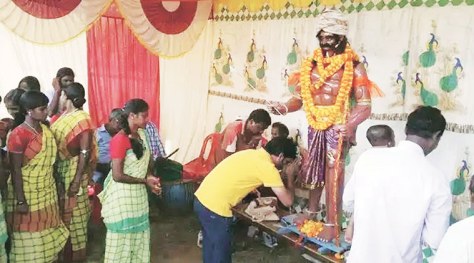
Mahishasur being worshipped in Purulia, Bengal 

In Parliament the other day, Minister for Education Smriti Irani emotionally prefaced her reluctant reading of an alleged JNU poster with “May my God forgive me for even reading this out”. I am mildly envious that she has a personalized god to take care of her doubtless more weighty requirements than an ordinary citizen (an anti-national at that) can claim.

Be that as it may, what she read out purported to be from a poster about an event in JNU organized by “SC, ST and minority students”, an event that celebrated Mahishasura:

“Durga Puja is the most controversial racial festival, where a fair-skinned beautiful goddess Durga is depicted brutally killing a dark-skinned native called Mahishasur. Mahishasur, a brave self-respecting leader, tricked into marriage by Aryans. They hired a sex worker called Durga, who enticed Mahishasur into marriage and killed him after nine nights of honeymooning during sleep,”

Now, she does not show us that poster. Does it really use the term “sex worker”? I have seen posters for Mahishasura Diwas on JNU campus and never noticed this phrase. However, if it has indeed been used, we could have a discussion around the gender politics of that term and of that poster. Moreover, reading (in translation) the tale of Mahishasura from Santhal poet Bajar Hembrom will also give us a sense of how and why that phrase could have been used, if it was.

Actually, the only place I have seen the words “sex worker” in conjunction with “Goddess Durga” was in an ABVP poster that accused All India Backward Students Forum (AIBSF) of describing Goddess Durga as “a sex worker, seducer and prostitute” in their account of Mahishasura Diwas. Just as I have heard the slogan Pakistan Zindabad only in the mouths of Hindutvaadis who accuse us of chanting it.

Continue reading Searching for Raja Debi – A Santhal poet tells the tale of Mahishasura

Sedition and the Problem of Discretionary Exercise of Police Power: Mathew John

This is a Guest Post by Mathew John

The interpretation of law does not only take place in courts. In our season of ‘seditious’ speech this would seem an obvious point as the police administration is as much engaged in the process of legal interpretation or, as legal speak would have it, exercising discretionary powers. However, while courts have to at least minimally ensure that their decisions are backed by reason and aligned with previous decisions, the cases filed against Kanaihya Kumar and others seems to suggest that the police administration can operate almost as a universe unto itself in its interpretation of Indian criminal law. Of course police action will have to tested and defended in court but what if the police bring flimsy cases to trial to inflict long drawn out legal process as punishment for dissenting speech?

There has been an avalanche of excellent recent writing in recent days on the criminal offence of sedition. These have emphasised two broad points. On the one hand they have traced the offence of sedition to the authoritarian designs of the British colonial state seeking to control restive Indian opinion. On the other, opinion has also noted that Indian Courts while upholding the constitutionality of the offence of sedition have held that the speech can be penalised on this ground only when accompanied by an imminent threat of disorder, disturbance or violence. However, the JNU fracas as other similar cases in recent memory involving Arundhati Roy, Binayak Sen and Aseem Trivedi among others, demonstrate that this judicial standard reading down the offence of sedition to a very narrow set of speech acts has not constrained subsequent police action. On the contrary police administrations in the current JNU case have pursued citizens for seditious speech even when their speech could not in any objective manner be tied to imminent threats of disorder. That is, the criminal provisions on sedition section are used against the spirit of the law as laid down by the Supreme Court and is mobilised to with little cause but the harassment of dissenting opinion. In such situations what can defenders of free speech do to ensure that legal process is not abused to harass dissent?

Continue reading Sedition and the Problem of Discretionary Exercise of Police Power: Mathew John

Consolidated Solidarity Statements in Support of JNU

Kafila has been receiving a huge number of solidarity statements from around the world in support of JNU students who have been arrested or charged recently. We are consolidating the statements received in the past few days in the following post. The institutions/groups are as follows in order of date received, starting from February 24, 2016: 

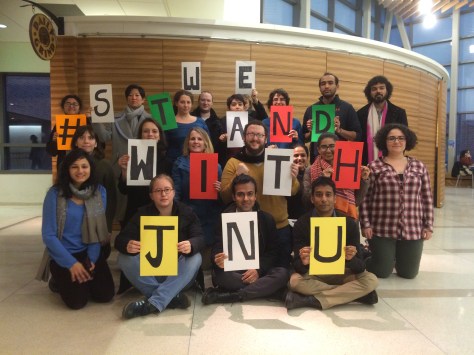
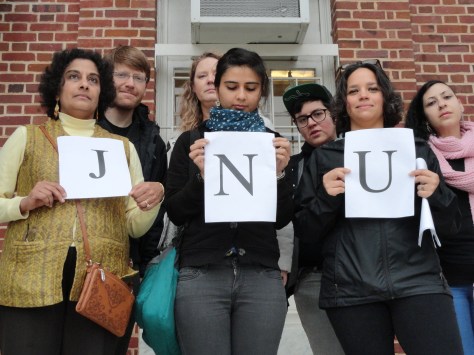
We Stand With JNU
Johns Hopkins Stands With JNU


Duke University Stands With JNU
  1. Teachers at Delhi University
  2. Professional Staff Congress, the City University of New York faculty and staff union (PSC-CUNY)
  3. Pinjra Tod, Delhi.
  4. Academics, Students, Writers, Academics and Activists from Australia.
  5. U.S Community Organisations.
  6. Students and Faculty at Johns Hopkins University, U.S.
  7. Academicians in Gujarat
  8. Students at Cornell University, U.S.
  9. South Asian Communities at Tufts and Harvard Universities, U.S
  10. Students, Faculty and Other Workers at Duke University, U.S.
  11. Mumbai students.

Please click on “read more” for the statements and signatories:

Continue reading Consolidated Solidarity Statements in Support of JNU

Judicial Indiscipline or a Cry for Help – The Interim Stay Order of Justice Karnan: Amita Dhanda

This is a Guest Post by AMITA DHANDA

Justice Karnan a sitting judge of the Madras High Court was transferred from Madras to Kolkatta to resolve the administrative logjam between Justice Karnan and the Chief Justice of the Madras High Court. 21other judges of the High Court also complained that it was difficult to work with Justice Karnan. The soft solution did not yield the desired result as the transferred judge invoked his alleged judicial power and pronounced an interim stay of his own transfer order. The stay he ruled would hold until the Chief Justice of India filed a written statement explaining the transfer order, which he contended was in breach of a 1993 judgement of the Supreme Court. The Supreme Court punctured this defiance by asking the Chief Justice of Madras High Court not to allocate any judicial work to the Judge. The judicial crisis has passed but the administrative and human challenge remains.

How should we as citizens view this exchange? How should this incident be understand by us? One way of looking at the episode is through the legal lens of constitutionality, due process and jurisdiction. The other is to perceive the lived reality of a Dalit judge when elevated to the higher judiciary. An analysis of the incident, only vis a vis the requirements of the law, would not provide even a working hypothesis on what caused Justice Karnan to adopt a course of action, which many would perceive as suicidal for his career. The eccentricity explanation, which is doing the rounds, conveniently escapes the matter of caste discrimination. Consequently, this piece firstly examines the manner in which existing law speaks to Justice Karnan’s decision; then dwells on the question of caste discrimination and lastly cogitates on possible ways of addressing this all pervasive discrimination.

Continue reading Judicial Indiscipline or a Cry for Help – The Interim Stay Order of Justice Karnan: Amita Dhanda

Confront the Rupa Subramanyas Within : A Note to a Nair-born Friend

Dear Kaviraj,

Just saw your post condemning The Telegraph’s representation of Smriti Irani as ‘Aunty’. I understand your indignation, though I am curious to know why few people like us stand up and protest when the people who supporte her, the sanghis, throw vile abuse at dissenters and feminists, label them prostitutes, and threaten them regularly with rape and disfigurement. My daughter was recently threatened in Delhi and warned not to behave like a ‘JNU randi’; senior women teachers from JNU were showered with similar abuse, shoved, groped, and hit at the Patiala House, and many of them have received direct and indirect threats. JNU women have been portrayed in the most despicable terms recently, before which Telegraphs’s characterisation of Irani as ‘Aunty’ is tame indeed even if unacceptable.

Continue reading Confront the Rupa Subramanyas Within : A Note to a Nair-born Friend

Caste, sedition, oppression: JNU round-up

Earlier this week, I tried to join the many dots of violence at universities into a coherent pattern. My central contention is:

Spirited resistance in campuses across the country suggests the politics of India’s youth are more fluid and assertive than expected. The mid-1990s empowerment of historically oppressed castes, narratives of economic aspiration from the 2000s and an instinctive suspicion of authoritarianism have come together to forge a bold poetic new politics of desire that has befuddled even ruthless and astute politicians like the prime minister.

and

Modi’s government uses outdated laws, a pliant police force and Hindu student organizations as a battering ram to crush this awakening, exacerbating the discord between a prime minister determined to stamp his authority on an unruly nation and students enraptured by a thrilling moment of unlikely solidarities that could define their generation.

Read the rest of the piece here:

National development, order and disorder – The tactical algorithm of the BJP today: R Srivatsan

Guest Post by R. SRIVATSAN

“Khamosh! Kutte!”  [Silence! Dog!]

(Unconfirmed rumors about the phone answer given by the most powerful man to Ehsan Jafri, when the latter called up the Gujarat administration for protection from the mobs during the Baroda riots in 2002.  Jafri was slaughtered and hacked limb from limb soon after the protection he sought was withdrawn, or rather never provided.)

algorithm:  noun, a process or set of rules to be followed in calculations or other problem-solving operations, especially by a computer.

While effort after effort was made to establish the culpability of Narendra Modi for the Gujarat riots, they all failed to produce any evidence that was acceptable in a court of law.   News records speculate that the administration, on direct orders, turned a blind eye to the rampage of the mobs.[1]

Much was made of his innocence, and after more than a decade of political exile, Modi has risen as the star of the BJP’s ruling formation since the last election.

India’s national development now is touted as set to occur at a blistering pace crossing 7% in the coming years.  This is the redoubtable Gujarat model where industrial development is paralleled by stagnant or retrogressive movement of all indicators of social development and well being.

Key to understanding the significance of this is the unpacking of the term ‘national development’ in the Modi mantra (the name being convenient shorthand for the BJP and the rising class which supports it).

What does ‘national development’ signify for the BJP and its supporters?  How should this ‘belief’ in the nation be read?

To understand this, it is important to look at the spate of responses of the right wing to recent events. Continue reading National development, order and disorder – The tactical algorithm of the BJP today: R Srivatsan

Reflections on India, JNU and Pakistan: Anjum Altaf

In a chilling analysis, ANJUM ALTAF sees a terrifying pattern unfold in India, one that Pakistanis are all too familiar with.

Below are excerpts, the entire article can be read at TheSouthAsianIdea Weblog.

Despite its very different political trajectory, India is repeating the patterns observed in Pakistan albeit with a considerable lag in time. We have already seen the injection of religion in politics and now, apropos of JNU, we are seeing manifestations of hyper-nationalism and the use of student proxies of political parties to crush dissent and intimidate opposing voices in universities and courts.

The interesting question for an outsider is why this is happening in India today. The answer points to another one of the contingent events of history. It seems that with the election of Narendra Modi a number of factors have come together in India – the rule of a party with a foundational commitment to a conservative ideology that it believes needs to be universally imposed, a visceral dislike for dissent that it deems anti-national, and the undiluted power to attempt to enforce its preferences. These elements might have existed individually or in pairs before but have never come together as they have now with the outright mandate obtained by the BJP in 2014 that relieves it of the need to placate coalition partners. Continue reading Reflections on India, JNU and Pakistan: Anjum Altaf

Why Caste is the Crux and Hindutva’s Fall Imminent: Prathama Banerjee

Guest post by PRATHAMA BANERJEE

The return of BJP to power in 2014 was the return centre-stage of the caste question. Not that caste had gone away. Far from it.But our public life had been unmistakably altered by caste radicalism in the last few decades. 1990s onwards, powerful and triumphant dalit voices – intellectual, literary and political – transformed the nature of our democracy such that questions of caste injustice and caste assertion could no longer be circumvented, passed over, as it was done in earlier decades, by both reactionaries and progressives. Nor could the dalit and the low-caste subject be any longer portrayed as mere outcast or victim. She had come into her own as an autonomous and assertive political subject, sometimes even the ruler. Christophe Jaffrelot called this India’s silent revolution, and rightly so. What we see today with the rise (and imminent fall) of Hindutva nationalism is an attempt at a counter-revolution, nothing less.

The Counter-revolution – Targeting Dalits

The signs are easy to read. Right after Modi’s win began the so-called gharvapasi campaign of the Hindutvavadis, seeking to reconvert to Hinduism those who had earlier seceded in favour of Islam and Christianity. While the issue was pitched as an issue of religion, it was clear that at the heart of the matter was caste. Continue reading Why Caste is the Crux and Hindutva’s Fall Imminent: Prathama Banerjee

DISSENT, DEBATE, CREATE