This October, a colleague and I tracked a group of young Dalits fighting caste atrocities in Uttar Pradesh. The documentary posted above is one part of an extended multimedia project. See the entire project here: https://www.thequint.com/quintlab/ambedkar-dalit-army-fights-caste-atrocities-in-uttar-pradesh/
The 125th birth anniversary of Ambedkar was celebrated in April 2016 all around, so much so that the United Nations, for the first time, observed this day with a focus on achieving Sustainable Development Goals (SDGs). As we know, the 17 goals along with 169 targets and 304 indicators, adopted in September 2015, aspire to transform our world by balancing the three dimensions of sustainable development: economic, social and environmental. The ‘plan of action for people, planet and prosperity’ has environment at its core, along with poverty and inequality: to ‘protect planet’, create ‘healthy environment’, and ensure equality, dignity and development ‘in harmony with nature’. And Ambedkar is found in this regard to be an apt and inspiring leader.
The world can see traces of Ambedkar’s vision in the SDGs and can find his views relevant for environmental sustainability, but not the Indian environmentalists! Indian environmental movements marginalize Ambedkar. From a historical past, environmental scholars have placed Gandhi at the apex of their inspiration. Recently, Nehru and Indira Gandhi too have been constructed through an ecological lens. However, Ambedkar’s engagement with the environmental question has been relatively unexplored, even when his thoughts and interventions on nature, village, land, agriculture, water, community, industry, technology and science are some of the enduring issues of India’s environmental and political traditions. In comparison with Gandhi, credited with having an intuitive critique of modern civilization, Ambedkar has often been criticized for his modernization vision, which it is argued, drew heavily on the west for inspiration (Nagaraj 2010: 56-7)
In the second instance of what I hope will become a regular feature on Kafila, I caught up with fellow journalist and Kafila contributor Prashant Jha on the We Are Sorry Campaign for Social Reform in Madhes , where upper-caste Nepali Hindus acknowledge they have benefited from the centuries long oppression of pretty much everyone else.
In our conversation Prashant addresses the substantive and well-founded criticism of the pledge [another example of upper-castes setting the terms of debate and discourse, largely symbolic] as well as broader questions of Nepali politics and nation-hood.
He will respond to comments on this site. Let me know if there are any particular themes you would like us to explore in our new audio work. All audio files in this series are freely downloadable, and shareable – so you can download them to your phone and listen on your commute to where ever.
Transcript and translation of lecture by Prof. K.SATYANARAYANA, speaking at the launch of book, Ambedkar Can Neither Be Adopted Nor Appropriated by The Hindutva Elements. The book, authored by Bojja Tharakkam, K. Satyanarayana, K. Laxminarayana and K. Y. Ratnam. It was launched in Hyderabad in July last year and is a reply to RSS’ Organiser special edition on Ambedkar. The text and video of the original Telugu lecture received by us via DALIT CAMERA.
All the friends who gave me this opportunity, to the many Ambedkarites present in this hall and to the very senior members, activists and intellectuals, I thank you all. After Anand Teltumbde has spoken, there isn’t much left to speak because he covered all the information in this book and also described completely about a lot of aspects about Maharashtra, about Ambedkar’s like and his work. Therefore there might not be much new information in my speech, but while writing this book, the distortions they made, or the attempts of RSS in relation to Ambedkar, as there is a need for historical context, I will speak about some of those issues. Firstly what Respected Mr. Tarakam has said is, to read some of the names of essays in the Organiser as the book is not available to everybody. When this book Organiser came out, generally RSS-BJP, when they talk about Ambedkar or about Babri-masjid, what we think is that they speak lies, false words, and mistruths and therefore there isn’t any danger as nobody will believe in their load of rubbish and lies. We think that way and if people understand the lies and if they don’t follow those words, there is no danger, but with this same type of propaganda, they completely changed the normal common-sense of the people and today Modi, as a K.D (drawn from an old colonial police/ legal category, it has become a Telugu expression that suggests a person with undesirable traits), as our brother has sung, is sitting in power.
In Conversation with Bezwada Wilson, National Convener of Safai Karmachari Andolan
The 125 day Bhim Yatra which started from Dibrugarh and traveresed 30 states and 500 districts to reach Delhi is now over. As everybody knows it culminated in a big rally coupled with people’s hearing where families of those victims who died while cleaning sewers and septic tanks shared their plight at the hands of state as well as civil society. The call of this Bhim Yatra raised by Safai Karmacharis – ‘Stop Killing Us’ – would could keep reverberating for quite some time. (https://kafila.org/2016/04/14/bhim-yatra-so-that-there-are-no-more-killings/)
Here follows an interview with Bezwada Wilson, National Convener of Safai Karmachari Andolan
How do you see the impact of ‘Bhim Yatra’ ?
As far as those people who are still condemned to do scavenging is concerned, the 125 day Bhim Yatra has made two significant impacts :
– It has made people aware that a new act (2013 act) has come into existence for elimination of manual scavenging and they should make use of it for their liberation.
Protestors set fire to containers representing septic tanks cleaning which manual scavengers have and continue to lose their lives even today ( Photo Courtesy : http://www.youthkiawaaz.com)
Rarely does Jantar-Mantar, the place in the heart of Delhi, gets ‘enlivened’ with people who share very similar type of tragedy – one should say man made tragedy.The culmination of 125 day Bhim Yatra – led by Safai Karmchari Aandolan – which had started from Dibrugarh in the North East on 10 th December and had traversed around 500 districts and 30 states, proved to be one such occasion. (13 th April 2016)
The big public meeting organised at Jantar Mantar, attended by hundreds of safai karmcharis from different parts of the country and many individuals, activists who are sympathetic to their cause, was just another way to celebrate Dr Ambedkar’s 125 th birth anniversary, a day earlier. Special focus of the Yatra was on deaths in sewers and septic tanks and the key slogan was ‘Stop Killing us in Dry Latrines, Sewers and Septic tanks’. In fact, most of the people who were sitting on the podium belonged to such families only, who had lost their near-dear ones in cleaning sewer or septic tanks. Continue reading Bhim Yatra .. so that there are no more killings→
Both the Hyderabad Central University (HCU) and Jawaharlal Nehru University (JNU) events were “ultra-Left movements” also involving a small section of “jihadis”, Finance Minister Arun Jaitley contended on Sunday.
In the case of JNU, the predominant section of those involved in the agitation was “ultra-Left” barring a small section of “jihadis”, who had their faces masked during a demonstration on the campus on February 9 in which anti-national slogans were raised, Mr. Jaitley said.
The name of Dr. B.R. Ambedkar was “unfairly used” in the case of HCU, where protests erupted after the suicide by research scholar Rohith Vemula, he told PTI. (emphasis added. See full report in The Hindu here)
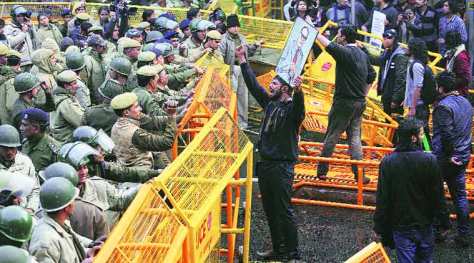
Ambedkar at the barricades, Express photo, courtesy Tashi Tobgyal
Ambedkar has become an insurgent figure today, breaking out of all the pre-set molds in which he was sought to be confined all these decades. He is no longer neither a mere Dalit leader, nor is he simply the Constitution-maker and constitutionalist who taught us to have faith in the law – the two comfortable and domesticated roles in which he has been presented to us so far by all interested parties and the powers-that-be. In the face of the new Sanghist/ fascist assault, he has broken his chains to come out on the streets, as universities and colleges across the country begin to reverberate with his spirit of rebellion. Ambedkar, the name and the face, is ubiquitous by his presence in all the struggles that mark this moment. Even as the struggle of the HCU students for justice for Rohith Vemula continues and the news of the first victory – their release on bail – trickles in, the figure of Ambedkar at the barricades gives the lie to Finance Minister Arun Jaitley’s claim above: that HCU and JNU movements were ‘ultra-Left movements’ and ‘jihadis’, and that “the name of Dr Ambedkar was ‘unfairly used’ in the case of HCU. How easy it would be, Mr Jaitley, to thus pronounce the dog mad and go about your business, and how embarrassing to have to confront Ambedkar facing your police and lathis, your courts and prisons. Continue reading Insurgent Ambedkar and a New Moment in Politics→
Violent thoughts and deeds are increasingly getting justified in the name of Indian nation. A mob of lawyers has attacked students, teachers and journalists, right in the middle of a court complex in the national capital. Leaders of these patriotic lawyers were later caught bragging on camera about how they will next time throw bombs on anti-nationals. A young woman in Delhi has received emails and face book posts threatening her with acid attack and sexual assault, because she happens to be a sister of Umar Khalid, one of the organisers of the JNU programme, during which according to police anti-India slogans were raised. The mere being of this woman, and her defence of her brother, is enough of a provocation for many men and women of the country to justify the threat of ultimate male violence against women. Another man, Mr Adarsh Sharma put posters in the central district of the capital announcing an award of Rs 11 lakh for anyone who kills Mr Kanhaiya Kumar, the president of the JNUSU, charged with sedition. Mr Sharma claims that his ‘blood boiled’ when he saw Mr Kumar’s much publicised speech after his release on bail. The popular movie Pyasa (1957) of Gurudutt had a song ‘Jinhen Naz hai Hind par vo kahaan hain’, which used the reality of social degradation to question celebrations of the nation. Sahir’s poem worked because it asked Indians to look at themselves in the mirror of public morality of the recently independent India. That mirror has been cracked for long. With the brazenly violent now claiming that their violence and threat to violence should really be the pride of the nation, we are now witnessing the final shattering of that mirror. Continue reading Nation and its Violences: Sanjay Kumar→
Zee News Anchor Sudhir Chaudhary whose heart beats for India tried to extort 100 crores from the Jindals, remember? No, no, please, kindly, take a few minutes to watch this, at least until 3.55.
This is a photo comparing Chaudhary with that the whistleblower in the Vyapam scam, who exposed a long-running case of serious corruption by the state and political parties which has involved the murders of over 45 individuals! The current government is providing Chaudhary X category security while with this cycle-borne ‘security’ the Vyapam whistleblower has survived 14 attacks on his life.
Two of the greatest, crazies, most beautiful minds produced by the Indian subcontinent in the Twentieth Century would have been arrested by the police and attacked by the RSS, as ‘Anti-Nationals’, perhaps rightly so, had they been alive today.After all, they never stopped being young.
The Young Ambedkar
One of them was tall, you know him – the big guy, with glasses, always dressed to the nines, (no itchy khadi or scratchy khaki would do for him) .
The Young Tagore
The other had long hair and a beard, and even became a contemporary artist in his old age.
The cops, or thugs-in-law of the RSS might even have said “saala JNU ka lagta hai” (looks like this ***** is from JNU).
So, here they are – Bhimrao Ambedkar (Baba Saheb), and Rabindranath Tagore.
Once again, Jai Bhim, Joy Guru. And pass the ammunition.
Guest Post by Students of Delhi School of Economics, Delhi University
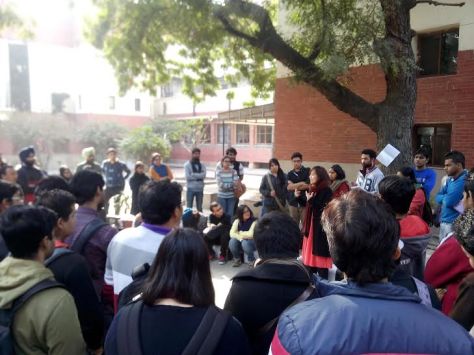
( A protest meeting on Rohith Vemula was organised in Delhi School of Economics, Delhi University on 28 th January. Find pasted below a brief report of the meeting followed by the statement which was read and passed in the meeting.)
We, the students of Delhi School of Economics organised a protest meeting in solidarity with the Joint Action Committee for Social Justice, University of Hyderabad. It was joined in by students from other departments of the university as well.
Let me speak first of Rohith Chakravarthi Vemula. I never met him. I wish I had, although that would have made me hardly any worthier of speaking about him. Had I met him, I would have come to know that I shared with him a passion for science, nature and stars. I would like to think that he would have found in me, despite my being from another generation, a comrade-in-arms and a fellow campaigner for a better world. Perhaps I would have also recognized a few of the scars left over from a childhood spent in poverty. But, there, the similarities would have ended.
We were born in the same country but at two different locations in the social universe. Distances separating these locations are not traversable – reason enough for this universe to collapse. Instead collapsed this remarkable young man who longed to be “treated as a mind” – “a glorious thing made up of stardust” – and who did not wish to be “reduced to his immediate identity and nearest possibility…to a vote…to a number…to a thing”. He was crushed under the weight of a millennial civilization. His end was precipitated by the malignant political forces ready to use state power to banish all reason and every shred of freedom from modern institutions and public sphere. He may have chosen the mode and the time of his death but it was an instance of a death foretold. In choosing death he has challenged the powers-that-be in a manner and with a force that no demons of deception, no army of liars and no battery of ministers can defend against. Continue reading Before I Speak of the Stars…Ravi Sinha→
Guest Post : Statement by New Socialist Initiative( NSI)
Comrade Rohith, we pay our deepest respects to you. We share your concerns. With you and like you we think that Systemic revolutions and great social transformations should go hand in hand. Rohith we fully agree with you that unless the oppressed are armed with scientific knowledge and rationality, revolution and emancipation remain elusive.
New Socialist Initiative pays its respects to Comrade Rohith Vemula, PhD scholar and student leader of University of Hyderabad. Rohith is not just a name of a scholar today. It has become a battle cry against the saffronisation of Indian education system. Rohith is the name of the relentless struggle against the upper caste domination in the institutions of higher education. Rohith has become a symbol of revolt against the decadence of our civilisation. Yes, Rohith committed suicide, killed himself, but not in desperation, not in fruitless vengeance. As his last words amply show, he seemed to be making a political and philosophical statement on the order of the things in this country, on the despicable manuvadi practices raising their ugly heads in the university campuses, on fascist targeting of Muslim minority community, on the rising intolerance and irrationality in our society.
Which leads to the oppression of the lower classes,
See what state of the society one lack of education can cause!”
Jyotiba Phule
..Most people do not realize that society can practise tyranny and oppression against an individual in a far greater degree than a Government can. The means and scope that are open to society for oppression are more extensive than those that are open to Government; also they are far more effective. What punishment in the penal code is comparable in its magnitude and its severity to excommunication? Who has greater courage—the Social Reformer who challenges society and invites upon himself excommunication or the political prisoner who challenges Government and incurs sentence of a few months or a few years imprisonment?..
(Ranade, Gandhi and Jinnah, Address delivered by Dr Ambedkar on the 101 st birthday celebration of M G Ranade, 18 th January, 1943)
Introduction
Understanding or rereading a historical figure – whose life and times have impacted generations of scholars and activists – who has been subjected to praise as well scrutiny by best brains of our times becomes a challenging task. One gets a feeling that whatever has to be said has already been said and perhaps there is not much novelty left. An added challenge becomes when you are face to face with scholars/activists who could be considered experts on the issue having done more detailed and through work on the subject. Continue reading Reading Phule – Now No More Silences!→
( Till 1992, 6 th December was remembered as ‘Parinirvan Divas’ of Dr Ambedkar, legendary son of the oppressed who had clearly recognised the true meaning of Hindutva and warned his followers about the dangers of Hindu Rashtra ; post 1992, 6 th December has an added meaning and it relates to the demolition of Babri Mosque undertaken by these very forces.
Apart from the fact that this event led to the biggest communal conflagaration at the national level post-independence, whose repercussions are still being felt and whose perpetrators are still roaming free, we should not forget that it was the first biggest attack on the principles of secularism and democracy, which has been a core value of the Constitution drafted under the Chairmanship of Dr Ambedkar.
What follows here is an edited version of the presentation made at Dept of Social Work, Delhi University, during their programme centred around 1 st Ambedkar Memorial Lecture)
“If Hindu Raj does become a fact, it will no doubt, be the greatest calamity for this country. No matter what the Hindus say, Hinduism is a menace to liberty, equality and fraternity. On that account it is incompatible with democracy. Hindu Raj must be prevented at any cost.”
– Ambedkar, Pakistan or Partition of India, p. 358
‘Indians today are governed by two ideologies. Their political ideal set in the preamble of the constitution affirms a life of liberty, equality and fraternity whereas their social ideal embedded in their religion denies it to them’
Mujadpur, a village in Haryana’s Hisar district, which has been in the news recently for what the government lexicon calls ‘dalit atrocities’, involving murders and ‘suicides’.
Recently, it was hit by another such incident, albeit of a less fatal nature: Members of the Jat community thrashed a dalit man called Ramdhari and his family members and stuffed cow dung in his mouth. Reportedly, Ramdhari installed a statue of BR Ambedkar in his house and that provoked the upper caste Jats.
The irony of this cannot be emphasised enough.
One does not know whether in an area dominated by the Jats, Ramdhari’s perpetrators have been arrested under provisions of the Scheduled Caste and Scheduled Tribe Prevention of Atrocities Act (1989) or not.
Or has the incident been explained away in the light of some vague personal animosity, which is what happened when two children in Sunped were recently killed by throwing of inflammable material in their house by dominant castes.
As the nation begins another series of grand celebrations, this time to celebrate the contributions of BR Ambedkar, the plight of a dalit family for merely installing his statue stares at us in our eyes. It is symptomatic of the gap between the principles and values on which the Constitution is based and the situation on the ground.
Public Statement issued by People’s Alliance for Democracy and Secularism (PADS) on 6 June, 2015
A case has been filed by the Hyderabad police against well known Dalit writer and academic Kancha Ilaiah on a complaint by Vishwa Hindu Parishad members for hurting their religious sentiments. The complaint was filed on the basis of Ilaiah’s article Devudu Prajasamya Vada Kada? (Is God a democrat?) published in a Telugu daily on May 9. In the said article Ilaiah had argued that the possibility of democracy, or its lack inside different religious groups depend on the conception of their God(s). The VHP activists have accused Prof Ilaiah of comparing Hindu gods with God in Christianity and Islam, and of ridiculing their worship. Police have filed a case under sections 153A and 295A which prescribe imprisonment upto three years for spreading enmity among groups of people and outraging religious feelings. The police action against Ilaiah has come around the same time that the IIT Madras has derecognised a student group Ambedkar Periyar Study Circle that organises discussions around socio-cultural and political issues. The group was derecognised after an anonymous complaint against it was filed with the central HRD ministry. While many political parties and groups have justifiably come out in support of the APSC, it is surprising that Prof Ilaiah has received little solidarity. Both these incidences are a proof of the aggressive intent of Hindutva forces to attack any discourse which publicly questions their castiest, Brahminical and majoritarian understanding of Indian society. Successes of Mr Narendra Modi in the recent elections have emboldened them further . Continue reading Withdraw police case against Prof Kancha Ilaiah and revoke the ban on Ambedkar Periyar Study Circle : People’s Alliance for Democracy and Secularism→
Whether discussing issues of contemporary concern among students, raising debates around them on the campus – taking inspiration from the ideas of leading social revolutionaries of 20th century – should be construed as an act of creating ‘social disharmony’ or ‘spreading hatred’ ?
Any sane person would rather reject this weird proposal but it appears that the bureaucrats in the Ministry of Human Resources Development (MHRD) think otherwise. It was evident in the way they acted on an anonymous complaint regarding the activities of a group of students in IIT Madras which calls itself ‘Ambedkar-Periyar Study Circle’ (APSC) – which comprises mainly of dalit, bahujan and adivasi students. Perhaps they were worried that the particular students group, has been critical about PM Modi’s policies and has been raising issues of caste, communalism as well as corporate loot of resources and challenging the ‘development’ narrative which is popular these days among a section of people. The impetuosity with which they acted when they wrote to the management of the Institute can also be gauged from the fact that in this process they violated the recommendations of the CVC (Central Vigilance Commission) itself which has ‘barred’ organisations from taking action on such (anonymous) complaints.
As of now the issue of ‘derecognition’ of APSC by the IITM management, has snowballed into a major controversy, with issues of curtailment of freedom of expression, infringement of autonomy of educational institutions and dominance of caste in higher education all coming to the fore. Continue reading No To Ambedkar-Periyar in ‘Modern Day Agraharam’?→
In order to gain larger legitimacy, RSS has been making claims of sorts. One of that which was made few months back was that Gandhi was impressed by functioning of RSS. Now on the heels of that comes another distortion that Ambedkar believed in Sangh ideology (Feb 15, 2015). This was stated recently by RSS Sarsanghchalak, Mohan Bhagwat. There cannot be bigger contrasts between the ideology of Ambedkar and RSS. Ambedkar was for Indian Nationalism, Secularism and social justice while the RSS ideology is based on two major pillars. One is the Brahmanic interpretation of Hinduism and second is the concept of Hindu nationalism, Hindu Rashtra.
Where does Ambedkar stand as for as ideology of Hinduism is concerned? He called Hinduism as Brahminic theology. We also understand that Brahmanism has been the dominant tendency within Hinduism. He realized that this prevalent version of Hinduism is essentially a caste system, which is the biggest tormentor of untouchables-dalits.
Statement by New Socialist Initiative, Delhi State Chapter
It is cleaning season in India. Country’s prime minister has gone to town with a broom. He started the campaign to clean India by sweeping a dalit neighburhood of erstwhile untouchables, seemingly breaking many caste barriers. There are very few public defenders of caste system nowadays. Upper caste men and women, whose ancestors only three generations ago fought tooth and nail to not yield even an inch of their caste privileges, now cry and organise under the slogan of Equality, once affirmative action for lower castes in educational institutions and government jobs has begun to have some traction. Is now not an opportune time to sweep away the garbage of caste into the dustbin of history?
Reality is too complex for this simple hope. If caste appears to be disregarded, or flouted, in some domains, its prejudices and violence are flourishing in others. The day country’s news channels were busy showing the prime minister sweeping a dalit basti in the heart of the capital, a young woman of Madurai in Tamil Nadu was burnt alive by her family for marrying a dalit. She could have been from anywhere in the country, from Haryana in the North to Maharashtra in the West, or Bihar in the East, to have met a similar fate; if not murder, certainly social ostracism. In all villages, where majority of Indians live, habitation areas are divided along caste lines; upper castes occupying the most secure central areas with easiest access to public utilities like road, school, and panchayat ghar; and dalits on the outskirts. In cities too, where caste markers are less visible, caste networks are the most potent resource the poor fall back upon while searching for job and habitation.
The Hindu Social Order is based upon a division of labour which reserves for the Hindus clean and respectable jobs and assigns to the untouchables dirty and mean jobs and thereby clothes the Hindus with dignity and heaps ignominy upon the untouchables.
(The Revolt of the Untouchables, Excerpted from Essays on Untouchables and Untouchability : Dr Babasaheb Ambedkar, Writings and Speeches, Vol 5 (Mumbai : Govt of Maharashtra, 1989, 256-58)
1.
The inauguration of the Swachh Bharat Abhiyan, (Clean India Campaign) with much fanfare, with ministers, bureaucrats and others holding Jhadoos evoked an interesting reaction from a ragpicker Sanjay who lives in Mehrauli with his parents. “These are the same people from whose houses we pick up garbage every day. This is part of our life. We don’t really understand why they are making it such a big deal,” Continue reading Swachh Bharat Abhiyan: Too Many Erasures→







 KAFILA - COLLECTIVE EXPLORATIONS SINCE 2006