Tag Archives: JNU

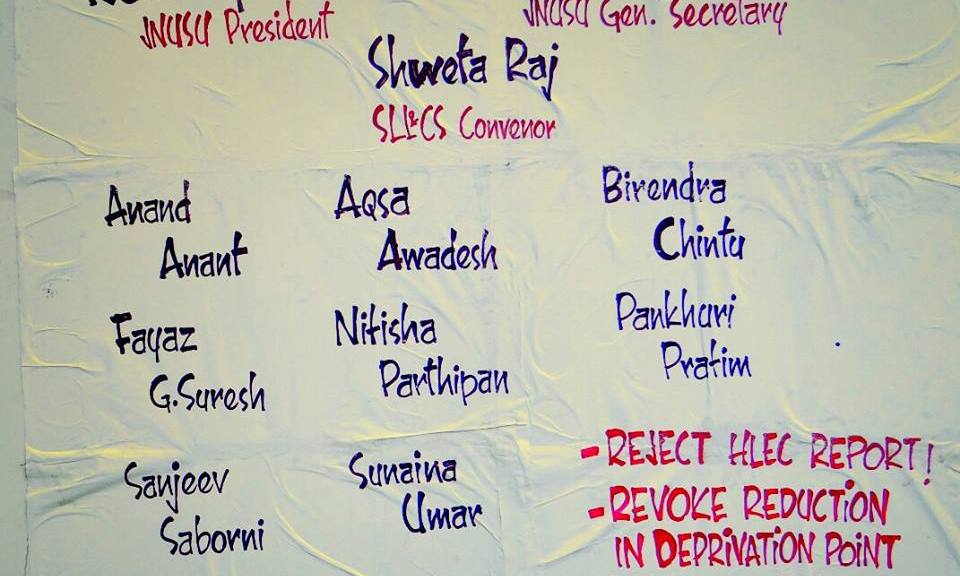
Diary of a JNU Student on Hunger Strike: Pankhuri Zaheer

Guest Post by Pankhuri Zaheer

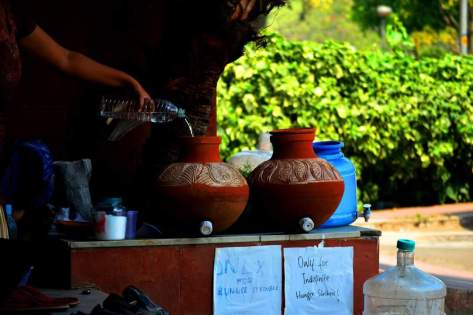
Water - A Gift for Hunger Strikers. Photo Courtesy, Azhar Amim
Water – A Gift for Hunger Strikers. Photo Courtesy, K. Fayaz Ahmed

“I wanted to bring you something but I didn’t know what to get you so I got you a bottle of water,” says a friend who would perhaps never identify herself as a student activist but since 9th February, like many like her, has been an integral part of the stand with JNU movement.

19 of us have decided to sit on an indefinite hunger strike till the time the farcical report of the High Level Enquiry is not rolled backed in its entirety. Today, April 30th, is the third day of our hunger strike.

Continue reading Diary of a JNU Student on Hunger Strike: Pankhuri Zaheer

The Difference between What They Tell Us and What We Know: Shehla Rashid

Guest Post by Shehla Rashid. Based on a Status Update on her Facebook Page.

They tell us that the military is meant for fighting the “terrorists”; But most of the time, it is the civilians who are killed.

They tell us that “special powers” for the army are necessary for national unity; But the army only teaches us how to hate India.

They say the University is anti-national because it wants to break India; But it’s the University that teaches us to love Indians.

Then, who is anti-national? Those who teach us how to hate India, or those who teach us how to love Indians?

Yes, we see the difference between India and Indians; India is at war with Indians throughout India.

I wish the Indian state could also see the difference between Kashmir, which it claims as its own, and Kashmiris who belong to no one; They claim to love Kashmir but hate and kill Kashmiris.

Continue reading The Difference between What They Tell Us and What We Know: Shehla Rashid

Nation and its Violences: Sanjay Kumar

Guest Post by Sanjay Kumar

Violent thoughts and deeds are increasingly getting justified in the name of Indian nation. A mob of lawyers has attacked students, teachers and journalists, right in the middle of a court complex in the national capital. Leaders of these patriotic lawyers were later caught bragging on camera about how they will next time throw bombs on anti-nationals. A young woman in Delhi has received emails and face book posts threatening her with acid attack and sexual assault, because she happens to be a sister of Umar Khalid, one of the organisers of the JNU programme, during which according to police anti-India slogans were raised. The mere being of this woman, and her defence of her brother, is enough of a provocation for many men and women of the country to justify the threat of ultimate male violence against women. Another man, Mr Adarsh Sharma put posters in the central district of the capital announcing an award of Rs 11 lakh for anyone who kills Mr Kanhaiya Kumar, the president of  the JNUSU, charged with sedition. Mr Sharma claims that his ‘blood boiled’ when he saw Mr Kumar’s much publicised speech after his release on bail. The popular movie Pyasa (1957) of Gurudutt had a song ‘Jinhen Naz hai Hind par vo kahaan hain’, which used the reality of social degradation to question celebrations of the nation. Sahir’s poem worked because it asked Indians to look at themselves in the mirror of public morality of the recently independent India. That mirror has been cracked for long. With the brazenly violent now claiming that their violence and threat to violence should really be the pride of the nation, we are now witnessing the final shattering of that mirror. Continue reading Nation and its Violences: Sanjay Kumar

Academics Worldwide Against the Vilification of Nivedita Menon

[Expressions of support from scholars wanting to sign on are continuing to pour in. We will therefore be continuously adding the names as they come in and keep updating the statement. – AN] 

VICIOUS CAMPAIGN AGAINST FEMINIST SCHOLAR

We, the undersigned, wish to express our shock and indignation at the vicious right wing media campaign conducted over the past few days against well-known feminist scholar and Jawaharlal Nehru University professor Nivedita Menon. This media campaign mischievously decontextualizes her lecture at the public teach-in programme in JNU with the use of selective clips and inflammatory commentary. The television channel Zee has led the main campaign by branding Professor Menon as ‘anti-national’ and instigating viewers to take action. Such branding is tantamount to a television channel acting as both judge and jury, and directly placing an individual’s rights and safety under threat.

The use of television media to attack intellectuals and instigate vigilante action is a feature of authoritarian regimes worldwide.  Similar tendencies are visible in recent months in India. Singling out individuals and creating a mass-frenzy against them by using the medium of TV is a dangerous trend that directly incites and encourages violence. This is a deep disregard for any process of law. We saw Zee TV do this earlier when doctored videos became the basis of arrest and harassment of JNU students. In this case, Twitter and social media campaigns have followed attacks on Professor Menon, demanding the framing of sedition charges against her and wielding open threats of rape. Most disturbingly, there are media reports of police complaints filed by interested parties demanding ‘action’ against Professor Menon.

Professor Menon is a renowned scholar and feminist thinker; her texts are used in university syllabi worldwide. As a prominent scholar and activist she has intervened in academic and public debates for decades. Professor Menon has also been known as an inspiring teacher for thirty years, guiding generations of students who now work in India and abroad. She has never shied away from intellectual debate in academic and public forums, passionately intervening in debates on feminism and social theory. This is the first time that her own freedom to articulate her ideas has been so viciously attacked in an orchestrated media campaign.

The freedom to articulate ideas is the basis of a university. When opinions voiced in a public lecture by an academic are made part of a selective media campaign that seeks not to debate but simply to malign, both democracy and the university are under threat. What is under question are not just Professor Menon’s ideas but also the very freedom for academics and citizens. We condemn this media campaign and associated threats, urging all academics and intellectuals to stand with Professor Menon at this time.

We call on the Vice Chancellor of JNU to swiftly defend Professor Menon from such attacks and protect the sanctity of university debate. We urge the JNU administration to stand by its faculty’s right to hold individual opinions and condemn all efforts to diminish this. We call on the university to immediately ensure that freedoms that form its very academic basis are not eroded in this moment. We call further for every censure and action against the unlawful actions of the television channels in question. Finally, we urge all well wishers of a democratic India to stand by Professor Menon for their own freedoms, and not just hers. Continue reading Academics Worldwide Against the Vilification of Nivedita Menon

Then They Came For ..

Tree Wants to be Calm
But Wind Will Not Stop !
-Jose Maria Sison
( Filipino Revolutionary and Poet)

Whether all the leading public intellectuals of our times have suddenly decided to go for a break – now that Kanhaiya Kumar is out of jail – or are thinking that the impending storm would peter away on its own. Anyone who has closely followed the public hounding of two of the finest human beings of our times – Prof Nivedita Menon and Gauhar Raza – and the silence which has followed with it ( barring a statement signed by many and few articles here and there on some webmagazines ) would understand what does that mean. While Prof Menon is being targetted because of airing of selective quotes from one of her lectures, Gauhar has been put under the scanner because of his participation in Indo-Pak mushaira. It is clear that one of his poems – focussing on the dangerous cocktail of religion and politics – which he recited there, has infuriated them. Continue reading Then They Came For ..

Conversations on Sedition: Ritanjan Das and Abhijit Sengupta

The weeks following the February 9th incident within the JNU campus have been nothing but eventful in India’s social and political discourse. At least, this is something most of us will agree on, no matter which side of this increasingly impermeable “fence” we sit on.  There have been arguments, counter arguments thrown from each side to the other, names have been dug up and hurled across, evidence in favour of what purportedly happened or did not happen have been put up by each side for the other to see. Videos have been made, unmade; cartoons have been drawn, redrawn; political figures have been idolised, lampooned; students have been demonized and idolized; dangers of the increasing menace of nationalism and anti-nationalism have been stuffed down one’s throat through the so called idiot box or the smart net.

In the midst of this deluge of opinions and ideas, information and misinformation, the question that some have raised is, are both sides losing the plot a bit? What exactly are we discussing or debating so vociferously? Are we really listening to the other sides’ arguments, or are we just hearing a few words we want to hear and voicing our own opinions in pre-designed responses? These are some of issues we are highlighting in this piece, hopefully in a slightly different format than what we are used to elsewhere.

What follows is a conversation between two intelligent people from opposite sides of the fence. The conversation is based on some real ones, which the authors of this piece had actually engaged in with different individuals over the last few weeks. We have attempted to distil the central ideas of both sides and present it to the readers. We cannot and have not included every aspect of the ideas and opinions of both sides, and we will not include the abuse. But what we have attempted to capture, is a reasoned and rational attempt at understanding the real problem(s), as understood by each side. Continue reading Conversations on Sedition: Ritanjan Das and Abhijit Sengupta

Rebellion as Contagion

IMG_2231

Perhaps this is the infection, the gangrene, that Justice Pratibha Rani fears: a slogan, chanted in the streets of Srinagar as a matter of routine, finds an opening at a university campus in New Delhi. Freed from the usual suspects, unmoored from the routine skirmishes, deaths, and encounters, along the Line of Control, the slogan floats through a university corridor – distracting rows of disciplined students from their academic pursuits.

A slogan’s explosive power, it seems, is not just about what is shouted – but rather where it appears, and who takes up the call. This realisation offers us an opportunity, long sought, to think through this troubling question of “Freedom of Expression.” Read the rest of this piece here

स्मृति ईरानी को एक जे-एन-यू के छात्र की चिट्ठि: अनन्त प्रकाश नारायण

Guest Post by Anant Prakash Narayan

सेवा में,

श्रीमती स्मृति ईरानी जी

“राष्ट्रभक्त” मानव संसाधन विकास मंत्री,

भारत सरकार

संसद में दिए गए आपके भाषण को सुना. इससे पहले की मै अपनी बात रखूँ , यह स्पष्ट कर दूं की यह पत्र किसी “बच्चे” का किसी “ममतामयी” मंत्री के नाम नहीं है बल्कि यह पत्र एक खास विचारधारा की राजनीति करने वाले व्यक्ति का पत्र दूसरे राजनैतिक व्यक्ति को है. सबसे पहले मै यह स्पष्ट कर दूं कि मै किसी भी व्यक्ति की योग्यता का आकलन उसकी शैक्षणिक योग्यता के आधार पर नहीं करता हूँ बल्कि साफ़ साफ़ कहूं तो मै “योग्यता”(मेरिट) के पूरे कांसेप्ट को खारिज करता हूँ.

मानव संसाधन मंत्रालय का पद भार लेने के साथ ही यह अपेक्षा की जाती है कि आप इस देश के केंद्रीय विश्वविद्यालयों में उनकी ऑटोनोमी का सम्मान करते हुए उसके लिए उत्तरदायी होंगी. रोहित वेमुला के मामले में आपने क्या किया यह सबके सामने है कि किस तरह से वहाँ के प्रशासन पर आपने दबाव डाला जिसका नतीजा रोहित के institutional मर्डर के रूप में हमारे सामने आया. लेकिन मै इन सारी चीजो पर अभी बात नही करना चाहता. आप बार बार अपनी औरत होने की पहचान (आइडेंटिटी) को assert करतीं हैं और इसको करना भी चाहिए क्यूंकि नारी जाति उन ढेर सारे हाशिये पर किए गए लोगों में एक है जिनको सदियों से शोषित किया गया है. मै आपसे यह पूछना चाहता हूँ कि एक दलित स्त्री जो कि हर तकलीफ उठाते हुए अकेले अपने दम पर जब अपने बेटे बेटियों को इस समाज में एक सम्मानपूर्ण जगह देने के लिए संघर्ष कर रही थी तब एक नारी होने के कारण आप की क्या जिम्मेदारी बनती थी ? क्या आपको उस महिला के जज्बे को सलाम करते हुए उसकी बहादुरी के आगे सर झुकाते हुए उसके साथ नहीं खड़ा होना चाहिए था? हाँ, मै रोहित की माँ के बारे में बात कर रहा हूँ. जो महिला इस ब्रहामणवादी व पितृसत्तात्मक समाज से लड़ी जा रही थी, अपने बच्चों को अपने पहचान से जोड़ रही थी, उस महिला को आप व आपकी सरकार उसके पति की पहचान से क्यूँ जोड़ रहे थे? आपको भी अच्छा लगता होगा की आपकी अपनी एक स्वतंत्र पहचान है. लेकिन यह अधिकार आप उस महिला से क्यूँ छीन  रहीं थीं? क्या आप भी पितृसत्तात्मक व ब्रहामणवादी समाज के पक्ष में खड़ी होती हैं? अपना पूरा नाम बताते हुए अपनी जाति के बारे में आपने सवाल पूछा और आपका भाषण खत्म होने के पहले ही लोगों ने आपकी जाति निकाल दी. मै आपकी जाति के बारे में कोई दिलचस्पी नहीं रखता हूँ और मै यह बिलकुल नहीं मानता हूँ की अगर आप उच्च जाति के होते हैं तो आप जातिवादी ही होंगे लेकिन आपके विभाग/मंत्रालय के तरफ से जो चिट्ठियाँ लिखी गई उसमे रोहित और उसके साथियों को जातिवादी /caste-ist बताया. मैडम क्या आप caste-ism और  caste assertion का अन्तर समझती हैं? मै समझता हूँ की आप ये अन्तर भली – भाँति समझती हैं क्यूंकि आर एस एस जो आपकी सरकार और मंत्रालय को चलाता है, वह वर्ण व्यवस्था के नाम पर जाति व्यस्वस्था को भारतीय समाज की आत्मा समझता है और आर-एस-एस के एजेंडे को लागू करवाने की राजनैतिक दृढ़ता हमने समय समय पर आप में देखी हैं.

Continue reading स्मृति ईरानी को एक जे-एन-यू के छात्र की चिट्ठि: अनन्त प्रकाश नारायण

Sedition and the Problem of Discretionary Exercise of Police Power: Mathew John

This is a Guest Post by Mathew John

The interpretation of law does not only take place in courts. In our season of ‘seditious’ speech this would seem an obvious point as the police administration is as much engaged in the process of legal interpretation or, as legal speak would have it, exercising discretionary powers. However, while courts have to at least minimally ensure that their decisions are backed by reason and aligned with previous decisions, the cases filed against Kanaihya Kumar and others seems to suggest that the police administration can operate almost as a universe unto itself in its interpretation of Indian criminal law. Of course police action will have to tested and defended in court but what if the police bring flimsy cases to trial to inflict long drawn out legal process as punishment for dissenting speech?

There has been an avalanche of excellent recent writing in recent days on the criminal offence of sedition. These have emphasised two broad points. On the one hand they have traced the offence of sedition to the authoritarian designs of the British colonial state seeking to control restive Indian opinion. On the other, opinion has also noted that Indian Courts while upholding the constitutionality of the offence of sedition have held that the speech can be penalised on this ground only when accompanied by an imminent threat of disorder, disturbance or violence. However, the JNU fracas as other similar cases in recent memory involving Arundhati Roy, Binayak Sen and Aseem Trivedi among others, demonstrate that this judicial standard reading down the offence of sedition to a very narrow set of speech acts has not constrained subsequent police action. On the contrary police administrations in the current JNU case have pursued citizens for seditious speech even when their speech could not in any objective manner be tied to imminent threats of disorder. That is, the criminal provisions on sedition section are used against the spirit of the law as laid down by the Supreme Court and is mobilised to with little cause but the harassment of dissenting opinion. In such situations what can defenders of free speech do to ensure that legal process is not abused to harass dissent?

Continue reading Sedition and the Problem of Discretionary Exercise of Police Power: Mathew John

Caste, sedition, oppression: JNU round-up

Earlier this week, I tried to join the many dots of violence at universities into a coherent pattern. My central contention is:

Spirited resistance in campuses across the country suggests the politics of India’s youth are more fluid and assertive than expected. The mid-1990s empowerment of historically oppressed castes, narratives of economic aspiration from the 2000s and an instinctive suspicion of authoritarianism have come together to forge a bold poetic new politics of desire that has befuddled even ruthless and astute politicians like the prime minister.

and

Modi’s government uses outdated laws, a pliant police force and Hindu student organizations as a battering ram to crush this awakening, exacerbating the discord between a prime minister determined to stamp his authority on an unruly nation and students enraptured by a thrilling moment of unlikely solidarities that could define their generation.

Read the rest of the piece here:

Vilification from the apolitical: The Dreyfus Affair and the case against JNU: Joyojeet Pal

This is a guest post by Joyojeet Pal

In 1894, a case of espionage broke out in France. Alfred Dreyfus, a young officer was arrested in connection with a letter suggesting a transfer of sensitive documents to the German attaché in Paris. Dreyfus was arrested for the crime, his family was intimidated and he was swiftly convicted despite weak evidence. After being publicly shamed as a traitor in a court-martial, he was sent to ‘Devil’s Island’ in French Guinea, a notorious penal colony. Within a couple of years of his conviction, a movement emerged to re-examine the facts of the case. Dreyfus would be eventually re-tried and re-convicted despite overwhelming evidence in his favour.

Dreyfus was Alsatian, Jewish, and a graduate of the elite École Polytechnique, one of the most competitive institutes in the country. Alsace had been lost by France following the Franco-Prussian war, the French were bitter about this, and Alsatians were often seen as a suspicious regional minority. The case that came to be known as the “Dreyfus Affair” in time became a landmark in modern French history because of the multilayered schisms in French society that it threw open.

Continue reading Vilification from the apolitical: The Dreyfus Affair and the case against JNU: Joyojeet Pal

Citizens Committee for the Defense of Democracy on the JNU Situtation

Guest Post by Citizens Committee for the Defense of Democracy

The Citizens Committee for the Defense of Democracy strongly condemns the clampdown in Jawaharlal Nehru University. We deplore the targeting of students and teachers and condemn the culture of authoritarian menace that the Central Government has unleashed.  We strongly believe that dissent is not sedition and invoking sedition laws against students, ordering the police to enter the campus and unlawfully arresting a student leader, issuing warrants against many others on charges of inciting violence, attacking students, teachers and arrested student in the court premises, are serious assault on the fundamental rights of the citizens of this country.  The right to dissent is fundamental to maintaining democracy and the recent developments have shaken the foundations of democracy. We condemn the indiscriminate use of the colonial law of sedition on dissenting voices.

The attack on JNU is an attack on our diversity, on public funding of universities and access to higher education for the common people. The vicious campaign of ‘tax-payers’ monies funding the anti-nationals’ is highly regressive and malicious.   It is only through public funding and reservation policies that access to higher education has been expanded for students from all backgrounds, especially girl students from poorer backgrounds. It is public funding which makes higher education accessible to many. Continue reading Citizens Committee for the Defense of Democracy on the JNU Situtation

The India I Came Back To: Namrata Sharma

This is a guest post by NAMRATA SHARMA


I will start this piece with a painful but short flashback tirade about myself. I moved back to New Delhi in 2014, after six long years in New York and Singapore. My decision to move back to the motherland was predominantly attributed to issues that a twenty-something grapples with when he or she is away from home and family. However, familial ties and emotional reasons aside, there was one factor which deeply resonated with me and was the driving force behind my decision to move back. This factor was – the liberty to express my thoughts and views on a topic, any topic, in an indulgent and lenient space, which, by virtue of being an Indian citizen, was guaranteed to me in India and not in other places. In India, this liberty transcended predictable spaces like classrooms, newsrooms and sophisticated editorial pages of the morning newspaper and was very organically present in the form of arm-chair political banter amongst friends and political conversations with family over dinner. Continue reading The India I Came Back To: Namrata Sharma

Solidarity Statement of Students from Northeast India, TISS, Mumbai 20th February 2016


We, the undersigned, students and research students from various states of northeastern region of India studying in Tata Institute of Social Sciences, Mumbai would like to highlight on the unprecedented shrinkage of academic spaces across various universities in India. We condemn the politically motivated interferences of the state in Jawaharlal Nehru University and in Hyderabad Central University (HCU), and other universities. We also condemn the mob justice perpetrated by lawyers against students, journalist, activists etc in the Patiala House Courts, New Delhi, and media trial led by prominent journalists from New Delhi. Continue reading Solidarity Statement of Students from Northeast India, TISS, Mumbai 20th February 2016

Statement on the Events at HCU and JNU From Faculty of the Tata Institute of Social Sciences


We, the undersigned, are deeply shocked and dismayed by the processes that led to the suicide of Rohith Vemula at HCU in January and the ongoing attacks on students and faculty of JNU. At Hyderabad Central University, RohithVemula a Dalit research scholar was labelled as anti-national and driven to suicide in January through systematic persecution. At Jawaharlal Nehru University (JNU), New Delhi over the past few days, Kanhaiya Kumar, the President of the JNU Students Union is held in police custody on the trumped up charge of sedition. On February 15, 2016, the police stood by as mute spectators while a group of lawyers and hooligan elements attacked students and faculty of JNU who had gone to the Patiala House courts in Delhi in solidarity with Kanhaiya Kumar who was to be produced there. Continue reading Statement on the Events at HCU and JNU From Faculty of the Tata Institute of Social Sciences

The Right to Reason and Imagine: Architects in Solidarity with the JNU Community

Guest Post by Architects from all over India and elsewhere

To: The JNU Teachers Association, JNU Students Union

CC: Vice Chancellor, JNU

We, the undersigned, are writing this in utmost shock and despair regarding the recent events and developments at your campus. We want to extend our full support to the JNU teachers association and the democratically elected JNU Student Union. We believe there is a difference between the nation, the state and the government of the day, and fully support your constitutional right to air your positions, as different or diverse as they may be, without illegal interference from any particular ruling ideology, party or state machinery.

As those engaged in architecture, we believe that imagination and reason are the highest of human faculties. This gift is what we constantly cultivate and rely on – in academia and in practice – when we question what exists, however natural, fixed and irreplaceable it may seem, and fearlessly posit alternatives. Indeed, there is little difference for us between possessing a moral imagination and being able to imagine such alternate worlds and other ways of being.

The inability therefore to envision life in another’s shoes, to disagree and to counter ideas with more aesthetic or eloquent ones without resorting to character assassination, violence and charges of anti-nationalism, betray to us an alarming lack of imagination, and we strongly condemn this in all its forms.

We condemn this absence of imagination and the physical and epistemic violence it has unleashed on the university community especially teachers and students. We stand with you in support of the university as a marketplace of ideas where all ideas and opinions are passionately argued, ripped apart, defended and critically re-imagined in ever new ways, leading to a more enlightened citizenry. This must be allowed to happen without fear or favor, risk of persecution or charges of sedition. If nothing else, the imagination of our founding fathers demands it, and we are in solidarity with your right to exercise it.

(This statement represents us in our individual capacities and not the institutions we are associated with.)

(In alphabetical order)

Continue reading The Right to Reason and Imagine: Architects in Solidarity with the JNU Community

Oxford University Members and Alumni in Solidarity with JNU: Oxford Students, Faculty and Alumni

Guest Post by students, faculty and alumni of Oxford University, UK

We, the undersigned members and alumni of the University of Oxford, stand firmly in solidarity with fellow students, teachers and scholars at the Jawaharlal Nehru University (JNU). We condemn the ongoing persecution of the student community in JNU, in particular the arrest of JNU Students Union (JNUSU) president Kanhaiya Kumar under sedition charges. We protest the use of institutional and state machinery to stifle dissent on campuses, and the attempt to persecute those whose views do not conform to the narrow narratives of ‘nationalism’, ‘nationhood’ and ‘Indian culture’ promoted and endorsed by the ruling party. We view the crackdown in JNU in a continuum with the use of state machinery to clamp down on dissenting views and ideologies on campuses, most prominently at the FTII, Jadavpur University, IIT-Madras and the University of Hyderabad (UoH). We would like to point out that it was a similar witchhunt, backed by state authority, that led to the suicide of Dalit scholar and student leader of the Ambedkar Students’ Association, Rohith Vemula. We also stand in solidarity with the ongoing rally hunger strike at UoH and the struggles of the Joint Action Committee for Social Justice, demanding justice for Rohith Vemula.

Continue reading Oxford University Members and Alumni in Solidarity with JNU: Oxford Students, Faculty and Alumni

Letter of Solidarity from International Association of Women in Radio and Television (India Chapter) for JNU

We the undersigned, from the India Chapter of the International Association of Women in Radio and Television (IAWRT), would like to place on record our solidarity with the students and teachers of the Jawaharlal Nehru University (JNU). We find the recent events that have taken place in JNU –  arrest of the JNUSU President Kanhaiya Kumar on charges of sedition, and a lookout by the police for several other students who allegedly raised anti-national slogans – extremely disturbing. We also feel that the use of the sedition law, which was enacted by British colonial government, draconian and has no place in India. A fundamental principle in a democracy is the right to free speech. Article 19 of the Indian Constitution grants it as a fundamental right, and the Indian courts have recognised this in the past, including in the case of Balwant Singh vs. State of Punjab. In this context, the framing of charges against the students of JNU is unacceptable, and should have no place in a democratic society.

Continue reading Letter of Solidarity from International Association of Women in Radio and Television (India Chapter) for JNU

Mea Culpa, Mea Culpa! : To A Student from CDS

Dear Student from CDS who pasted the posters criticising  our collective effort to stand with JNU

I write in response to the views that you expressed on those posters. First of all, let me tell you how much I’d have appreciated if you expressed those views openly right from the beginning, so that we could have had a proper debate. I do wish we stopped scribbling comments on each others’ posters – this is an open campus, and surely, we don’t practice the Sangh Parivar’s intolerance of a contrary opinion. No one, I assure you, will harm you in any way, and I am sure all my fellow teachers, students, and non-teaching staff will join me in assuring you thus.

Continue reading Mea Culpa, Mea Culpa! : To A Student from CDS

A message of Solidarity and a Statutory Warning: Pankaj Mishra

Guest Post by author Pankaj Mishra
One can only welcome the broad coalition that has sprung up against the assault on JNU and in defense of the right–eternally vouchsafed to students–to intellectual freedom. But the imperative of solidarity should not make us forget that this multi-pronged violence—ordered by the government, and assisted by police officers, university officials, lawyers and sections of the media—has been in the making for a while—at least a decade and a half.
The empowerment of a technocratic elite that presumes to know exactly what the ‘New India’ ought to do in order to be wealthy and powerful made much intellectual and artistic endeavour, not to mention political struggle, seem unnecessary. Its cherished epithet ‘jholawallah,’ aimed to scornfully delegitimate a whole spectrum of demands for justice and equality as well as a culture of reflection and debate. Wealth-creators and their lackeys in politics, business and the media have long been united in their contempt for intellectual dissent—roughly interpreted as anything that seems to impede or slow down their own progress towards more wealth and power.

Continue reading A message of Solidarity and a Statutory Warning: Pankaj Mishra

JNU: 1975, 1983 and 2016: Two interviews

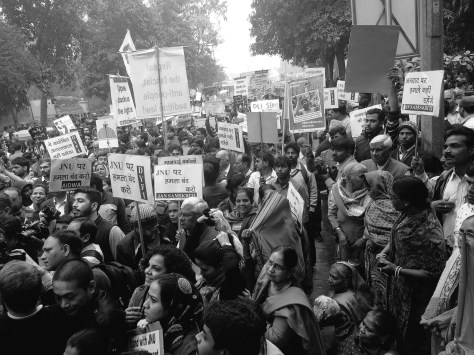
IMG_6506At the JNU rally in Delhi yesterday, I caught up with JNU alumni and historians, Rana Behal and Mukul Mangalik and asked them about their experiences as students at JNU in the 1970s (Behal) and 1980s (Mangalik) and what brought them to Mandi House on a damp, but pleasant, thursday afternoon.

Continue reading JNU: 1975, 1983 and 2016: Two interviews