Guest post by AYESHA SIDDIQA: The renowned television anchor Quatrina Hosain was in tears. A day after the incident of her being sexually assaulted at a Pakistan Tehreek-e-Insaaf (PTI) jalsa by party workers in Wah Cantonement, she talked about how the bruises may heal but not her emotional scars. She was covering election rallies and got invited by a PTI candidate Mohammad Sarwar to his rally in Wah. It was a sudden plan so no one could have conspired to misbehave. This is important to note, as many PTI workers have subsequently tried to blame the incident on Pakistan Muslim League (Nawaz)’s workers. However, when confronted with facts, PTI workers tried to hide behind the argument that women should not provoke people by coming out and mixing with them. Continue reading Naya Pakistan, an old fable: Ayesha Siddiqa→
SAAD SARFRAZ SHEIKH sends us this photo essay from Lahore: On 9th March, 2013, I saw an entire neighborhood burn right in front of my eyes. All I could do was watch, as the houses fell and their residents watched in vain.
And now, there are burnt teddy bears and dolls, broken doors and melted buckets stuck on the floor. It seems I am on fire.
Nasreen’s defunct washing machine is now as black as the night. Her child sits on it and weeps. Like a surgeon, she salvages the motor and tells me that it could still work. But her microwave, she tells me, is a painful puddle on the floor. Continue reading Ilyas Masih wants to stay in the dustbin: Saad Sarfraz Sheikh→
Here’s wishing all men and women across borders and boundaries, in New Delhi and New Haven, Ranchi and Russia, Dublin and Damascus, Srinagar and Sri Lanka, Bhutan and the Bermudas, a very happy International Women’s Day. These images are from the ‘I Need Feminism’ Campaign at the Lahore University of Management Sciences
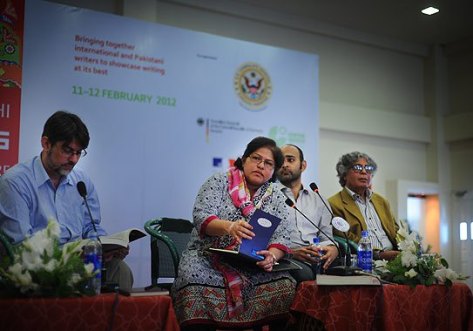
Here we are seemingly in an age of intellectual freedom, burgeoning media industry and literature festivals. There are numerous festivals held all over South Asia celebrating books new and old, bringing people together for exchange of ideas. But these festivals seem to be wrapped in their own politics. In some cases, certain cliques that want to encourage a peculiar perspective dominate the show. I understood this through my interaction with the Karachi Literature Festival. Continue reading Who’s afraid of the Karachi Literature Festival?: Ayesha Siddiqa→
A young man wearing faded jeans and a t-shirt too unpleasantly tight around his middle, sits on his end in front of a laptop, weeping. The tears aren’t exactly the gushing springs of fresh grief, more the trickling of nostalgic streams. He misses his favourite website. Everything bookmarked in his browser that isn’t pornography is from that site. He contemplates an incalculable loss. Today, as many times before, he’s come home from a hard day of not doing anything at work, just wanting to lose himself in the magical world of user uploaded videos. Continue reading Life without YouTube: Haseeb Asif→
Lahore-based journalist-singerALI AFTAB SAEEDexplains how we can classify news into three kinds, and how doing so helps us make better sense of the world. He says at the end this is true not just of Pakistan – indeed, this is a very useful classification to understand the Indian medial landscape as well!
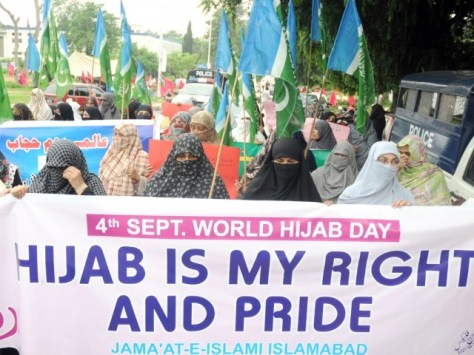
The Islamia College in Karachi is the hub of the Islami Jamiat-e-Tulba (IJT) [1]. Last year, the nationalist banners displayed near the college to mark Pakistan Defense Day (6th Sept), were strategically flanked by two complementary gendered messages. One such banner publicized the event (in Urdu) as ‘Hejab Numaaish’ (Parade of the Hejab – 4th Sept) and below it, in English ran the claim ‘Hejab is My Right and Pride’. The other banner declared simply, ‘Afia[2] is our Pride’. Both messages are signifiers and comments on the re-visitation of the themes of religious and nationalist agendas, played out across the body politic of women, in a post 9/11-Pakistan.
This essay discusses the resurgence of a new form of religious nationalism and its impact on the narrative of gendered politics in Pakistan. It also examines the worth of a recent body of Pakistani scholarship[3]that opposes the misguidedness of liberal-secular resistance to religious politics. Instead, such academic work invests hope in something termed, ‘Islamist secularization’. Continue reading Engendering the Sovereignty of the Islamic Republic of Pakistan: Afiya Shehrbano Zia→
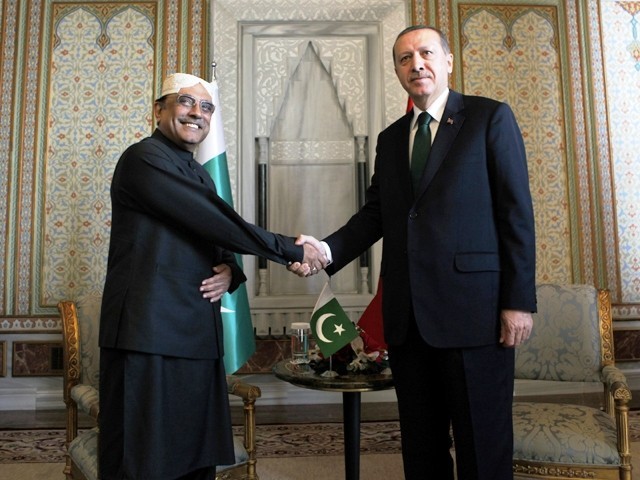
Pakistan’s President Asif Ali Zardari with the Turkish Prime Minister Recep Tayyip Erdoğan. Reuters photo
Everybody loves Turkey. It’s where Pakistani families go for holidays, where students now go for education, where laborers go for work, where clerics go for counsel, and where both civilian and military officials and dignitaries go to find inspiration. Due to Turkey’s momentous economic and political rise, especially in the last decade, it is being held up to the rest of the Muslim world as a country worth emulating, and experts from everywhere have been referring to the “Turkish model” – an Islamic democracy with a robust economy – as the blueprint for a strong and stable (and still Muslim) country. Continue reading Why Pakistan Loves Turkey: Saim Saeed→
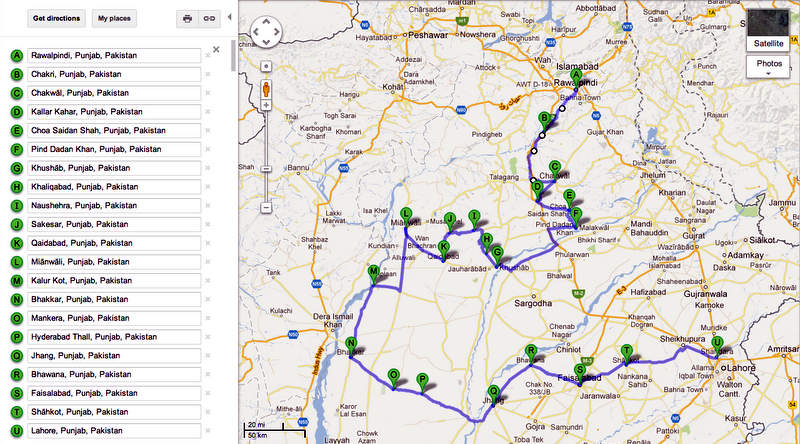
In 2010, I embarked on an ambitious bike trip of Punjab, visiting 30 cities in 30 days, covering 5,000km. That was a wonder experience but limited to big cities and towns. This time I want to see the rural side of Punjab. The idea is to avoid highways and travel through the roads connecting villages and small towns of Punjab. The following photographs are from the first phase of this trip, from Rawalpindi to Lahore through the towns and villages in west Punjab, away from the G.T. Road. I quit my day-job a few months ago. The 9-6 life wasn’t meant for me, I guess. Folklore and Punjab are the two things that fascinate me the most. That’s the reason I founded folkpunjab.com. These travels will one day provide me the base for writing something substantial on the folklore of Punjab. Continue reading A Journey in the Punjab: Sohail Abid→
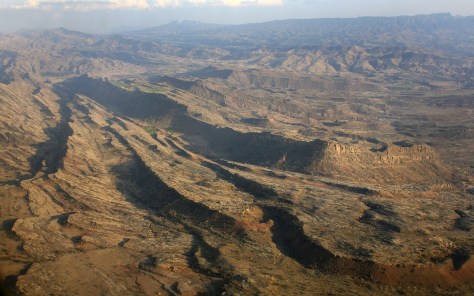
Pakistan’s remote North Waziristan tribal area is seen from the air Feb. 17, 2007. Photo by John Moore/Getty Images
One day as I walked to the market to buy some eggs, I noticed strange graffiti on a wall. Emblazoned in red paint was an invitation to join the fight against zionist subversion, western imperialism and painful hemorrhoids; the end having been muddled with a physician’s note.
It was an open call to Jihad by a militant Islamic organization. Jihad! The camaraderie, the righteousness, the third degree burns; it’s all I’d ever wanted. I was tired of being oppressed. There I was, in the prime of my youth, jobless, eggless, with subnormal visual acuity and four strands of the dengue virus, and who was to blame? I could imagine the conversation with my therapist.
“Doctor, I’m moody, I can’t sleep and I never seem to have enough energy to do anything.”
“Why, I believe you’re suffering from oppression”
I called their toll free number and signed myself up. They sent me a brochure and a medical plan; both had pictures of the same mutilated bodies.
‘Jihad summer camp, three months, graduating candidates get a certificate of martyrculation and up to 72 virgins in heaven (note: amount varies according to stock), HEC accredited, facial hair mandatory’.
I consulted with my parents, my mother was thrilled; she’d always wanted a martyr in the family. Father just grunted and made a time honoured gesture with his middle finger.
Two days later a brother Mehsud showed up at my door, he’d been sent by the organization to escort me back to their base.
This press release was put ou on 28 September 2011 by theASSOCIATION OF PARENTS OF DISPLACED PERSONS, The Bund, Amira Kadal, Srinagar – 190001
In Pakistan the judiciary is attempting to provide justice to the family members of those who have been subjected to enforced disappearance. In 2008, the Chief Justice of Pakistan entered into confrontation with the then President of Pakistan for taking a pro-active stance against disappearances. That confrontation ultimately emboldened the judicial system in Pakistan to be more pro-active on human rights issues. This judicial intervention on enforced disappearances has created an atmosphere in Pakistan which has pushed Pakistani government to invite United Nations Working Group on Enforced or Involuntary Disappearances (UNWGEID). The UNWGEID recently concluded its first 10 day visit to Pakistan and have begun their investigations on enforced disappearances. Continue reading Allow UNWGEID to probe disappearances in Jammu and Kashmir: APDP→
I was last in Pakistan in 2006 during Ramzan. Rahul had some work in Islamabad, Peshawar and Lahore and I had used that as an excuse to visit my mother’s place of birth. While I had visited my mother’s beloved Lahore a few times earlier this was to be my first trip to Islamabad and Peshawar.
To cut a long story short, on our first evening in Peshawar, post iftaar, we found ourselves in the fabled Qissa Khwani bazaar, the Bazaar of Story tellers. It was here that in 1930 British troops had fired upon an anti-colonial demonstration of non violent, unarmed nationalist Khudai Khidmatgars leaving more than 400 amongst them dead. History has come a long way since then marking contemporary Peshawar as one of the more violence prone cities of Pakistan. Continue reading Our search for Charasi Kababs: Saba Dewan→
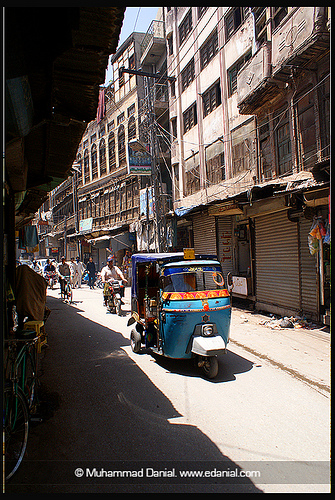
The entry to a temple in Gunjmandi. All photos by Shiraz Hasan
In the early 19th century, the British made Rawalpindi the central seat of military power as they aimed towards Afghanistan. This was in line with their strategic approach towards the Russian Empire in order to enjoy and retain complete control over central Asia. Known as the Great Game, the conflict continues today in another form. Continue reading The abandoned mandirs of Rawalpindi: Shiraz Hassan→
In neighbouring Pakistan, an Islamic cleric recently accused a young Christian girl, Rimsha Masih, of blasphemy, a charge punishable by life imprisonment. He said she had burnt some pages that contained verses from the Quran. The 14 year old girl hails from a poor family and suffers from Down’s Syndrome. An eyewitness to the event showed courage and told a magistrate the truth: it was the Muslim cleric who had put those burnt pages in Rimsha’s bag. The cleric has been arrested and is set, in turn, to be charged with blasphemy.
I have been thinking about the incident. Insulting somebody’s religion is bad. It may cause offence. Often it is intended to cause offence. If somebody insults Islam, by doing things like burning pages containing verses from the Quran, it is bound to outrage a Muslim. Continue reading When the pseudo-sentiments of the pseudo-religious are pseudo-hurt→
The words are beautiful; the voices that sing them mellifluous. And yet, I find that instead of being overwhelmed as I usually am by the qawwali of Fareed Ayaz and Abu Muhammad, enraptured by the transcendental waves of their music, parts of my consciousness are held down, niggled. Perhaps it’s the constant drumming and strumming, perhaps it’s the psychedelic sound waves zipping across giant screens, perhaps it’s the acoustics that throw back bits of the singers’ strains at them. But the Coke Studio version of Khabaram Raseedah doesn’t affect me the way even scratchy recordings of live, open-air concerts do. Continue reading Coke Studio Pakistan – At a crossroads: Nandini Krishnan→
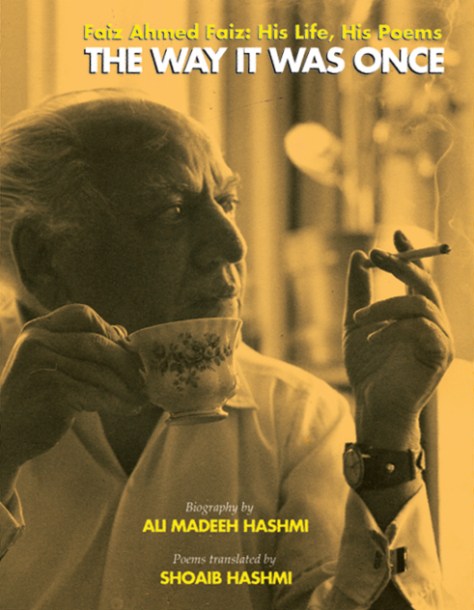
Faiz Ahmed Faiz: His Life, His Poems: The Way It Was Once by Ali Madeeh Hashmi/ Shoaib Hashmi; pp 256; Rs 499; Harper Collins Publishers India, 2012
After a decade without a day job, and associating with Dastangoi for over six years, I can safely say that I am a career storyteller. And one of the things I have learned is that resumes don’t make a person, stories do. Often these stories are not our own stories, but stories we’ve heard amongst loved ones, extended families, friends, work places, milieu; stories we’ve grown up with, stories distilled deep enough to become an integral part of our existence. We may not often identify with our resume but with our stories, always – acquaintanceship strikes, the moment our stories resonate. Continue reading The Poet, His Poems and His Tales→
At the Lifestyle Pakistan trade exhibition that concluded in Delhi on Sunday, one stall stands out from a distance for just its name – Deepak Perwani, one of Pakistan’s most famous fashion designers. This was the first of its kind exposure for Perwani outside the Indian fashion circuit, of which he has long been a friend and fellow traveller. The humble Perwani, though, has long been used to facing Indian surprise. “People keep asking me, ‘Oh you guys didn’t migrate?’, ‘How are you treated there?’ and so on. The questions show a lack of awareness.” Pakistani Hindus do not exist in the Indian imagination, but Perwani is part of Karachi’s flourishing Hindu community, which is small but visible and influential even today. One lakh of Karachi’s 1.3 crore population is Hindu.
This guest post byAYESHA SIDDIQA is the text of a speech delivered by her at a recent civil society review of the India-Pakistan peace process, organised by the Centre for Policy Analysis in Delhi.
This time it seems better then last time! I suppose this is what we said the last time as well. India–Pakistan relations have a cycle of ups and down: a crest followed by a trough and then a crest again. Although there is increased frustration on both sides for not being able to solve the ‘relationship’ mystery, the leadership and people in general remain eager to have peace rather than war. However, we also remain elusive regarding our threshold of peace, or what would be the cut-off point in settling for peace with each other. This cyclic peace of war and peace has remained primarily due to the peace process being elitist and confined to the strategic/security community. Therefore, I would like to argue three points:Continue reading Who are the real stakeholders of Indo-Pak peace?: Ayesha Siddiqa→
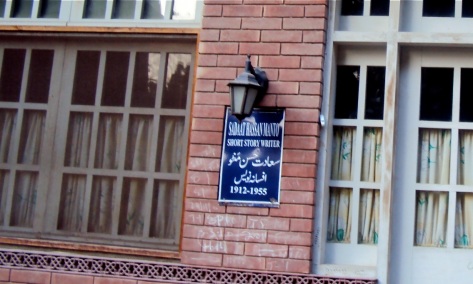
“Here lies buried Saadat Hasan Manto in whose bosom are enshrined all the secrets and art of short story writing. Buried under mounds of earth, even now he is contemplating whether he is a greater short story writer or God.”
May 2012 will mark the hundredth birth anniversary of the man who wrote that epitaph for himself, Saadat Hasan Manto (1912-1955). One cannot help but compare Manto’s centennial to Faiz Ahmed Faiz’s last year, preparations for which had begun much in advance. There seems to be an odd silence about Manto. Continue reading A Hundred Years of Manto→




 KAFILA - COLLECTIVE EXPLORATIONS SINCE 2006