Tag Archives: #Stand with JNU

Statement on the Events at HCU and JNU From Faculty of the Tata Institute of Social Sciences


We, the undersigned, are deeply shocked and dismayed by the processes that led to the suicide of Rohith Vemula at HCU in January and the ongoing attacks on students and faculty of JNU. At Hyderabad Central University, RohithVemula a Dalit research scholar was labelled as anti-national and driven to suicide in January through systematic persecution. At Jawaharlal Nehru University (JNU), New Delhi over the past few days, Kanhaiya Kumar, the President of the JNU Students Union is held in police custody on the trumped up charge of sedition. On February 15, 2016, the police stood by as mute spectators while a group of lawyers and hooligan elements attacked students and faculty of JNU who had gone to the Patiala House courts in Delhi in solidarity with Kanhaiya Kumar who was to be produced there. Continue reading Statement on the Events at HCU and JNU From Faculty of the Tata Institute of Social Sciences

Statement of Solidarity with Students in JNU, India – by students in KU Leuven, Belgium

We, the undersigned, students in the social sciences and humanities programs at KU Leuven, strongly condemn the Indian state’s heavy handed and politically motivated action against the students at the Jawaharlal Nehru University (JNU), Delhi.

We condemn the brutal police action against students, especially the arrest of JNU Students’ Union (JNUSU) president, Kanhaiya Kumar on 12 February 2016 – who has been charged under colonial-era sedition laws. We equally condemn the witch-hunt against and media trials against JNU, its faculty, and its students – especially Umar Khalid, an atheist-Leftist activist, who is wrongfully being called an ‘Islamist’ by some in the media.

Over the last few months, Indian universities have become a crucial site to contest and resist the arbitrary and concerted efforts of the Indian state to quash academic autonomy and dissent – from the scrapping of non-NET fellowships in 2015, to the death of Dalit PhD scholar Rohith Vemula at the Hyderabad Central University, earlier in January.

We underscore the fact that universities have historically been sites of critical thinking and politics, and need to remain the same. Furthermore, as the recent cases in India have shown, it is often students from under-privileged backgrounds who raise critical questions against the workings of the state, and also question structures of privilege within universities, in peaceful and non-violent ways.

The government and police action against the students at JNU seriously undermines and threatens these values. These (re)actions are based on questionable facts and charges of anti-nationalism and sedition. Indeed, no is within the space of the university that ideas of the ‘nation’ – who is included within it, and who is excluded – can be questioned and debated.

Continue reading Statement of Solidarity with Students in JNU, India – by students in KU Leuven, Belgium

Purdue University Stands in Solidarity with JNU

We, the undersigned faculty and students at Purdue University, strongly condemn the arrest of JNUSU President Kanhaiya Kumar. We oppose the systematic and deliberate attempts to humiliate, bully and terrorize the university’s community of scholars and political activists. It is unethical for a government to spread canards about students with the hope of distracting attention away from its over-zealous, slapdash interventions in academic institutions. We demand that this scapegoating and hounding of Umar Khalid, and all other students, cease immediately.

We salute the courageous JNU community that stands proud and resolute in the face of physical violence, media trials, and sectarian, antediluvian discourses that confuse students for enemies, and dissent – the cornerstone of democracy – for sedition.

More generally, we detect a pattern in this government’s deployment of the state machinery against young adults committed to addressing the inequities and discriminations so blatant in our country today. We insist, therefore, that the central government end its programmatic assault on public educational institutions and the spirit of free-thought. Institutions of higher education must be created and preserved as spaces where caste oppression, gender and minority-exclusion can be studied, and their resistance practiced. JNU exemplifies a dual commitment to combining academic rigor with a political-ethical conscience. We stand in solidarity with JNU’s vision of a diverse campus, charged with a robust polity, where no monolithic, auto-corrected version of the nation or patriotism dominates. We believe that university campuses, like society at large, can thrive only when celebrations of the myriad manifestations of the nation are accompanied by an honest and fearless capacity to criticize its inadequacies. Continue reading Purdue University Stands in Solidarity with JNU

Support and stand for Jagdalpur Legal Aid Group: Mohammad Zafar

This is a guest post by MOHAMMAD ZAFAR

We are going into a dangerous situation now. It is that time when we all should come together to work against autocracy, state led atrocities, bullying, dictatorship and authoritarianism and any other form of injustice. We all know about JNU case, role of Lawyers & MLA O. P. Sharma in the shameful acts of abuse and warnings to people who take initiative to speak against atrocities and injustice all-over the country. Now Raman Singh’s model of development has also showed us two shameful cases in Chhattisgarh. One is attack on Tribal activist and AAP’s leader Soni Sori who has faced a lot of humiliation, atrocities and pain but always stood steadfast on her path and is still fighting. And one more case of state-led dictatorship is related to Jagdalpur Legal Aid Group, which is a legal aid group to support tribal people who are facing problems in that region in terms of false cases, fake encounters, etc. for details about its existence see this link of the Hindu’s article (http://www.thehindu.com/news/national/a-group-of-lawyers-trying-bring-law-to-lawless-bastar-region/article7735079.ece) They worked for people facing false charges of Naxalism, against controversial encounters and other issues where there is a need to work hard for giving support to the voice of justice among tribes.

This has become problematic for state and police. They first started annoying them, throwing false allegations against their degrees and eligibility to fight case. When they fought and won against those charges now some organizations (with the support of state officials & police) also warned them to leave that place and said that they are Maoist sympathizers. And now finally they left their landlord’s rented home in Jagdalpur when police pressurized their landlord who (according to one member of Jagdalpur Legal Aid Group (JAGLAG) in an interaction to a reporter) is very good for them and they don’t want to be a problem for him. For further details and mail of a member of JAGLAG see the article in this link.

            We should think again, is it development where state itself making people speechless and generating more mistrust among people for government, where they do violence by their own way and more than that they are even silencing voices of resistance. These officers will get awards by government like Ankit Garg who shamelessly ordered humiliation and sexual abuse of Soni Sori. They want to silence voices like JAGLAG so that they will punish more innocents in the name of Naxalism as they did with Kartam Joga, who because of lot of efforts of Lawyers and activists found a new life after 3 years’ Jail and pain of brutality of Police. They don’t want any voices of resistance because they know their reality will emerge; so they beat people without any reason as they did with Lakhan Lal and broke his legs just for replying “Laal Salaam” in the dead of the night; their shameful act of humiliating Soni Sori in jail in the name of police inquiries is also for the same reasons. In the name of Anti-Naxalism/Maoism they are trying to silence all voices and justifying all their acts as their friends are trying to do in the name of nationalism in other parts of country. We should support now all members of Jagdalpur Legal Aid Group and raise this issue on all platforms.

University of Minnesota Stands in Solidarity with Jawaharlal Nehru University

IMG_20160219_151429805

We, the undersigned at the University of Minnesota, strongly condemn the concerted attack on the students, faculty and academic culture of Jawaharlal Nehru University. At the behest of the government, the Delhi police has pressed sedition charges on unnamed students of the university. Reminiscent of the Emergency, the students’ union president Kanhaiya Kumar has been arrested, several students have been suspended and the Delhi police has been hounding students in hostels, homes as well as public spaces in the city. Sections of the mainstream media have launched a vicious campaign to declare JNU an “anti-national” university, and some journalists have gone so far as to spin lies about the “terrorist connections” of student activist Umar Khalid. As a consequence, mob violence against JNU students and faculty has spread across the city and even entered the courtrooms where the case against the JNU students’ union president was being heard. We strongly condemn this hate campaign and demand the immediate release of the JNU students’ union president. We also demand that the suspension of students is revoked and unsubstantiated sedition charges are withdrawn immediately.

Continue reading University of Minnesota Stands in Solidarity with Jawaharlal Nehru University

#StandwithJNU: Solidarity Statement from the Institute for Gender, Race, Sexuality and Social Justice at the University of British Columbia

We, graduate students and faculty at the Institute for Gender, Race, Sexuality and Social Justice and the broader University of British Columbia community stand in absolute and resounding support of the students, faculty, staff and allies at Jawaharlal Nehru University (JNU). We condemn the political and legal clout being exercised by the Indian government in Kanhaiya Kumar’s arrest and subsequent reaction to protests. Not only is Kanhaiya’s arrest erroneous and suspect to begin with, the consequent unraveling of systematic hatred towards these “anti-national” scholars creates an environment where anyone perceived to be against ‘Hindu’-hence-Indian culture is at risk of personal harm meted out by the State.

It is deeply disturbing to note public debate around this on mainstream Indian media and TV news channels. The contention is that universities should not be spaces of political engagement, but of quiet scholarly repose.  As students and researchers committed to the principles of transnational social justice, it is distressing to note this attempt to depoliticize the university space by dismissing students as undeserving of their spot for being actively engaged in the future of their country.

To term universities and institutions that foster alternative spaces of being and thinking ‘anti-national’ is commandeering an invective that is untrue and wholly vicious.  Moreover, the violence meted out to Kanhaiya as well as journalists at Patiala Court is horrifying, especially noting Delhi police’s inaction and complicity in this, despite tight presence. It is precisely this sort of unprovoked violence by the State apparatus that is undemocratic. It is baffling to note the Delhi police’s apparent inability to track down the people who attacked Kanhaiya, while at the same time it launches a now country-wide witch hunt for another JNU student leader Umar Khalid (who allegedly organized the protest in question), based on completely false Islamophobic allegations.

We believe that universities are sites of active engagement, and using an old colonial remnant that is the sedition charge betrays intent to suppress the voice of a democracy. To hold debates and discussions is not anti-national, even more so when there is overwhelming testimony that Kanhaiya Kumar was not involved in the particular sloganeering for which he was arrested. An active and thriving student body presence is what makes JNU one of Asia’s premiere institutions. It is deeply disappointing to note the efforts by the current government to clamp down on this. It is with rising alarm that we register the chain of events that connect other established institutions like the Film and Television Institute of India (FTII) and the University of Hyderabad (UoH).

Continue reading #StandwithJNU: Solidarity Statement from the Institute for Gender, Race, Sexuality and Social Justice at the University of British Columbia

UNIVERSITY OF ILLINOIS STANDS WITH JNU

Students and Faculty, University of Illinois Urbana Champaign in Solidarity with JNU

We, the undersigned students, faculty, staff, and other members of the University of Illinois community are in solidarity with students, faculty and staff at Jawaharlal Nehru University (JNU), India, against the ongoing anti-democratic actions by the Indian state. We demand an immediate end to the police action against students on campus, and withdrawal of all charges against Kanhaiya Kumar, President of the JNU Students’ Union. We unequivocally condemn the witch hunting of students, using archaic laws of sedition, who organized the cultural event questioning capital punishment and the deliberate vandalism and violence unleashed by those affiliated with Hindu Nationalist groups. We are also dismayed at the violence used by lawyers aligned with the government in their acts of vigilantism which are aimed at using the garb of patriotism to impose their ideology through violence.

We strongly believe that the charge of sedition against Kanhaiya Kumar, Umar Khalid and the other 6 students are based on spurious evidence. This arrest is an excuse for the state to root out dissenting voices on JNU campus, a move towards converting educational institutions like JNU into an arm of the authoritarian state. Attempts of a similar nature have been witnessed recently at other Indian educational institutions such as Film and Television Institute of India (FTII) and Hyderabad University. The growing threat to academic freedom and the practice of fundamental thinking and critique, posed by the current political climate is transnational, and extends beyond India to other parts of the world–it is a threat we face here in the United States, too.

Continue reading UNIVERSITY OF ILLINOIS STANDS WITH JNU

Mea Culpa, Mea Culpa! : To A Student from CDS

Dear Student from CDS who pasted the posters criticising  our collective effort to stand with JNU

I write in response to the views that you expressed on those posters. First of all, let me tell you how much I’d have appreciated if you expressed those views openly right from the beginning, so that we could have had a proper debate. I do wish we stopped scribbling comments on each others’ posters – this is an open campus, and surely, we don’t practice the Sangh Parivar’s intolerance of a contrary opinion. No one, I assure you, will harm you in any way, and I am sure all my fellow teachers, students, and non-teaching staff will join me in assuring you thus.

Continue reading Mea Culpa, Mea Culpa! : To A Student from CDS

ALL INDIA LAWYERS UNION RAJASTHAN STATE COMMITTEE: Solidarity Message to JNU

ALL INDIA LAWYERS UNION RAJASTHAN STATE COMMITTEE

Dated:18.2.2016

SOLIDARITY MESSAGE TO JNU

All India Lawyers Union (AILU), Rajasthan State Unit, strongly condemn the recent incident where individuals in uniform of Advocates misbehaved and assaulted Mr. Kanhaiya Kumar, the president of JNU Students Union, JNU faculties, Media persons on 15.2.2016 when Mr. Kanhaiya Kumar was produced in court before the magistrate is very serious issue and it became vigorous when the incident was repeated after two days, on 17.2.2016 despite of the actions given byHon’ble Supreme Court.

Further the AILU is of the view that the Jawahar Lal Nehru University is one of the institutions in the world where healthy atmosphere is developed over a time to discuss over the national and international issues. The students as well as the faculty members thereof is of the caliber to suggest a visionary and logical culmination, which not only important for individual but also for the nation and humanity as whole. Furthermore, University is a place where new ideas are developed, questions are asked and policies are praised or criticized. If any unwarranted incident is happened in the campus of the university, certainly an action has to be initiated against the responsible individual and for such action the university administration is having sufficient measures to act upon and no police action inside the campus was required at all. If the university authorities failed to take action or has shown its inability to restrict such activity, only then the police force may be used.

As such the police action in the university campus was absolutely unwarranted, unjustified and abuse of power by the state machinery.

Arrest of Mr. Kanhaiya Kumar and other students and treating them like hardcore criminals/terrorists, in the name of sedation without any substantial evidence, is not expected in a civilized society. The crime of sedation was inserted in IPC by the British rule in order to supress anyone who used to speak against the colonial rule. This term ‘sedation’ is obsolete and has no place in a democratic system like ours, especially in the educational institutions, having international reputation. Framing students in the name of sedation is clearly an attack on the fundamental rights, that is, of speech and expression.

Intentional avoidance of the Hon’ble Supreme Court instructions is apparently an act of contempt of court for which stern action has to be taken. AILU strongly suggests to take following actions against the responsible :

(i) Criminal case has to be registered against the advocates or the persons in the advocates’ uniform indulged in assaulting within the court premises;

(ii) Separate proceeding of criminal contempt is to be started against the persons involved in assaulting despite instructions of Supreme Court;

(iii) The police personals deployed at the court campus, in front of whom the act of assault was occurred has to be suspended henceforth and inquiry has to be initiated against them;

(iv) Mr. Om Prakash Sharma, the sitting MLA, who was apparently involved in the assaulting and to instigate others to involve in assaulting, his membership of Legislative Assembly is to be seized, proceeding of criminal contempt is to be initiated against him;

(v) The courts are the place where people come with the deep faith to get justice but such type of incidents not only deprive the people to avail justice but also diminish the belief in rule of law, and therefore, stern action has to be initiated against each and every responsible person whomsoever he is;

(vi) Code of conduct for advocates has to be reviewed and it may be inserted that any advocate, who involves in such incidents occured on 15.2.2016 and 17.02.2016, shall be restricted to appear in court as well as seize their auth of advocacy;

(vii) The magistrate, before whom the repeated disruption of court proceeding was occurred but no action against the responsible advocates/persons was taken, no FIR was lodged, stern action is required to be initiated against him.

The AILU condemn both the incidents, i.e. abuse of power by the police administration in the JNU campus and omission to prevent the assault on the students faculties and media persons in the court room /campus of Patiala House court. Our organization also demands for immediate release of Kanhaiya Kumar, president of JNUSU, so that normalcy can be restored.

(Dr. Vikram Singh Nain)

General Sectretary

General Secretary: Dr. Vikram Singh Nain Advocate Mobile No: +91 9414069959 Office: 0141-2810959 E-mail: nain_vs@yahoo.co.in

President: Sanjay Tyagi Advocate Mobile No.+91 9414048493 +91 9314013492

8, Nagaur Nagar, Nr. Kisaan Dharam Kanta Gopalpura Bye-pass Road, Jaipur-302019

Letter of solidarity with JNU: Students, Staff and Faculty, Ashoka University

We, the undersigned—who study and work at Ashoka University, as well as the alumni of the Young India Fellowship, in our private capacity—write to voice our solidarity with the students and faculty at Jawaharlal Nehru University (JNU). Recent events at JNU, including the arrest of the JNUSU President over the charge of sedition, as well as other disproportionate measures, amount to a deeply troubling attack on academic and cultural freedom. We strongly condemn the display of brute force by the police, who were given free entry to the campus, including hostels, to question, detain and arrest students and faculty members. We protest the lack of police protection to those students and faculty, and condemn the use of State force against democratic expressions of dissent.

As proponents of liberal education, we believe that societies can only grow when they foster intellectual engagement with fundamental social questions and contemporary political issues through non-violent debate and argumentation. University campuses are, and should be, autonomous spaces where people can peacefully express as well as challenge dissent and opinions. However, the recent spate of events involving many university campuses across the country has posed a serious threat to the sanctity of such spaces as well as the democratic right to dissent and freedom of speech and expression. This includes the turn of events that led to Rohith Vemula’s death at the University of Hyderabad, the withholding of grants by the Ministry of Human Resource Development to Panjab University, and several instances of violent disruption of the screening of the film Muzaffarnagar Baaqi Hai in campuses across the country.

We condemn the State-backed misuse of the charge of sedition, a colonial era provision in the Indian Penal Code, against the JNUSU President, Kanhaiya Kumar. In the documented absence of any allegedly ‘anti-national’ actions or rhetoric on his part, we see the charge as an attempt to stifle dissent from the dominant order and silence critique of the State. We strongly believe that the provision against sedition, which was repealed in the United Kingdom itself in 2009, has no place in modern democracy. Most immediately, we strongly disapprove of the action of certain lawyers and a Member of the Legislative Assembly who physically attacked JNU students and faculty members as well as journalists outside the Patiala Court House premises on 15th February, 2016.

We fear that the continued State inaction against such instances of violence will foster an environment in which the label “anti-national” or “traitor” can be imposed on every voice of dissent.

We urge that:

the JNU campus be restored to normalcy and the police be withdrawn from all parts of the campus.

the JNUSU President, Kanhaiya Kumar be released from police custody immediately and all charges be dropped against him.

such unconstitutional actions be denounced.

we be allowed to nurture our universities as tolerant, democratic spaces where dissent and disagreement is respected, discussions are nurtured, and critical thinkers are born.

Faculty

Ajit Mishra

Bhaskar Dutta

Malvika Maheshwari

Alex Watson

Debarati Roy

Mandakini Dubey

Anisha Sharma

Durba Chattaraj

Maya Saran

Anunaya Chaubey

Gilles Verniers

Nayanjot Lahiri

Anuradha Saha

Gwendolyn Kelly

Rajendran Narayanan

Aparajita Dasgupta

Jonathan Gil Harris

Ratna Menon

Aparna vaidik

Kranti Saran

Ravindran Sriramachandran

Arunava Sinha

Kunal Joshi

Saikat Majumdar

Aruni Kashyap

M A Ahmad Khan

Supriya Nayak

Pulapre Balakrishnan

Madhavi Menon

Vaiju naravane

Bharat Ramaswami

Malabika Sarkar

Vishes Kothari

Staff

Adil Shah

Kanika Singh

Shiv D Sharma

Aniha Brar

Karuna

Shreya Khedia

Anu Singh

Meena S. Wilson

Sudarshana Chanda

Anuja Kelkar

Mercia Prince

Suha Gangopadhyay

Charu Singh

Priyanka Kumar

Sukanya Banerjee

Chiranjit mahato

Sarah Afraz

Sushmita Nath

Dr Maaz Bin Bilal

Saumya Varma

Swarnim Khare

Harshita Tripathi

Saurav Goswami

Tanita Abraham

Ishan de Souza

Sayan Chaudhuri

Zehra

Sushmita Samaddar

Surya Raman

Sandeep Saraswal

Apoorva Gupta

Aditya Sarin

Chandan Sharma

Alumni

Aafaque R Khan

Kaavya Gupta

Rishi Iyengar

Akanksha

Kande Sruthi Niveditha

Ritesh Agarwal

Akshay Barik

Kaustubh Khare

Rohini Singh

Ananta Seth

Maansi Verma

Rupali Kapoor

Antony Arul Valan

Malini Bose

Sai Krishna Kumaraswamy

Anushka Siddiqui

Mayank Sharma

Sakshi Ghai

Ashish Kumar

Mrudula Nujella

Shahzaib Ahmed

Ashweetha

Neil Maheshwari

Shaleen Wadhwana

Avni Ahuja

Neelakshi Tewari

Shashank Mittal

Chaarvi Badani

Nikita Saxena

Shivangi Pareek

Danish Ahmad Mir

Nina Sud

Shrestha Mullick

Debanshu Roy

Nipun Arora

Shweta Subbaraman

Deepika Ghosh

Parushya

Simeen Kaleem

Devleena Chatterji

Pavithra Srinivasan

Simranpreet Oberoi

Dhaneesh Jameson

Poornima Sardana

Sonal Jain

Dhwani Sabesh

Pragya Mukherjee

Subhodeep Jash

Hardika Dayalani

Prama Neeraja

Tanuj Bhojwani

Harsh Mani Tripathi

Rahul Sreekumar

Taysir Moonim

Harsh Snehanshu

Rajat Nayyar

Vaishnavi Viraj

Himanshu Ranjan

Ratul Chowdhury

Venkat Prasath

Jahanara Rabia Raza

Rimjhim Roy

Vishal Khatri

#StandWithJNU: Solidarity Statement by Academics in the UK

This is a statement by over three hundred and fifty academics based in the UK.

We, the undersigned, stand in solidarity with the students, faculty, and staff of Jawaharlal Nehru University (JNU). We condemn the BJP government-sanctioned police action in the JNU campus and the illegal detention of the JNUSU President Kanhaiya Kumar. We strongly condemn the manner in which political dissent is being stifled, reducing academic spaces to fortresses. We also condemn the widespread witch-hunt of left-wing students and student groups that this police action has unleashed.

These recent acts are representative of the larger trend that we have been observing – the imposition of an authoritarian and regressive agenda in institutions of higher learning from Films and Television Institute [FTII], Hyderabad Central University [HCU] to Jawaharlal Nehru University [JNU]. From the institutional murder of HCU student, Rohith Vemula, and the suppression of student protests at FTII to the illegal detention of the student union leader Kanhaiya Kumar and pervasive police presence at JNU, there has been a constant non- observance and disregard of administrative and legal norms as well as a gross infringement of the democratic rights of the student community. These actions are embedded in a deeply chauvinistic cultural nationalism, which espouses a casteist and Brahmanical, homophobic, and patriarchal worldview.

We strongly believe that student politics is being targeted currently by giving a new lease of life to a sedition law that was a draconian tool in the hands of the colonial state and has no place in a democracy. It is our democratic right to dissent, disagree, organise and struggle against state, institutions or policies that transgress and suppress democratic and egalitarian values. Expression of dissent cannot and should not be equated with being ‘anti-national’ (or any other such constructed category) and is definitely not punishable under law especially if it is non-violent.

Disguising targeted assault on oppositional student groups/political movements within the narrative binaries of nationalism/anti nationalism only reflects how vulnerable the BJP government feels in its own ability to provide accountable governance.

We also believe that institutions of higher learning should be publicly funded spaces for political engagement, debates, and critical discussions – a legacy campuses (be it JNU, DU, or FTII) have embodied. As they always have, university spaces should subsidise costs of education for students, irrespective of the political disposition of the students. A rather disturbing feature of the narratives around this issue has been the construction and furthering of an artificial dichotomy between academics and politics that suggests that being ‘political’ is an aberration. This would certainly appear to be the case, if seen through the neoliberal lens of perceiving education as an industry that produces ‘semester bred’ automated ‘disciplined’ individuals who are mere consumers.

However, as the nonviolent expressions of dissent by students in JNU clearly demonstrate, contrary to this neo liberal view of academia,we believe that ‘personal is political’ and there is no sphere that is devoid of politics.We believe that good academic work necessarily involves a critical engagement with society and its power inequities and in that sense is always politically engaged. This engagement thrives in the democratic space of the university where many dissenting views can be heard and debated. The vilification of JNU as a space of ‘anti-national’ politics is being carried out by ABVP and BJP in order to attack and break this democratic spirit of academic and political life in Indian universities.

As teachers, students, scholars, and academics from the UK, who are keenly observing the developments unfolding in JNU, we express our solidarity with the students, faculty and staff of JNU as they non-violently resist this infringement on their rights. We urge the Vice Chancellor of JNU to uphold the institutional autonomy and the democratic rights of the student community. We also urge the government of India to stop encroaching on our rights as citizens, students, activists, political and politicised subjects.

Continue reading #StandWithJNU: Solidarity Statement by Academics in the UK

#NoDissentNoCOUNTRY #StandWithJNU

As the People’s Republic of Delhi dances to freedom’s song, people from around the world liberate banned speech. Bol Ke Labh Azad Hain Tere!

http://https://www.youtube.com/watch?v=hZynKr4GF-I&feature=youtu.be

Divya Cherian, (JNU 2008) Rutgers University


http://https://www.youtube.com/watch?v=sEkVDcXH_l0

Dora Zhang and Damon Young, University of California, Berkeley


http://http://www.youtube.com/watch?v=EhwQAbFPr9Y

Greta LaFleur, Yale University

A full text of Kanhaiya Kumar’s speech and a video is available here:http://kafila.org/2016/02/15/jnusu-president-kanhaiya-kumars-speech-before-being-arrested/

A complete English Translation may be accessed here: http://www.telegraphindia.com/1160216/jsp/frontpage/story_69576.jsp#.VsMg17R97GL

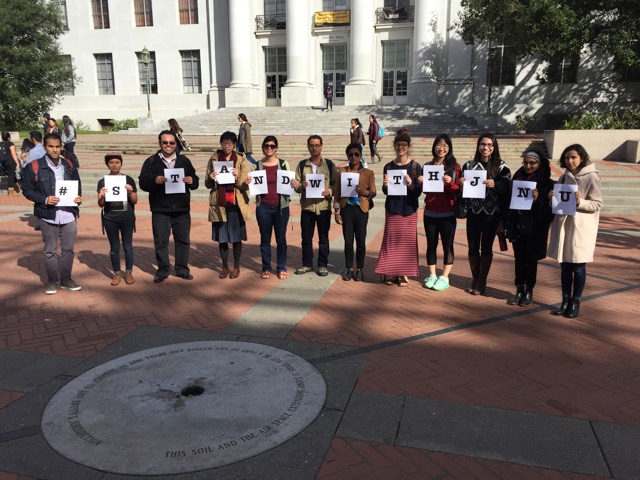
As The People’s Republic of New Delhi Marches in the Free Air Students of Berkeley #StandWithJNU

As the people of Delhi march, sing, run and dance to freedom’s call, as they cock a snook at the shackles of nationalism, casteism and authoritarian stupidity, a gift of love from afar. Look at them standing in the free air! Look at them standing around a piece of earth unbound from the myopia of nationalism!

BerkeleyStudents

“This soil and the air space extending above it shall not be a part of any nation and shall not be subject to any entity’s jurisdiction,”
 At the memorial to the 1964 Free Speech Movement on the campus of University of California, Berkeley, students and faculty stand in love and solidarity with JNU. #standwithJNU
 The memorial the 1964 Free Speech Movement at the University of California, Berkeley, like the thing it celebrates, is both invisible and embattled. The monument appears to be a circle of concrete six feet in diameter, in the middle of the famed Sproul Plaza where thousands of students gathered to demand the right to free speech and academic freedom on one of America’s most prominent and celebrated public university campuses. But that monument is so much more than what can be seen. The concrete circle, bearing the inscription “This soil and the air space extending above it shall not be a part of any nation and shall not be subject to any entity’s jurisdiction,” encompasses a 6-inch wide indentation into the ground that reaches into the soil below and 60,000 feet upwards into the sky, to the limits of American airspace. That is, in fact, the monument to free speech at Berkeley: 60,000 feet and 6-inches of invisible insistence that to speak freely is not and cannot be a right granted by any sovereign, mandated by any state. The width of the depression in the ground is as large as a person’s two feet. The ground on which they stand. From which they speak. This is the lasting monument to free speech at Berkeley. From a space as wide as our stance, reaching in an unseeable column of air to the limits of the stratosphere. A monument of air that can never, like free speech itself, be contained, torn down, or granted by another. It lies, unassuming, built as it is out of the immateriality of inalienable rights, in the middle of a campus that grapples daily with the legacy of that now 50 year old fight for the right to claim the space of the university as one of protest, of politics, of resistance.


But Berkeley, we mustn’t forget, exists on occupied territory. Its celebrated monument digs into soil that was taken, without recompense or acknowledgement, from the Ohlone people who were stripped of their lands, their language, their culture, and their lives in what America today celebrates as its great westward expansion. Thus, the monument to free speech at the University of California, Berkeley, roots itself into a soil it claims belongs to no nation and also reifies centuries of the genocide of indigenous people and of settler colonialism. This too is the legacy of the Free Speech Movement. Of the student-led activism that created Ethnic Studies programs across California and the rest of the United States. To stand in the 6-inch wide memorial is to stand in land that is occupied and to nonetheless believe that no occupation, no nation, no state, mandates our ability and our right to speak, to protest, to imagine otherwise the world in which we live.

From Berkeley to JNU. With love and solidarity.

Poulomi Saha

University of California, Berkeley

JNU Teachers Statement

After the arrest of JNUSU President Kanhaiya Kumar on 12 February and the entry of the police into JNU Campus, the situation has worsened for our students over the last few days. Sections of the mainstream and social media have carried unsubstantiated rumours targeting students, and organised groups have been making threats against them and indulging in hate speech in order to intimidate. The viciousness of this section of the media and amounts to a public trial and the frightening abuses being hurled at them make us feel deeply concerned for their personal safety and possibilities of their obtaining justice.

We strongly condemn these acts that create an environment of extreme prejudice and potential violence. We demand that the campus be allowed to return to normalcy at the soonest, so that students can return to their regular academic life in an atmosphere of trust and safety. The slander campaign against the University based on unsubstantiated claims not only tarnishes JNU’s image as one of best regarded institutions of higher education in the country, it also destroys JNU’s peaceful academic life. We are deeply concerned about the students’ future, which is being affected by this malicious campaign against JNU.

We the teachers of JNU wish that the Indian people should see through this orchestrated design to transform JNU into a space which will be unable to encourage or sustain critical thinking, so vital to the functioning of our democracy and our nation. It will also endanger the futures of thousands of students who are uncertain about the consequences that such a sustained campaign will have on their futures. We call upon the broadest possible sections of the Indian people to preserve the character of this much cherished national institution.

 C.P. Chandrasekhar

G. Arunima

Ayesha Kidwai

Udaya Kumar

Pratiksha Baxi

Chirashree Dasgupta

Saradindu Bhaduri

Rajat Datta

Vinay Kumar Ambedkar

Ranjani Mazumdar

Jayati Ghosh

Navaneetha Mokkil

Rohith Azad

Ameet Parameswaran

Joy Pachuau

Yashadatta Alone

Rajarshi Dasgupta

Mohan Rao

Vikas Bajpai

Sujatha V

Parul Mukherjee

Ramila Bisht

Surinder Jodhka

Happymon Jacob

Supriya Varma

Mallarika Sinha Roy

Parnal Chirmuley

Nivedita Menon

Hemant Adlakha

Lata Singh

Urmimala Sarkar

Rajib Dasgupta

Rama Baru

Prachin Ghodajkar

Vikas Rawal

Partho Datta

Papia Sengupta

Ira Bhaskar

Sandesha Rayipa-Garbiyal

Veena Hariharan

Pradipta Bandyopadhyay

Biswajit Dhar

Neera Kongari

Geetha Nambissan

Brahma Prakash

Brinda Bose

Maitrayee Chaudhuri

Rashmi Barua


Solidarity Statement from Writers and Activists in Nepal

We stand with JNU From Nepal

We are deeply concerned by recent developments in one of India’s premier academic institutions, Jawaharlal Nehru University. The fact that Mr. Kanhaiya Kumar, JNUSU president, has been arrested and accused of sedition for a speech meant to promote more meaningful dialogue on civil liberties and freedom to dissent is an attack on the freedom of expression,a universal value which ought to be at the heart of any center of learning.

The Indian state apparatus has come out aggressively to demean and dismiss an institution’s independent practice of scholarship. This should be a cause of concern, not only to the citizens of India, but to each individual who envisions a more equal and just society. Because the impulse to stifle dissent begins incrementally, but then it becomes a barrage, a torrent, and an avalanche until it smothers every differing voice. Such attempts at stifling any voice at all should be condemned unequivocally.

We, the signatories from Nepal as listed below, unequivocally condemn the oppression of dissent at Jawaharlal Nehru University. We condemn in the clearest terms the actions of the Indian state and non-state mechanisms that have shown alarming vigor towards silencing dissent and curbing free speech.

Manjushree Thapa, Writer

Khagendra Sangraula, Writer

CK Lal, Writer

Kishore Nepal, Writer

Hari Roka, Writer/JNU Alumni

Continue reading Solidarity Statement from Writers and Activists in Nepal

#NoDissentNoCountry #StandwithJNU

Bol ke labh azaad hain tere: Speak for your lips are yet free

Partha Chatterjee, Columbia University and CSSS Calcutta

A full Hindi transcript of Kanhaiya Kumar’s speech is available here:http://kafila.org/2016/02/15/jnusu-president-kanhaiya-kumars-speech-before-being-arrested/

A full English translation can be accessed here:http://www.telegraphindia.com/1160216/jsp/frontpage/story_69576.jsp#.VsVc8HQrK8r

#NoDissentNoCOUNTRY #StandwithJNU

Bol ke labh azad hain tere: Speak for your lips are yet free

Eleanor Newbigin, SOAS, University of London

A full Hindi transcript and video of Kanhaiya Kumar’s speech is available here:http://kafila.org/2016/02/15/jnusu-president-kanhaiya-kumars-speech-before-being-arrested/

An English translation can be accessed here: http://www.telegraphindia.com/1160216/jsp/frontpage/story_69576.jsp#.VsVc8HQrK8r

#NoDissentNoCOUNTRY #StandwithJNU

Bol, ke lab azaad hai tere: Speak for your lips are yet free


Akshaya Tankha (JNU 2006) University of Toronto

A full Hindi transcript and video of Kanhaiya Kumar’s speech may be found here: http://kafila.org/2016/02/15/jnusu-president-kanhaiya-kumars-speech-before-being-arrested/

A complete English translation may be accessed here:http://www.telegraphindia.com/1160216/jsp/frontpage/story_69576.jsp#.VsVc8HQrK8r

Statements of Solidarity For JNU From Various Quarters

We at Kafila have been receiving amazing statements of solidarity with JNU and its elected students’ President Kanhaiya Kumar over the past three days. We are posting them below, along with affiliations: South Asia University (teachers and students); Grinnell College, USA, Ambedkar University Delhi Faculty Association, Democratic Teachers Network, Hyderabad, and over a hundred students from Department of English, Delhi University.


STUDENTS OF SOUTH ASIA UNIVERSITY

We, the students of South Asian University, New Delhi (comprising of students from eight SAARC nations – Afghanistan, Bangladesh, Bhutan, India, Maldives, Nepal, Pakistan and Sri Lanka) strongly oppose the idea that one’s nationalism be defined in terms of hatred towards another nation (for example, Indian nationalism be defined as hatred towards Pakistan, or vice versa). We cherish the common cultural and social heritage of the South Asian region, and shall not let any kind of jingoist nationalism being endorsed by any religious group, political party or state hinder our shared solidarity. However, in recent times, such groups and establishments have unleashed an attack on democratic and critical voices in our universities across the South Asian region, masked under religious conformity, state intervention or sometimes in the form of an act of terrorism.

Thus, we stand in complete solidarity with the student and faculty community of Jawaharlal Nehru University (JNU) in their collective struggle against the ongoing police intervention by slapping the baseless charges of sedition on many students, including the arrest of JNUSU President – Kanhaiya Kumar, and against the massive propaganda terming the JNU as ‘a den of anti-nationals’. We would like to reiterate that our collective nationalism stands responsible only to the interests of our people and our land, and not to the divisive forces which have had and are still trying to create boundaries between us.

STATEMENT OF SOLIDARITY WITH STUDENT PROTESTS IN INDIA, FROM STUDENTS, FACULTY, AND STAFF OF GRINNELL COLLEGE

Grinnell-JNU Solidarity

Continue reading Statements of Solidarity For JNU From Various Quarters

On framing JNU for an imaginary crime: Aditya Sarkar

This is a guest post by ADITYA SARKAR

JNU has entered an indefinite state of siege. Police have been swarming all over campus, raiding hostels, picking up students and interrogating them. The ABVP, predictably, have been directing them to the lairs of ‘anti-national elements’. When immense demonstrations of public solidarity with the accused students were organized, ABVP activists have attacked these, in one case mounting a violent physical assault on a visiting speaker. The JNU administration has gone to the extent of cutting off the power supply to the microphones used at a protest meeting. At Patiala House on Monday the 15th of February, the BJP’s MLAs and what appear to be a group of lawyers have assaulted JNU students, faculty and supporters in full view of the police, with what can only be regarded as smug impunity. More than one observer has remarked that this is the Emergency all over again.

It is clear that the arrayed forces of the central government are pitted against a campus which has long been an object of hatred for the Right. There’s no telling how matters will develop in the days and weeks to come. So it might be necessary to step back a bit and consider the sequence of events that led to the current situation.

In the past month, JNU students organized a protest meeting which raised the issue of Kashmiri rights, and drew attention – just as Rohith Vemula’s protest in Hyderabad had done – to the execution of Afzal Guru in 2013. Since the mainstream news outlets systematically censor any attempt to reopen that extremely murky case, it’s worth reminding ourselves of precisely why the execution was so controversial. The terrorist attack on Parliament in December 2001 produced a police investigation on which serious doubt was cast from the beginning. Afzal Guru’s laptop and mobile phone, key pieces of evidence, had not been sealed prior to investigation. One of the other accused in the case, a Delhi University lecturer (who was later emphatically acquitted) was viciously framed by Zee News, which used the police charge-sheet to make a documentary ‘establishing’ his guilt. The court proceedings were even more revealing. The Supreme Court admitted that there was no hard evidence to conclusively establish Afzal Guru’s involvement in criminal conspiracy. But these admissions were merely qualifications to what was perhaps the most extraordinary decision in the history of the judiciary in independent India. Afzal Guru was eventually hanged in 2013 on the basis that only this would appease ‘the collective conscience of the nation society’.

Continue reading On framing JNU for an imaginary crime: Aditya Sarkar

JNU Bashing is an old pastime, but things just got much, much worse

In light of the glorious vigilantism being witnessed today, in which the lumpen lawyers at Patiala House are joining hands with Guardian of the Nation Horn-nob Go-Swamy on primetime TV A few years ago, finding myself in a heated but very enjoyable argument on why women change their surnames after marriage, somebody yelled from across the room, “What has JNU done to you?!”

I wasn’t surprised, only annoyed. Reducing my entire biography and political beliefs to an institution I attended once upon a time is a favourite pastime in India, when that institution happens to be JNU. I could have explained to the genius who shouted this that if I do have political opinions, neither were they surgically implanted in me at JNU nor will they wither away like the bourgeois state in Marxism if JNU ceases to exist. I should have been grateful that the JNU-phobia was posed through the formal courtesy of a query. Usually, it takes the form of a statement, “You JNU folk are all lunatics!”

In family settings, JNU-bashing is the preferred insult to shut down an argument, “It’s the JNU in you speaking!” At seminars, a question or a paper can be made illegitimate with the simple investigative exercise of determining if you’re from ‘a particular institution with a particular ideology’. Of course, the person asking the question has miraculously escaped institutions and ideology, remaining gloriously neutral in this fractured world.

Continue reading JNU Bashing is an old pastime, but things just got much, much worse