All posts by Aarti Sethi

I am an M.Phil student at the School of Arts and Aesthetics, JNU, New Delhi. This blog is meant to be a space for conversation with friends on my ongoing work on cinema and the city. And since all of you know me there not much else to say ;)

#NoDissentNoCountry #StandWithJNU

Williams College Stands with JNU!


http://https://www.youtube.com/watch?v=AQm_SvFKiJ4

Kajri Jain, University of Toronto


Aarti Sethi, (JNU 2009), Columbia University

A complete Hindi transcript and video of Kanhaiya Kumar’s speech is available here.

A complete English translation may be accessed here.

Rohith Vemula’s last note may be accessed here.

A Solidarity Poem for JNU from the Incarcerated Community of Philadelphia

A solidarity poem for Kanhaiya and the JNU protestors from the Center for Carceral Communities (a collective of current and previously incarcerated people and advocates in Philadelphia, housed at the University of Pennsylvania, USA).


we are with you kanhaiya

reaching out from our barred windows

all 2.5 million of US

we cross borders and seas

to smuggle in

wirecutters and metalfiles

and circuitbreakers

hidden deep

in these words and

outraged tears

we are with you

as you dance on this

multiheaded serpent

this global picture-in-picture-in-picture

of progress-in-democracy-in-prison-in-silence-in-fear

with you

shoulder to shoulder

as you scream over and over

abvpISobamaISbushISmodi

hand-in-hand with you

dear kanhaiya

as you christen

this revolution

with blood and urine

spilt in these corridors

of power

slick with the froth

of hindutva

with you always

as you stare down

this justice

turned

slippery and slick

and cold

until it is just / ice

Signed:


mouth

Alison Neff (Director, CCC)

Toorjo Ghose (Associate Professor, SP2, UPenn)

35 members of the CCC collective (who need to remain anonymous)

on behalf of

2.5 million who are currently incarcerated in the U.S. (who are forced to remain anonymous)


ALL INDIA LAWYERS UNION RAJASTHAN STATE COMMITTEE: Solidarity Message to JNU

ALL INDIA LAWYERS UNION RAJASTHAN STATE COMMITTEE

Dated:18.2.2016

SOLIDARITY MESSAGE TO JNU

All India Lawyers Union (AILU), Rajasthan State Unit, strongly condemn the recent incident where individuals in uniform of Advocates misbehaved and assaulted Mr. Kanhaiya Kumar, the president of JNU Students Union, JNU faculties, Media persons on 15.2.2016 when Mr. Kanhaiya Kumar was produced in court before the magistrate is very serious issue and it became vigorous when the incident was repeated after two days, on 17.2.2016 despite of the actions given byHon’ble Supreme Court.

Further the AILU is of the view that the Jawahar Lal Nehru University is one of the institutions in the world where healthy atmosphere is developed over a time to discuss over the national and international issues. The students as well as the faculty members thereof is of the caliber to suggest a visionary and logical culmination, which not only important for individual but also for the nation and humanity as whole. Furthermore, University is a place where new ideas are developed, questions are asked and policies are praised or criticized. If any unwarranted incident is happened in the campus of the university, certainly an action has to be initiated against the responsible individual and for such action the university administration is having sufficient measures to act upon and no police action inside the campus was required at all. If the university authorities failed to take action or has shown its inability to restrict such activity, only then the police force may be used.

As such the police action in the university campus was absolutely unwarranted, unjustified and abuse of power by the state machinery.

Arrest of Mr. Kanhaiya Kumar and other students and treating them like hardcore criminals/terrorists, in the name of sedation without any substantial evidence, is not expected in a civilized society. The crime of sedation was inserted in IPC by the British rule in order to supress anyone who used to speak against the colonial rule. This term ‘sedation’ is obsolete and has no place in a democratic system like ours, especially in the educational institutions, having international reputation. Framing students in the name of sedation is clearly an attack on the fundamental rights, that is, of speech and expression.

Intentional avoidance of the Hon’ble Supreme Court instructions is apparently an act of contempt of court for which stern action has to be taken. AILU strongly suggests to take following actions against the responsible :

(i) Criminal case has to be registered against the advocates or the persons in the advocates’ uniform indulged in assaulting within the court premises;

(ii) Separate proceeding of criminal contempt is to be started against the persons involved in assaulting despite instructions of Supreme Court;

(iii) The police personals deployed at the court campus, in front of whom the act of assault was occurred has to be suspended henceforth and inquiry has to be initiated against them;

(iv) Mr. Om Prakash Sharma, the sitting MLA, who was apparently involved in the assaulting and to instigate others to involve in assaulting, his membership of Legislative Assembly is to be seized, proceeding of criminal contempt is to be initiated against him;

(v) The courts are the place where people come with the deep faith to get justice but such type of incidents not only deprive the people to avail justice but also diminish the belief in rule of law, and therefore, stern action has to be initiated against each and every responsible person whomsoever he is;

(vi) Code of conduct for advocates has to be reviewed and it may be inserted that any advocate, who involves in such incidents occured on 15.2.2016 and 17.02.2016, shall be restricted to appear in court as well as seize their auth of advocacy;

(vii) The magistrate, before whom the repeated disruption of court proceeding was occurred but no action against the responsible advocates/persons was taken, no FIR was lodged, stern action is required to be initiated against him.

The AILU condemn both the incidents, i.e. abuse of power by the police administration in the JNU campus and omission to prevent the assault on the students faculties and media persons in the court room /campus of Patiala House court. Our organization also demands for immediate release of Kanhaiya Kumar, president of JNUSU, so that normalcy can be restored.

(Dr. Vikram Singh Nain)

General Sectretary

General Secretary: Dr. Vikram Singh Nain Advocate Mobile No: +91 9414069959 Office: 0141-2810959 E-mail: nain_vs@yahoo.co.in

President: Sanjay Tyagi Advocate Mobile No.+91 9414048493 +91 9314013492

8, Nagaur Nagar, Nr. Kisaan Dharam Kanta Gopalpura Bye-pass Road, Jaipur-302019

STATEMENT OF SOLIDARITY WITH STUDENT ACTIVISTS IN INDIA: University of Pennsylvania & Philadelphia South Asian Collective

We, activists and academics in the Pennsylvania region, strongly condemn the attack on academic freedom at Jawaharlal Nehru University (JNU), New Delhi. The arrest of Kanhaiya Kumar, the President of the JNU Student’s Union, on charges of sedition has brought to light the intervention of the Union Government in the internal matters of the university. The repeated interference by police personnel at the behest of Vice Chancellors on university campuses is a draconian move. The charges against students were brought after an event organized by a section of students on campus premises to discuss the judicial execution of Afzal Guru. The JNU Students’ Union was subsequently held responsible for the “anti-national” slogans that were chanted by a group of students. We condemn these trumped-up and unconstitutional charges and stand in solidarity with the efforts to repeal capital punishment in India.

The events unfolding at JNU reveal disturbing similarities with instances of government repression on other campuses. We remember, with distress, the actions of the University of Hyderabad (UoH) administration in cahoots with the Central Government, actions that led to the death of a promising Ambedkarite student-activist, Rohith Vemula. The protests that arose indicted the discriminatory atmosphere prevailing in our universities as tantamount to the denial of the fundamental right to education to socially marginalized groups. Further, the murder of social thinkers like Govind Pansare and M.M. Kalburgi by hyper-nationalist elements under the tacit encouragement of the policies of the Central Government has shocked all advocates of free speech in India.

The charges of sedition against students participating in democratic discussion of public events is highly objectionable. The stifling of voices through intimidation and muscle power does not bode well for educational institutions.

Debate and dissent are integral parts of a strong democracy. Universities are critical public spaces that support these democratic practices to realize the values of social justice enshrined in the ideals of the constitution. International campuses like JNU, FTII and UoH bring together diverse group of students in the spirit of self-reflexive and deep intellectual engagement to ask fundamental questions of their social realities. An attack on these institutions is an attack on this precious pedagogical space. Student movements in India in alliance with other social movements in the country have historically been a resilient and sensitive force. The BJP government’s efforts to undermine them is nothing but an assault on Indian democracy. The government has failed to protect the rights of student bodies, and the highhandedness of the police highlights the insecurities of the present government.

In the United States during a presidential election year, we watch increasingly bigoted views against blacks, Muslims, and immigrants gaining ground. These events cannot be seen in isolation and we stand at the intersection of socio-political movements in the US and South Asia.

We stand in solidarity with students and faculty of JNU and demand the immediate release of the detained students. We appeal to all advocates for academic freedom in India and abroad to stand united against this state atrocity.

  1. Anannya Bohidar, Graduate Student, South Asia Studies, University of Pennsylvania
  2. Ammel Sharon, Graduate Student, South Asia Studies, University of Pennsylvania
  3. Meghna Chandra, Philadelphia South Asian Collective
  4. Ania Loomba, English, University of Pennsylvania
  5. Projit Mukharji, History and Sociology of Science, University of Pennsylvania
  6. Najnin Islam, Graduate Student, English, University of Pennsylvania

Continue reading STATEMENT OF SOLIDARITY WITH STUDENT ACTIVISTS IN INDIA: University of Pennsylvania & Philadelphia South Asian Collective

Letter of solidarity with JNU: Students, Staff and Faculty, Ashoka University

We, the undersigned—who study and work at Ashoka University, as well as the alumni of the Young India Fellowship, in our private capacity—write to voice our solidarity with the students and faculty at Jawaharlal Nehru University (JNU). Recent events at JNU, including the arrest of the JNUSU President over the charge of sedition, as well as other disproportionate measures, amount to a deeply troubling attack on academic and cultural freedom. We strongly condemn the display of brute force by the police, who were given free entry to the campus, including hostels, to question, detain and arrest students and faculty members. We protest the lack of police protection to those students and faculty, and condemn the use of State force against democratic expressions of dissent.

As proponents of liberal education, we believe that societies can only grow when they foster intellectual engagement with fundamental social questions and contemporary political issues through non-violent debate and argumentation. University campuses are, and should be, autonomous spaces where people can peacefully express as well as challenge dissent and opinions. However, the recent spate of events involving many university campuses across the country has posed a serious threat to the sanctity of such spaces as well as the democratic right to dissent and freedom of speech and expression. This includes the turn of events that led to Rohith Vemula’s death at the University of Hyderabad, the withholding of grants by the Ministry of Human Resource Development to Panjab University, and several instances of violent disruption of the screening of the film Muzaffarnagar Baaqi Hai in campuses across the country.

We condemn the State-backed misuse of the charge of sedition, a colonial era provision in the Indian Penal Code, against the JNUSU President, Kanhaiya Kumar. In the documented absence of any allegedly ‘anti-national’ actions or rhetoric on his part, we see the charge as an attempt to stifle dissent from the dominant order and silence critique of the State. We strongly believe that the provision against sedition, which was repealed in the United Kingdom itself in 2009, has no place in modern democracy. Most immediately, we strongly disapprove of the action of certain lawyers and a Member of the Legislative Assembly who physically attacked JNU students and faculty members as well as journalists outside the Patiala Court House premises on 15th February, 2016.

We fear that the continued State inaction against such instances of violence will foster an environment in which the label “anti-national” or “traitor” can be imposed on every voice of dissent.

We urge that:

the JNU campus be restored to normalcy and the police be withdrawn from all parts of the campus.

the JNUSU President, Kanhaiya Kumar be released from police custody immediately and all charges be dropped against him.

such unconstitutional actions be denounced.

we be allowed to nurture our universities as tolerant, democratic spaces where dissent and disagreement is respected, discussions are nurtured, and critical thinkers are born.

Faculty

Ajit Mishra

Bhaskar Dutta

Malvika Maheshwari

Alex Watson

Debarati Roy

Mandakini Dubey

Anisha Sharma

Durba Chattaraj

Maya Saran

Anunaya Chaubey

Gilles Verniers

Nayanjot Lahiri

Anuradha Saha

Gwendolyn Kelly

Rajendran Narayanan

Aparajita Dasgupta

Jonathan Gil Harris

Ratna Menon

Aparna vaidik

Kranti Saran

Ravindran Sriramachandran

Arunava Sinha

Kunal Joshi

Saikat Majumdar

Aruni Kashyap

M A Ahmad Khan

Supriya Nayak

Pulapre Balakrishnan

Madhavi Menon

Vaiju naravane

Bharat Ramaswami

Malabika Sarkar

Vishes Kothari

Staff

Adil Shah

Kanika Singh

Shiv D Sharma

Aniha Brar

Karuna

Shreya Khedia

Anu Singh

Meena S. Wilson

Sudarshana Chanda

Anuja Kelkar

Mercia Prince

Suha Gangopadhyay

Charu Singh

Priyanka Kumar

Sukanya Banerjee

Chiranjit mahato

Sarah Afraz

Sushmita Nath

Dr Maaz Bin Bilal

Saumya Varma

Swarnim Khare

Harshita Tripathi

Saurav Goswami

Tanita Abraham

Ishan de Souza

Sayan Chaudhuri

Zehra

Sushmita Samaddar

Surya Raman

Sandeep Saraswal

Apoorva Gupta

Aditya Sarin

Chandan Sharma

Alumni

Aafaque R Khan

Kaavya Gupta

Rishi Iyengar

Akanksha

Kande Sruthi Niveditha

Ritesh Agarwal

Akshay Barik

Kaustubh Khare

Rohini Singh

Ananta Seth

Maansi Verma

Rupali Kapoor

Antony Arul Valan

Malini Bose

Sai Krishna Kumaraswamy

Anushka Siddiqui

Mayank Sharma

Sakshi Ghai

Ashish Kumar

Mrudula Nujella

Shahzaib Ahmed

Ashweetha

Neil Maheshwari

Shaleen Wadhwana

Avni Ahuja

Neelakshi Tewari

Shashank Mittal

Chaarvi Badani

Nikita Saxena

Shivangi Pareek

Danish Ahmad Mir

Nina Sud

Shrestha Mullick

Debanshu Roy

Nipun Arora

Shweta Subbaraman

Deepika Ghosh

Parushya

Simeen Kaleem

Devleena Chatterji

Pavithra Srinivasan

Simranpreet Oberoi

Dhaneesh Jameson

Poornima Sardana

Sonal Jain

Dhwani Sabesh

Pragya Mukherjee

Subhodeep Jash

Hardika Dayalani

Prama Neeraja

Tanuj Bhojwani

Harsh Mani Tripathi

Rahul Sreekumar

Taysir Moonim

Harsh Snehanshu

Rajat Nayyar

Vaishnavi Viraj

Himanshu Ranjan

Ratul Chowdhury

Venkat Prasath

Jahanara Rabia Raza

Rimjhim Roy

Vishal Khatri

#NoDissentNoCOUNTRY #StandWithJNU

As the People’s Republic of Delhi dances to freedom’s song, people from around the world liberate banned speech. Bol Ke Labh Azad Hain Tere!

http://https://www.youtube.com/watch?v=hZynKr4GF-I&feature=youtu.be

Divya Cherian, (JNU 2008) Rutgers University


http://https://www.youtube.com/watch?v=sEkVDcXH_l0

Dora Zhang and Damon Young, University of California, Berkeley


http://http://www.youtube.com/watch?v=EhwQAbFPr9Y

Greta LaFleur, Yale University

A full text of Kanhaiya Kumar’s speech and a video is available here:http://kafila.org/2016/02/15/jnusu-president-kanhaiya-kumars-speech-before-being-arrested/

A complete English Translation may be accessed here: http://www.telegraphindia.com/1160216/jsp/frontpage/story_69576.jsp#.VsMg17R97GL

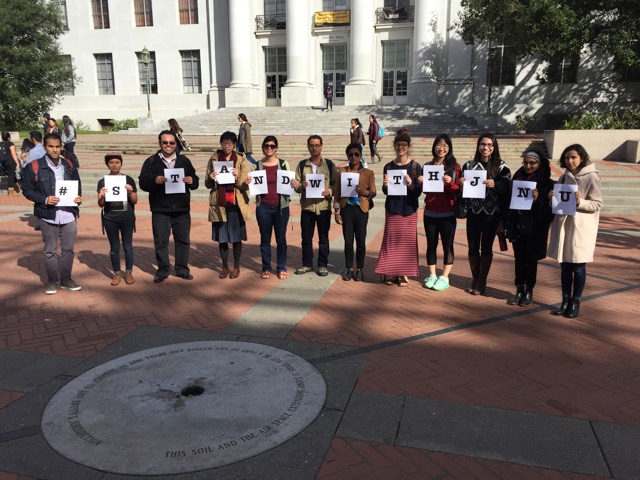
As The People’s Republic of New Delhi Marches in the Free Air Students of Berkeley #StandWithJNU

As the people of Delhi march, sing, run and dance to freedom’s call, as they cock a snook at the shackles of nationalism, casteism and authoritarian stupidity, a gift of love from afar. Look at them standing in the free air! Look at them standing around a piece of earth unbound from the myopia of nationalism!

BerkeleyStudents

“This soil and the air space extending above it shall not be a part of any nation and shall not be subject to any entity’s jurisdiction,”
 At the memorial to the 1964 Free Speech Movement on the campus of University of California, Berkeley, students and faculty stand in love and solidarity with JNU. #standwithJNU
 The memorial the 1964 Free Speech Movement at the University of California, Berkeley, like the thing it celebrates, is both invisible and embattled. The monument appears to be a circle of concrete six feet in diameter, in the middle of the famed Sproul Plaza where thousands of students gathered to demand the right to free speech and academic freedom on one of America’s most prominent and celebrated public university campuses. But that monument is so much more than what can be seen. The concrete circle, bearing the inscription “This soil and the air space extending above it shall not be a part of any nation and shall not be subject to any entity’s jurisdiction,” encompasses a 6-inch wide indentation into the ground that reaches into the soil below and 60,000 feet upwards into the sky, to the limits of American airspace. That is, in fact, the monument to free speech at Berkeley: 60,000 feet and 6-inches of invisible insistence that to speak freely is not and cannot be a right granted by any sovereign, mandated by any state. The width of the depression in the ground is as large as a person’s two feet. The ground on which they stand. From which they speak. This is the lasting monument to free speech at Berkeley. From a space as wide as our stance, reaching in an unseeable column of air to the limits of the stratosphere. A monument of air that can never, like free speech itself, be contained, torn down, or granted by another. It lies, unassuming, built as it is out of the immateriality of inalienable rights, in the middle of a campus that grapples daily with the legacy of that now 50 year old fight for the right to claim the space of the university as one of protest, of politics, of resistance.


But Berkeley, we mustn’t forget, exists on occupied territory. Its celebrated monument digs into soil that was taken, without recompense or acknowledgement, from the Ohlone people who were stripped of their lands, their language, their culture, and their lives in what America today celebrates as its great westward expansion. Thus, the monument to free speech at the University of California, Berkeley, roots itself into a soil it claims belongs to no nation and also reifies centuries of the genocide of indigenous people and of settler colonialism. This too is the legacy of the Free Speech Movement. Of the student-led activism that created Ethnic Studies programs across California and the rest of the United States. To stand in the 6-inch wide memorial is to stand in land that is occupied and to nonetheless believe that no occupation, no nation, no state, mandates our ability and our right to speak, to protest, to imagine otherwise the world in which we live.

From Berkeley to JNU. With love and solidarity.

Poulomi Saha

University of California, Berkeley

Solidarity Statement from Writers and Activists in Nepal

We stand with JNU From Nepal

We are deeply concerned by recent developments in one of India’s premier academic institutions, Jawaharlal Nehru University. The fact that Mr. Kanhaiya Kumar, JNUSU president, has been arrested and accused of sedition for a speech meant to promote more meaningful dialogue on civil liberties and freedom to dissent is an attack on the freedom of expression,a universal value which ought to be at the heart of any center of learning.

The Indian state apparatus has come out aggressively to demean and dismiss an institution’s independent practice of scholarship. This should be a cause of concern, not only to the citizens of India, but to each individual who envisions a more equal and just society. Because the impulse to stifle dissent begins incrementally, but then it becomes a barrage, a torrent, and an avalanche until it smothers every differing voice. Such attempts at stifling any voice at all should be condemned unequivocally.

We, the signatories from Nepal as listed below, unequivocally condemn the oppression of dissent at Jawaharlal Nehru University. We condemn in the clearest terms the actions of the Indian state and non-state mechanisms that have shown alarming vigor towards silencing dissent and curbing free speech.

Manjushree Thapa, Writer

Khagendra Sangraula, Writer

CK Lal, Writer

Kishore Nepal, Writer

Hari Roka, Writer/JNU Alumni

Continue reading Solidarity Statement from Writers and Activists in Nepal

#NoDissentNoCountry #StandwithJNU

Bol ke labh azaad hain tere: Speak for your lips are yet free

Partha Chatterjee, Columbia University and CSSS Calcutta

A full Hindi transcript of Kanhaiya Kumar’s speech is available here:http://kafila.org/2016/02/15/jnusu-president-kanhaiya-kumars-speech-before-being-arrested/

A full English translation can be accessed here:http://www.telegraphindia.com/1160216/jsp/frontpage/story_69576.jsp#.VsVc8HQrK8r

#NoDissentNoCOUNTRY #StandwithJNU

Bol ke labh azad hain tere: Speak for your lips are yet free

Eleanor Newbigin, SOAS, University of London

A full Hindi transcript and video of Kanhaiya Kumar’s speech is available here:http://kafila.org/2016/02/15/jnusu-president-kanhaiya-kumars-speech-before-being-arrested/

An English translation can be accessed here: http://www.telegraphindia.com/1160216/jsp/frontpage/story_69576.jsp#.VsVc8HQrK8r

#NoDissentNoCOUNTRY #StandwithJNU

Bol, ke lab azaad hai tere: Speak for your lips are yet free


Akshaya Tankha (JNU 2006) University of Toronto

A full Hindi transcript and video of Kanhaiya Kumar’s speech may be found here: http://kafila.org/2016/02/15/jnusu-president-kanhaiya-kumars-speech-before-being-arrested/

A complete English translation may be accessed here:http://www.telegraphindia.com/1160216/jsp/frontpage/story_69576.jsp#.VsVc8HQrK8r

Indian Scientific Community Letter to Jawaharlal Nehru University Vice Chancellor

This is a guest post by SUVRAT RAJU

Three hundred and seventy-nine Indian scientists and academics have written a letter to the Vice Chancellor of JNU expressing their dismay at the recent events there.

In the letter, the signatories express their “deep disappointment” with the actions of the JNU Vice Chancellor, and call on him to take “urgent corrective steps to ensure that the police releases the arrested students, and also to ensure that it drops the unsubstantiated charges against them.”

The list of signatories includes hundreds of scientists from the leading scientific institutions in the country. The fact that so many members of what is otherwise an apolitical community signed this letter within about 24 hours indicates the level of outrage that these events have generated.

Please see below a full text of the letter and a list of signatories.


16 February 2016


Prof. M. Jagadesh Kumar

Vice Chancellor

Jawaharlal Nehru University

New Delhi-110 067, India


Dear Prof. Kumar,

We are writing, as a group of academics, to express our deep disappointment with your actions in the events leading up to the arrest and detention of several students last week.

We understand that last Tuesday, a student group organized a rally to commemorate the death anniversary of Afzal Guru. The police alleges that some of the students voiced controversial opinions. The police then proceeded to arrest the president of the JNU Students Union, Kanhaiya Kumar, and charged him with sedition. This has been followed by a number of further detentions. What is most disturbing is that the JNU administration appears to have defended and aided these repressive actions by the police, rather than defending the students who were involved in a non-violent activity.

The arrest of the president of the JNUSU is especially troublesome since he was not even an organizer of the rally but merely present to express his solidarity. However, even as far the organizers and the speakers at the event are concerned, we hope that you recognize that expressing controversial views in a peaceful forum cannot be equated with sedition. For example, many people believe that Afzal Guru was let down by a lack of appropriate legal representation in his trial, and that his execution was therefore a grave miscarriage of justice. One may agree or disagree with this viewpoint — and, indeed, signatories to this letter hold different positions —  but we are unanimous that students should have the right to freely discuss this issue. This is such a basic pillar of academic ethics that we were dismayed by the statement made by the registrar of JNU, Mr. Bupinder Zutshi, who reportedly said “The government of India hanged him [Afzal Guru] after declaring him a terrorist. How could we allow them to organise an anti-Indian programme?” This indicates a complete lack of appreciation of the concept of academic freedom.

India is a vast country, and no one group can define what it means to be “nationalist” or “anti-national” is, in specific terms of positions to hold and causes to support. The country’s fabric is strong enough to accommodate a plurality of views. It is the attempt to suppress differing viewpoints that is genuinely damaging for the country’s democratic ethos. Further, we believe that creativity in all branches of knowledge  — surely in the interest of our nation — finds highest expression in a milieu that does not put constraints on the freedom of thought.

It is ironic that this attempt to suppress dissent occurred at one of the country’s leading Universities. A University is a site where contesting ideas are explored and where students should be able to freely debate and discuss various views, including controversial ones, without the threat of state action.

Senior members of the government have aggressively targeted your students. The JNU administration should have protected its students against these attacks and charges that have also vitiated the police investigation. We are deeply disappointed that you have failed to carry out this responsibility.

We hope that you will take urgent corrective steps to ensure that the police releases the arrested students, and also to ensure that it drops the unsubstantiated charges against them. We also hope that, in the future, you will take steps to protect freedom of speech on the JNU campus.

Continue reading Indian Scientific Community Letter to Jawaharlal Nehru University Vice Chancellor

SOLIDARITY STATEMENT BY JNU ALUMNI AND INTERNATIONAL ACADEMIC COMMUNITY

The statement below represents the concerns of JNU’s international alumni, and a wider global academic community of friends and comrades. The support demonstrated by the names below testifies that JNU is far more than a besieged university campus in India. JNU stands for a vital imagination of the space of the university – an imagination that embraces critical thinking, democratic dissent, student activism, and the plurality of political beliefs. It is this critical imagination that the current establishment seeks to destroy. And we know that this is not a problem for India alone. Similar attacks on critical dissent and university spaces are being attempted and resisted across the world.

If you would like to stand in solidarity with the students and faculty of JNU, and the ethos of university spaces everywhere, please mention your name and current institutional affiliation in the ‘Comments’ section. Also, in case you are a JNU alumnus, please mention the year you graduated. This list will be regularly updated.

****SOLIDARITY STATEMENT****

We, the undersigned, stand in solidarity with the students, faculty and staff of Jawaharlal Nehru University, New Delhi against the illegal ongoing police action since February 9, 2016. With them, we affirm the autonomy of the university as a non-militarized space for freedom of thought and expression. Accordingly, we condemn police presence on campus and the harassment of students on the basis of their political beliefs.

The charge of sedition, under the guise of which the police have been given a carte blanche to enter the JNU campus, to raid student hostels, arrest and detain students, including Kanhaiya Kumar, the current president of the JNU Students Union, is an alibi for the incursion of an authoritarian regime onto the university campus. Under Indian law sedition applies only to words and actions that directly issue a call to violence. The peaceful demonstration and gathering of citizens does not constitute criminal conduct. The police action on JNU campus is illegal under the constitution of India.

An open, tolerant, and democratic society is inextricably linked to critical thought and expression cultivated by universities in India and abroad. As teachers, students, and scholars across the world, we are watching with extreme concern the situation unfolding at JNU and refuse to remain silent as our colleagues (students, staff, and faculty) resist the illegal detention and autocratic suspension of students. We urge the Vice Chancellor of Jawaharlal Nehru University to protect members of the university community and safeguard their rights.


Dated/- 15 February 2016


  1. Asma Abbas, Bard College at Simon’s Rock
  2. Syed Shahid Abbas, Institute of Development Studies, Brighton, U.K.
  3. Gilbert Achcar, SOAS, University of London
  4. Katie Addleman, University of Toronto
  5. Barun Adhikary, JNU
  6. Aniket Aga, Yale University Continue reading SOLIDARITY STATEMENT BY JNU ALUMNI AND INTERNATIONAL ACADEMIC COMMUNITY

CPDR Statement on Maharashtra Cow Slaughter Ban

Committee for the Protection of Democratic Rights, Mumbai
THE MAHARASHTRA ANIMAL PRESERVATION (AMENDMENT) ACT, 1995
18 March 2015

As if the 1976 Maharashtra Animal Preservation Act banning the slaughter of cows, including the male and female calf of the cow, enacted by the Shankarrao Chavan-led Congress government during the Emergency was not enough, the Devendra Fadnavis-led Bharatiya Janata Party-Shiv Sena government is elated that the 1995 Maharashtra Animal Preservation (Amendment) Act, enacted by a previous BJP-Sena led by Manohar Joshi, that extends the ban to include slaughter of bulls and bullocks, has now received presidential assent. Despite the BJP’s claims justifying the ban on agro-economic grounds, among others, the driving force behind the prohibition is the ideology of Hindutva, presented as “a way of life” rooted in the central beliefs of neo-Vedantic Hinduism, of which cow slaughter and beef eating are supposedly anathema.

Continue reading CPDR Statement on Maharashtra Cow Slaughter Ban

A Daughter’s Plea For A Better Way to Die: Gowri Parameswaran

This is a guest post by Gowri Parameswaran on behalf of her mother Sulochana

“Life changes in the instant, the ordinary instant” wrote Joan Didion in her book The Year of Magical Thinking. Didion wrote about her attempts to cope with her husband’s death and her reference was to the moment of his passing. I had picked up the book in JFK and had completed it by the time I reached Chennai. I needed the sustenance that the book seemed to offer; I was coming to see and take care of my mother (Amma we called her) who had been admitted to the hospital with decompensated lungs for the third time in two months. Her heart was too sluggish to pump her blood through the arteries and the fluid had backed up into her lungs; her lungs were decompensated. I remembered the ominous prognosis that one book on Heart Failure had spelled out about this turn of events in her health – that this was a seminal indication that the heart had reached the end of the road. She seemed so normal when I left her in October. The doctor had pronounced her heart healthy under the circumstances.

“Life changes in the instant,

The ordinary instant”. Continue reading A Daughter’s Plea For A Better Way to Die: Gowri Parameswaran

The deadly land policies planned by Modi’s advisers and the links to Ukraine and Honduras: Aditya Velivelli

This is a guest post by ADITYA VELIVELLI

One year after the Land Acquisition Act was passed in Parliament with bipartisan support, commerce minister Nirmala Sitharaman stated that changes will be made to the Act during the upcoming Winter Session of Parliament.

The earliest indication that this would happen, came from of all people, a first-time MP and microfinance lobbyist Jayant Sinha. Sinha had mentioned in a CNBC interview right after BJP’s win that land acquisition policy was the first priority. For those wondering why CNBC interviewed Sinha and allowed Sinha to lay out the new Government’s priorities, and why Sinha has been appointed junior finance minister, they should refer – Who is guiding Modi’s economic thinking and what is their background? Continue reading The deadly land policies planned by Modi’s advisers and the links to Ukraine and Honduras: Aditya Velivelli

“Haider” – Hamlet in Kashmir: Suhas Munshi

This is a guest post by SUHAS MUNSHI

The challenge of telling stories of a conflict is its victims. Each, traumatized in their own way, needs their own story. The narrator is bound to fail not only those he didn’t include but those who didn’t see their stories recreated faithfully. Had Basharat Peer set himself the task of faithfully adapting the violence done to Kashmiris he would have had to script a pornographic narrative for the screen. Some of the bile directed at him from Kashmiris comes from a dissatisfaction of not depicting the true extent of the brutality of the Indian army and rendering its casualties adequately pitiful. An opinion piece written on the movie in ‘The Parallel Post’ titled ‘Setting the wrong precedent’ condemns torture scenes in the movie as having actually undermined the actual extent of army atrocity in Kashmir. The piece goes on to say, ‘army excesses wane out by the time movie reaches its climax.’

However, the only service that a story teller from Kashmir could do to art and to humanity is to depict the people living there, especially the victims, as humans; as people, just as they are found anywhere else in the world, and not continue to peddle the cliché of the valley being a dehumanized pastoral paradise. Accusations of betrayal, conceit and condescension are being hurled at Basharat Peer, the writer, when he has got, for the first time ever, the words ‘plebiscite’, ‘half-widows’ and the rousing call of ‘Azadi’ in a script, through a movie, on mainstream cinema. Continue reading “Haider” – Hamlet in Kashmir: Suhas Munshi

On The Real Tragedy of Secular Modernity: Anand Vivek Taneja

This is a guest post by ANAND VIVEK TANEJA

anandpost

In the discussion around Aarti Sethi’s essay on Remembering Maqsood Pardesi some very important questions arose. As these questions are directly relevant to my work, but also to the larger concerns of the Kafila community, I decided to dwell on them at some length. As these reflections were written in response to the comments of one particular person, I address him directly in what follows below.

Dear Imtiaz,

In your comments on Aarti’s essay, you say the following things about my work:

The tragedy of secular moderns of India is their fascination with Islam… And it appears secular modern Hindus are too busy analyzing jinns of Delhi, which is really sad!

… what do I do with the knowledge of emerging liberal ideologues working for the empire writing enchanting texts about chattan baba or the jinns?


I think that your opening statement is profound. But to understand its true depth, we need to revisit the terms “secular”, and “modern”, as well as our understandings of “Hinduism” and “Islam.” As an entry point into these questions, I will address your (rhetorical) question about what one should, and can do with “enchanting” texts about jinns. Continue reading On The Real Tragedy of Secular Modernity: Anand Vivek Taneja

Towards a Rational Literacy – Education and Beyond: Shivali Tukdeo

[Anyone who is familiar with the writings and positions of various Kafila authors will see, we do not subscribe to or share many of the views expressed by Shivali Tukdeo in this essay. Several of us have our own fairly strong critiques of the processes of colonial and post-colonial knowledge formation which condemned a whole host of practices, and the lifeworlds in which they were located, as “andhvishwas”. However there is also a simultaneous extremely interesting history of efforts at the inculcation of a “rational temperament” that used emergent discourses of science and modernity to question traditional hierarchies of caste and so on. Maharashtra is an especially vibrant locale for such experiments and their location within long histories of oppressed caste mobilizations. Recent violent assertions by the Hindu Right on the grounds of “tradition”, as evidenced in the tragic murder of Dr. Dabholkar, further complicate the terrain within which these questions arise. So we are carrying this essay as an offering and opening to what we hope will be a spirited conversation around reason, science and faith of all varieties – andh, kana and trilochan. AS]

This is a guest post by SHIVALI TUKDEO

In what can only be termed as an ultimate irony and deep embarrassment, the Maharashtra police allegedly resorted to relying on planchet tricks of a self-claimed god-man to investigate the brutal murder of Dr. Narendra Dabholkar, a rationalist and organiser of Andhashraddha Nirmoolan Samiti (ANS)—Committee against Eradication of Blind Faith[i]. The ‘supernatural intervention’ in this high-profile murder case is painfully damaging, no doubt; however, it is neither an isolated instance nor is it confined to the police department alone. As reportage in the aftermath of the case reveals, police departments routinely subscribe to such practices. Moreover, the widespread practice of offering prayers to Thirupathi before a space launch or the decision to conduct excavation based on a Sadhu’s dream aptly illustrate the powerful hold superstitions have. Such instances also point to the deep and long standing crisis in India’s education. Continue reading Towards a Rational Literacy – Education and Beyond: Shivali Tukdeo

Remembering Maqsood Pardesi

Shiite_Calligraphy_symbolising_Ali_as_Tiger_of_God

On 23rd September 2014 Maqsood Pardesi lost his life. He had gone to the National Zoological Gardens in Delhi to meet a tiger. The tiger killed him. He was 20 years old. Maqsood worked as a daily wage laborer and lived with his family under the Zakhira flyover in central Delhi. He is survived by his father Mehfuz Pardesi, his mother Ishrat, his brother Mehmood and his wife Fatima.

There are conflicting reports as to how Maqsood found himself en face a tiger. Several reports state that, despite being discouraged by a guard on two occasions, he managed to climb into the tiger’s enclosure when the guard’s attention wavered. Some reports suggest that he accidentally fell into it. The authorities have vigorously denied the possibility of accidental entry and contested the assignation of blame on the zoo, or the tiger, for Maqsood’s death. Other reports have dwelt on Maqsood having a history of mental illness. Some state that he was drunk when he entered the enclosure. Some claim that he threw stones at the tiger, lost his balance and fell. Like the dissection of Maqsood, there has been speculation about Vijay, the tiger. The zoo authorities defend against charges that Vijay is aggressive. The tiger is not at fault many say: how can it be held responsible for the death of a man who enters its enclosure? The head zoo keeper has said, “Maqsood was mentally unstable otherwise why would a sane person jump into the tiger’s enclosure.” Why indeed? Continue reading Remembering Maqsood Pardesi

Let the flower bloom in Jadavpur: Arindam Majumdar

This is a guest post by ARINDAM MAJUMDAR

Last week the columns of many newspapers took a comprehensive look at the imbroglio that has gripped Jadavpur University and concluded that the movement was a backdoor attempt by the beleaguered Left to crawl its way back into the political arena of the state. In doing so, they have unwillingly lend political colours to a movement that has been a silver lining amidst the dark cloud of indecency that has almost but killed the political environment of Bengal, once revered for its Bhadrolok culture and statesman leaders.

Student unrest in college campus is not a new phenomenon in Bengal. This community has always been politically aware and has not hesitated to stand up against any form of oppression or state sponsored violence. In the 1960s when the US forces invaded Vietnam, cries of Amar naam, tomar naam, Vietnam echoed in the anti-war demonstrations in the streets of Kolkata and the students were at the forefront of it. During the heydays of Naxal movement in 1970s, college students, including that of Jadavpur University, participated in the bloody street battles of Kolkata. This author does not intend to dwell on the motives behind those violent days, but it cannot be denied that brilliant students left behind their secure career and dreamt of turning a system, that they considered as oppressive, upside down. Continue reading Let the flower bloom in Jadavpur: Arindam Majumdar