All posts by Aditya Nigam

A Theatre Olympics that Isn’t: Arundhati Ghosh

Guest post by ARUNDHATI GHOSH

Image courtesy Deccan Herald

I have been working for the past 16 years with a small organisation called India Foundation for the Arts (IFA) that attempts to support arts and culture projects across the country. In these years I have been fortunate enough to travel across the country to big cities and small ones, towns and villages where arts practitioners and scholars work intensely, passionately, with almost no economic resources or social acknowledgements. The percentage of our total national budget outlay to the arts and culture is negligible as is the amount that finally gets spent on it. The state of our national arts and culture institutions is abysmal and much has been written by eminent experts critiquing the vision, mandates, policies and mechanisms of funding or the lack of any of these prerequisites to support the sector with an imagination that attempts to build a robust, vibrant ecology for the arts.

Continue reading A Theatre Olympics that Isn’t: Arundhati Ghosh

No your lordship, everybody opposing Aadhar is not following an“NGO line”: Baidik Bhattacharya

Guest post by BAIDIK BHATTACHARYA

We live in strange times. A judge in the country’s Supreme Court believes anyone challenging the government’s decision to impose Aadhar-based surveillance regime is following an “NGO line.” Another judge wonders in the court whether “one nation one identity” is not the necessary path forward. Soon, one wonders, if any opposition to surveillance, and any resistance to being spied upon by the state, will be deemed anti-national not only by the government but also by our top judiciary.

Since the hearings on the various anti-Aadhar pleas are being heard in the Supreme Court, and since such inconsiderate observations are being made regularly, let us look at a few problematic aspects of the biometry-based Aadhar idea itself—not only the technical glitches and possible misuses (of which there are many), but the central philosophy that underlines the state’s eagerness to bring every citizen under one biometric identity.

Continue reading No your lordship, everybody opposing Aadhar is not following an“NGO line”: Baidik Bhattacharya

Adam, Eve, Art – Neither Belief Nor Unbelief: Prasanta Chakravarty

Guest post by PRASANTA CHAKRAVARTY

Stephen Greenblatt has struck upon a sheer and stupendous idea: to retell the tale of the first couple of the Christian world, Adam and Eve. The Rise and Fall of Adam and Eve is a sweeping work with a remarkably ranging scholarship, galloping through centuries in minutes. The tone and the expanse of the book successfully hide the vertical depth of laborious research that has gone into bringing such an ambitious endeavour into culmination.  This is also a book of reliving an ancient art: the bare act of telling a story, holding up the full panoply of its rich narrative contours. The book jauntily speculates as much as it reveals. The very subject matter allows Greenblatt to do so. But there is yet another dimension to this project— a life-long, intense personal engagement with the idea of how conscious human intervention may have altered man’s relationship with whatever is cosmic, mythical and animistic. To that end it is also an ideological book that tells the story of Adam and Eve as it tries to grapple with our modern condition.

Continue reading Adam, Eve, Art – Neither Belief Nor Unbelief: Prasanta Chakravarty

Defend Constitutional Values, Save Hinduism from Hindtuva: For Civil Servants and Armed Forces Veterans

On 30 January 2018, retired civil servants and veterans of the armed forces jointly organised a conclave on ‘Hinduism and Hindutva’ at the Indian Social Institute, New Delhi. The conclave attended by over hundred participants, emphasized the need to rescue both Hinduism and the Indian Constitution from the clutches of the political project that calls itself Hindutva, and which has nothing to do with religion as such. The participants at the conclave sought to make a plea for saving Hinduism without making any concessions to the monstrosity of caste oppression, which in the spirit of many earlier reformers, they rejected.

This conclave followed an earlier one on ‘A Fractured Polity: The
Relevance of Gandhi Today’ organised on 10 October 2017, which had been
addressed by Justice A P Shah, Mrinal Pande and Ramachandra Guha. The
speeches are available on YouTube (Justice A.P. Shah, Mrinal Pande,
Ramachandra Guha). These civil servants and veterans have also raised severe
concerns about the present situation in a series of open letters over the last few
months: on vigilantism and hyper-nationalism; the suspicious death of Justice
Loya; and violence and discrimination against minorities in India. (See: Retired
Civil Servants open letter – 10 June 2017, Armed Forces Veterans open letter –
30 July 2017, Retired Civil Servants Letter 02 December 2017 – Enquiry into
Judge Loya’s death, Armed Forces Veterans letter to Supreme Court & Bombay
High Court on Judge Loya’s death, Retired Civil Servants open letter – 28 January
2018).
Continue reading Defend Constitutional Values, Save Hinduism from Hindtuva: For Civil Servants and Armed Forces Veterans

कासगंज हिंसा- तिरंगे को हड़प जाएगा भगवा? वैभव सिंह

Guest post by VAIBHAV SINGH

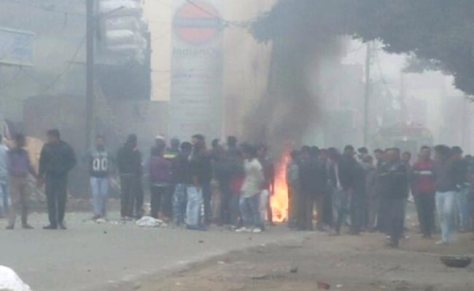
kasganj-uttar-pradesh-violence, image courtesy ndtv

पूरे हिंदी क्षेत्र में और विशेषकर उत्तरप्रदेश में ऐसे बडे, छोटे और मंझोले किस्म के नेताओं की बड़ी फौज पैदा हो गई है जिसकी नेतागिरी केवल सांप्रदायिक नारे लगाने और समाज में सांप्रदायिकता फैलाने पर टिकी है। सार्वजनिक जीवन पर इन संकीर्ण सोच वाले हिंदुत्व नेताओं की निरंतर मजबूत होती पकड़ ने सांप्रदायिक हिंसा को ‘न्यू नार्मल’ के रूप में मान्यता दिला दी है। हिंदू धर्म को कलंकित करने में इस नए जमाने के हिंदुत्व की क्या भूमिका है, यह अब किसी से छिपा नहीं है। एक समय था जब समाज पर समाजवादी और गांधीवादी विचारों के प्रभाव के कारण सांप्रदायिकता का सामना करना अपेक्षाकृत कम मुश्किल काम था। पर इन विचारधाराओं का प्रभाव कम हो जाने से सांप्रदायिक नेताओं-समूहों का तेजी से विस्तार हो रहा है। एबीवीपी, विहिप, हिंदू युवावाहिनी और बजरंग दल जैसे संगठन सामाजिक-राजनीतिक जीवन के पूरे परिदृश्य पर हावी हो चुके हैं।अक्सर साधारण परिवारों के युवक इन संगठनों की चपेट में इसलिए आ जाते हैं क्योंकि सांप्रदायिक संगठन समाज सेवा के मुखौटे के भीतर रहकर अपना काम करते हैं। वे दिखावे के तौर पर ब्लड डोनेशन या स्वच्छता मिशन या फिर शहीदों के सम्मान जैसी गतिविधियां करते हैं पर उनका असल मकसद समाज में सांप्रदायिकता का विचारधारा का विस्तार करना होता है। मुस्लिमों में भी सांप्रदायिकता है, पर वे उस प्रकार से संगठित सांप्रदायिकता को व्यक्त नहीं कर रहे हैं। Continue reading कासगंज हिंसा- तिरंगे को हड़प जाएगा भगवा? वैभव सिंह

A Revolution Called Chandrashekhar Azad ‘Ravan’ – the Republic on Trial

देख ज़िन्दां के परे, रंग-ए-चमन, जोश-ए-बहार

रक्स करना है तो पॉंव की ज़ंजीर न देख – मजरूह सुल्तानपुरी

Look –  beyond the the prison walls, the brilliance of flowers, the vitality of spring

If you must dance, ignore the chains that bind your feet – Majrooh Sultanpuri

Today, the scared Republic that has imprisoned its young idealistic fighter son, Chandrashekhar, is on trial. The Republic, scared of its own offspring, stands in the dock. This Republic Day, we must all answer how it came to pass that a gang of adventurers and marauders simply took it over, submitted it to their command, while all the elderly, wise men and women, watched. Today, when the Republic bondage we must seek answers from all those who watched helplessly – or self-righteously – as marauders took it over.

It is official now. A radiogram from the Deputy Secretary, Home, Govt of Uttar Pradesh to the Superintendent, Saharanpur District Jail, dated 23 January 2018, confirms the slapping of charges under the National Security Act, on Bhim Army founder, Chandrashekhar Azad ‘Ravan’. Pradeep Narwal, Coordinator, Committee for the Defence of Bhim Army, who met Chandrashekhar in jail yesterday, underlined how the Karni Sena activists attacking school buses and vandalizing schools were being allowed the freedom to do so while Chandrashekhar, responsible for setting up and running of schools (see the video below), is being held in jail for months and has now been slapped with charges under NSA. “Karni Sena are apparently deshbhakts and Shekher bhai and Bhim Army are ‘terrorists’ in the perverted logic of this government,” he said.


In conversations with friends and sympathizers who have been meeting him over the past months, including Pradeep Narwal, Chandrashekhar ‘Ravan’ has been expressing a fear that many of us have also had, independently, for some time now: that the government wants to actually get rid of him – just as judge Loya was, it now transpires. Continue reading A Revolution Called Chandrashekhar Azad ‘Ravan’ – the Republic on Trial

The Meaning of Jignesh Mevani

[A shorter version  of this article was published in The Wire on 18 December. I thank K. Satyanarayana, P. Sanal Mohan and Jangam Chinnaiah for their very helpful comments on it, which have helped me to clarify and elaborate on certain points.]

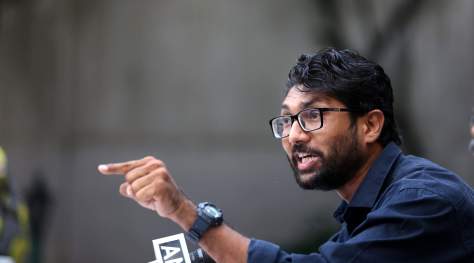
Jignesh Mevani, image courtesy New Indian Express

The rise of Jignesh Mevani constitutes a significant landmark in the political configuration in which the Congress has risen, despite itself, from a state of utter disarray to become the point of articulation for a possible political realignment in the near future. The process of political reconfiguration had already begun as a very significant section of the powerful patidar community, long understood to be the bedrock of the BJP’s social base in the state, had broken away from it. But alongside this, the rise of the young leaders Hardik Patel, Alpesh Thakore and Jignesh Mevani together produced the new young face of emergent Gujarat.

There is no doubt that the vacuum that characterized the space where the opposition should have been, no longer exists. The masthead of a new opposition formation is evident on the horizon. This turnaround in the fortunes of the Congress would not have been possible without the re-alignments in the non-electoral arena, facilitated in no small measure by the rise of this young leadership.

Continue reading The Meaning of Jignesh Mevani

The Indian Constitution too was Demolished Along With Babri Masjid 25 Years Ago

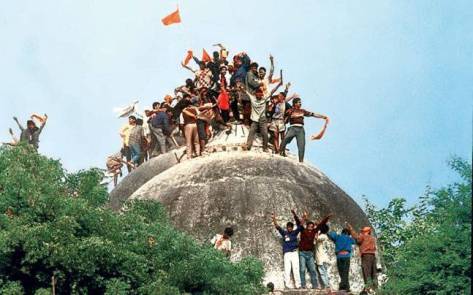
Twenty five years ago, on 6 December 1992, the structure of Babri Masjid was brought down by a mob of vandals, presided over by the top leadership of the BJP/RSS/VHP, as the Congress government led by prime minister Narasimha Rao looked on benignly. As did the Supreme Court before which a commitment was made by the Kalyan Singh (BJP) government in Uttar Pradesh – to the effect that nothing would be allowed to happen to the structure of the mosque.

Journalist Sajeda Momin, covering the demolition, recalls the scene thus,

I can still see the thousands of saffron-clad ‘kar sevaks’ clambering atop the 16th century mosque and pounding it with shovels, iron rods, pickaxes and anything they could lay their hands on. I can hear the screeching of Sadhvi Uma Bharti egging them on shouting “ek dhakka aur do, Babri Masjid tod do” through the microphones from atop the specially-built watchtower for the BJP/RSS/VHP leadership. I can visualize the three domes of the mosque collapsing inwards one by one at intervals of roughly an hour on that cold, wintery Sunday afternoon.

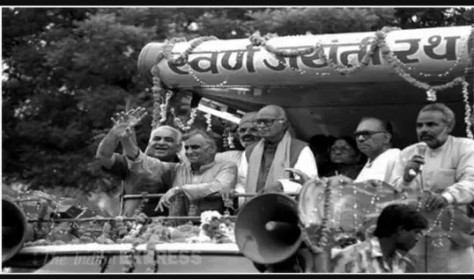
Everyone knew who were the dramatis personae at each level – and practically every bit of evidence that would ever have been required exists, captured in videos and photographs. Our present prime minister was said to be  one of the key organizers of the of the Rath Yatra that led up to the demolition and can be seen holding the microphone in his  hands in the photograph below.

Rath Yatra – precursor to the demolition, image courtesy Quora.com

Worse was to follow the demolition. The  demolition of the structure of the mosque was over that day but the process of the demolition of the Indian Constitution that had begun with what was called the ‘Ram janmabhoomi movement’ continued. By ‘Constitution’ I do not simply mean the book that embodies the law of the land but rather the very weave that came to constitute Indian society as a result of the new contract that the document called the Constitution embodied. Constitution, therefore in a triple sense. The document called the Constitution too was not merely a book of laws; it was rather, the only existing, largely agreed upon, vision of a modern India. It was a vision which was put in place through the long process of struggles, debates and contestations over the long decades of the anticolonial movement and finally given shape in, in the Constituent Assembly. There was nothing benign or innocuous about it – every bit of it had to be achieved through a fight. And yet, in the end, that was the document that embodied the vision of modern India. The only political current that stood far away from both the anticolonial struggle and had no role in the creation of this vision is the political force that rules India today.

The RSS and its numerous offshoots were neither fighting the British nor joining in the anti-caste and anti-untouchability struggles through the period since they came into existence in the mid-1920s. No wonder leaders of the Sangh combine think the anti-colonial/ national struggle was about cow-protection. That they neither subscribed to the anti-British agenda nor to the anti-caste agenda around which struggles of that period took shape, is not just a matter of historical record but is also visible in the way its leaders and ranks conduct their politics today. Every single step taken by the Sangh leaders is a step out of sync with the vision of the future spelt out by the social contract of modern India. That the Sangh attributes this vision to the Congress is an expression of its own illiteracy about the diverse forces in struggle throughout that period.

Even though it is conducted in the name of Hindus, there is nothing ‘Hindu’ about its agenda. Sangh and Sanghism is the name of a malignant political machine that seeks to destroy the very body of society in the name of an ancient past. That is the political machine we confront today. That is the political machine that we must fight today with all our vigour.

What’s in a Name? The Demolition of ‘Babri Masjid’, the Name and the Mosque: Hilal Ahmed

Babri-Masjid – Before the Demolition, image courtesy Tehelka.com

The gradual erasure of the words ‘Babri Masjid’ from our everyday memory actually began in 1986, when the Hindu community was granted the exclusive right to worship there. This happened without any regard ownership disputes the and illegal conversion of this mosque into a temple in 1949.

This story of the dispute itself is disputable. It is imperative to revisit three interesting moments, which no one talks of these days.

The 1949 moment

On the night of 23 December 1949, a group of local Hindus entered the mosque and installed the idols of Lord Ram inside it. Although the police filed an FIR in which the building is clearly defined as a functional mosque, the local administration took charge of the building, and without removing the idols from the mosque space, declared it a legally “disputed site”. Read the full article here


‘Revolution against Das Kapital’ and the ‘Lonely Hour of the Economy’

This is a modified version of the article that was published earlier in The Wire

(T)he economic dialectic is never active in the pure state; in History, these instances, the superstructures etc – are never seen to step respectfully aside when their work is done or, when the Time comes, as his pure phenomena, to scatter before His Majesty the Economy as he strides along the royal road of the Dialectic. From the first moment to the last, the lonely hour of the ‘last instance’ never comes. – Louis Althusser, For Marx, London: Verso 1979, p. 113

The event known to the world as the ‘October’ revolution in Russia – or simply as the ‘Russian revolution’ – took place on 7-8 November, a hundred years ago. But then why call it the October revolution? Thereby hangs a tale – the tale of modernity, myth-making and of a new imagination of Time.

The moment of revolution, image courtesy libcom.org

As a matter of fact, the Revolution occurred on 25-26 October, according to the Julian calendar (so called because it had been promulgated by Julius Caesar), which Russia, along with a large part of the Western world, followed at that time. It was only in January 1918 that the Soviet government decreed the shift to the Gregorian calendar. The reason was that Russia should join ‘all cultured nations in counting time’, as a decree cited by historian Mark Steinberg put it. Accordingly, the first anniversary of the revolution was celebrated on 7 November 1918 throughout the Soviet Union.

What is interesting here is not so much the shift but the reason assigned for it – joining other ‘cultured nations’ of the world, which in the language of the early twentieth century meant only one thing – the modern West, which had long been setting the norm for everything desirable. Ways of ‘counting time’ too had to be aligned with Europe, lest one be considered insufficiently modern. Spatially, the Czarist Russian empire straddled both Europe and Asia, which had already, in the new reckoning of Time, been cast as ‘advanced’ and ‘backward’ respectively. The desire to become modern and join the ‘cultured nations’ was to run through the history of the revolution and its consolidation into the new Stalinist state. This desire was to be manifested in its deep distrust of the peasantry and rural life on the one hand, and in the frenetic drive to ‘catch up’ with Western Europe. As Stalin would say, he wanted to accomplish in a couple of decades what Europe had in a few centuries, compressing time, as it were, into one dizzying experience for entire society. The continuing ‘past’ had to be annihilated.

Continue reading ‘Revolution against Das Kapital’ and the ‘Lonely Hour of the Economy’

Revoke NSA Charges against Chandrashekhar of Bhim Army: Committee for the Defense of Bhim Army

The Committee for the Defense of Bhim Army has released the following statement against framing of Chandrashekhar Azad ‘Ravan’ under NSA

Committee for the Defense of Bhim Army


#StandWithChandrashekharAzad


PRESS RELEASE

4 November 2017

The Committee for the Defense of Bhim Army (CDBA) expresses it shock at the act of the Uttar Pradesh government and the Saharanpur district administration in slapping charges under the National Security Act on Bhim Army founder President Chandrashekhar.

It is telling that the NSA was slapped against Chandrashekhar after the Allahabad High Court gave him bail on 2 November after a long legal battle. The High Court had observed while granting bail to Chandrashekhar and three other Bhim Army activists that the charges were politically motivated.

It appears that the decision of the district administration to book Chandrashekhar under NSA was taken a long time back and the government and local administration were keeping their options open about when exactly to move in this direction. Around 6-7 September, Chandrashekhar had already written about this in a hand-written letter from prison, addressed to his comrades, friends and well wishers of the Bhim Army. He had mentioned that he had learnt from sources in the jail that the administration (and state government) did not want him to fight for his bail, and if he did, they would book him under NSA. This information and Chandrashekhar’s letter was shared by the CDBA in its press conference held in Press Club, in New Delhi on 12 September 2017.

The decision to invoke the NSA now, immediately after Chandrashekhar and others were granted bail by the High Court proves that the information put out by Chandrashekhar in early September was correct and that the decision is mala fide.

We consider that the UP government and the district administration is invoking the NSA to delay, if not actually circumvent the judicial process and thus keep Chandrashekhar in prison as long as possible – even though they know that these charges cannot be sustained in the court of law.

This step by the Yogi Adityanath government, we believe, is in keeping with its consistently anti-Dalit attitude and its attempts to keep its upper caste support intact. The increasing attacks on Dalits with complete impunity has, in fact, now become a hallmark of BJP governments everywhere in the country.

The Committee for the Defense of Bhim Army calls upon all democratic forces to raise their voice against this monstrous decision to frame Chandrashekhar. The attack on Bhim Army and Chandrashekhar and his comrades is an attack on the very principles of democracy and the rule of law and it is of utmost importance that voices across the board join in opposing this act of the UP government and its Saharanpur district administration.


Sanjeev Mathur                                Pradeep Narwal                    Praveen Verma

Coordinators, Committee for the Defense of Bhim Army

Failings Foretold – Reflections on the Unreflective Masculinity in the Time of the List: R Srivatsan

Guest post by  R. SRIVATSAN

It is with a recognition of a failing foretold that I read the different posts, letters and conversations around the list (the unmistakable one today).  That one’s teachers, seniors, peers and respected fellow academics have been named as having sexually harassed women cannot be digested without trouble.  I struggled to comprehend what had happened and went through all the emotions of denial and outrage, followed by shock, acceptance and hopefully a slowly emerging wisdom.

It then came back to memory that I too have sexually harassed women on three occasions.  However, I was in anonymous situations which were not explicitly relationships of power or authority.  And I did withdraw an overture (or a pass, to call it out by its name) when rejected.  Perhaps I have been cautious in not letting my shenanigans come back from the past to bite me.  Or perhaps I cleverly chose occasions and situations that would not be traceable to me.  Also, most importantly, perhaps those women who could have named and shamed me have been kinder and gentler than I deserved.  Finally, if I were a successful teacher today, perhaps my name too would have been on the list.  This response is based on the recognition that I virtually am.

Continue reading Failings Foretold – Reflections on the Unreflective Masculinity in the Time of the List: R Srivatsan

Response to ‘From Feminazi to Savarna Rape Apologist in 24 hours’: Sayantan Datta

Guest post by SAYANTAN DATTA

 [Note- The author believes that the structure of language has mirrored the patriarchal structure of the society, and therefore they practices aungendering mechanism persynally by neutralizing gendered roots of some words.]

I write this from my persynal discomfort with Prof.Menon’s recent response – this, although situated in the ‘Name and Shame’ debate, doesn’t derive anything more than grounding from it; this response is based on what Prof. Menon writes in the blog, and my somewhat naïve, but absolutely honest thoughts about it.

Firstly, I would like to myntion my constant and almost stagnant disapproval of how our loci as feminists are suddenly becoming one of legal negotiation – I refuse to engage in such a form of reimagining of feminism that, as she duly points out, has taken decades to strengthen its voice. She, in her response, points at ‘an atmosphere in which Indian courts are increasingly referring to ‘false’ complaints of domestic violence, and ‘misuse’ of rape laws, it is incumbent upon feminists to establish to the extent possible, context and explanation around our claims of sexual harassment’.

Continue reading Response to ‘From Feminazi to Savarna Rape Apologist in 24 hours’: Sayantan Datta

Against the De-politicization of Mental Health- Harassment is Not a Myth: Simple Rajrah

Guest post by SIMPLE RAJRAH

This article is written in response to the article Activism as a blue whale challenge by Manu Joseph that first appeared in Livemint.

“Our love is constructed. Our beliefs colored. Our originality valid through artificial art. It has become truly difficult to love without getting hurt”

Dalit Scholar Rohith Vemula, who was institutionally murdered.

Often academic interests die a quiet death due to crassly political reasons but they die yet again, due to non-recognition and to their relentless reduction to the apolitical. Much as there must be emphasis on seeking solutions to the troubles that humanity is facing, it cannot be ignored that reducing the ‘root’ cause of everything to the realm of ‘apolitical’ can be academically simplistic and politically dangerous.  And why must there be an obsession with relegating everything to the ‘apolitical’ domain? Why do journalists who continually work within political systems still consider depression to be something external to the sphere of politics? Why must there be academicians who discount historicity and complexity by equating violence with counter violence? And why, similarly, must there be politicians who condemn violence on ‘both sides’? Because, even a simple reading of the political should reveal its association with power, challenge its centralization, and more importantly the show up the invisibilization that generates hegemony.

Continue reading Against the De-politicization of Mental Health- Harassment is Not a Myth: Simple Rajrah

Sad at Killing of My Ambedkarite Elder Sister Gauri Lankesh, says Chandrashekhar of Bhim Army, as Govt Moves to Slap NSA on BA Activists

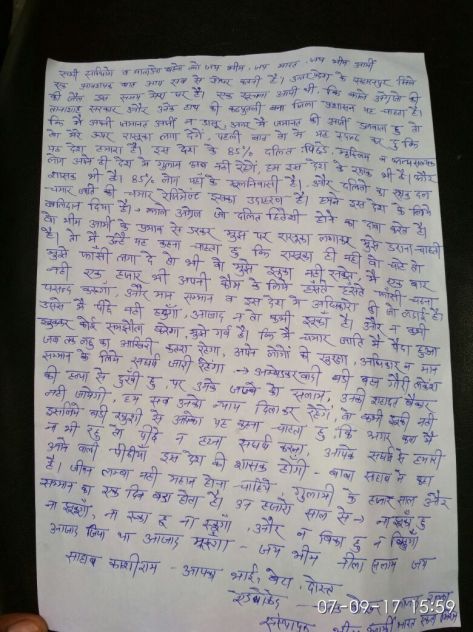
This is an amazing moment. From what we at the Committee for the Defense of Bhim Army have gathered, and from Chandrashekhar’s own letter from Saharanpur District Jail (see below), the administration is moving to slap charges under the National Security Act on Chandrashekhar and other activists. However, while expressing his resolve to fight on, Chandrashekhar also makes it clear in this letter (the facsimile and the text below) that he is equally concerned and saddened at the killing of Gauri Lankesh. He refers to her as his ‘Ambedkarite elder sister’ and pledges to carry forward the struggle to get her justice as well. This is how different dots in the struggle get connected. This is how new nodes of thinking and doing politics emerge. Right now, for us however, the struggle, for the legal defense of Chandrashekhar and other Bhim Army activists is paramount. They want to crush the movement in its infancy and we must ensure it can grow and carry on its struggle for liberation from the yoke of Hinduism and Hindutva.
It is worth placing on record here that when the formation of the Committtee for the Defense of Bhim Army was announced, Gauri had got it touch and expressed her wish to be on the Committee. Unfortunately, that was not to be. But we are sure that this is perhaps the best tribute we can offer to Gauri – carry on the fight for the defense of Bhim Army!
Chandrashekhar’s letter from jail
सभी साथियों व माताओं बहनों को जय भीम जय भारत, जय भीम आर्मी,
 एक आवश्यक बात आप सब से शेयर करनी है उत्तर प्रदेश के सहारनपुर जिले की जेल इस समय मेरा घर है. एक सूचना आई थी की काले अंग्रेजों की तानाशाह सरकार और उनके हाथ की कठपुतली बना जिला प्रशासन यह चाहता है कि मैं अपनी जमानत अर्जी ना डालू अगर मैं जमानत की अर्जी डलवाता हूं तो वो मेरे ऊपर रासुका लगा देंगे.
पहली बात तो मैं यह स्पष्ट कर दूं कि यह देश हमारा है इस देश के 85 % दलित पिछड़े मुस्लिम वह अल्पसंख्या लोग अपने ही देश में गुलाम अब नहीं रहेंगे हम इस देश के Rakshak भी है और शासक भी है 85 % लोग यहां के मूल निवासी है और दलितों का रक्षक दल चमार जाति की चमार रेजिमेंट इनका उदाहरण है हमने इस देश के लिए बलिदान दिया है काले अंग्रेज जो दलित विदेशी होने का दावा करते हैं वह भीम आर्मी के प्रभाव से डरकर मुझ पर रासुका लगाकर मुझे डराना चाहते हैं तो मैं उन्हें यह कहना चाहता हूं कि रासुका ही नहीं वह चाहे तो मुझे फांसी लगा दे तो भी वह मुझे झुका नहीं सकते.
मैं एक बार नहीं एक हजार बार भी अपनी कौम के लिए हंसते हंसते फांसी चढ़ना पसन्द करुगा और मान-सम्मान वे इस देश में अधिकारों की जो लड़ाई है उसे पीछे नहीं हटूंगा. आजाद न तो कभी झुका है और ना कभी झुक  कर कोई समझौता करेगा मुझे गर्व है कि मैं चमार जाति में पैदा हुआ जब तक लहू का आखरी करता रहेगा अपने लोगों की सुरक्षा अधिकार वह मान सम्मान के लिए संघर्ष जारी रहेगा ।।
अंबेडकरवादी बड़ी  बहन गौरी लंकेश की हत्या से दुखी हूं पर इनके जज्बे को सलाम उनकी शहादत बेकार नहीं जाएगी हम सब उनको न्याय दिलाकर रहेंगे वो कभी झुकी नहीं इसलिए बड़ी खुशी से आपको यह कहना चाहता हूं कि अगर कल मैं ना भी रहूं तो पीछे न हटना संघर्ष करना आपके संघर्ष से हमारे आने वाली पीढ़ियां इस देश की शासक होगी बाबा साहब ने कहा जीवन लंबा नहीं महान होना चाहिए गुलामी और सम्मान का एक दिन बड़ा होता है उन हजारों साल से ना झुका हु  ना झुका गा ना रुका हु ना रुकू गा और ना बिका हु ना बिकुगा आजाद जिया था आजाद मरूँगा  जय भीम नीला सलाम जय साहब कांशीराम ।
       आपका भाई बेटा दोस्त
*(एडवोकेट चंद्रशेखर आजाद रावण संस्थापक भीम आर्मी भारत मिशन)*

Literature and Silence: Prasanta Chakravarty

Guest post by PRASANTA CHAKRAVARTY

“Then is Now. The star you steer by is gone, its tremulous thread spun in the hurricane spider floss on my cheek.”
~ Basil Bunting, Briggflatts


“He who writes the work is set aside; he who has written it is dismissed. He who is dismissed, moreover, doesn’t know it. This ignorance preserves him.”
~Maurice Blanchot, The Space of Literature


“Blanchot is even greater waste of time than Proust,” Georges Poulet had famously remarked. Poulet was hinting at the grandeur of wasted time. A ruthless negativity, a rigorous retreat must take on all forms of reparation and facile optimism of human agency. Unconcern must be at the front and centre of our concern. The work of art is. Nothing more. The very idea of elucidation—to dwell upon the actual object that a writer has to offer us—is aesthetically vulgar and politically reactionary. A deep futility marks all perfection. A creation, like Eurydice when Orpheus looks at her, must disappear. The work is remote from itself. It is the incapacity to stop feeling what is not there to be felt.

All quests are echoes. Foreign to presence. Any presence. Quests grasp us rather. But they exclude the writer. He is stupefied. He is idled out of his own work—hence he must go back to work, tirelessly. The lucidity of his insomniac regression keeps on emerging infernally in what we call art. Write he must. But only and solely by being on the verge of his ruinous look back.

Continue reading Literature and Silence: Prasanta Chakravarty

हिंदुत्व और निजता का अधिकार : वैभव सिंह

Guest post by VAIBHAV SINGH

सुप्रीम कोर्ट के द्वारा निजता के अधिकार संबंधी फैसले ने निजी बनाम सार्वजनिक, व्यक्ति बनाम समाज, सरकार बनाम नागरिक के द्वैत को फिर बहस के केंद्र में ला दिया है।ऐसा समाज जहां गली-मोहल्लों व गांव-देहातों में निजी जानकारी छिपाने की कोई धारणा न तो रही है, न उसका सम्मान रहा है, उसी समाज में बड़े कारपोरेशन, सरकारी तंत्र व राज्य ने जब निजी जानकारियों का दुरुपयोग करना आरंभ किया तो गहरी प्रतिक्रिया हुई। इसका मनोवैज्ञानिक कारण यह है कि राज्य व बड़े कारपोरेशन्स समाज के लिए ‘बाहरी शक्ति’ के रूप में रहे हैं। वे पराए, अजनबी और अनजान तत्व हैं जो मनुष्य की निजी सूचना जुटा रहे हैं। उनके बाहरी शक्ति और विशाल संरचना होने के बोध ने निजी जानकारी के मुद्दें पर लोगों को उद्वेलित कर दिया। आधार कार्ड, सोशल साइट्स, सरकारी स्कीम आदि कई चीजें ऐसी रही हैं, जिनका सहारा लेकर नागरिकों की निजी जानकारियों मे बड़े पैमाने पर सेंध लगाई जा रही है और उन जानकारियों को निहित स्वार्थ वाले बेचेहरा व अज्ञात समूहों में शेयर किया जा रहा है। ऐसे माहौल में सुप्रीम कोर्ट का ‘राइट टु प्राइवेसी’ को स्वीकृति देते हुए यह कहना काफी मायने रखता है कि अनुच्छेद 21 के तहत जीने के अधिकार की सार्थकता तभी है जब व्यक्ति की गरिमा और निजता की भी रक्षा की जाए। व्यक्ति को यह पता हो कि उसकी निजी जानकारियां किसे, कब और क्यों दी जा रही हैं। कानून या राज्य के पास निजता को समाप्त करने के मकसद से देश का विकास, प्रशासनिक मजबूरी या डेटा-कलेक्शन की जरूरत का तर्क देने का विकल्प नहीं है।कोर्ट ने अपने फैसले में ‘सेक्सुअल ओरियंटेशन’ के बारे में टिप्पणी करते हुए इसे भी निजता के दायरे में रखा है। Continue reading हिंदुत्व और निजता का अधिकार : वैभव सिंह

Committee for the Defense of Bhim Army Formed Amidst Continuing Repression

Image courtesy Indian Express

Even as the state government’s repression on Bhim Army continues, most of its leaders still in jail and some forced to leave Saharanpur, a committee has been formed for the defense of Bhim Army. (For background information, please see the ‘Note on Bhim Army’, appended at the end of this post, which carries links to informative videos as well). A group of activists and committed lawyers have been following up the legal struggle practically at their own expense – which at the moment involves getting the arrested activists, including the founder-President Chandrashekhar out of bail as the topmost priority. Some of the activists have started getting bail many still remain, including just ordinary people simply picked up by the people and framed by the police as Bhim Army activists.

However, getting the jailed activists out on bail is simply the first step in a long battle. The deliberate campaign of vilification that has been going on about Bhim Army has tried to paint the organization as ‘antinational’ and ‘instigators of violence’ who apparently have ‘Naxalite’ connections. Even though none of this could be substantiated and thus brought by the police into their charges against the jailed activists, the campaign of demonization has nevertheless continued through some sections of the media. Needless to say, such misleading campaign is meant to incite popular feelings against such groups who have been working mainly for education and self respect among the Dalit population in their area. Such a campaign of vilification cannot but affect the chances of wining the legal battle as well. It also ends up driving people who may have initially been sympathetic to their cause by sowing doubts about them in the popular mind.

It is with this concern in mind that a large number of citizens from different walks of life have come together to form the Committee for the Defense of Bhim Army, in order to mobilize all possible support for the embattled activists.

The Committee for the Defense of Bhim Army has been constituted comprising the following members from different walks of life:

Coordinators: Pradeep Narwal and Sanjeev Mathur

Treasurers: Presenjit Gautam and Nakul Singh Sawhney

  1. Anand Teltumbde, Civil rights thinker and activist, Mumbai
  2. Jignesh Mewani, Rashtriya Dalit Adhikar Manch
  3. Kancha Ilaiah, Political scientist, thinker and writer, Hyderabad
  4. Chandrabhan Prasad, Dalit thinker
  5. Radhika Ramaseshan, Senior journalist with Business Standard
  6. Harsh Mander, Human rights activist and Director, Centre for Equity Studies, Delhi
  7. Syeda Hamid, Former member, Planning Commission
  8. Om Thanvi, Senior journalist, former editor, Jansatta
  9. Sambhaji Bhagat, Cultural activist, Maharashtra
  10. Meera Velayudhan, Academic, Centre for Development Studies, Trivandrum
  11. Martin Macwan, Social activist, Gujarat
  12. Ratan Lal, Academic, Hindu College, Delhi University
  13. Sachin Mali, Cultural activist
  14. Sheetal Sathe, Cultural activist
  15. S.R Darapuri , Former IPS officer, social activist
  16. Colin Gonzalves, Lawyer
  17. Anand Patwardhan, Film maker
  18. Anil Chamadia, Journalist
  19. Subhash Gatade, Writer and social activist
  20. Akram Hassan, Social activist, Shamli
  21. Surender, Dalit youth activist, Delhi University
  22. N. Sukumar, Academic, Delhi University
  23. Rehana Adib, Social activist, Saharanpur
  24. Banojyotsna Lahiri, Academic and independent researcher
  25. Mohammad Zeeshan Ayyub, Actor
  26. Amar Singh, SC/ST Trade Union, Delhi University
  27. Dr. Mahesh Chandra, Bhim Army
  28. Sanjay Tegwal, Bhim Army
  29. Zakia Soman, Bharatiya Muslim Mahila Andolan
  30. Presenjit Gautam, Jati Todo Manch, Ghaziabad
  31. Pradeep Narwal, Dalit youth activist, Jawaharlal Nehru University
  32. Saroj Giri, Academic, Delhi University
  33. Tushar Parmar, IRS
  34. Sanjeev Mathur, Journalist
  35. Nakul Singh Sawhney, Film maker
  36. Praveen Verma, Research scholar, Delhi University
  37. Aditya Nigam, Academic, Centre for the Study of Developing Societies, Delhi
  38. Amar Paswan, Ambedkarvadi Chhatra Sabha, Gorakhpur
  39. Dhirendra, Poorvanchal Sena
  40. Anil Yadav, Rihai Manch
  41. Sagar Raghunath, Chhatra Bharati activist
  42. Dr J.K. Gautam, Doctor
  43. Dr. Sushil Kumar Gautam, Dalit Youth Activist, Chaudhary Charan Singh University, Meerut
  44. Subhashini Ali, Social Activist
  45. Mohinder Singh, Professor, JNU
  46. Prashant Nihal, Social Activist (Bihar)
  47. Atul Meena, Research Scholar JNU

Continue reading Committee for the Defense of Bhim Army Formed Amidst Continuing Repression

When Charlatans Become Ideologues – The Real ‘Prisoners of the Binary’

Present day Hindus are probably the strongest opponents of Marxism. They are horrified at its doctrine of class-struggle. But they forget that India has been not merely the land of class struggle but she has been the land of class wars. – B. R. Ambedkar, Philosophy of Hinduism.

I often find myself in a bind over whether or not to respond to supposed RSS ideologues, given that they simply trade in lies and hatred with the supreme arrogance of ignorance. One such is the upcoming star on the RSS horizon, a gentleman called Rakesh Sinha, who like the rest of his pack (led by the supreme leader) is currently engaged in a cheap attack on the outgoing Vice-President, Hamid Ansari. His piece in the Indian Express today (linked above) is an  instance of a combination of all these things. So, why should one bother about such a character? Why take him and his discourse seriously? Well, someone had better respond because, because, for one thing they are in power, and are going to teach generations of students that valorous ‘Hindus’ like Maharana Pratap won all the wars, though by some magic, ‘Muslims’ continued to rule for about 8 centuries! For another, there are enough gullible types who really think these people ‘have a point of view’, which should be debated.

As we have repeatedly seen, their ‘having a point of view’ has nothing to do with debate. It is to be enforced by gangs of gorakshaks, anti-romeo squads, hoodlums deciding what will or will not be taught in universities and schools, what will be written, how people should dress and love – and when nothing works, ‘win’ a ‘debate’ like Arun Jaitley claimed they did, by simply arresting the opponents and slapping sedition charges on them. Given this, I do not really address, in person, the ideologue, Rakesh Sinha, who has now made it a fine art to pick up some phrases from the toolkit of what is understood as ‘postmodernism’ by many. Wasn’t it postmodernism, one can  hear them say, that said all viewpoints are equally valid and ‘everything goes’? Wasn’t it postmodernism that challenged the hegemony of Western thought, its logocentrism, its Rationalism (with a capital R) from within that very tradition? Wasn’t it postmodernism again, that by decentering West’s logocentrism, actually gave these RSS-type creatures the gumption to claim that their utterly unsubstantiated viewpoint about the past too was as valid as that of historians who struggled with evidence, painstakingly putting together texts, artefacts and procedures of dating in order to produce a plausible account of the past?

Continue reading When Charlatans Become Ideologues – The Real ‘Prisoners of the Binary’

No to ‘Geri Route’, Bekhauf Azadi/ Reclaim the Night in Chandigarh: Janaki Srinivasan

Guest post by JANAKI SRINIVASAN

Reclaim the Night

If you are a resident of Chandigarh and came across pictures of the Bekhauf Azaadi Reclaim the Night and the Streets march of August 11 in the newspapers, it is most likely that you assumed it to be just another routine protest.  Protests in ‘the city beautiful’ do tend to follow a standard template. A small number gather in the Sector 17 plaza, banners are held, a few speeches made, photographs taken and a brief news report gets generated for the inner pages of the city supplement. In a small city, finding a mention in the newspapers is no indicator of the importance of one cause or one protest over others. Over the past decade, the administration has ensured this indifference, by physically redirecting political rallies- any event with the potential for large numbers- away from both government offices and public spaces to the outer perimeter of a severely gridlined map. The ‘Rally Ground’ neighbours the crematorium and the garbage landfill. Yet just as Le Corbusier’s monotonous plan and strict guidelines have been subverted by its residents to infuse vitality and uniqueness to the city, the protest template too sees a rare upheaval. Continue reading No to ‘Geri Route’, Bekhauf Azadi/ Reclaim the Night in Chandigarh: Janaki Srinivasan

Beneath the Veil – Lipstick Under My Burkha and Debates around the Uniform Civil Code (UCC): Debaditya Bhattacharya and Rina Ramdev

Guest post by DEBADITYA BHATTACHARYA and RINA RAMDEV

*Disclaimer: Even as news pours in of Pahlaj Nihalani’s ouster as CBFC chief, consider this essay an earnest tribute to the man who is ‘alleged’ to have beeped sense out of Indian cinema. We repeat, merely ‘alleged’ – since we go on to prove otherwise.*

Let us start out with a basic methodological premise – that forms and effects of ideological mensuration cannot exhaust the life of cinema, or even be adequate to an understanding of the ways in which a film-text lives. To that extent, the ferocious debates around how much or how little of Lipstick Under My Burkha qualifies as feminist material have only generated a fair share of readings. While acknowledging the need and value of these aligned readings, we would also urge a look at cinema’s ‘coming into being’ as something more than an image or a text or a performative medium. Often, in our haste for neat hermeneutic closures, reading a film as cognitive-critical material could tend to a negation of the very relationship between the cinematic object and the everyday. The site of a film’s meaning is necessarily in excess of its narrative unfolding as viewing experience. It lies in the negotiations of its object-world – which includes the plot, the actors, the techniques of representation, the exhibition-settings, the infrastructures of distribution and marketing strategies, discourses around its production and release, celebrity-scandals or pre-release promotions, box-office statistics, publicity routines and review ratings, as well as non-audience expectations – with the other object-worlds of thought, feeling and belief. With that note of ‘methodological caution’, as one might call it, we would argue that a movie like Lipstick is also more than just a story of four women as desiring subjects, grappling with their own bodies to secure the most intimately ‘fundamental’ right to dream.

Continue reading Beneath the Veil – Lipstick Under My Burkha and Debates around the Uniform Civil Code (UCC): Debaditya Bhattacharya and Rina Ramdev