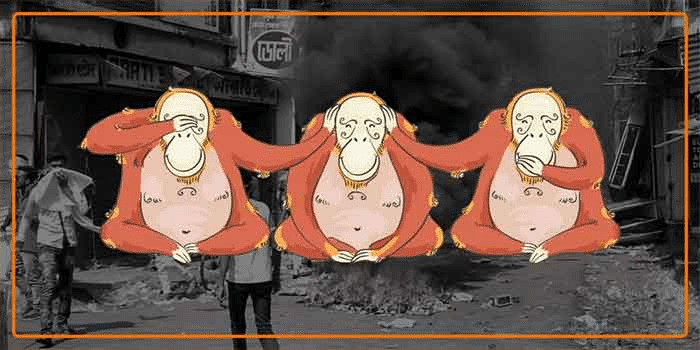
Why the Corporate Czars are Silent over increasing attacks on Social Fabric and rising Communalism
Celebrity actors and players share an interesting commonality in this part of South Asia.
Their moral compass normally veers towards the ‘righteousness’ of the rich, powerful and the influential.
Lynching of innocent people on the streets for their faith, social and governmental hounding of lovers belonging to different communities, call for genocide of religious minorities from public forums and similar hate filled acts, nothing normally impinges on their conscience.
Corporate elites are qualitatively no different.
Occasionally, there are feeble voices of disagreements also.
What Kiran Mazumdar Shaw – founder of India’s largest biopharmaceutical company Biocon – did was exactly this only. She expressed her indignation about growing religious divide in the country and underlined how it would be detrimental to India’s global leadership in ITBT ( Information Technology and Bio Technology)
Definitely her statement which was couched in ‘economic terms’ was very mild, but it did not stop attacks by right-wing trolls.
Prof Zoya Hasan, Professor Emerita, Jawaharlal Nehru University and Distinguished Faculty, Council for Social Development, New Delhi, will be delivering the 16 th lecture in the Democracy Dialogues Series, organised by New Socialist Initiative, at 6 PM, (IST) Sunday, 27 th March, 2022.
She will be speaking on ‘Challenges to India’s Democracy‘
Prof Zoya Hasan has written and edited many books on state, political parties, ethnicity, gender and minorities in India and society in north India and has been a visiting Professor to the Universities of Zurich, Edinburgh and Maison des Sciences de L’Homme, Paris.
Her most recent publications include Forging Identities : Gender, Communities And The State In India ( edited) , Agitation to Legislation – Negotiating Equity and Justice in India , Congress after Indira: Policy, Power and Political Change (1984–2009), Politics of Inclusion: Castes, Minorities and Affirmative Action, (2009) and a collection of essays titled Democracy and the Crisis of Inequality
Abstract
Challenges to India’s Democracy
The 75th anniversary of Indian Independence is a landmark event in the history of our democracy. It is for this reason a significant moment to assess the state of India’s democracy. As the largest democracy in the non-western world, India is a success story. Its success, however, has primarily been recognized as an electoral democracy, with regular free and fair elections registering high voter participation, and also peaceful transfer of power. Elections certainly are a climactic moment of the democratic process but by no means the only important one. Politics between elections is central for understanding the challenges facing Indian democracy, and it is important, therefore, to contextualize democracy.
Three years since the Bhartiya Janata Party government was re-elected has seen the consolidation of the process begun in 2014 – the establishment of a Hindu state. This process has been facilitated by the combination of majoritarianism and authoritarianism which has resulted in democracy becoming thinner, not accidentally, but deliberately. This does raise certain questions about the relationship between Hindu nationalism and democracy which seems to weaken the idea of democracy moderated by institutions.
This paper tries to make sense of these shifts through a thematic exploration of the trajectory of Indian democracy since 2014 focusing on three overlapping developments -the consolidation of a majoritarian brand of politics, the decline of independent institutions and the shrinking space for political dissent and protests -which has undermined democracy. Each of these issues distinct and significant in its own right when taken together constitutes a major risk to Indian democracy. However, public protests in the last few years have emerged as a major bulwark against authoritarian rule and the erosion of democratic dissent. For the Opposition it’s a moment of reckoning but there are signs of churning among the Opposition as well.
When Government itself Does Not Have Any Qualms in rationalising Drona Mindset
( Photo Courtesy : Feminism in India)
[H]istory has come to a stage when the moral man, the complete man, is more and more giving way, almost without knowing it, to make room for the . . .commercial man, the man of limited purpose. This process, aided by the wonderful progress in science, is assuming gigantic proportion and power, causing the upset of man’s moral balance, obscuring his human side under the shadow of soul-less organization.
—Rabindranath Tagore, Nationalism, 1917
( Quoted in ‘Not for Profit – Why Democracy Needs Humanities, Martha Nussbaum, Princeton University Press, 2010)
A single story is sometimes enough to tell how an institution functions and how it needs to be overhauled.
Aruna’s long struggle to get overseas scholarship is one such story.
Son of landless agricultural labourers from Orissa, this bright student, belonging to a socially oppressed community, had applied to get a overseas scholarship via the National Overseas Scholarship – which awards scholarships to students from SC, ST, Denotified tribes etc – and even had lost two years in bureaucratic wrangling despite the fact that he had already got admission into Essex University.
Thanks to the timely intervention of a group of Ambedkarite thinkers from Nagpur, who filed a petition in the Delhi Highcourt on his behalf , which ultimately ruled in the student’s favour.
It would be cliche to say that Aruna’s struggle is an exception.
Story of Vishal Kharat is qualitatively no different who is still trying to get a scholarship for the last two years and has discovered to his dismay that the scholarship portal itself does not work properly.
Instances galore how this ambitious scheme which was launched in the wee hours of India’s independence when Nehru was the Prime Minister and a great scholar and freedom fighter Maulana Abul Kalam Azad was a Cabinet Minister for education, has been left to go slowly into oblivion.
The latest decision by the Union ministry of social justice and empowerment, to not to fund scholarships for marginalised students keen to study India’s history, culture abroad, is just another indication of how it is being implemented.
We can recall that it was the year 2012 when UPA government led by Congress was in the saddle this scheme was extended to Humanities as well and every year 100 students from the socially deprived, oppressed communities started receiving it but with the change of power at the centre things started changing drastically.
Like many of its earlier decisions, this decision to axe scholarship to study humanities abroad was taken without consulting the stakeholders involved in the process or without even giving a hint of how the government wants to proceed in this unique empowerment initiative. The fact that the final date to apply for this scheme is to expire on 31 st March and when there was hardly anytime left to young scholars who are keen to study abroad, to search for alternate path to fulfill their dreams.
The rationale being provided by the powers that be appears unconvincing.
It talks of utilising rich availability of repositories, records as well as books available in Indian institutions and various experts on this subject of India’s culture, civilisation etc and divert the resources thus saved to study other subjects like Science, technology.
It is rather difficult to believe this claim but even if for the sake of discussion we concede, can it be said with certainty that the existing faculty and these institutions would be sensitive to the issue or the concerns of emerging talents from the oppressed, exploited sections of our society, and would be accommodating as well! Fact is that even Higher Educational Institutions are not free from exclusions, discrimination on the basis of caste, gender, community and despite constitutional provisions for affirmative action existing since decades, the character of the academia in most of these institutions is very much exclusive mainly dominated by the so called upper castes.
Cases of discrimination faced by students from such Institutions keep piling up leading even to many unfortunate incidents – rightly called as ‘institutional murders’ of many such talents.
The stories of suicides of the likes of of RohithVemula, ( HCU, Hyderabad) ; Payal Tadvi ( Medical College, Mumbai,) or Fathima Latheef ( IIT Madras) and many of their ilk cannot be seen as exceptions.
A related point is the status of academic freedom in India.
With the ascendance of right-wing politics world over the very idea of academic freedom has come under attack globally – including India
Thanks to the majoritarian turn in the Indian politics where religious minorities are being further marginalised and invisibilised – the ambience which exists here within the academia itself is a pale shadow of its earlier situation. It is becoming increasingly difficult nay impossible to have a critical, open minded discussion on themes, topics which are found not palatable to the ruling dispensation which is a prerequisite for any healthy educational institution.
We have before us cancellation of international seminars on innocuous themes even like Scientific Temper or teachers being hauled to courts after taking up discussions about ‘Kashmir within the class ‘ or for engaging in open ended discussion about nationalism inside class or students-teachers being charged with sedition for protesting about highhandedness of the government.
Secondly, with the rightwing holding reins of power with a brutal majority, has also led to radical changes in the content of humanity studies playing mythology over facts e.g. there are allegations how the draft history syllabus pushed by the UGC presents a theory of the origin of caste system which relates to the advent of the ‘Muslim rule’ here.
Can we ever accept that these bright students opting for scholarships abroad who have themselves experienced caste, community or class based deprivation, discrimination in their younger days, would be ever ready to easily gulp down such trash as intellectual discourse.
Definitely not.
This decision to axe funds to socially oppressed sections to study humanity abroad very much gels with the overt concerns of the people in power which are evident in the New Education Policy 2020 which envisions restoring the the role of India as a ‘Vishwa Guru’ and interestingly remains silent on caste and other discriminations and even does not talk about reservations. It clubs SC / ST, OBC and minority communities as an acronym SEDGs – Socially and Economically Disadvantaged Groups.
What needs to be underlined that this step by the Ministry has raised concerns among the members of the international academic community, and scholars of India spread all over the world as well and in an open letter addressed to the Ministry of Social Justice and Empowerment they have demanded that the government withdraws this immediate changes in the policy.
It emphasises how ‘[t]he argument that one need not go abroad to study India is intellectually flawed and will only serve to isolate Indian scholarship from the rest of the world.’ and these amendments attest to a lack of understanding of how interdisciplinary research is conducted today, where natural sciences, law, history, sociology and the humanities work together beyond national boundaries.
Another important point which it make that how it will further negatively impact women recipients of this scholarship who are already ‘disproportionately under-represented in scientific and technological disciplines and tend to more easily find opportunities in the Social Sciences and Humanities’
Last but not the least it also displays the great hiatus between the outwardly, strong image of the ruling dispensation and how paranoid, insecure it is about deeper fault lines of the Indian society.
Perhaps it worries that with increasing interest of the academia of the west in what is happening to the largest democracy in the world, and the study of caste and its attendant asymmetries receiving special attention by them, and also dalit activists, scholars there pursuing it at various levels there, these exclusivist hierarchies have rapidly attracted attention. Not some time ago the California State University system added caste to its non-discrimination policy, prohibiting caste-based discrimination or bias across its 23 campuses.
The ruling dispensation knows very well that the more students from dalit, adivasi and other deprived sections of society go out to study abroad, it will have to be ready to face many such embarassing moments because whereas it itself is keen to invisibilise caste once for all, and even clubbed all these sections – the SC / ST, OBC and minority communities as an acronym SEDGs – Socially and Economically Disadvantaged Groups; the reality as it exists would continue to haunt it.
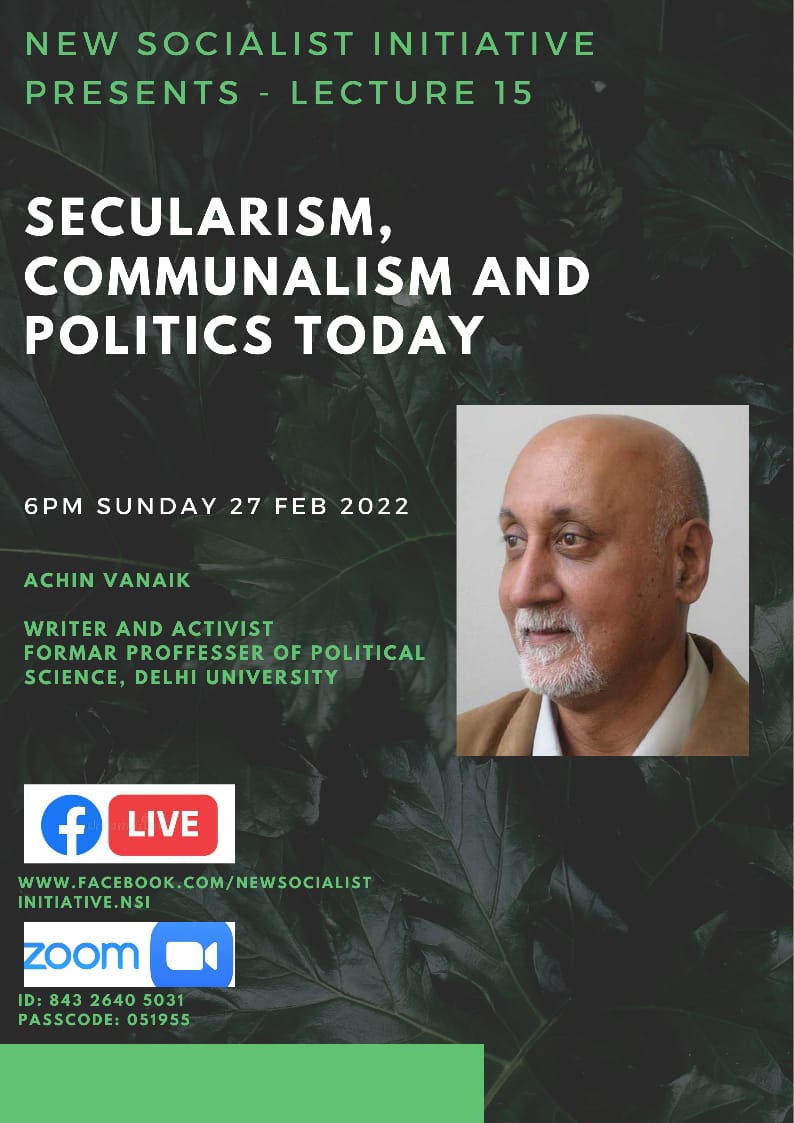
The 15 th lecture in the Democracy Dialogues Series will be delivered by Prof Achin Vanaik on Sunday, 27 th February at 6 PM (IST)
He will be speaking on
‘Secularism, Communalism and Indian Politics Today‘
Speaker
Writer and Social Activist, Former Professor of Political Science at Delhi University Prof Achin Vanaik is a fellow of the Transnational Institute
He is author of numerous books including The Furies of Indian Communalism ( 1997) , The Painful Transition : Bourgeois Democracy in India ( 1990) , Hindutva Rising – Secular Claims, Communal Realities (2017), “Nationalist Dangers, Secular Failings:A Compass for an Indian Left”
Summary :
The presentation will start with a series of definitions of crucial concepts such as secular, secularization, secularism as well as distinguishing between religious fundamentalism, religious nationalism and communalism. This is important to get a handle on how the widespread Indian understanding of secularism as an ancient form of ‘tolerance’ is dangerously mistaken. Of course the rise of the political right and far-right is a global phenomenon in the last few decades giving rise to different forms of what can be called the ‘politics of cultural exclusivism’. So the first principle of explanation for this rise has also to be transnational. After this the question of the rise of the Sangh/BJP in the wider context of developments in India over time will be taken up. It is obvious that the Sangh/BJP is seeking to expand its existing power and influence i.e., to establish and expand its hegemony and this must be understood as well as what are the projects central to its efforts to establish a Hindu Rashtra or Nation. It should be obvious that its particular conception of how to secure a strong Indian nation/nationalism must be exposed and combated. The presentation will end with recognising that this is a long term struggle and how we must go about it.
The third lecture in the ‘Sandhan Vyakhyanmala’ series – initiated by New Socialist Initiative ( Hindi Pradesh) will be delivered by Prof Savita Singh, leading poetess, feminist scholar and writer on Saturday 19 th February 2022, at 6 PM (IST). She will be speaking on ‘Hindi Literature and New Light of Feminist Thought (हिंदी साहित्य और स्त्रीवादी चिंतन का नया आलोक’ )
The focus of this lecture series – as you might be aware – is on the Hindi belt, especially, on literature, culture, society and politics of the Hindi region where we intend to invite writers, scholars with a forward looking, progressive viewpoint to share their concerns.
You are cordially invited to attend and participate in the ensuing discussion.
वक्ता: प्रोफ़ेसर सविता सिंह प्रसिद्ध कवयित्री, नारीवादी सिद्धांतकार और लेखिका
विषय: ‘हिंदी साहित्य और स्त्रीवादी चिंतन का नया आलोक’
19 फरवरी शाम 6बजे
सारांश स्त्रीवाद को लेकर हिंदी साहित्य में आजकल बहुत सारी बातें हो रही हैं। वे अपनी अंतर्वस्तु में नई भी हैं और पुरानी भी। यह भी कह सकते हैं की पितृसत्ता ने अपने भी स्त्रीवादी विमर्श तैयार किए हैं स्त्रियों के लिए। जब स्त्रियां इसे अपना लेती हैं, अपना कह कर इसे किसी वसन की तरह पहन लेती हैं तो जरूरी हो जाता है इनपर गहनता और गहराई से बात करना। वह एक बात थी जब स्त्री लेखिकाओं ने अपने को स्त्रीवादी होने या कहे जाने से परहेज किया, और यह दूसरी जब स्त्रीवाद के अनेक रूप गढ़े गए। भारतीय परिवेश में स्त्री विमर्श के भीतर बहुलता और भिन्नता तो होनी ही थी। इसी विषय पर हम क्यों न इसपर बात करें। क्या हिंदी में स्त्रीवादी लेखन कोई नया समाज बनाने के संकल्प से लिखा जा रहा है या फिर अभी भी पितृसत्ता का सह उत्पादन ही हो रहा है, यह हमारे लिए चिंता और बहस का मुद्दा बनना ही चाहिए।
(Opening remarks in an ongoing discussion within New Socialist Initiative (NSI) on Left’s approach to Electoral Politics in Contemporary India)
The Speaker :
Ravi Sinha is an activist-scholar who has been associated with progressive movements for nearly four decades. Trained as a theoretical physicist, Dr. Ravi has a doctoral degree from MIT, Cambridge, USA. He worked as a physicist at University of Maryland, College Park, USA, at Physical Research Laboratory, Ahmedabad and at Gujarat University, Ahmedabad before resigning from the job to devote himself full time to organizing and theorizing. He is the principal author of the book, Globalization of Capital, published in 1997, co-founder of the Hindi journal, Sandhan, and one of the founders and a leading member of New Socialist Initiative.
The 14 th Lecture in the Democracy Dialogues Series organised by New Socialist Initiative was delivered by Prof Irfan Habib, Famous Historian, Public Intellectual and Marxist Thinker, on Sunday 30 th January 2022 at 6 PM (IST). Prof Habib spoke on ‘Doctored History : From Ancient Times till Today’
About the Speaker :
Prof Irfan Habib ( Professor of History at the Aligarh Muslim University, Retd) is a well-known historian and author of the The Agrarian System of Mughal India ( 1963), An Atlas of the Mughal Empire ( 1982), Essays in Indian History : Towards a Marxist Perception ( 1985) , The Economic History of Medieval India : A Survey ( 2001) , Medieval India : The Study of a Civilisation ( 2008), a multivolume study titled ‘People’s History of India’ etc and has edited many books
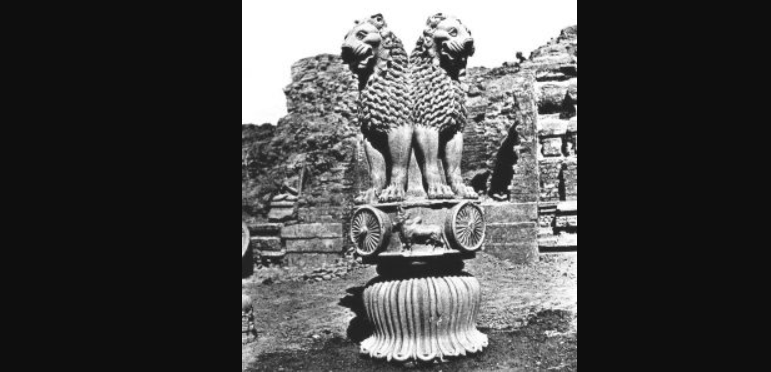
Ashokan lions adorn Indian currency and the Dharmachakra features in the tricolour. Neither symbol has any sanctity for the ideologues of the ruling dispensation.
Thousands of kings and emperors shone for a brief moment in history, then quickly disappeared. But in ‘The Outline of History: The Whole Story of Man’, H.G. Wells writes, “Ashoka shines and shines brightly like a bright star, even unto this day.” The famous British historian EH Carr also wrote, “What is history? It is a continuous process of interaction between the historian and his facts, an unending dialogue between the present and the past.”
Yet, history is a continuous ‘us versus them’ for some individuals and outfits in India. Their interaction with the past typically degenerates into a vicious monologue aimed to vitiate the present and control the future. Nowhere is their vandalism of history more visible than what the Hindutva brigade is doing to the last great Mauryan ruler, Ashoka (304-232 BCE). Often compared with a medieval Mughal ruler—whom the Hindutvadis detest and distort in equal measure—they are now transforming the Ashokan period beyond recognition into a symbol of cruelty and bigotry.
Ashoka is widely known to have filled with remorse after the tremendous bloodshed in the battle of Kalinga. After that, he is known to have devoted his life to “conquest by Dhamma or right/moral life”. It is less known that Ashoka was among the earliest rulers to launch public utilities such as hospitals, encouraged tree-plantation, dug public wells and ordered the construction of rest houses along roads. His commitment to public reason is considered phenomenal, as he, two hundred years before Christ, organised the earliest open general meetings in the world.
The second lecture in the ‘Sandhan Vyakhyanmala’ series – initiated by New Socialist Initiative ( Hindi Pradesh) will be delivered by Sanjeev Kumar, Well known Critic and Deputy General Secretary of Janwadi Lekhak Sangh on Saturday 15 th January 2022 at 6 PM (IST). He will be speaking on हिंदी की मार्क्सवादी बहसें : ‘विचारधारा’ से विचारधारा तक ( Hindi ke Marxwadi Bahasein : ‘Vichardhara’ se Vichardhara tak) The focus of this lecture series – as you might be aware – is on the Hindi belt, especially, on literature, culture, society and politics of the Hindi region where we intend to invite writers, scholars with a forward looking, progressive viewpoint to share their concerns. The inaugural lecture in the series was delivered by poet and thinker Ashok Vajpayi, where he spoke on ‘Thought and Literature”
सन्धान व्याख्यानमाला दूसरा वक्तव्य हिंदी की मार्क्सवादी बहसें : ‘विचारधारा’ से विचारधारा तक वक्ता : श्री संजीव कुमार आलोचक संयुक्त महासचिव, जनवादी लेखक संघ 15 जनवरी , शनिवार शाम 6 बजे
सारांश
क्या वजह है कि हिंदी में पिछली सदी के 40 और 50 के दशक में प्रगतिशीलों के बीच जितने मुद्दों पर मतभेद उभरे, उनमें वही मत संख्याबल से विजयी रहा (और कमोबेश अभी तक है) जो हिंदी लोकवृत्त की स्थापित मान्यताओं के प्रति पूरी तरह से अनालोचनात्मक था? क्या यह एक परिवर्तनकामी वैचारिकी का परचम लहरानेवालों के भीतर वर्चस्व की प्रदत्त व्यवस्था का पोषण करनेवाली विचारधारा की सुप्त मौजूदगी थी जो भक्ति आंदोलन की विभिन्न धाराओं के रिश्ते, कथित हिंदी नवजागरण में भारतेन्दु और उनके मंडल के योगदान, हिंदी-उर्दू और उनके इलाक़े की सभी भाषाओं के आपसी संबंध, साहित्य में यौन-नैतिकता जैसे तमाम मसायल पर सभी असहज करनेवालों सवालों को हाशिये पर धकेल रही थी? क्या प्रगतिशील और मार्क्सवादी होने में अपने ‘संस्कारों’ के साथ एक तकलीफ़देह लड़ाई लड़ने और उपलब्ध सहूलियतों-रियायतों का त्याग करने की जो अपेक्षा निहित होती है, यह उससे पल्ला छुड़ाना था? या कि यह प्रगतिशील आंदोलन को वर्चस्वशाली बनाने के लिए सबको अपने साथ ले चलने की एक कार्यनीतिक पहल थी जो कि शायद सफल भी रही?
एक आत्मावलोकन से शुरुआत करनेवाला यह पर्चा इन प्रश्नों की दिशा में एक प्रस्थान है।
The literary award must generate wider discussion in society on what plagues us. After all, the writer has always been outspoken against extremism.
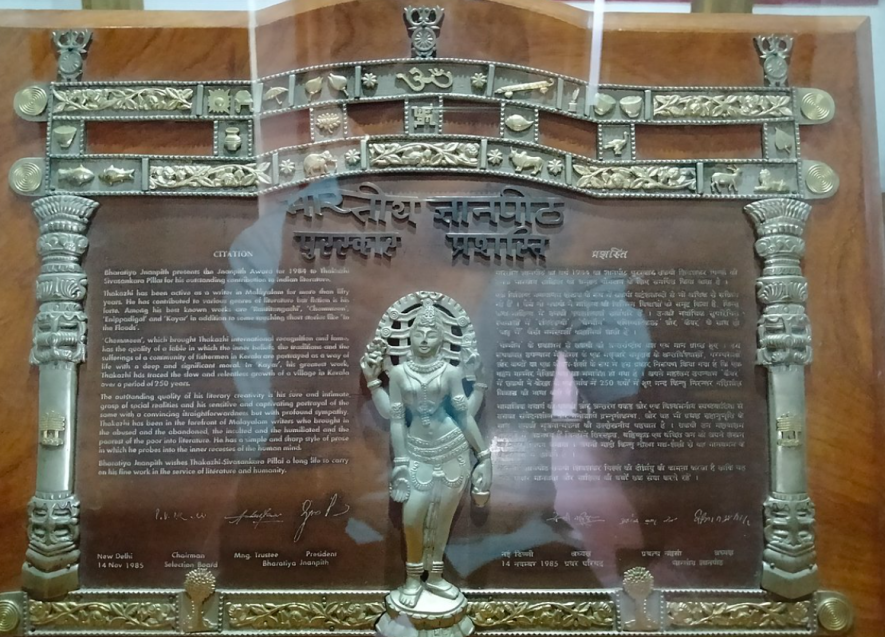
This year’s Jnanpith Award for best literature has gone to Damodar Mauzo, the famous Konkani novelist and short story writer. The great Assamese poetic talent, Nilmani Phookan Jr, has also been awarded the Jnanpith for 2020. Hopefully, as we celebrate “their outstanding contribution towards literature,” our discussions will not remain confined to the literary domain.
In his acclaimed novel, ‘Karmelin’ (1980), Mauzo writes about the abuse of women who go to work as housemaids in the Middle East. This novel came long before everybody started talking about this issue. His story, ‘The Burger’, is about two school friends, Irene and Sharmila, and the guilt little Irene experiences over ‘polluting’ Sharmila with a beef burger. Another story describes how cow vigilantes intimidated a Dalit youth long before others talked about the phenomenon.
Maybe Mauzo could see beyond the immediate and obvious, which prompted his social and political actions on issues of concern to all of society. That social engagement allowed him to observe the dangers that lurked in our society in the form of the right-wing, and gave him courage to never shy away from boldly speaking out against them.
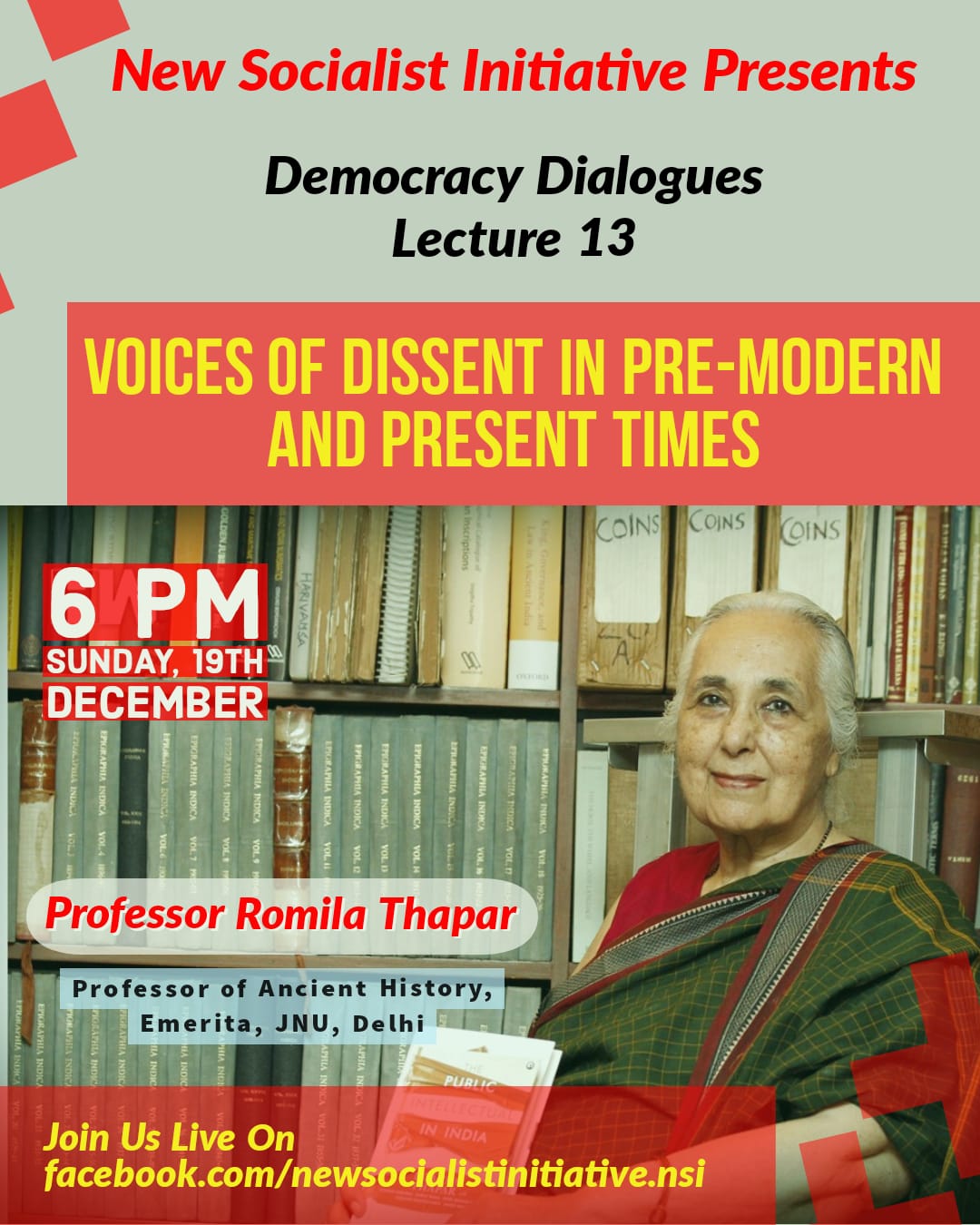
The13 th Lecture in the Democracy Dialogues Series organised by New Socialist Initiative will be delivered by Prof Romila Thapar, Professor of Ancient History, Emerita, JNU, author of many books and a leading public intellectual on Sunday 19 th December 2021 at 6 PM (IST). Prof Thapar would be speaking on ‘Voices of Dissent in Pre-Modern and Present Times‘
About the Speaker :
Internationally renowned scholar of Ancient History, Prof Thapar was elected General President of the Indian History Congress in 1983 and a Fellow of the British Academy in 1999. In 2008, she was awarded the prestigious Kluge Prize of the US Library of Congress which complements the Nobel, in honouring lifetime achievement in disciplines not covered by the latter.
Prof Thapar has been a visiting professor at Cornell University, the University of Pennysylvania, and the College de France in Paris and holds honorary doctorates from the University of Chicago, the Institut National des Langues et Civilisations Orientales in Paris, the University of Oxford, the University of Edinburgh (2004), the University of Calcutta and from the University of Hyderabad.
Here is a select list of Prof Thapar’s publications
Ashoka and the Decline of the Mauryas, 1961 ( Oxford University Press) ; A History of India : Volume 1, 1966 ( Penguin) ; The Past and Prejudice, NBT ( 1975) ; Ancient Indian Social History : Some Interpretations, 1978 ( Orient Blackswan) ; From Lineages to State 1985 : Social Formations of the Mid-First Millenium B.C. in the Ganges Valley, 1985 ( Oxford University Press) ; Interpreting Early India, 1992 ( Oxford University Press) ; Sakuntala : Text, Reading, Historie, 2002 ( Anthem) . Somanatha : The Many Voices of History, Verso ( 2005) ; The Aryan : Recasting Constructs, Three Essays ( 2008) ; The Past As Present: Forging Contemporary Identities Through History, 2014
For security reasons the zoom invite will be shared individually. Please write to us at democracydialogues@gmail.comif you are interested in attending the lecture
p.s. Here is a playlist of lectures in the series :
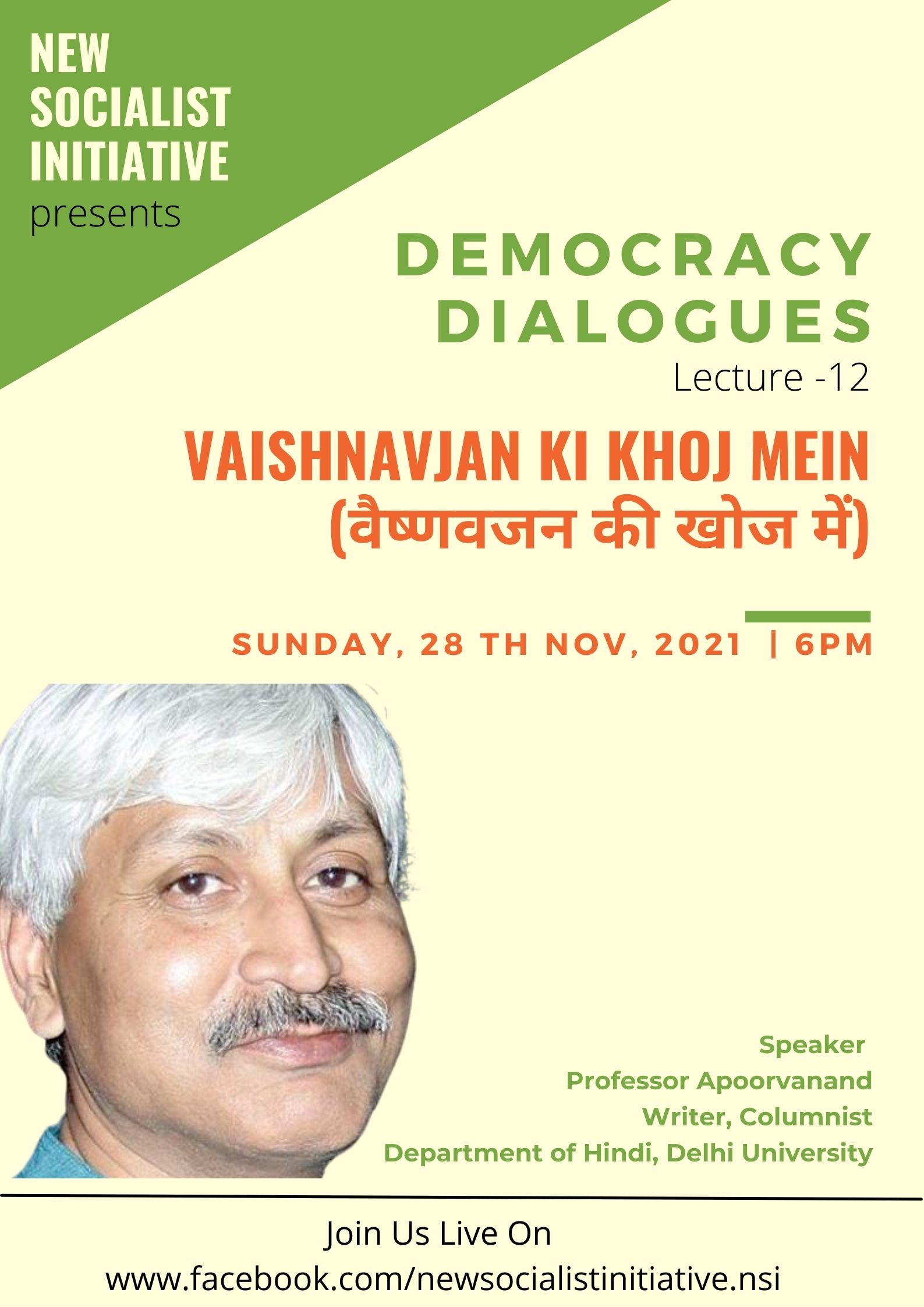
न्यू सोशलिस्ट इनिशिएटिव की तरफ से आयोजित ‘डेमोक्रेसी डायलॉग्स सीरीज ‘ का 12 वां व्याख्यान अग्रणी लेखक, स्तम्भकार, दिल्ली विश्वविद्यालय में हिंदी विभाग से सम्बद्ध प्रोफेसर अपूर्वानंद 6 बजे शाम, रविवार, 28 नवम्बर 2021 को प्रस्तुत करेंगे।
विषय : ‘वैष्णवजन की खोज में’
“वैष्णवजन की कल्पना को राजनीतिक और सामाजिक पटल पर स्थापित करने का श्रेय गाँधी को है। इस बात पर ध्यान जाना चाहिए कि उपनिवेशवाद विरोधी आंदोलन में या राष्ट्र की स्वतंत्रता के संघर्ष में गाँधी ने वैष्णवजन को संभवतः इस आंदोलन के लिए आदर्श आंदोलनकारी के रूप में पेश किया। वह कैसा जन है? पीर और पराई , इन दोनों से उसका रिश्ता क्या होगा? और क्यों एक सच्चा जनतांत्रिक जन वैष्णवजन ही हो सकता है? हमारे संविधान की प्रस्तावना में हम भारत के लोग जिस यात्रा पर निकले हैं क्या वह इस वैष्णवजनत्व की तलाश की यात्रा है?”
हिंदी तथा अंग्रेजी अख़बारों तथा अन्य प्रकाशनों में तथा टीवी की चर्चाओं में अपनी निरंतर सशक्त उपस्थिति दर्ज करते रहने वाले प्रोफेसर अपूर्वानंद सार्वजनिक जीवन में न्याय, समता और तार्किकता के पक्ष में अपने सक्रिय हस्तक्षेप के लिए जाने जाते हैं .
आप ने कई किताबें भी लिखी हैं, जिनमें से कुछ के शीर्षक इस प्रकार हैं : ‘सुंदर का स्वप्न ‘ ( वाणी प्रकाशन, 2001 ) , ‘साहित्य का एकांत’ ( वाणी प्रकाशन , 2008 ), The Idea of University ( Context, 2018 ) , Education at the Crossroads ( Niyogi Books, 2018 )
हिन्दी इलाके को लेकर विचार-विमर्श के लिये “सन्धान व्याख्यानमाला” की शुरुआत इस शनिवार, 13 नवम्बर, को शाम 6 बजे प्रख्यात कवि और विचारक श्री अशोक वाजपेयी के व्याख्यान से हो रही है.
इस व्याख्यानमाला की शुरुआत के पीछे हमारी मंशा ये है कि हिन्दी में विचार, इतिहास, साहित्य, कला, संस्कृति और समाज-सिद्धान्त के गम्भीर विमर्श को बढ़ावा मिले. हिन्दी इलाक़े के सामाजिक-सांस्कृतिक विकास को लेकर हमारी चिन्ता पुरानी है. आज से बीस साल पहले हमारे कुछ अग्रज साथियों ने “सन्धान” नाम की पत्रिका की शुरुआत की थी जो अनेक कारणों से पाँच साल के बाद बन्द हो गयी थी. इधर हम हिंदी-विमर्श का यह सिलसिला फिर से शुरू कर रहे हैं. यह व्याख्यानमाला इस प्रयास का महत्वपूर्ण अंग होगी.
हममें से अधिकांश लोग “न्यू सोशलिस्ट इनिशिएटिव” नाम के प्रयास से भी जुड़े हैं. यह प्रयास अपने आप को सामान्य और व्यापक प्रगतिशील परिवार का अंग समझता है, हालाँकि यह किसी पार्टी या संगठन से नहीं जुड़ा है. इसका मानना है कि भारतीय और वैश्विक दोनों ही स्तरों पर वामपन्थी आन्दोलन को युगीन मसलों पर नए सिरे से विचार करने की और उस रौशनी में अपने आप को पुनर्गठित करने की आवश्यकता है. यह आवश्यकता दो बड़ी बातों से पैदा होती है. पहली यह कि पिछली सदी में वामपन्थ की सफलता मुख्यतः पिछड़े समाजों में सामन्ती और औपनिवेशिक शक्तियों के विरुद्ध मिली थी. आधुनिक लोकतान्त्रिक प्रणाली के अधीन चलने वाले पूँजीवाद के विरुद्ध सफल संघर्ष के उदहारण अभी भविष्य के गर्भ में हैं. दूसरी यह कि बीसवीं सदी का समाजवाद, अपनी उपलब्धियों के बावजूद, भविष्य के ऐसे समाजवाद का मॉडल नहीं बन सकता जो समृद्धि, बराबरी, लोकतन्त्र और व्यक्ति की आज़ादी के पैमानों पर अपने को वांछनीय और श्रेष्ठ साबित कर सके.
“सन्धान व्याख्यानमाला” का प्रस्ताव यूँ है कि हिन्दी सभ्यता-संस्कृति-समाज को लेकर हिंदी भाषा में विचार की अलग से आवश्यकता है. हिन्दी में विचार अनिवार्यतः साहित्य से जुड़ा है और हिन्दी मनीषा के निर्माण में साहित्यिक मनीषियों की अग्रणी भूमिका है. हम हिन्दी साहित्य-जगत के प्रचलित विमर्शों-विवादों से थोड़ा अलग हटकर साहित्य के बुनियादी मसलों से शुरुआत करना चाहते हैं. प्रगतिशील बिरादरी का हिस्सा होते हुए भी हम यह नहीं मानते कि साहित्य की भूमिका क्रान्तियों, आन्दोलनों और ऐतिहासिक शक्तियों के चारण मात्र की है. हम यह नहीं मानते कि साहित्यकार की प्रतिबद्धता साहित्य की उत्कृष्टता का एकमात्र पैमाना हो सकता है. हम अधिक बुनियादी सवालों से शुरू करना चाहते हैं, भले ही वे पुराने सुनायी पड़ें. मसलन, साहित्य कहाँ से आता है – ऐसा क्यों है कि मानव सभ्यता के सभी ज्ञात उदाहरणों में साहित्य न केवल पाया जाता है बल्कि ख़ासकर सभ्यताओं के शैशव काल में, और अनिवार्यतः बाद में भी, उन सभ्यताओं के निर्माण और विकास में महती भूमिका निभाता है. साहित्य के लोकमानस में पैठने की प्रक्रियाएँ और कालावधियाँ कैसे निर्धारित होती हैं? क्या शेक्सपियर के इंग्लिश लोकमानस में पैठने की प्रक्रिया वही है जो तुलसीदास के हिन्दी लोकमानस में पैठने की? निराला या मुक्तिबोध के लोकमानस में संश्लेष के रास्ते में क्या बाधाएँ हैं और उसकी क्या कालावधि होगी? इत्यादि. हमारा मानना है कि “जनपक्षधर बनाम कलावादी” तथा अन्य ऐसी बहसें साहित्य के अंतस्तल पर और उसकी युगीन भूमिका पर सम्यक प्रकाश नहीं डाल पातीं हैं. बुनियादी और दार्शनिक प्रश्न संस्कृतियों और सभ्यताओं पर विचार के लिए अनिवार्य हैं.
इस व्याख्यानमाला में हम विचार-वर्णक्रम के विविध आधुनिक एवं प्रगतिशील प्रतिनिधियों को आमन्त्रित करेंगे. ज़रूरी नहीं है कि वक्ताओं के विचार हमारे अपने विचारों से मेल खाते हों. हमारी मंशा गम्भीर विमर्श और बहस-मुबाहिसे की है.
प्रख्यात कवि और विचारक श्री अशोक वाजपेयी इस शृंखला के पहले वक्ता होंगे जिनका मानना है कि साहित्य की अपनी “स्वतन्त्र वैचारिक सत्ता होती है; उस विचार का सामान्यीकरण नहीं किया जा सकता; वह विचार अन्य विचारों से संवाद-द्वन्द्व में रहता है पर साहित्य को किसी बाहर से आये विचार का उपनिवेश बनने का प्रतिरोध करता है; साहित्य का विचार विविक्त नहीं, रागसिक्त विचार होता है.”
आप सभी इस शृंखला में भागीदारी और वैचारिक हस्तक्षेप के लिये आमन्त्रित हैं.
The 11 th lecture in the Democracy Dialogues Series organised by New Socialist Initiative was delivered by Ashutosh, TV anchor, columnist, author and co-founder of satyahindi.com at 6 PM ( IST), Sunday, 31 st October 2021.
Mr Ashutosh spoke on ‘Will India Survive as a Democracy ?’ A highly acclaimed journalist and TV News Anchor, a reputed Columnist, and a successful Author, Ashutosh was associated with AAP for a while but was soon disenchanted with this experiment and returned to journalism again with a new experiment in the form of satyahindi.com
He has many books to his credit, Anna – 13 days that awakened India, (2012) ; The Crown prince, The Gladiator & The Hope — Battle for Change ; Mukhaute ka Rajdharm ( 2015). In his latest book Hindu Rashtra published in 2019, he takes a hard look at the political reality of India and what its future may hold.
Modern-day Eklavyas are depriving students of their dues across the country. No government can compensate for robbing students from underprivileged backgrounds of their future.
In the 19th century, Chatra district in Jharkhand hosted the legendary Raja Rammohan Roy for a while. A memorial to Subedar Nadir Ali Khan and Jay Mangal Panday, martyred during the 1857 war of independence, is also here. Now, this district is in the news again, but for the wrong reasons.
A Comptroller and Auditor General (CAG) report tabled in the state Assembly has detailed the embezzlement of around Rs. 85 crore, meant to fund the scholarship of students belonging to the backward classes. The siphoning went on from 2013-18, says the CAG report for 2018-19.
The modus operandi of the scammers was simple. The money was not transferred to the accounts of beneficiaries, as the state department for Scheduled Caste, Scheduled Tribes, Minority and Backward Class Welfare says. Instead, it went into the bank accounts of other individuals.
The explanation offered by the concerned people was straightforward. They told the CAG that documents related to the transfer of Rs. 70 crore got destroyed in a fire. A significant portion of the Rs. 85 crore is yet to get recovered. The department never bothered to reconcile its accounts even after the fire incident.
The BJP is imposing harmful dietary restrictions and refusing to accept that more Indians want to consume meat, fish and eggs for their nutritional benefits.
Representational use only
.
In 1902, the prolific British writer HG Wells delivered a philosophical speech titled “The Discovery of the Future” at the Royal Institution in London. Wells is often remembered for his “predictions”, for example, the approximate date when the second world war would begin. In this speech, he envisioned something else with equally significant ramifications—the collapse of the capitalist system. Wells also anticipated that a world of peace and plenty would follow in its wake.
What if someone, following Wells example, attempts a similar extrapolation for India? If anybody could foresee such things, what would they find lies ahead for the “biggest democracy” in the world?
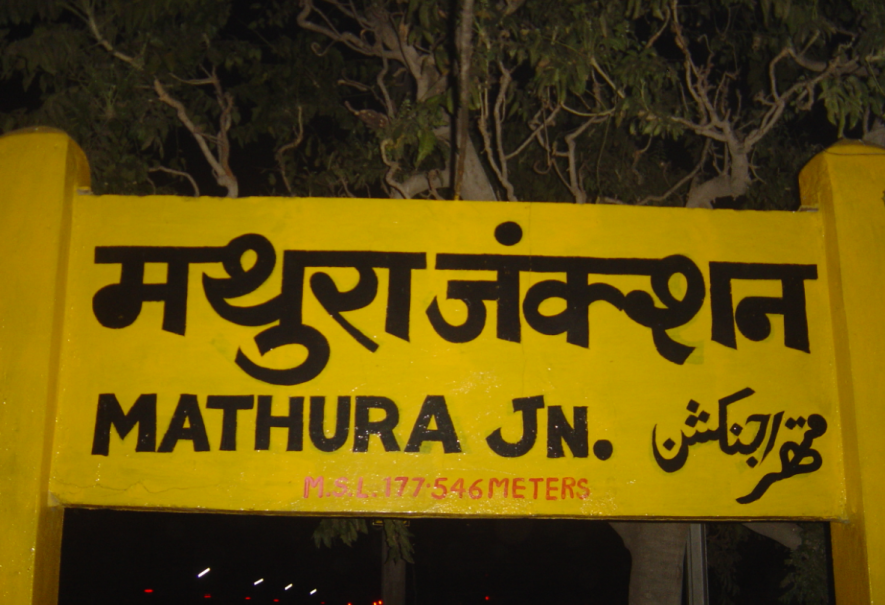
In the absence of Wells, perhaps present-day events can be a map or guide to the future. For example, during recent Janamashtmi celebrations, Uttar Pradesh, Chief Minister Yogi Adityanath announced that his government would ban meat and liquor in Mathura city. He said the meat-sellers and liquor dealers of the area could switch to selling milk. According to his government, a meat and liquor ban would help combine “modern technology” with the cultural and spiritual heritage of the region.
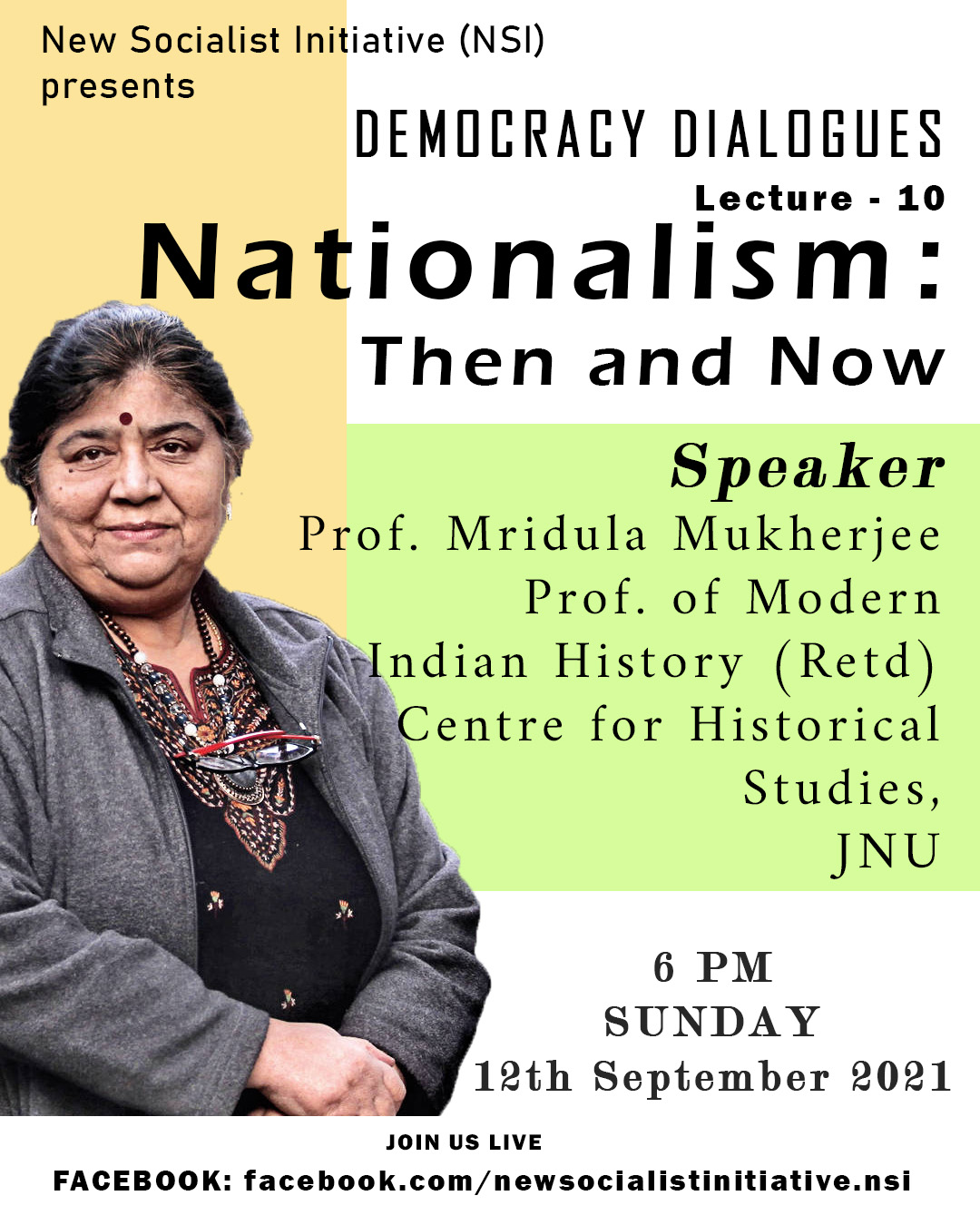
The 10 th lecture in the Democracy Dialogues Series organised by New Socialist Initiative was delivered by Prof Mridula Mukherjee ( Retd.) on Sunday, 12 th Sepember at 6 PM ( IST). She spoke on ‘Nationalism : Then and Now’
Prof. Mridula Mukherjee, was associated with Centre for Historical Studies, JNU for a long time and was also Director of Nehru Memorial Museum and Library, ( NMML), New Delhi.
Well known as a historian for her work on the role of peasants in the Indian independence movement, she has authored two important books on the theme, Peasants in India’s Non-Violent Revolution ( Sage 2004) and Colonising Agriculture : Myth of Punjab Exceptionalism ( Sage 2005). She has also coauthored books with Prof Bipan Chandra, Prof Aditya Mukherjee on ‘India’s Struggle for Independence’ ( Penguin 2000) and ‘India After Independence‘ ( Penguin 2008). The monograph ‘RSS, School Texts and Murder of Mahatma Gandhi‘ which she has coauthored with Prof Aditya Mukherjee and Prof Sucheta Mahajan has been widely appreciated.
In this lecture Prof Mridula Mukherjee discussed Nationalism and its origins as a modern ideology, how nations are historical constructs with each nation having its own distinctive historical evolution and the emergence of two kinds of nationalism and how the present notion of aggressive, chauvinistic nationalism is in sharp contrast to the once evolved by the freedom struggle and how the task of preventing the appropriation of nationalism and its creative linking to progressive agenda is the need of the hour.
Please write to us at democracydialogues@gmail.com if you are interested in getting upadates about the series.
Moderation and acceptance are parts of a continuous struggle to ensure that democracy does not get subsumed by majoritarianism.
‘The sublime and the ridiculous are often so nearly related that it is difficult to class them separately. One step above the sublime makes the ridiculous,
and one step above the ridiculous makes the sublime again.’ –Thomas Paine, The Age of Reason.
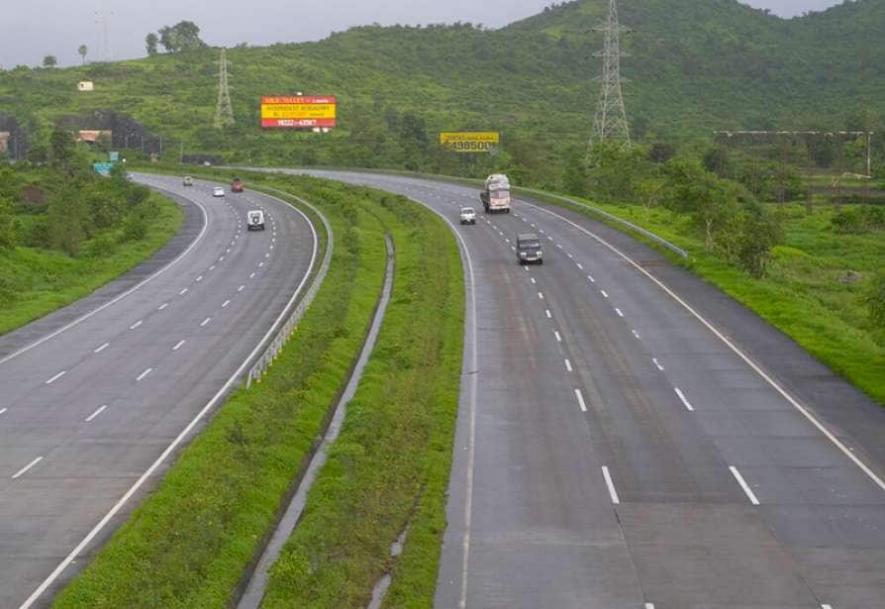
The idea of public good faced a faith hurdle in Kerala recently. The issue was the widening of National Highway 66 on a stretch in Umayanalloor village, Thazhuthala, and adjacent towns of the Kollam district. A batch of petitions challenged the highway because two temples and mosques were in its alignment. It was a tricky situation, and a hasty decision may well have had consequences.
Without wavering on constitutional principles, the Kerala High Court handled the case skilfully. A single-judge bench of Justice PV Kunhikrishnan rejected petitions that opposed the land acquisition and asked citizens to rise above difficulties for better highways for all citizens. It emphasised that courts could not intervene in acquisition proceedings unless there is patent illegality or malafide action.
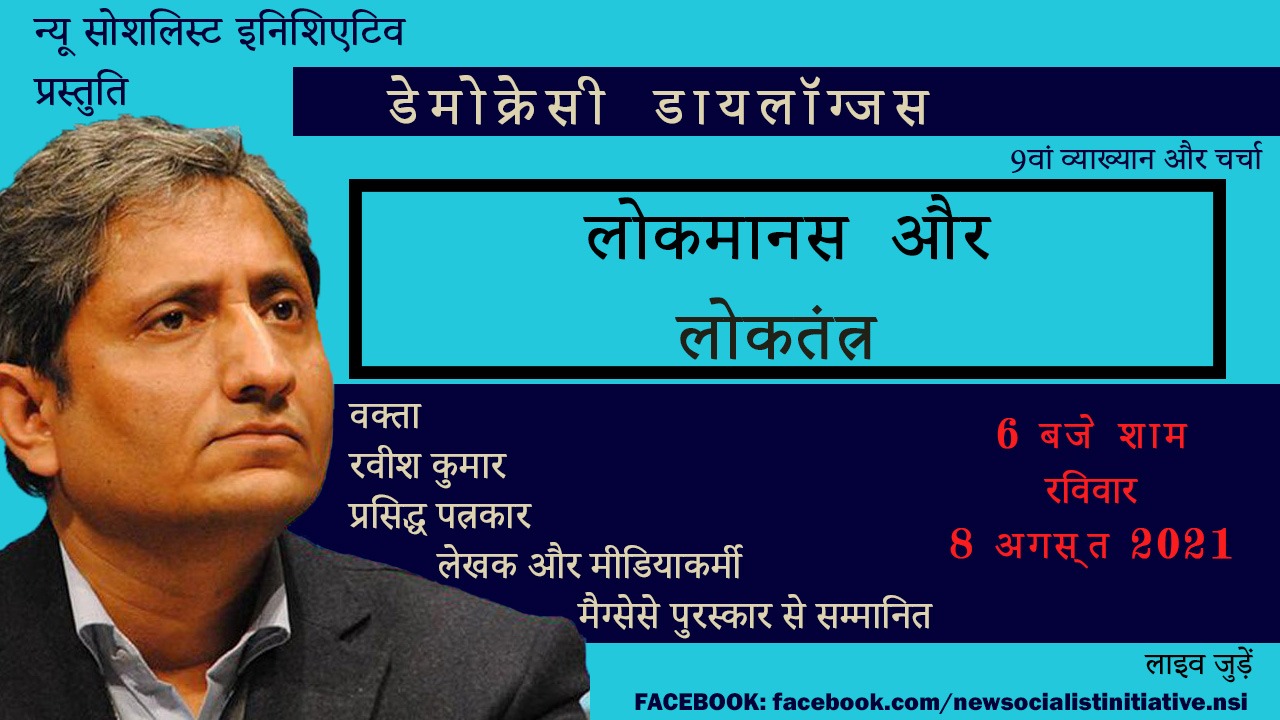
न्यू सोशलिस्ट इनिशिएटिव की तरफ से शुरू की गयी आनलाइन व्याख्यानमाला ‘डेमोक्रेसी डायलॉग्ज’ की अगली कड़ी में मेगसेसे पुरस्कार विजेता, प्रख्यात पत्रकार और विश्लेषक रवीश कुमार हमारे अगले वक्ता होंगे। आप सभी जानते हैं कि रवीश कुमार न केवल एक जानेमाने टीवी एंकर हैं बल्कि भारतीय राजनीतिक-सामाजिक परिदृश्य पर पैनी निगाह रखनेवाले निर्भीक लेखक हैं और साहसी टिप्पणीकार हैं।
इस अवसर पर व्याख्यानमाला में आए चार महिने के अंतराल के प्रति भी हम खेद प्रगट करना चाहते हैं। इस के पीछे एकमात्र कारण कोविड महामारी की दूसरी लहर के चलते भारत की जनता पर बरपा प्रचंड कहर और भयानक त्रासदी ही है। हम सभी इस विभीषिका के गवाह रहे हैं और हममें से कइयों ने इस दौरान अपने आत्मीयों को, अपने दोस्तों-मित्रों को या अपने पड़ोसियों को खोया है। हमारे इर्द गिर्द मची इस तबाही के बीच व्याख्यानमाला के आयोजन को जारी रखना हमें मुनासिब नहीं लगा था।
रवीश चाहते हैं कि उनका व्याख्यान संवाद नुमा और बातचीत की शक्ल में हो। हमें पूरी उम्मीद है कि आप भी न केवल इस बातचीत को सुनना चाहेंगे और उसमें शामिल भी होना चाहेंगे। कार्यक्रम फेसबुक लाइव होगा।
कार्यक्रम का विवरण इस प्रकार है :
न्यू सोशलिस्ट इनिशिएटिव
प्रस्तुति
डेमोक्रेसी डायलॉग्जस
9 वां व्याख्यान और चर्चा
विषय : लोकमानस और लोकतंत्र
वक्ता :रवीश कुमार
प्रख्यात पत्रकार, लेखक और मीडियाकर्मी , मैग्सेसे पुरस्कार से सम्मानित
Accountability is foundational to democracy and, ultimately, people are supposed to take those in power to account through democratic processes and mechanisms. But, then, we also know what often happens in democracy. Electoral competition gives rise to ‘technologies’ (often religious, cultural and identity-based) which turn citizens into “Bhakts” (devotees) and storm-troopers (remember Hitler’s “Brownshirts”). The dark side of democracy comes on top more often than the other side. India is witnessing that disaster. Trump was a testimony to the same phenomenon in the United States.
But what about movements? Are they also supposed to be accountable to someone or something? One would presume that movements are accountable to their own missions, values, objectives, arguments and strategies. Is anyone taking the movements to account on that score?
One would imagine that the left movement has been taken sufficiently to account all over the world. So much so that, for most people, there is no longer any need to take it to account. In many eyes, it is finished. Why waste time on something that is finished? And yet, the most curious thing is that the left remains the favourite whipping boy of most other movements and their intellectual luminaries. Here in India a favourite pre-occupation of Dalit intellectuals is to expose the Savarna (upper caste) hegemony over the left movement and many feminists focus on the misogyny of leftists. As if in a survey of the Indian society, leftists have come on top as the most likely and most numerous perpetrators of oppression and violence against Dalits and women! There is no denying that left must be taken to task for all its ills and all its failings. But, should a movement that is often pronounced dead be the prime example when it comes to evaluating movements?
The Bahujan Samaj Party (BSP) in Uttar Pradesh has declared that it would be the party that would actually build the Ram temple. This party is openly and loudly appealing to Brahmins as a caste to come into its fold. Babasaheb Ambedkar famously talked about annihilation of caste and declared that there is no scope of Dalit liberation under Hinduism. This irony is not confined to BSP. A Dalit is submissively the President under the current dispensation and an ex-Dalit Panther is a minister. All this can be explained away as pragmatic responses to the demands and rigours of democracy. But what about the movement itself? What about Ambedkar’s mission?
The question goes far deeper. Why is it the case that Hindutva has been able to make such inroads into Dalit communities? In what ways and to what degrees the ‘Hindu civilizational mind’ sits within the ‘Dalit cultural mind’? Why is it the case that in Gujarat carnage and elsewhere Dalits have been as much and as willing a part of the Hindutva “Brownshirts” as any other community? Why is it the case that an occasional Dalit leader who emerges as a fiery meteorite in the aftermath of a gruesome atrocity disappears as fast from the social and political horizon and the masters of the electoral machinations remain as much in control of the actual political arena?
One hopes that the theorists of social movements – from Columbia and Harvard Universities to JNU and Osmania – are earnestly grappling with this puzzle. We all know the simple and common-sense answers, but they do not suffice. The puzzle needs a deeper explanation. How long the intellectual prophets of the social movements remain content with celebrating the history and the survival of these movements? How long will Dalit writers remain content with asking the caste lineage of other (Savarna) writers and denouncing them for the surnames they use? How long will they be content with demanding monopoly over literary depiction and theoretical explanation of Dalit life and experience? Real questions and real challenges remain unattended.
Several courts have tried to reign in states bent on holding religious events during the pandemic. Judiciary must more proactively prevent them as the third wave approaches.
Simple things need retelling when society is in a state of flux. The fact that India is a republic—has been one for more than 70 years—where sovereignty rests with the people and not with scriptures is one fact. That India runs by its Constitution and laws under it is another fact.
The Uttarakhand High Court reminded the state government of these facts when it objected to proposals to live-stream the historic Char Dham Yatra on the plea that the scriptures do not sanction it. The court rejected the petition, saying India is a democracy where the rule of law, not religious texts, govern.