All posts by Nivedita Menon

National Alliance of People’s Movements condemns killing of Anti-Sterlite protestors

NAPM demands Court – monitored Judicial Inquiry by Retired Apex Court Judge & action against senior political leaders, officials responsible for the massacre. Demands that Government of Tamil Nadu must ensure permanent shut down of old and proposed units of Sterlite.

National Alliance of People’s Movements (NAPM) strongly condemns the brutal gunning down of over 11 citizens including a 17 year old girl and violence on more than 60 persons by the Tamil Nadu Police, during the mass and largely peaceful protests against the Sterilite Copper Plant of Vedanta Pvt. Ltd. in Thoothukudi, Tamil Nadu. It is know that the people of Thoothukudi have been protesting against the pollution of ground water and air by the copper smelter for years. This current phase of protest started in early march when the expansion of Sterlite plant to double capacity was announced.  On the 100th day of protest i.e. 22nd May, against the Sterlite copper unit Ltd, thousands of people of Thoothukudi took out a pre-announced march towards the Collectorate. The march was to reiterate their demand to shut down the existing copper smelter, causing severe pollution and health hazards. Over 10,000 people – men, women and children marched to meet the collector. Continue reading National Alliance of People’s Movements condemns killing of Anti-Sterlite protestors

Letter from former civil servants to Chief Secretary, Haryana on intimidation of Muslims offering namaz

Former civil servants have written open letters since 2017 (here and here), expressing their anguish at the unchecked attempts to spread hatred and discord among communities. Eleven of these civil servants have now written (on May 7, 2018) to the Chief Secretary of Haryana on the issue of harassment and intimidation of Muslims offering namaz in Haryana, by vigilante groups.

To Shri Depinder Singh Dhesi IAS,  Chief Secretary, Govt of Haryana.

Dear Chief Secretary,

We write to draw your attention to an urgent problem.

Over the last one month, Friday namaaz offered by the Muslim community in open spaces have been attacked and disrupted at several locations in Gurgaon district. These attacks have been organised by a dozen or so organisations (including the Vishwa Hindu Parishad, Bajrang Dal, Hindu Kranti Dal, Gorakshak Dal, Hindu Jagaran Manch and Shiv Sena) that have come together under the umbrella of the Hindu Sanyukt Sangharsh Samiti.

The attacks are coordinated, violent and clearly designed to terrorise and intimidate and are taking place across the district. Last Friday a group of hoodlums arrived in four jeeps at a namaaz venue on MG Road and started shouting abusive and provocative slogans at the assembled namaazis. Although a police force was present, it took no action to stop the sloganeering and threats. On the contrary, the police asked the namaazis to disperse. At a namaaz in Sector 40, the Imam who was leading the prayers was pushed to the ground. People who came for the prayers had no option but to fold up their mats and leave.

Continue reading Letter from former civil servants to Chief Secretary, Haryana on intimidation of Muslims offering namaz

Media professionals protest against government proposal to regulate online media

In a letter to Ms Smriti Irani, Minister of Information & Broadcasting, a group of over 100 journalists and other professionals related to online media  expressed concern over the government proposal to extend traditional broadcasting rules and restrictions to the Internet. This could have a drastic impact on a medium that is widely credited with making the media and information landscape more open and democratic across the world, their letter said. 

A website, https://onlinefreedomfoundation.org, has also been set up to allow ordinary citizens to oppose the move to regulate online content.

Letter to Minister of Information & Broadcasting

We are a group of Indian citizens who depend on the Internet to gather and share information on a daily basis.

We have come to know that this ministry has issued an order dated Apr 4, 2018 seeking to establish content regulations for the Internet modeled on those applicable for traditional media like print and TV. This letter is to place on record our feedback on the said order.

In the order, you make the following statements: Continue reading Media professionals protest against government proposal to regulate online media

Impeachment of Chief Justice of India – what is the real danger to democracy? Bobby Kunhu

Guest post by BOBBY KUNHU

Yesterday, on 23rd April 2018, the Vice President of India and the Chairperson of Rajya Sabha declined to admit an impeachment motion against the Chief Justice of India, thereby setting a dangerous precedent that scuttles a constitutionally mandated provision to ensure judicial accountability. There are two things that this action signifies. First, the rumors of the executive subverting judicial independence gains credence as the executive has refused to endorse a Parliamentary enquiry into the same. Second, it provides the needed impunity for any judge to act in any manner she deems fit as long as she curries favor with the executive.

It is the hegemonic notion of maintaining patriarchal, feudal and caste status quo that wants to protect powerful institutions and people from being accountable – and imagines it a scandal if an alleged  wrongdoing is investigated. The archaic common law maxim; rex non potest peccare (the King can do no wrong) is rooted in this. The illogical reprimands and criticisms against the attempted impeachment motion against the Chief Justice of India need to be examined in this light. Continue reading Impeachment of Chief Justice of India – what is the real danger to democracy? Bobby Kunhu

On Not Having Sindh – Reflections on an Irredentist Anthem: Sajan Venniyoor

Guest Post by  SAJAN VENNIYOOR

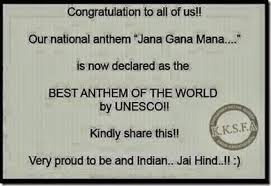
Hoax claim that circulated for a while

(Image added by Kafila for no good reason)

Every once in a while, it dawns on an Indian citizen that, among the list of provinces of British India thoughtfully provided by Tagore in our national anthemSindh is an anomaly.

Sindh was a fairly significant part of the British Empire ever since it was absentmindedly conquered by General Napier in the 1840s. (He is believed to sent his superiors a brief message on the conquest, Peccavi, Latin for ‘I have sinned’, which is to say, Sindh. The man was an insufferable nerd).

However, the Partition of 1947 placed Sindh on the wrong side of the Indian border, and its continued presence in the national anthem does not sit well with some Indians. “Why Sindh?” they ask plaintively. “Why not Rajasthan or Jammu & Kashmir? What about the North East States? Isn’t it time we rewrote Jana Gana Mana to reflect our current political realities, etc?”

Passing lightly over the fact that replacing ‘Sindh’ with ‘the North East States and Sikkim’ would play hell with the scansion of the disputed line, there are apparently very good arguments for not tinkering with Jana Gana Mana as it has stood from 1911.  I have only the haziest notion of what these arguments are, but among other things, we are told it would “disregard its existence as a poem by Rabindranath Tagore and an associated ethic that you do not take other people’s poetry and make changes to them.” Continue reading On Not Having Sindh – Reflections on an Irredentist Anthem: Sajan Venniyoor

JNU Faculty Stand With The Women Students Of SLS

We, the undersigned teachers of Jawaharlal Nehru University, are deeply distressed to read about extremely grave allegations of moral turpitude against Prof. Atul Johri, amounting to charges of sexual harassment, academic dishonesty, and financial misappropriation. We now hear that seven women have made police complaints. Coming on the heels of recent media stories that Prof. Johri was involved in the forgery of assent by leading scientists in a signature campaign, we are appalled by the university’s silence about an individual that it has vested with so many offices. Prof. Atul Johri is the Director of the University’s Internal Quality Assurance Cell, the Director of the Human Resource Development Cell, a warden, and the Vice-Chancellor’s favourite nominee on several committees.

We demand that Prof. Johri be immediately removed from all these positions, as the allegations against him bring great disrepute to the university. We expect the university to take all the requisite measures to investigate the charges that may be brought against Prof. Johri and to pursue them to their logical conclusion.

As faculty who have fought for and long supported the GSCASH, which this administration has shut down, we are distraught that complainants have had to take charges that should have been pursued within the institution to the police, because of a lack of faith in the university’s internal complaints committee nominated by the Vice Chancellor. We support the complainants’ exercise of their rights to approach the police, but rue the fact that the illegal and immoral dissolution of GSCASH has resulted in a situation in which no aggrieved person seems to have any faith in the delivery of justice within the institution on matters of sexual harassment. This is the second such case when allegations about sexual harassment have been filed under the IPC, because complainants do not have faith in the autonomy, impartiality, and commitment to complete confidentiality of the JNU ICC. We would like to emphasise the complainants’ rights to approach the police with their complaints must be respected and protected, and that the complainants must be given full protection against victimisation and full cooperation by the university authorities in pursuing their complaints.  Continue reading JNU Faculty Stand With The Women Students Of SLS

In the wake of the AUD report

This post is not a statement from the Kafila collective, but my individual response to the news about the Ambedkar University report having found Lawrence Liang guilty of sexual harassment. This response will also address some of the comments that were posted on the Kafila statement posted yesterday.

We learnt from media reports that a duly constituted committee of AUD has found Lawrence Liang guilty of sexual harassment. We did not know about this earlier, as some characteristically self-righteous and ill informed twitterati assume we did. Those whose social concern and activism is limited to busy fingertips obviously have no idea about the processes that have been carefully put in place in sexual harassment policies in universities, which protect confidentiality primarily to protect the complainant. So the first we heard of the leaked AUD report was from the media. Lawrence’s own statement was then issued that says that he plans to appeal this decision. This statement too we saw in the media.

From enquiry to report to appealing the decision (which can be done by complainant or accused) – these are all established stages of due process that feminists have worked for decades to establish, from the Vishakha judgement of 1997 onwards. That judgement itself was a result of feminist intervention. I do not understand ‘due process’ as a technicality alone, nor do feminists in general who have worked with women and men complainants on this complicated issue, especially in a context of power in academic contexts. Continue reading In the wake of the AUD report

Exposing the mirage of ‘Modicare’: Jan Swasthya Abhiyan

Statement by JAN SWASTHYA ABHIYAN

The Union Budget 2018-19 makes tall claims, with no clear road map for the health sector, one that is sensitive to the needs of the poor and the vulnerable population of India.

The allocations for Ministry of Health and Family Welfare (MoHFW) (including for AYUSH) have increased from Budget Estimate of Rs. 50,281 crore in 2017-18 Rs. 56,226 crore in 2018-19.

However, from 2017-18 (Revised Estimate) the increase is much lower, a mere Rs. 1374 crore, or just about 2.5 percent. This is a decline in real terms if we account for inflation, and Union Budget allocations for the health sector have stagnated at 0.3 percent of Gross Domestic Product (GDP). The 2017 target of National Health Policy (NHP) is 2.5 percent of GDP as health expenditure by the Government (both Centre and States) by 2025. However, with central allocations stagnating at the current 0.3 percent of GDP, it would not be possible to achieve this target.

The ‘Modicare’ mirage

Continue reading Exposing the mirage of ‘Modicare’: Jan Swasthya Abhiyan

International Mother Language Day: Ayesha Kidwai

Guest post by AYESHA KIDWAI

Happy International Mother Language Day. This day, declared by UNESCO, is straight up South Asia’s alley as it celebrates linguistic diversity and multilingualism. In other words, it celebrates each Indian.

Here’s what you can do from now on to celebrate it:
1. Resist Hindi imposition. An official language is not the national language. Persian was the language of administration for close to three hundred years, Sanskrit has been the language of knowledge for close to two thousand years, but neither were the only languages in the room. And we know what happened to those languages over time.

2. Defend diversity: Understand that, as in nature, numerical strength is not might (e.g., there may be more cockroaches in the world than humans), so if you belong to a large group of people, then this doesn’t mean that your language is better and more representative of the ‘heart and soul’ of ‘Indianness’. In India, literally hundreds of languages with populations ranging between 500 to 10,000 have flourished (many reported over all the Census) because

(a) mothers and fathers speak the language to their children in their homes beyond their school years, and Continue reading International Mother Language Day: Ayesha Kidwai

The Vice Chancellor of JNU has lost all moral authority: A dossier of misdeeds

SEE UPDATE AT END OF POST, ADDED ON FEBRUARY 20, 2018

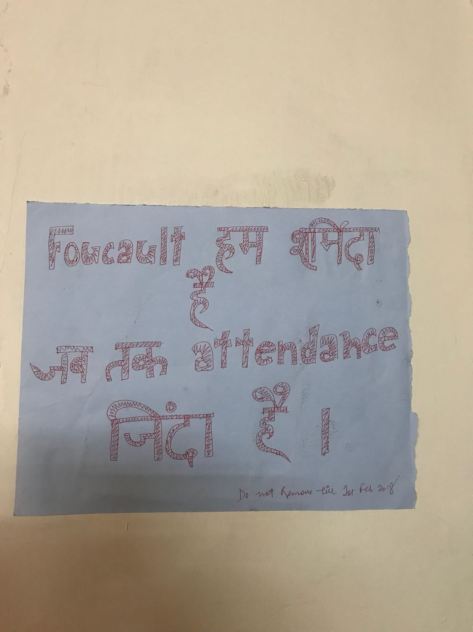
Student poster displaying a clear understanding of Foucault and surveillance. Compulsory attendance is really not needed at JNU!

Let us begin with a basic fact. The diktat on compulsory attendance in JNU is only a symptom of the larger, continuing crisis created by the utterly dictatorial style of functioning of this Vice Chancellor.

Professor Mamidala Jagadesh Kumar has, since his taking over in January 2016:

  • openly flouted every statute and regulation of the university
  • shut down admissions almost entirely for the 2017 academic year
  • violated the law of the land, that is, constitutional provision for reservations
  • failed to implement JNU’s Deprivation Point system that attempts to bring about representation for students from a diversity of class, regional and caste backgrounds
  • shut down the country’s oldest functioning Committee on Sexual Harassment (GSCASH)
  • brazenly cooked up and manipulated Minutes of meeting after meeting of the Academic Council and
  • treated faculty and students of JNU as his enemies to be defeated by the naked use of authoritarian power.

Continue reading The Vice Chancellor of JNU has lost all moral authority: A dossier of misdeeds

His Smile Matters Too: Vikas Bajpai

Guest Post by VIKAS BAJPAI


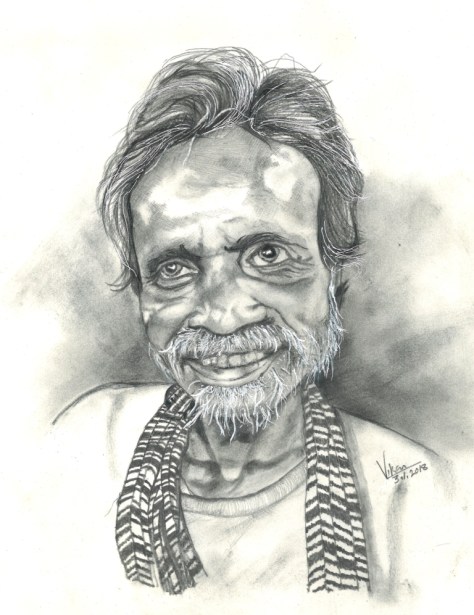
Ram Teke Bhoi, rickshaw puller from Puri, Odisha

My search for Mr Bhoi, whose sketch I present above, had started on the 1st of January 2017. It culminated sometime around the middle of May 2017 in Puri while on my sojourn to the state of Odisha for conduct of Jawaharlal Nehru University’s entrance exam. Between these two points in time I shall try to weave a tiny story, albeit a true one, of the hundreds of millions of our country’s women and men who live by the sweat of their brow but are expected to remain content with the brow beatings they get in return. Mr Bhoi to me emerges as emblematic of this goings on.

In the last week of December 2016 our ‘twosome awesome’ daughters – Moozna and Amaira, my wife and I had been on a vacation to Meghalaya. On our return back home we decided to have a teat-a-tea with the rhinos at the Kaziranga National Park. Kaziranga in itself was a tame affair and is not relevant to the narrative I attempt to weave here. Rather your attention is solicited for something that transpired on our way back to Guwahati from Kaziranga.

Continue reading His Smile Matters Too: Vikas Bajpai

Development Outcomes And Politics in Gujarat: Atul Sood

Guest Post by ATUL SOOD

Development is back in focus after the endless noise about cow protection, nationalism, Hindu-Muslim, janeus, Shiv Bhakti, Gorakhpur governance, casteism, love jihad, enemy nation and the rest. Why this talk about development now? Perhaps the dissent and protests on the ground by various sections in Gujarat in the last few years have compelled even the diehards to acknowledge (Mr. Amit Shah recently said ‘It is not my point that the issues raised in those agitations are not an issue’), that something is deeply problematic about the “Gujarat Model of Development”. The ASHA workers have taken to the streets demanding a living wage, regularized working hours and social security; dalits are no longer silent about the violence, indignity and intimidation heaped upon them; displaced families from Sardar Sarovar Dams have occupied streets seeking rehabilitation; farmers are demanding reprieve from a crisis to which they have had no hand in creating; tribals and evicted farmers are protesting against showpiece infrastructure projects which have meant their displacement and destruction of human habitations; and the youth from cultivating castes are seeking guarantee for jobs.  The list is continuing.  

Continue reading Development Outcomes And Politics in Gujarat: Atul Sood

Was the ‘Dancing Girl’ of Mohenjodaro actually a warrior?

NAMAN AHUJA, art historian, asks an exciting question that reminds us that the interpretation of artefacts, indeed, interpretation as such, is inevitably framed by the context of the viewer, and therefore always open to rethinking.

The image below is one that we are all familiar with, the exquisite sculpture of the ‘Dancing Girl’ found at Mohenjodaro.

Naman Ahuja, speaking to Anindita Ghose, suggests that the reading of this image as a dancing girl can be attributed to a perspective arising from the normalizing of patriarchal values prevalent in contemporary society. Ahuja offers an alternative reading that is much more persuasive:

The figure has bangles all the way up her left arm but her right arm is bare, as any working person would have it. A decorated left arm and a bare right arm free for labour…or for war? If she was a dancing girl by profession, surely it would have been relevant to keep both arms decorated? Look at the way she is standing. Look at her confidence. One arm on hip. Head thrown back. The way her hand is sculpted, there might have been a spear in her hand. Is she a warrior figure? Could she be a soldier rather than a dancing girl?

I can’t wait for this exhibition, India And The World: A History In Nine Stories,  to come to Delhi!

Nightmarish Visions – Indian government proposal for ‘Institutions of Eminence’: JNUTA

Statement by JNU Teachers’ Association

In early November, the JNU administration forwarded to all Centres/Special Centres/Schools, the Government of India proposal to establish twenty “Institutions of Eminence” to achieve world class status, from amongst the existing Government/Private institutions and new institutions from the private sector. It conveyed its intentions to submit an application to the UGC under the scheme and has asked Centres/Special Centres/Schools to provide comments on Part-1 – III [Vision for Institute of Eminence], Part-1 – IV [proposed fifteen year strategic plan], and Part-1 – VI [Proposed five years implementation plan] of the attached proforma.

This note from JNUTA is first to direct colleagues’ attention to the serious debate that this GoI plan has occasioned, in a country where higher education has simply failed to deliver in terms of access, quality, and justice — with a Gross Enrolment Ratio of just 20.4, as per the All India Survey of Higher Education (2013), it is the responsibility of educationists to query whether an outlay of Rs. 10,000 crore on ten institutions is warranted in the first place. (Please see the following pieces in favour of the proposal, and against it, in particular). Given that the goal of this whole initiative is a limited one of achieving a breakthrough into the world top 100 rankings, the teaching community must thoroughly discuss what rankings are good for anyway, and what significance the term ‘world class’ truly signifies, if the goals of education are essentially humanist and necessarily inclusive in character.

Continue reading Nightmarish Visions – Indian government proposal for ‘Institutions of Eminence’: JNUTA

Statement by concerned citizens on the continued incarceration of Hadiya

We, the undersigned concerned citizens, are greatly disturbed by news reports of the NCW in-charge, Rekha Sharma’s visit to meet Hadiya at the home of her father, Mr. Asokan, where she continues to be incarcerated. These reports raise more fears than they allay.

Ms Hadiya has been reported by Ms Sharma to be ‘healthy and happy’. However, Ms. Sharma goes on to state, without providing any evidence whatsoever, that while there is no ‘love jihad’ in Kerala, there are forced conversions.

It bears reiteration that Ms. Hadiya is a twenty four year old adult woman, who took a decision to convert to Islam, and then to marry a Muslim man. For this exercise of self determination, Ms. Hadiya has been placed under house arrest in her parents’ control, and this shocking violation of Ms. Hadiya’s personal liberty and her right to take decisions about her own life, has been endorsed by the legal system.

Continue reading Statement by concerned citizens on the continued incarceration of Hadiya

#whatnow? Ponni

THIS POST IS WRITTEN BY PONNI

To all the men, women, and all those of named and unnamed genders in my life, intimate, private and public, who have shown me safety, joy, pleasure, comfort and love and who ask of me, gently, the same. I love you all.

I was raped when I was 14, Or maybe 15. Not sure. It took me three years to realise it happened. Another ten to choose to begin to deal with it. And another six to realise the details and extent of what happened. And so, the process continues. Far from over. So yeah, #metoo.

When I moved to Delhi I called home crying everyday, not only because I didn’t know Hindi and everyone chided me by calling me madrasi, but because I got sexually harassed everyday. It wasn’t the ‘far away’ whistling kind I was used to in Chennai. I saw penises from unzipped pants in the crushing closeness of Delhi buses. Again, on the bus, I had men masturbate on my shoulders and am still showering to get it off me. So yeah, #metoo.

Once I was older, I acquired some ‘power’ (by my standards) – people had heard of my name from publications, activist work – I was accused or it was implied that I could have sexually harassed or abused two women at two different times. I was in romantic relationships with them. Neither one made the accusation public. Neither one of them were my equals in age, or cultural capital. One of them got in touch many years later and tried to establish a friendship again while implying that she never meant to make me feel that way. But I was too scared to even respond. The other was much closer to me and so I said more and she said more to me. She was the one I had a physical relationship with. I will never forget that feeling of power, enormous self doubt, and painful reflection. I will always ask myself what my intentions were, how I may have expressed them and why I wasn’t able to negotiate power in a way that was adequately and appropriately dignified, respectful, kind and most importantly equal-ising.

Continue reading #whatnow? Ponni

Statement Condemning BJP Appropriation Of Muslim Women’s Voices: Bebaak Collective

We, as Bebaak Collective (Voices of the Fearless), are writing this statement unequivocally condemning  the comment made by the BJP leader Subramanian Swamy in an event in Mumbai on Friday, 27th October that the party could win in Uttar Pradesh elections because Muslim women believed that it was BJP who could save them from ‘triple talaq’. (See, “Muslim women felt only BJP could save them from triple talaq says Swamy” Indian Express, 28th October) BJP leaders have time and again celebrated the victory of the recent judgement that invalidates the instantaneous practice of triple talaq and the leadership have often claimed the victory to itself, strategically pointing out the silence of the Congress government during the Shah Bano case.

Continue reading Statement Condemning BJP Appropriation Of Muslim Women’s Voices: Bebaak Collective

Say NO to Aadhar – sign the petition

Sign the petition here.

Text of the petition

I’m Saying NO to Aadhaar

We the undersigned wish to place on record our opposition to the Aadhaar scheme which is being aggressively pushed by the government in complete violation of norms, procedures and Supreme Court orders. 

Many of us have resisted enrolment. Many of us are already enrolled. But today, we stand together to say NO To Aadhaar. 

We oppose Aadhaar because it violates our Constitutional rights and freedoms as citizens. 

We oppose Aadhaar because it undermines the foundations of our democracy, disempowering us as citizens while giving government the means to control every aspect of our lives. 

The mess created by Aadhaar is not a matter of poor implementation or “teething troubles” as claimed by the government.  Aadhaar cannot be fixed with some tweaking and tinkering. It is fundamentally flawed and  must be scrapped.      

We say NO to Aadhaar because  Continue reading Say NO to Aadhar – sign the petition

From Feminazi to Savarna Rape Apologist in 24 hours

Two explanations before I begin.

First – I write this in my personal capacity. In this article I represent none of the other signatories to the statement that appealed for the crowd-sourced list of sexual offenders to be withdrawn, and for complaints to be followed through institutional mechanisms (henceforward referred to as Statement). I might still use the pronoun ‘we’ sometimes, please consider that a slippage; that collective identity is something developed over three decades in a movement, and I hope I never lose that habit. But this is my individually written post. Similarly, after the Statement, Kavita Krishnan has written on Scroll, Ayesha Kidwai on Facebook and Nandini Rao on  her blog, each expanding on some aspect or the other of our brief statement.

Second – the Statement was not and is not a ‘Kafila’ statement, it was simply posted on Kafila. Just as a statement posted on Wire is not a Wire statement or a statement on Scroll a Scroll statement, unless explicitly declared to be. Kafila is a collectively run blog with about 20 members, of which I am one of the founder members. Any member of the collective can post directly on Kafila without checking back with other members of the collective. We have often had robust debates among collective members taking opposing sides on a situation, and these debates have played out on Kafila in the past. Only one Kafila member is a signatory to the Statement, myself. I posted it on Kafila because it is a site which is my first site of preference, whether I am attacking the Hindu right or writing on feminist issues. I asked the other signatories if I could post it here, since I have to ask nobody nor approach anybody to post on Kafila.

Lawrence Liang is also a member of the Kafila collective. He does not ‘run’ Kafila (as has been alleged by many), no individual does. But it seems that in this new era of ‘radical’ politics, individual control and leadership of campaigns is assumed.  Further, Mahmood Farooqui too was a Kafila collective member. When a specific complaint of sexual abuse and rape was brought against him by a complainant anonymous to us, the Kafila collective suspended him immediately from Kafila publicly, pending investigation of the complaint. That was the only collective statement Kafila has issued in its ten years of functioning as a voluntary, non-funded blog.

Continue reading From Feminazi to Savarna Rape Apologist in 24 hours

Statement by feminists on Facebook campaign to “Name and Shame”

As feminists, we have been part of a long struggle to make visible sexual harassment at the workplace, and have worked with the movement to put in place systems of transparent and just procedures of accountability. We are dismayed by the initiative on Facebook, in which men are being listed and named as sexual harassers with no context or explanation. One or two names of men who have been already found guilty of sexual harassment by due process, are placed on par with unsubstantiated accusations. It worries us that anybody can be named anonymously, with lack of answerability. Where there are genuine complaints, there are institutions and procedures, which we should utilize. We too know the process is harsh and often tilted against the complainant. We remain committed to strengthening these processes. At the same time, abiding by the principles of natural justice, we remain committed to due process, which is fair and just.
This manner of naming can delegitimize the long struggle against sexual harassment, and make our task as feminists more difficult.
We appeal to those who are behind this initiative to withdraw it, and if they wish to pursue complaints, to follow due process, and to be assured that they will be supported by the larger feminist community in their fight for justice.

Ayesha Kidwai

Brinda Bose

Janaki Abraham

Janaki Nair

Kavita Krishnan

Madhu Mehra

Nandini Rao

Nivedita Menon

Pratiksha Baxi

Ranjani Mazumdar

Sabeena Gadihoke

Shikha Jhingan

Shohini Ghosh

Vrinda Grover


Violence against women – two patriarchal judgements: Gargi Mishra and Shreya Munoth

Guest post by GARGI MISHRA AND SHREYA MUNOTH 

Do a woman’s attire, appearance, sexual history or prior relationship with a perpetrator of sexual violence constitute a valid defence for a perpetrator of a sexual offence? Does the meaning of consent vary for educated women? The law, as it stands, doesn’t permit these factors to be taken into account while adjudicating crimes of violence against women nor does it prescribe varying standards. Unfortunately, however, deeply ingrained patriarchal mindsets rear their ugly heads ever so often flouting express statutory proscriptions, most recently demonstrated by two judgments delivered in the last fortnight dealing with rape.

The Punjab and Haryana High Court suspended the sentences of three students granted by the trial court for the rape of another student. The basis for this suspension, amongst others, was the victim’s “misadventures and experiments”, her “promiscuity” and the absence of brutal violence accompanying the sexual assault. Close on the heels of this, the Delhi High Court, on appeal, acquitted Mahmood Farooqui, a filmmaker, overturning the trial court’s verdict of finding him guilty of rape having performed forced oral sex on a visiting woman scholar.  While so doing, the Delhi High Court purposively misinterpreted the position of law on what constitutes consent and seems to have been largely influenced by the victim’s previous relationship with Farooqui, her being educated (a “woman of letters”), the supposed feebleness with which she said ‘no’ to the sexual act, and the fact of Farooqui’s bipolar disorder. Continue reading Violence against women – two patriarchal judgements: Gargi Mishra and Shreya Munoth