All posts by Nivedita Menon

Don’t miss the Nigah Queer Fest in Delhi

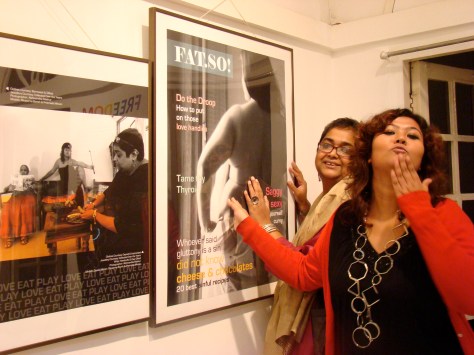
Artists: Neelima and Abhinandita

Models: (to put my nepotistic interests up-front) – my sister Pramada, my mother Devaki and friend Rituparna

This is just one panel of a visual arts exhibition at Max Mueller Bhavan, Delhi, and there are films and performances too. It’s on from 26th November to 5th December, 2010.

Check out the programme at http://www.thequeerfest.com/

25,000 Maheshwar dam oustees march in Madleshwar: Narmada Bachao Andolan

Thousands demand revoking of clearance and scrapping of dam

Press note from NBA

The Mandleshwar town resounded with the voices of 20,000 to 25,000 people (over 50% of them women) affected by the Maheshwar dam who marched through the town today, in defence of their rights despite the heavy rain, asking for rehabilitation and land, or scrapping of the dam. After marching through the main roads of Mandleshwar town, the oustees reached the Narmada River and after affirming and renewing their resolve to struggle against all odds, the people congregated in a huge public meeting at the local “Krishi Upaj mandi” in Mandleshwar. Continue reading 25,000 Maheshwar dam oustees march in Madleshwar: Narmada Bachao Andolan

On the November Massacres in Assam: Aruni Kashyap

This is a guest post by ARUNI KASHYAP

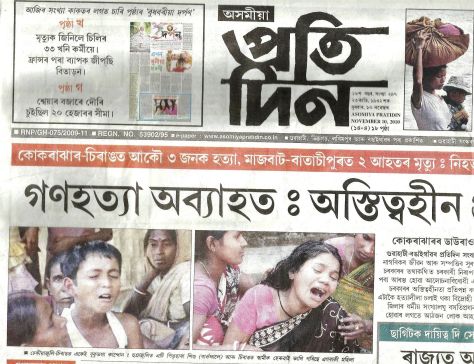
The front page of Asomiya Pratidin on 10 November

In the beginning of this month, the anti-talks faction of NDFB carried out a state-wide massacre of non-Bodos, mostly Hindi speaking settlers in Assam in a revenge-killing spree after Mahesh Basumatary, who allegedly was a cadre of NDFB, was killed by the Indian security forces in Assam’s Sonitpur district. The Bodo militant organisation claimed that the person was an innocent civilian and wasn’t linked to their organisation in any way while the security forces claimed otherwise. A recent report aired in a local television news channel DY365 records the victim’s family and his resident village’s viewpoint that matches with the claims of the NDFB. Continue reading On the November Massacres in Assam: Aruni Kashyap

Semester Fever – Is it curable?: Alok Rai

This is a guest post by ALOK RAIIt was first sent to the Indian Express which refused to publish it.

Deepak Pental’s inter-personal skills are, of course, legendary. And this last – his parting shot in Indian Express (28 October)merely strengthens his already formidable reputation, and ensures that he will be regarded with the customary affection even as he leaves. Thus, not only is the Teachers’ Association compared to a khap panchayat – could this conceivably be a compliment, either to his beloved teachers, or to the khap panchayats? – but an entirely gratuitous insult is directed at college teachers, en bloc. Thus, they are stagnant, distant from research, unlike (!) University professors. This is rich, but Professor Pental can manage his own friends and enemies, and I have no desire to engage with him at this point. However, this is being written in the hope that his successor – whoever he or she may be – would at least like to choose their own battles, and not merely fight inherited ones on the bloodied, toxic battlefield bequeathed to them. And, indeed, by way of doing my citizenly duty to assist the honourable judges of the High Court, who are periodically asked to take a stand on the vexed question of “semesterization”.

Continue reading Semester Fever – Is it curable?: Alok Rai

Anti-National Thoughts

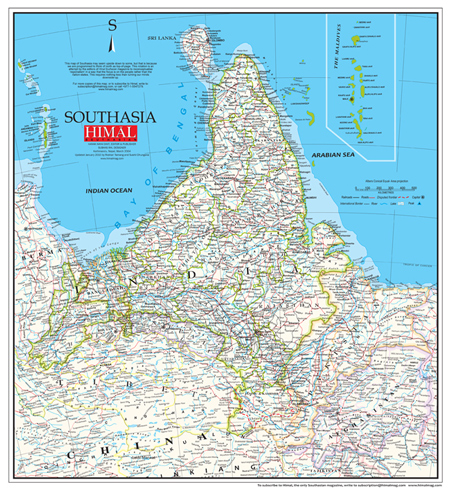
Himal Southasian's 'right-side-up' map. In their words: “This map of Southasia may seem upside down to some, but that is because we are programmed to think of north as top of page. This rotation is an attempt by the editors of Himal to reconceptualise ‘regionalism’ in a way that the focus is on the people rather than the nation-states. This requires nothing less than turning our minds downside-up.”

Nation-states have a logic of their own. So insidiously is this logic purveyed through the state’s institutions that it becomes common-sense, particularly among the educated. Perspectives that differ from this common-sense are then easily seen as signs of illiteracy, or more dangerously, treachery.

A woman employed for housework by a Pakistani living for a while in Delhi, could never quite understand where her employer was from. “Bahar se?” she would ask, “Amreeka se?” No, would come the patient reply: from outside, yes, but not from America, from Pakistan. Where is that? ‘Well, you know that “here”,  yahan is Bharat? India? Hindustan? I am from vahan, there, Pakistan, another country’. But yet again, the domestic help’s bewildered response – yahan matlab Dilli? Here, meaning Delhi?

Continue reading Anti-National Thoughts

Sedition: ‘The highest duty of a citizen’

Sedition: the attempt “to excite disaffection towards the Government established by law in India”, a crime under Section 124 A of the Indian Penal Code, a provision introduced by the British colonial government in 1860.

The only revisions to this colonial legal provision since its passing have been over the years, to remove anachronistic terms like “Her Majesty”, “the Crown Representative”, “British India”, “British Burma” and “Transportation for life or any shorter term”.

But it seems “Disaffection towards the government”, the archaic usage notwithstanding, is a timeless crime. Section 124A, therefore, these few cosmetic changes apart, has remained unchanged for the last 150 years.

Continue reading Sedition: ‘The highest duty of a citizen’

Sedition provision gags free speech: Barun Das Gupta

This is a guest post by BARUN DAS GUPTA

The detractors of Arundhati Roy have found a fresh casus belli against her for her recent speech (Oct. 21) in New Delhi, on Kashmir. The participants in the polemics include such intellectuals as Swapan Dasgupta, a journalist and a BJP leader. The burden of their criticism is that Arundhati should be arrested for sedition because by her speeches she has caused hatred and disaffection towards the Government and actually championed the secession of a part of India, that is, Jammu and Kashmir.

Let us examine this matter of “creating hatred and disaffection” towards the Government, not from the legal point of view but from the political point of view. Section 124A of the Indian Penal Code says: “Whoever brings or attempts to bring in hatred, contempt or excites disaffection towards the Government shall be punished ……” Before proceeding further, let us note that the concerned section speaks of “disaffection towards the Government”, without specifying whether by “Government” the Central Government is meant or the State Governments. Since there is no explanation, it may be inferred that “Government” means both Central and State Governments. Continue reading Sedition provision gags free speech: Barun Das Gupta

No to social apartheid! JNU students protest today against CWG ‘view cutters’


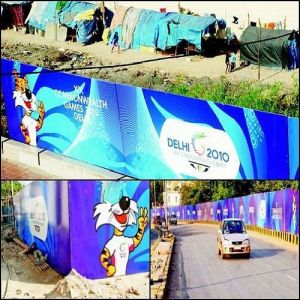
AP photo by Manish Swarup


Latest Indian addition to the English language: View cutter.
The government and civic agencies in association with the Commonwealth Games Organising Committee (OC) had identified several sites central to hosting the Games where view cutters were put up to conceal the eyesores as well as for security reasons.
A government official said one of the purposes to put up the view cutters was to screen the beggars who crowd major religious and historical landmarks.
The plan is to relocate the destitute to parks and surround the place with slick banners and paraphernalia sporting Games mascot Shera and other logos, the official said.
Protest March today, 13th of October, 4 p.m. from Ganga Dhabha to the slum dwellings at the Priya crossway. 


Leaflet issued by the joint protest committee, JNU

Friends, CWG 2010 is now almost coming to an end. The whole country has been in a celebratory frenzy for the last two weeks. The government has made the successful completion of these games an issue of “National pride”. They have left no stones unturned to impress the whole world. The same government which claims to have no money when it comes to the issues of drought, health and education has wasted thousands of crores on just the opening ceremony. It is distressing to see that while we are counting medals won by India, we have completely forgotten that there is a vast section of people who instead of benefitting are adversely affected during our blind celebration of this “colonial hangover”.

Continue reading No to social apartheid! JNU students protest today against CWG ‘view cutters’

The Ayodhya Verdict: Rohini Hensman

This is a guest post by ROHINI HENSMAN

Reactions to the Allahabad High Court verdict in the Babri Masjid case have varied widely, from triumphalism from some actors, through appeals for calm and hopes of reconciliation from others, to expressions of disappointment and dismay from yet others. This is partly a consequence of the complex character of the split verdict. On the issue of whether a Hindu temple had been destroyed in order to build the Babri Masjid in 1528, S.U. Khan, in a minority opinion, said that it was built on the ruins of a temple, but nothing was destroyed, while Justice D.V. Sharma and Justice S. Agarwal held that a Ram temple had been destroyed in order to build the mosque. On the issue of whether it was the Ram Janmabhoomi, Justice Sharma, in a minority judgment, ruled that the site was the birthplace of Lord Ram, and therefore the entire property should go to the Hindu litigants. The majority judgment of Justice Agarwal and Justice Khan stated that Hindus believed it was the birthplace of Ram, and divided the property three ways, giving one-third to the Sunni Waqf Board and two-thirds to Hindu litigants. The status quo was to be maintained for three months, during which the parties were free to appeal the judgment in the Supreme Court (Allahabad High Court 2010).

Continue reading The Ayodhya Verdict: Rohini Hensman

Nirmohi Akhara and Ram Lalla Virajaman: Susmita Dasgupta

[In this guest post, Susmita Dasgupta throws light on some important aspects of the Ayodhya issue that have been misunderstood. First, she argues that there is an anomaly in treating the Nirmohi Akhara as a “Hindu” group, when in fact historically, akharas (aakhra in Bengali) were gymnasiums associated with sects that were usually opposed to organized and/or textual religions like Hinduism and Islam and claimed themselves to be non-Hindus. More importantly, she points out that the worship of the child-God – Ram Lalla, or Balkishan – was an important ingredient of defiance against organized religion. The Hindu appropriation of Ram Lalla, she argues, is therefore the greatest anomaly in the case, and this is the anomaly, she suggests, that historians should have focused on.]

Archaeologists are divided over the issue of whether a Ram Temple at all existed under the dome of the Babri Masjid and the Muslim theologicians are divided over whether the Babri is a legitimate mosque at all because in Islam if a mosque is built over a heathen’s structure of worship then it is not fit for prayers. Historians from JNU are almost universally concerned that whatever the archaeology is, the mosque should remain intact as a historical monument. The secularists are upset that the fictitious Ram Lalla be accepted as a party to a dispute and every structure of the Muslims could be pulled down on the flimsiest belief that the land archaeologically belonged to the Hindus. Such a judgment would then be a precedent in pulling down every mosque in the land and may even cast aspersions on the continued existence of the Taj Mahal and Red Fort !! I, too share similar concerns.

Continue reading Nirmohi Akhara and Ram Lalla Virajaman: Susmita Dasgupta

Eight reasons why you should oppose Unique Identification: Stop UID Campaign

Drafted by KALYANI MENON-SEN for the Stop UID Campaign

AN APPEAL TO CITIZENS

The National Identification Authority of India Bill approved by the Union Cabinet on Friday has sidestepped critical privacy aspects relating to profiling and function creep — a term used to describe the way in which information is collected for one limited purpose but gradually gets used for other purposes.

Here are some reasons why you should oppose this Bill:

1. False claims

The Government of India and Nandan Nilekani, Chairperson UIDAI, have been claiming that the UID scheme will enable inclusive growth by providing each citizen with a verifiable identity, that it will facilitate delivery of basic services, that it will plug leakages in public expenditure and that it will speed up achievement of targets in social sector schemes.

Continue reading Eight reasons why you should oppose Unique Identification: Stop UID Campaign

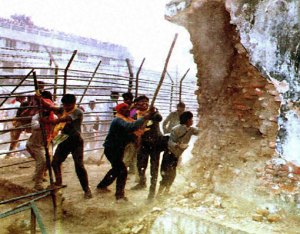
The Second Demolition: Ayodhya Judgement September 30, 2010

December 6, 1992

A shameful and shocking judgement.

I am shattered by what it does, by its implications for democracy, and by the statement it makes about what we can expect for the future.

My rage is growing with every statesman-like pronouncement from one pompous man after the other in the media, gravely holding forth on the maturity of the compromise that has been reached.

Continue reading The Second Demolition: Ayodhya Judgement September 30, 2010

Repeal AFSPA: Committee for the Release of Dr Binayak Sen Mumbai


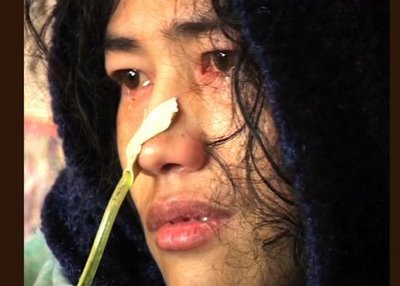
Irom Sharmila has been on a fast unto death for the repeal of the Armed Forces (Special Powers) Act (AFSPA) after troops of the Assam Rifles gunned down 10 civilians at Malom near Imphal airport on November 2, 2000. She is periodically arrested and force-fed by the Indian state.

Dear Prime Minister, Home Minister and Sonia Gandhi,

We have noticed a striking anomaly in the way the armed forces and the state treats the people of Kashmir and the Northeast. When contemplating the use of the armed forces in the forest belt, the armed forces and the state concluded (quite correctly, in our opinion) that they should not be used against the people of this region, including the Maoists, since ‘they are our people’. Yet the very same armed forces have no compunction about being deployed against the people of Kashmir and the Northeast, and the state agrees! Worse still, the armed forces insist that they cannot carry out their duties without AFSPA, which allows them to rape, torture and kill with impunity.

So what is happening here? Are the people of Kashmir and the Northeast not ‘our people’? This is indeed the message that comes across. And if these people feel that they are not regarded or treated as ‘our people’ by the state and armed forces of India, is it surprising that many of them do not want to belong to India?

In fact, AFSPA allows the armed forces to commit atrocities that would be considered war crimes even if they were directed at a foreign enemy. There is no justification for keeping it on the statute books, because it is incompatible with international humanitarian law. Its enforcement in these states has been one of the main reasons why there has been no resolution of the conflicts in them for decades. Consulting the armed forces about the repeal of a law that allows them unlimited power is worse than useless: why would they ever agree? Surely you ought instead to be consulting people like Irom Sharmila, who has been waging a heroic and totally non-violent struggle against AFSPA for ten years!

Shouldn’t the government be asking her why she is ready to sacrifice her life to get this law repealed? And taking her answer deadly seriously before she dies?

FROM
COMMITTEE FOR THE RELEASE OF DR BINAYAK SEN MUMBAI

Apni Dilli Unke Khel

Written, performed and directed by  ASUR (Narendra,  Rakesh, Archna  and Ravi)

The Banality of Shame

BANAL: everyday, ordinary, commonplace

SHAME: the  painful  feeling  arising  from  the  consciousness  of  something  dishonourable done  by  oneself  or another


Jana gana mana adhinayaka jaya he

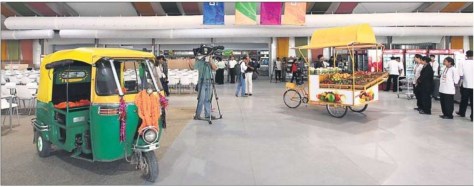
An auto-rickshaw and a street hawker’s pushcart as showpieces in the Commonwealth Games Village dining hall

* MCD to raze dhabas on Games route: It doesn’t matter if you are running your business legally or illegally. If your shops fall on the route of a Games event, chances are that you will have to shut shop. A shop and taxi stand in front of Bal Bhawan — which have been running for 20 years — were demolished by MCD on Saturday and the civic agency is planning to raze all dhabas  functioning along the stretch in the coming days even as the dhaba owners claim that they have been paying rent to MCD.

Continue reading The Banality of Shame

Rayana R Khazi and The Specter of Religious Fundamentalism in the Kerala Public Sphere: Jenny Rowena & K Ashraf

This is a guest post by JENNY ROWENA and K ASHRAF
Rayana R Khazi is a young student from Cherkalam in Kasargode. Recently she has been in the news after she came out to speak to the media about the threatening letters and phone calls that she was receiving, all of which demanded her to wear the Purdah. After Rayana’s revelations, media, human rights and feminist activists have rushed to her aid, starting off yet another round of anxieties about the growth of Islamic fundamentalism.  Even as we fully support Rayana’s need for a more livable life, it is also important that, at this juncture, we look at the numerous issues that this incident brings forth into the public sphere of Kerala.
Control of Women’s Bodies
In this controversy, one of the most important issues being raised is about the control of women’s bodies by male, religious fundamentalists in the Muslim community.  Such responses, be it from a reactionary, anti-Islamophobic perspective or from a more progressive view- point, which is aware of the rampant Islamophobia of our times, carries out a similar function in Kerala. Continue reading Rayana R Khazi and The Specter of Religious Fundamentalism in the Kerala Public Sphere: Jenny Rowena & K Ashraf

Building, dead bodies and the emergency decree in Thailand

This is a guest post with photographs by ANON.

Sunday 1 August 2010

Activists and people in the red shirt movement organized the event Building, dead bodies and the emergency decree at the memorial “14 October 1973”, a memorial built to remember those who died fighting against the dictator on that date.  This event was organized to raise funds to help the victims and their families, affected by the Thai government crack down during the pro-democracy Red Shirt Political protests in April 2010 and May 2010. Continue reading Building, dead bodies and the emergency decree in Thailand

POSCO Pratirodh Sangram Samiti to Jairam Ramesh

This is a press release issued last week by PPSS, pointing out the illegalities   being committed by the Orissa government and the Central Ministry of Environment and Forests in connection with the POSCO project.

POSCO PRATIRODH SANGRAM SAMITI

Dhinkia, Nuagaon, Gadkujang; Jagatsinghpur District, Orissa

11.08.2010

To:

Shri Jairam Ramesh

Minister of Environment and Forests

Paryavaran Bhavan

New Delhi

Sub: Regarding POSCO project – need for withdrawal of illegal final clearance; new Meena Gupta Committee clearly aimed at delaying matters Continue reading POSCO Pratirodh Sangram Samiti to Jairam Ramesh

University Community for Democracy on relay hunger-strike against CWG evictions

We have had an earlier post on the University Community for Democracy which was formed in the wake of the arbitrary and authoritarian eviction of students from the hostels of Delhi University for the Commonwealth Games, but which raises wider questions about the “reckless logic by which the city is being re-made”.

This is their latest press release, followed by their letter to the National Commission for Women.

University Community for Democracy

PRESS RELEASE 10/08/10

The University Community for Democracy is initiating a RELAY HUNGER STRIKE FROM  9 AM TO 9 PM, 12TH AUGUST THURSDAY ONWARDS at the Arts Faculty Main gate, North Campus. Each day there will be five people (teachers, students and researchers) who will be on a hunger strike, as well as many others who will sit in solidarity.

The University Community for Democracy has been challenging a number of decisions taken by both Delhi University and the government with regard to the commonwealth games for over a month now. The Forum is deeply concerned by the gross violations of rights that the city has witnessed in the name of the Games and condemns the irresponsible manner in which Delhi is being prepared for this mega- event.

Continue reading University Community for Democracy on relay hunger-strike against CWG evictions

A Dialogue with God and Dialogues that go missing

Guest post by SUDEEP KS and BOBBY KUNHU

On Sunday 4 July 2010, T J Joseph, a college lecturer, was attacked by a group of people on his way back from the church in Muvattupuzha in central Kerala, and his right hand was chopped off. We believe this heinous act deserves to be condemned, and that such acts pose a major threat to the secular fabric of the Kerala society.

The attack has attracted immediate media attention, and it is said to be related to a recent controversy over a question paper. Joseph, in his Malayalam question paper, had asked one question that apparently hurt the religious sentiments of some people.

The Kerala society’s response to this whole episode has been equally disturbing. Pinarayi Vijayan, state head of Communist Party of India (Marxist), calls it ‘Talibanization of Kerala’. It has been made out to be a question of ‘freedom of speech’. The media, politicians and intellectuals are busy expressing serious concerns over a ‘religion’ that is intolerant and fanatic. The Police has also let out suspicions on some groups involved in this incident, and both the television and print media have been religiously reporting it. Continue reading A Dialogue with God and Dialogues that go missing

Swami & Friends: JTSA’s response to Praveen Swami

The story so far…

Jamia Teachers Solidarity Association was  formed after the so-called “encounter” at Batla House in 2008, in which two students of Jamia Millia Islamia were killed. You may remember posts on kafila at the time, questioning the credibility of police accounts of the “encounter” and criticizing the unethical nature of media coverage:

A little less melodrama, a lot more forensics;

The Jamia Nagar encounter: Curiouser and curiouser;

Shame is a revolutionary sentiment;

Some questions about the Delhi encounter.

In April this year, JTSA, which has been demanding an independent probe into the encounter, issued a statement after the post mortem reports of Atif Ameen and Md. Sajid were made public, revealing that the two boys were not  killed in cross fire as Delhi Police claimed:

Batla House ‘Encounter’: Whom is the JP Trauma Centre Shielding?

On April 25, 2010, Countercurrents published another statement by JTSA, titled Praveen Swami’s Not so Fabulous Fables, which began thus:

“If there is one infallible indicator of what the top Indian Intelligence agencies are thinking or cooking up, it is this: Praveen Swami’s articles. Each time the security establishment wishes to push a certain angle to this bomb blast or that, Swami’s articles appear magically, faithfully reflecting the Intelligence reports. After the Batla House ‘encounter’, he launched a tirade against all those who were questioning the police account of the shootout labeling them all ‘Alices in wonderland’. He went so far as to identify ‘precisely’ how Inspector Sharma was shot by claiming that “abdomen wound was inflicted with [Atif] Amin’s weapon and the shoulder hit, by Mohammad Sajid”.

And no sir, Swami’s conclusion was not based on post mortem reports of the killed, fire arm examination report or ballistic report but on this innocent fact: “the investigators believe that…” He certainly brings in a whole new meaning to ‘investigative journalism’. Swami however felt no need to pen an article when the postmortem reports of Atif and Sajid revealed that they had been shot from close range and that neither of them sustained gunshot wounds in the frontal region of the body—an impossibility in the case of a genuine encounter. Was it because the police and the Home Ministry chose to remain quiet after the revelations—hoping that the storm would quietly blow over?
Praveen Swami wrote an injured response via a letter to Annie Zaidi, which too was published on Countercurrents.
And now read on, as JTSA responds to Swami.

Continue reading Swami & Friends: JTSA’s response to Praveen Swami