Category Archives: Bad ideas

The Twitter Gherao of Mamidala90 on the 10th Day of Najeeb Ahmed’s Disappearance from JNU: Shehla Rashid

Guest Post by Shehla Rashid

[ Between the 9th and 1oth day of the disappearance of Najeeb Ahmed from the JNU campus, the JNU Vice Chancellor, Mamidala Jagadesh Kumar decided to salvage his reputation on twitter, even as he squandered it on the grounds of the campus of the university he presides over. And so he let forth a volley of tweets, while sitting inside his office and his residence, even as he refused to meet or listen to the JNU students who have grown increasingly concerned and anxious at the university administrations callous laxity about the fate of Najeeb Ahmed, the missing students.

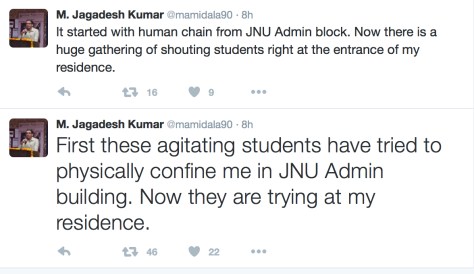
While students marched down the campus, forming a human chain that culminated at the gates of the VC’s residence near the university’s east gate, Mamidala90 (the handle with which the VC distinguishes himself in twitsville) began getting extremely active. While the students were peacefully assembled at the gates of the VC’s residence, very much not in ‘gherao’ or ‘blockade’ mode, Mamidala90 whined about being ‘blockaded’.

A Sample of Mamidala90's tweets while students gathered peacefully outside his residence. Is this what it felt like to hear Nero fiddle while Rome burnt?
A Sample of Mamidala90’s tweets while students gathered peacefully outside his residence. Is this what it felt like to hear Nero fiddle while Rome burnt?

Continue reading The Twitter Gherao of Mamidala90 on the 10th Day of Najeeb Ahmed’s Disappearance from JNU: Shehla Rashid

Bring Back Najeeb Ahmed to JNU: A Call to Resist Terror in Universities

14615765_679911288839993_8711625822412574391_o-1

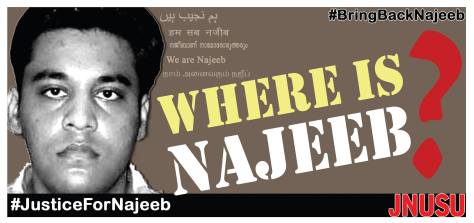
It is now more than a week since Najeeb Ahmed, an MSc (first year) student of Biotechnology at Jawaharlal Nehru University, Delhi has been reported missing, after an altercation with members of the RSS affiliated ABVP student organization, which reportedly left him injured and severely traumatized.

Continue reading Bring Back Najeeb Ahmed to JNU: A Call to Resist Terror in Universities

Ezhuka Tamil – A Conversation about Democracy :Dharsha Jegatheeswaran and Gajen Mahendra

This is a guest post by DHARSHA JEGATHEESWARAN AND GAJEN MAHENDRA


On Saturday September 24, 2016, Ezhuka Tamil, organized by the Tamil People’s Council, became the largest rally to happen since the end of the war in the North-East of Sri Lanka. Over 10,000 people took to the streets to demand an end to ongoing human rights violations, particularly militarization and Sinhala-Buddhisization of the North-East,reiterate their demand for genuine accountability and justice and voice their expectations regarding the ongoing political processes. The political elite in Colombo and their supporters elsewhere have however chosen to read Ezhuka Tamil as an expression of ‘Tamil extremism’. This response requires us to critically interrogate the nature of democratic spaces in post-war Sri Lanka available to the numerically smaller communities and more largely what our understanding of democracy is. This is very necessary if we believe in the need for public participation in the constitutional and transitional justice process currently underway. Continue reading Ezhuka Tamil – A Conversation about Democracy :Dharsha Jegatheeswaran and Gajen Mahendra

Communal goons and ‘Secular’ Police collude to deny Atheists Space in Vrindavan

It looks like the fringe has been active again, this time inVrindavan. A small gang of people from the Vishwa Hindu Parishad, Bajrang Dal and other groups disrupted a gathering of atheists on Friday, beating up attendees and causing general mayhem. This in itself has become so commonplace that it is no longer news. However, what should alarm us all is the way the police – which is under the ‘secular’ state government of Akhilesh Yadav – joined the disruptors. Instead of protecting the participants of the atheism conference by dispersing the small saffron gang, the police joined them and forced the event’s organiser to cancel the meeting. Unsatisfied with that, the police also insisted on the participants’ immediate departure from Vrindavan itself. Continue reading Communal goons and ‘Secular’ Police collude to deny Atheists Space in Vrindavan

दुर्गा दुर्मतिनाशिनी

षष्ठी की सुबह यह लिख रहा हूँ .  आज माँ भगवती के भक्तों की वर्ष भर की प्रतीक्षा पूरी होती है. माँ की प्रतिमा में आज प्राण-प्रतिष्ठा होगी. वे जीवंत हो उठेंगी. आज से चार दिन उनकी आराधना के दिन हैं. मैं रोज़ अपनी बहन को देखता हूँ, चंडी पाठ सुनते हुए. बचपन की माँ याद आ जाती है: दशहरा आते ही घर में धूप की एक सुगंध उठने लगती थी. तुरत नहाई माँ को दुर्गा की छवि के आगे आँख मूँदे हुए पाठ करते देखता था. उस छवि के आगे रक्त जवा या उड़हूल फूल के अर्पण को नहीं भूलता. शरद की वह गंध-छवि अब तक मन में बसी है.इस बार मालूम हुआ, अम्मी पाठ नहीं कर पा रही हैं .यह सुनकर मुझ जैसे ईश्वरसंदेही को भी कुछ लगेगा, सोचा नहीं था.

आरम्भ लेकिन षष्ठी से हो, ऐसा नहीं. बचपन से ही महालया की प्रतीक्षा व्यग्रता से होती थी. इस बार भूल ही गया. पिता ने, जो फेसबुक-संसार के सहज नागरिक हैं, महालया के दिन आगाह किया:

“देवी पक्ष के प्रारम्भ होने की सूचना हो गई है। देवघर में हमारी चेतना में यह बात रही है कि दुर्गापूजा के अवसर पर उमा एक साल बाद कैलास से अपने मायके चार दिनों के लिए आती हैँ। सप्तमी को उनका आगमन और दशमी को विदाई होती है। आगमनी गीत बेटी के लिए माँ की व्यथा की मार्मिक प्रस्तुति हैं। Continue reading दुर्गा दुर्मतिनाशिनी

Extra-Judicial Killings in Bijapur, Chhattisgarh: Women Against Sexual Violence and State Repression

Press release from WSS – Women Against Sexual Violence and State Repression – a nationwide platform of feminist activists and women’s organizations working to expose, challenge and resist sexual violence and its use as a tool of systemic repression.
Challenging State Impunity – A PIL on Extra-Judicial Killings in Bijapur, Chhattisgarh
Even as the Bastar police celebrate their “success” in having killed over a hundred alleged Naxalites this year, a Public Interest Litigation challenging the spate of encounters in Bijapur has been filed before the Chhattisgarh High Court in Bilaspur. The petitioners are two young women from Korcholi with extra-ordinary grit and determination –Suneeta Pottam (19 years old).and Munni Pottam (18 years old), who have been supported in this effort by a national women’s organization, the WSS (wssnet.org) as the third petitioner.

 The Petitioners, Suneeta Pottam and Munni Pottam, with a copy of their petition, in their lawyer’s office
The Petition

This petition highlights the extra-judicial executions of 6 people, which took place in the villages of Kadenar, Palnar, Korcholi and Andri in Bijapur district over the course of the last year. The police acknowledge only three of these incidents as encounters, and in each one of these, they providean almost identical story to the media –that these “encounters” occurred when combined teams of local police and paramilitary forces had gone out on combing operations after receiving “verified information” about the presence of Maoists in the area. In each one of these cases –  Kadernar, Palnar and Korcholi – the police claim that they first came under fire, forcing them to return fire – and it was only on searching the area in the aftermath that they stumbled onto the bodies of dead Maoists who had been killed in the exchange of fire. All of these dead Maoists, as per the police accounts, were found conveniently clad in uniforms and lying next to arms, spent ammunition and Maoist literature.
However, the villagers have something completely different to say.  Accompanying this petition are sworn affidavits of ten villagers who are family members of the deceased or eye witnesses of the incident, who challenge the police versions.  In Kadenar, the villagers talk about how a married couple, Tati Pande and Manoj Hapka, were forced out of their home in the evening at gunpoint, on the pretext of getting them “surrendered” in the Gangaloor police station. In Palnar, Seetu Hemla was dragged from the fields which he was ploughing, with his hands tied behind him, in full view of his young wife, mother and other villagers. In Korcholi, the womenfolk witnessed Sukku Kunjam of Itavar being shot point-blank, while he was visiting his relatives house in November 2015.

Continue reading Extra-Judicial Killings in Bijapur, Chhattisgarh: Women Against Sexual Violence and State Repression

Academics VS Nationalist Militia

The story of Indian universities is generally written (and read) as a long lament. But we could also write it as a heroic ballad – or, to be more accurate, a narrative of individual courage and collective failure.

Universities are supposed to be places where we learn to put everything to the test. So the first thing we are taught is to have courage in the face of authority of all kinds. How are our universities doing on this front?

It could be said that the university leadership is failing the university and betraying its cause while a handful of teachers and students struggle to keep it alive. The most recent case is that of the Central University of Haryana. Here, the teachers of the Department of English are facing nationalist wrath manufactured though a series of deceptive acts by the Akhil Bharatiya Vidyarthi Parishad, the student arm of the Rashtriya Swayamsevak Sangh and the Bharatiya Janata Party. Continue reading Academics VS Nationalist Militia

मज़ाक मज़ाक में : किशोर

Guest Post by Kishore
(Summary: Article is about recent  racial comments on a  actress  and channel’s response to it.Now a days there is increasing trend of serving any thing in the name of comedy. This article raises questions on comedy. Is purpose of comedy is just to make us laugh or it has any social resposibility)
 पिछले दिनों तानिष्ता चटर्जी के रंग पर की गयी टिप्पणी के बाद वह एक मशहूर कॉमेडी शो को बीच में छोड़ कर चली गयी. बाद में उन्होंने इस टिप्पणी को नस्लवादी करार दिया. दूसरी तरफ इस चैनल ने इस आरोप को गलत बताते हुए कहा है वह तो बस “रोस्ट” ( एक तरह की खिंचाई) कर रहे थे और रोस्ट करना उनके शो में व्यंग करने करने का तरीका है . साथ में यह भी कहा कि उन्हें पहले ही बता दिया गया था कि उन्हें “ रोस्ट” किया जाएगा. किसी के रंग पर उलटे सीधे व्यंग करना कैसी  खिंचाई है इसका कोई स्पष्टीकरण नहीं दिया गया.
इसके बाद मुझे ध्यान आया कि पिछले कुछ सालों में टेलीविजन पर कॉमेडी शो की बाढ़ सी आ गयी है जो खुद ही कुछ कह कर खुद ही हँसते है. इन शो में किसी का मजाक उड़ाना कॉमेडी समझा जाता और इनमे किसी स्थिति से हास्य पैदा करने का सामर्थ् नहीं है. इन शो में कई बार किसी व्यक्ति या समूह को नीचा दिखा कर मजाक उड़ाया जाता है. अगर मैं कॉमेडी को एक विधा समझता हूँ या मैं उस समुदाय से सम्बन्ध रखता हूँ तो इस व्यंग पर मुझे हंसी नहीं आएगी.
वैसे मुझ जैसे अज्ञानियो को इन जैसे कॉमेडी शो से ज्यादा हंसी ए इस पर दिखाए जाने वाले होरर शो पर आती है जो डराने के मकसद से बनाये जाते हैं. खैर यह दीगर बात हएै पर एक बात तो तय है कि यह शो  बहुत लोकप्रिय हुए हैं और इनको देखने वालों की संख्या लाखो में है. भले ही तानिष्ता को उनके व्यंग करने के तरीके पर एतराज हो पर लोग इस अंदाज को बहुत पसंद कर रहे हैं.
मुझे उन लोगों की बात भी याद आई जो, जो मन में आये वह कह देते हैं और फिर कहते हैं इस बात को इतनी संजीदगी से लेने की क्या जरूरत है , यह तो महज एक मजाक था. इसी तरह किसी खास समुदाय और औरतो को लेकर बहुत से चुटकले चलते हैं जिनमें बहुत खराब खराब बातें होती है, और लोग हँसते भी है . आलोचना करने  पर इतना कह  कर बात टाल देते हैं कि यह चुटकला ही तो है. आखिर हम लोग कब कॉमेडी को संजीदगी से लेना शुरू करेंगे.
कॉमेडी का एक साधारण सा नियम तो समझ आता है कि कॉमेडी में जो हंसी का पात्र बनता है या बनती है उसे खुद भी अपनी उस स्थिति पर वैसे ही हंसी आनी चाहिए जैसे  की किसी और को आ रही है.  अर्थार्थ हंसी उसके रंग रूप , आकार या नैन नक्श से निरपेक्ष उस कलाकार के हाव भाव या उस परिस्थिति से आनी चाहिए. यह स्पष्ट है कि हंसी का कारण रंग रूप , आकार या नैन नक्श नहीं है.
दूसरी बात कि हंसी का कारण किसी समुदाय विशेष के प्रति पूर्वाग्रह नहीं होना चाहिए. हम यह कह कर मुक्त  नहीं हो सकते कि यह तो एक मजाक है. वास्तविकता यह है कि इस तरह के मजाक पूर्वाग्रहों को मजबूती देते हैं. यकीन ना हो तो अपने आसपास नजर दौड़ा कर देख लो. क्या इन पूर्वाग्रहों के सुदृढ़ होने मैं इस तरह के मजाक का हाथ नहीं है? क्या औरतों और पत्नियों के प्रति होने वाले मजाक ने समाज में उनकी स्थिति को प्रभावित नहीं किया ?
इन शो में से अधिकतर शो में कलाकार अपने हाव भाव और बातों से हंसाया जाता है. अब कोई पूछ सकता है कि हाव भाव या बातों से हंसाने में बुराई क्या है. सभी महान हास्य कलाकार बातों और हाव भाव से ही तो हंसाते थे या हैं. तो यह शो उन हास्य शो या फिल्मों से अलग कैसे हुए?
अंतर है कि किन बातों या किस हाव भाव से हंसाया जा रहा है. उस बात की विषय वस्तु  क्या है. कोई हाव भाव या बात फूहड़ या अश्लील  भी हो सकती है और सौम्य  भी. अब प्रश्न यह उठता है कि यह कौन तय करेगा कि यह विषय वस्तु फूहड़ या अश्लील है या सौम्य? हर समाज में फूहड़ या सौम्य होने के कुछ मानदंड होते हैं और कॉमेडी शो कि विषय वस्तु भी उसी से तय होगी. पर यह कहने में मुझे एक खतरा दिख रहा है? जिस तरह से किसी भी चीज को अश्लील या अनैतिक बता कर उस पर हमले हो रहे और कलाकारों की अभिव्यक्ति की स्वतंत्रता पर रोक लगाई जा रही  हैं उसमे इन शब्दों का प्रयोग बहुत संभल कर करना होगा.
मैं इस बात से आश्वस्त हूँ कि “ जाने भी दो यारों” नामक फिल्म में जो हास्य था वह उच्च कोटि का था और सौम्य था और जो मैं आजकल टी.वी. शो में देख रहा हूँ वह फूहड़ है. पर मैं यहाँ अपना तर्क गढ़ नहीं पा रहा कि क्या चीज “जाने भी दो यारों” को इन टी.वी. शो से अलग करती है. मेरा इस बात पे भी दृढ विशवास है  कि किसी के रंग रूप, नैन नक्श या किसी समुदाय के आधार मजाक उड़ाना गलत है . मैं पूरी तरह से इस शो के खिलाफ तानिष्ता का समर्थन करता हूँ.
बस मुझे बस इस बात पर संशय है कि किस आधार पर किसी बात को फूहड़ कहा जाएगा और किस आधार पर सौम्य?
(लेखक डेवलेपमेंट प्रोफेश्नल के रूप में  में कार्यरत हैं  और पिछले कई सालों से बाल अधिकारों के क्षेत्र में काम कर रहे हैं।)

Ae Shareef Insanon – Sahir Ludhianvi Talks to Those Who Are Still Sane in India and Pakistan

Ae Shareef Insanon

(Sahir Ludhianvi)

khoon apna ho ya paraya ho,
nasl-e-adam ka khoon hai aakhir;

jang mashriq mein ho ya maghrib mein,
aman-e-alam ka khoon hai aakhir.

jang to khud hi ek maslaa hai,
jang kyaa maslon ka hal degi;

aag aur khoon aaj bakhshegi,
bhookh aur ehtiyaaj kal degi.

bartaree ke saboot ki khatir,
khoon bahana hi kya zaroori hai?

ghar ki tareeqiyan mitane ko,
ghar jalana hi kya zaroori hai?

Bomb gharon par giren ke sarhad par,
Rooh-e-taameer zakhm khati hai;

Khet apne jalein ke auron ke,
Zeest faaqon mein tilmilati hai.

Tank aage badhe ke peeche hate,
Kokh dharti ki baanjh hoti hai;

Fateh ka jashn ho ke haar ka soug,
Zindagi maiyaton pe roti hai.

Isliye ae shareef insanon,
jang taltee rahe to behtar hai;

aap aur ham sabhi ke aangan mein,
shama jalti rahe to behtar hai.


اے شريف انسانو !
(ساحر لدھيانوي)

خون اپنا ہو يا پرايا ہو
نسلِ آدم کا خون ہے آخر
جنگ مشرق ميں ہو کہ مغرب ميں
امنِ عالم کا خون ہے آخر
بم گھروں پر گريں کہ سرحد پر
روح تعمير زخم کھاتی ہے
کھيت اپنے جليں کہ اوروں کے
زيست فاقوں سے تلملاتی ہے
ٹينک آگے بڑھيں، کہ پيچھے ہٹيں
کوکھ دھرتی کی بانجھ ہوتی ہے
فتح کا جشن ہو کہ ہار کا سوگ
زندگی ميتوں پر روتی ہے
جنگ تو خود ہی ايک مسئلہ ہے
جنگ کيا مسئلوں کا حل دے گی
آگ اور خون آج بخشے گی
بھوک اور احتياج کل دے گی
اس ليے اے شريف انسانو !
جنگ ٹلتی رہے تو بہتر ہے
آپ اور ہم سبھی کے آنگن ميں
شمع جلتی رہے تو بہتر ہے
برتری کے ثبوت کی خاطر
خوں بہانا ہی کيا ضروری ہے
گھر کی تاريکياں مٹانے کو
گھر جلانا ہی کيا ضروری ہے
جنگ کے اور بھی تو ميدان ہيں
صرف ميدانِ کشت و خوں ہی نہيں
حاصلِ زندگی خِرد بھی ہے
حاصلِ زندگی جنوں ہی نہيں
آؤ اس تيرہ بخت دنيا ميں
فکر کی روشنی کو عام کريں
امن کو جن سے تقويت پہنچے
ايسی جنگوں کا اہتمام کريں
جنگ، وحشت سے، بربريت سے
امن، تہذيب و ارتقاء کے ليے
جنگ، مرگ آفريں سياست سے
امن، انسان کی بقاء کے لیے
جنگ، افلاس اور غلامی سے
امن، بہتر نظام کي خاطر
جنگ بھٹکي ہوئي قيادت سے
امن، بےبس عوام کي خاطر
جنگ، سرمائے کے تسلط سے
امن، جمہور کي خوشي کے ليے
جنگ، جنگوں کے فلسفے کے خلاف
امن، پُرامن زندگي کے ليے‘


Oppose the Communally Motivated Proposed Amendments to the Citizenship Act, 1955 : Delhi Action Committee for Assam

Guest Post by Delhi Action Committee for Assam

The proposed amendment to India’s Citizenship Act, 1955 has raised grave concern among democratic circles in Assam and in other parts of the country. The proposed amendment reads that “persons belonging to minority communities, namely, Hindus, Sikhs, Buddhists, Jains, Parsis and Christians from Afghanistan, Bangladesh and Pakistan, who have been exempted by the Central Government by or under clause (c) of sub-section (2) of section 3 of the Passport (Entry into India) Act, 1920 or from the application of the provisions of the Foreigners Act, 1946 or any order made thereunder, shall not be treated as illegal migrants for the purposes of this Act” and that for persons belonging to the aforementioned minority communities, “the aggregate period of residence or service of a Government in India as required under this clause shall be read as ‘not less than six years’ in place of ‘not less than eleven years’.” The proposed amendment which is being considered by a Joint Parliamentary Committee is indeed is a matter of grave concern for the whole of India. Government officials have claimed that the decision to grant Indian citizenship to the above mentioned discriminated religious communities in neighbouring countries is premised on ‘humanitarian grounds’. Notwithstanding this benevolent claim by the government, one needs to carefully place this proposed amendment in perspective.

The proposed amendment is premised on the religious persecution of non-Muslim minorities in neighbouring Muslim majority countries. While religious basis have ‘softly’ underlined India’s approaches to the issue of immigration since the Partition, what is alarming with the amendment proposed by the current government is its vehement attempt, in the garb of humanitarianism, to upturn the Constitution of India by slyly trying to introduce religious right-to-return. The current government displays zero or very little humanitarian concern for non-Hindu marginalised communities in the country and in neighbouring countries.

Unlike Israel, Korea (both South and North), and few other countries, Indian law and the Constitution till today doesn’t recognise any notion of ‘Right to return’. This is the first time, when a sort of religious ‘right to return’ – is being advocated by the law-makers. To reiterate, this runs contrary to the secular fabric of the Constitution.

Further apart from complicating the already vulnerable demographic cauldron of the state of Assam, the circumstances under which the amendment is sought to be carried out raise questions about the federal structure of the country. The proposed amendment overrides the Assam Accord of 1985 which sets the date of 24 March 1971 as the cut off date for categorisation of illegal foreign immigrants to Assam, irrespective of Muslims or Hindus. In 1986 the Citizenship Act was amended and Article 6A was inserted. Retrospectively Article 6A granted citizenship to all those who entered Assam on or before 24 March 1971. How many amendment to Citizenship Act is required? Ain’t the amendments made after the Assam Accord of 1985 not enough?

We strongly demand that the proposed amendment to the Citizenship Act 1955 be immediately withdrawn.

Join the Protest Demonstration Against Citizenship (Amendment) Bill, 2016, at 2 pm, 29th September, Jantar Mantar

The Orphaning of ‘Women’s Collective Interests’ in Kerala


There is considerable outrage in Kerala about how the accused in the murder of the young woman worker Soumya in 2011 has slipped the noose at the Supreme Court. There is considerable doubt remaining on how the murder of the young dalit woman student Jisha was handled by the present government. In both cases, the accused are not men who would earn the sympathy of the Malayali middle-class – in one case, a tamil homeless man, and in the other, a Muslim migrant worker. Not surprisingly, the cry for their blood has been particularly shrill. Outrage at the Supreme Court’s refusal to endorse the lower court’s judgment in the first case is particularly striking – not only because of its loudness, but also because one is unable to forget the Suryanelli case. The difference between the present cases and the Suryanelli case is that in the latter, the victim has been condemned to living death, though she has persistently fought to be heard as a survivor of the most horrific violence. Yet her pleas that the powerful Malayali politician P J Kurien be also tried never roused the kind of outrage was have heard recently. It appears that the Malayali public is kinder to dead violated women than women who survive violation; it also seems harsher towards abjected males than to .powerful males who occupy the pedestal of elite masculinity. Continue reading The Orphaning of ‘Women’s Collective Interests’ in Kerala

Self and Other : Indus Chadha

This is a guest post by INDUS CHADHA

The summer that I was 5-years-old, I took my first flight alone because I wanted to spend my holidays with my grandparents. My parents prepared me well—they even read aloud and recorded my favourite stories on an audio cassette which we put into our Walkman for my long solo journey. But there was one question they neglected to answer. “What should I do if the flight crashes?” I had asked. “It won’t…” they had brushed my question away. So when the flight attendant came out into the aisle and announced that one of our engines had failed and we would have to turn back to our point of origin to make an emergency landing—I wondered what I should do.

A man a few rows ahead of me got up from his seat and started shouting at the flight attendant. He was obviously afraid and seemed to hope oddly that he could frighten some comfort out of her. I remember him saying over and over again that he had a young child with him on the flight and that made me conscious of both the gravity of the situation and the fact that I was so young and all alone. I felt tears start to well up in my throat and took small sips of my orange juice to wash down the urge to cry. And then, out of the blue, the young man sitting beside me started talking to me. He asked me what I was studying at school and when I told him our theme for the last term had been pirates he exclaimed that he was a ‘shippie’ and knew all about them.

Continue reading Self and Other : Indus Chadha

On the Ongoing Debate in CPI(M): Dheeresh Saini

Guest Post by DHEERESH SAINI

“In India today, neither has fascism been established, nor are the conditions present — in political, economic and class terms — for a fascist regime to be established. There is no crisis that threatens a collapse of the capitalist system; the ruling classes of India face no threat to their class rule. No section of the ruling class is currently working for the overthrow of the bourgeois parliamentary system. What the ruling classes seek to do is to use forms of authoritarianism to serve their class interests,”

-Prakash Karat

When CPI(M) was under the stewardship of now deceased, voluntarily or forcefully retired leaders, young leaders-workers would say that when young leaders (who were actually middle aged then) like Prakash Karat and Sitaram Yechury take over, the party would zoom on to its real revolutionary track. Karat was always considered more principled and genuine between the two. Yechury has now succeeded Karat as the topmost leader. Meanwhile, the situation of the party that prided itself in waging nationwide struggle against the fascist forces went from bad to worse in West Bengal considered as its fort. In the present scenario, any party considered as progressive or secular, would be bound to face such situation. But it is disappointing to see CPI(M) hog the headlines, in such tough times, on account of constant tussle between its two stars considered most resplendent. Continue reading On the Ongoing Debate in CPI(M): Dheeresh Saini

Statement against the Kaziranga Police Killings : Delhi Action Committee Against Kaziranga Police Killings

Guest Post by Delhi Action Committee Against Kaziranga Police Killings


Protest Demonstration

 Against  Kaziranga Police Killings

2pm, 23rd September, Assam Bhawan, Sardar Patel Marg,


After the BJP came to power in Assam in May 2016, the state government has unleashed a reign of terror to execute its fascistic agendas. Within 2 months into power, the government opened fire and killed a 25 year old man Mintu Deuri, during a protest organized in Raha against the transfer of the site for a proposed AIIMS in the state on 15th July 2016. Now on 19 September 2016, just 34 days after the Raha incident, the police has again opened fire and killed two people – Anjuma Khatun and Fakhruddin, at a demonstration led by the Krishak Mukti Sangram Samiti (KMSS) and All Assam Minority Students’ Union (AAMSU) at Banderdubi revenue village near the Kaziranga National Park. The protestors were demanding resettlement and adequate compensation against an eviction drive carried out by the mandate of the Gauhati High Court order dated 9 October 2015 which was supposed to happen two days later, i.e. on 21 September 2016 but had been preponed to avoid protests. The villagers, belonging mainly to the Muslim community of erstwhile East Bengal origin, have been residing in the village for more than half a century.

Continue reading Statement against the Kaziranga Police Killings : Delhi Action Committee Against Kaziranga Police Killings

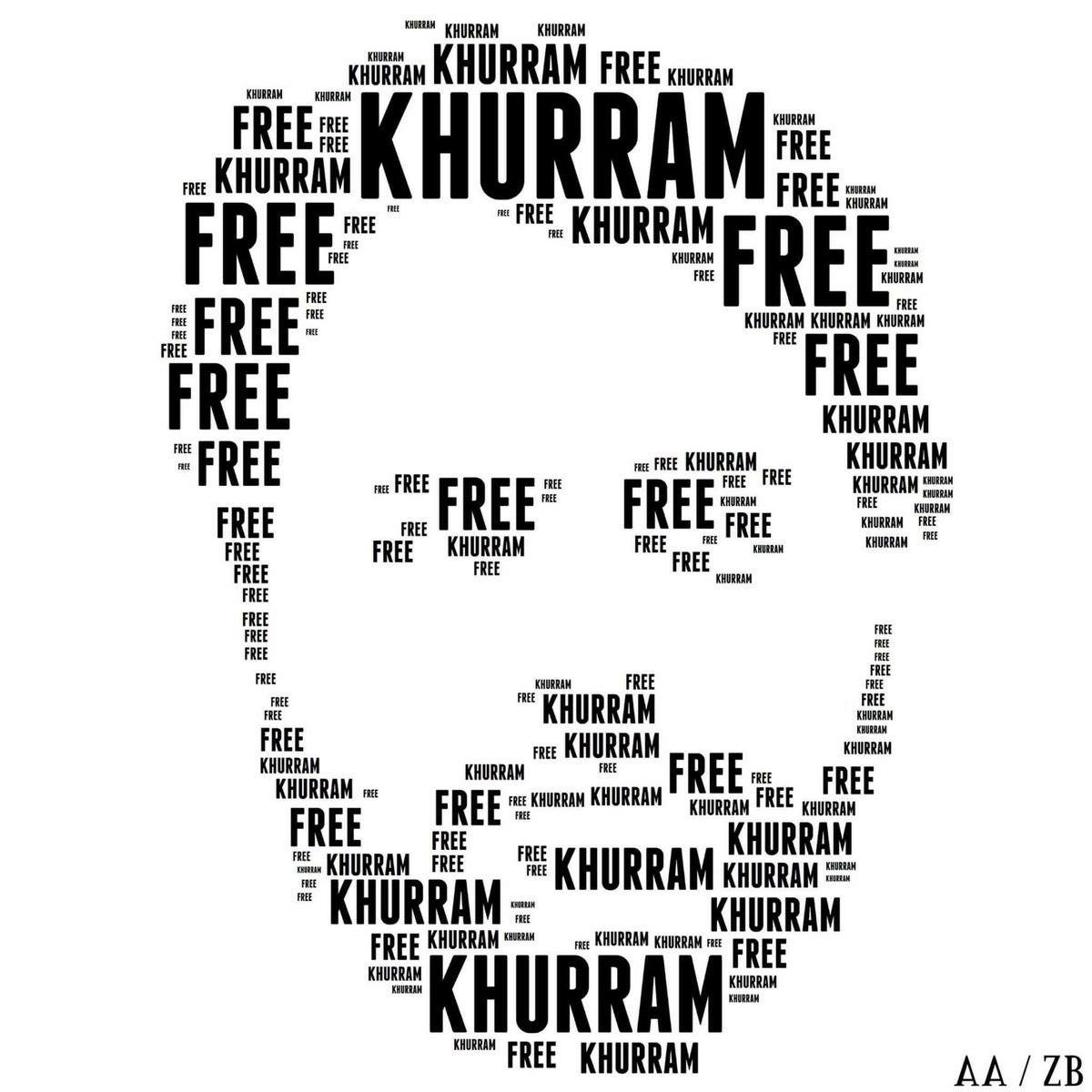
Statement in Support of Khurram Parvez from Groups and Individuals in Karnataka

Over the past 70 days, there have been over 84 deaths, hundreds have lost their eyesight to pellet wounds and thousands have been injured in Kashmir. As news reports of the death of 11 year old Nasir Shafi, son of Muhammad Shafi, a resident of New Theed Harwan in Srinagar emerge, we also hear about Showkat Ahmed Misger, a person with mental disabilities from Safa Kadal who was admitted in hospital in a critical condition with pellet wounds. Though the people of Chandpora were told by the police that Nasir Shafi was mauled by a bear, pictures of his body with pellet wounds and torture marks stand in contradiction to this official version of events. The violence unleashed by the armed forces continue unabated in Kashmir inspite of extensive social media outrage and mass protests in  Indian cities like Patna, Kolkatta, Chennai, Bangalore, Delhi etc.

Continue reading Statement in Support of Khurram Parvez from Groups and Individuals in Karnataka

The Radical Significance of the DU Photocopy case for Global Copyright

protest

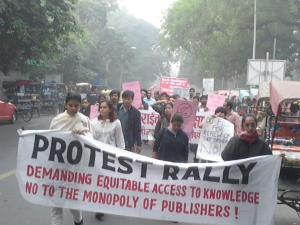
While the immediate beneficiaries of the Delhi high court’s judgment in the Delhi University photocopy case are obviously the university, the photocopy shop and the students and academics who filed intervention petitions supporting the right to photocopy, the import of Justice Endlaw’s finely reasoned judgment goes well beyond this specific case as well as its impact on access to knowledge in India. The judgment and its treatment of educational exceptions in copyright law is unprecedented and could well become a model of how national IP laws should be interpreted. To understand its global significance we should turn to a short history of norm creation in copyright and its relation to specific national and local needs. 

The Berne convention in 1886 for the first time laid out uniform global norms for copyright protection and established minimum standards that would apply to all signatory states. This was concretised further through the TRIPS agreement in 1994. In addition to laying out the common minimum standard that would define the global intellectual property regime, these treaties also allowed countries some amount of flexibility in customizing their national legislation to respond to their access to knowledge needs. These were by way of exceptions and limitations that a country could impose on the exercise of intellectual property rights, and  it in this tricky terrain that many global IP battles have been fought. Both the Berne convention and the TRIPS agreement allow for fair dealing exceptions in national legislations, and in the case of the Berne convention there is also a special exception allowed for educational uses.  Continue reading The Radical Significance of the DU Photocopy case for Global Copyright

Victory for Students and Access to Knowledge in DU Copyright Case :ASEAK

Guest Statement by Association of Students for Equitable Access to Knowledge (ASEAK)

Victory for Students and Access to Knowledge in DU Copyright Case : Corporate Publishers Market ends at the gates of the University

In a rare and incredible order today, the Delhi High Court has dismissed the copyright infringement case filed by Oxford University Press, Cambridge University Press and Taylor and Francis (Routledge) against Rameshwari Photocopy Shop in Delhi School of Economics and Delhi University. Justice R.S Endlaw in a 94 pages long judgment interpreted educational exception under section 52(1)(i) of the copyright act in broad enough manner to cover the acts of photocopying.

The publishers sought to claim damages to the tune of 60 lakh rupees from the shop citing infringement of copyright which the publishers claimed was happening through photocopying of parts of books published by them. However, the publishers themselves stated that this case, for them, was a test case where they wanted to introduce licensing systems across universities in India. These licensing systems intended to control the extent to which material could be photocopied and also direct a share of profit from these reproductions to the publishers. We, the Association of Students for Equitable Access to Knowledge (ASEAK) demanded to be made a defendant in this case as we believed that it is the rights of students to access reading material that was at stake in this case- “Association of Students for Equitable Access to Knowledge (ASEAK) filed IA No.3454/2013 for impleadment in the present suit and which was allowed vide order dated 1st March, 2013 and ASEAK impleaded as defendant No.3.” (from the judgment). Continue reading Victory for Students and Access to Knowledge in DU Copyright Case :ASEAK

पवित्र नगरों की सियासत

Amritsar

जनाब अरविन्द केजरीवाल, जो इन दिनों पंजाब के दौरे पर हैं, उनके एक ऐलान ने एक पुरानी बहस को नयी हवा दी है. उन्होंने कहा कि अगर उनकी पार्टी जीतती है तो वह अमृतसर को ‘पवित्र नगर’ का दर्जा प्रदान करेगी. इतना ही नहीं वह स्वर्ण मंदिर के आसपास शराब, मीट और टुबैको के उपभोग पर भी रोक लगाएंगे.

उनके मुताबिक खालसा को जन्म देने वाले आनंदपुर साहिब को भी पवित्र नगर का दर्जा दिया जाएगा. वैसे यह पहली दफा नहीं है जब उन्होंने नगरों को ‘पवित्र’ घोषित करने की बात कही है. याद रहे जिन दिनों वह वाराणसी से चुनाव लड़ रहे थे, उन्होंने अपने बनारस संकल्प में अन्य कुछ मांगों के अलावा इस बात का भी विशेष उल्लेख किया था कि वह वाराणसी को ‘पवित्र नगरी’ का दर्जा दिलाएंगे.

(Read the full article here : http://hindi.catchnews.com/india/politics-of-holy-city-1473905440.html/fullview)

Kafila was hacked – but we’re back!

For the second time in two years, we were the target of  a malicious cyber attack.

We must be doing something right!

For ten years, since October 2006, Kafila has served as a forum or debate and dissent, and with the support of our readers, contributors and commentators, we hope to keep going.

Thank you to the group of superb experts (in the games people play in the cyber-universe), who were so prompt and generous with their time, enabling us to get back up and running.

Our new domain name is kafila (dot) online.

As Faiz said:

mata-e-lauh-o-qalam chhin gayi to kya gham hai

ki khoon-e-dil men dabo lee hain ungliyan maine

(So what if my slate and pencil have been snatched,

I have dipped my fingers in the blood of my heart)


No Country for Free Speech : Shiv Inder Singh

Guest Post by Shiv Inder Singh

freedom of expression के लिए चित्र परिणाम

(Photo courtesy : humanrightshouse.org)

In an open letter, Mr Shiv Inder Singh, an independent overseas journalist from Punjab, claims that he lost his job owing to his criticism of PM Modi’s government. 

Dear Sir/ Madam,

I am an independent journalist based in Punjab, India. I have been associated with the media industry for the past fifteen years. My work experience includes the time period of five years as an overseas’ contributor for Canada-based radio stations in Ontario, Alberta and British Columbia. In that capacity I have been giving daily news updates and political commentary on India at these radio channels.

I want to bring to your knowledge that the Vancouver-based Radio Red (93.1) FM for which I have been working since October 2014 has arbitrarily suspended my services due to political interference which amounts to trampling of freedom of expression. Continue reading No Country for Free Speech : Shiv Inder Singh

Everybody Loves A Good Riot

This here is a 360 video of Friday namaaz at the Rangrezi masjid in Lisad, a village where 13 Muslims were killed in the Muzaffarnagar Riots of 2013.

Play the video, and tilt your phone left, right, up or down to explore the mosque. If you are watching this on your computer, click on the screen and drag your mouse to look around this space.

I shot this video last week in Muzaffarnagar as part of “Everybody Loves A Good Riot” – an immersive multimedia project detailing western Uttar Pradesh’s “riot economy”. The story features 2 more 360 videos like the one above, as well as a text story to mark the 3rd anniversary of the Muzaffarnagar riots. Experience the full story here