Category Archives: Bad ideas

Peace on Earth and Social Justice – Christmas greetings!

images

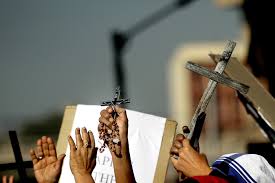
Protest at Delhi Police Headquarters after the burning of St Sebastian’s Church in Dilshad Gardens/ Image from The Indian Express

We observe Christmas today under the ominous cloud of Hindutvavaadi violence against minorities, which began on the very day of the BJP electoral victory seven months ago, and their determined attempt to obliterate all religious identities other than their own narrow version of Hinduism, a Hinduism that brutally excludes even large numbers of people who would consider themselves Hindu. From burning churches to physically attacking ‘Muslim-looking’ men, to trying to erase Christmas under the banal bureaucratese of Good Governance Day – Hindutvavaad has never had it so safe, never has it been so arrogant, as under the protective gaze of Modi, a Prime Minister who produces reams of flowery prose in his speeches, but through his public silence on these atrocities, satisfies both Hindutvavaad and his neo-liberal supporters – the one recognizing his benign encouragement, the other fooling itself that his silence shows displeasure. Continue reading Peace on Earth and Social Justice – Christmas greetings!

The Secular Stake- A Burden, or a Democratic Imperative? Sanjay Kumar

Guest Post by Sanjay Kumar

Mr Asaduddin Owaisi, the leader of MIM recently remarked in a media conclave that ‘Muslims are not coolies of secularism’. The statement made perfect sense for his politics. He is the leader a party that aims to mobilise voters on the basis of them being Muslim. The unprecedented success of Hindutva under Mr Modi in recent elections has upset many old electoral calculations, and opened new opportunities. Mr Owaisi is smelling a chance for the MIM to expand beyond its turf in Hyderabad, to regions where non-BJP parties have been getting the major chunk of Muslim votes with the slogan of secularism, seen principally as the promise of protection from riots. For Mr Owaisi, the remark serves multiple purposes. Average Muslim citizens are deeply disillusioned with a political process that has resulted in the utter marginalisation of their community.  For such voters, the statement is intended to clearly distinguish his party from the so-called secular non-BJP parties. It is calibrated to raise a doubt in their mind, why should only Muslims be expected to vote for such parties, when significant sections of the Hindus have sided with the communal BJP? It is also a preemptive answer to his political competitors and ideological critics, who are likely to accuse him of being communal.

Otherwise too, the secular discourse in India has largely become a minorities’ affair. It is said to be under threat when minorities are attacked. It is claimed to be flourishing when minorities rights are protected. A corollary belief among major sections of the so called majority community is that India  could have as well been non-secular if there were no minorities in the country, or if they are put in their place as the RSS political programme demands. Continue reading The Secular Stake- A Burden, or a Democratic Imperative? Sanjay Kumar

Impossible Lessons: Ravi Sinha

Guest Post by RAVI SINHA

Far away from Peshawar five men and a woman sat in a physician’s waiting room in Lucknow. The television screen that ordinarily shows some Bollywood film or a cricket match had a news channel on. It was day after the slaughter of children. The assistant who maintains the waiting list of patients and collects the doctor’s fee said something very predictable, even if heart-felt, expressing his horror and revulsion. The matter would have passed as unremarkably as most things do most of the times, except for what an elderly gentleman waiting to see the doctor had to say in response.

In a feeble yet firm voice whose conviction and sincerity was unmistakable, he said – dhaarmikata ko badhaava doge to kattarta badhegi; kattarta badhegi to aatank upajega, haivaaniyat saamne aayegi. (If you will promote religiosity, fundamentalism will grow, and from that will emerge terror and barbarism.) After a pause he added – hamaare desh mein bhee yahee ho rahaa hai, haalaan ki abhee hum pehle daur mein hain, dhaarmikata badhaane ke daur mein. (Same thing is happening in our country too, although we are in the first phase so far – that of promoting religiosity.) Continue reading Impossible Lessons: Ravi Sinha

Make in India – A critical examination of an economic strategy: Leila Gautham

This is a guest post by LEILA GAUTHAM

‘Make in India’ is now an all-pervasive catchphrase – every newspaper and television channel trumpeting the Modi’s ‘clarion call’ to investors – but surprisingly empty in terms of substance. The website is flashy and vastly different from the run-of-the-mill government-of-India websites one is used to – but one has a hard time imagining the ‘captains of industry’ who attended the Make in India launch on September 25th finding any use for it. One begins to wonder, who exactly is the campaign aimed at? Is it the Indian public? An impressive farce, an ad campaign, the neoliberal dream of the efficient state come true – Make in India is not some brilliant brainwave of Modi’s: it is the culmination of very intensive campaign of worldwide propaganda that has been launched by global corporate capital.

I tried to probe deeper, to tease out concrete details if any – and the following article reflects my understanding, incomplete though it may be.

Continue reading Make in India – A critical examination of an economic strategy: Leila Gautham

Statement on David Bergman Case in Bangladesh: Concerned South Asian Journalists and Others

Guest Post. Statement by Concerned South Asian Journalists, Writers, Historians and Activists

We, the undersigned journalists, writers, historians and activists from South Asia,  are deeply concerned about the use of ‘contempt of court’ law to curb freedom of expression. The conviction and sentencing on December 2, 2014, of Dhaka-based journalist David Bergman by the International Crimes Tribunal 2 on charges of “contempt of court” for citing published research on killings during the Bangladesh Liberation War of 1971, is a serious set-back to Bangladesh’s commitment to free speech and independent scholarship.

At the outset, we reiterate our belief that those responsible for genocide and international crimes during the Liberation War must be prosecuted and punished through an open and transparent process.

Continue reading Statement on David Bergman Case in Bangladesh: Concerned South Asian Journalists and Others

Claiming the Right to Life: Kiss Against Fascism at IFFK

Maybe fighting moral policing is optional for you. But for us women, it is life and death.

We do not need swaddling clothes of modesty

For we are not corpses yet.

We are not lifeless chattels

To be put away in good order.

Nor are we  shop-front mannequins 

with  folded palms and plastic smiles,

Saree-clad, or stripped naked.

Continue reading Claiming the Right to Life: Kiss Against Fascism at IFFK

Stop Manual Scavenging in JNU: Forum Against Manual Scavenging

Authors’ Note:

The Chennai based Forum Against Manual Scavenging, (FAMS) can be contacted at famschennai@gmail.com. We have tried to create some awareness on this issue especially among student community (with the assistance of some of the Professors/Faculty based in Chennai) in which we were guided by Safai Karamchari Andolan, Rashtriya Garima Abhiyan, Tamil Nadu Untouchability Eradication Front, Janodayam Social Education CentreRepublic Trade Union of IndiaRed Flag Union of Tamil Nadu and other similar organizations (in and outside Chennai) struggling on this issue which are led primarily by the Dalit Women from the community itself.  

A documentary, ‘Sahar se Pehle’ (Before the Dawn) on sanitation workers in Jawaharlal Nehru University (JNU) campus in Delhi was made by some students of the university. The JNUSU has been consistently raising the issue of abysmally bad condition of sanitation workers in JNU for quite some years now. Earlier in 2012, JNUSU had also participated in a signature campaign against manual scavenging (signed by the then JNUSU President). The documentary shows the manual scavenging is still prevalent in the premier university even after the ban on manual scavenging by the Delhi government (sanitation is a State subject according to the Constitution of India) and after the enactment of “The Prohibition of Employment as Manual Scavengers and their Rehabilitation Act, 2013.”

This documentary was also selected for the Canadian Labour International Film Festival, 2014, and was available online on YouTube and other sites from February 2014, but was not widely circulated on mainstream media or social media. We also came to know about it only a fortnight ago because the write-up attached to it does not explicitly mention manual scavenging.

The JNU student community has started a campaign called Stop Manual Scavenging in JNU, with the message “Use hashtag #StopMSinJNU to SPEAK OUT against the inhuman practices of manual scavenging and hazardous cleaning in #JNU.”  Continue reading Stop Manual Scavenging in JNU: Forum Against Manual Scavenging

Demolition Drive in Vadodara, 2014: Kathyayini Dash, Rushabh Vishawakarma, Hussain Sabu, Bhagwati Prasad Suryavanshi

Guest post by KATHYAYINI DASH, RUSHABH VISHAWAKARMA, HUSSAIN SABU & BHAGWATI PRASAD SURYAVANSHI

Untitled

In Tarsali, 10 kilometers from Vadodara

Note from authors:

We are a group of friends and students from MS University, Baroda. One of us, Rushabh, lives in Kalyannagar which has partly been demolished and this house too is slated for demolition. We have written this to bring to the surface what demolition and displacement means, from the perspective of those who live in places like Kalyannagar, which cannot even be called a ‘slum’. We could see first hand what happened during the demolition because our friend lived there.  We all have spent happy times at Kalyannagar, Rushabh’s home. We felt we owe it to these memories to at least record these events. You can visit us at BarodaBeat.

Development they say…

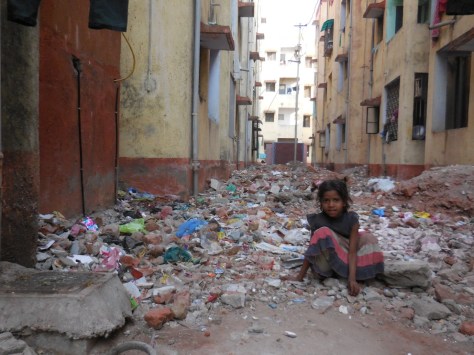
They say by 2015, not one jhopdi will be seen…Vadodara’s landscape would be studded with flyovers, high rise buildings, malls, clean pothole-free roads. There will be no stench of garbage, leave alone the sight of it.

The recent floods in Vadodara set off an alarm, urging the quick setting up of “river-front projects” which included the demolition and re-location of slum dwellings near the river which were so awfully affected during the floods.

They say, “this is not fair. They sure need help; first priority in fact. They have to be the first to be taken into consideration before going on to people who have it all: a raised plinth level, a well cemented house, resources to recover the losses incurred in the floods. The jhopdiwaale, well, they have nothing at all, don’t they? Already low on the economic scale, they have no resources to recover the losses incurred during the floods, they don’t even have pakka houses to resist the floods. And on top of it all, they have houses built along the river itself. Poor things, where else would they build their houses. But then, these houses shouldn’t be there in the first place isn’t it? Because this is government land, and they don’t have the right to live there. What good is it anyway?” they say. “It is near the river, there is always a dangerous risk of the river flooding and them and their houses drowning,” they say. Continue reading Demolition Drive in Vadodara, 2014: Kathyayini Dash, Rushabh Vishawakarma, Hussain Sabu, Bhagwati Prasad Suryavanshi

From Ferguson to Pune—The Minority Report: Archit Guha

This is a guest post by ARCHIT GUHA

Prima facie, the grand jury decision in the United States to not indict a white police officer, Darren Wilson, in the murder of a black teenager, Michael Brown, and the flurry of protests that have occurred since the incident in August are distinctly symptomatic of the structural racism that continues to plague the settler colonial nation that institutionalized slavery nearly 500 years ago, but claims to be post-racial today. Continue reading From Ferguson to Pune—The Minority Report: Archit Guha

Appeal to Stay the Execution of Surinder Koli: Concerned Women, Individuals and Groups

Guest Post by Concerned Women, Womens’ Groups and Others against the Death Penalty Awarded to Surinder Koli

To,

The President of India

Rashtrapati Bhavan, New Delhi, India.

2 December 2014

Subject:  Execution of Surinder Koli Would be a Travesty of Justice:
Plea for Mercy from Women’s Groups, Lawyers, Academics, Students and Activists

As women who have been engaged in the struggles for women’s rights and justice, (and their allies) we appeal to you to commute Koli’s death sentence or at least to stay his execution till the completion of the other cases involving other Nithari victims in which he is an accused. 

Continue reading Appeal to Stay the Execution of Surinder Koli: Concerned Women, Individuals and Groups

അഴിക്കാനും ആടാനും തുനിഞ്ഞിറങ്ങിയവർ തന്നെ നാം : തെരുവിൽചുംബനസമരക്കാർക്ക് ഒരു സന്ദേശം

സുഹൃത്തുക്കളെ,


കിസ് ഒഫ് ലൌ സമരങ്ങളുടെ രാഷ്ട്രീയത്തെക്കുറിച്ച് പലതരം ആശങ്കകൾ കേട്ടുതുടങ്ങിയിരിക്കുന്നു.

അത് ആഗോളീകരണ അഴിഞ്ഞാട്ടമാണെന്നും,

അതല്ല, മദ്ധ്യവർഗ്ഗ സന്തതികളുടെ എടുത്തുചാട്ടമാണെന്നും,

അതുമല്ല, അതിനു രാഷ്ട്രീയമേ ഇല്ലെന്നു വരെയും, കേരളത്തിലെ ബദൽരാഷ്ട്രീയങ്ങളിലെ പ്രമുഖവ്യക്തിത്വങ്ങൾ അടക്കമുള്ള പലരും മുറുമുറുക്കുന്നു.

Continue reading അഴിക്കാനും ആടാനും തുനിഞ്ഞിറങ്ങിയവർ തന്നെ നാം : തെരുവിൽചുംബനസമരക്കാർക്ക് ഒരു സന്ദേശം

3 lakh bogus voters found in Modi’s Varanasi seat?

It appears that the Election Commission has so far traced 3,11,057 fake voters who cast their votes in Varanasi in the Lok Sabha election earlier this year. The district administration is expecting the number of fake voters to reach around 6,47,085 by the end of the examination process.

Remember – Narendra Modi ‘won’ this seat by 3 lakh 71 thousand 784 votes.

This news was first reported in Navbharat Times on November 25, 2014:

जिस वाराणासी संसदीय सीट से नरेंद्र मोदी ने 371784 वोटों से जीत हासिल की है, वहां 311057 फर्जी वोटर मिले हैं। अभी गिनती जारी है और जिला प्रशासन का अनुमान है कि फर्जी वोटरों की संख्या 647085 जा सकती है। इतनी बड़ी संख्या में फर्जी वोटर पहली बार वाराणसी में सामने आए हैं। लाखों की तादाद में मिले फर्जी वोटरों का खुलासा तब हुआ जब भारत निर्वाचन आयोग के निर्देश पर जिला प्रशासन ने मतदाता सूची का पुनरीक्षण अभियान शुरू किया। जिले के सभी पोलिंग सेंटर पर तैनात बूथ लेवल ऑफिसर से घर-घर जाकर मतदाताओं का सत्यापन करवाने के बाद इन बोगस वोटरों का खुलासा हुआ है।

Aaj Tak reported it on November 26, 2014:

प्रधानमंत्री नरेंद्र मोदी और उनकी पार्टी बीजेपी के लिए मुश्किलें बढ़ाने वाली खबर है. खबरों के मुताबिक, नरेंद्र मोदी के संसदीय क्षेत्र वाराणसी में 3 लाख 11 हजार 57 फर्जी वोटर मिले हैं. याद रहे कि यहां मोदी ने 3,71,784 वोटों से आम आदमी पार्टी के अरविंद केजरीवाल को हराया था.

बताया जा रहा है कि फर्जी वोटरों की गिनती अभी जारी है और जिला प्रशासन का अनुमान है कि फर्जी वोटरों की संख्या 6 लाख 47 हजार से ज्यादा जा सकती है. इतनी बड़ी संख्या में फर्जी वोटर वाराणसी में पहली बार सामने आए हैं. ये वे लोग हैं जिन्होंने दो या उससे ज्यादा विधानसभा क्षेत्र की मतदाता सूची में अपना नाम लिखवा रखा है. इसी के साथ सोशल मीडिया पर AAP समर्थक नरेंद्र मोदी पर फर्जी मतों से जीत हासिल करने का आरोप लगाने लगे हैं. गौरतलब है कि आम आदमी पार्टी पहले भी बीजेपी पर फर्जी वोट डलवाने का आरोप लगाती रही है.

According to Shubhanshu Sharma:
If we go by district administration’s claims, they are expecting to find around 1,12,160 bogus voters in Pindra, 1,01,456 in Ajgara, 87,140 in Shivpur, 84,757 in Rohania, 65,989 in Cantt, and 90,942 in Sewapuri regions. 
Kohram News had claimed soon after results were declared in May 2014 that the calculation of votes in the Varanasi seat was anomalous:
Kohram News had also publicized the news of the EVM found in the home of Ankit Gaurav Srivastava, an engineer in Varanasi, the night before the elections.  This news had circulated widely, including on Kafila.
If this is true, what next? As I understand it, according to Article 329 of the Constituion of India, for an election to be set aside, an election petition must be presented “to such authority and in such manner as may be provided for by or under any law made by the appropriate Legislature.”

The Election Commission later recommended that trial of election petitions should be entrusted to the High Courts instead of election tribunals. Parliament thus enacted Section 80-A of the Representation of the People Act, 1951 providing that the High Court shall be the authority for presentment of election petitions under Article 329 (b) of the Constitution. This was incorporated by an amendment in the year 1966 (Act 47 of 1966).

The last time the election of a sitting Prime Minister was set aside for corrupt electoral practices, on June 12, 1975, Indira Gandhi (for it was she), declared a state of emergency.

We can expect no less from a Prime Minister who watches benignly over the continuous and growing humiliation of minorities and murderous attacks  on them; and who carefully supervises the wholesale handing over of the country to the biggest and most corrupt corporate bidders.

There is a lot at stake for Modi and his corporate bosses. And now they have the full backing of state power.

Nevertheless, if the news of bogus voters in Varanasi is true, Modi’s election should be set aside through due process.

The deadly land policies planned by Modi’s advisers and the links to Ukraine and Honduras: Aditya Velivelli

This is a guest post by ADITYA VELIVELLI

One year after the Land Acquisition Act was passed in Parliament with bipartisan support, commerce minister Nirmala Sitharaman stated that changes will be made to the Act during the upcoming Winter Session of Parliament.

The earliest indication that this would happen, came from of all people, a first-time MP and microfinance lobbyist Jayant Sinha. Sinha had mentioned in a CNBC interview right after BJP’s win that land acquisition policy was the first priority. For those wondering why CNBC interviewed Sinha and allowed Sinha to lay out the new Government’s priorities, and why Sinha has been appointed junior finance minister, they should refer – Who is guiding Modi’s economic thinking and what is their background? Continue reading The deadly land policies planned by Modi’s advisers and the links to Ukraine and Honduras: Aditya Velivelli

‘Law of the land’ on Kissing in Public: Sanjay Palshikar

SANJAY PALSHIKAR, Professor, Political Science department, University of Hyderabad, clarifies the ‘law of the land’ on kissing in public, to the Committee set up by the Vice-Chancellor to ‘look into the matter of the incident of November 2, 2014.’

Respected Members,

At the centre of the incidents of November 2, 2014, is the alleged act by some students to display demonstratively mutual affection in the form of kissing. Without going into the factual correctness of the charge, let me share with you what I have learnt from legal scholars and activists. I do so in the hope that this will help the Committee “ascertain” “the position of the law of the land” regarding kissing in public.

  1. Indian judiciary at the higher levels has not universally treated kissing in public as illegal. In appropriate context, spelt out variously by the relevant judgments, it has been seen as an expression of love, expression of love and compassion, and its artistic representation as defensible. Absent in all theses cases is the tendency to presume that every kiss is an act of sexual expression and that indulging in this act in public is always obscene. (A & B vs State Thr. N.C.T. of Delhi 2009; Friday vs K.J. Sebastian 2001).
  1. The Supreme Court has observed that the Indian Penal Code “does not define the word obscene and this delicate task has to be performed by courts….” If the Apex Court considers it a delicate task, how much more challenging it would be for university teachers and police officers to say if an act is obscene! (Udeshi vs State of Maharashtra 1965).

Continue reading ‘Law of the land’ on Kissing in Public: Sanjay Palshikar

‘Sant Rampal’ – Farmer’s Son Challenges Hegemony of Arya Samaj, RSS Ally In Haryana : Jaspal Singh Sidhu

Jaspal Singh Sidhu looks at the genesis of Sant Rampal and ‘Satlok Ashram’ the religious centre he established.

The arrest of former public servant -turned-godman 63-year-old Rampal from his Barwala (Hissar) ashram seems to have ended the two-week long much publicized drama enacted by the Haryana police, but it has, rather, widened social and religious gulf among the people of the area . The police operation took life of five women and a child, injuring of many others including two dozen media persons covering the event. Technically, Rampal’s arrest was sought by the Punjab and Haryana high court in a case of ‘criminal contempt of court’ following his persistent in refusal to appear before the court.

The Barwala event signals much more than what one gathers from the media. Rampal’s abortive defiance appears to be (consciously or unconsciously) challenging the hegemony of the Sangh Privar ideology based on Aryans and non- Aryans divide which uses the Vedic literature as manifestation of the Aryan race. The media story, invariably, only covers the present happenings. And, it is meant for the consumption of general public only interested in the day-to-day developments. For obvious reasons, such reporting suits both the government of the day and the media outlets. By and large, the media (newspapers and TV channels) reels out largely that information (official version) which police and official machinery serves them with punctuation of a little-bit material on the root cause of the controversy which has climaxed to the dramatic custody of Rampal by the police.

Read the rest of the article here.

We, or our Nationhood, Redefined.

A couple of weeks ago, filmmaker Anand Patwardhan was invited by the Editors’ Guild to deliver its annual lecture. Patwardhan’s speech, titled We or our Nationhood Redefined, was marked by his characteristically cool tone, systematically reassembling facts that have a tricky habit of leaking from national memory. Facts like the twentieth century’s worst genocidal dictator Adolf Hitler and his programme of racial cleansing has a respectable and massive following in India in the form of the Rashtriya Swayamsewak Sangh. That the RSS has at least 50,000 branches across the country with over 40 million members, and runs a network of 18,000 schools across India. That one such child, recruited from the age of 8 from a relatively poor family, is Prime Minister Modi; and another is Party Chief Amit Shah. That just before the recent reshuffle, 5 Chief Ministers and 17 of the 23 Cabinet-level senior ministers were current or former RSS members. That the assassins of Gandhi are really the RSS, not the lone lunatic Godse who merely carried out what others dreamed about. That RSS’s poisonous communal agenda was roundly condemned by Sardar Patel, of whom PM Modi has promised to build the world’s tallest statue. Or more obscure but equally revealing facts, like the letter written by RSS chief Balasaheb Deoras from jail during Emergency, praising Indira Gandhi and especially her programme of sterilisation of Muslims. And those truly mind-boggling-in-their-irony facts, like the widespread involvement of the RSS in the 1984 anti-Sikh pogrom, when the BJP cynically says “1984” every time somebody says “2002”.

On a day when the Nanavati Commission has termed the 2002 anti-Muslim pogrom in Gujarat as a purely communal reaction to Godhra, and cleared then Chief Minister Modi’s government of any wrongdoing, or even inaction, it is critical we re-read Patwardhan’s speech, to remind ourselves exactly what we are up against if we believe in a non-communal, non-divided, heterogenous India. As Patwardhan put it, given the history of the RSS in this subcontinent, if a Modi didn’t exist, he would have to be invented. Read more.

A kiss for your thoughts, University of Hyderabad: Anu K Antony, Mohan K Pillai, Sinjini Bhattacharya and Vaikhari Aryat

Guest Post by ANU K ANTONY, MOHAN K PILLAI, SINJINI BHATTACHARYA, VAIKHARI ARYAT 

HYD

The protest meeting organised by the students of the University of Hyderabad on the university campus

‘That is knowledge which liberates’, proudly proclaims the crest of University of Hyderabad, a prominent central university in our country. A University space has been traditionally seen as the vanguard of socio-cultural critique and change. Universities pride themselves in upholding the values of freedom of thought, expression and debate. And yet, the reaction of the administration of the University of Hyderabad (UoH) to a recent event, in an otherwise liberal-tolerant and progressive-leaning campus, leaves much space for thought.

On November 2nd, a group of students organised an event on campus in solidarity with the much discussed “Kiss of Love” protest in Kerala. Titled “UoH Against Moral Policing”, the on-campus event, publicised solely on online social media, was supposed to create a space to discuss issues surrounding moral policing and the chain of Kerala incidents, bring out narratives of moral policing, talk about morality and Indian culture, and recite poetry. Also planned was a symbolic act of kissing on a chart paper, with the slogan “Our lips don’t char”. However, some ABVP and BJYM activists, with the aim of saving the students and the Indian culture from Western “immorality”, barged into campus and tried to attack the student protesters. The Telangana Police and campus security, who had failed to stop the intruders, did later succeed in cordoning them off from the protesting crowd, while insisting that the students call off the protest and disperse.

Unaccustomed to Police chauvinism and empowered enough to insist on their rights, the students managed to continue with their planned activities, although once in a while some right-wing activists managed to break ranks and tried to incite violence. The campus community however showed great restraint and continued protesting peacefully.  In response to such moral policing inside campus, the 250-plus students spontaneously started hugging and kissing each other, before dispersing.  Continue reading A kiss for your thoughts, University of Hyderabad: Anu K Antony, Mohan K Pillai, Sinjini Bhattacharya and Vaikhari Aryat

The Class Politics of Blasphemy in Pakistan: Fatima Tassadiq

Guest Post by FATIMA TASSADIQ

The brutal murders of Shehzad and Shama, a Christian couple in the village of Kot Radha Kishan in Kasur district on 4th November, spawned predictable outrage in the press and social media. The rush of horror, the diagnoses and prescribed course of action against such violence involved the familiar paternalistic discourse of the ‘illiterate masses’ whose ‘ignorance’ evidently leaves them particularly vulnerable to the manipulation of the much maligned mullahs. Such a narrative serves the dual function of reducing religious violence to the faceless masses while at the same time reaffirming the educated urban upper class as the rightful custodian of Islam and Pakistan. This construction conveniently ignores the role played by the state and the elite in producing religious violence and feeds the class-based blind spots that exist in our understanding of what constitutes religious extremism.

Continue reading The Class Politics of Blasphemy in Pakistan: Fatima Tassadiq

नौ नवंबर:एक और वर्षगाँठ

नौ नवंबर एक और वर्षगाँठ है.इस साल नौ नवंबर को अयोध्या में रामजन्मभूमि मंदिर के शिलान्यास के पचीस साल हो जाएँगे.यह मात्र एक मंदिर का नहीं,हिंदू राष्ट्र का शिलान्यास है,अशोक सिंघल ने शिलान्यास के बाद कहा था.1989 कई दृष्टियों से घटनापूर्ण वर्ष था.यूरोप में बर्लिन की दीवार का दरवाज़ा नौ नवंबर को ही खोल दिया गया जिससे पूर्वी और पश्चिमी जर्मनी के लोग आसानी से आ-जा सकें.यह बर्लिन की दीवार के ढहने की शुरुआत थी.राष्ट्रीय स्वयंसेवक संघ के समर्थक जय दुबांशी ने लिखा,“इधर एक मंदिर खड़ा हो रहा था और उधर एक मंदिर ढह रहा था.” सिंघल और दुबांशी के वक्तव्यों में रामजन्म भूमि मंदिर अभियान के राजनीतिक प्रोजेक्ट को लेकर कोई दुविधा नहीं.यह एक दक्षिणपंथी,राष्ट्रवादी राजनीतिक परियोजना थी जो भारत में बहुसंख्यक हिन्दूवाद को संगठित किए बिना  फल-फूल नहीं सकती थी.

1989 के अक्टूबर के अंत में ही भागलपुर में भारत की एक और  भयानक साम्प्रदायिक हिंसा हुई.यह भी याद रखने की ज़रूरत है कि प्रधान मंत्री राजीव गाँधी ने भागलपुर पहुँचकर जब लापरवाही और हिंसा को जारी रखने के आरोप के कारण वहाँ के पुलिस उपाधीक्षक को निलंबित किया तो स्वयं पुलिस ने विद्रोह कर दिया और उनका घेराव कर लिया.यह घटना तत्कालीन भारत में सांप्रदायिक मानस के आक्रामक होने की सूचना देती है और प्रशासन की हर स्तर पर उसमें भागीदारी का एक प्रमाण भी है.भागलपुर की सांप्रदायिक हिंसा में राष्ट्रीय स्वयंसेवक संघ की भागीदारी के साफ प्रमाण हैं.याद रखने की ज़रूरत है कि यह रामशिला पूजन के समय ही भड़की हिंसा थी.न भूलें कि संघ ने दो  सौ हिंदू छात्रों के मारे जाने और छात्राओं के बलात्कार की अफवाह फैलाई थी जिससे उनके गाँव में हिंसा भड़काने में आसानी हुई.भागलपुर में अफवाहों के जरिए लोगों को भड़काकर मुस्लिम-विरोधी हिंसा भड़काने के संघ के तरीके को याद इसलिए रखना ज़रूरी है कि मुज़फ्फ़रनगर के गाँवों में फैली मुस्लिम विरोधी हिंसा को समझने में वह मददगार है.इसलिए भी कि कई विद्वानों ने मुज़फ्फ़रनगर को इस वजह से विलक्षण माना था कि यहाँ ग्रामीण क्षेत्र हिंसा में शामिल हुए. ऐसा करते वक्त वे भागलपुर को भूल ही गए थे. Continue reading नौ नवंबर:एक और वर्षगाँठ

Resist the Sangh Parivar’s Hatred of Love: Nayanjyoti and Subhashini

Guest Post by Nayanjyoti and Subhashini

In late October, the youth wing of the Sangh Pariwar among others vandalised a café in Calicut on the pretext that lovers ‘date’ each another sitting in this café. When many young men and women in Kochi gathered together to protest by expressing their love in public, they got beaten up by various right wing groups and the police in response. The students and youths in different regions of the country gathered in solidarity of this protest going by the name of ‘Kiss of Love’. At the same time, as the news spread rapidly through the media and social networking site, a polarization continues to develop in the society, even among the individual activists and similar organizations, for and against the form of this movement.

Continue reading Resist the Sangh Parivar’s Hatred of Love: Nayanjyoti and Subhashini

Statement Condemning Rape on EFLU Campus: EFLU Alumni and Other Concerned Individuals

Guest Post by EFLU Alumni and Other Concerned Individuals

[ This is a statement prepared by some alumni of EFLU, in the aftermath of the rape of a woman student on campus last week. The statement was then shared on the social media for endorsement. Those who had drafter the statement say that they “…were overwhelmed by the support shown by a cross section of people including alumni, not just practicing academics and students of other universities, but also techies and bankers, journalists and professionals.” The statement is intended to be seen as an expression of solidarity with the complainant, in appreciation of her bravery and as a means of extending support to the EFLU community who are trying to fight for gender justice in innovative and inclusive ways. ]

This is a public statement condemning the rape of a girl student in the hostels of The English and Foreign Languages University, Hyderabad. We express our solidarity with the complainant and demand that the guilty be punished. Happening within the university space, this action by the student’s peers shocks and saddens us, but also points at the deep entrenchment of patriarchy even within the most radical of spaces.

Continue reading Statement Condemning Rape on EFLU Campus: EFLU Alumni and Other Concerned Individuals