Category Archives: Capitalism

The Gaze of the Developmental State and the Narmada Action Plans: Ashwin V.S

Guest Post by ASHWIN V.S
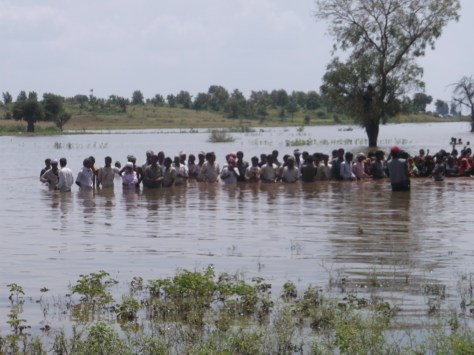
Malud-Jal-satyagrah

Jal Satyagraha in Narmada valley 2013

The years following the Second World War were characterized by a renewed focus on the ‘Modernization’ of nation-states. While the constant feature of the post-war years was the high-stakes rivalry and arms race between the USA and the USSR; both tread a common ground as regards high-modernization and ‘development’. ‘Development’ fuelled growth was considered a panacea to all ills and soon became dominant across the post-colonial world. WW Rostow’s The Stages of Economic Growth was a significant work which argued for five stages of growth in which “traditional societies” could transform themselves into the “age of high mass-consumption”. It was no wonder therefore as to which nation-states were characterized as ‘traditional’ under this rubric and pushed towards ‘development’.

A standard feature of ‘development’ in India has been the showcasing of large scale industrial and apparently ‘public purpose’ projects; an instance of this is seen in the construction of large dams. As much as ‘modernization’ or ‘development’ can be witnessed through the industrial or ‘public’ projects themselves; the ambition of the ‘developmental state’ and its vision can certainly be understood through the one-constant feature of the bureaucratic machinery – paperwork.

Therefore, for the purposes of this essay, I attempt to evaluate the ambition of the post-colonial ‘developmental state’ in India by analyzing the language of a few planning documents. In this case, I consider the Narmada Valley Development Authority’s (NVDAs) Action Plans prepared in the years 1991, 1993, 1995 and 2000 for the Resettlement and Rehabilitation (R&R) of Sardar Sarovar Project ‘oustees’ in Madhya Pradesh. These Documents are revealing in aspects of the modern state’s enterprise and it’s most significant undertaking, planning.

The State’s gaze and legibility:

James Scott’s magnificent work Seeing Like a State characterizes a crucial difference between the pre-modern state and the modern state: while the former “was in many crucial respects, partially blind” and “knew precious little about its subjects”, the modern state is consumed by a desire to know. Armed with statistics and other tools of ‘accuracy’, the modern state stakes its claim to the accurate depiction of the social world, which it then tries to alter in accordance to its designs of ‘development’. Continue reading The Gaze of the Developmental State and the Narmada Action Plans: Ashwin V.S
Release Piyush Sethia Manush! Coalition for Environmental Justice – India


Piyush-k0hB--621x414@LiveMint

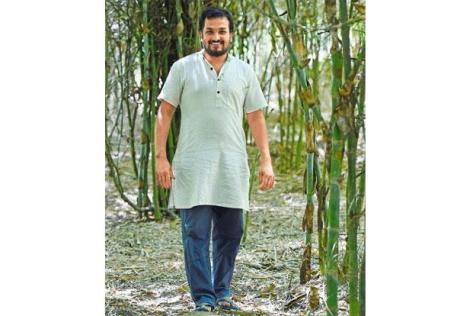
Piyush Sethia (Manush) (Image courtesy LiveMint)

Coalition for Environmental Justice – India has issued this statement:

We write as concerned citizens and environmental justice activists in support of Piyush Sethia of Salem, Tamil Nadu who has been arrested, denied bail and beaten  inside Salem Central prison. Piyush is a noted environmental activist of Salem Citizen’s Forum (SCF). He has been booked under IPC  sections 341,188, 353 and 506 (2).

On 8.07.2016, when Piyush and other members of SCF were protesting against the railway authorities for starting the construction work of Mulvadi gate over-bridge in Salem without giving prior notice to the people in the area and without laying an alternate road, police arrested Piyush and two other activists, Eesan Karthik and Muthu of SCF.

On 14.07.2016, the Salem Magistrate’s court dismissed Piyush’s bail application while granting conditional bail to the other two activists. Piyush has been kept in solitary confinement since the day of his arrest. And as per Piyush’s wife and his lawyer, Piyush is being subjected to physical and mental harassment and not allowed  to receive reading material or allowed to speak to his wife and other supporters freely. Infact, some of the supporters in Salem are being intimidated and threatened via phone calls to isolate Piyush. According to Piyush’s lawyer, Piyush was beaten ‘for a good half an hour before they sent him to solitary confinement’. Yesterday Piyush informed his lawyer that ‘he was abused by a group of unknown persons numbering nearly 30 inside the prison several times’. We are shocked at this high-handedness of prison authorities and custodial assault on Piyush.

Piyush has done commendable work in the field of Environmental Protection and Climate Change mitigation. We would like to bring to your notice some of them:

1. He leads Salem Citizens Forum to revive many water bodies in Salem city like Mukaneri, Ammapettai eri Kundukkal eri, Ismailkhan eri, Arisipalayam Theppakulam and Pallappatti well.

2. He has created a co-operative forest in Dharmpuri extending upto 150 acres, with the support of his friends and well wishers. This mountain forest acts as a water catchment area for Ettimarathupatti Canal which supplies irrigation water to 17 villages in the vicinity.

3. He has led many citizens’ initiative to protect the natural resources of Salem and its surrounding areas. He has also initiated many green and sustainable livelihood projects and protected the Salem, Yercaud and Hoggenekkal Dam areas from environmental damage.

4. In the recent floods of Chennai and Cuddalore, Piyush and members of SCF, Nizhal and Dharmapuri People’s Forum mobilized 35 containers of relief material and tirelessly worked to reach the materials in time. This won Piyush a CNN-IBN award recently. He was also named as one of the advisors of Nilam, Neer, Neethi (Land, Water, Justice) initiative of Ananda Vikatan group which was kicked off following the floods to protect water bodies in Tamil Nadu.

We demand:

Immediate release of Piyush and all charges foisted against him and other activists be withdrawn forthwith.

Sign the petition for the release of Piyush Manush 

Teacher Killings Ignite Calls for Revolution in Mexico

The violent police crackdown on teachers’ union protests recently have spurred widespread condemnation of the government’s privatization drive, backed by repression. The following is extracted from two reports by Lauren McCauley, staff writer, Common Dreams (commondreams.org)

Oaxaca protests, Mexico
Oaxaca protests- teachers block highway, Mexico, (Photo: Luis Alberto Hernandez/ AP)

An initial report in Common Dreams, on 20 June 2016 reported: ‘A Mexican teacher protest against neoliberal education policies turned deadly on Sunday, with nine people killed, after police unleashed gunfire on the demonstrators’ road blockade.

According to TeleSUR, teachers from the dissident union, Coordinadora Nacional de Trabajadores de la Educación (CNTE), “had set up the blockade as part of protests over an education reform implemented by President Enrique Peña Nieto and the arrest of several of the unions’ leaders over the past week,” which they said, were politically motivated.


Continue reading Teacher Killings Ignite Calls for Revolution in Mexico

Of experts and politicians – The Raghuram Rajan Drama: C. P. Chandrasekhar

Guest Post by C. P. CHANDRASEKHAR

The attack on Raghuram Rajan spearheaded by Sangh Parivar trouble-maker Subramanian Swamy has disturbed even those who otherwise support Prime Minister Modi’s government. The attack has received even more attention because it preceded Rajan’s surprise announcement of his departure from the Reserve Bank of India (RBI), prior to the government’s decision on whether he should be given a second term. It is clear from his letter to the RBI’s staff announcing his decision to keep out of the race for the job as central bank chief, that Rajan would have liked to serve a second term. But sensing that he was not going to be offered the extension and could even rejected if he applied for it, Rajan chose to step down.

It would be giving Swamy too much credit to hold that his letters to the Prime Minister claiming that Raghuram Rajan was wrecking the economy, was not “nationalist” enough because of his American green card, and was a stooge of the Congress, were responsible for the latter’s decision to exit. Swamy is widely seen as a maverick, and Rajan is too smart not to know that if anything, it is the BJP MP’s credibility that has been affected. What must have irked him more is the failure of the government and the PM to stand up for him. That silence possibly explains the arrogant shift of Swamy’s target of attack to the Chief Economic Advisor, Arvind Subramanian, who is more vulnerable because of his advice in the past to the US government, calling for stronger action against India on intellectual property issues. Continue reading Of experts and politicians – The Raghuram Rajan Drama: C. P. Chandrasekhar

Modiversary – Mera Desh Badal Raha Hai! Really

It was late mid-eighties when we use to do streetplays in Varanasi as part of our activities as a left student group – which called itself ‘Gatividhi Vichar Manch’ in Banaras Hindu University. One such plays was titled Desh ko Aage Badhao. The 5-7 minute play was part of a compilation of many other plays brought out possibly by Jana Natya Manch. We must have done hundreds of shows of the other play Raja Ka Baja – which was about the dire state of education and employment.

The theme of this short play Desh ko Aage Badhao was rather crisp. It showed a Netaji/leader in white clothes telling people gathered around him how the ‘nation is progressing’. When the innocent people ask for details, then he starts listing out his personal achivements and the wealth he has acquired through all these years of ‘serving the masses’. The tagline was Arrey Murkhon, dekho desh kaise aage badh raha hai‘ ( You fools, look how the nation is progressing)

The end scence showed people coming together, getting organised and slowly pushing the Netaji. When the terrified Netaji use to ask Arrey Murkhon, yeh kya kar rahe ho. (What are you doing idiots). The awakened people use to answer in unison Netaji, desh ko aage badha rahe hain ( We are pushing the nation forward).

I was reminded of this short play when TV started showing the ad how the nation is changing and how it is progressing with a tagline Mera Desh Badal Raha Hai, Aage Badh Raha Hai. ( How my nation is changing, and advancing) focussing itself on two years of Modi government at the centre. Continue reading Modiversary – Mera Desh Badal Raha Hai! Really

Niyamgiri – An Unending Struggle for Livelihoods and Habitat: Kamal Nayan Choubey

Guest post by KAMAL NAYAN CHOUBEY

On the 6th of May, 2016 the Supreme Court rejected Odisha government’s petition for conducting Gram Sabha meetings for a second time in villages near Niyamgiri hills for the extraction of bauxite. Earlier, in August 2013, following Supreme Court directions, the Dongria Kondh tribals of Niyamgiri clearly decided in 12 Gram Sabha meetings that they would not give any permission for mining in their place of worship. The Odisha government filed an interlocutory application in February 2016 and argued that situation had changed in that area because mining was now proposed to be done by Odisha Mining Corporation (OMC) instead of a joint venture project between OMC and Vedanta. The Odisha government filed the petition to help the Anil Agrawal-owned Sterlite (formerly Vedanta Alumina) company, which wants to extract bauxite from Niyamgiri hill in Kalahandi for its Lanjigarh refinery. The Supreme Court, however, rejected the arguments of Odisha government and accepted the validity of August 2013 Gram Sabha meetings. Now, the Odisha government can claim that it wants to ensure the development of all groups of the state and create more alternatives for marginalized groups like Dongria-Kondhs. The question, however, is whether the Odisha government can claim, on moral grounds, that it has not been working as an agent of corporate capital? What can a marginalized group do when it finds that a democratically elected government is relentlessly working against its interest and violating constitutional provisions? Indeed the Niyamgiri experience has raised many questions not just about the violence caused by dominant ‘development’ model against marginalized adivasi groups, but also about the crisis of constitutionalism and the role of democratically elected government in using/misusing state apparatus for the benefit of capitalists.

Continue reading Niyamgiri – An Unending Struggle for Livelihoods and Habitat: Kamal Nayan Choubey

But She was a Law Student …


In a way that is perhaps unprecedented, today, a very large number of Malayalis feel connected to each other by a veritable tsunami of pain. No wonder perhaps, because the veils of our complacency have been ripped off too thoroughly. The immediate context is the gruesome murder of a young Dalit student in central Kerala, in the tiny, rickety squatter-shack that was her home, in full daylight.

At a single stroke, the incident fully exposed the dimensions of social exclusion in contemporary Kerala. Hers was an all-woman family among families deemed ‘properly gendered’, they were lower caste people trapped and isolated among upper and middle caste families, they were the working-class poor without property in an area full of propertied domestic-oriented bourgeois and petty-bourgeois families. Oppressed in all these ways, they were invisible to the state and the political parties. They possessed no form of capital that would have allowed them upward mobility. Yet, the young woman struggled on and reached the law college.

‘But she went to college’, some ask, ‘how could she have been so helpless?’

Read the rest of the article here 


Workers and Students Unite on May Day in JNU: Aswathi Nair & Umar Khalid

Guest Post by Aswathi Nair and Umar Khalid (With Photographs and Videos by K. Fayaz Ahmed, Azhar Amim, Samim Asgor Ali, Reyazul Haque and Agnitra Ghosh)

Exactly nine years back, in 2007, ten students were rusticated (again) in the month of May for their “crime” of agitating along with workers to ensure the legally mandatory minimum wages for the workers here in JNU. It was the peak of summer, the time of holidays, and the administration (like this time, like every time) thought that they could break the unity of the workers and students with crackdown timed to coincide with what was thought to be the ‘weakest’ time for mobilization on campus. The administration’s plans did not bear fruit then, they will not work now either.

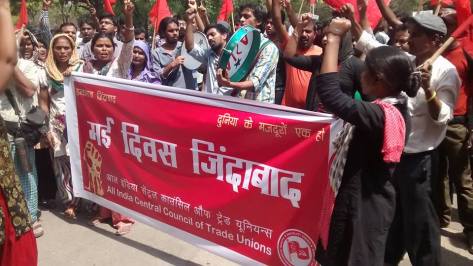
Workers and Students Unite in JNU on May 1, 2016, International Labour Day

We are in that strange time again. The summer of 2016 has witnessed a May Day wherein the workers in JNU not only took out their own rally, but also rallied with us students sitting on the 4th Day of their Indefinite Hunger Strike against administrative crackdown on our democratic spaces. Continue reading Workers and Students Unite on May Day in JNU: Aswathi Nair & Umar Khalid

Bhim Yatra .. so that there are no more killings

Protestors set fire to containers representing septic tanks cleaning which manual scavengers have and continue to lose their lives even today ( Photo Courtesy : http://www.youthkiawaaz.com)

Rarely does Jantar-Mantar, the place in the heart of Delhi, gets ‘enlivened’ with people who share very similar type of tragedy – one should say man made tragedy.The culmination of 125 day Bhim Yatra – led by Safai Karmchari Aandolan – which had started from Dibrugarh in the North East on 10 th December and had traversed around 500 districts and 30 states, proved to be one such occasion. (13 th April 2016)

The big public meeting organised at Jantar Mantar, attended by hundreds of safai karmcharis from different parts of the country and many individuals, activists who are sympathetic to their cause, was just another way to celebrate Dr Ambedkar’s 125 th birth anniversary, a day earlier. Special focus of the Yatra was on deaths in sewers and septic tanks and the key slogan was ‘Stop Killing us in Dry Latrines, Sewers and Septic tanks’. In fact, most of the people who were sitting on the podium belonged to such families only, who had lost their near-dear ones in cleaning sewer or septic tanks. Continue reading Bhim Yatra .. so that there are no more killings

Petition to Demand Release of Anti-Mining Activist , Writer, Film-maker Debaranjan Sarangi

Guest Post by Kamayani Bali Mahabal

Release Anti-Mining Activist , writer, film-maker - Debaranjan Sarangi

Debanjan Sarangi , , documentary film maker, writer and human rights activist  has been arrested in the early hours around 6.30 AM on March 18, 2016, by the Odisha police in Kuchaipad village in Kashipur block of Raygada district of Odisha. The defender has been arrested with the help of local police on the basis of a non-bailable warrant issued against him in a previous case of the year of 2005.

Debaranjan Sarangi along with others went to Kuchaipad village in Kashipur block of Raygada district of Odisha to participate in the FUNERAL  of activist late Mr. Laxman Majhi on March 16, 2016, evening. The rituals were completed on March 17, 2016. While other persons accompanied the defender returned on the same evening,

Debaranjan decided to stay back in the village for another day. In the early morning on March 18, 2016, he went out to a nearby riverside and while he was coming back, he saw two police men in civil clothes who came to him and took him. They did not allow him to change his clothes and forced him to go along with them in his lungi to the nearest police station at about 6.30 AM. Continue reading Petition to Demand Release of Anti-Mining Activist , Writer, Film-maker Debaranjan Sarangi

Patented Patriotism: Kalyani Menon-Sen

Guest post by KALYANI MENON-SEN

The last few months have seen an unusual public engagement around questions of secularism, freedom of speech, sedition and the like, with furious debates everywhere from our campuses, streets and TV studios to the floor of Parliament. The budget session has been enlivened by scenes of high drama, with the leading lights of the Treasury benches bringing colour, sound and fury to their tutorials on patriotism and nationalism.

While these high-decibel histrionics have been appreciated and applauded by many, some unpatriotic elements are asking if they are designed to divert public attention away from behind-the-scenes negotiations and surreptitious deal-making that could undermine the rights and compromise the survival of millions of Indian citizens.

One such deal is now out in the open. In written submissions to the US Trade Representative, two US industry bodies (the US Chamber of Commerce and the US-India Business Council) have said that the Government of India has “privately reassured” them that it will not use the mechanism of compulsory licensing to allow commercial production of cheaper generic versions of patented medicines in India.[1]

The note of gleeful triumph in this announcement is unmistakable. Ever since the present government came to power, US trade bodies and pharma industry bodies have stepped up their attack on India’s patent system and demanded the dismantling of safeguards that protect citizens’ rights from being sacrificed to commercial concerns. The provision for compulsory licensing, empowering the government to override patents and allow the marketing of generic medicines in the public interest, is a prime target for this attack. Also in the firing line are measures to prevent patent holders from dragging out their monopoly by “evergreening” (making changes that do not enhace the therapeutic value of a product and patenting it anew), and allowing third parties (such as consumer groups or generic manufacturers) to challenge and oppose patent applications before they are finally granted. Continue reading Patented Patriotism: Kalyani Menon-Sen

When Crime Becomes Ordinary, Ordinary Life Will be Criminalised

  1. Zee News Anchor Sudhir Chaudhary whose heart beats for India tried to extort 100 crores from the Jindals, remember? No, no, please, kindly, take a few minutes to watch this, at least until 3.55.


  1. This is a photo comparing Chaudhary with that the whistleblower in the Vyapam scam, who exposed a long-running case of serious corruption by the state and political parties which has involved the murders of over 45 individuals! The current government is providing Chaudhary X category security while with this cycle-borne ‘security’ the Vyapam whistleblower has survived 14 attacks on his life.
main-qimg-ce1f1542701c71d0da51f68ad43ecab8
Courtesy: Quora.com

Continue reading When Crime Becomes Ordinary, Ordinary Life Will be Criminalised

Appreciating Diversity, Corporate Style – Guest Post by Anonymous

Guest Post by Anonymous

A senior leader of India’s leading IT Services Company took a moment on March 8th to send a note to his colleagues wishing them on International Women’s Day.  In the mailer, he also exhorted his colleagues, among other things, to strive towards building an environment that appreciates variety. The variety of Race, Ethnicity, Gender or Generation! He did not stop there, but went on to talk about drawing strength from these differences. Caste, quite evidently, is conspicuous by its absence in the corporate discourse on diversity (or variety as they also like to call it).

What is it that makes Corporate India, or a part of it, sensitive towards race issues/matters on one hand but allows them ignore caste on the other? Is it reflective of what a social activist friend once mentioned to me in a private conversation – Caste is only visible from “down below” and not “up above”? Continue reading Appreciating Diversity, Corporate Style – Guest Post by Anonymous

The ‘Non-Science’ Of Grabbing Grasslands And Promoting A Futuristic ‘Science City’: A.R.Vasavi

Guest Post by AR VASAVI

January, 26th, 2016, the 66th year of celebrating the declaration of India as a ‘Republic’ and the passage of the Indian Constitution, witnessed an unusual gathering at an auditorium at Challakere town (Chitradurga District, Karnataka). Local residents, farmers, shepherds and a number of environmentalists, academics, reporters, and students from various towns and cities of Karnataka participated at a public hearing on the appropriation by the governments of India and Karnataka of more than ten thousand acres of a common grazing land called the Amrut Mahal Kaval which had been allocated to various public and private sectors for the construction of a futuristic ‘science city’. Organised by Amrit Mahal Kaval Hitarakshana Haagu Horata Samithi [Amrit Mahal Kaval Conservation and Struggle Committee] the public hearing was to assess the pros and cons of such land allocation.  Local shepherds and farmers from the surrounding villages highlighted the impact of the loss of their grasslands (kavals). In their eloquent and well-thought-out statements, the local residents sought to retain their rights to the grassland (a collectively maintained resource) and to the livelihoods and life that it enabled. They questioned the undemocratic process by which their land had been appropriated and commented on  the nature of the nation’s institutions. Although they had all been invited, none of the representatives of the government departments and the organisations which had received land deemed it worthy to attend this public hearing. This meet and the visit to the Kavals (now cordoned off with a double boundary; an outer wire fence and an inner stone, concrete and steel meshed 15 feet high fence, reminiscent of high-security prisons) were testimony to the unusual trajectory of the Indian Republic where the voices of common people are increasingly silenced and the state, and its institutions of the military, the science establishment, and some private players have gained ascendency.

Continue reading The ‘Non-Science’ Of Grabbing Grasslands And Promoting A Futuristic ‘Science City’: A.R.Vasavi

Bastar to Delhi – Increasing Threat to the Rule of Law and Freedom of Expression

STATEMENT BY CONCERNED CITIZENS

It seems that an undeclared state of emergency is sought to be imposed upon us: a series of seemingly unconnected events across the country, in universities (most recently in Hyderabad and Delhi), factory premises and court halls, our streets and over large parts of the countryside, bear this out. We would like to draw wider attention, in particular, to recent disturbing developments in Jagdalpur, Bastar, that have been somewhat overshadowed by events in the Jawaharlal Nehru University, New Delhi.

In Delhi as in Bastar, the state is using its coercive power to stifle dissent and lock up dissenters by labelling them anti-national or, in the case of Bastar, Maoists. In Chhattisgarh, it has long been standard practice to label anybody with an opinion of development contrary to the mainstream view (of development as corporate welfare and environmental destruction) as a Maoist. This is usually a prelude to police action ranging from harassment and intimidation to arrest, torture, and even death. The adivasi inhabitants of Bastar have not enjoyed the rule of law since 2005, when the Salwa Judum, a vigilante paramilitary group, was formed in the name of combating Maoism. Nor does the law offer much protection to ordinary people elsewhere seeking to exercise their constitutional rights as law enforcement agencies and governments trample upon civil liberties in the name of nationalism.

Continue reading Bastar to Delhi – Increasing Threat to the Rule of Law and Freedom of Expression

In the Name of the ‘Nation’: Vidya K. Subramanian and C. J. Kuncheria

This is a guest post by VIDYA K S and C J KUNCHERIA

“Don’t you dare speak over me when I am speaking of Lance Naik Hanumanthapa! We’re proud of him and we’re ashamed of you!,” screamed Arnab Goswami at Umar Khalid, the JNU student at the centre of unfolding events at the university. Hundreds of thousands of self-proclaimed nationalists cheered at that instant, and many more did as the clip went viral over social media. The death of the soldier, one of the 869 who have been killed in the last four years by the punishing weather on Siachen, had been conveniently used to invoke a cathartic nationalism. Continue reading In the Name of the ‘Nation’: Vidya K. Subramanian and C. J. Kuncheria

The India I Came Back To: Namrata Sharma

This is a guest post by NAMRATA SHARMA


I will start this piece with a painful but short flashback tirade about myself. I moved back to New Delhi in 2014, after six long years in New York and Singapore. My decision to move back to the motherland was predominantly attributed to issues that a twenty-something grapples with when he or she is away from home and family. However, familial ties and emotional reasons aside, there was one factor which deeply resonated with me and was the driving force behind my decision to move back. This factor was – the liberty to express my thoughts and views on a topic, any topic, in an indulgent and lenient space, which, by virtue of being an Indian citizen, was guaranteed to me in India and not in other places. In India, this liberty transcended predictable spaces like classrooms, newsrooms and sophisticated editorial pages of the morning newspaper and was very organically present in the form of arm-chair political banter amongst friends and political conversations with family over dinner. Continue reading The India I Came Back To: Namrata Sharma

Solidarity Statement of Students from Northeast India, TISS, Mumbai 20th February 2016


We, the undersigned, students and research students from various states of northeastern region of India studying in Tata Institute of Social Sciences, Mumbai would like to highlight on the unprecedented shrinkage of academic spaces across various universities in India. We condemn the politically motivated interferences of the state in Jawaharlal Nehru University and in Hyderabad Central University (HCU), and other universities. We also condemn the mob justice perpetrated by lawyers against students, journalist, activists etc in the Patiala House Courts, New Delhi, and media trial led by prominent journalists from New Delhi. Continue reading Solidarity Statement of Students from Northeast India, TISS, Mumbai 20th February 2016

Statement on the Events at HCU and JNU From Faculty of the Tata Institute of Social Sciences


We, the undersigned, are deeply shocked and dismayed by the processes that led to the suicide of Rohith Vemula at HCU in January and the ongoing attacks on students and faculty of JNU. At Hyderabad Central University, RohithVemula a Dalit research scholar was labelled as anti-national and driven to suicide in January through systematic persecution. At Jawaharlal Nehru University (JNU), New Delhi over the past few days, Kanhaiya Kumar, the President of the JNU Students Union is held in police custody on the trumped up charge of sedition. On February 15, 2016, the police stood by as mute spectators while a group of lawyers and hooligan elements attacked students and faculty of JNU who had gone to the Patiala House courts in Delhi in solidarity with Kanhaiya Kumar who was to be produced there. Continue reading Statement on the Events at HCU and JNU From Faculty of the Tata Institute of Social Sciences

Undeclared Emergency? State Repression from JNU students to HONDA workers: Nayan Jyoti

Guest Post by Nayan Jyoti

[ Even as the repression on students in universities, continues, the BJP regimes in Rajasthan and Haryana have attacked peaceful assemblies of young workers in the National Capital Region (NCR). This calls for widening and deepening the resistance against the Modi regime, whose fascist character is now nakedly visible. When the state starts hunting down workers and students at the same time, it is time for workers and students (and their friends) to stand united together and resist the repression by all means necessary and possible. We are posting below an account by Nayan Jyoti, a young activist, of the violence unleashed by the BJP governments in Rajasthan and Haryana, in collusion with factory managements, using the brute force of armed police and hired thugs in the last few days, with the hope that it will add crucially to our understanding of what exactly is going on in India.The Modi regime is in a deep crisis, and the only way the BJP (both at the centre and at the provincial levels) knows how to respond is through violence. Modi is the best student of Indira Gandhi in Indian politics, and he is following totally in her footsteps, invoking exactly the same ‘Anti-National’ tag, especially in terms of the way she led up to the declaration of the emergency in 1975. Things are different now, but also very similar. This is the beginning, as the author of this post says, of an undeclared emergency. The difference between a declared and an undeclared emergency appears at the moment to be only a formality. It is time we saw through the veil of this formality.]

We #standwithJNU and raised our united voices against State repression and witch-hunt of students for #righttodissent since 9th February. On 18th February, more than 15,000 people said so clearly in Delhi and pointed out that this has directly followed in a coordinated manner more recently from the institutional murder of Rohith Vemula in HCU by the anti-Dalit administrations under influence of the BJP, and right-wing attack on FTII students to completely control freedom of thought and expression earlier and the murder of progressive intellectuals by right-wing groups in recent times.

As this terrorizing and silencing of progressive voices, students and intellectuals goes on by both the BJP government and its police-administration from the top and the RSS vigilante groups on the streets, another much more brutal crackdown on thousands of workers has just happened and continues in the Haryana-Rajasthan border.

Continue reading Undeclared Emergency? State Repression from JNU students to HONDA workers: Nayan Jyoti

Mea Culpa, Mea Culpa! : To A Student from CDS

Dear Student from CDS who pasted the posters criticising  our collective effort to stand with JNU

I write in response to the views that you expressed on those posters. First of all, let me tell you how much I’d have appreciated if you expressed those views openly right from the beginning, so that we could have had a proper debate. I do wish we stopped scribbling comments on each others’ posters – this is an open campus, and surely, we don’t practice the Sangh Parivar’s intolerance of a contrary opinion. No one, I assure you, will harm you in any way, and I am sure all my fellow teachers, students, and non-teaching staff will join me in assuring you thus.

Continue reading Mea Culpa, Mea Culpa! : To A Student from CDS