കേന്ദ്രത്തിൽ മോഡിസർക്കാർ ഭരണത്തിൽ വന്നതിനു ശേഷം നരകത്തിൻറെ വാതായനങ്ങൾ ഒന്നൊന്നായി പിളരുകയും അവ നമ്മേ വിഴുങ്ങുകയും മഹാപാതകങ്ങൾക്ക് നിസ്സഹായരായ ദൃക് സാക്ഷികളാവുക എന്ന അപാരപരീക്ഷണത്തിനു നാം വിധേയരാവുകയും ചെയ്തിരിക്കുന്നു. നിരർബുദനരകവും അർബുദനരകവും പല വട്ടം നാം കടന്നിരിക്കുന്നു. മാട്ടിറച്ചിയുടെ പേരിലും പിറന്നു പോയ ജാതിയുടെയും മതത്തിൻറെയും പേരിൽ നിരപരാധികളായ മനുഷ്യർ ഇവിടങ്ങളിലേക്കു വലിച്ചെറിയപ്പെടുന്നത് അധികവും നിസ്സഹായരായി കണ്ടുനിൽക്കേണ്ട ദുര്യോഗം താങ്ങാവുന്നതിലും അധികമായിരിക്കുന്നു. Continue reading മഹാനരകങ്ങൾക്കെതിരെ : ഏപ്രിൽ 23ൻെറ പ്രതിഷേധക്കൂട്ടയ്മയ്ക്കു വേണ്ടി ഒരു കുറിപ്പ്→
लोग अब समझने लगे हैं कि अपने संकीर्ण एजेंडे को आगे बढ़ाने के लिए सत्ताधारी जमातें भले डॉ आंबेडकर की मूर्तियां लगवा दें, मगर तहेदिल से वह मनु की ही अनुयायी हैं.
एससी/एसटी एक्ट को कमज़ोर करने के ख़िलाफ़ बुलाए गए भारत बंद का दृश्य. (फोटो: पीटीआई)
2 अप्रैल का ऐतिहासिक भारत बंद लंबे समय तक याद किया जाएगा. जब बिना किसी बड़ी पार्टी के आह्वान के लाखों लाख दलित एवं वंचित भारत की सड़कों पर उतरें और उन्होंने अपने संघर्ष एवं अपने जज्बे से एक नई नजीर कायम की.
आजादी के सत्तर सालों में यह पहला मौका था कि किसी अदालती आदेश ने ऐसी व्यापक प्रतिक्रिया को जन्म दिया था. ध्यान रहे कि इस आंदोलन के दौरान हिंसा हुई और चंद निरपराधों की जानें गईं, उसे कहीं से भी उचित नहीं कहा जा सकता!
मगर क्या इसी वजह से व्यापक जनाक्रोश की इस अभिव्यक्ति ने उजागर किए सवालों की अहमियत कम हो जाती है? निश्चित ही नहीं!
The raging controversy over the cover of a breastfeeding woman looking up with no shame about her exposed breast has, quite expectedly, sent conservative fools in Kerala into a raving frenzy. The case against the model and the conservative breast-beating going on now must be dismissed summarily as useless bullshit.
However, I must say that I had very mixed feelings about the cover and the defense offered for it by many. For many arguing in its defense seem to be saying that all one needs is gratefulness for the effort to open up the issue and the space gained, and all else raised isn’t really worth the trouble. Even this intelligent piece in the Ladies Finger slides into such complacency.
If you ask me, this cover is not of a woman breastfeeding, but of one who is declaring her determination to be comfortable while breastfeeding, thereby reinforcing her commitment to breastfeed her baby. I think this difference is important. Breastfeeding is a very intimate act; it is highly physical. If the mother and child are well, happy, and don’t have issues that may make this feel like a chore or hard to do, then it is very highly pleasurable too. As a woman who has breastfed continuously for 9 years with just a short break of a few months during my second pregnancy, I can say this: breastfeeding is also ‘breastfeeling’, so your attention is on the act, and you really don’t want to focus on anything else, especially irritating stares. It is as pleasurable as lovemaking. Many years later (my daughters are 25 and 20 this year), when I remember the act, my nipples rise, tingling. Breastfeeding was also play time, when the little one played with her mum’s breast with her tiny fingers feeling and squeezing it; and my younger one was especially playful, twisting her tiny body in sheer pleasure, and sometimes, remaining still and then naughtily sinking her little tooth into the nipple, rolling her eyes up to check the reaction from her mum! So when we traveled, I always carried a big, opaque duppatta with which I made a ‘tent’ over our heads that covered us completely. We would be sitting in a corner seat in the train, and having fun, she sitting on my lap (and later the tent would be big enough for the three of us, myself, my six-year-old, and one-year-old, the former listening to a story, and the latter happily suckling). We would sing, tickle, do what not. Demanding the freedom to breastfeed without being too bothered about modesty and in public without anyone staring, for me, then, is demanding the right to such intimate pleasure in public. In that sense, this should have been one of the afterlives of Kerala’s Kiss of Love protests.
I don’t have the image of me breastfeeling happily, but here is the picture of my little one after one of our sessions. Does anyone doubt anymore, that it is indeed breastfeeling, not just breatfeeding. Here is she, looking ecstatic, the milk still in her little mouth!
However, the sartorial codes of the model make me feel very disconcerted. Sharanya Gopinathan, in the above piece, argues that Grihalakshmi caters to largely savarna women probably. But no, savarna women are not the demographic majority, and they are possibly not the dominant section in the magazine’s readership. But savarna culture is pervasive in Kerala, cutting across caste and faith, and the cover clearly panders to it. The model’s huge sindoor — mark you, wearing the sindoor is a very recent import from the north to Kerala, the demure-looking sari, and the girl-next-door look was probably calculated to make up for the exposure of the breast. So we have a young woman who announces through her sindoor that she is married — legally and customarily penetrated, to adopt a Foucaldian way with words — and modestly dressed, that she belongs to the elite, evident in her professionally-groomed looks, and also tells the world that she is determined to breastfeed no matter how much the lechs stare. Intended or not, it brings to the mind too readily the dream-girl of the Hindutva modernist vanguard: the educated woman, maybe even a corporate professional, with looks that fit that environment, who is determined to mother well and indeed stay close to her biological ‘essence’, and of course whose maternity has not been allowed to affect her slim body and maidenly-looking breasts. The idea, I think, was to say that such a woman can and should be brave enough to fend off irritating stares — but it backfired with the conservatives, apparently, who are not ready to concede any quarter. Breastfeed she must, remember her womanhood, she must, look pretty and stay slim she must — and demand no open breastfeeding.
When will we see the image of a woman you see in the bus stops every day in Kerala, harried, sweaty, with her budget-beauty parlour looks and less-than-chic sartorial choices sitting in a bus shelter perhaps and immersed in feeding her infant, her not-perfect breasts bulging out un-prettily, caring nothing at all for what the world thinks? She can of course be imagined as staring back defiantly, but the glow of pleasure is what should animate her being and fill her with courage. Normination to be a good biological woman and mother. Not the developmentalist commitment to produce healthy babies. What ultimately counts is the space of intimacy between a mother and her child, which is physical, which involves pleasure — and we need to demand that women should be able to create it everywhere.
And why on earth are we waiting for Grihalakshmi to lead? Thankfully, third wave feminism in Kerala is devoid of prudishness and values pleasure — and among our third gen we have a great many artists — poets, painters, photographers, of many genders! We should be able to assert that what is at stake is breastfeeling, not just breastfeeding. Let us reduce ourselves to neither those who sneak in a litany to biological motherhood through their seemingly radical cover, nor with those who want to see nothing but physical nourishment in breastfeeding.
This is a guest post by TANNISTHA SAMAMTHA andMUKTA GUNDI
With the success of “PadMan”, Akshay Kumar has established himself to be a bleeding-heart ‘feminist’. News channels are pouring praises for a film that introduces a ‘bold’ topic while regurgitating the crucial link between safe menstrual practices and women’s health. While the message is old (and important), the euphoria around it is new. Continue reading PadMan, Patriarchy and the Poor Man’s Innovation: Tannistha Samantha and Mukta Gundi→
Happy International Mother Language Day. This day, declared by UNESCO, is straight up South Asia’s alley as it celebrates linguistic diversity and multilingualism. In other words, it celebrates each Indian.
Here’s what you can do from now on to celebrate it:
1. Resist Hindi imposition. An official language is not the national language. Persian was the language of administration for close to three hundred years, Sanskrit has been the language of knowledge for close to two thousand years, but neither were the only languages in the room. And we know what happened to those languages over time.
2. Defend diversity: Understand that, as in nature, numerical strength is not might (e.g., there may be more cockroaches in the world than humans), so if you belong to a large group of people, then this doesn’t mean that your language is better and more representative of the ‘heart and soul’ of ‘Indianness’. In India, literally hundreds of languages with populations ranging between 500 to 10,000 have flourished (many reported over all the Census) because
I have been working for the past 16 years with a small organisation called India Foundation for the Arts (IFA) that attempts to support arts and culture projects across the country. In these years I have been fortunate enough to travel across the country to big cities and small ones, towns and villages where arts practitioners and scholars work intensely, passionately, with almost no economic resources or social acknowledgements. The percentage of our total national budget outlay to the arts and culture is negligible as is the amount that finally gets spent on it. The state of our national arts and culture institutions is abysmal and much has been written by eminent experts critiquing the vision, mandates, policies and mechanisms of funding or the lack of any of these prerequisites to support the sector with an imagination that attempts to build a robust, vibrant ecology for the arts.
T T Sreekumar, an important commentator on contemporary politics in Kerala — a public intellectual who now qualifies to be an irritant in the eyes of the Kerala police, now that he has openly declared his allegiance to the dalit people fighting injustice and Vadayambady and inaugurated a protest-event there — writes about the issue and its historical origins:
When I visited Vadayambady the other day to express my solidarity with the cause of the agitation, what I witnessed there was an atmosphere of utmost fear and police terror. A big task force of police was stationed at the location. The team that included the special branch officers, had created a situation of terror at the peaceful site. Activists mentioned that a particular police officer continuously hurled abuses, including caste abuses, at the protesters that included Dalit women and children. When the protest began to draw national attention, the ruling dispensation of CPIM that had hitherto remained unconcerned has started to take up some damage control measures. However, when they finally arrived at the site of the agitation almost after a year since the agitation began, the CPIM leaders allegedly refused to address the caste question involved. Dalit activists, including women activists, surrounded them and raised several objections to this attitude pointing to their sheer hypocrisy and lack of integrity.
The almost insoluble task is to let neither the power of others, not our own powerlessness, stupefy us.
Adorno.
As frightening spectres of untouchability and unseeability hover around the festering sore of the ‘caste-wall’ at Vadayambady in Kerala, as the so-called mainstream left-led government here continues to pour its energy and resources into aiding and abetting caste devils there, as most mainstream media turns a blind eye, as the Kerala police continues its mad-dog-left-loose act, many friends ask me: why have you not yet written about the struggle there of dalit people fighting of the demon of caste now completely, shamelessly ,in the public once more? Continue reading Malayali Feminism 2018: In the Light of Vadayambady and Hadiya’s Struggle→
On 30 January 2018, retired civil servants and veterans of the armed forces jointly organised a conclave on ‘Hinduism and Hindutva’ at the Indian Social Institute, New Delhi. The conclave attended by over hundred participants, emphasized the need to rescue both Hinduism and the Indian Constitution from the clutches of the political project that calls itself Hindutva, and which has nothing to do with religion as such. The participants at the conclave sought to make a plea for saving Hinduism without making any concessions to the monstrosity of caste oppression, which in the spirit of many earlier reformers, they rejected.
This conclave followed an earlier one on ‘A Fractured Polity: The
Relevance of Gandhi Today’ organised on 10 October 2017, which had been
addressed by Justice A P Shah, Mrinal Pande and Ramachandra Guha. The
speeches are available on YouTube (Justice A.P. Shah, Mrinal Pande,
Ramachandra Guha). These civil servants and veterans have also raised severe
concerns about the present situation in a series of open letters over the last few
months: on vigilantism and hyper-nationalism; the suspicious death of Justice
Loya; and violence and discrimination against minorities in India. (See: Retired
Civil Servants open letter – 10 June 2017, Armed Forces Veterans open letter –
30 July 2017, Retired Civil Servants Letter 02 December 2017 – Enquiry into
Judge Loya’s death, Armed Forces Veterans letter to Supreme Court & Bombay
High Court on Judge Loya’s death, Retired Civil Servants open letter – 28 January
2018). Continue reading Defend Constitutional Values, Save Hinduism from Hindtuva: For Civil Servants and Armed Forces Veterans→
Ghalib has fascinated generations of people and they have tried to understand/ interpret his poetry in their own way. For any such individual it is really difficult to recollect when and how Ghalib entered her/ his life and ensconced himself comfortably in one’s heart.
This wanderer still faintly remembers how many of Ghalib’s shers were part of common parlance even in an area whose lingua franca is not Hindustani. His andaaz-e-bayaan, his hazaron khwahishein, his making fun of the priest etc. could be discerned in people’s exchanges – without most of them even knowing that they were quoting the great poet.
To be very frank, to me, it is bewildering that a poet – who died over 150 years back – looks so contemporary or at times even a little ahead of our own times. Is it because, he talks about primacy of human being, at times philosophising about life, and on occasions talking about rebelling against the existing taboos in very many ways? But then have not many other great poets have dealt with the same subjects/ topics? Continue reading ‘Why Ghalib appears so contemporary even today ?’ : Interview with Hasan Abdullah→
रक्स करना है तो पॉंव की ज़ंजीर न देख – मजरूह सुल्तानपुरी
Look – beyond the the prison walls, the brilliance of flowers, the vitality of spring
If you must dance, ignore the chains that bind your feet – Majrooh Sultanpuri
Today, the scared Republic that has imprisoned its young idealistic fighter son, Chandrashekhar, is on trial. The Republic, scared of its own offspring, stands in the dock. This Republic Day, we must all answer how it came to pass that a gang of adventurers and marauders simply took it over, submitted it to their command, while all the elderly, wise men and women, watched. Today, when the Republic bondage we must seek answers from all those who watched helplessly – or self-righteously – as marauders took it over.
It is official now. A radiogram from the Deputy Secretary, Home, Govt of Uttar Pradesh to the Superintendent, Saharanpur District Jail, dated 23 January 2018, confirms the slapping of charges under the National Security Act, on Bhim Army founder, Chandrashekhar Azad ‘Ravan’. Pradeep Narwal, Coordinator, Committee for the Defence of Bhim Army, who met Chandrashekhar in jail yesterday, underlined how the Karni Sena activists attacking school buses and vandalizing schools were being allowed the freedom to do so while Chandrashekhar, responsible for setting up and running of schools (see the video below), is being held in jail for months and has now been slapped with charges under NSA. “Karni Sena are apparently deshbhakts and Shekher bhai and Bhim Army are ‘terrorists’ in the perverted logic of this government,” he said.
In conversations with friends and sympathizers who have been meeting him over the past months, including Pradeep Narwal, Chandrashekhar ‘Ravan’ has been expressing a fear that many of us have also had, independently, for some time now: that the government wants to actually get rid of him – just as judge Loya was, it now transpires. Continue reading A Revolution Called Chandrashekhar Azad ‘Ravan’ – the Republic on Trial→
The recent reference to how the distribution of food in Malayali homes is often skewed against women by the actor Rima Kallingal in a recent talk has sparked off yet another round of attacks against feminists in Kerala. It is interesting to see how this seems to have brought together men of all political stripes and colours (may I say, from pro- and anti-Hadiya camps!). The attacks range from mild smirking to outright abuse, but are equally revealing of the fear of women’s feminist self-assertion. So even those men who supported Hadiya’s decision to choose her faith and community find it hard to swallow when women start laying bare the injustices of the ubiquitous patriarchal family, fearing that there may be an implicit choice in this criticism, to move away from the patriarchal family, and indeed, craft other non-patriarchal forms of intimate connection and commitment. After all, whatever be the community, the patriarchal family is acknowledged by patriarchal authorities everywhere as the foundation Continue reading From Nangeli to Rima Kallingal: Who are fit to claim Nangeli’s Legacy?→
I went to Maharashtra as I along with other activists and intellectuals were invited to come there. I along with others was a guest there. And I would remember fondly the love and support that I received in Pune and Mumbai. I would remember the resilience and enthusiasm of the people I met and their resoluteness to fight Manuvaad and centuries old casteist tyranny. I would remember the immense inspiration that I felt, when we paid homage to Jyotiba Phule and Savitribai Phule in Phule-wada, Pune. And, No I will not let two days of media trials by a few TV anchors, who are more of professional howlers, spoil these wonderful memories. I will not let their criminal cacophony and mindless vilification of me, Jignesh & others shadow my beautiful memories of Maharashtra.
The state of Maharashtra as well as the rest of the country is at a critical juncture today. On the one hand are forces in power who want to push our country back to many centuries and on the other are people who are resisting this Neo-Peshwahi, the casteist-communal-fascist regime of BJP-RSS. In my speech at Elgar Parishaad on 31st December 2017, I had said that the year 2018 is going to be a very challenging one. The last 3 and half years of the Modi Sarkar has exposed the BJP’s jumlas of Ache Din and Vikas as hollow, bitter and brutal lies.
As the General Elections of 2019 approach, BJP/RSS will now resort to creating civil strife amongst the people, polarising them on the basis of caste and religion and unleashing attacks on muslims and Dalits. The developments over the last few days vindicate me, a little too soon. Several regions of Maharashtra are in the midst of an acute agrarian distress. Both Marathas and Dalits are victims of this agrarian crisis that has been precipitated by the policies of both Modi and Fadnavis. The BJP/RSS regime has no resolution to offer to the farmers of Maharashtra. Therefore, unleashing attacks on Dalits through their hoodlums and portraying it as a caste clash between Dalits & Marathas will remain their only strategy. Continue reading Statement about the attacks on Dalits in Bhima Koregaon & the Subsequent developments in Maharashtra : Umar Khalid→
[ This post is based on updates posted by me on my Facebook wall ]
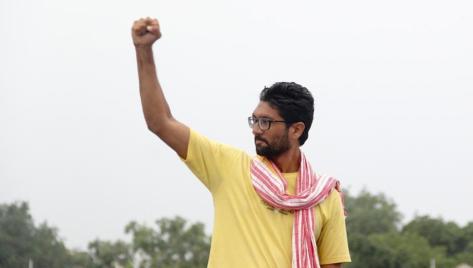
Jignesh Mevani. Photograph by Siddharaj Solanki, HT (Hindustan Times) File Photo, accessed from the HT website
A great kerfuffle has ensued ever since the recently elected independent MLA from Vadgam, Gujarat and Rashtriya Dalit Adhikar Manch activist Jignesh Mevani gave an interview in which he had some choice things to say about the Prime Minister and BJP leader Narendra Modi. Mr. Mevani made some positive and gentle suggestions, to the effect that because Mr. Modi has stopped being relevant, has not delivered on even one of the promises made by him, he should retire, proceed towards the Himalayas, and in the phrase that has caused the greatest commotion, ‘melt his bones’.
#JigneshInsultsPM | Series of abuses after winning his debut poll, is this Jignesh's arrogance or immaturity? Fire in your views using the hashtag and let us know! pic.twitter.com/N6H6yr8oTA
Predictably, Mr. Modi’s personal broadcasting service, known as Republic TV has kicked up the greatest fuss. Arnab Goswami has been especially indignant, and he was joined in his rage by BJP spokesperson, the orotund television commentator and historical photo-shop scam artist, Mr. Sambit Patra. Mr. Mevani offered a robust and dignified refusal to apologize for what he said about Mr. Modi, when Republic TV demanded that he do so. Continue reading Jignesh Mevani, The Meltdown of Modi-Men and Dadhichi’s Bones→
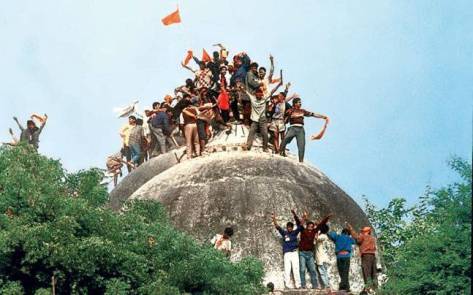
Twenty five years ago, on 6 December 1992, the structure of Babri Masjid was brought down by a mob of vandals, presided over by the top leadership of the BJP/RSS/VHP, as the Congress government led by prime minister Narasimha Rao looked on benignly. As did the Supreme Court before which a commitment was made by the Kalyan Singh (BJP) government in Uttar Pradesh – to the effect that nothing would be allowed to happen to the structure of the mosque.
Journalist Sajeda Momin, covering the demolition, recalls the scene thus,
I can still see the thousands of saffron-clad ‘kar sevaks’ clambering atop the 16th century mosque and pounding it with shovels, iron rods, pickaxes and anything they could lay their hands on. I can hear the screeching of Sadhvi Uma Bharti egging them on shouting “ek dhakka aur do, Babri Masjid tod do” through the microphones from atop the specially-built watchtower for the BJP/RSS/VHP leadership. I can visualize the three domes of the mosque collapsing inwards one by one at intervals of roughly an hour on that cold, wintery Sunday afternoon.
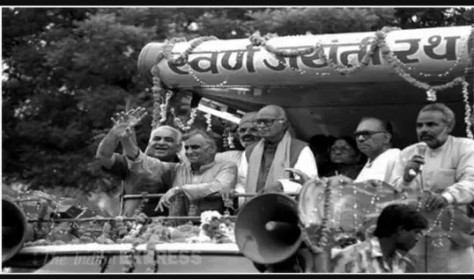
Everyone knew who were the dramatis personae at each level – and practically every bit of evidence that would ever have been required exists, captured in videos and photographs. Our present prime minister was said to be one of the key organizers of the of the Rath Yatra that led up to the demolition and can be seen holding the microphone in his hands in the photograph below.
Rath Yatra – precursor to the demolition, image courtesy Quora.com
Worse was to follow the demolition. The demolition of the structure of the mosque was over that day but the process of the demolition of the Indian Constitution that had begun with what was called the ‘Ram janmabhoomi movement’ continued. By ‘Constitution’ I do not simply mean the book that embodies the law of the land but rather the very weave that came to constitute Indian society as a result of the new contract that the document called the Constitution embodied. Constitution, therefore in a triple sense. The document called the Constitution too was not merely a book of laws; it was rather, the only existing, largely agreed upon, vision of a modern India. It was a vision which was put in place through the long process of struggles, debates and contestations over the long decades of the anticolonial movement and finally given shape in, in the Constituent Assembly. There was nothing benign or innocuous about it – every bit of it had to be achieved through a fight. And yet, in the end, that was the document that embodied the vision of modern India. The only political current that stood far away from both the anticolonial struggle and had no role in the creation of this vision is the political force that rules India today.
The RSS and its numerous offshoots were neither fighting the British nor joining in the anti-caste and anti-untouchability struggles through the period since they came into existence in the mid-1920s. No wonder leaders of the Sangh combine think the anti-colonial/ national struggle was about cow-protection. That they neither subscribed to the anti-British agenda nor to the anti-caste agenda around which struggles of that period took shape, is not just a matter of historical record but is also visible in the way its leaders and ranks conduct their politics today. Every single step taken by the Sangh leaders is a step out of sync with the vision of the future spelt out by the social contract of modern India. That the Sangh attributes this vision to the Congress is an expression of its own illiteracy about the diverse forces in struggle throughout that period.
Even though it is conducted in the name of Hindus, there is nothing ‘Hindu’ about its agenda. Sangh and Sanghism is the name of a malignant political machine that seeks to destroy the very body of society in the name of an ancient past. That is the political machine we confront today. That is the political machine that we must fight today with all our vigour.
Babri-Masjid – Before the Demolition, image courtesy Tehelka.com
The gradual erasure of the words ‘Babri Masjid’ from our everyday memory actually began in 1986, when the Hindu community was granted the exclusive right to worship there. This happened without any regard ownership disputes the and illegal conversion of this mosque into a temple in 1949.
This story of the dispute itself is disputable. It is imperative to revisit three interesting moments, which no one talks of these days.
The 1949 moment
On the night of 23 December 1949, a group of local Hindus entered the mosque and installed the idols of Lord Ram inside it. Although the police filed an FIR in which the building is clearly defined as a functional mosque, the local administration took charge of the building, and without removing the idols from the mosque space, declared it a legally “disputed site”. Read the full article here
[This is the text of the open letter to the Chief Minister of Kerala from the celebrated Tamil poet Rajathi Salma, a leading literary and activist voice from South India whose writing has often revealed the pain and poignancy of women’s unfreedoms and the denial of a creative life of choice to them. This is about the never-ending agony that the confinement of a young woman, Hadiya, by her father, has become. Hadiya is to be heard by the Supreme Court of India on 27 November 2017, but the Kerala government refuses to take responsibility for her safe travel to Delhi, after many many pleas from civil society] Continue reading Hadiya’s Safety is the Kerala Government’s Responsibility: Rajathi Salma writes to the Chief Minister of Kerala→
किसी भी संतुलित मस्तिष्क व्यक्ति के लिए यह सवाल विचित्र मालूम पड़ सकता है। अलबत्ता सामाजिक-राजनीतिक आंदोलनों पर निगाह रखनेवाला व्यक्ति बता सकता है कि जब लोग सदियों से जकड़ी गुलामी की बेड़ियों को तोड़ कर आगे बढ़ते हैं तो न केवल /बकौल शायर/ ‘आसमां में भी सुराख हो सकता है’ बल्कि ‘ पानी में भी आग लग सकती है।’
2017 का यह वर्ष पश्चिमी भारत की सरजमीं पर हुए एक ऐसे ही मौके की नब्बेवी सालगिरह है, जब सार्वजनिक स्थानों से छूआछूत समाप्त करने को लेकर महाड नामक जगह पर सार्वजनिक तालाब से पानी पीने के लिए डा अंबेडकर की अगुआई में हजारों की तादाद में लोग पहुंचे थे। /19-20 मार्च 2017/ कहने के लिए यह एक मामूली घटना थी, लेकिन जिस तरह नमक सत्याग्रह ने आज़ादी के आन्दोलन में एक नयी रवानी पैदा की थी, उसी तर्ज पर इस अनोखे सत्याग्रह ने देश के सामाजिक सांस्कृतिक पटल पर बग़ावत के नए सुरों को अभिव्यक्ति दी थी।
NAMAN AHUJA, art historian, asks an exciting question that reminds us that the interpretation of artefacts, indeed, interpretation as such, is inevitably framed by the context of the viewer, and therefore always open to rethinking.
The image below is one that we are all familiar with, the exquisite sculpture of the ‘Dancing Girl’ found at Mohenjodaro.
Naman Ahuja, speaking to Anindita Ghose, suggests that the reading of this image as a dancing girl can be attributed to a perspective arising from the normalizing of patriarchal values prevalent in contemporary society. Ahuja offers an alternative reading that is much more persuasive:
The figure has bangles all the way up her left arm but her right arm is bare, as any working person would have it. A decorated left arm and a bare right arm free for labour…or for war? If she was a dancing girl by profession, surely it would have been relevant to keep both arms decorated? Look at the way she is standing. Look at her confidence. One arm on hip. Head thrown back. The way her hand is sculpted, there might have been a spear in her hand. Is she a warrior figure? Could she be a soldier rather than a dancing girl?
I can’t wait for this exhibition, India And The World: A History In Nine Stories, to come to Delhi!
We, the undersigned concerned citizens, are greatly disturbed by news reports of the NCW in-charge, Rekha Sharma’s visit to meet Hadiya at the home of her father, Mr. Asokan, where she continues to be incarcerated. These reports raise more fears than they allay.
Ms Hadiya has been reported by Ms Sharma to be ‘healthy and happy’. However, Ms. Sharma goes on to state, without providing any evidence whatsoever, that while there is no ‘love jihad’ in Kerala, there are forced conversions.
It bears reiteration that Ms. Hadiya is a twenty four year old adult woman, who took a decision to convert to Islam, and then to marry a Muslim man. For this exercise of self determination, Ms. Hadiya has been placed under house arrest in her parents’ control, and this shocking violation of Ms. Hadiya’s personal liberty and her right to take decisions about her own life, has been endorsed by the legal system.
This is a GUEST POST by DEBADITYA BHATTACHARYA and RINA RAMDEV
The past few years have not allowed us the respite to prepare for a fight. We were perpetually donning our war-gear – often forced without necessary ammunition into a battle that raged through parliaments and streets and colleges and colonies and our doorsteps. There was no time to strategise, no time to theorize, no time to bargain and no time to compose ourselves for the next day’s onslaughts. And yet, the onslaughts never abated. The mundane was coupled with the spectacular, the anti-national with the terrorist, the intellectual with the condom-user, the dissenter with the stone-pelter, and the everyday with the genocidal. Continue reading Sexual Harassment in the Academia – What the Hitlist Misses: Debaditya Bhattacharya and Rina Ramdev→





 KAFILA - COLLECTIVE EXPLORATIONS SINCE 2006