Impeachment by Anjali Deshpande, published by Hachette India, is a well-told fictional narrative skilfully woven around the aftermath of the shameful disaster commonly known as the Bhopal Gas Tragedy.

The novel is dedicated to Dr Heeresh Chandra, a name we have seldom heard in the 28 years since the tragedy. Who is this doctor to whom the book is dedicated? The author, in a conversation says that for her, this doctor of the dead is not simply unsung but the only true hero of Bhopal.
While reading Impeachment it is difficult to decide whether it is history claiming to be fiction or fiction masquerading as history. The novel recounts actual incidents that still haunt us, intertwined with the fictional private lives of activists that are also the arena of intense gender and caste politics.
I recently read a scathing article on Oprah Winfrey. I was quite shocked. The journalist made such fuss about her honest observations as if it’s criminal to not know something. However, what were more astonishing were the serendipitous parallels between her journey to Indian and mine to US. And when I read the article, I almost felt as if someone was mocking at me. I felt outraged and decided that I’ll write this note in solidarity with Oprah. Perhaps then, people will see the injustice done to her. Well, I am a celebrity too, here in this country. Not as big as Oprah but it doesn’t matter. It doesn’t matter even if you’re not able to place me at all. The real celebrities don’t publicize themselves anyway. They’re obscure, consigned to oblivion, with some quaint looking academic in some foreign university (probably US) fawning at the greatness of their work. These days all it takes to be a celebrity is to be notorious with your face pasted everywhere. You’d be surprised by the lack of work backing most people you take for celebrities. Anyway, I am notorious enough for the people who’ve suffered me on stage, I really don’t have much work to support me, and I guess I have had had enough presence in media to statistically pass off as a celebrity. Continue reading In Solidarity with Oprah→
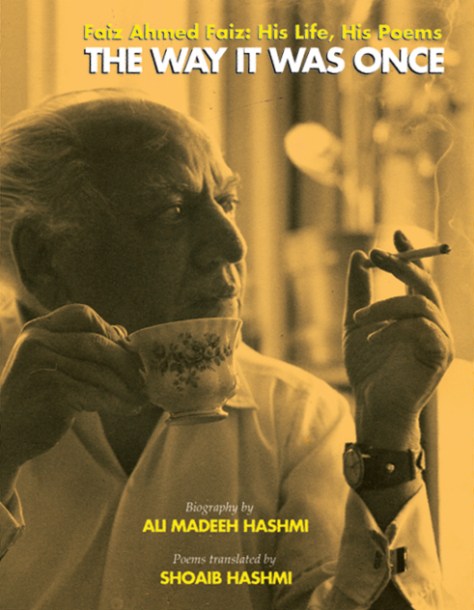
Faiz Ahmed Faiz: His Life, His Poems: The Way It Was Once by Ali Madeeh Hashmi/ Shoaib Hashmi; pp 256; Rs 499; Harper Collins Publishers India, 2012
After a decade without a day job, and associating with Dastangoi for over six years, I can safely say that I am a career storyteller. And one of the things I have learned is that resumes don’t make a person, stories do. Often these stories are not our own stories, but stories we’ve heard amongst loved ones, extended families, friends, work places, milieu; stories we’ve grown up with, stories distilled deep enough to become an integral part of our existence. We may not often identify with our resume but with our stories, always – acquaintanceship strikes, the moment our stories resonate. Continue reading The Poet, His Poems and His Tales→
Mad Rush for Top CPM Jobs!: CPI (Mohammad Rafi) News Service
New Delhi, 15 July 2012: The CPI(M) headquarters saw a mad rush of job applicants after General Secretary Prakash Karat said in a magazine interview that his party paid Rs. 3000-4000 to its whole-time cadre as salary every month. Job seekers from around the country clamoured for immediate appointment to as full time party cadre amidst unruly scenes reminiscent of a typical day at the Indian Parliament.
Karat had mentioned this figure while answering a question as to why the Party’s leaders were mostly from upper caste and middle class backgrounds. According to the CPM General Secretary working class members were hesitant to become whole-timers as ‘ it’s not easy to survive on this small amount’. Continue reading Mad Rush for Top CPM Jobs!: CPI (Mohammad Rafi) News Service→
The Sufi Courtyard: Dargahs of Delhi by Sadia Dehlvi; pp 252; Harper Collins Publishers, India, 2012
There is a sudden spurt of interest in Sufism among a section of our population that did not have such an interest a decade or two ago. Some were introduced to Sufism and its spiritual philosophical moorings through interactions with those who knew something about it, and realised that the ideas of Wahdat-ul-Wujood had parallels in the Adwait philosophy and it was this consonance that intrigued many to an extent that they got interested in exploring Sufism a little more. There were others who discovered Sufism through the west. Just as many had discovered Hindustani classical music when George Harrison began to learn the Sitar from Pandit Ravi Shankar in the ’60s, there are those who discovered Rumi when there was a spurt of interest in Jalal-ud-Din Rumi in the west, particularly in the US, with several translations appearing within a short span. Rumi has been known for centuries in our parts as Maulana Room; his poetry was quoted by Persian-knowing Indians till the 1950s and early 1960s, in conversations and writings, almost as often as Mir and Ghalib are quoted by the Urduwallas. An introduction to Rumi in the last decade or so has led eventually and inevitably to Sufism and a kindling of interest in our own indigenous Sufis. Continue reading Discordant notes: A review of Sadia Dehalvi’s “The Sufi Courtyard: Dargahs of Delhi”→
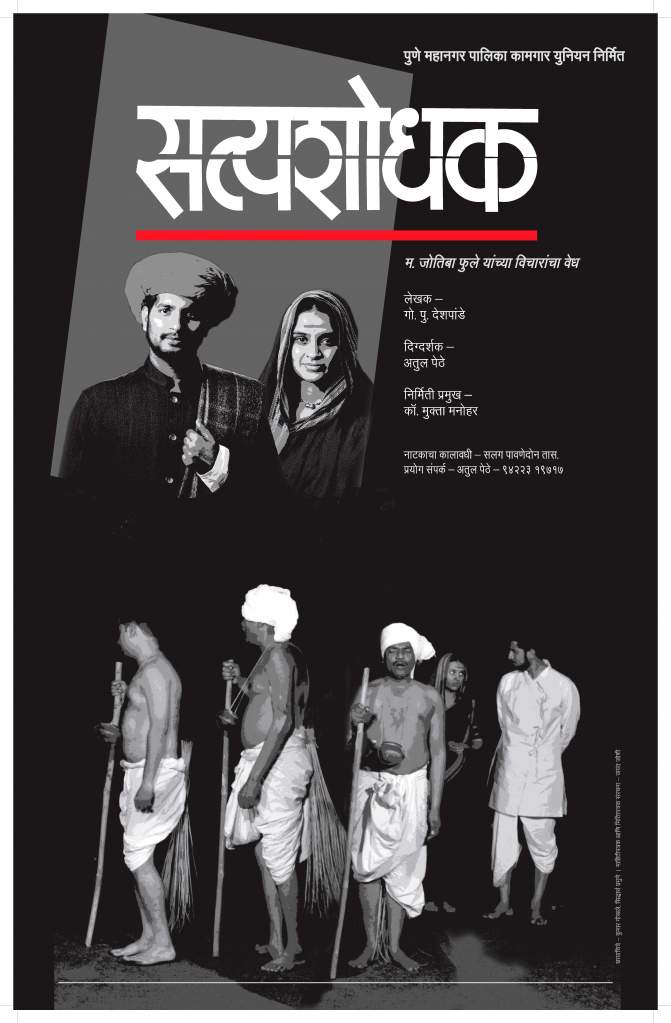
G. P. Deshpande’s play Satyshodhak is currently being performed in Maharashtra and Delhi and has received positive reviews in print and electronic media1 .It is praised for portraying Jotiba Phule’s life and work, its relevance for dalit emancipatory politics and also for the participation of the Pune Municipal Corporation’s workers as actors. There is a mood of celebration and a congratulatory back patting tone in the appraisal of a supposedly qualitatively different production. In addition to that, the writer has claimed that the production means a ‘successful and meaningful experiment of political education’ 2 of the workers/actors who are dalits. However, the flaunted success of the play and claims about its political import are belied by a performance that offers a very brahmanised Phule. It is very interesting to see that the author claims ‘a meaningful experiment’ of political education of the workers by offering them a pro-upper caste version of Phule. The very choice of producing a play about Phule in 2012 after a shelf life of twenty years 3, the writer’s articulated positions regarding it and the knowledge of Phule delivered through it, involve, I suggest, an upper caste cultural politics embodied in the brahman friendly figure of Phule.
It is a minute and a half long, and from the moment you see it, you will know that there is something sinister about it—a scenario of forced forgetfulness. It is displacement incarnate, and what is it doing, this aesthetic of obscenity? Is this retribution or charity, or retribution through charity, the developmental discourse of murderous sustainability through erasure? You will be puzzled and worried, harried and then it will make you sleep again in pious numbness, for isn’t the world—its deep blue sky and crystal fluid and cleansing sunlight, and bright flowery faces, its innocent time—just so beautiful! You will find that you cannot respond to it, physically, humanly, for it is not receptive to the organic. It cannot be mediated. It is a ghoul, perched to haunt and hypnotize us out of the memory of its past terrors. You remember, lenore, and wasn’t it to be nevermore? It is an electrical transmission and nothing more, or is it? It is a triumph of pre-postmodern, oily chic, so cloaked in ancient blood, that the blood has caked and turned black and fallen off, revealing the identical colour of the master’s heart, now you see it, now you don’t. The laceration has been hidden by the three-day apoptosis—the extra-cellular matrix, the forgetful memory’s collagen. But you will need to dig outward and inward from here, and very deep. It is there on my screen, this light of blood-lust, “Vedanta: Creating Happiness”, and every time a new or repeated tale from half way across the world is beamed, news every quarter of an hour, this monstrosity accompanies those facts like some leech feeding on reality. You remember Sontag, and isn’t she who had her way with those words: “Now there is a master scenario available to everyone. The color is black, the material is leather, the seduction is beauty, the justification is honesty, the aim is ecstasy, the fantasy is death.”
(A shorter version of this review appeared in Tehelka)
Writer: G P Deshpande
Director: Atul Pethe
Performed by Pune Safai Karmacharis Union
It was apt that a landmark production of G P Deshpande’s 1992 play Satyashodhak on the life of the 19th century anti-caste crusader Jyotiba Phule was performed in a week that witnessed the killing of the head of the Ranbir Sena – a week in which we were reminded that the bitter legacy of caste haunts us as strongly as ever. It was unusual however, that the performance should be held at the recently-opened May Day café and bookstore in Delhi – a space dedicated to the different and more hopeful legacy of the international working class movement, and located close to the heart of a former industrial district in a city that practices careful amnesia about its working classes. It is entirely unusual further that the performers were both Dalit and members of the Pune Municipal Safai Karmacharis Union. While the ancient, poisoned streams of caste and class have often overlapped on the subcontinent, they have not, as we are aware, produced unified or even similar political responses.
There is no point living in India if one cannot make spontaneous journeys, of all kinds and in all directions, for there is scarcely another country in which one can move so seamlessly and rapidly between such different worlds, both literal and metaphorical. It is the great charm of not residing in the bosom of the capitalised, industrialised west, with its clockwork uniform comforts. So when the serendipitous sighting of a photo of Ajmer Sharif, all lit up for Urs – celebrating the death anniversary of Khawaja Moinuddin Chishti, in this case – prompted a yearning to be there, I decided for once to ignore the rational self with all its programmed misgivings, and just go. Continue reading A Pilgrimage to Ajmer: Kaveri Gill→
During a recent trip to Lahore, I visited the Sang-e-Meel bookshop on Lower Mall Road in search of K.K. Aziz’s The Coffee House of Lahore. Happily, the store was well stocked with the late historian’s final work, and I spent the afternoon reading the text at a table outside the nearby Tollinton Market. It was a betrayal, perhaps, to read the book in this way, sipping cold drinks from the Hafiz Fruit and Juice Corner rather than something appropriately caffeinated, purchased amidst a flurry of conversations in a busy café. I took some solace in the fact that I was sitting not a stone’s throw away from the former Pak Tea House, once a hub of cultural life in the city and among the many spaces of discourse and dissent mapped by Aziz in his narrative of mid-twentieth century Lahore.
Today, the Pak Tea House appears hollowed and shuttered, no longer decorated with a sign to declare its name or to suggest life inside. In spite of recent rumours of a revival, its vacant façade appears a testament to Aziz’s loud lament in The Coffee House of Lahore: that the city’s culture has “disappeared from view”, that its original landmarks “have been obliterated”. The book emerged out of the historian’s desire to capture, before it is lost, the memory of a period of free thought, argument and cultural effervescence, encapsulated in the life of institutions like the Tea House, the Indian Coffee House, the Arab Hotel, the Nagina Bakery, and other important places of assembly, all of which have now vanished from the urban fabric. Aziz chooses to focus on the particularly tumultuous period between 1942 and 1957, when he was an active participant in this culture as a student of politics and later as a lecturer in Lahore’s Government College. Continue reading KK Aziz and the Coffee House of Lahore: Chris Moffat→
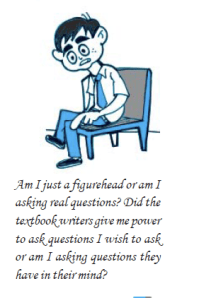
“Am I just a figurehead or am I asking real questions? Did the textbook writers give me power to ask questions I wish to ask or am I asking questions they have in their mind?” [Page 85, Chapter 4: Executive, Indian Constitution at Work, for class XI]
This cartoon appears in the context of the discussion on the powers of the President of India in the political science textbook of NCERT. It seems this question has a function far wider than the limited task of revealing the institutional blueprint of Indian politics. It pushes the student to ask something very uncomfortable. Am I really the one asking the questions I ask? Or am I rehearsing questions that someone else has decided for me?
As teachers of political science, our constant effort is to understand the ways in which power operates. None of the themes of our syllabi can be taught without reference to the resistance, critique and offending positions taken by groups who challenge the status quo. Sanitizing the history of critique and resistance that is encapsulated in satirical modes of representation like cartoons, can only be at the cost of keeping the discipline of political science uprooted from its very object of study. In the recent cartoon controversy, however, the issues at stake are many more than a defence of critical pedagogy.
“क्या आपको इस बात का अहसास है कि ताकाहाशी को ‘तुम्हारी पूँछ तो नहीं है?’ पूछने पर कैसा लगा होगा” बच्चे शिक्षिका का जवाब नहीं सुन पाए. उस समय तोत्तो चान यह नहीं समझ पायी कि पूंछ वाली बात से हेडमास्टर साहब इतना नाराज़ क्यों हुए होंगे क्योंकि अगर कोई उससे यह पूछता कि तोत्तो चान तुम्हारे क्या पूंछ है? तो उसे तो इस बात में मजा ही आता.
-‘तोत्तो चान’ (तेत्सुको कुरोयांगी, अनुवाद – पूर्वा याग्निक कुशवाहा)
दलित चेतना और कार्टूनों का पुनर्पाठ
इस कार्टून पर चली ऐतिहासिक बहस के बाद अब यह पक्के तौर पर कहा जा सकता है कि साहित्य से आगे अभिव्यक्ति के अन्य क्षेत्रों में भी दलित चेतना ने दस्तक दे दी है। शायद हम कल चित्रकला और बहुत आगे संगीत में भी दलित चेतना युक्त दृष्टि से इतिहास का पुनर्पाठ देखेंगे। Continue reading ’बिगड़ैल बच्चे की खोज में’: हिमांशु पंड्या→
Earlier this month, I signed, with some disquiet, onto this petition. Initiated by some members of the CHS at JNU, the petition protests against the withdrawal, in the wake of the cartoon controversy, of all NCERT Political Science textbooks, and seeks to defend the ‘gains of the new National Curriculum Framework 2005’. One reason I signed the petition was because it seems to me urgent that we try to save the NCF 2005 textbooks. They are, quite simply, amongst the most superb provocations available anywhere to critical thinking for young minds. I have over the years read them with my two children, and I would be very disappointed if other children were deprived of the same experience. There were other reasons too: I share the petition’s criticisms of the government’s arbitrary way of making its decisions about the textbooks, and its demand that textbooks be produced by an ‘academic, collective, democratic and inclusive process’ that excludes any ‘direct government intervention’. Continue reading Violence and Laughter: Ajay Skaria on the Ambedkar cartoon controversy→
With the recent article by Prabhat Patnaik, the controversy over the ‘Ambedkar cartoon’ issue has now moved into a different terrain. In this important statement, Prabhat undertakes the task of pointing out the numerous red herrings that have entered into the debate. These include ‘freedom of expression’ and ‘sense of humour’ and the question of whether Ambedkar had actually seen and let pass this cartoon. Prabhat’s point about the changed sensitivities and increased audibility of the dalit movement today is also well taken.
We must also be thankful to Prabhat for stating his views so candidly over the past few years, on a number of critical issues ranging from Nandigram and the electoral defeat of the Left to the ongoing cartoon controversy. We must thank him because because in my opinion, all his positions on these disparate sets of issues are of a piece and take us to the very heart of the impasse, not merely in the Left but in our politics itself. But before I respond to some of the issues raised by Prabhat, let me restate my positions on some aspects of the ongoing controversy. This is also necessary in order to identify what exactly it is in Prabhat’s piece that is so disturbing.
Dalit Response and Hurt Sentiments
In its initial phases, the cartoon issue was certainly a ‘dalit issue’ – even if it was raised only by a section of the dalit political leadership and intelligentsia. Very soon, however, it became clear that there was a more cynical game being played where the most corrupt and compromised sections of our politicians – especially those in parliament – were using Ambedkar as a shield, in order to deflect the blows that were actually aimed at them. The amazing unity of purpose and determination displayed by the parliament has rarely been seen in recent times; nor has the love for Ambedkar ever been expressed with such vigour.
No, this post is not mainly about the ghastly murder of the rebel communist leader T P Chandrasekharan at Vatakara in Kerala early this month. It appears clear now that irrespective of whether the CPM leadership was directly involved or not, local CPM cadre were involved in the conspiracy. Certainly, it is an act gruesome enough to feed nightmares through many nights. And the way the gory details of the planning and execution of the murder continue to appear in the print and visual media, the Malayalee public is almost on its knees, holding on to their stomachs, racked by seemingly never-ending bouts of nausea. But I have my reasons for not wanting to focus on this incident here, reasons more than the sheer irritation felt with sections of the media that demand shrilly that ‘cultural leaders’ have not condemned the murder sufficiently. Continue reading The Anti-Politics of Murder→
संसद राजनीति और लोकतंत्र पर स्कूली किताबों में कार्टून नहीं चाहती है. इस मसले को लेकर संसद के दोनों ही सदनों में सारे राजनीतिक दलों में अभूतपूर्व मतैक्य देखा गया. एक राजनीतिक दल, जिसका नाम नेशनल कान्फरेंस है, इस दमनकारी बहुमत से अलग स्वर में बोलने की कोशिश करता रह गया, उसे क्रूर बहुमत ने बोलने नहीं दिया. आखिर वह एक बहुत छोटे से इलाके का था! मुख्य भूमि में बन रही सहमति में विसंवादी स्वर पैदा करने की अनुमति उसे दी ही कैसे जा सकती थी? उसे उसकी लघुता के तर्क से नगण्य माना जा सकता था. यह स्वर कश्मीर से आ रहा था जिसे भारत का अंग बनाए रखने के लिए देश के क्रूरतम क़ानून की मदद लेनी पड़ती है.
यह विवरण यहाँ अप्रासंगिक लग सकता है.लेकिन मुझे इसमें एक तरह की प्रतीकात्मक संगति दिखलाई पड़ती है. वह संगति असहिष्णुताजन्य अधैर्य के तत्व से निर्मित होती है जो हमारे सामाजिक और सांस्कृतिक जीवन को परिभाषित करता है और इसीलिए सरलीकरण की पद्धति उसके चिंतन की दिशा तय करती है.Continue reading पाठ्यपुस्तक का संघर्ष →
You may have read it by now but in case you haven’t, the best article on Manto’s birth centennial came from Mohammad Hanif:
Your problem, Manto sir was that you weren’t satisfied with mentioning one haram thing per story. We do realise that in the world of short stories sometimes you have to describe bad things, things that our religion and our culture don’t approve of but couldn’t you have exercised a bit of moderation? As if having a prostitute as your main character wasn’t enough, you had to make her drink alcohol, and as if her drinking wasn’t bad enough you had to make her go to sleep with a flea-ridden dog. And I am not even mentioning the uncalled for description of her blouse where she stuffs her haram-earned money. Why did you have to do all that when you could have written about banana peels? [Read]
Two friends and I had gone to interview an old lady born 90 years ago in 1922. We had hoped to jog her memory about events that she had seen unfold, and events that she had heard her parents and grandparents talk about. We were hoping to get a slice of history going back a century and a quarter, but things did not work out as well as we had thought. Nevertheless, we got lucky through Saeed-ur-Rehman, her 72 year old son. He told us much about Delhi and about a real life encounter that his maternal grandfather and uncle had with the Jinn of Ferozeshah Kotla.
This is how he related the encounter:
“My Nana [maternal grandfather] was a great one for fishing and his favourite spot for fishing was the Firozeshah Kotla. In those days the Jamuna used to flow right next to the Kotla wall, and my Nana would go there often. He would carry his huqqa with him, cast the line and sit puffing away at and wait for the fish to take the bait. He would spend the better part of the day there and return with a bagful of fish in the evening. One afternoon he asked our Mamu [maternal uncle] to accompany him and this is what our Mamu told us about the events of the day. Continue reading Where have all the ghosts gone?→
मई दिवस और गणपति में सम्बन्ध ही क्या हो सकता है? दोनों की न तुक मिलती है और न ही अनुप्रास की छटा दोनों के पास–पास होने से बिखरती है. फिर गणपति शुद्ध हिन्दू देवता हैं, गणेश चतुर्थी के अवसर पर तो उनका नामजाप समझ में आता है, लकिन मई दिवस पर उनका आह्वान? इससे बड़ा दूषण हो ही नहीं सकता और इसका दंड उन्हें तो किसी न किसी रूप में भुगतना ही पड़ेगा. सो हुआ.
सती अनामंत्रित अपने पिता दक्ष के घर गई थीं और अपमान न सह पाने के कारण उन्हें यज्ञ वेदी में ही कूद कर जल मरना पड़ा . किसी भी जगह बिन बुलाए नहीं जाना चाहिए, इसकी सीख देने के लिए यह कथा वे सुनाते हैं जिन्हें इस समय भी कुछ कथाएँ याद रह गयी हैं. निश्चय ही त्रिथा को यह प्रसंग या तो पता न होगा या वे इसे भूल गईं जब मई दिवस पर जवाहरलाल नेहरु विश्वविद्यालय में एक वामपंथी छात्र संगठन द्वारा आयोजित एक संगीत संध्या में मंच पर वे अनामंत्रित गाने चली गईं. एक तो वे स्वयं अनपेक्षित , अतः किंचित अस्वस्तिकर उपस्थिति थीं , दूसरे आयोजकों और श्रोताओं को , जो मई दिवस पर संघर्ष और क्रान्ति के जुझारू गीत सुन कर अपने शरीर के भीतर जोश भरने आये थे इसकी आशंका थी कि वे इस पवित्र अवसर पर जाने क्या गा देंगी. और आखिरकार उन्होंने इस आशंका को सही साबित कर दिया, जब वे शास्त्रीय संगीत के नाम पर वक्रतुंड, महाकाय …. गाने लगीं. थोड़ी देर पहले जो सैकड़ों शरीर ‘हिल्लेले हिलोर दुनिया ‘ पर झूम रहे थे, उनसे नहीं–नहीं का शोर उठा. इस छात्र जनता के नेता जन–भावना का आदर करते हुए मंच पर पहुंचे और त्रिथा को अपना गाना बीच में रोक कर मंच से जाना पड़ा.Continue reading मई दिवस और गणपति→
Delhi, Or Dilli has been a city and a capital for a long time and even when it was not the capital, during the Lodi and early Mughal period, and later between 1858 and 1911, it continued to be an important city. We are of course talking of what is historically established and not of myths and legends. During this period there have been 7 major and several minor cities within the territories now identified as the National Capital Territory of Delhi (NCR-Delhi). New Delhi is the eight city. This piece marking the hundred years of the shifting of the colonial capital to Delhi from Calcutta in 1912, will talk about both Shahjahanabad and New Delhi. We will see how Shahjahanabad the once most powerful and rich city of its time and the last capital of the Mughals was gradually ruined, plundered and virtually reduced to a slum while next door arose, a new enclave of Imperial grandeur known now as New Delhi. Continue reading Delhi 1803-2012: A Brief Biography→
At the end of last month (March 2012) students of Jawaharlal Nehru University (JNU), New Delhi under the banner of a recently formed group called the New Materialists (NM) organized a public meeting to debate the issue of (dis)allowing certain kinds of food – beef and pork in particular – on the campus. The group, as one of its members Suraj Beri said, intended to petition the university administration to allow the sale of beef and pork in the canteen(s), and fight for inclusion of the same in the hostels’ menus; it was a struggle, as the NM declared, against the Brahmanical dietary impositions on Dalits and other minority community students of JNU. In fact, Francis (JNU students of the 1990’s would remember the man from Kerala) who ran a canteen at the basement of the School of Social Sciences II did serve beef curry on Saturdays, and it would not be an exaggeration to say that there would be more than a mad rush for that. However, he was pressurised – by Hindu right wing groups and other similar forces – to stop the sale of the “forbidden” food, and the canteen was eventually closed down.