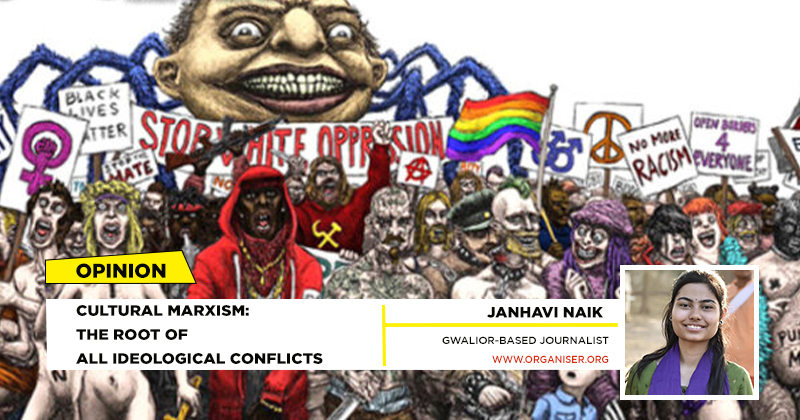
‘It was Norwegian far-right terrorist Anders Breivik, who killed over seventy people in a car bombing and mass shooting of children in 2011, who first brought the term “Cultural Marxism” to the world’s attention in his thousand-some paged statement of belief, which focused almost entirely on the concept.’ (Joan Braune, ‘Who’s Afraid of the Frankfurt School – “Cultural Marxism” as an Antisemitic Conspiracy Theory’, Journal of Social Justice, Vol. 9, 2019: 2)
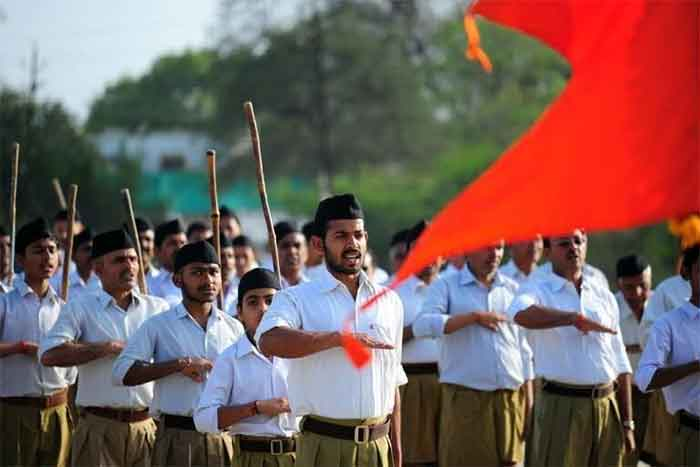
Image from RSS mouthpiece Organizer on ‘Cultural Marxism’
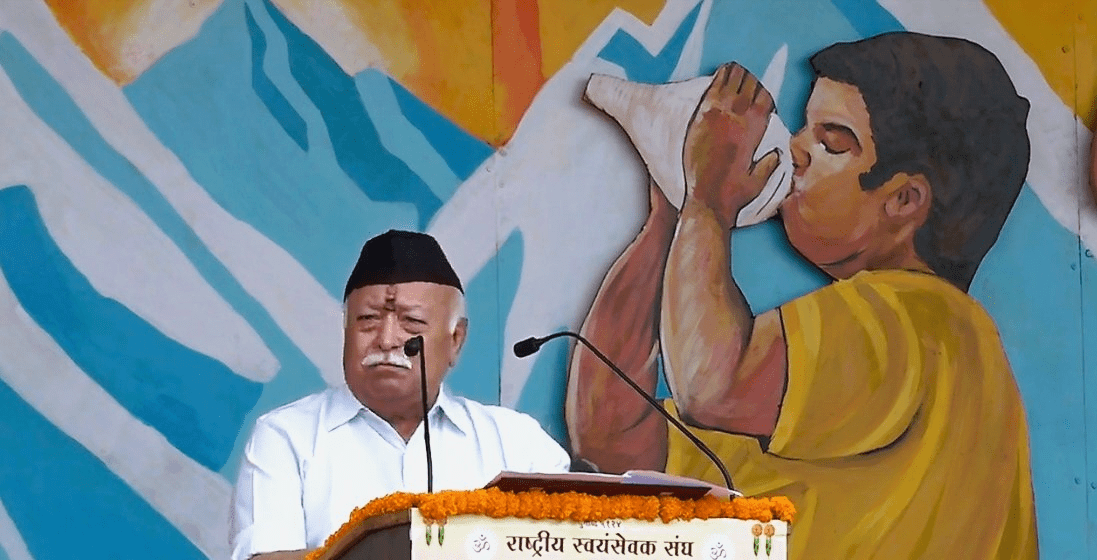
The ideology of Hindu supremacism is going global. Last Vijaya Dashami the RSS supremo Mohan Bhagwat had waxed eloquent on a new enemy, imported directly from White supremacist terrorist discourse, namely ‘Cultural Marxism’. The term is a New Right invention that has nothing to do with any specific tendency, Marxist or otherwise. It is the name of a right-wing conspiracy theory that blames all the different claims being made today as threatening to ‘traditional family values’ (read patriarchy) and to ‘traditional ways of living’ of the Whites, now threatened by growing demands of equality and multiculturalism from various quarters. As the quote above states, this term was first brought to the world’s attention by a mass murderer who killed 77 people in Norway some thirteen years ago. According to Paul Rosenberg, Brevik had used the term ‘cultural Marxists’ or ‘cultural Marxism’ 600 times in his 1500-plus page manifesto.
Anantkumar Hegde, BJP MP from Uttari Karnataka, is again in the news.
Close on the heels of his controversial statement about demolition of a mosque and his invoking of Hindu community who would not rest ‘until more mosques are reclaimed ‘ (1) he has delivered another explosive statement.
This time the whole edifice of Constitution is under his attack, which according to him has ‘distortions introduced by the Congress to suppress Hindu society’. (2) ..
..Critics have rightly said how this suggestion exhibits real intentions of the saffron regime which wants to usher us into Hindu Rashtra, end reservation for scheduled and backward communities, reinforce caste system and also replace Constitution drafted by Dr Ambedkar with a worldview inspired by Manusmriti. The main opposition party Congress has expressed fear that all such statements, steps just go to vindicate how a ‘cloud of dictatorship’ now hovers over India. (3)
It is a different matter that neither BJP top guns nor PM Modi – who had famously declared way back in 2014 that for him ‘Constitution is the most sacred book’ deemed it important to condemn Hegde’s statements or ordered him to seek apology for his claim.
One learns that it has merely distanced itself from Hegde’s controversial statement to convey an impression that what he said was his ‘Mann ki Baat’ and not BJP’s Dil ki Baat’ .
An atheist school teacher’s case in Nashik before the Bombay HC resonates with the recent case of a Dalit teacher’s suspension in Rajasthan.
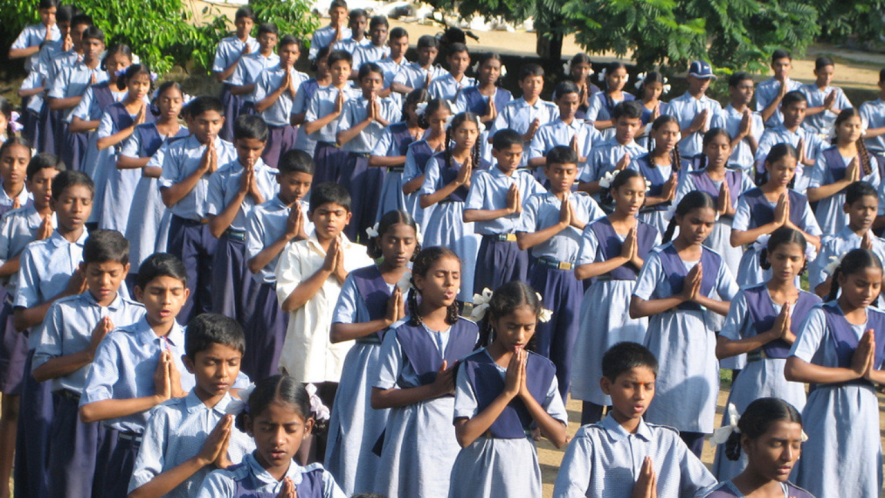
Representational Image. Image Courtesy: Flickr
Can anyone compel a teacher to offer prayers inside a school?
This was a little vexed question before the Bombay High Court when a case came up before a two-judge bench led by Justice Abhay Oka and Justice Revethi Mohiti-Dhere. Sudhir Salve, an atheist teacher from a school in Nashik — who otherwise had an excellent record in his profession — had approached it for relief, because the school management where he worked had denied increment to him for ‘indiscipline’.
The teacher’s refusal to fold hands at the time of school prayer or even at the time of taking oath of the Constitution was construed as such an act. As it happens in most such cases, Salve’s case had lingered on for more than six years in the lower courts.
But it did not take much time for the two-judge bench to decide the case, which declared that any such compulsion to fold hands will be a ‘[v]iolation of the fundamental rights conferred on an individual under the Constitution’.
One was reminded of Salve’s case when the suspension of Hemlata Bairwa, a Dalit lady teacher from an upper primary school in Rajasthan’s Baran district, made headlines recently.
To recapitulate the turn of events, it was Republic Day (January 26, 2024) and Bairwa had garlanded the portraits of B.R. Ambedkar, Savitribai Phule and Mahatma Gandhi before the assembly of students in her school. Two of her fellow teachers interrupted the programme and asked her to put a photograph of Saraswati, goddess of knowledge as per Hindu mythology, which she plainly refused. Despite pressure by them, who even allegedly made casteist slurs against her and were even helped by the local head of the panchayat, Bairwa refused to relent.
When the video of the whole incident went viral, the state education minister Madan Dilawar announced her suspension in a public programme — an act that evoked a strong reaction within the Dalit community. Demonstrations were held in different parts of the state opposing this action by the education minister, demanding revocation of the suspension order and removal of the minister from the post.
The question arises: Will Bairwa similarly have to wait for a long period like Salve for justice? Or whether the Bombay High Court’s intervention would impel the Rajasthan High Court to take up her case suo motu.
कहीं ऐसा तो नहीं कि ‘सांस्कृतिक मार्क्सवादी’ और ‘वोक पीपल’ (Woke People) को लेकर संघ सुप्रीमो की ललकार एक तरह से उत्पीड़ितों की दावेदारी और स्वतंत्र चिंतन के प्रति हिंदुत्व वर्चस्ववाद की बढ़ती बेचैनियों को ही बेपर्द करती है.
मुल्क की दारूल हुकूमत अर्थात राजधानी दिल्ली- आए दिन कुछ न कुछ सेमिनार, संगोष्ठियां, विचारोें के अनौपचारिक आदान-प्रदान की मौन गवाह बनी रहती है. आम तौर पर वह ख़बर भी नहीं बन पाते, अलबत्ता कुछ तबादले खयालात कभी-कभी सुर्खियां बन जाते हैं.
पिछले दिनों यहां के भव्य ताज एम्बेसेडर होटल में एक विचार-विमर्श चला, जो अलग कारणों से सुर्खियां बना. आयोजक के चलते और जिस मसले पर वहां गुफ्तगू चली उसे लेकर. दरअसल इसका आयोजन भारतीय जनता युवा मोर्चा ने किया था, जो आम तौर पर ऐसी बौद्धिक गतिविधियों के लिए जाना नहीं जाता है.
दूसरी अहम बात थी कि इस विचार-विमर्श में अमेरिका, जर्मनी और चंद अन्य पश्चिमी मुल्कों के कई अनुदारवादी, रूढ़िवादी विचारक, अकादमिशियन जुटे थे और भारत के शिक्षा संस्थानों से जुड़े कई अकादमिशियन भी थे. बातचीत किन मसलों पर चली इसके आधिकारिक विवरण उपलब्ध नहीं है, लेकिन इतना तो समाचार में सुनने को मिला है कि वहां ‘वोकवाद’ (Wokeism-वोक़िज़्म) पर भी बातचीत चली थी. ( Read the rest of the article here)
How Mohan Bhagwat’s exhortation that ‘cultural marxism’ and ‘woke people’ are spoiling India’s ethos betrays Hindutva Supremacism’s real agenda vis-a-vis assertion of the subalterns and independent thinking
‘A spectre is haunting the Conservative world – the spectre of Wokeism’
The brainstorming by conservatives from US, Germany and other Western countries along with academics from India is over. The host was Bharatiya Janata Yuva Morcha (BJYM) the youth front of the ruling dispensation here namely BJP – which loves to call itself ‘the biggest organisation of youth in the world.’
One does not know whether the organisers had put any such banner regarding the ‘spectre’ or not but few of the available details of meeting tell us that the gathering did discuss ‘wokeism’ apart from other issues.
BJYM’s sudden waking up on the challenge of ‘wokeism’ is not difficult to understand.
It could be easily traced to Sangh Supremo Mohan Bhagwat’s exhortation in his Vijayadashmi Speech – few months back – wherein he had castigated ‘cultural marxists’ and ‘woke people’. in no uncertain terms, who according to him were ‘spoiling Indian ethos’. He even accused them of undermining education and culture, promoting conflicts and disrupting social cohesion. ( Read the full article here)
“They took so much away from us that they ended up taking away our fear” — Message scrawled on a placard in a women’s march in Spain
’How does Justice feel?’
A difficult query to answer but perhaps Bilkis Bano would be the best person to respond to it.
Yes the same Bilkis – survivor of a mass rape and the only witness to horrific massacre of her 14 relatives – when the state she lived witnessed a carnage when officially one thousand innocents perished in the communal pogrom and many thousands were displaced from their homes and were condemned to live as internal refugees.
One can still recollect her words when the highest courts of the country finally cancelled the remission of sentences to her perpetrators who had been convicted for this heinous crime. [1].
She frankly narrated her feelings before a reporter.
’It feels like a stone the size of a mountain has been lifted from my chest, and I can breathe again. This is what justice feels like.”
We publish below a statement circulated by Lalit Kala Kendra(Gurukul) alumni, art educators, visiting faculty and theatre/cine artistes regarding the recent attack on the students making an examination presentation of a play woven around a Ram Leela rehearsal, where routinely men play women’s roles. This attack took place on 2 February. This incident was preceded by an attack on FTII students on 23 January by a group of right-wing goons. We also present in this post, for the record, a statement on the previous incident by the FTII Students’ Association and a solidarity statement by FTII Alumni.
Statement from Lalit Kala Kendra(Gurukul) alumni, art educators, visiting faculty and theatre/cine artistes
We would like to begin by saying that despite our diverse ideological, cultural, social, religious and geographical backgrounds and identities, we write this note together as informed and sensitive artists, and citizens of India. We would like to strongly emphasise that we have great respect for all religions, castes, creeds, sects etc. We are proud of and value our rich Indian culture and traditions.
समान नागरिक संहिता के विधेयक के मसौदे पर उत्तराखंड महिला समूहों का यह बयान हम यहाँ छाप रहे हैं ताकि इस ख़तरनाक़ बिल पर और बहस हो सके।
6 फरवरी 2024
उत्तराखंड महिला समूह और प्रतिनिधि राज्य विधानसभा में पेश किए गए इस विधेयक को पूरी तरह से खारिज करते हैं।
संवैधानिक व्यवहार को अपराध बनाने वाला, नैतिक पुलिसिंग का परिचय देने वाला विधेयक अस्वीकार्य है।
प्रस्तुत हिंदूकृत समान संहिता विधेयक का एजेंडा सभी वर्गों के परिवारों में असमानताओं को दूर करना नहीं है, बल्कि मुस्लिम अल्पसंख्यक और वयस्कों के स्वायत्त व्यवहार को अपराधी बनाना है।
[We are publishing this response of the Uttarakhand Women’s Groups to the Uttarakhand Draft for initiating further debate.]
The Uttarakhand women’s groups and representatives reject this Bill in toto, in the form introduced in the State Assembly.
A Bill criminalizing constitutional behaviour, and introducing moral policing is unacceptable.
The Bill which is predominantly a cut paste from the Hindu family laws, does not remove inequalities in family across the spectrum of religious and secular laws, but criminalises the Muslim minority and autonomous, consensual behaviour of adults.
Demands that it is sent to the Standing Committee for further deliberations.
UGC led by Chairman Jagdeesh Kumar refuses to remain beyond controversy for long time.
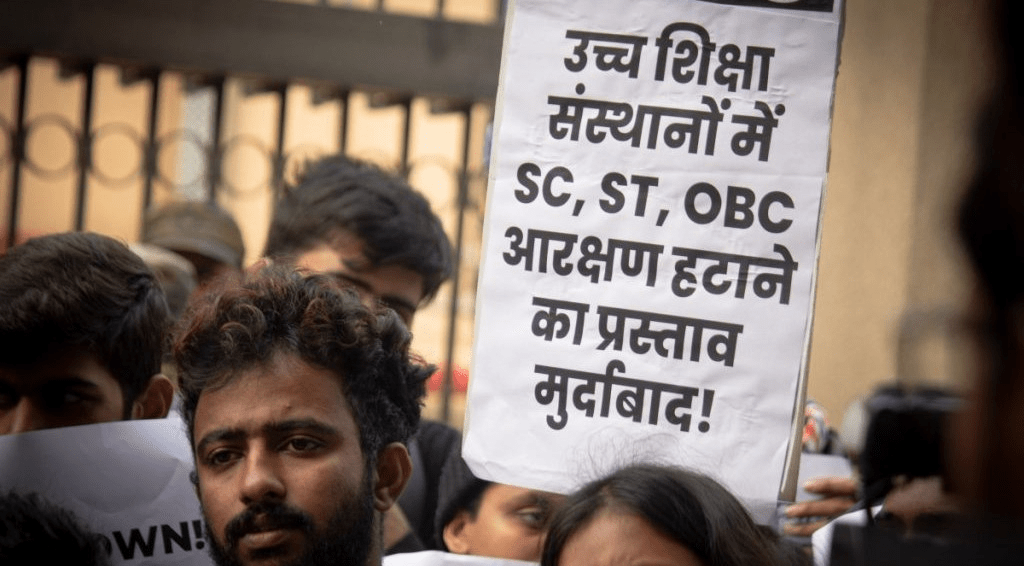
The latest being its draft proposal of ‘dereservation’ of seats if not a suitable candidate from reserved category is found wherein it asked people’s views till 28 th January.
As expected this proposal which smacked of the ruling dispensation’s surreptitious and even direct attempts at attacking or biting away at the affirmative action policies emanating from the Constitution rightly led to protests in various quarters, There were protests opposing this proposal on JNU and other campuses and even opposition parties attacked the ruling party for its compromising attitude towards reservation rights and its desire and moves to either dilute or hollow out the provisions of these socially progressive policies and this led to an intervention from the Human Resources Ministry underlining that there is no such proposal.
‘Men never do evil so completely and cheerfully as when they do it from religious conviction.’ Blaise Pascal, French Mathematician and Physicist who lived some 400 years ago and died young (1623 to 1662 AD)
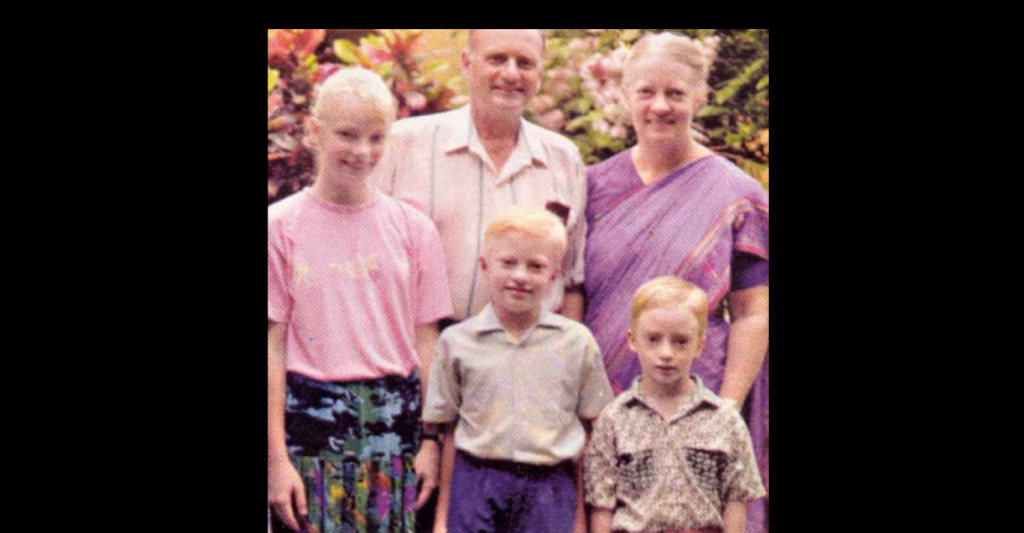
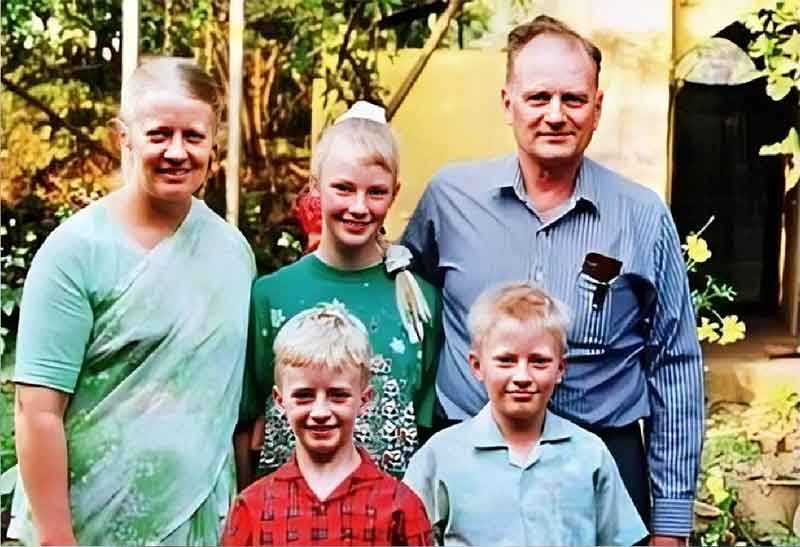
ग्राहम स्टेंस, जो ऑस्ट्रेलिया से भारत पहुंचे ईसाई पादरी थे और ओडिशा के बेहद पिछड़े आदिवासी बहुल इलाकों में गरीबों एवं कुष्ठरोगियों की सेवा में संलग्न थे, उन्हें और उनकी दो संतानों फिलिप और टिमोथी को कथित तौर पर हिंदुत्ववादी जमातों से जुड़े मानवद्रोहियों ने 22 जनवरी 1999 को जिंदा जलाया था.
22 जनवरी की तारीख की बीती तारीख को इस घटना की पच्चीसवीं सालगिरह थी.
राम मंदिर आयोजन की चकाचौंध में किसी ने इस बर्बर हत्या और उसके निहितार्थों को याद करना भी मुनासिब नहीं समझा, जबकि हम पाते हैं कि इस बर्बर हत्याकांड में वह तमाम संकेत मिलते हैं, जिन्हें 21वीं सदी की बहुसंख्यकवादी राजनीति में भरपूर प्रयोग में लाया गया.
The life of the dead is placed in the memory of the living.
– Marcus Tullius Cicero
Politics is nothing but theology in action
– Ambedkar
Right-wing politics suffers from a common syndrome everywhere.
It never feels confident to project its own icons for the rest of the humanity, whatever might be their claims about their worldview, it knows that its own icons are detested by a wide spectrum of people.
The easiest way it finds to overcome this lacunae is to appropriate already established icons – who were even opposed to their world view as well and claim them their own. In fact, it does not have any qualms in utilising dates – bearing special significance for exploited and oppressed and marginalised of the world – to put their stamp on it.
The project of Hindutva Supremacism – which yearns / strives to transform a Secular, Socialist, Democratic and Sovereign Republic into a Hindu Rashtra has perhaps achieved near perfection in this kind of politics.
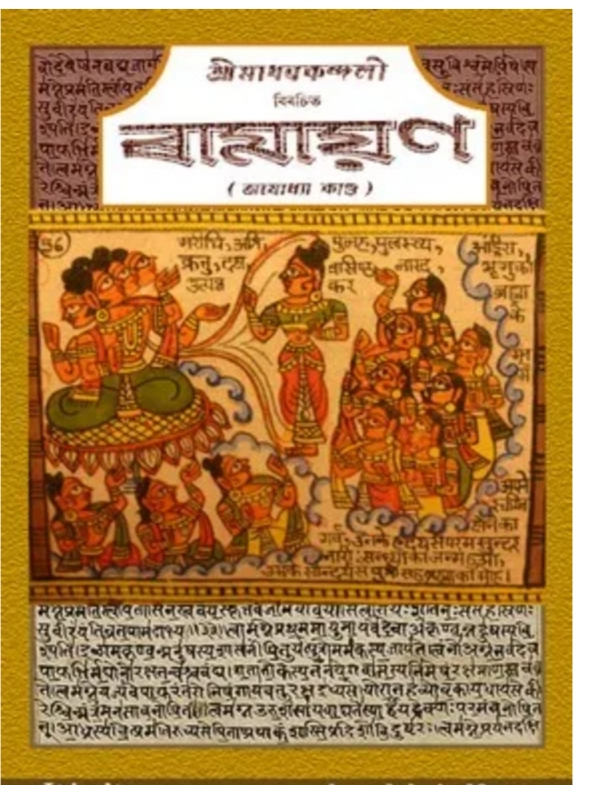
An excerpt from Sita’s Voice in the Assamese Ramayana: Selected Verses from the RAMAYANA of Madhava Kandali and UTTARAKANDA by Sankaradeva, Translated, with Introduction and commentary by TILOTTOMA MISRA (Zubaan: April 2024 Forthcoming)
The figure of Rāma has seldom attracted the Assamese vaiṣnava devotees as much as that of Kṛṣṇa. Rāma has been considered as an incarnation of Viṣṇu, while Kṛṣṇa has been worshipped as Viṣṇu himself. Significantly, there is also no known religious sect in Assam which claims to be “exclusively Ramaite”. While there are many references to Kṛṣṇa in the copper-plate inscriptions found in Assam which date back to the early seventh century, there is hardly any mention of Rāma in the early literary records of the region. Biswanarayan Shastri has observed that while a large number of temples dedicated to Rāma or Māruti exist all over India, there is no evidence of the existence of such a temple with the images of Rāma or Maruti, intact or in ruins, in Assam. According to him even in the architecture of ancient Assam, there is no known evidence of the Rāma legend being represented anywhere.
The Rāmāyaṇa of Mādhava Kandalī, therefore, as well as the two kāṇḍas prefixed and appended to it by Mādhavadeva and Śaṅkaradeva, have never held “that exalted position in popular estimation which the Rāmacarita-mānasa of Tulsidas has been occupying for the last few centuries in north India.” Rāma and Sītā seldom attained the stature of divinity in the imagination of the Assamese people although the heroic and miraculous elements in the Rāmāyaṇa and ‘Rāma-kathā’ have continued to be a lively ingredient of folk-drama and musical performances of the ojā-pāli. It is understandable therefore that for the common people of this region the Assamese Rāmāyaṇa is hardly the religious text that the Bhāgavata-purāṇa is. Continue reading Sita’s Voice in the Assamese Ramayana: Tilottoma Misra→
Prof Romila Thapar, great historian and public intellectual , will be delivering the 28 th Lecture in the Democracy Dialogues Series on Sunday 28 th January 2024 at 6 PM (IST).
Please reserve the time and date for the lecture. Details are given below
Democracy Dialogues – 28 th Lecture
Organised by
New Socialist Initiative (NSI)
Theme : Our History, Their History, Whose History?
The zoom invite will be shared closer to the date.
Abstract: My purpose in this talk would be to examine the link between history and particular kinds of nationalism. I hope to show that nationalism can be a process, bringing together and uniting all the communities that inhabit a particular territory in support of a change in society or opposing a target common to all. This earlier form is what I would like to call a unitary, integrative nationalism that cut across communities and drew them together in a particular country to support a single purpose. This I would differentiate from the latter forms in some countries which identified with units of society or communities according to certain common features, such as a particular religion or language, or caste or ethnicity. I would call it segregated nationalism, where each community is segregated and treated as having a distinctly different identity and its own separate goal. History is brought in when the community that gives an identity to its nationalism insists on tracing its origins to a historical past. This pattern of integrated and segregated nationalisms would seem to apply to India of the twentieth century. There was the all-inclusive national movement whose participants were from every community; its objectives were to maintain the unity of the Indian people and overthrow colonial rule. The other nationalism, segregated nationalism, was seeded in the 1920s and assumed the existence of two nations – the Hindu and the Muslim – which, it was argued, go back to earlier times. Integrated nationalism succeeded in 1947 in bringing about independence, but its foundations needed strengthening, for we are now witnessing the strong presence of religious nationalism in the attempt to inaugurate a Hindu Rashtra in India.
– Romila Thapar
About the Speaker:
Internationally renowned scholar of Ancient History, Prof Thapar was elected General President of the Indian History Congress in 1983 and a Fellow of the British Academy in 1999. In 2008, she was awarded the prestigious Kluge Prize of the US Library of Congress which complements the Nobel, in honouring lifetime achievement in disciplines not covered by the latter. Prof Thapar has been a visiting professor at Cornell University, the University of Pennysylvania, and the College de France in Paris and holds honorary doctorates from the University of Chicago, the Institut National des Langues et Civilisations Orientales in Paris, the University of Oxford, the University of Edinburgh (2004), the University of Calcutta and from the University of Hyderabad
Here is a select list of Prof Thapar’s publications Ashoka and the Decline of the Mauryas, 1961 ( Oxford University Press) ; A History of India : Volume 1, 1966 ( Penguin) ; The Past and Prejudice, NBT ( 1975) ; Ancient Indian Social History : Some Interpretations, 1978 ( Orient Blackswan) ; From Lineages to State 1985 : Social Formations of the Mid-First Millenium B.C. in the Ganges Valley, 1985 ( Oxford University Press) ; Interpreting Early India, 1992 ( Oxford University Press) ; Sakuntala : Text, Reading, Historie, 2002 ( Anthem) . Somanatha : The Many Voices of History, Verso ( 2005) ; The Aryan : Recasting Constructs, Three Essays ( 2008) ; The Past As Present: Forging Contemporary Identities Through History, (2014) ;Voices of Dissent: An Essay, (2020); The Future in the Past: Essay ( 2023)
This guest post was written by HASINA, with co-authorship contributions from Sanjhana and Mridul from Bebaak Collective, ‘Voices of the Fearless,’ a collective dedicated to addressing the citizenship rights of marginalized communities.
A thread of commonality that ties together Indian society – from familial space to the entertainment industry, from the personal sphere to the political sphere – is the oppression of gender minorities under patriarchy. The longstanding structures of patriarchy and misogyny subject women to various forms of violence and abuse within and outside the household. Such a harsh reality of society is reflected by the popular media and film industry very promptly. The new movies that are being directed and the new music that’s being produced are a great reflection of how we, as a society, have failed women and queer communities. The peppy lyrics that objectify and hyper-sexualise women’s bodies and the movies that glorify toxic masculinity do nothing but perpetuate and normalise gendered violence. As we step into the New Year, we must ask ourselves if we can leave these outdated notions behind and step into a society that fosters peace, equality, and love amongst all.
यह पोस्ट सोशल मीडिया पर कई लोगों ने साझा की थी । बताया जा रहा था कि इसके लेखक सरोज मिश्र हैं। इस बीच इसके असल लेखक से हमारा संपर्क हुआ है जिनका नाम विवेक कुमार उर्फ़ विवेक असरी है। मूल लेख 2010 में छपा था जिसे यहाँ पढ़ा का सकता है।
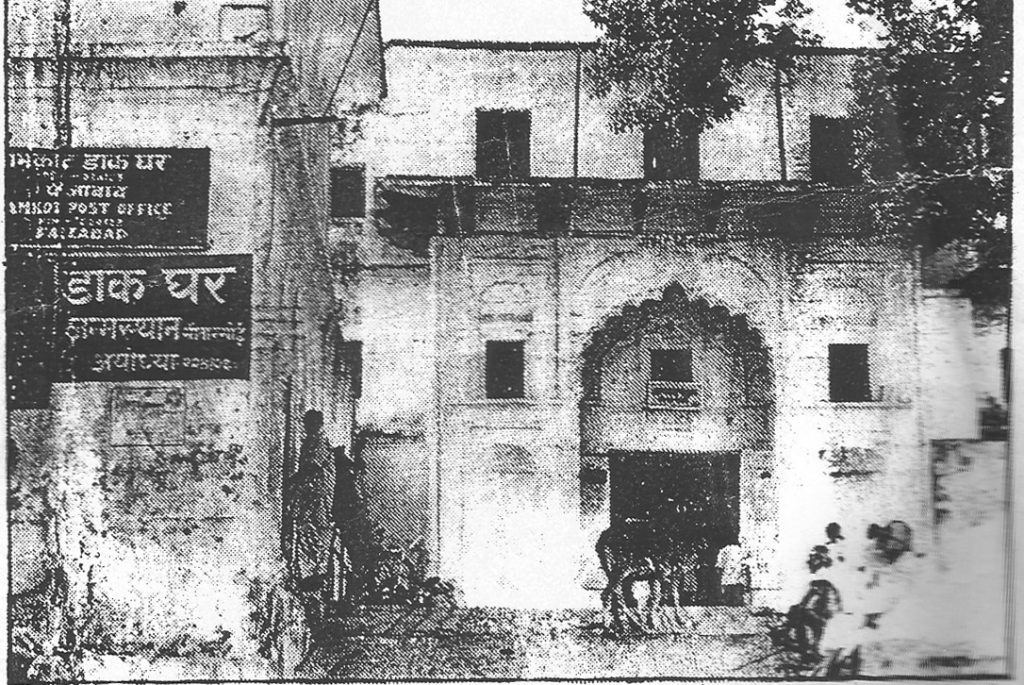
अयोध्या का यह 300 साल पुराना जन्मस्थान मंदिर था जिसके लिए ज़मीन एक मुसलमान ज़मींदार के दान की थी। नए राम मंदिर के विस्तार के लिए अगस्त 2020 में इसे ढहा दिया गया। (छवि साभार द वायर)
कहते हैं अयोध्या में राम जन्मे, वहीं खेले-कूदे, बड़े हुए, बनवास भेजे गये, लौटकर आये तो वहाँ राज भी किया। उनकी ज़िंदगी के हर पल को याद करने के लिए एक मंदिर बनाया गया। जहाँ खेले, वहाँ गुलेला मंदिर है। जहाँ पढ़ाई की, वहाँ वशिष्ठ मंदिर हैं। जहाँ बैठकर राज किया, वहाँ मंदिर है। जहाँ खाना खाया, वहाँ सीता रसोई है। जहाँ भरत रहे, वहाँ मंदिर है। हनुमान मंदिर है, कोप भवन है। सुमित्रा मंदिर है, दशरथ भवन है। ऐसे बीसियों मंदिर हैं, और इन सबकी उम्र 400-500 साल है। यानी ये मंदिर तब बने, जब हिंदुस्तान पर मुगल या मुसलमानों का राज रहा।
(Translated by Nivedita Menon from a widely circulating post earlier attributed to Saroj Mishra, on social media, originally in Hindi.
UPDATE: We have since heard from the author himself. This post was written in 2010 by VIVEK KUMAR (Vivek Asri) and so we have made the necessary changes. Here is the link to VIVEK KUMAR’s original post.
This 300 year old Janmasthan temple in Ayodhya, built on land donated by a Muslim zamindar, was demolished in August 2020 to accommodate an expanded vision of the new Ram Mandir. Image courtesy The Wire
They say Ram was born in Ayodhya; in Ayodhya he played and roamed around as a youth, grew into adulthood, was sent from there into exile in the forest, and then returned to rule there. There are temples in Ayodhya to commemorate every moment of his life. Where he played, there is Gulela Mandir. Where he studied there is Vashishta Mandir. Where he sat and ruled, there is a mandir. Where he ate his meals, there is Sita Rasoi. Where Bharat stayed, there is a mandir. There’s Hanuman Mandir, Kop Bhavan. There’s Sumitra Mandir, Dashrath Bhavan. There are many many such temples and all of them are about 400 to 500 years old. That is to say, these temples were built when Hindustan was ruled by the Mughals, by Muslims.
Jorg Haider, a far-right Austrian politician who died in 2008, is largely forgotten. It is also forgotten that merely two decades ago, he was considered a very dangerous man in Europe, whose ascent to power had prompted rare European Union unity aimed to thwart his ambitions.
Twice elected as governor of the southern state of Carinthia, Haider—who opposed immigration and was critical of Islam and Muslims—once praised the Nazi regime’s “employment policies”.
His Freedom Party of Austria allied with another party, the OVP, which allowed Haider to become the country’s chancellor. But the possibility of a ‘right-wing extremist’ ruling a European Union member country prompted the other 14 members to join hands punitively against Australia, putting Haider out of the chancellorship race.
The European Union stuck by the 1997 Treaty of Amsterdam principles and emphasised that nobody would be allowed to “breach them”.
Many European countries threatened to recall envoys from Austria, and some said that Austria could be shunted out of the union if the need arose. The Belgian foreign minister at the time said, “Europe can very well do without Austria. We don’t need it.
After much water has flown down the Thames, the Rheins, the Danubes and all other rivers of Europe, the world has Geert Wilders in the Netherlands, a “political earthquake”, whom some consider more extreme and fanatical than Haider. But Wilders’ views on immigration and Islam cause no similar outrage in European capitals today.
Wilders’s party, which promised to ban mosques and compared the Quran with the infamous Mein Kampf, has won 37 seats in a 150-member Parliament. It is now the number one party in the country’s parliament.
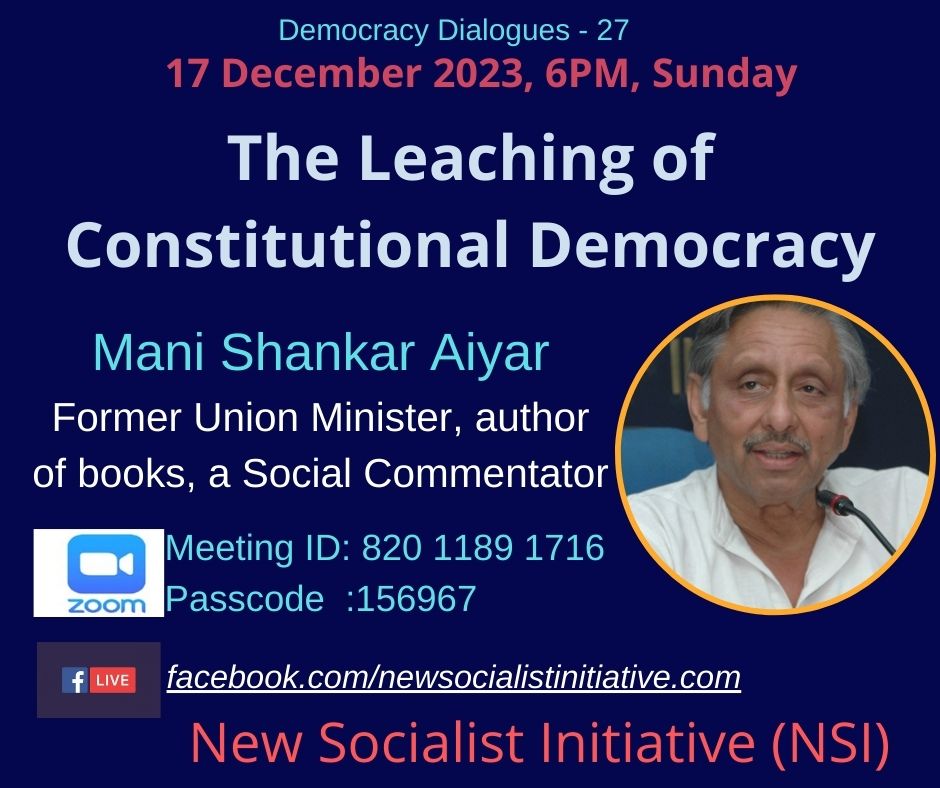
On the face of it, we are an on-going democracy. We have a Constitution which has been honoured by the present government declaring 26 November as Constitution Day. We have regular elections at national, State and panchayat levels. We have the various institutions of democracy in place: an elected Parliament; an independent judiciary; an accountable executive; and a functioning, non-governmental media. Yet, there is fear all around. a new fear, a fear not seen since the Emergency, that has been spreading over the past decade. Why? Is it perhaps because the “spirit of constitutionalism”, as Fali Nariman has put it in his latest work, missing? Can we continue to be the nation envisaged by Gurudev Rabindranath Tagore: “Where the mind is without fear/And the head is held high”? Are we progressing towards or in retreat from that “Heaven of Freedom” of which Tagore sang?. Are the institutions of democracy functioning? Is the Preamble being venerated or violated? Are our civil servants really free? Is our civil society being muzzled? Is the media glowing in the light of freedom of expression? Is the investigative and judicial process being made the punishment? Is the economy in any meaningful sense “socialist” as enjoined by the Preamble? Is the Constitution being reduced in practice to a non-justiciable set of Directive Principles of State Policy? Above all, are we as a nation still ‘secular” – again as enjoined by the Preamble? Is Hindutva compatible with the basics and parameters of the Constitution? Is our ‘unity in diversity” threatened or is it being revered?What are the challenges ahead that need to be addressed before we cease being the world’s largest democracy?
Speaker :
Mani Shankar Aiyar
Author of many books and a regular social commentator, Mani Shankar Aiyar, has had a distinguished foreign service career , he was Union Ministers during Congress led government (2004 till 2009) and has handled different ministries. Ministry of Petroleum and Natural Gas, ( 2004-06) Youth Affairs and Sports (2006-08), and Development of North Eastern Region ( 2008-09).
Here is a list of few of his publications :Memoirs of a Maverick Juggernaut, 2023 ; A Time of Transition: Rajiv Gandhi to the 21st Century, Penguin, 2009 ; Confessions of a Secular Fundamentalist, Penguin, 2004; Rajiv Gandhi’s India, 4 vols. (General Editor), UBSPD New Delhi, 1997, Knickerwallahs, Silly-Billies and Other Curious Creatures, UBS Publishers, 1995 . Pakistan Papers, UBSPD, New Delhi, 1994 ; One Year in Parliament, Konark, New Delhi, 1993 ; Remembering Rajiv, Rupa & Co., New Delhi, 1992 ; Rajiv Gandhi: The Great Computer Scientist of India, Mughal Publishers, New Delhi, 1991 ; How To Be A Sycophant, NBS, New Delhi, 1990
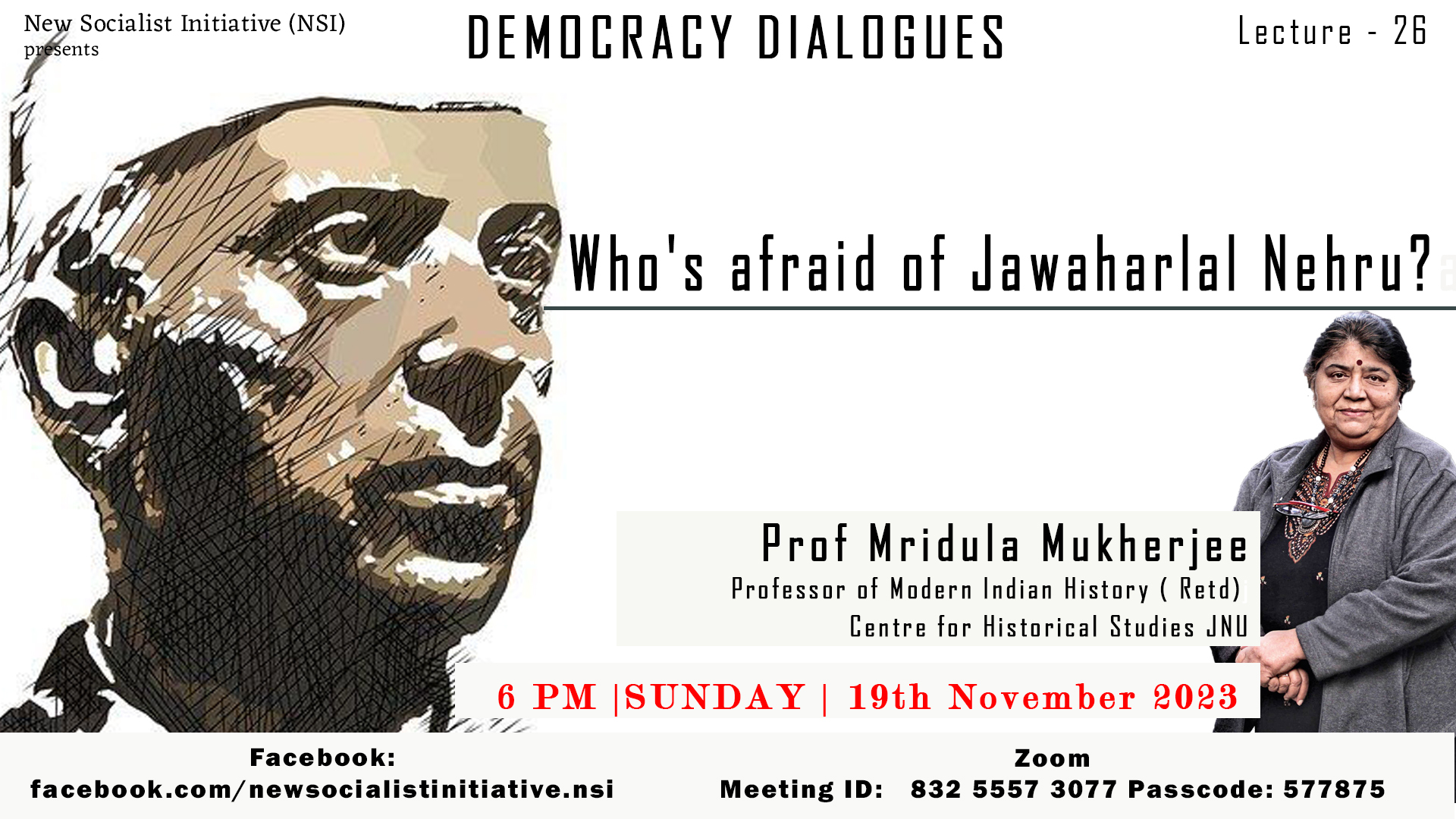
Professor Mridula Mukherjee, Professor of Modern Indian History ( Retd), Centre for Historical Studies, JNU, will be delivering the 26 th Democracy Dialogues Series lecture on Sunday, 19 th November 2023 at 6 PM (IST).
Theme : Who’s Afraid of Jawaharlal Nehru? Time: Nov 19, 2023 06:00 PM India
Summary : In his lifetime, Jawaharlal Nehru was recognized the world over as a statesman and an Indian leader second only to Gandhiji. A foremost leader of the freedom struggle, who gave it a decided socialist orientation, he remained unrivaled as Prime Minister after independence and built the solid foundations of a sovereign, secular, democratic, and egalitarian republic. He evolved the concept of non-alignment which enabled many ex-colonial countries to avoid becoming a part of the two power blocs engaged in the Cold War.
However, he is today the favourite whipping boy of the establishment. We are told he was responsible for the partition, for the mess in Kashmir, for the death of Subhash Bose, for delaying the integration of Hyderabad, and of Goa, for the defeat at the hands of China in 1962, for neglecting agriculture, and primary education, and much else. The reason for the defamation is of course that he stood for the exact opposite of what is valued today. His life and work present a continuous question mark to the regressive trends in fashion.
This will become evident as we focus in the talk especially on two areas of great relevance today in which we are facing a grave crisis: Democracy and Civil liberties, and Communalism/Secularism. We will also focus attention on Nehru’s evolving understanding of Mahatma Gandhi’s vision and method of non-violent struggle, of which he became the most ardent advocate after his death.
Speaker :
Author of many books, Prof Mukherjee has been a visiting Scholar at Duke University, USA, and at the Institute of Oriental Culture, University of Tokyo and was also Director of Nehru Memorial Museum and Library, ( NMML), New Delhi. She has published widely in the areas of agrarian history, peasant movements, social movements and the Indian national movement.
Here is a list of a few of her publications : Colonializing Agriculture, The Myth of Punjab Exceptionalism Sage (2005) ; Peasants in India’s Non Violent Revolution : Practice and Theory (Sage 2004).
This list also includes India’s Struggle for Independence (1999) and India After Independence 1947–2000 (2000), RSS, School Texts and the Murder of Mahatma Gandhi The Hindu Communal Project (2008) co-authored with Prof Bipan Chandra and others.