Category Archives: Culture

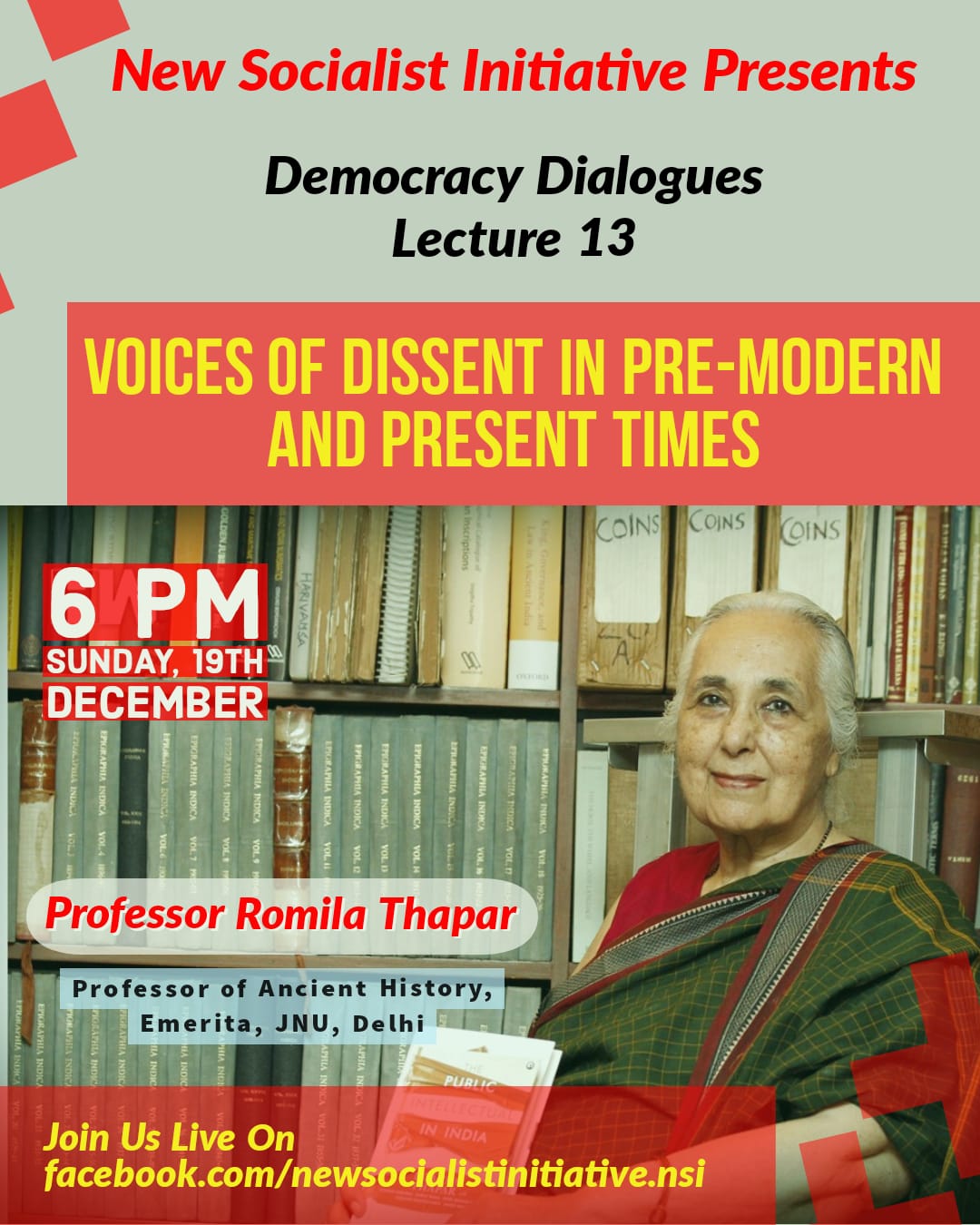
Voices of Dissent in Pre-Modern and Present Times : Prof Romila Thapar

The13 th Lecture in the Democracy Dialogues Series  organised by New Socialist Initiative will be delivered by Prof Romila Thapar, Professor of Ancient History, Emerita, JNU, author of many books and a leading public intellectual on Sunday 19 th December 2021 at 6 PM (IST).
Prof Thapar would be speaking on  ‘Voices of Dissent in Pre-Modern and Present Times

About the Speaker :

Internationally renowned scholar of Ancient History, Prof Thapar was elected General President of the Indian History Congress in 1983 and a Fellow of the British Academy in 1999. In 2008, she was awarded the prestigious Kluge Prize of the US Library of Congress which complements the Nobel, in honouring lifetime achievement in disciplines not covered by the latter.  

Prof Thapar has been a visiting professor at Cornell University, the University of Pennysylvania, and the College de France  in Paris and holds honorary doctorates from the University of Chicago, the Institut National des Langues et Civilisations Orientales in Paris, the University of Oxford, the University of  Edinburgh (2004), the University of Calcutta and from the University of Hyderabad.


 Here is a select list of Prof Thapar’s publications


Ashoka and the Decline of the Mauryas, 1961 ( Oxford University Press) ; A History of India : Volume 1, 1966 ( Penguin) ; The Past and Prejudice, NBT ( 1975) ; Ancient Indian Social History : Some Interpretations, 1978 ( Orient Blackswan) ; From Lineages to State 1985 : Social Formations of the Mid-First Millenium B.C. in the Ganges Valley, 1985  ( Oxford University Press) ; Interpreting Early India, 1992 ( Oxford University Press) ; Sakuntala : Text, Reading, Historie, 2002 ( Anthem) . Somanatha : The Many Voices of History, Verso ( 2005)  ; The Aryan : Recasting Constructs, Three Essays ( 2008) ; The Past As Present: Forging Contemporary Identities Through History, 2014

The lecture will be live on facebook.com/newsocialistinitiative.nsi.

For security reasons the zoom invite will be shared individually. Please write to us at democracydialogues@gmail.com if you are interested in attending the lecture

p.s. Here is a playlist of  lectures in the series :

 : https://www.youtube.com/playlist?list=PLtXBfoS5KZ78UFI_aYzROjUss8ZzhUKxy.
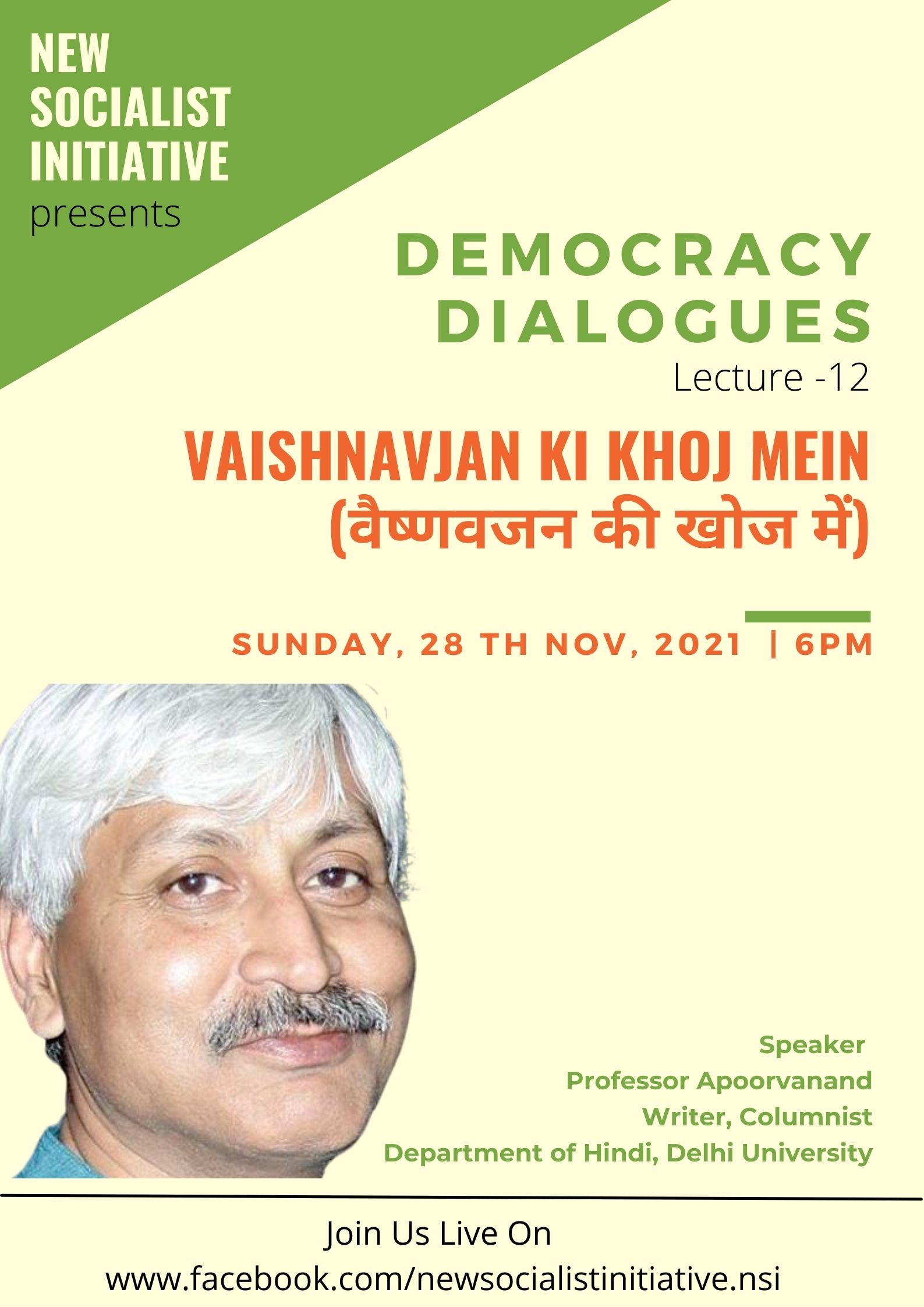
वैष्णवजन की खोज में : अपूर्वानंद

न्यू सोशलिस्ट इनिशिएटिव की तरफ से आयोजित ‘डेमोक्रेसी डायलॉग्स सीरीज ‘  का 12 वां व्याख्यान अग्रणी लेखक, स्तम्भकार, दिल्ली विश्वविद्यालय में हिंदी विभाग से सम्बद्ध  प्रोफेसर अपूर्वानंद 6 बजे शाम, रविवार, 28 नवम्बर 2021 को प्रस्तुत करेंगे। 

विषय : ‘वैष्णवजन की खोज में’ 


वैष्णवजन  की  कल्पना को राजनीतिक और सामाजिक पटल पर स्थापित करने का श्रेय गाँधी को है। इस बात पर  ध्यान जाना चाहिए  कि उपनिवेशवाद विरोधी आंदोलन में या राष्ट्र की स्वतंत्रता  के संघर्ष में गाँधी ने  वैष्णवजन को संभवतः इस आंदोलन के लिए  आदर्श आंदोलनकारी के रूप में पेश किया। वह कैसा जन है? पीर और पराई , इन दोनों से उसका रिश्ता क्या होगा? और क्यों  एक सच्चा जनतांत्रिक जन वैष्णवजन ही हो सकता है? हमारे संविधान की प्रस्तावना में हम भारत के लोग जिस यात्रा पर निकले हैं क्या वह इस  वैष्णवजनत्व की तलाश की यात्रा है?”

हिंदी तथा अंग्रेजी  अख़बारों तथा अन्य प्रकाशनों में  तथा  टीवी की चर्चाओं में अपनी निरंतर सशक्त उपस्थिति दर्ज करते रहने वाले प्रोफेसर अपूर्वानंद सार्वजनिक जीवन में न्याय, समता  और तार्किकता के पक्ष में अपने सक्रिय हस्तक्षेप के लिए जाने जाते हैं .

आप ने कई किताबें भी लिखी  हैं, जिनमें से कुछ के शीर्षक इस प्रकार हैं : ‘सुंदर का स्वप्न ‘ ( वाणी प्रकाशन, 2001 ) , ‘साहित्य का एकांत’ ( वाणी प्रकाशन , 2008 ), The Idea of University ( Context, 2018 ) , Education at the Crossroads ( Niyogi Books, 2018 )

व्याख्यान फेसबुक पर live होगा  : facebook.com/newsocialistinitiative.nsi

अगर आप zoom पर जुड़ना चाहते हैं तो हमें democracydialogues@gmail.com पर लिखें 

Restore Faith in Kerala’s Progressive Legacy — Open Letter to the Chief Minister of Kerala: Prof Mohan Rao

The strange case of ‘honour-baby-snatching”,: involving a local-level CPM leader in Thiruvananthapuram city, Peroorkkada Jayachandran is still haunting us despite every attempt by the CPM cyberwarriors to smother it. Mr Jayachandran still feels completely justified and hundreds of left supporters, including so-called progressive women, are ready to proclaim that this dastardly act is a ‘father’s right’. Mr Jayachandran’s nineteen year old daughter Anupama fell in love with a dalit man, a leader of the DYFI, got pregnant by him, and decided to keep the child. Anupama’s parents decided that there was loss of honour in this and proceeded to perpetrate unspeakable violence on the young woman, trying to force her to abort her baby, and finally by snatching away her baby days after it was born. They twisted the entire machinery of child protection and adoption and the police to give the child away without the consent of its parents.

Continue reading Restore Faith in Kerala’s Progressive Legacy — Open Letter to the Chief Minister of Kerala: Prof Mohan Rao

साहित्य का विचार : अशोक वाजपेयी

May be an image of one or more people and text that says 'सुन्धान व्याख्यानमाला पहला वक्तव्य विषय: साहित्य का विचार वक्ता: श्री अशोक वाजपेयी वरिष्ठ कवि, अग्रणी विचारक 6 बजे शाम शनिवार 13 नवंबर 2021 ZOOM ID: 841 7299 8046 PASSCODE: 885810 फेसबुक लाइव: FACEBOOK.COM/NEWSOCIALISITIATIVE. NSI आयोजक न्यू सोशलिस्ट इनिशिएटिव (हिंदी प्रदेश)'

अभिवादन

हिन्दी इलाके को लेकर विचार-विमर्श के लिये “सन्धान व्याख्यानमाला” की शुरुआत इस शनिवार, 13 नवम्बर, को शाम 6 बजे प्रख्यात कवि और विचारक श्री अशोक वाजपेयी के व्याख्यान से हो रही है.

इस व्याख्यानमाला की शुरुआत के पीछे हमारी मंशा ये है कि हिन्दी में विचार, इतिहास, साहित्य, कला, संस्कृति और समाज-सिद्धान्त के गम्भीर विमर्श को बढ़ावा मिले. हिन्दी इलाक़े के सामाजिक-सांस्कृतिक विकास को लेकर हमारी चिन्ता पुरानी है. आज से बीस साल पहले हमारे कुछ अग्रज साथियों ने “सन्धान” नाम की पत्रिका की शुरुआत की थी जो अनेक कारणों से पाँच साल के बाद बन्द हो गयी थी. इधर हम हिंदी-विमर्श का यह सिलसिला फिर से शुरू कर रहे हैं. यह व्याख्यानमाला इस प्रयास का महत्वपूर्ण अंग होगी.

हममें से अधिकांश लोग “न्यू सोशलिस्ट इनिशिएटिव” नाम के प्रयास से भी जुड़े हैं. यह प्रयास अपने आप को सामान्य और व्यापक प्रगतिशील परिवार का अंग समझता है, हालाँकि यह किसी पार्टी या संगठन से नहीं जुड़ा है. इसका मानना है कि भारतीय और वैश्विक दोनों ही स्तरों पर वामपन्थी आन्दोलन को युगीन मसलों पर नए सिरे से विचार करने की और उस रौशनी में अपने आप को पुनर्गठित करने की आवश्यकता है. यह आवश्यकता दो बड़ी बातों से पैदा होती है. पहली यह कि पिछली सदी में वामपन्थ की सफलता मुख्यतः पिछड़े समाजों में सामन्ती और औपनिवेशिक शक्तियों के विरुद्ध मिली थी. आधुनिक लोकतान्त्रिक प्रणाली के अधीन चलने वाले पूँजीवाद के विरुद्ध सफल संघर्ष के उदहारण अभी भविष्य के गर्भ में हैं. दूसरी यह कि बीसवीं सदी का समाजवाद, अपनी उपलब्धियों के बावजूद, भविष्य के ऐसे समाजवाद का मॉडल नहीं बन सकता जो समृद्धि, बराबरी, लोकतन्त्र और व्यक्ति की आज़ादी के पैमानों पर अपने को वांछनीय और श्रेष्ठ साबित कर सके.

“सन्धान व्याख्यानमाला” का प्रस्ताव यूँ है कि हिन्दी सभ्यता-संस्कृति-समाज को लेकर हिंदी भाषा में विचार की अलग से आवश्यकता है. हिन्दी में विचार अनिवार्यतः साहित्य से जुड़ा है और हिन्दी मनीषा के निर्माण में साहित्यिक मनीषियों की अग्रणी भूमिका है. हम हिन्दी साहित्य-जगत के प्रचलित विमर्शों-विवादों से थोड़ा अलग हटकर साहित्य के बुनियादी मसलों से शुरुआत करना चाहते हैं. प्रगतिशील बिरादरी का हिस्सा होते हुए भी हम यह नहीं मानते कि साहित्य की भूमिका क्रान्तियों, आन्दोलनों और ऐतिहासिक शक्तियों के चारण मात्र की है. हम यह नहीं मानते कि साहित्यकार की प्रतिबद्धता साहित्य की उत्कृष्टता का एकमात्र पैमाना हो सकता है. हम अधिक बुनियादी सवालों से शुरू करना चाहते हैं, भले ही वे पुराने सुनायी पड़ें. मसलन, साहित्य कहाँ से आता है – ऐसा क्यों है कि मानव सभ्यता के सभी ज्ञात उदाहरणों में साहित्य न केवल पाया जाता है बल्कि ख़ासकर सभ्यताओं के शैशव काल में, और अनिवार्यतः बाद में भी, उन सभ्यताओं के निर्माण और विकास में महती भूमिका निभाता है. साहित्य के लोकमानस में पैठने की प्रक्रियाएँ और कालावधियाँ कैसे निर्धारित होती हैं? क्या शेक्सपियर के इंग्लिश लोकमानस में पैठने की प्रक्रिया वही है जो तुलसीदास के हिन्दी लोकमानस में पैठने की? निराला या मुक्तिबोध के लोकमानस में संश्लेष के रास्ते में क्या बाधाएँ हैं और उसकी क्या कालावधि होगी? इत्यादि. हमारा मानना है कि “जनपक्षधर बनाम कलावादी” तथा अन्य ऐसी बहसें साहित्य के अंतस्तल पर और उसकी युगीन भूमिका पर सम्यक प्रकाश नहीं डाल पातीं हैं. बुनियादी और दार्शनिक प्रश्न संस्कृतियों और सभ्यताओं पर विचार के लिए अनिवार्य हैं.

इस व्याख्यानमाला में हम विचार-वर्णक्रम के विविध आधुनिक एवं प्रगतिशील प्रतिनिधियों को आमन्त्रित करेंगे. ज़रूरी नहीं है कि वक्ताओं के विचार हमारे अपने विचारों से मेल खाते हों. हमारी मंशा गम्भीर विमर्श और बहस-मुबाहिसे की है.

प्रख्यात कवि और विचारक श्री अशोक वाजपेयी इस शृंखला के पहले वक्ता होंगे जिनका मानना है कि साहित्य की अपनी “स्वतन्त्र वैचारिक सत्ता होती है; उस विचार का सामान्यीकरण नहीं किया जा सकता; वह विचार अन्य विचारों से संवाद-द्वन्द्व में रहता है पर साहित्य को किसी बाहर से आये विचार का उपनिवेश बनने का प्रतिरोध करता है; साहित्य का विचार विविक्त नहीं, रागसिक्त विचार होता है.”

आप सभी इस शृंखला में भागीदारी और वैचारिक हस्तक्षेप के लिये आमन्त्रित हैं.

Join Zoom Meeting
https://us02web.zoom.us/j/84172998046?pwd=dHRzRDhsTFNSOURKQjA3R1o2Y0xsQT09

Meeting ID: 841 7299 8046
Passcode: 885810

facebook live : facebook.com/newsocialistinitiative.nsi

The Angry Young Woman and the Malayali (Progressive) Acchan -2 : The Second Season

I should be forgiven for this flippant-sounding title. But it is a living reality in Kerala that gender politics is increasingly reduced to soppy sentimental drama. Honestly, if there are CPM supporters out there, especially the Delhi-elite breed who call this title mere click-bait, I don’t give a flying fuck about what you think. You are not living this nightmare, we are.

Continue reading The Angry Young Woman and the Malayali (Progressive) Acchan -2 : The Second Season

Decolonizing Thought – Beyond Indian/ Hindu Exceptionalism

A Decolonization mural in Oakland, USA, photo HiMYSYeD, Oakland Wiki

This post is prompted by a discussion that followed some remarks I had made on social media regarding the way in which a certain common sense that we may call ‘Hindu Nationalist’, had come to dominate the sensibilities of even those intellectuals in the Hindi world who otherwise might stand opposed to the Hindu Right. ‘Decolonizing’ has lately become a banner of the Hindu Right and for many otherwise secular Hindi intellectuals too, an occasion for an often strident anti-West rhetoric. Such a common sense assumes, simply by default, that the only “authentic” position of critique of the West is one framed by Hindu/ Indian exceptionalism. Needless to say, as I have argued at length in my recent book (Decolonizing Theory), the narrative that structures the imaginative world of many such modern Hindus is already a narrative produced by colonialism.

Continue reading Decolonizing Thought – Beyond Indian/ Hindu Exceptionalism

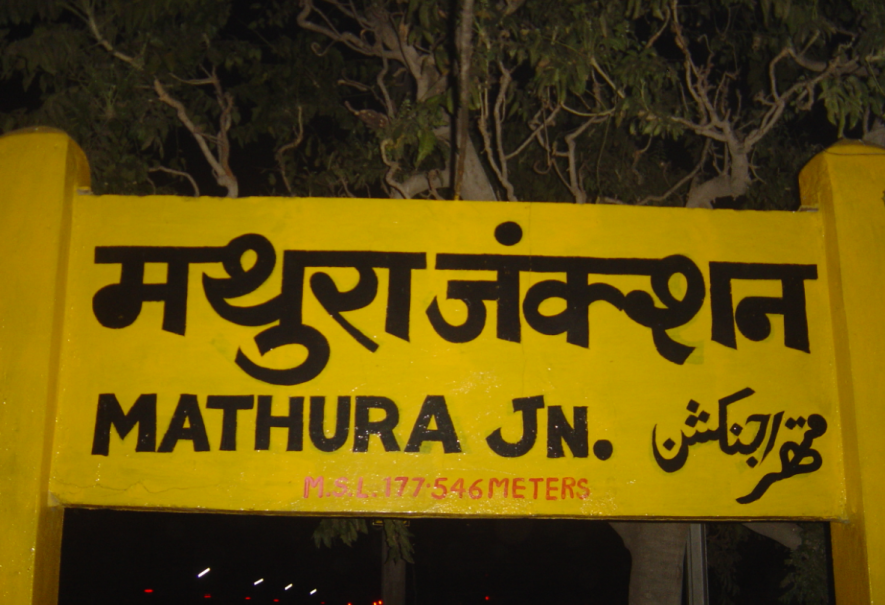
Why BJP Wants Meat Banned in Mathura

The BJP is imposing harmful dietary restrictions and refusing to accept that more Indians want to consume meat, fish and eggs for their nutritional benefits.

Mathura
Representational use only

.

In 1902, the prolific British writer HG Wells delivered a philosophical speech titled “The Discovery of the Future” at the Royal Institution in London. Wells is often remembered for his “predictions”, for example, the approximate date when the second world war would begin. In this speech, he envisioned something else with equally significant ramifications—the collapse of the capitalist system. Wells also anticipated that a world of peace and plenty would follow in its wake.

What if someone, following Wells example, attempts a similar extrapolation for India? If anybody could foresee such things, what would they find lies ahead for the “biggest democracy” in the world?

In the absence of Wells, perhaps present-day events can be a map or guide to the future. For example, during recent Janamashtmi celebrations, Uttar Pradesh, Chief Minister Yogi Adityanath announced that his government would ban meat and liquor in Mathura city. He said the meat-sellers and liquor dealers of the area could switch to selling milk. According to his government, a meat and liquor ban would help combine “modern technology” with the cultural and spiritual heritage of the region.

( Read the full article here)

If Hindutva is dismantled, whom will it harm?

An upcoming conference in the USA, “Dismantling Global Hindutva”, organized by Indians in the USA, most of whom are legally “Hindus”, and supported by over 40 US universities, has provoked the ire of the Hindu Rashtravaadis there as well as in India. Conflating Hindutva with Hinduism is the first step. Based on this, the Hindu American Foundation claims this conference is “Hindu phobic”, that it will put the well-being of Hindu students and faculty at risk, and that “they may feel targeted or threatened, or face hostility or harassment” as a result of “the kinds of generalisations, misunderstandings, and ‘otherising’” the event will perpetuate.

Ho hum. Just another day in Hindu Rashtra-that-is-India then, for most of us “Hindus” who oppose the politics of Hindutva that promotes misunderstandings and otherises us, all the way to mob and media violence, lynchings and jail. It is from Hindutva that “Hindus” are most at risk in India today, not from any non-Hindu “Other”.

(Why these repeated quotation marks around “Hindu”? We will come to that).

An article in Firstpost uses words like “genocidal” and “xenophobic” to describe what this conference is going to be. The conference brochure shows “Rashtriya Swayamsevak Sangh (RSS) figures being uprooted, roots and all, with the claw end of a hammer”, and this is “genocidal” according to the author. Showing the German Nazi Party being uprooted would amount to genocide too, in this understanding, perhaps? Since Hindutvavaadis are actively seeking co-victimhood with victims of anti-Semitism, as another article explicitly states, they might want to reconsider this second conflation, of the neo-fascist RSS with “Hindu”. This second article says the conference will “dehumanize Hindus everywhere” and asks indignantly if a conference titled “Dismantling Global Jewry” would be acceptable. Continue reading If Hindutva is dismantled, whom will it harm?

Knoxpet to Murphy Town – and back: Janaki Nair

Guest Post by JANAKI NAIR

Images by CLARE ARNI

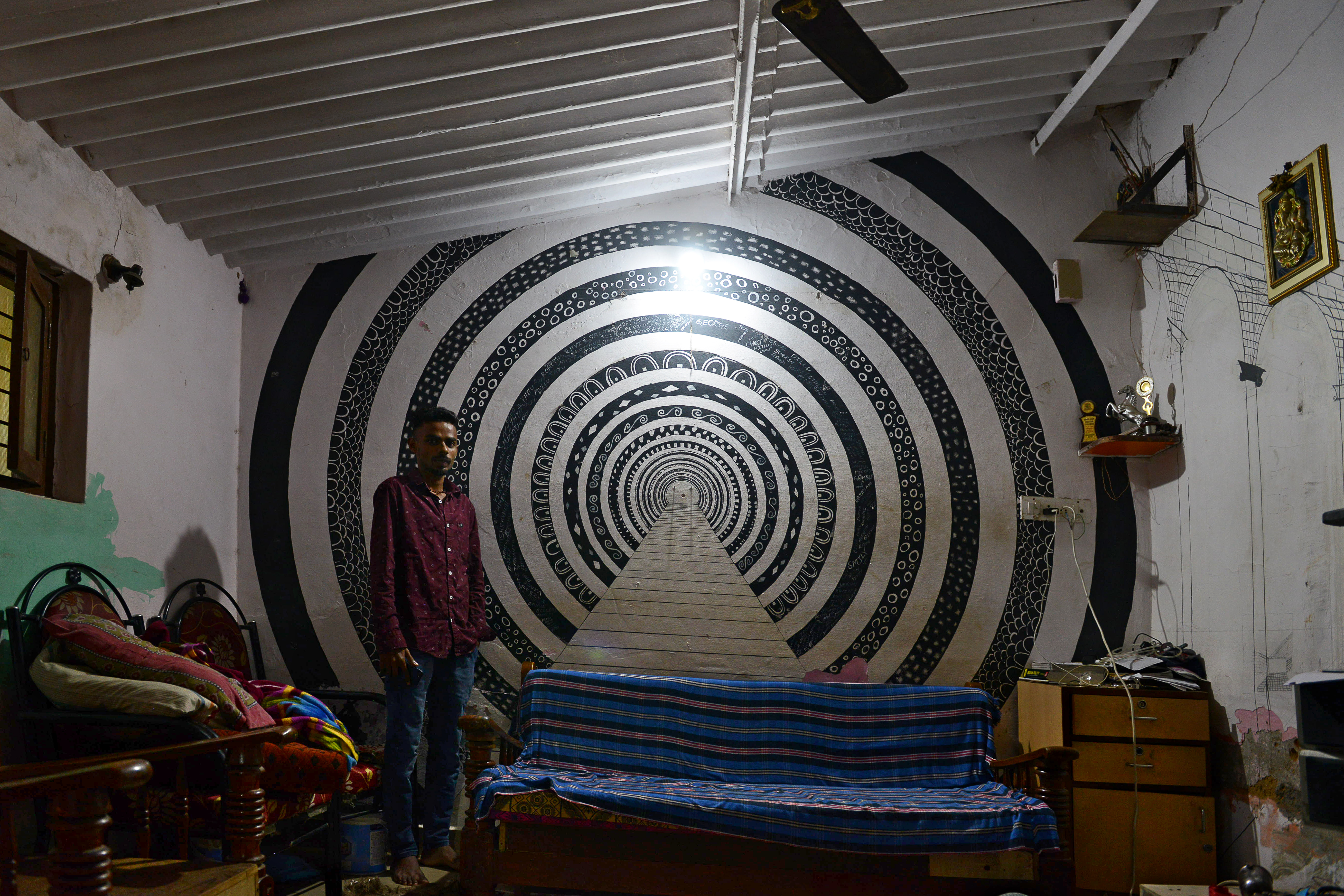
Inside the home of Arun, standing in front of the mural he created (August 2021)

Twenty one years ago, the photographer Clare Arni and I meandered through Murphy Town, shooting images for my exhibition and book on Bangalore. I had eyes only for the physical-material fabric of the place. A working class neighbourhood, designed in the 1920s by an inspired municipal engineer, Murphy, who wanted to build urban forms that would elevate the then leather workers – Tamil speaking Chuckliars producing saddles and boots for the army – to a higher and more respectable place than they had been assigned  in the cruelly divided, hierarchical world of caste.  I had read about the plans for transforming the area called Knoxpet in the archives, and wanted to see for myself how this unique experiment in social engineering had turned out in what came to called Murphy Town.

It was a near idyllic place, dotted with squares rimmed by low, tiled houses, shaded by at least two, sometimes more, capacious raintrees. Lines of washing sometimes crossed the squares, and there were goats and chickens minding their business, but it was a sight for sore eyes, a quiet leafy neighbourhood that workers – and shoemakers at that — could only dream about. We were content to feast our eyes on those visuals. I don’t think I fully realized the social importance of that little miracle that had been wrought in brick and tiles. The exhibition, Beladide Noda, Bengaluru Nagara! was held in three locations in Bangalore in 2000, and the book came out in 2005. They both featured the famous squares of Murphy Town. Continue reading Knoxpet to Murphy Town – and back: Janaki Nair

Some Remarks about Movements

Guest Post by Ravi Sinha

Accountability is foundational to democracy and, ultimately, people are supposed to take those in power to account through democratic processes and mechanisms. But, then, we also know what often happens in democracy. Electoral competition gives rise to ‘technologies’ (often religious, cultural and identity-based) which turn citizens into “Bhakts” (devotees) and storm-troopers (remember Hitler’s “Brownshirts”). The dark side of democracy comes on top more often than the other side. India is witnessing that disaster. Trump was a testimony to the same phenomenon in the United States.

But what about movements? Are they also supposed to be accountable to someone or something? One would presume that movements are accountable to their own missions, values, objectives, arguments and strategies. Is anyone taking the movements to account on that score?

One would imagine that the left movement has been taken sufficiently to account all over the world. So much so that, for most people, there is no longer any need to take it to account. In many eyes, it is finished. Why waste time on something that is finished? And yet, the most curious thing is that the left remains the favourite whipping boy of most other movements and their intellectual luminaries. Here in India a favourite pre-occupation of Dalit intellectuals is to expose the Savarna (upper caste) hegemony over the left movement and many feminists focus on the misogyny of leftists. As if in a survey of the Indian society, leftists have come on top as the most likely and most numerous perpetrators of oppression and violence against Dalits and women! There is no denying that left must be taken to task for all its ills and all its failings. But, should a movement that is often pronounced dead be the prime example when it comes to evaluating movements?

The Bahujan Samaj Party (BSP) in Uttar Pradesh has declared that it would be the party that would actually build the Ram temple. This party is openly and loudly appealing to Brahmins as a caste to come into its fold. Babasaheb Ambedkar famously talked about annihilation of caste and declared that there is no scope of Dalit liberation under Hinduism. This irony is not confined to BSP. A Dalit is submissively the President under the current dispensation and an ex-Dalit Panther is a minister. All this can be explained away as pragmatic responses to the demands and rigours of democracy. But what about the movement itself? What about Ambedkar’s mission?

The question goes far deeper. Why is it the case that Hindutva has been able to make such inroads into Dalit communities? In what ways and to what degrees the ‘Hindu civilizational mind’ sits within the ‘Dalit cultural mind’? Why is it the case that in Gujarat carnage and elsewhere Dalits have been as much and as willing a part of the Hindutva “Brownshirts” as any other community? Why is it the case that an occasional Dalit leader who emerges as a fiery meteorite in the aftermath of a gruesome atrocity disappears as fast from the social and political horizon and the masters of the electoral machinations remain as much in control of the actual political arena?

One hopes that the theorists of social movements – from Columbia and Harvard Universities to JNU and Osmania – are earnestly grappling with this puzzle. We all know the simple and common-sense answers, but they do not suffice. The puzzle needs a deeper explanation. How long the intellectual prophets of the social movements remain content with celebrating the history and the survival of these movements? How long will Dalit writers remain content with asking the caste lineage of other (Savarna) writers and denouncing them for the surnames they use? How long will they be content with demanding monopoly over literary depiction and theoretical explanation of Dalit life and experience? Real questions and real challenges remain unattended.

(https://www.facebook.com/newsocialistinitiative.nsi/posts/2635781250063345)

Field report from protest against granite mining at Bodikonda: Chandra Sekhar

Guest post by Chandra Sekhar

All images courtesy the author

Background

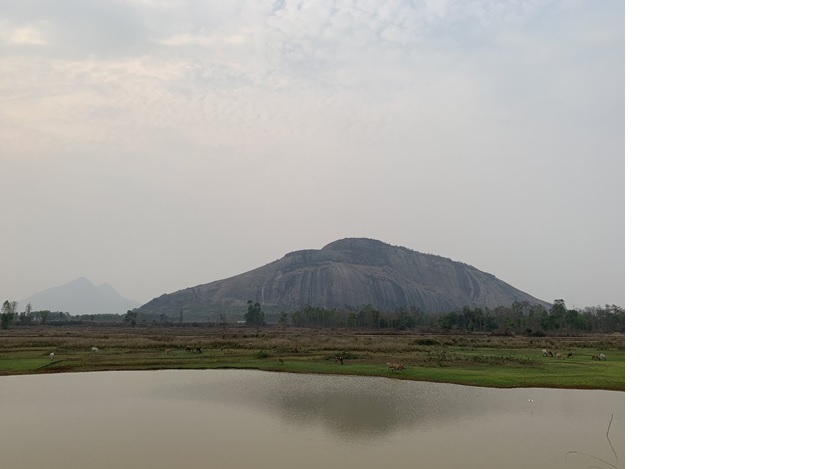
Bodikonda is a monolithic stone hill in Lakshminarayanapuram village in Parvathipuram mandal in Vizianagaram district. This has been in the news on and off over the last two years or so, because local people have been protesting the lease given to private companies for mining colour granite, without their being consulted nor any sort of public hearing.

Three leases for quarrying coloured granite were granted and executed in favour of MSSS Srinivas for an extent of nine hectares, M Madhupriya for an extent of six hectares and Kishore Granites Pvt. Ltd. for another nine hectares ( total of 24.29 hectares) for a period of 20 years. This comprises almost 50% of the area of the total hill. These companies applied for a lease in 2010 to the Assistant Director of Mines and Geology, Vizianagaram, and new licences were given in December 2019.

Procedural Discrepancies Continue reading Field report from protest against granite mining at Bodikonda: Chandra Sekhar

Governments Must Implement the Constitution, Not Religious Texts

Several courts have tried to reign in states bent on holding religious events during the pandemic. Judiciary must more proactively prevent them as the third wave approaches.

Constituion of india

Simple things need retelling when society is in a state of flux. The fact that India is a republic—has been one for more than 70 years—where sovereignty rests with the people and not with scriptures is one fact. That India runs by its Constitution and laws under it is another fact.

The Uttarakhand High Court reminded the state government of these facts when it objected to proposals to live-stream the historic Char Dham Yatra on the plea that the scriptures do not sanction it. The court rejected the petition, saying India is a democracy where the rule of law, not religious texts, govern.

( Read the full text here)

Stan Swamy’s Custodial Murder – Joining the Dots From Santhal Hul To the Pathalgadi Movement

Fr. Stanislaus Lourduswamy aka Stan Swamy, image by Sarah Modak, courtesy Article 14

There are just no words left to express the anger and helplessness that overcame hundreds and thousands of people like me when they heard of the custodial murder of an ailing, frail, octogenarian, Fr Stanislaus Lourduswamy, known to the world as Stan Swamy. The various issues that arise from the virtual judicial abdication of responsibility has been powerfully articulated by former Delhi High Court Chief Justice, AP Shah and one can hardly add to that. What is perhaps the most shocking is not that the judiciary abdicated in observing its duty of upholding the Constitutional rights of a citizen but that it seems to have lost even the minimum grace and human concern.

“Medical reports taken on record clearly showed that Fr Swamy had the degenerative Parkinson’s disease, and could not even do basic tasks, such as holding a spoon, writing, walking or bathing. Indeed, the court noted that he had a severe hearing problem, and was physically very weak. But even that did not move them. Every regular bail application that was filed by his lawyers was unequivocally rejected.” 

This is shocking beyond words – or used to be once upon a time. But as each day of this regime passes, our threshold of taking shock increases by leaps and bounds. Are we really surprized now, that while this was how they treated Stan Swamy, a goon who had just the other day openly called for mob violence and “shooting down anti-nationals” has now been promoted to the Central ministry?

Continue reading Stan Swamy’s Custodial Murder – Joining the Dots From Santhal Hul To the Pathalgadi Movement

How Might a Feminist Respond to a Collegial Mansplaining of Feminism? Anannya Dasgupta

Guest post by ANANNYA DASGUPTA

Scroll had recently featured the Foreword to a book, with the heading ‘What do allies write about when they write (poetry) about feminism?’ The descriptive tag read – Saikat Majumdar surveys a unique anthology in his Foreword to ‘Collegiality and Other Ballads’. What makes this anthology unique? Sometime in 2020, Shamayita Sen had circulated a call ‘seeking poems on feminist ideology’ from ‘non-women’. I remember thinking, surely the call will be revised; feminist allies must know that there is a problem with excluding women from a space meant to check the pulse of contemporary feminisms. Besides, who is non-woman enough to want to be a part of such a man-book? While the premise of the book was not revised, the category ‘non-woman’ has been. The title page of the anthology now reads: Collegiality and Other Ballads with a tag – feminist poetry by males and non-binary allies. The opening line of Majumdar’s Foreword adds to the uniqueness of this mostly male-only feminist anthology by attributing uniqueness to feminism itself: ‘Feminism is the name of a unique battle.’

Continue reading How Might a Feminist Respond to a Collegial Mansplaining of Feminism? Anannya Dasgupta

Sushant Singh Rajput, Hindu Rashtra and Bollywood

A slightly longer version of this post was published under a different title in  Southasia Multidisciplinary Academic Journal (Issue 24/25, 2020)

A young, successful, Hindi film actor died in tragic circumstances.  What followed was a sensational real life movie, scripted in the headquarters of Hindu Rashtra, as part of its larger campaign to control the cultural arena.

Sushant Singh Rajput was found hanging in his bedroom in a Mumbai flat in June 2020, and it was initially declared as suicide by the Mumbai police. Within days however, the hashtag Justice for SSR started trending, and suddenly thousands of devoted and inconsolable fans had sprung up all over social media, all attacking “Bollywood” (the Bombay film industry) for its “nepotism” which had deprived a talented actor of work, driving him to suicide. “Boycott Bollywood” was a key theme in this frenzied outpouring of apparent grief.  From here it escalated to claims that Rajput had been murdered, and that a drug cartel linked to Bollywood stars was involved in the crime. Soon these claims were all that one could see on social media, and on some Hindi, Marathi and English television channels, specially Republic and Times Now, which specialize in sensationalist and blatantly pro-Hindutva political reportage, including fake news (for one instance see Bajpai 2020). Continue reading Sushant Singh Rajput, Hindu Rashtra and Bollywood

Who Feels the Pain of the Injured?

India’s most prominent sports and entertainment figures have to traverse a long distance to achieve true greatness.

Who feels the Pain of the Injured?

Representational Image. Image Courtesy: Freepik

The racial bias in the American education system came under the scanner recently from an unexpected quarter. The occasion was a series of events to mark the 100th anniversary of an organised massacre of Blacks in Tulsa, Oklahoma, in 1921. Mobs of violent white supremacists had destroyed the prosperous black Greenwood neighbourhood in a well-planned and predetermined manner, many aided and abetted by city officials, who provided arsonists with weapons. Actor-filmmaker Tom Hanks, regarded as an American cultural icon, underlined the conspiracy of silence in the school curriculum around this tragic race massacre in which 300 Black people died, and 10,000 became destitute or homeless.

In his essay, “You Should Learn the Truth about Tulsa Race Massacre”, published this month in the New York Times, Hanks unpacks the systematic cover-up of the massacre and other instances of racial bias and discrimination that the school education system papers over. He writes that white teachers and school administrators prioritise white feelings over Black experiences, which helps them omit “volatile” topics and preserve the status quo. Hanks has not limited his focus to the racial bias in the American education system but admits the role of Bollywood in shaping “what is history and what is forgotten”.

Have the icons of entertainment in India ever taken a leaf out of Hank’s book and searched their soul about the exclusions, discriminations and humiliations rampant in Indian society and their “industry”? For example, forty-two people, most of them Dalit women and children, were killed in the Thanjavur district of Tamil Nadu in 1969 by local landlords. The Kilvenmani massacre took place more than a half-century ago. On its fiftieth anniversary, a series of remembrance events were held across the country, not unlike the events that marked the Tulsa race violence. The Thanjavur killings are said to be the first massacre of their kind in independent India. No perpetrator of this attack ever got punished. The court held that since the alleged attackers belonged to the upper strata of society, it was difficult to believe that they had walked into the village…(Read the full text here))

मुक्तिबोध : हृदय के पंख टूटने पर

यह मुक्तिबोध की जन्मशती नहीं है. कोई ऐसा अवसर जिसके बहाने कवि या रचनाकार पर वार्ता फिर से शुरू करने का आयोजन किया जाए. एक तरह से यह मुक्तिबोध को असमय, बिना किसी प्रसंग के पढ़ने का निमंत्रण है. हर दूसरे दिन हम मुक्तिबोध के साथ हाजिर होंगे.

मुक्तिबोध शृंखला;1

प्रिय नेमि बाबू,

आपका पत्र नहीं. समय का भाव नित्य से अधिक ही होगा. पर याद आपकी आती रहती है. आजकल धूप अच्छी खिलती है और मन तैर तैर उठता है, और आपकी याद भी इसी सुनहले रास्ते से उतर आया करती है.”

देखा अक्टूबर का ख़त है. 26 अक्टूबर,1945 का. शारदीया धूप ही रही होगी? सोचता हूँ, मुक्तिबोध को “अँधेरे में” लिखने में अभी वक्त है. कोई 13 साल बाद वे इस कविता को लिखना शुरू करेंगे. और फिर उनकी याद से धीरे-धीरे यह धूप, यह सुनहली धूप पोंछ दी जाएगी. मुक्तिबोध अँधेरे के कवि रह जाएँगे. भीषण, भयंकर के भावों के.

उस युवा कवि का, लेखक का अपने मित्र को उसका पत्र न मिलने पर दिया गया उलाहना आगे पढ़ता हूँ. धूप ने उसके मन को रंग दिया है.

“गो मैं यह सोचता हूँ कि यह सब गलत है. दिन के बँधे हुए कार्य को अधिक बाँधकर करने के पक्ष में रहते हुए भी कामचोरी से दिली मुहब्बत टूट नहीं पाती. मैं मानता हूँ कि कर्तव्य ही सबकुछ है. … क्या ज़रूरी है कि कर्तव्य किया ही जाय और उस समय आनेवाली आपकी याद को बाहर खड़ा रखकर मन के दरवाज़े को बंद कर दिया जाय.”

यह कर्तव्य है रोज़मर्रा की ज़िंदगी को पटरी से लगाए रखने का कर्तव्य. जो आदमी को धीरे धीरे घिस डालता है और उसे औसतपन की सतह से बाँध देता है. इससे कैसे छुटकारा पाएँ?

Continue reading मुक्तिबोध : हृदय के पंख टूटने पर

Missing footsoldiers seek positivity amid raging pandemic

While Rome never burned, Nero never played the fiddle…

RSS

Pragya Singh Thakur, the Lok Sabha Member of Parliament from Bhopal, would never have imagined that the leading Hindi daily Dainik Bhaskar would mark her return to her constituency after a 70-day gap with a sarcastic article published on its front page. The headline read, “He Digvijayi Sadhvi Pragya! Shukriya, Aap Ko Bhopal ki Yaad to Aayi—O World Conqueror, Many Thanks, You Remembered Bhopal at Last.”

The daily was giving vent to the feelings of the lakhs of citizens of the capital of Madhya Pradesh. Some had even organised a social media campaign revolving around their “missing” MP.

The last time Thakur was in the city was 2 March, to participate in a condolence meeting for a BJP leader. Thereafter, she was away from the city. The intervening period had proved extremely harsh for residents due to the deadly second wave of the Covid-19 pandemic, which has already claimed hundreds of lives

The anger of citizens was palpable. That is why the daily asked her, “When Bhopal was sick and desperate for help, you were not to be seen. When the city needed oxygen and Remdesivir, you were still not here.”

The absence of an elected leader belonging to the ruling dispensation when people need her the most raises a pertinent question. Was this an exception? Forget the fact that the BJP-Sangh Parivar repeatedly claim they are “disciplined soldiers”, a number of those associated with right-wing organisations have gone missing in action. 

( Read the full article here)

पितृसत्तात्मक हिंसा के प्रति शून्य सहिष्णुता की नीति अपना कर अपने संघर्षों को मज़बूत करें! – नारीवादी व महिला संगठनों के बयान

टिकरी बॉर्डर पर युवा महिला कार्यकर्त्ता के साथ यौन हिंसा और अपहरण पर सार्वजनिक बयान, 9 मई, 2021

बंगाल से आयी असोसियेशन फॉर प्रोटेक्शन ऑफ़ डेमोक्रेटिक राइट्स (एपीडीआर), श्रीरामपुर की 26 वर्षीय कार्यकर्त्ता के 30 अप्रैल 2021 को बहादुरगढ़, हरियाणा में हुए निधन पर हमें गहरा अफ़सोस है। यह युवती किसान आंदोलन से बेहद प्रेरित हुई और 2 से 11 अप्रैल को बंगाल में आन्दोलन का प्रचार कर रहे किसान सोशल आर्मी के साथ टिकरी बॉर्डर पर आंदोलन के प्रति अपना समर्थन दर्ज कराने आयी थी। उसे खोने का शोक मनाते हुए, हम टिकरी बॉर्डर पर उसके द्वारा बिताये चंद दिनों के दौरान उसके साथ हुए घटनाक्रम के बारे में सुन कर भी बेहद चिंतित और परेशान हैं।

Continue reading पितृसत्तात्मक हिंसा के प्रति शून्य सहिष्णुता की नीति अपना कर अपने संघर्षों को मज़बूत करें! – नारीवादी व महिला संगठनों के बयान

Strengthening our Struggles through Zero Tolerance to Patriarchal Violence: Statement by Women’s organizations

Public Statement on the Sexual Assault and Abduction of a Young Woman Activist at Tikri Border issued on 9 May 2021

We deeply mourn the death of a 26-year old activist from APDR (Sreerampur) in West Bengal, who passed away on 30th April, 2021 at Bahadurgarh in Haryana. She was deeply inspired by the farmers’ movement and had gone to express her solidarity at the Tikri border with the Kisan Social Army who had been campaigning around Bengal from 2nd April to 11th April, 2021. As we mourn her loss, we are also deeply troubled and concerned on hearing the events that had unfolded during her short stay at the Tikri border.

Continue reading Strengthening our Struggles through Zero Tolerance to Patriarchal Violence: Statement by Women’s organizations

Why ensuring dalit human rights is still a tough task in the 21 st century

‘Sunped in Haryana and Natham in Tamil Nadu, separated from each other by hundreds of kilometers, populated by communities speaking different languages and cultures, find themselves connected because of this ‘Unity in Diversity’ of a different kind; being witness to atrocities on Dalits in very many ways.’

Representational image. | Image Courtesy: Wall Street Journal

“The Smallest Coffins are the Heaviest”.

Sunped, a small village in Faridabad, Haryana, hit the national headlines recently once again, when a CBI court gave its verdict in case of the deaths of two Dalit children.

If memory does not fail you, one would recall that this village had witnessed the deaths of two children – two and a half year-old Vaibhav and ten-month-old Divya – who were burned alive and their parents Rekha and Jitender suffering burn injuries half a decade ago. 

These deaths in a village which had a background of simmering conflict between dominant castes and Dalits, despite police protection provided to the ill-fated family, had caused  tremendous uproar at the national level. Rallies and marches were held in different parts of the state and in the rest of India as well, demanding justice for the family. A callous statement by a Union Cabinet Minister about the incident where he argued that the government cannot be held responsible if “someone throws stones at a dog” had then added further fuel to the fire.

Perhaps to douse popular anger, the state government led by Manohar Lal Khattar had ordered a CBI enquiry into the case. It also took into custody eleven members of the dominant caste (namely Rajputs) from Sunped for their alleged involvement in these killings, based on a complaint by the victims.  

The verdict by the CBI court in the case has landed the struggle for justice in this particular case into a black hole. 

( Read the full article here)