There are enough reasons for for the upbeat and celebratory mood in the anti-BJP-RSS camp following the resignation of BS Yeddyurappa even before the floor test. After all, for once, the game plan of the Modi-Shah duo fell flat, thanks in no small measure, to the Supreme Court’s intervention in directing that the floor test be done by 19 May, knocking down the (RSS) Governor’s initial provision of 15 days to the government to prove its majority. In a manner of speaking, we escaped just by the skin of our teeth.
Both the parties concerned – the Congress and the Janata Dal (S) – were on tenterhooks throughout and the surreal accounts of the high drama of the past three days read like they could be about the nether worlds of crime and mafias. Offers to buy off MLAs with money ranging from Rs 5 crores and a ministry to Rs 100 crores have openly been alleged but these were the relatively minor matters. Congress and JD (S) MLAs were not allowed to leave Bengaluru as their chartered flights were ‘denied permission’. [An MLA, in fact told the Times of India, in the same report linked here that by manipulating resources, the BJP had ‘caged us’ in the state]. Their security cover was withdrawn. The management of the resort in Kochi (another state, not even ruled by the BJP) they had booked into by the Central leadership, actually backed out stating that they were under tremendous pressure. Then began the trip by road to Hyderabad, where eventually, it was the Telengana police that ensured their safety. Stories of individual MLAs, either being offered with withdrawal of pending cases or being threatened with harassment with new ones have also been doing the rounds. And for those who have been following what has been happening to the AAP MLAs in Delhi, nothing of this should be unbelievable.
There is all around jubilation in the anti-BJP, particularly the Congress camp that the Supreme Court has cut short the time given to Yediyurappa by the Governor to prove his majority from 15 days to 24 hours. This jubilation is extremely myopic and self serving and is in no way rooted in the tall claims that the Congress has been making about trying to save the Constitution. All the Supreme Court order does is reduce the window of opportunity for the BJP to indulge in horse trading and increase the chances of the Congress-JDS combine to keep their flock together and win the assembly – and also substantially reduce the resort costs.
लोग अब समझने लगे हैं कि अपने संकीर्ण एजेंडे को आगे बढ़ाने के लिए सत्ताधारी जमातें भले डॉ आंबेडकर की मूर्तियां लगवा दें, मगर तहेदिल से वह मनु की ही अनुयायी हैं.
एससी/एसटी एक्ट को कमज़ोर करने के ख़िलाफ़ बुलाए गए भारत बंद का दृश्य. (फोटो: पीटीआई)
2 अप्रैल का ऐतिहासिक भारत बंद लंबे समय तक याद किया जाएगा. जब बिना किसी बड़ी पार्टी के आह्वान के लाखों लाख दलित एवं वंचित भारत की सड़कों पर उतरें और उन्होंने अपने संघर्ष एवं अपने जज्बे से एक नई नजीर कायम की.
आजादी के सत्तर सालों में यह पहला मौका था कि किसी अदालती आदेश ने ऐसी व्यापक प्रतिक्रिया को जन्म दिया था. ध्यान रहे कि इस आंदोलन के दौरान हिंसा हुई और चंद निरपराधों की जानें गईं, उसे कहीं से भी उचित नहीं कहा जा सकता!
मगर क्या इसी वजह से व्यापक जनाक्रोश की इस अभिव्यक्ति ने उजागर किए सवालों की अहमियत कम हो जाती है? निश्चित ही नहीं!
Every once in a while, it dawns on an Indian citizen that, among the list of provinces of British India thoughtfully provided by Tagore in our national anthem, Sindh is an anomaly.
Sindh was a fairly significant part of the British Empire ever since it was absentmindedly conquered by General Napier in the 1840s. (He is believed to sent his superiors a brief message on the conquest, Peccavi, Latin for ‘I have sinned’, which is to say, Sindh. The man was an insufferable nerd).
However, the Partition of 1947 placed Sindh on the wrong side of the Indian border, and its continued presence in the national anthem does not sit well with some Indians. “Why Sindh?” they ask plaintively. “Why not Rajasthan or Jammu & Kashmir? What about the North East States? Isn’t it time we rewrote Jana Gana Mana to reflect our current political realities, etc?”
Passing lightly over the fact that replacing ‘Sindh’ with ‘the North East States and Sikkim’ would play hell with the scansion of the disputed line, there are apparently very good arguments for not tinkering with Jana Gana Mana as it has stood from 1911. I have only the haziest notion of what these arguments are, but among other things, we are told it would “disregard its existence as a poem by Rabindranath Tagore and an associated ethic that you do not take other people’s poetry and make changes to them.” Continue reading On Not Having Sindh – Reflections on an Irredentist Anthem: Sajan Venniyoor→
This post is not a statement from the Kafila collective, but my individual response to the news about the Ambedkar University report having found Lawrence Liang guilty of sexual harassment. This response will also address some of the comments that were posted on the Kafila statement posted yesterday.
We learnt from media reports that a duly constituted committee of AUD has found Lawrence Liang guilty of sexual harassment. We did not know about this earlier, as some characteristically self-righteous and ill informed twitterati assume we did. Those whose social concern and activism is limited to busy fingertips obviously have no idea about the processes that have been carefully put in place in sexual harassment policies in universities, which protect confidentiality primarily to protect the complainant. So the first we heard of the leaked AUD report was from the media. Lawrence’s own statement was then issued that says that he plans to appeal this decision. This statement too we saw in the media.
From enquiry to report to appealing the decision (which can be done by complainant or accused) – these are all established stages of due process that feminists have worked for decades to establish, from the Vishakha judgement of 1997 onwards. That judgement itself was a result of feminist intervention. I do not understand ‘due process’ as a technicality alone, nor do feminists in general who have worked with women and men complainants on this complicated issue, especially in a context of power in academic contexts. Continue reading In the wake of the AUD report→
The raging controversy over the cover of a breastfeeding woman looking up with no shame about her exposed breast has, quite expectedly, sent conservative fools in Kerala into a raving frenzy. The case against the model and the conservative breast-beating going on now must be dismissed summarily as useless bullshit.
However, I must say that I had very mixed feelings about the cover and the defense offered for it by many. For many arguing in its defense seem to be saying that all one needs is gratefulness for the effort to open up the issue and the space gained, and all else raised isn’t really worth the trouble. Even this intelligent piece in the Ladies Finger slides into such complacency.
If you ask me, this cover is not of a woman breastfeeding, but of one who is declaring her determination to be comfortable while breastfeeding, thereby reinforcing her commitment to breastfeed her baby. I think this difference is important. Breastfeeding is a very intimate act; it is highly physical. If the mother and child are well, happy, and don’t have issues that may make this feel like a chore or hard to do, then it is very highly pleasurable too. As a woman who has breastfed continuously for 9 years with just a short break of a few months during my second pregnancy, I can say this: breastfeeding is also ‘breastfeeling’, so your attention is on the act, and you really don’t want to focus on anything else, especially irritating stares. It is as pleasurable as lovemaking. Many years later (my daughters are 25 and 20 this year), when I remember the act, my nipples rise, tingling. Breastfeeding was also play time, when the little one played with her mum’s breast with her tiny fingers feeling and squeezing it; and my younger one was especially playful, twisting her tiny body in sheer pleasure, and sometimes, remaining still and then naughtily sinking her little tooth into the nipple, rolling her eyes up to check the reaction from her mum! So when we traveled, I always carried a big, opaque duppatta with which I made a ‘tent’ over our heads that covered us completely. We would be sitting in a corner seat in the train, and having fun, she sitting on my lap (and later the tent would be big enough for the three of us, myself, my six-year-old, and one-year-old, the former listening to a story, and the latter happily suckling). We would sing, tickle, do what not. Demanding the freedom to breastfeed without being too bothered about modesty and in public without anyone staring, for me, then, is demanding the right to such intimate pleasure in public. In that sense, this should have been one of the afterlives of Kerala’s Kiss of Love protests.
I don’t have the image of me breastfeeling happily, but here is the picture of my little one after one of our sessions. Does anyone doubt anymore, that it is indeed breastfeeling, not just breatfeeding. Here is she, looking ecstatic, the milk still in her little mouth!
However, the sartorial codes of the model make me feel very disconcerted. Sharanya Gopinathan, in the above piece, argues that Grihalakshmi caters to largely savarna women probably. But no, savarna women are not the demographic majority, and they are possibly not the dominant section in the magazine’s readership. But savarna culture is pervasive in Kerala, cutting across caste and faith, and the cover clearly panders to it. The model’s huge sindoor — mark you, wearing the sindoor is a very recent import from the north to Kerala, the demure-looking sari, and the girl-next-door look was probably calculated to make up for the exposure of the breast. So we have a young woman who announces through her sindoor that she is married — legally and customarily penetrated, to adopt a Foucaldian way with words — and modestly dressed, that she belongs to the elite, evident in her professionally-groomed looks, and also tells the world that she is determined to breastfeed no matter how much the lechs stare. Intended or not, it brings to the mind too readily the dream-girl of the Hindutva modernist vanguard: the educated woman, maybe even a corporate professional, with looks that fit that environment, who is determined to mother well and indeed stay close to her biological ‘essence’, and of course whose maternity has not been allowed to affect her slim body and maidenly-looking breasts. The idea, I think, was to say that such a woman can and should be brave enough to fend off irritating stares — but it backfired with the conservatives, apparently, who are not ready to concede any quarter. Breastfeed she must, remember her womanhood, she must, look pretty and stay slim she must — and demand no open breastfeeding.
When will we see the image of a woman you see in the bus stops every day in Kerala, harried, sweaty, with her budget-beauty parlour looks and less-than-chic sartorial choices sitting in a bus shelter perhaps and immersed in feeding her infant, her not-perfect breasts bulging out un-prettily, caring nothing at all for what the world thinks? She can of course be imagined as staring back defiantly, but the glow of pleasure is what should animate her being and fill her with courage. Normination to be a good biological woman and mother. Not the developmentalist commitment to produce healthy babies. What ultimately counts is the space of intimacy between a mother and her child, which is physical, which involves pleasure — and we need to demand that women should be able to create it everywhere.
And why on earth are we waiting for Grihalakshmi to lead? Thankfully, third wave feminism in Kerala is devoid of prudishness and values pleasure — and among our third gen we have a great many artists — poets, painters, photographers, of many genders! We should be able to assert that what is at stake is breastfeeling, not just breastfeeding. Let us reduce ourselves to neither those who sneak in a litany to biological motherhood through their seemingly radical cover, nor with those who want to see nothing but physical nourishment in breastfeeding.
It is often advised that civil disobedience in the form of breaking a law must not be practiced under a democracy. It is because democracy by giving the space for open discussion prevents a situation wherein people are compelled to think of civil disobedience. Moreover, if citizens develop faith in civil disobedience then that only undermines the rule of law. Such an act doesn’t strengthen democracy but rather helps in diminishing its ethos. People must be discouraged to break laws because in a democracy, it is they who elect their representatives through free and fair elections. These representatives then make laws to which open disobedience must not be practiced. Citizens can also vote for change of leadership in the subsequent election cycle, if they feel their representatives have been incompetent. However, while these provisions fulfil the conditions of a well functioning procedural democracy, what recourse do citizens have, when their representatives don’t act in the interest of the governed continuously but function in an autocratic manner? What if laws are made without following the spirit of democracy? Does that really result in making a substantive democracy?
The Union Budget 2018-19 makes tall claims, with no clear road map for the health sector, one that is sensitive to the needs of the poor and the vulnerable population of India.
The allocations for Ministry of Health and Family Welfare (MoHFW) (including for AYUSH) have increased from Budget Estimate of Rs. 50,281 crore in 2017-18 Rs. 56,226 crore in 2018-19.
However, from 2017-18 (Revised Estimate) the increase is much lower, a mere Rs. 1374 crore, or just about 2.5 percent. This is a decline in real terms if we account for inflation, and Union Budget allocations for the health sector have stagnated at 0.3 percent of Gross Domestic Product (GDP). The 2017 target of National Health Policy (NHP) is 2.5 percent of GDP as health expenditure by the Government (both Centre and States) by 2025. However, with central allocations stagnating at the current 0.3 percent of GDP, it would not be possible to achieve this target.
SEE UPDATE AT END OF POST, ADDED ON FEBRUARY 20, 2018
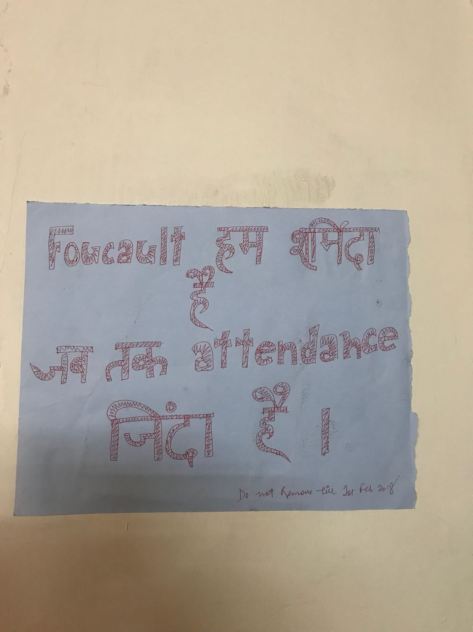
Student poster displaying a clear understanding of Foucault and surveillance. Compulsory attendance is really not needed at JNU!
Let us begin with a basic fact. The diktat on compulsory attendance in JNU is only a symptom of the larger, continuing crisis created by the utterly dictatorial style of functioning of this Vice Chancellor.
Professor Mamidala Jagadesh Kumar has, since his taking over in January 2016:
openly flouted every statute and regulation of the university
shut down admissions almost entirely for the 2017 academic year
violated the law of the land, that is, constitutional provision for reservations
failed to implement JNU’s Deprivation Point system that attempts to bring about representation for students from a diversity of class, regional and caste backgrounds
shut down the country’s oldest functioning Committee on Sexual Harassment (GSCASH)
brazenly cooked up and manipulated Minutes of meeting after meeting of the Academic Council and
treated faculty and students of JNU as his enemies to be defeated by the naked use of authoritarian power.
T T Sreekumar, an important commentator on contemporary politics in Kerala — a public intellectual who now qualifies to be an irritant in the eyes of the Kerala police, now that he has openly declared his allegiance to the dalit people fighting injustice and Vadayambady and inaugurated a protest-event there — writes about the issue and its historical origins:
When I visited Vadayambady the other day to express my solidarity with the cause of the agitation, what I witnessed there was an atmosphere of utmost fear and police terror. A big task force of police was stationed at the location. The team that included the special branch officers, had created a situation of terror at the peaceful site. Activists mentioned that a particular police officer continuously hurled abuses, including caste abuses, at the protesters that included Dalit women and children. When the protest began to draw national attention, the ruling dispensation of CPIM that had hitherto remained unconcerned has started to take up some damage control measures. However, when they finally arrived at the site of the agitation almost after a year since the agitation began, the CPIM leaders allegedly refused to address the caste question involved. Dalit activists, including women activists, surrounded them and raised several objections to this attitude pointing to their sheer hypocrisy and lack of integrity.
The almost insoluble task is to let neither the power of others, not our own powerlessness, stupefy us.
Adorno.
As frightening spectres of untouchability and unseeability hover around the festering sore of the ‘caste-wall’ at Vadayambady in Kerala, as the so-called mainstream left-led government here continues to pour its energy and resources into aiding and abetting caste devils there, as most mainstream media turns a blind eye, as the Kerala police continues its mad-dog-left-loose act, many friends ask me: why have you not yet written about the struggle there of dalit people fighting of the demon of caste now completely, shamelessly ,in the public once more? Continue reading Malayali Feminism 2018: In the Light of Vadayambady and Hadiya’s Struggle→
On 30 January 2018, retired civil servants and veterans of the armed forces jointly organised a conclave on ‘Hinduism and Hindutva’ at the Indian Social Institute, New Delhi. The conclave attended by over hundred participants, emphasized the need to rescue both Hinduism and the Indian Constitution from the clutches of the political project that calls itself Hindutva, and which has nothing to do with religion as such. The participants at the conclave sought to make a plea for saving Hinduism without making any concessions to the monstrosity of caste oppression, which in the spirit of many earlier reformers, they rejected.
This conclave followed an earlier one on ‘A Fractured Polity: The
Relevance of Gandhi Today’ organised on 10 October 2017, which had been
addressed by Justice A P Shah, Mrinal Pande and Ramachandra Guha. The
speeches are available on YouTube (Justice A.P. Shah, Mrinal Pande,
Ramachandra Guha). These civil servants and veterans have also raised severe
concerns about the present situation in a series of open letters over the last few
months: on vigilantism and hyper-nationalism; the suspicious death of Justice
Loya; and violence and discrimination against minorities in India. (See: Retired
Civil Servants open letter – 10 June 2017, Armed Forces Veterans open letter –
30 July 2017, Retired Civil Servants Letter 02 December 2017 – Enquiry into
Judge Loya’s death, Armed Forces Veterans letter to Supreme Court & Bombay
High Court on Judge Loya’s death, Retired Civil Servants open letter – 28 January
2018). Continue reading Defend Constitutional Values, Save Hinduism from Hindtuva: For Civil Servants and Armed Forces Veterans→
Ghalib has fascinated generations of people and they have tried to understand/ interpret his poetry in their own way. For any such individual it is really difficult to recollect when and how Ghalib entered her/ his life and ensconced himself comfortably in one’s heart.
This wanderer still faintly remembers how many of Ghalib’s shers were part of common parlance even in an area whose lingua franca is not Hindustani. His andaaz-e-bayaan, his hazaron khwahishein, his making fun of the priest etc. could be discerned in people’s exchanges – without most of them even knowing that they were quoting the great poet.
To be very frank, to me, it is bewildering that a poet – who died over 150 years back – looks so contemporary or at times even a little ahead of our own times. Is it because, he talks about primacy of human being, at times philosophising about life, and on occasions talking about rebelling against the existing taboos in very many ways? But then have not many other great poets have dealt with the same subjects/ topics? Continue reading ‘Why Ghalib appears so contemporary even today ?’ : Interview with Hasan Abdullah→
The recent reference to how the distribution of food in Malayali homes is often skewed against women by the actor Rima Kallingal in a recent talk has sparked off yet another round of attacks against feminists in Kerala. It is interesting to see how this seems to have brought together men of all political stripes and colours (may I say, from pro- and anti-Hadiya camps!). The attacks range from mild smirking to outright abuse, but are equally revealing of the fear of women’s feminist self-assertion. So even those men who supported Hadiya’s decision to choose her faith and community find it hard to swallow when women start laying bare the injustices of the ubiquitous patriarchal family, fearing that there may be an implicit choice in this criticism, to move away from the patriarchal family, and indeed, craft other non-patriarchal forms of intimate connection and commitment. After all, whatever be the community, the patriarchal family is acknowledged by patriarchal authorities everywhere as the foundation Continue reading From Nangeli to Rima Kallingal: Who are fit to claim Nangeli’s Legacy?→
(To be published in the special issue of ‘Janata’)
The spectacle of what is called religion, or at any rate organised religion, in India and elsewhere, has filled me with horror and I have frequently condemned it and wished to make a clean sweep of it. Almost always it seemed to stand for blind belief and reaction, dogma and bigotry, superstition, exploitation and the preservation of vested interests.
– Toward Freedom: The Autobiography of Jawaharlal Nehru (1936), pp. 240–241.
If Hindu Raj does become a fact, it will no doubt, be the greatest calamity for this country. No matter what the Hindus say, Hinduism is a menace to liberty, equality and fraternity. On that account it is incompatible with democracy. Hindu Raj must be prevented at any cost.
– Ambedkar, ‘Pakistan or Partition of India’, p. 358.
Introduction
India’s slow ushering into a majoritarian democracy is a matter of concern for every such individual who still believes in pluralism, democracy, equality and a clear separation of religion and politics. The way people are being hounded for raising dissenting opinions, for eating food of their choice or entering into relationships of their own liking or celebrating festivals according to their own faith is unprecedented. The situation has reached such extremes that one can even be publicly lynched for belonging to one of the minority religions or for engaging in an activity which is considered to be ‘suspicious’ by the majority community.
No doubt there is no direct harm to the basic structure of the Constitution, its formal structure remains intact, de jure India does remain a democracy as well as a republic, but de facto democracy has slowly metamorphosed into majoritarianism and the sine qua non of a republic—that its citizens are supreme—is being watered down fast. It does not need underlining that this process has received tremendous boost with the ascent of Hindutva supremacist forces at the centrestage of Indian politics. Continue reading Nehru, Ambedkar and Challenge of Majoritarianism→
I went to Maharashtra as I along with other activists and intellectuals were invited to come there. I along with others was a guest there. And I would remember fondly the love and support that I received in Pune and Mumbai. I would remember the resilience and enthusiasm of the people I met and their resoluteness to fight Manuvaad and centuries old casteist tyranny. I would remember the immense inspiration that I felt, when we paid homage to Jyotiba Phule and Savitribai Phule in Phule-wada, Pune. And, No I will not let two days of media trials by a few TV anchors, who are more of professional howlers, spoil these wonderful memories. I will not let their criminal cacophony and mindless vilification of me, Jignesh & others shadow my beautiful memories of Maharashtra.
The state of Maharashtra as well as the rest of the country is at a critical juncture today. On the one hand are forces in power who want to push our country back to many centuries and on the other are people who are resisting this Neo-Peshwahi, the casteist-communal-fascist regime of BJP-RSS. In my speech at Elgar Parishaad on 31st December 2017, I had said that the year 2018 is going to be a very challenging one. The last 3 and half years of the Modi Sarkar has exposed the BJP’s jumlas of Ache Din and Vikas as hollow, bitter and brutal lies.
As the General Elections of 2019 approach, BJP/RSS will now resort to creating civil strife amongst the people, polarising them on the basis of caste and religion and unleashing attacks on muslims and Dalits. The developments over the last few days vindicate me, a little too soon. Several regions of Maharashtra are in the midst of an acute agrarian distress. Both Marathas and Dalits are victims of this agrarian crisis that has been precipitated by the policies of both Modi and Fadnavis. The BJP/RSS regime has no resolution to offer to the farmers of Maharashtra. Therefore, unleashing attacks on Dalits through their hoodlums and portraying it as a caste clash between Dalits & Marathas will remain their only strategy. Continue reading Statement about the attacks on Dalits in Bhima Koregaon & the Subsequent developments in Maharashtra : Umar Khalid→
[A shorter version of this article was published in The Wire on 18 December. I thank K. Satyanarayana, P. Sanal Mohan and Jangam Chinnaiah for their very helpful comments on it, which have helped me to clarify and elaborate on certain points.]
Jignesh Mevani, image courtesy New Indian Express
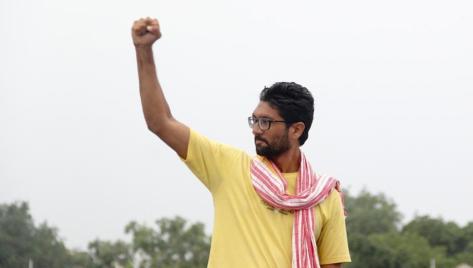
The rise of Jignesh Mevani constitutes a significant landmark in the political configuration in which the Congress has risen, despite itself, from a state of utter disarray to become the point of articulation for a possible political realignment in the near future. The process of political reconfiguration had already begun as a very significant section of the powerful patidar community, long understood to be the bedrock of the BJP’s social base in the state, had broken away from it. But alongside this, the rise of the young leaders Hardik Patel, Alpesh Thakore and Jignesh Mevani together produced the new young face of emergent Gujarat.
There is no doubt that the vacuum that characterized the space where the opposition should have been, no longer exists. The masthead of a new opposition formation is evident on the horizon. This turnaround in the fortunes of the Congress would not have been possible without the re-alignments in the non-electoral arena, facilitated in no small measure by the rise of this young leadership.
[ This post is based on updates posted by me on my Facebook wall ]
Jignesh Mevani. Photograph by Siddharaj Solanki, HT (Hindustan Times) File Photo, accessed from the HT website
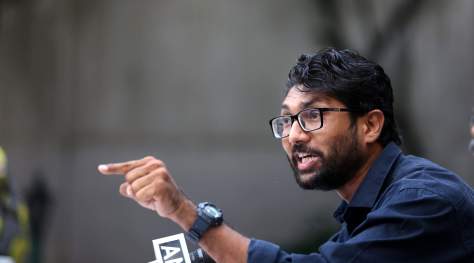
A great kerfuffle has ensued ever since the recently elected independent MLA from Vadgam, Gujarat and Rashtriya Dalit Adhikar Manch activist Jignesh Mevani gave an interview in which he had some choice things to say about the Prime Minister and BJP leader Narendra Modi. Mr. Mevani made some positive and gentle suggestions, to the effect that because Mr. Modi has stopped being relevant, has not delivered on even one of the promises made by him, he should retire, proceed towards the Himalayas, and in the phrase that has caused the greatest commotion, ‘melt his bones’.
#JigneshInsultsPM | Series of abuses after winning his debut poll, is this Jignesh's arrogance or immaturity? Fire in your views using the hashtag and let us know! pic.twitter.com/N6H6yr8oTA
Predictably, Mr. Modi’s personal broadcasting service, known as Republic TV has kicked up the greatest fuss. Arnab Goswami has been especially indignant, and he was joined in his rage by BJP spokesperson, the orotund television commentator and historical photo-shop scam artist, Mr. Sambit Patra. Mr. Mevani offered a robust and dignified refusal to apologize for what he said about Mr. Modi, when Republic TV demanded that he do so. Continue reading Jignesh Mevani, The Meltdown of Modi-Men and Dadhichi’s Bones→
When Hadiya Shafin shouted to the crowd that she converted voluntarily, that Shafin was her chosen husband, and that she wished to spend her life with him, some leading rationalist liberal feminists in Kerala sniggered at her: be grateful for the Indian Constitution which allows you to make a choice. This statement hid a despicable insult to her choice of Islam, slyly implying that it would not permit her any choices.
Goodness knows where these puerile, vain, indurate minds live their everyday lives. Maybe they are either still able to insulate themselves somehow from the onslaught of Hindutva violence, or find it useful to use the arms of this Hindutva hegemonised thuggish state to their narrow, shamefully narrow, ends.
Whatever, I could see no trace of the protective presence of the Indian Constitution when the Supreme Court heard Hadiya. I could see not the highest court of Justice of a vibrant democracy but I got a sense of how the Gates of Celestial Vaikuntam may look like:
Read more at : https://thewire.in/200701/hadiya-supreme-court-nia/
The following is a statement by WSS on the lists of sexual harassers being circulated on social media. We reproduce it here as part of the ongoing dialogue on the issue.
Women Against Sexual Violence and State Repression (WSS) stands
firmly with the survivors who have faced sexual harassment at the hands of the
perpetrators on and off the list and, most importantly, extends solidarity in this
moment of unravelling narratives, disjointed arguments and personal struggles of
individuals voicing their experiences.
The last few weeks have seen lists of sexual harassers in academia and civil society published and circulated on social media, statements issued by groups of persons and individuals reflecting on the lists, and questions raised on the ways of dealing with such lists, perpetrators of harassment, and the mechanisms in place to address it.
Alongside the lists and statements, there has been a marked silence from some of the avenues that normally engage with sexual violence and harassment, both within and outside academia. While social media was abuzz with discussions and debates, now, once again, there is silence. As a collective standing against sexual violence and state repression, we recognise that institutional spaces can be fraught with sexual violence of varying kinds and, sometimes, despite systems and processes in place, the journey of seeking justice for each individual can be a long and lonely one. Continue reading [Statement]: Women Against Sexual Violence and State Repression (WSS) on the on-going conversation on “The List”→
[This is the text of the open letter to the Chief Minister of Kerala from the celebrated Tamil poet Rajathi Salma, a leading literary and activist voice from South India whose writing has often revealed the pain and poignancy of women’s unfreedoms and the denial of a creative life of choice to them. This is about the never-ending agony that the confinement of a young woman, Hadiya, by her father, has become. Hadiya is to be heard by the Supreme Court of India on 27 November 2017, but the Kerala government refuses to take responsibility for her safe travel to Delhi, after many many pleas from civil society] Continue reading Hadiya’s Safety is the Kerala Government’s Responsibility: Rajathi Salma writes to the Chief Minister of Kerala→





 KAFILA - COLLECTIVE EXPLORATIONS SINCE 2006