Category Archives: Debates

ALL INDIA LAWYERS UNION RAJASTHAN STATE COMMITTEE: Solidarity Message to JNU

ALL INDIA LAWYERS UNION RAJASTHAN STATE COMMITTEE

Dated:18.2.2016

SOLIDARITY MESSAGE TO JNU

All India Lawyers Union (AILU), Rajasthan State Unit, strongly condemn the recent incident where individuals in uniform of Advocates misbehaved and assaulted Mr. Kanhaiya Kumar, the president of JNU Students Union, JNU faculties, Media persons on 15.2.2016 when Mr. Kanhaiya Kumar was produced in court before the magistrate is very serious issue and it became vigorous when the incident was repeated after two days, on 17.2.2016 despite of the actions given byHon’ble Supreme Court.

Further the AILU is of the view that the Jawahar Lal Nehru University is one of the institutions in the world where healthy atmosphere is developed over a time to discuss over the national and international issues. The students as well as the faculty members thereof is of the caliber to suggest a visionary and logical culmination, which not only important for individual but also for the nation and humanity as whole. Furthermore, University is a place where new ideas are developed, questions are asked and policies are praised or criticized. If any unwarranted incident is happened in the campus of the university, certainly an action has to be initiated against the responsible individual and for such action the university administration is having sufficient measures to act upon and no police action inside the campus was required at all. If the university authorities failed to take action or has shown its inability to restrict such activity, only then the police force may be used.

As such the police action in the university campus was absolutely unwarranted, unjustified and abuse of power by the state machinery.

Arrest of Mr. Kanhaiya Kumar and other students and treating them like hardcore criminals/terrorists, in the name of sedation without any substantial evidence, is not expected in a civilized society. The crime of sedation was inserted in IPC by the British rule in order to supress anyone who used to speak against the colonial rule. This term ‘sedation’ is obsolete and has no place in a democratic system like ours, especially in the educational institutions, having international reputation. Framing students in the name of sedation is clearly an attack on the fundamental rights, that is, of speech and expression.

Intentional avoidance of the Hon’ble Supreme Court instructions is apparently an act of contempt of court for which stern action has to be taken. AILU strongly suggests to take following actions against the responsible :

(i) Criminal case has to be registered against the advocates or the persons in the advocates’ uniform indulged in assaulting within the court premises;

(ii) Separate proceeding of criminal contempt is to be started against the persons involved in assaulting despite instructions of Supreme Court;

(iii) The police personals deployed at the court campus, in front of whom the act of assault was occurred has to be suspended henceforth and inquiry has to be initiated against them;

(iv) Mr. Om Prakash Sharma, the sitting MLA, who was apparently involved in the assaulting and to instigate others to involve in assaulting, his membership of Legislative Assembly is to be seized, proceeding of criminal contempt is to be initiated against him;

(v) The courts are the place where people come with the deep faith to get justice but such type of incidents not only deprive the people to avail justice but also diminish the belief in rule of law, and therefore, stern action has to be initiated against each and every responsible person whomsoever he is;

(vi) Code of conduct for advocates has to be reviewed and it may be inserted that any advocate, who involves in such incidents occured on 15.2.2016 and 17.02.2016, shall be restricted to appear in court as well as seize their auth of advocacy;

(vii) The magistrate, before whom the repeated disruption of court proceeding was occurred but no action against the responsible advocates/persons was taken, no FIR was lodged, stern action is required to be initiated against him.

The AILU condemn both the incidents, i.e. abuse of power by the police administration in the JNU campus and omission to prevent the assault on the students faculties and media persons in the court room /campus of Patiala House court. Our organization also demands for immediate release of Kanhaiya Kumar, president of JNUSU, so that normalcy can be restored.

(Dr. Vikram Singh Nain)

General Sectretary

General Secretary: Dr. Vikram Singh Nain Advocate Mobile No: +91 9414069959 Office: 0141-2810959 E-mail: nain_vs@yahoo.co.in

President: Sanjay Tyagi Advocate Mobile No.+91 9414048493 +91 9314013492

8, Nagaur Nagar, Nr. Kisaan Dharam Kanta Gopalpura Bye-pass Road, Jaipur-302019
STATEMENT OF SOLIDARITY WITH STUDENT ACTIVISTS IN INDIA: University of Pennsylvania & Philadelphia South Asian Collective

We, activists and academics in the Pennsylvania region, strongly condemn the attack on academic freedom at Jawaharlal Nehru University (JNU), New Delhi. The arrest of Kanhaiya Kumar, the President of the JNU Student’s Union, on charges of sedition has brought to light the intervention of the Union Government in the internal matters of the university. The repeated interference by police personnel at the behest of Vice Chancellors on university campuses is a draconian move. The charges against students were brought after an event organized by a section of students on campus premises to discuss the judicial execution of Afzal Guru. The JNU Students’ Union was subsequently held responsible for the “anti-national” slogans that were chanted by a group of students. We condemn these trumped-up and unconstitutional charges and stand in solidarity with the efforts to repeal capital punishment in India.

The events unfolding at JNU reveal disturbing similarities with instances of government repression on other campuses. We remember, with distress, the actions of the University of Hyderabad (UoH) administration in cahoots with the Central Government, actions that led to the death of a promising Ambedkarite student-activist, Rohith Vemula. The protests that arose indicted the discriminatory atmosphere prevailing in our universities as tantamount to the denial of the fundamental right to education to socially marginalized groups. Further, the murder of social thinkers like Govind Pansare and M.M. Kalburgi by hyper-nationalist elements under the tacit encouragement of the policies of the Central Government has shocked all advocates of free speech in India.

The charges of sedition against students participating in democratic discussion of public events is highly objectionable. The stifling of voices through intimidation and muscle power does not bode well for educational institutions.

Debate and dissent are integral parts of a strong democracy. Universities are critical public spaces that support these democratic practices to realize the values of social justice enshrined in the ideals of the constitution. International campuses like JNU, FTII and UoH bring together diverse group of students in the spirit of self-reflexive and deep intellectual engagement to ask fundamental questions of their social realities. An attack on these institutions is an attack on this precious pedagogical space. Student movements in India in alliance with other social movements in the country have historically been a resilient and sensitive force. The BJP government’s efforts to undermine them is nothing but an assault on Indian democracy. The government has failed to protect the rights of student bodies, and the highhandedness of the police highlights the insecurities of the present government.

In the United States during a presidential election year, we watch increasingly bigoted views against blacks, Muslims, and immigrants gaining ground. These events cannot be seen in isolation and we stand at the intersection of socio-political movements in the US and South Asia.

We stand in solidarity with students and faculty of JNU and demand the immediate release of the detained students. We appeal to all advocates for academic freedom in India and abroad to stand united against this state atrocity.

  1. Anannya Bohidar, Graduate Student, South Asia Studies, University of Pennsylvania
  2. Ammel Sharon, Graduate Student, South Asia Studies, University of Pennsylvania
  3. Meghna Chandra, Philadelphia South Asian Collective
  4. Ania Loomba, English, University of Pennsylvania
  5. Projit Mukharji, History and Sociology of Science, University of Pennsylvania
  6. Najnin Islam, Graduate Student, English, University of Pennsylvania

Continue reading STATEMENT OF SOLIDARITY WITH STUDENT ACTIVISTS IN INDIA: University of Pennsylvania & Philadelphia South Asian Collective

Solidarity Statement for JNU by IIT Scholars

This is a statement issued by the undersigned, scholars of Departments of Humanities and Social Sciences of IITs across the country.

We, the undersigned, scholars of Departments of Humanities and Social Sciences of IITs across the country, condemn the police action in JNU and the arrest of the JNUSU President Kanhaiya Kumar on the charge of sedition. We also denounce the repeated acts of violence unleashed by some lawyers and others at the Patiala House Court against faculty, students and the media, as well as police inaction regarding the same.

In addition, we appeal for media and public trials to cease and for civil society to instead focus on debating issues in an amicable and reasonable manner, without slandering JNU or questioning the academic integrity or patriotic fervour of JNU and its supporters. We criticise the general atmosphere of fear and intimidation that is being created to target the entire university. Given the fast polarizing political atmosphere in the country, we appeal to the media organisations to display greater responsibility and conduct television debates in such a manner that no prejudicial public opinion is created while there is an ongoing enquiry into the entire episode by the authorities concerned. Resorting to jingoism and sensationalism may cause avoidable hazards. Continue reading Solidarity Statement for JNU by IIT Scholars

#NoDissentNoCOUNTRY #StandWithJNU

As the People’s Republic of Delhi dances to freedom’s song, people from around the world liberate banned speech. Bol Ke Labh Azad Hain Tere!

Divya Cherian, (JNU 2008) Rutgers University


Dora Zhang and Damon Young, University of California, Berkeley


Greta LaFleur, Yale University

A full text of Kanhaiya Kumar’s speech and a video is available here:http://kafila.org/2016/02/15/jnusu-president-kanhaiya-kumars-speech-before-being-arrested/

A complete English Translation may be accessed here: http://www.telegraphindia.com/1160216/jsp/frontpage/story_69576.jsp#.VsMg17R97GL

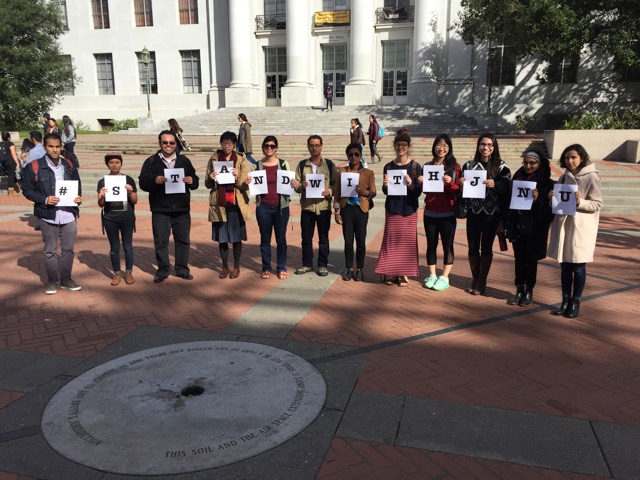
As The People’s Republic of New Delhi Marches in the Free Air Students of Berkeley #StandWithJNU

As the people of Delhi march, sing, run and dance to freedom’s call, as they cock a snook at the shackles of nationalism, casteism and authoritarian stupidity, a gift of love from afar. Look at them standing in the free air! Look at them standing around a piece of earth unbound from the myopia of nationalism!

BerkeleyStudents

“This soil and the air space extending above it shall not be a part of any nation and shall not be subject to any entity’s jurisdiction,”
 At the memorial to the 1964 Free Speech Movement on the campus of University of California, Berkeley, students and faculty stand in love and solidarity with JNU. #standwithJNU
 The memorial the 1964 Free Speech Movement at the University of California, Berkeley, like the thing it celebrates, is both invisible and embattled. The monument appears to be a circle of concrete six feet in diameter, in the middle of the famed Sproul Plaza where thousands of students gathered to demand the right to free speech and academic freedom on one of America’s most prominent and celebrated public university campuses. But that monument is so much more than what can be seen. The concrete circle, bearing the inscription “This soil and the air space extending above it shall not be a part of any nation and shall not be subject to any entity’s jurisdiction,” encompasses a 6-inch wide indentation into the ground that reaches into the soil below and 60,000 feet upwards into the sky, to the limits of American airspace. That is, in fact, the monument to free speech at Berkeley: 60,000 feet and 6-inches of invisible insistence that to speak freely is not and cannot be a right granted by any sovereign, mandated by any state. The width of the depression in the ground is as large as a person’s two feet. The ground on which they stand. From which they speak. This is the lasting monument to free speech at Berkeley. From a space as wide as our stance, reaching in an unseeable column of air to the limits of the stratosphere. A monument of air that can never, like free speech itself, be contained, torn down, or granted by another. It lies, unassuming, built as it is out of the immateriality of inalienable rights, in the middle of a campus that grapples daily with the legacy of that now 50 year old fight for the right to claim the space of the university as one of protest, of politics, of resistance.


But Berkeley, we mustn’t forget, exists on occupied territory. Its celebrated monument digs into soil that was taken, without recompense or acknowledgement, from the Ohlone people who were stripped of their lands, their language, their culture, and their lives in what America today celebrates as its great westward expansion. Thus, the monument to free speech at the University of California, Berkeley, roots itself into a soil it claims belongs to no nation and also reifies centuries of the genocide of indigenous people and of settler colonialism. This too is the legacy of the Free Speech Movement. Of the student-led activism that created Ethnic Studies programs across California and the rest of the United States. To stand in the 6-inch wide memorial is to stand in land that is occupied and to nonetheless believe that no occupation, no nation, no state, mandates our ability and our right to speak, to protest, to imagine otherwise the world in which we live.

From Berkeley to JNU. With love and solidarity.

Poulomi Saha

University of California, Berkeley

Modi Govt. Stifles Dissent and Democratic Values – The real aim of the politics of ‘Desh-droh’ and ‘Gaddaar’ : NSI

Guest Post by New Socialist Initiative (NSI)

There is poison in the air. Loud abuses of ‘deshdrohi’, ‘gaddar’, ‘maaro maaro’ are rending the air. Angry men shouting these words have beaten up teachers and students of one of the best known universities in the country in the Patiala House Court of Delhi, barely three kilometers away from the seat of the national government. An elected MLA of the ruling party was part of the team of attackers. Women teachers of the university have publicly said that they were physically harassed by the mob, while the police looked the other way. This happened on 15th February. We can turn a day back.
The Home Minister of the country announced to the world that a protest by a handful of students at the Jawaharlal Nehru University was the handiwork of India’s ‘enemy number one’, Hafez Saeed of Lashkar-E-Taiba. The basis of his claim proved to be a fake tweet within hours. Three days before that, the elected president of JNU students union Mr Kanhaiya Kumar was arrested by Delhi police on charges of sedition, under the same clause of IPC which was used by the colonial rulers against Indian freedom fighters.

Continue reading Modi Govt. Stifles Dissent and Democratic Values – The real aim of the politics of ‘Desh-droh’ and ‘Gaddaar’ : NSI

Solidarity with JNU and Conversations on Kashmir: JKCCS

Guest Post by Jammu Kashmir Coalition of Civil Society

Jammu Kashmir Coalition of Civil Society (JKCCS) expresses its solidarity with the striking students and teachers of Jawaharlal Nehru University, New Delhi. We have watched with a sense of horror and dismay, the violent criminalizing of student democracy and dissent, not just at Jawaharlal Nehru University but across Indian campuses in the recent past. Having long and intimate knowledge of violent repression and legalized impunity that Indian state is capable of, especially against those it considers ‘anti-national’ we are not surprised by these events, but have a special empathy with all who suffer its horrors. We demand the release of all student dissenters and political prisoners in the custody of the Indian state, and an end to acts of policing and surveillance on campuses, and targeting of students on the basis of political beliefs and speech.

The Kashmiri students in different colleges and universities in India, who have always faced discrimination and intimidation time to time, are now feeling the extreme regressive and oppressive means used by right wing groups and the government. After being hounded, Kashmiri students have begun leaving Delhi. There are several places where the landlords, in whose properties Kashmiri students were renting flats, have asked the students to vacate. These experiences of Kashmiri students are part of the larger reality faced by Kashmiri youth in Jammu and Kashmir and in India. The voices of dissent in Jammu and Kashmir have been dealt with administrative detentions under Public Safety Act, illegal detentions, torture, surveillance and killings by armed forces including the most recent one of Asif and Shaista at Pulwama on 14th of February.

We also view with alarm, the reports about the cynical use of Kashmiri students studying in Delhi as hostages in the politically illegitimate process of government formation in Srinagar.

We are dismayed that the public narrative about the recent events has often descended into disputes over Indian ‘patriotism’ and the shrill condemnation of a few ‘fringe’ ‘radical’ ‘traitors’ for ‘irresponsible’ slogans. These sentiments are neither mere slogans nor represent the ‘fringe’ in Kashmir, the very place they were made in reference to. As Kashmiris, we believe that the right to self-determination is inseparable from the right to political association, dissent and free expression, and these rights cannot be selectively asserted or upheld. In the competitive public proclamations of nationalistic credentials, what has been lost is that courageous act of defiant solidarity with the Kashmiri people’s struggle for justice and self-determination, that lies at the heart of these debates. Despite the disavowals and the state repression, the solidarity with the political rights of the Kashmiris is growing and spreading, as events in Jadavpur University demonstrate. We acknowledge the emerging spaces in Indian civil society to converse on the question of Kashmir, beyond nationalist framings. We hold out hope for future alliances with students, groups and individuals willing to engage in honest conversations, in which they alone do not determine the boundaries of what can or cannot be said, thought or felt.

Spokesperson
JKCCS

“A Glorious Thing Made Up Of Stardust:” What Pat Parker & Rohith Vemula Ask Us to Consider Lata Mani

This is a guest post by LATA MANI

The first thing you do is to forget that I’m black
Second, you must never forget that I’m black

Pat Parker (1978)

In these opening lines of her poem, For the White Person Who Wants to Know How to be My Friend, Pat Parker names a paradox at the heart of challenging socially produced difference. Parker is speaking not to diversity in nature, nor to the diversity of nature. Not to the variations of appearance – size, shade, height, foliage, texture; or mode of expression – hoot, howl, accent, gesture, cultural practices. Her lines address a uniquely human phenomenon: prejudice. They speak to the poignant difficulty of challenging a spurious and malevolent construction of racial difference in a society still in the grip of its miasma.

I have recalled Parker’s lines many times in the days of sorrow, tumult and righteous rage that have followed Rohith Vemula’s suicide. “Rohith Vemula’s suicide.” I am holding off from saying “Dalit scholar Rohith Vemula’s suicide.” Or, as is now being said with good reason, “Dalit scholar Rohith Vemula’s institutional murder.” I defer by a couple of sentences a description of him that refers to the caste into which he was born; to honour if only symbolically his anguish that the contingent facts of his birth had indelibly defined his life.

Continue reading “A Glorious Thing Made Up Of Stardust:” What Pat Parker & Rohith Vemula Ask Us to Consider Lata Mani

Solidarity Statement from Writers and Activists in Nepal

We stand with JNU From Nepal

We are deeply concerned by recent developments in one of India’s premier academic institutions, Jawaharlal Nehru University. The fact that Mr. Kanhaiya Kumar, JNUSU president, has been arrested and accused of sedition for a speech meant to promote more meaningful dialogue on civil liberties and freedom to dissent is an attack on the freedom of expression,a universal value which ought to be at the heart of any center of learning.

The Indian state apparatus has come out aggressively to demean and dismiss an institution’s independent practice of scholarship. This should be a cause of concern, not only to the citizens of India, but to each individual who envisions a more equal and just society. Because the impulse to stifle dissent begins incrementally, but then it becomes a barrage, a torrent, and an avalanche until it smothers every differing voice. Such attempts at stifling any voice at all should be condemned unequivocally.

We, the signatories from Nepal as listed below, unequivocally condemn the oppression of dissent at Jawaharlal Nehru University. We condemn in the clearest terms the actions of the Indian state and non-state mechanisms that have shown alarming vigor towards silencing dissent and curbing free speech.

Manjushree Thapa, Writer

Khagendra Sangraula, Writer

CK Lal, Writer

Kishore Nepal, Writer

Hari Roka, Writer/JNU Alumni

Continue reading Solidarity Statement from Writers and Activists in Nepal

#NoDissentNoCountry #StandwithJNU

Bol ke labh azaad hain tere: Speak for your lips are yet free

Partha Chatterjee, Columbia University and CSSS Calcutta

A full Hindi transcript of Kanhaiya Kumar’s speech is available here:http://kafila.org/2016/02/15/jnusu-president-kanhaiya-kumars-speech-before-being-arrested/

A full English translation can be accessed here:http://www.telegraphindia.com/1160216/jsp/frontpage/story_69576.jsp#.VsVc8HQrK8r

#NoDissentNoCOUNTRY #StandwithJNU

Bol ke labh azad hain tere: Speak for your lips are yet free

Eleanor Newbigin, SOAS, University of London

A full Hindi transcript and video of Kanhaiya Kumar’s speech is available here:http://kafila.org/2016/02/15/jnusu-president-kanhaiya-kumars-speech-before-being-arrested/

An English translation can be accessed here: http://www.telegraphindia.com/1160216/jsp/frontpage/story_69576.jsp#.VsVc8HQrK8r

Stand With JNU – SUNY College, Colgate and Syracuse Universities for Academic Freedom in India

Guest Post by Students and Teachers of Syracuse University, Colgate University and SUNY College of Environmental Science and Forestry

We, the undersigned at Syracuse University, Colgate University, and SUNY College of Environmental Science and Forestry, are in solidarity with our comrades at Jawaharlal Nehru University (JNU), India against the ongoing anti-democratic actions by the Indian state. We demand an immediate end to the police action against students on campus, and withdrawal of all charges against Kanhaiya Kumar, President of the JNU Students’ Union. We further demand that the Central Government put an immediate end to its prejudiced persecution of student activists on campuses across the country.

We strongly believe that the charge of sedition against Kanhaiya Kumar follows spurious claims. This arrest is an excuse for the state to root out dissenting voices on JNU campus, a move towards converting educational institutions like JNU into an arm of the authoritarian state. Attempts of a similar nature have been witnessed recently at other Indian educational institutions such as Film and Television Institute of India (FTII) and Hyderabad University. The growing threat to academic freedom posed by the current political climate is transnational, and extends beyond India to other parts of the world–it is a threat we face here in the United States, too.

For any word or action to qualify as being “seditious” under Indian law, it has to directly issue a call to violence. This was not the nature of the protest held by a group of JNU students against the judiciary’s decision regarding Afzal Guru, who was convicted of an attack on the Indian parliament. The peaceful protest held on February 9 on campus was not unlike other protests convened at the university over the last several decades. Dissent is an essential part of a healthy democracy. We therefore strongly condemn the Indian government’s response to the students’ protests and demand that the state refrain from authoritarian behaviour. In this spirit, we urge the Vice Chancellor of JNU to protect members of the university community and safeguard their democratic rights. Continue reading Stand With JNU – SUNY College, Colgate and Syracuse Universities for Academic Freedom in India

A letter to Umar Khalid: Pallavi Paul

Guest Post by Pallavi Paul

Dear Umar,

My name is Pallavi Paul and like you I am a PhD student at JNU.

I write this letter to apologize to you. What thoughts must be crossing your mind and that of your family, friends and comrades- as bloodthirsty, jingoist goons are on a shameless head hunt for you and your friends. I apologize to you for the poverty of imagination of a state that brands you as anti-national, while continues to trample on the rights and bodies of those living within its borders from Pulwama to New Delhi to Hyderabad. I apologize to you that you find yourself in a society where to echo the feelings of thousands of Kashmiris, to think of yourself as first devoted to the idea of justice before any arbitrary construct of the nation, to be moved by suffering, to critique capital punishment – is considered an act of terrorism. In a beautiful post on Facebook your sister lovingly called you a “communist paagal”. I apologize to you that this current oppressive climate is too cramped for your magical madness. The imagination of a beautiful world which has place not only for sangh certified, brahminically privileged, self- affirming ‘Indian-ness’, but for everyone who has found themselves left outside of this fold- the landless, the stateless, those without the protections of caste, class, religion, gender or nation.

What a wonderful name you chose for the event on the 9th of February – Country Without A Post Office. After, one of Agha Shahid Ali’s most haunting works, which references a time in the 1990s when no letters were delivered to Kashmir. There was no way for people to talk to or hear one another. You chose to think about the punishment accorded to Afsal Guru, along with this history. Your efforts to create a conversation, a debate on what it means to take a human life, is today being branded as evidence of your anti-nationalism. I apologize to you for the amnesia and the fragile ego of this country, which is unable to revisit its history without a shred of doubt or criticality. Where the only way to serve the cause of the country is by mouthing its praises and letting it rot in its own status quo and not by bringing to it newer questions, possibilities and challenges.

Many television channels like Times Now, News X, Zee have been ruthless and vicious in trying to establish links between you and terrorist organizations like the Jaish- e- Mohammad. I am sorry that you are living in a country where your name makes it so easy for this connection to be made. While comrade Kanhaiya is still in Police Custody fighting the preposterous charge of sedition, even as I write this to you- he has at the very minimum the assurance that he will not be linked to an Islamist Terrorist Organization. You, dear Umar do not even have that. Even that you are a self proclaimed atheist is not guarantee against prejudiced links being made between the religion you were born into and your political beliefs. That you made a choice outside of religion and the various forms of violence that its fundamentalist interpretations throw up, has been drowned in the noise being whipped up by vigilante, self proclaimed ‘nationalists’.

Like every storm this too will pass. The arrogance of this regime will be its undoing. Today there is a report in the Hindu, where the Central Government has denied receiving any report linking you to terrorist outfits. It is being widely shared on social media with the hashtag #weareumarkhalid. We know that your social media account has been hacked , but be assured that many voices are also rising in your support. I do not know when or whether you will be able to read this letter, but I hope that whenever we meet we will be able to celebrate freedom, justice and the spirit of critique. The seasons will change and the breeze will blow more merrily.

Take care of yourself dear comrade, the struggle is on.

Lal Salaam!

Pallavi Paul is a filmmaker and a PhD candidate at the School of Arts and Aesthetics, Jawaharlal Nehru University.

Break Down the Barriers: Reading Robin T, Bhimrao and the Nation State in JNU

Jai Bhim, Joy Guru, Lal Salaam

Two of the greatest, crazies, most beautiful minds produced by the Indian subcontinent in the Twentieth Century would have been arrested by the police and attacked by the RSS, as ‘Anti-Nationals’, perhaps rightly so, had they been alive today.After all, they never stopped being young.


The Young Ambedkar
The Young Ambedkar

One of them was tall, you know him – the big guy, with  glasses, always dressed to the nines, (no itchy khadi or scratchy khaki would do for him) .

995
The Young Tagore

The other had long hair and a beard, and even became a contemporary artist in his old age.

The cops, or thugs-in-law of the RSS might even have said “saala JNU ka lagta hai” (looks like this ***** is from JNU).

So, here they are – Bhimrao Ambedkar (Baba Saheb), and Rabindranath Tagore.

Once again, Jai Bhim, Joy Guru. And pass the ammunition.

Continue reading Break Down the Barriers: Reading Robin T, Bhimrao and the Nation State in JNU

Statements of Solidarity For JNU From Various Quarters

We at Kafila have been receiving amazing statements of solidarity with JNU and its elected students’ President Kanhaiya Kumar over the past three days. We are posting them below, along with affiliations: South Asia University (teachers and students); Grinnell College, USA, Ambedkar University Delhi Faculty Association, Democratic Teachers Network, Hyderabad, and over a hundred students from Department of English, Delhi University.


STUDENTS OF SOUTH ASIA UNIVERSITY

We, the students of South Asian University, New Delhi (comprising of students from eight SAARC nations – Afghanistan, Bangladesh, Bhutan, India, Maldives, Nepal, Pakistan and Sri Lanka) strongly oppose the idea that one’s nationalism be defined in terms of hatred towards another nation (for example, Indian nationalism be defined as hatred towards Pakistan, or vice versa). We cherish the common cultural and social heritage of the South Asian region, and shall not let any kind of jingoist nationalism being endorsed by any religious group, political party or state hinder our shared solidarity. However, in recent times, such groups and establishments have unleashed an attack on democratic and critical voices in our universities across the South Asian region, masked under religious conformity, state intervention or sometimes in the form of an act of terrorism.

Thus, we stand in complete solidarity with the student and faculty community of Jawaharlal Nehru University (JNU) in their collective struggle against the ongoing police intervention by slapping the baseless charges of sedition on many students, including the arrest of JNUSU President – Kanhaiya Kumar, and against the massive propaganda terming the JNU as ‘a den of anti-nationals’. We would like to reiterate that our collective nationalism stands responsible only to the interests of our people and our land, and not to the divisive forces which have had and are still trying to create boundaries between us.

STATEMENT OF SOLIDARITY WITH STUDENT PROTESTS IN INDIA, FROM STUDENTS, FACULTY, AND STAFF OF GRINNELL COLLEGE

Grinnell-JNU Solidarity

Continue reading Statements of Solidarity For JNU From Various Quarters

On framing JNU for an imaginary crime: Aditya Sarkar

This is a guest post by ADITYA SARKAR

JNU has entered an indefinite state of siege. Police have been swarming all over campus, raiding hostels, picking up students and interrogating them. The ABVP, predictably, have been directing them to the lairs of ‘anti-national elements’. When immense demonstrations of public solidarity with the accused students were organized, ABVP activists have attacked these, in one case mounting a violent physical assault on a visiting speaker. The JNU administration has gone to the extent of cutting off the power supply to the microphones used at a protest meeting. At Patiala House on Monday the 15th of February, the BJP’s MLAs and what appear to be a group of lawyers have assaulted JNU students, faculty and supporters in full view of the police, with what can only be regarded as smug impunity. More than one observer has remarked that this is the Emergency all over again.

It is clear that the arrayed forces of the central government are pitted against a campus which has long been an object of hatred for the Right. There’s no telling how matters will develop in the days and weeks to come. So it might be necessary to step back a bit and consider the sequence of events that led to the current situation.

In the past month, JNU students organized a protest meeting which raised the issue of Kashmiri rights, and drew attention – just as Rohith Vemula’s protest in Hyderabad had done – to the execution of Afzal Guru in 2013. Since the mainstream news outlets systematically censor any attempt to reopen that extremely murky case, it’s worth reminding ourselves of precisely why the execution was so controversial. The terrorist attack on Parliament in December 2001 produced a police investigation on which serious doubt was cast from the beginning. Afzal Guru’s laptop and mobile phone, key pieces of evidence, had not been sealed prior to investigation. One of the other accused in the case, a Delhi University lecturer (who was later emphatically acquitted) was viciously framed by Zee News, which used the police charge-sheet to make a documentary ‘establishing’ his guilt. The court proceedings were even more revealing. The Supreme Court admitted that there was no hard evidence to conclusively establish Afzal Guru’s involvement in criminal conspiracy. But these admissions were merely qualifications to what was perhaps the most extraordinary decision in the history of the judiciary in independent India. Afzal Guru was eventually hanged in 2013 on the basis that only this would appease ‘the collective conscience of the nation society’.

Continue reading On framing JNU for an imaginary crime: Aditya Sarkar

Fearless Minds and Heads Held High: To the CDS Student Community


Dear Friends

Ever since the Hindutva right-wing attacks on the country’s youthful citizens intensified – from the Kiss of Love protests to the attacks on politicized dalit youth on the campuses of IIT Madras and HCU, and now, against JNU – we have come together several times as a group to defend our right to critical thinking, action, and speech and protest against atrocities in the name of national interest and culture. We have come out not to defend our petty interests but in defense of the Indian Nation as we imagine it – differently from the right-wing – as belonging to  the communities of peasants, workers, students, artisans, dancers, singers, small traders, and thousands of other groups that contribute to the economy of this country, as the homeland of vast sections of underprivileged people denied humanity in the name of caste, class, culture, ethnicity and gender. Continue reading Fearless Minds and Heads Held High: To the CDS Student Community

The Tendency of the Price of Young Life to Fall and the Hope that it May Rise

The war on young people continues. In this post we will only consider it’s arithmetic. Not even its algebra, simply its arithmetic.

I am prompted to do this by a strange acoustic co-incidence. While standing as part of a cordon of faculty and friends protecting the students of JNU on the public meeting on the 13th of April from a handful of ABVP activists who liked invoking blood and bullets in their slogans, I head one that stayed with me, and made me revisit a question that often bothers me.

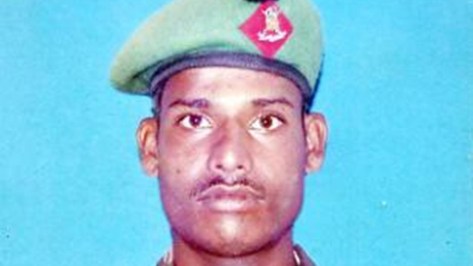
lance-naik-hanumanthappa

This was the slogan ‘Hanumanthappa hum sharminda hain, tere qatil zinda hain’. (‘Hanumanthappa we are ashamed, your murders are still alive’ ). Lance Naik Hanumanthappa, as we all know now, was a thirty two year old soldier of the Indian army who survived six days under an avalanche on the Siachen Glacier in Kashmir and then died of multiple organ failure in a Delhi military hospital. His young body must have had a tremendous and a passionate yearning for life. Sometimes I think of what a fine father or husband or lover or friend a man who loved life so must have been, could have continued to have been.

Continue reading The Tendency of the Price of Young Life to Fall and the Hope that it May Rise

Spring Comes to JNU : Love, Laughter and Rage

A Small Fragment of the Human Chain in JNU, 14th February, 2016

February is a beautiful time of the year in Delhi. It inaugurates Basant, spring, the season for love. And it is made more beautiful by an incandescent, insurgent spirit, that spreads in the air like a loving contagion, especially around what the Hindu Right rehearses for months on end to spoil – the new found festival of Valentine’s Day.

Traditionally (or at least since as long ago as the late twentieth century CE), on Valentine’s Day, the loony Hindu right goes looking for lovers in the parks of Delhi and tries to ply its own line in the extortion trade. This time, they have been joined by some big guns. The Delhi police descended on some young people belonging to a theatre group who had stepped out to have tea during a poetry reading at the IGNCA on the grounds that they ‘looked like they were JNU students’. Meanwhile, their boss, the Honorable Union Home Minister Rajnath Singh (who deserves a Bharat Ratna all by himself for skills as a performance artist) regaled a press conference with a poker faced comic act –  his revelation of the Lashkar e Taiba’s links to the JNU protests on the basis of the discovery of a fake twitter handle. The fact that Rajnath Singh still has his job is because his boss Narendra Modi, our ‘dear leader’, is the chief architect of  the ‘Fake in India’ campaign.

Holy Cow
Holy Cow (courtesy, ‘Guess Who’)

One needs love, and laughter, plenty of laughter, to survive these times, and the antics of these men. Over the last two days, it is love, laughter, sorrow and rage, in equal proportion that have been most evident in the JNU campus in Delhi. Their signs were evident again, appropriately,  yesterday, on Valentine’s Day. A student population of thousands has been able to transform its rage at the capitulation of the recently appointed vice-chancellor and his cronies to the diktats of an incompetent home minister and his minions in the Delhi Police apparatus into a deep and abiding sense of good humoured solidarity. This is demonstrated by the support that they have readily offered Kanhaiya Kumar, the president of their students union, who is currently detained, facing ridiculous charges of sedition, and several other students, including some JNUSU office bearers, who the police are still reportedly hunting for. The hashtag #StandwithJNU has gone viral, spreading, connecting, bringing people together like the sudden awakening of spring after a cruel winter. What better way can there be of celebrating Valentine’s Day than to declare, en masse, a love for liberty, and for learning?

Continue reading Spring Comes to JNU : Love, Laughter and Rage

Statement by Educators, Intellectuals, Artists and Writers on Police Action in JNU

We, the undersigned, (educators, professors, intellectuals, writers and artists), are shocked by the appalling conduct of Delhi Police at Jawaharlal Nehru University in New Delhi yesterday. We also condemn the irresponsible sloganeering by some people at the fringes of a gathering on the JNU campus to mark the third anniversary of the execution of Afzal Guru. We believe that such calls to ‘war, until the destruction of India’ erode the gravity of any serious discussion on any political question, be it capital punishment, human rights or even the question of self-determination. Such conduct is shameful, regardless of who does it, and deserving of the sharpest criticism.

That said, the only way to counter such incidents, when they occur, is through a deepening of dialogue, not through police action. The police has no business to enter places of learning and harass students (including students who were clearly trying to defuse the situation and to take a stand against the irresponsible elements who gave the objectionable slogans) when there had been no breach of peace.

We condemn the arrest of Kanhaiyya Kumar, president of the Jawaharlal Nehru University Students Union on trumped up charges of sedition and demand that he be released immediately. Kanhaiyya’s public statements, which are widely available, clearly show that sedition is the last thing that you can charge him with. The University Authorities must take steps to ensure that the witch hunt that is ensuing against other students must also cease immediately. We demand that there be no more arrests of students. We are saddened by the new JNU Vice Chancellor’s readiness to submit to the diktats of the police, and we condemn the totally outrageous statements by the Union Home Minister Rajnath Singh, and the Minister for Human Resources Development Smriti Irani which virtually declare war on universities as spaces for dissent and debate.

We demand an unconditional withdrawal of police personnel from campuses, and reiterate our support and solidarity with the students, faculty and staff of JNU, and with students everywhere in India who are pursuing a courageous resistance against the ongoing assault on higher education unleashed by the BJP government.

Aditya Nigam, Professor, Centre for the Study of Developing Societies, Delhi

Ashis Nandy, Distinguished Fellow, Centre for the Study of Developing Societies, Delhi

Bharti Kher, Artist, Delhi

Debjani Sengupta, Associate Professor, Department of English, Indraprastha College, Delhi University

Gauri Gill, Artist, Delhi

Gayatri Sinha, Curator, Delhi

Geeta Kapur, Curator, Delhi

Iram Ghufran, Filmmaker, Delhi

Jeet Thayil, Poet, Delhi

K. Satchidanandan, Poet, Delhi

Karen Gabriel, Department of English, St. Stephen’s College, Delhi University

Lawrence Liang, Alternative Law Forum, Bangaluru

Moinak Biswas, Professor, Department of Film Studies, Jadavpur University, Kolkata

Nancy Adajania, Curator, Mumbai

Nandini Datta, Associate Professor, Miranda House, Delhi University

Neha Choksi, Artist, Mumbai

Nivedita Menon, Professor, Centre for Comparative Politics & Political Theory, School of International Studies, Jawaharlal Nehru University, Delhi

P.K.Vijayan, Department of English, St. Stephen’s College, Delhi University

Pallavi Paul, Artist/Filmmaker, Delhi

Parnal Chirmuley, Associate Professor, Centre of German Studies, School of Language, Literature and Culture Studies, Jawaharlal Nehru University, Delhi

Pratiksha Baxi, Associate Professor, Centre for the Study of Law and Governance, Jawaharlal Nehru University, Delhi

Rajarshi Dasgupta, Assistant Professor, Centre for Political Studies, Jawaharlal Nehru University, Delhi

Rajeev Bhargava, Professor, Centre for the Study of Developing Societies, Delhi

Ravi Sundaram, Professor, Centre for the Study of Developing Societies, Delhi

Ravi Vasudevan, Professor, Centre for the Study of Developing Societies, Delhi

Romila Thapar, Historian, Emeritus Professor, Jawharalal Nehru University

S. Kalidas, Critic, Delhi / Goa

Sahej Rehal, Artist, Mumbai

Sabina Kidwai, Associate Professor, AJ Kidwai Mass Communication Research Centre, Jamia Millia Islamia, Delhi

Sabeena Gadihoke, Associate Professor, AJ Kidwai Mass Communication Research Centre, Jamia Millia Islamia, Delhi

Sanjay Kak, Filmmaker, Delhi

Sarnath Banerjee, Artist, Delhi / Berlin

Saumyajit Bhattacharya, Associate Professor, Department of Economics, Kirori Mal College, University of Delhi

Sibaji Bandyopadhyay, Fellow, Centre for the Studies of Social Sciences, Kolkata

Shohini Ghosh, Professor, AJ Kidwai Mass Communication Research Centre, Jamia Millia Islamia, Delhi

Shuddhabrata Sengupta, Artist, Raqs Media Collective, Delhi

Subodh Gupta, Artist, Delhi

Sumit Sarkar, Historian, Formerly Professor, Department of History, Delhi University

Tanika Sarkar, Historian, Formerly Professor, Centre for Historical Studies, Jawaharlal Nehru University, Delhi

Vivan Sundaram, Artist, Delhi


PLEASE SIGN AND SHARE WIDELY BY VISITING THIS PETITION PAGE ON CHANGE.ORG

ചിത്രലേഖയുടെ സമരം – ഒരു ഓർമ്മപ്പെടുത്തൽ കൂടി


“ആ ചിത്രലേഖയ്ക്ക് ഇനിയും സമരം ചെയ്ത് കൊതി തീർന്നില്ലേ,” കഴിഞ്ഞ ദിവസം ഒരു പരിചയക്കാരൻ എന്നോട് ചോദിച്ചു. “അവർക്ക് പൊതുജനശ്രദ്ധയോട് അഡിക്ഷനാണ്, അയാൾ തുടർന്നു. ആവശ്യം ചില്ലറയല്ല – സ്ഥലവും വീടും. ഇങ്ങനെ നാട്ടിലെല്ലാവരും തുടങ്ങിയാൽ സ്ഥിതി കഷ്ടമാകുമല്ലോ.” Continue reading ചിത്രലേഖയുടെ സമരം – ഒരു ഓർമ്മപ്പെടുത്തൽ കൂടി