Category Archives: Debates

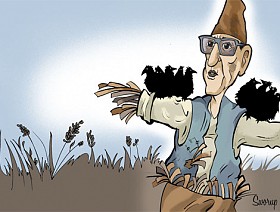
Confuse and deceive – Email interception in Kerala and the formula for political survival: Yaseen Ashraf

Guest post by YASEEN ASHRAFassociate editor of the Malayalam weekly, Madhyamam

An article by Viju V Nair in Madhyamam Weekly (issue 727, 23 January 2011) has raised the hackles of the Kerala Government and its political allies. Strange, because the report was about the excesses of the police intelligence, something which can be – and should be – investigated and corrected. The investigative report claimed that 268 email accounts were ordered by the Kerala state intelligence to be tapped, out of which a huge majority belong to Muslims. None of these persons has any previous criminal history. So it is not clear why they are put under the cyber scanner. Continue reading Confuse and deceive – Email interception in Kerala and the formula for political survival: Yaseen Ashraf

Following the Protest Movement in Sri Lankan Universities

Some of the stronger protests and forceful political debates in Sri Lanka are taking place in relation to student rights, university teachers pay, allocation of government expenditure on education and inequalities relating to the Government’s private university bill. University students have been on the boil over issues from militarisation of the universities, including compulsory military training for entering university students last year, to attempts to ban student unions. University teachers carried out strike action for months last year extracting promises of higher pay and input into educational policy which were not carried forward with the Budget, leading to a token strike on January 17th. I wrote an article on the neoliberalisation of university education in the Sunday Island on Jan 15th discussing the larger project at work with the backing of the World Bank and IMF. Kumar David has written an article in the Jan 22nd issue of the Sunday Island explaining the z-scores scandal – about the Advanced Level exam results which are used for university entrance – and its relationship to the protests against the private university bill. The Young Asia Television in their episode of Connections today has documented the recent protests including some interviews with student leaders and university teachers. The uteachers blog is an excellent resource to find more articles and presentations by academics involved in the recent protests and actions. Historically, the universities have been a hot bed of protest as well as social and political change in Sri Lanka, and those in solidarity with progressive forces struggling for social justice in Sri Lanka may want to follow the protest movement gaining ground in the universities.

Le Grande Triptych Humanism: Brinda Bose and Prasanta Chakravarty

Guest post by BRINDA BOSE and PRASANTA CHAKRAVARTY

Haruki Murakami’s much-hyped IQ84 that released worldwide in translation a couple of months ago is (Our) Big Fat Japanese Novel, three volumes in one. Closer home, Amitav Ghosh is in the process of completing the definitive South Asian Maritime Novel in trilogy. Young, prize-winning, promising writers from around the world – New Zealand, Malaysia, Bangladesh – are pledged to regale us with long large narratives that will tell us everything we ever wanted to know about their cultures, societies, lives – in trilogies and quartets. Intriguing? Indeed. Coincidental? Perhaps not.

Even as new literary canons are continually in consolidation, interrogation and re-formation, Franco Moretti – acclaimed, revered, preeminent theorist of the Novel and World Literature (which enjoy an odd synecdochic relationship) – has systematically constructed a blueprint for ways to appreciate the worth of such a grand, if loose, canon as World Literature by a particular reading technique he calls ‘distance-reading’.

Continue reading Le Grande Triptych Humanism: Brinda Bose and Prasanta Chakravarty

Fear, Safety and Livelihood: The Biopolitics of Mullaperiyar: T. T. Sreekumar

Guest post by T. T. SREEKUMAR

The Mullaperiyar Dam controversy  embodies a concrete and complex example of the imperial matrix of biopolitical legacy that post-colonial societies continually encounter even after decades of political independence.  More than a century ago, the British colonial Government administering Madras Presidency, which included parts of Tamil Nadu State, directed the erstwhile princely state of Travancore (which forms the southern districts of Kerala) to sign an agreement to divert water from the Periyar river in Travancore to the relatively arid zones adjoining the Western Ghats within the presidency, and to lease out a large tract of its territory for the construction of a Dam for a time span of 999 years.  In the post-independence period, two supplemental agreements to the original Lease Deed of 1886 have been signed between the Madras government and the Government of Kerala regarding fishing rights and generation of hydroelectric power, the former in favour of Kerala and latter favouring Tamil Nadu. The supplementary agreements negotiated and enhanced the annual lease rent and the rate of pay for the electrical energy generated.

Continue reading Fear, Safety and Livelihood: The Biopolitics of Mullaperiyar: T. T. Sreekumar

JTSA lists some more ‘genuine’ encounters in Delhi for the Home Minister

This release comes from the JAMIA TEACHERS’ SOLIDARITY ASSOCIATION

Mr. Chidambram,

You say there shall be no re-visit of the Batla House encounter. You are of course absolutely right. All those agencies who conducted the encounter have already given themselves a clean chit. What further proof could be required of the genuineness of the encounter than the fact that no less than Karnail Singh, Joint Commissioner of Police, Special Cell, Delhi, (who by the by, was also trying to derail the probe into Ishrat Jahan encounter) wrote to the Lt Governor and the NHRC vouching for the innocence of their gallant heroes. Speaking of gallant heroes, we are sure it has been brought to your notice—or maybe it hasn’t—that some of the brave hearts of the Delhi Police Special Cell have been indicted by the courts in the past couple of years for scripting and executing fake encounters. These are the very men whom you have been felicitating with gallantry awards and Presidents’ medals. But Sir, rest assured, we are not asking what sort of democracies fete and glorify killers. Our kind, of course. Continue reading JTSA lists some more ‘genuine’ encounters in Delhi for the Home Minister

Nepal – The Nostalgia for 1990

Kanak Mani Dixit’s efforts to portray 1990s as blissful, and Maoists to solely blame for all of Nepal’s ills, is revisionist history, facts be damned. Dixit’s rejoinder (‘The perils of executive presidency’, Jan 5) to my column (‘A question of form’, Jan 4) reveals fundamental differences in how we see recent Nepali history. The gist of Dixit’s rather simplistic world view is that the 1990s were wonderful and the Maoists destroyed it and are all evil. Let us examine this in more detail.
The 1990s

The 1990 constitution opened up Nepali society; it guaranteed fundamental freedoms and allowed groups to organise themselves at all levels; and economic policies pursued then led to the creation of a bigger middle class.

But there were two fundamental drawbacks of that period, which is what led to its eventual breakdown. Continue reading Nepal – The Nostalgia for 1990

The Regulation of Surrogacy in India – Questions and Concerns: SAMA

Guest post by SAMA, a resource group for women and health.

As the clamor dies down, of news reports celebrating the ‘miracle of science’ that made the arrival of Aamir Khan and Kiran Rao’s baby boy possible,  it would serve to look more closely at commercial surrogacy in India.  Estimated to be a multi-million dollar industry, Assisted Reproductive Technologies  (ARTs, through which surrogacies are conducted) are a recent and fast-growing addition to India’s medical market and medical tourism sector. Their unregulated proliferation over the last few years has raised serious issues of safety, ethical practice, costs, and rights. While the proposed Draft Assisted Reproductive Technologies (Regulation) Bill & Rules-2010 is a long-awaited step towards regulation, several clauses, especially concerning commercial surrogacy, leave much to be desired.

Continue reading The Regulation of Surrogacy in India – Questions and Concerns: SAMA

On ‘gay conditionality’, imperial power and queer liberation: Rahul Rao

Guest post by RAHUL RAO

It’s not clear what (or whether) David Cameron was thinking when he suggested recently that British aid should be linked to respect for LGBT rights in recipient countries. Almost immediately, the statement evoked homophobic responses from political and religious leaders in Tanzania, Uganda, Ghana and elsewhere. Perhaps more importantly, African social justice activists (including many of the leading LGBTI activists on the continent) advanced a comprehensive critique of ‘gay conditionality’ in a letter criticising Cameron’s statement, signed by 53 organisations and 86 individuals. Warning that the refusal of aid on LGBT rights grounds could provoke a backlash against queers who would be scapegoated for reduced aid flows, the critics have pointed out the insidious ways in which such initiatives could drive a wedge between queers and a broader civil society in recipient countries, besides reinforcing perceptions of the westernness of homosexuality as well as the imperial dynamics already prevailing between donor and recipient countries.

Continue reading On ‘gay conditionality’, imperial power and queer liberation: Rahul Rao

Three Formidable Barriers to the Advance of Democracy: Ravi Sinha

This guest post by RAVI SINHA is the text of the key note address to the Pakistan-India People’s Forum for Peace and Democracy in Allahabad on 30 December 2011

I must begin by expressing my gratitude to the organizers of this Convention and to this Forum for the opportunity and the honor you have given me by letting me address this impressive assembly. Also, I must congratulate you for choosing a theme that articulates, perhaps, the central challenge confronting all peoples and all nations of the world and more so for the peoples and the nations on the subcontinent. We are all witness to and victims of the times characterized by monstrous brutalities of war and deep scars of deprivations, inequities and oppressions. We live under a world order wherein those who brought, for example, untold tragedy and destruction to Iraq will never be brought to justice because they are the global hegemons. They will not be questioned about the hundreds of thousands of dead and maimed Iraqi men, women and children; they will not be questioned about the thousands of dead and decapitated American soldiers; they will not be questioned about the trillions of dollars spent on the war and further trillions destroyed by the war; and they will not be questioned about the kind of Iraq they are leaving behind.

Continue reading Three Formidable Barriers to the Advance of Democracy: Ravi Sinha

New friends of ISKCON? On the Gita controversy

The Parliament which has remained rather dysfunctional for different reasons all the year witnessed a strange bonhomie few days back. It was difficult to believe that they are the same representatives of people who could not see eye to eye on various issues of concern and were always keen to score their point over their political adversaries. Led by the likes of Laloo Prasad Yadav – interspersed with slogans of ‘Jai Krishna’ –  the government’s alleged silence on the developments in a faraway court in Russia was called into question.

Interestingly, BJP the party which happens to be the chief opposition party, found itself playing second fiddle to the troika of Laloo, Mulayam and Sharad Yadav on this matter. The issue related to proceedings in a court in Tomsk which supposedly had found portions of ‘Gita’ objectionable and ‘extremist’ and was contemplating to ban it.

Continue reading New friends of ISKCON? On the Gita controversy

Merry Christmas, Rev. Khanna: Thinking about Freedom and Intolerance in Kashmir

I want to begin writing this by wishing a very happy Christmas to Reverend C.M. Khanna, a Protestant presbyter in the All Saint’s Church, Srinagar, Indian held Jammu & Kashmir, who has been facing a situation that no free man should ever have to countenance. He has had to face an arrest (though, thankfully now he is out on bail) and social ostracism for doing nothing that can be construed as criminal or harmful to any individual or society at large. I write this in solidarity with him and his family, and with all those who have been harassed for their faith, or for their lack of faith, anywhere.

(Please follow this link for a comprehensive report on Rev. Khanna’s situation, in the form of a press note submitted by John Dayal)

I know that many people in Kashmir continue to be in prison for reasons of conscience, because they want to be free of the occupation. And this Christmas, my greetings are to them and to their families too. I know that Reverend Khanna is out on bail now, and that many others are not. And I hope that they too will see freedom soon. I am writing about Reverend Khanna not because I value his freedom more than that of others incarcerated in Kashmir, but because if we value freedom, we should not have to measure its value, or calculate its worth depending on who happens to get bail, and who happens to rot in jail. Continue reading Merry Christmas, Rev. Khanna: Thinking about Freedom and Intolerance in Kashmir

Does the Universal Declaration of Human Rights impose Western values?: Gita Sehgal

The Indian freedom fighter was a key drafter

Guest post by GITA SEHGAL

10 December was Human Rights Day, anniversary of the Universal Declaration of Human Rights. Does the idea of human rights with their firm assertions, their belief in the ‘rule of law’ and their globalised vision, remain relevant in the world? The idea that there are absolute standards has come under attack from both the left and the right. The philosopher Alasdair MacIntyre , author of ‘After Virtue’, said, Natural rights and self evident truths proclaimed in the American declaration of independence are tantamount to belief in witches and unicorns. While from the left,  in ‘Human Rights and Empire’, Costas Douzinas has called human rights the political philosophy of cosmopolitanism and argued that human rights now codify and ‘constitutionalise ‘ the normative sources of Empire. Continue reading Does the Universal Declaration of Human Rights impose Western values?: Gita Sehgal

High theory, Low ‘Kolaveri Di’: Why I am a Fan of this Flop Song: AS Ajith Kumar

Guest post by AS AJITH KUMAR

YouTube’s search results for the `Kolaveri di ’ song are amazing. It is hard to pick the `original’ from the plethora of `kolaveri di ’ songs -the `reply cover version’, kids version by Naveen Nigam, the damn version, and many more. I was very excited to find this possibility-a song has initiated a dialogue, and that too a musical engagement. This I think are the new possibilities that the new media has brought into the field of music. Here  is not the two- way process that we are familiar with, between the music and the listener, but a number of activities in multiple tracks.

The ‘listener’ is more visible  now, and has more powers. He/she shares, likes, comments, makes his/her own videos and broadcasts them by herself/himself. I am not trying to jump into a sort of technological determinism, but approaching the shifts in the music field – in the making, listening, broadcasting and sharing of music. I would say that it is within this context that we have to reflect on the popularity of the `kolaveri di ’ song.

Continue reading High theory, Low ‘Kolaveri Di’: Why I am a Fan of this Flop Song: AS Ajith Kumar

What Kapil Sibal does not understand: the internet

A  few days ago a friend asked me if I knew someone who had the ability and inclination to help out a certain department of the central government with using social media. My friend did not name who the prospective employer was, but clearly, with even Digvijay Singh on Twitter, the Congress party is worried about social media. No surprise that this should happen in a year when the UPA government’s popularity has taken a nose-dive.

The New York Times revealed on 5 December that Kapil Sibal summoned Facebook officials and showed them a Facebook page that allegedly maligned Congress president Sonia Gandhi and said that this was unacceptable. While HRD officials refused to reveal much in that NYT copy, they must have realised that shit has hit the fan, because the next morning’s Indian Express the spin doctoring was clear: there was now a mention of allegedly derogatory pictures of Prophet Mohammed along with the Prime Minister and the Congress President (who are no doubt as sacred in his books as Prophet Mohammed).By the time he held his press conference yesterday, it became about things that Hurt Our Religious Sentiments. On the 19th anniversary of the Babri Masjid demolition, it is very interesting to see a Congress minister using religion to cover up power politics.  Continue reading What Kapil Sibal does not understand: the internet

Hindi and Urdu: Sa’adat Hasan Manto

This is MUHAMMAD UMAR MEMON‘s translation of an article by SA’ADAT HASAN MANTO. The translation first appeared in The Annual of Urdu Studies.

The Hindi-Urdu dispute has been raging for some time now. Maulvi Abdul Haq Sahib, Dr Tara Singh and Mahatma Gandhi know what there is to know about this dispute. For me, though, it has so far remained incomprehensible. Try as hard as I might, I just haven’t been able to understand. Why are Hindus wasting their time supporting Hindi, and why are Muslims so beside themselves over their preservation of Urdu? A language is not made, it makes itself. And no amount of human effort can ever kill a language. When I tried to write something about this current hot issue, I ended up with the following long conversation:

Munshi Narain Parshad:  Iqbal Sahib, are you going to drink this soda water?

Mirza Muhammad Iqbal: Yes, I am.

Munshi: Why dont you drink lemon?

Iqbal: No particular reason. I just like soda water. At our house, everyone likes to drink it.

Munshi: In other words, you hate lemon. Continue reading Hindi and Urdu: Sa’adat Hasan Manto

Indian Government’s Claims About Corporate Retail and the Reality: Shankar Gopalakrishnan

The vociferous supporters of corporate retail in India seem to believe, or would like us to believe, that there is no previous experience of corporate retail anywhere in the world to learn lessons from. In this guest post, SHANKAR GOPALAKRISHNAN analyses available data on the experience of the entry of corporate retail globally, to outline the disastrous consequences it has had everywhere it has been introduced.  On the basis of extensive research, he concludes:  “The growth of corporate retail not only will not address the key problems plaguing India’s economy today – it will greatly exacerbate many of them. In particular, the crisis in agriculture, environmental destruction, declines in land productivity, urban unemployment, price volatility and unequal access to resources would all be worsened by unchecked growth of corporate retail.” Shankar’s article follows.

In the flood of rhetoric following the government’s decision to permit FDI in retail, the actual reality of what this will mean is being lost. For that it is necessary to look at international data and what it shows about the claims being made. Commerce Minister Anand Sharma’s letter offers a good place to start. His claims can be summarised as follows: Continue reading Indian Government’s Claims About Corporate Retail and the Reality: Shankar Gopalakrishnan

When an Ecofeminist Dies: Anupam Pandey

Guest post by ANUPAM PANDEY

“The government said, “If they only planted trees, we wouldn’t bother with them. But they also plant ideas. And I say, it’s true”

Wangari Mathaai (1940-2011)

When the death of Steve Jobs evoked such unprecedented emotions of manic proportions in India which is not even a market of consequence for Apple, it is astounding that the passing away of Wangari Mathaai (a few days before Jobs’ death) did not even create a ripple of interest. But then, in the power hierarchy of global capitalism, what is the worth of the life of an ecofeminist compared to that of the one which is associated with one of the most popular consumer brands in the world? Continue reading When an Ecofeminist Dies: Anupam Pandey

Some FAQs about Koodankulam and Nuclear Power: Nityanand Jayaraman and G. Sundar Rajan

Steel drums with nuclear waste. The inescapable byproduct generated from the fission of nuclear fuel in the form of uranium or plutonium creates what is called nuclear waste. This waste comes in a huge variety of extremely radioactive material with half-lives ranging from 8 days to hundreds of thousands of years. In other words their radioactivity takes a really, really long time to decay, thousands of times our human life-times. These fission products if released to the environment will last a long time, and it is almost impossible to decontaminate them.

NITYANAND JAYARAMAN and G. SUNDAR RAJAN of the Chennai Solidarity Group for Koodankulam Struggle developed  the  fact-sheet below in response to real questions that they encountered during the course of street and college campaigns. They say: “The questions were sincere, so we felt a sincere response was warranted.”

Continue reading Some FAQs about Koodankulam and Nuclear Power: Nityanand Jayaraman and G. Sundar Rajan

Mobpublic vs. Counterpublic in Kerala

[with inputs from Baiju John]

Recent events in Kerala convince me that we need to think more closely about the ways in which our political public life is being slowly overwhelmed by something that is profoundly anti-public but somehow manages to resemble it — I’m tempted to call it the Mobpublic. I’m of course not referring to formal politics, where political parties and powerful communities continue to squabble without any serious difference in their programmes. Very little of either the political or the public survives in them; all one hears for most of the time are the tales of internal squabbling which is neither political (yes, despite all of V S Achuthanandan’s efforts to coopt oppositional civil social struggles) nor public. Perhaps the decline of the political is a condition for the rise of the mobpublic.

Continue reading Mobpublic vs. Counterpublic in Kerala

Trading with the Enemy: Raza Rumi

Guest post by RAZA RUMI

Reports suggest that Pakistan has decided, in principle, to grant the Most Favoured Nation (MFN) status to India. Much progress has taken place since the earlier announcement and several parleys between the officials suggest that trade relations may finally ‘normalise’. India already conferred MFN status to Pakistan in 1996. India and Pakistan have no formal trade agreement. Until now Pakistan maintained a Positive List of importable items from India consisting of 1075 items.

Most Favoured Nation: Under the WTO agreements, countries cannot normally discriminate between their trading partners. Grant someone a special favour (such as a lower customs duty rate for one of their products) and you have to do the same for all other WTO members. This principle is known as most-favoured-nation (MFN) treatment. It is so important that it is the first article of the General Agreement on Tariffs and Trade (GATT), which governs trade in goods. MFN is also a priority in the General Agreement on Trade in Services (GATS). Continue reading Trading with the Enemy: Raza Rumi

‘A Call for Rejecting 2011 Land Acquisition Bill’

This joint statement, signed and endorsed by various organisations and individuals from across India, named at the end, was put out on 12 November 2011. 

The 2011 Land Acquisition, Resettlement and Rehabilitation Bill is a dangerous exercise in doublespeak that will worsen the injustice and devastation caused by the present law. Below is a joint statement on this legislation from a number of organisations and individuals, calling for the rejection of the new Bill and raising the basic issues that need to be addressed by any legal framework.

The statement points out that:

Continue reading ‘A Call for Rejecting 2011 Land Acquisition Bill’