Category Archives: Education

From Jadavpur University, Kolkata – ‘I am, one of those survivors, who has experienced a nightmare last night’: Tanumay Naskar 


Guest Post by TANUMAY NASKAR

[ This is an account of the events of last night in Jadavpur University, Kolkata, were students sitting in on a peaceful protest against university authorities inaction on a recent complaint of sexual harrassment. What followed (an attack from two fronts, by police and goons affiliated to the Trinamool Congress) brought back memories of the many times that students have been attacked mercilessly in JU. Currently, around 40 students have had to receive medical attention, and 38 are in police detention. Protests against this event are being organized today in Kolkata (at 4:00 in the afternoon, at Jadavpur University, and at 6:00 PM at JNU in Delhi, by the JNU Students Union]

Follow this link to read a detailed time-line of the events as they unfolded.

Follow this hashtag – ‪#‎hokkolorob‬ for details of how people are responding to the situation.


I am one of those survivors who has experienced a nightmare last night.
We were singing. We were dancing. We were peacefully protesting. 
When someone yelled, “Let’s make the barricades, the police is coming”. 
After that, we saw police (READ GOONS) of grade A, barred all the entrances and charged us with Lathis.

Continue reading From Jadavpur University, Kolkata – ‘I am, one of those survivors, who has experienced a nightmare last night’: Tanumay Naskar 


Jadavpur University students struggle against gender violence

In Jadavpur University (a State aided university of West Bengal), the Arts Students Faculty Union organizes a students’ cultural festival, Sanskriti. On the second night of the festival, an incident of violence occurred in the campus that resulted in a chain of events.

On the night of 28th August, during the ongoing festival, a second year student from the Department of History, Jadavpur University, was allegedly molested inside campus premises by a group of people from the hostel, and her male friend (not a JU student), was beaten up. According to the victim, she had gone near the hostel to relieve herself given the unavailability of bathrooms at the time, accompanied by her friend. On their way back, a group of hostel boys allegedly passed snide remarks which led to a scuffle, and then escalated to something bigger. While her friend was allegedly pulled away and beaten up, she was dragged into the hostel, where she claims she was molested. Continue reading Jadavpur University students struggle against gender violence

The Wrongs In The Right To Education: Noyonika Bose

Guest Post by  NOYONIKA BOSE

In the winter of 2013 I had carried out a survey as part of an NGO CRY, Child Rights and You in 10 schools in the heavily populated slums of Rajabazar, an area in north Kolkata. The objective of the survey was to see whether the Right To Education (RTE) Act was being properly implemented in these schools.  The findings of the survey though not absolutely abysmal, were not positive either. However what I learnt is that it is not entirely the fault of these government and government aided schools that they were unable to provide their students with quality education. It has also to do with the basic structure of the RTE act which is peppered with several flaws. This article is a critique of the RTE and some possible solutions. Continue reading The Wrongs In The Right To Education: Noyonika Bose

September 5 as Teachers’ Day – The Dalit Critique: Abhay Kumar

Guest post by ABHAY KUMAR

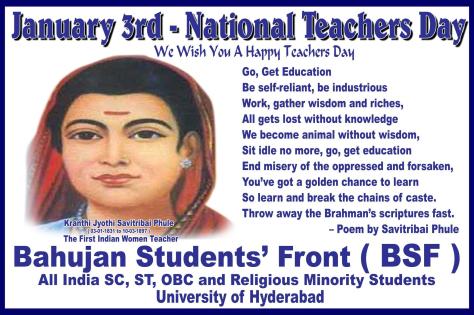
While the schools and educational institutions of the country have been observing September 5 as Teachers’ Day since 1962, on the birth anniversary of the first Vice-President and second President of independent India Dr. Sarvepalli Radhakrishnan (1888-1975), a section of Dalits, mostly students, activists and intellectuals at public universities, are increasingly denouncing its observance. They contend that the birthday of Radhakrishnan, a Brahmin, should no longer be held as Teachers’ Day because he had made no contribution to the educational uplift of lower castes and classes. Instead they exhort people to observe National Teachers’ Day on January 3, the birth anniversary of the nineteenth century social reformer, and teacher from backward caste, Savitribai Phule (1831-1897).

national_teachers_day

According to the biographer of Savitribai Phule, M. G. Mali (Krantijyoti Savitribai Phule, 2005), she was taught by her husband in a school run under the shade of a mango tree. Access to education enabled her to become aware about egalitarian movements at global level as she managed to read the biography of Thomas Clarkson (1760-1846), who fought for liberation of the Black. Later when she became a teacher, it was vehemently opposed by reactionary Brahmins who pelted stone and threw dung on her in order to “save” orthodox Hindu religion. When frustrated Brahmins were unable to deter the zeal of Phules about imparting education, they succeeded in reasoning with her father-in-law, Govinda Rao, to force them to leave home. She preferred eviction with her husband from home to giving up her mission on education. Despite the opposition, they continued to persuade parents to send their daughters to schools. As a result of their hard work, 18 schools were opened from 1848 to 1852. Her dedication to spread education, particularly among subalterns is self-evident from a few lines of her poem. ‘All gets lost without knowledge… We become animal without wisdom…So learn and break the chains of caste….Throw away the Brahman’s scriptures fast.’   Continue reading September 5 as Teachers’ Day – The Dalit Critique: Abhay Kumar

Collective struggle strengthens autonomy: Saroj Giri

Guest post by SAROJ GIRI, continuing the discussion on roll-back of FYUP in Delhi University. 

Earlier posts on this issue are listed and linked to here.

Here is one way to make sense of the core issue at stake in Delhi University today – this piece by Nandini Sundar arguing that the UGC directive amounts to hampering institutional autonomy of DU.

But this is a flawed position in the present context. It conflates the autonomy of DU with the autonomy of the VC. It construes DU’s autonomy in narrow institutional terms, overlooking the larger movement of teachers and students which is also ‘DU’ and which has consistently opposed the FYUP.

Sundar suggests withdrawal of the UGC directive, the setting up of a DU committee to overhaul the programme, and deliberation in the Academic Council, this time taking proper heed of anti-FYUP views. But do we need a fresh round of discussion on the pros and cons of FYUP?

Absolutely not. For there have been tons of deliberations over the FYUP. Just go back to the minutes and records of the many different meetings and Committees, or recall the many demos and dharnas. There is ample evidence of deliberation where the members of the University have given sound reasons why the FYUP is bad.

Indeed, the picture presented that it is the Ministry or the UGC imposing its diktat from above is simply not true. It is not some committee in the UGC or Ministry which on their own have decided to stall the FYUP. For it is force of the movement against FYUP and the many, many voices active since the last few years who have prevailed now – it is this which is reflected in the UGC directive. Continue reading Collective struggle strengthens autonomy: Saroj Giri

Autonomy for what, from whom, and for whom?

It seems the unthinkable has happened – the Vice Chancellor of Delhi University has resigned over the UGC’s pressure to withdraw the Four-Year Undergraduate Programme (FYUP). I won’t go into the debate on the FYUP, which has been covered extensively on Kafila and elsewhere [1]. See particularly this post by Professors at the University. I am only interested in two issues that arise from the news coverage of the event as it has unfolded through the day.

One, the question of autonomy. Prima facie, as Apoorvanand and Satish Deshpande have argued comprehensively on Kafila, the resignation of a VC over pressure from the UGC seems to be evidence of bureaucratic or ministerial over-reach. Questions have been raised (rightly) over the timing of this pressure, coming as it does on the heels of a political shift of colossal proportions at the national level. It doesn’t take a rocket scientist (I find myself in agreement with Congress spokesperson Manish Tewari’s language on this) to figure out that the change in Delhi University has political backing. For one, rollback of the FYUP was on the BJP’s agenda/manifesto – that is as political as it gets! Second, it was this very UGC that had been so coy about commenting on the FYUP for the past one and a half years, a coyness that amounted to tacit support. Only very recently had it moved its mammoth bureaucratic feet on the matter, constituting a committee to look into complaints from students and teachers that had finally reached its mammoth bureaucratic ears. The VC, being well acquainted with elephants, would be able to explain the mammoth temporality of this apex organisation better than any of us, having benefited from it for a goodly amount of time. Even after the constitution of the committee, the VC continued to be lauded by the UGC for his efforts at implementation of former HRD minister Kapil Sibal and his successor Pallam Raju’s efforts at radical educational reform. The committee met at a leisurely pace, no doubt fortified by several hundred samosas and robust air-conditioning in the UGC’s Bahadur Shah Zafar Marg office in central Delhi, while anti-FYUP protestors enjoyed the blazing sun or freezing cold outdoors, as they had been enjoying for a year and a half.

Continue reading Autonomy for what, from whom, and for whom?

स्वायत्तता की फिक्र किसे है? अपूर्वानंद, सतीश देशपांडे

पिछला एक हफ्ता भारत के शैक्षणिक समुदाय के लिए, खासकर उनके लिए जो किसी न किसी रूप में दिल्ली विश्वविद्यालय और विश्वविद्यालय अनुदान आयोग से जुड़े रहे हैं, सामूहिक शर्म का समय रहा है. यह अकल्पनीय स्थिति है कि आयोग एक सार्वजनिक नोटिस जारी करके किसी विश्वविद्यालय के पाठ्यक्रम में दाखिले की प्रक्रिया के बारे में निर्देश जारी करे. आयोग ने दिल्ली विश्वविद्यालय के स्नातक पाठ्यक्रम में दाखिले के सिलसिले में अभ्यर्थियों को कहा है कि वे विश्वविद्यालय द्वारा विज्ञापित चार वर्षीय स्नातक पाठ्यक्रम में प्रवेश न लें. उसने विश्वविद्यालय प्रशासन को फौरन यह पाठ्यक्रम वापस लेने और 2013 के पहले के पाठ्यक्रम को बहाल करने का आदेश दिया है. उसने विश्वविद्यालय के सभी कॉलेजों को भी सीधे चेतावनी दी है कि उसका आदेश न मानने की सूरत में उन्हें अनुदान बंद किया जा सकता है. किसी विश्वविद्यालय को नज़रअंदाज कर उसकी इकाई से उससे सीधे बात करना अंतरसांस्थानिक व्यवहार के सारे स्वीकृत कायदों का उल्लंघन है. व्यावहारिक रूप से यह दिल्ली विश्वविद्यालय का अधिग्रहण है.यह भारत के विश्वविद्यालयीय शिक्षा के इतिहास में असाधारण घटना है और सांस्थानिक स्वायत्ता के संदर्भ में इसके अभिप्राय गंभीर हैं. Continue reading स्वायत्तता की फिक्र किसे है? अपूर्वानंद, सतीश देशपांडे

History Scholars Write to UGC on Need to Radically Restructure NET

To:

The Chairman, University Grants Commission.

Dear Sir,

The University Grants Commission has mandated that an exam i.e. the National Eligibility Test, be passed as a requirement for the teaching of History at the undergraduate and post-graduate levels, except in the case where the candidate has a PhD. Those who score highly are given the Junior Research Fellowship which greatly strengthens their candidacy for the Ph.D. program.

We the undersigned, as teachers and researchers of History, believe that the NET exam as it exists does not measure competence in History as a discipline in any imaginable sense. The NET’s own understanding of History is fundamentally different from the practice of the discipline across the world. This understanding, as reflected in the question papers, holds History to lie solely in the memorization of facts. Therefore, in the NET’s version of History, the mechanical retention and retrieval of information appears to be the only competence required for the teaching of the subject.  Continue reading History Scholars Write to UGC on Need to Radically Restructure NET

All Is Not Well at AUD: Natasha Narwal

Guest post by NATASHA NARWAL

Ambedkar University Delhi, a recently established State University in the NCR, has become the new buzz in the academic circles of the Capital. It is seen as space full of creative opportunities by an academic community exhausted by bureaucratic regimes and the sheer weight of established institutions stifling any real creativity and innovations in most central Universities. In a recent article in Economic and Political Weekly, Janaki Nair described AUD as a ‘viable, vibrant space of thinking and learning, striving to provide affordable and yet sustainable fee structures and encouraging creativity and non-hierarchical structures of learning.’ To be fair, such perceptions are not entirely baseless. As it is a recently established University, almost everything, from the various schools, courses, syllabus even physical infrastructure is in the making without very rigid contours. All this gives one a sense of an innovative and fluid space. Many of the faculty members indeed do strive hard to design courses in consultation with students and give them space to express themselves. But beneath this, on the grounds, all is not well at AUD. Continue reading All Is Not Well at AUD: Natasha Narwal

Save the AP State Archives: Coalition of Concerned Citizens and Academics

This petition is being circulated by a coalition of concerned citizens, local and international academics and scholars

The historical collections at two major archives in Hyderabad, the Andhra Pradesh Government Oriental Manuscripts Library (APGOML) and the Andhra Pradesh State Archives and Research Institute (APSARI), are under threat in the bifurcation of Telangana and residuary Andhra Pradesh. The institutions’ collections are slated for division between the two new states. These collections have long suffered from neglect, and now face the likelihood of irreparable damage from arbitrary division, handling, and transfer.

Local and international scholars and activists have organized a petition to preserve these historical documents. Our primary concern is for the integrity of the collections and we seek to avoid entanglement in the Telangana/Andhra debates. The petition is aimed, in part, at demonstrating that there is a concerned audience of international scholars and interested parties who care about and use these collections. This wider expression of concern will help support the efforts of local citizens who plan to submit the petition to the Governor before the end of the month.

Please take a moment to add your voice:

http://www.ipetitions.com/petition/protect-the-andhra-pradesh-state-archives-and Continue reading Save the AP State Archives: Coalition of Concerned Citizens and Academics

Attitudes towards Menstruation – Notes from Assam: Priyanka Chakrabarty

This is a Guest Post by PRIYANKA CHAKRABARTY 

GOOD NEWS, GOOD NEWS…They are blessed with a child! Oh, what child, boy or girl? This is the most common response that new parents will encounter, one that indicates what people find most interesting about a new birth. We examine its genital parts and then say, it is a boy or girl. During this time, the difference between male and female is only the biological difference of sex,  of the presence of the penis or the vagina. Gradually the child is ‘socialised’ (read normalised) into a ‘woman’ or a ‘man’.

One of the key aspects of a girl’s socialization is her introduction to the bodily process of menstruation. Superficially, and as a purely biological process, menstruation is the discharge of blood from the vagina. This is widely considered to be the ‘development’ of the female body and after the start of menstruation, a girl is believed to have attained womanhood –attained puberty. Continue reading Attitudes towards Menstruation – Notes from Assam: Priyanka Chakrabarty

EFLU Hyderabad Rusticates Students for Wanting to Keep Library Open: Sudha and Muhammad Afzal

Guest Post by Sudha K F and Muhammed Afzal P

The semester break seems to be the most active time for the English and Foreign Languages University (Hyderabad) administration. What are these activities that the administration invests so much of its energies in, when most students have left the campus for their vacation? It is sending memos, show cause notices and the latest: the RUSTICATION of two significant student leaders on the EFLU campus.

When the word ‘fascist’ has become an everyday term, to talk about the Modi nightmare and its anxieties, we have more to add to that list from EFLU, Hyderabad. Mohan Dharavath, President of Dalit Adivasi Bahujan Minority Students’ Association and Satish N, General Secretary of Telengana Students’ Association, have been rusticated from the University for two years, the latest in a series of draconian and undemocratic moves, on the part of the autocratic EFLU administration. The two students, along with another student, Subhash Kumar, were given show cause notices by the Proctor’s office on 24 March, to which they responded, denying the baseless charges levelled against them. The rustication is part of the disciplinary action against these students who were part of a massive protest that took place against the administration, called forth by the EFLU Students’ Union. This protest was against the absolute closure of the only 24-hour reading room, and library, on the small EFLU campus in the first week of March 2014.

Continue reading EFLU Hyderabad Rusticates Students for Wanting to Keep Library Open: Sudha and Muhammad Afzal

Implausible Deniability – Reading Amish Tripathi’s ‘Shiva’ Trilogy: Eric Gurevitch

Guest Post by Eric .M. Gurevitch

A few years ago I had the pleasure of sitting in on a seminar Wendy Doniger taught on Hindu Mythology. On the final day of the class, Professor Doniger was addressing the continuing questions of students. A young man raised his hand and was called upon. “Professor Doniger,” he said somewhat sheepishly, “why do Indians keep retelling the same stories over and over again?” The rest of the students looked on somewhat aghast—clearly this student hadn’t understood the point of the class at all. But Doniger just chuckled. “Well,” she said, a sly grin creeping across her face, “because they can never get them quite right.” Her point is a simple but powerful one. As she went on to explain to the class (and in her book The Implied Spider), the stories we tell reflect the world around us. And as soon as we write a story down, the world we were trying to capture has changed. We cannot help but retell the stories that we value—after all, they are never quite right for us—in our time. And even if we manage to get them quite right, they are only right for us—other people living around us will have different reasons for telling similar stories, for appealing to the same stock of authoritative figures for different purposes. The importance of analyzing the implications of retelling of Indian stories takes on new meaning in a modern India where Wendy Dongier’s controversial book The Hindus, an Alternative History is no longer sold in stores.

Continue reading Implausible Deniability – Reading Amish Tripathi’s ‘Shiva’ Trilogy: Eric Gurevitch

Elections, Propaganda and Education

The Aam Aadmi Party was reluctant to include the issue of the rights of the LGBT people in its Delhi manifesto due to strategic reasons. Explaining the absence, the party officials said that conservative voters might turn away from the party if they find it supporting the LGBT cause. The LGBTs also seem to ‘understand’ the constraints of the poor party. The election meetings could have served as a wonderful platform had the party decided to talk to the people about this issue, telling them why it is important for us to ensure liberty to individuals to decide about their bodies. It would have been an educational exercise. Given the fact that people are ready to listen to this new party and its ideas, this reluctance on its part to take up this role says a lot not only about it, but also about the health of our polity.

The AAP candidate challenging Rahul Gandhi is harping on the bad condition of the roads of Amethi and lack of electricity there. One wonders whether Rahul Gandhi, in his response, would have the courage of a now-forgotten former Congressman. Abdul Ghafoor, once Chief Minister of Bihar, was campaigning in Siwan in a Parliamentary election. At a meeting, voters started complaining about the bad condition of roads and sanitation. He told them bluntly that he was there to seek their approval for his candidature for the membership of the Parliament and they should not waste their votes on him if they expected him to fix these problems. The problems they cited were something a municipal councilor was supposed to look after. It is a different story that he lost the election. Continue reading Elections, Propaganda and Education

Dalit Students and Journalists – from Classroom to Newsroom: Shivnarayan Rajpurohit

This is a guest post by SHIVNARAYAN RAJPUROHIT

The conscious or unconscious exclusion of Dalits (SC/ST) from the Indian mediascape has given way to a lopsided public sphere which hardly manages to generate comprehensive debates. Corporate interests have aggravated this malaise, given the indifference of the corporate sector towards fomenting a diverse media, cutting across caste, religious and class lines. The following paper looks at the absence of Dalit journalists and students from English press and journalism schools. The primary conclusion of my research is that English-language media as an institution has been undemocratic because it draws its workforce from a homogenous set of people, overlooking the urgent need for diversity. In that sense it is hostile to opposing viewpoints and diversity of arguments. The paper is primarily divided into five parts: counting Dalit journalists, reason for exclusion, classroom to newsroom, need for Dalits in media and Blacks in USA.

Continue reading Dalit Students and Journalists – from Classroom to Newsroom: Shivnarayan Rajpurohit

The ‘Occupy Library’ Protest in EFLU, Hyderabad: Anonymous

Guest Post by a student who wishes to remain anonymous

The recent incidents in the English and Foreign Languages University (EFLU), Hyderabad, shows yet another move from the part of the administration to bypass democratic procedures and suppress the voice of the student community. Ever since she took charge, the current VC Sunaina Singh has managed to acquire infamy for her anti-student and totalitarian mode of governance. The most recent one was closing down the common reading room for students, which was functional 24*7. The initial reason given was that it was under renovation. Later, notifications were put out stating that the previous reading room will be attached to the library (which closes down at 8pm on weekdays and at 6pm on weekend). Separate reading rooms were allotted for male and female students in their respective hostels, each of which cannot accommodate more than 20 students at a time (the total strength of the university is 2500+).

This decision, in effect, meant that boys and girls had no place to study/ work together after the stipulated working hours of the library. The authorities even posed the question as to why it was necessary that boys and girls have to study together. Excuse my hyperbole, but probably the next step would be to prohibit the formation of mixed groups for class works, assignments and presentations.

This particular incident of closing down the common reading room has to be viewed by placing it in the context of the larger issue- the regulations imposed on the students over the past one year and attempts to curb the liberal values that EFLU has always held up.  Continue reading The ‘Occupy Library’ Protest in EFLU, Hyderabad: Anonymous

Report of a Protest by Students at UP Bhavan in Delhi against Harrassment and Slapping of Sedition Charges on Kashmiri Students at SVSU, Meerut: Kashif Ahmed Faraz

Guest Post by KASHIF AHMED FARAZ

Several students protested on the 7th of March in Delhi against the harassment and eviction of Kashmiri students in SVSU (Swami Vivekanand Subharti University), Meerut and the slapping of sedition charges against 67 Kashmiri students. The protesters included activists, students from universities, mostly from JNU and also Kashmiri Students residing in Delhi. The protest took place at Uttar Pradesh Bhawan, New Delhi.

Signs at Protest at UP Bhavan against Harrassment of Kashmiri Students in Meerut

Continue reading Report of a Protest by Students at UP Bhavan in Delhi against Harrassment and Slapping of Sedition Charges on Kashmiri Students at SVSU, Meerut: Kashif Ahmed Faraz

राष्ट्रवाद का मौसम

मेरठ के एक निजी विश्वविद्यालय में भारत-पाकिस्तान के बीच हुए क्रिकेट मैच में पाकिस्तान की जीत पर कश्मीरी छात्रों की खुशी जाहिर करने पर स्थानीय छात्रों द्वारा उनकी पिटाई और तोड़-फोड़ के बाद तीन दिनों के लिए छियासठ छात्रों के  निलंबन (निष्कासन नहीं) और फिर ‘उनकी हिफाजत के लिए’ उन्हें उनके घर भेजने के विश्वविद्यालय के फैसले के बाद उन छात्रों पर राष्ट्रद्रोह की धाराएं लगाने से लेकर उन्हें वापस लेने तक और उसके बाद भी जो प्रतिक्रियाएं हुई हैं,वे राष्ट्रवादी नज़रिए मात्र की उपयोगिता को समझने के लिहाज से काफी शिक्षाप्रद हैं.आज यह खबर आई है कि ग्रेटर नॉएडा के शारदा विश्विद्यालय में भी छह छात्रों को छात्रावास से ऐसी ही घटना के बाद निकाल दिया गया है जिनमें चार कश्मीरी हैं. मामला इतना ठंडा क्यों है, ऐसी निराशा जाहिर करते हुए फेसबुक पर टिप्पणी की गयी है और उसके बाद तनाव बढ़ गया है.

रोशोमन नियम के अनुसार घटना के एकाधिक वर्णन आ गए हैं और तय करना मुश्किल है कि इनमें से कौन सा तथ्यपरक है. स्थानीय (राष्ट्रीय या राष्ट्रवादी?) तथ्य यह है कि पाकिस्तानी खिलाड़ियों के प्रदर्शन और फिर उस टीम की जीत पर कश्मीरी छात्रों ने पाकिस्तान जिंदाबाद के नारे लगाए जिससे  भारतीय टीम की हार से पहले से ही दुखी स्थानीय छात्रों में रोष फैल गया. निलंबित कश्मीरी छात्रों का कहना है कि वे हर उस खिलाड़ी के प्रदर्शन पर ताली बजा रहे थे जो अच्छा खेल रहा था. बेहतर टीम पकिस्तान के जीतने पर उनका खुशी जाहिर करना कहीं से राष्ट्रविरोधी नहीं कहा जा सकता. उनके मुताबिक  इसके बाद उन्हें पीटा गया और तोड़-फोड़ की गई. Continue reading राष्ट्रवाद का मौसम

CHS, JNU Statement on the Wendy Doniger Issue

The following is the text of a statement issued by the Faculty of the CENTRE FOR HISTORICAL STUDIES, Jawaharlal Nehru University, protesting against the recent decision by Penguin India to withdraw and pulp all remaining copies of Wendy Doniger’s Hinduism. An Alternative History

We are outraged by the news that Penguin India has agreed to withdraw Wendy Doniger’s much acclaimed book The Hindus: An Alternative History and pulp all existing copies of the book in stock. Professor Doniger is one of the most respected Indologists in the world. She has spent a lifetime exploring the richness of India’s religious pasts, showcasing the creative interplay between multiple traditions — the Puranic and the Vedantic, the folkloric and the Brahmanic. Innovatively drawing on many disciplines, she has investigated the variegated world of Hindu mythology and theology, to explore what they say about order and chaos, morality and ethics, the good and the evil, the erotic and the non-erotic. Her reading of Hinduism has inevitably disturbed those who wish to sanitize and straitjacket Hinduism, and repress the multiplicity of traditions that constitute it. While welcoming all critical engagements with the book, the faculty of the CHS condemns any attempt to curtail the circulation of this book in any form.

The decision of Penguin India to sign an out-of-court settlement to withdraw Professor Doniger’s book is therefore an act of abandoning the basic ethics of publishing. What is most disturbing is the fact that Penguin Books — which had in the past a sturdy reputation of defending freedom of expression — has agreed to a settlement even without the Indian state or the Indian judiciary taking a position against the book. This decision will affirm the power of the forces of religious intolerance, encourage further attacks on authors who question the fundamentalist interpretation of the past, and subvert the right to freedom of expression. It will undermine further the rapidly eroding public space wherein critical debates and discussions can take place. This is a space that all who believe in democratic values — publishers included — need to preserve and defend.

Please note that individual names are not being listed in this statement as this is emanating from the entire faculty.

Thank you,

Professor Rajat Datta

Statement by Scholars in North American Universities on Withdrawal of Wendy Doniger’s book

This statement expresses the views of the individuals listed below and does not represent the views of the University of Chicago or any of its departments.

We, the undersigned, as students of South Asia, strongly condemn the withdrawal by Penguin Press India of Wendy Doniger’s The Hindus: An Alternative History from distribution in India. We believe that this work has been attacked because it presents a threat to orthodox Brahminical interpretations of Hinduism. We believe that this attack is part of ongoing attempts by upper-caste extremist Hindu forces to stifle any alternative understandings of Hinduism. As students in the United States, we are acutely aware that North American organizations of the Hindu right initiated the protests against Wendy Doniger’s scholarship. Hindu right wing organisations in India have worked in tandem with their North American counterparts to suppress alternative voices in India and too often violently. We are deeply concerned about the alarming increase in attacks on any academic study of Hinduism that does not fit these groups’ narrow and exclusionary vision of Hinduism which is part of their desire to create a Hindu India that excludes the religious minorities of Indian Muslims and Indian Christians. Continue reading Statement by Scholars in North American Universities on Withdrawal of Wendy Doniger’s book

Legal notice to Penguin Books India for violation of rights of readers

Advocate LAWRENCE LIANG  has served this legal notice to Penguin Books, India, on behalf of Shuddhabrata Sengupta and Aarti Sethi. 

Under instructions from, for and on behalf of my clients Sh. Shuddhabrata Sengupta and Ms. Aarti Sethi, both residing at New Delhi, I serve upon you this legal notice for the following reasons and purposes:

  1. My client, Mr. Sengupta, is an artist and writer based in New Delhi with a longstanding interest in the comparative history of religions. Ms. Sethi is an anthropologist with a deep interest in Hindu philosophy. Both Mr. Sengupta and Ms. Sethi are avid bibliophiles, ardent supporters of freedom of speech and expression and have in the past been admirers of Penguin Books.
  2. My clients were delighted when YOU NOTICEE published Wendy Doniger’s  “The Hindus: An Alternative History” and as people who have closely followed the scholarly contributions of the said author they regard this book to be a significant contribution to the study of Hinduism. They consider Ms. Doniger’s translations of Indian classical texts and her work on various facets of Hinduism from morality in the Mahabarata to the erotic history of Hinduism as an inspiration for their own intellectual pursuits.
  3.  It has come to the notice of my clients that YOU NOTICEE have withdrawn publication of the book “The Hindus: An Alternative history” pursuant to an agreement entered between YOU NOTICEE and Shri. Dinanath Batra; O.P.Gupta, Sharvan Kumar and a few other busybody etcetera’s on the 4th of February 2014. YOU NOTICEE have further agreed not to sell, publish or distribute the book and also to pulp all unsold copies of the book. Continue reading Legal notice to Penguin Books India for violation of rights of readers