Category Archives: Education

Hari Vasudevan, the Soviet Archives and the Left Establishment: Sobhanlal Datta Gupta

This tribute to Prof HARI VASUDEVAN by Prof SOBHANLAL DATTA GUPTA, who passed away in Kolkata recently, is being reproduced here, courtesy Mainstream Weekly.

Thereafter, as we proceeded in our work on the publication of the texts of the documents, we began to face insurmountable resistance, quite surprisingly, from a section of the Left establishment in West Bengal. We were threatened, maligned and discouraged not to proceed with this work any further and ridiculed for our research on documents which were described as “fake” and “doctored”.

It was May, 1995, exactly 25 years ago. Hari Vasudevan (Calcutta University), Purabi Roy (Jadavpur University) and I myself (Calcutta University) were in Moscow for two months, working as a team sent by The Asiatic Society, Calcutta in connection with a project of collection of documents from the newly opened Soviet archives on Indo-Russian Relations : 1917-1947. This project was the result of a Protocol signed between The Asiatic Society, Calcutta and Moscow’s Institute of Oriental Studies. With extremely limited funding we were expected to prepare catalogues of as many documents as possible and bring home photocopies/microfilms of those documents which we considered most important, depending, of course, upon their accessibility. It was a Herculean job, since we had no idea of the materials we had to handle. Working on hundreds and hundreds of documents, catalouging and copying them (in many cases because of paucity of funds and since we had no laptop, quite often we had to take down a document by hand) demanded a division of labour. While Purabidi worked in the State Archives of the Russian Federation (GARF), Archives of the Ministry of External Affairs (MID), Russian State Military Historical Archive (RGVIA), Hari and I worked in the former Central Party Archives, Institute of Marxism-Leninism (now known as Russian State Archive for Social and Political History or RGASPI ). Continue reading Hari Vasudevan, the Soviet Archives and the Left Establishment: Sobhanlal Datta Gupta

The Pandemic as pretext – Murdering the university in India: Ayesha Kidwai

Guest post by AYESHA KIDWAI

The recommendations of the UGC panels are circulating on WhatsApp (See Appendix at the end of this article). If these are indeed what is going to be presented at the full UGC meeting, then there is no doubt in my mind that the pandemic is a pretext to get rid of the university altogether, to move it notionally online, to make education the tool for surveillance, and to change the way that all educational institutions function. If the recommendations are accepted, then 25% of the syllabus in any course henceforth will have to be completed online, all universities will have to form virtual classrooms, through an MHRD dedicated portal, develop e-learning syllabi, and change their degrees. What this will mean for academic jobs henceforth is obvious, but what it will entail for the content of education is far worse.

Continue reading The Pandemic as pretext – Murdering the university in India: Ayesha Kidwai

‘The Man Who Knew Infinity’ : Team Umang Library

Guest Post by Team Umang Library

Remembering Great Mathematician Srinivasa Ramanujan
on his hundredth death anniversary                                                                                                                                                                                                                                                                     (Watch the video on Youtube uploaded by Umang Library:
First Part: https://www.youtube.com/watch?v=Rehg3WtiBKc
Second Part: https://www.youtube.com/watch?v=y1I1NaWoajY

Srinivasa Ramanujan Facts: 40 Facts on Self-Taught Mathematical Genius

Photo Courtesy : https://factslegend.org/

It was the year 1913 when Srinivasa Ramanujan, then an ordinary clerk in Madras Port Trust, drafted letters to Prof G H Hardy, then a leading mathematician at Cambridge University, containing his mathematical theorems.

The rest as we know is history.

Continue reading ‘The Man Who Knew Infinity’ : Team Umang Library

National Protest Day on April 25th against state attack on student activists: Young India against CAA-NRC-NPR

Young India against CAA-NPR-NRC calls for  National Protest Day on 25th April, 2020.

Stop the attack on Student Activists During Pandemic!

Drop UAPA Charges!

Raise Your Voice!
Physical Distancing- YES!
Solidarity of Student-Youth- YES!

India Is Starving without Food, Ration and Money in Lockdown but the Govt is Busy in Framing Student Activists Falsely!

People of India are suffering massively due to the lockdown without proper plan by the govt. Millions of poor are starving. Workers and students are stranded in different cities without proper food, ration and money.

Doctors are without gear!
Workers are without food!
Health facility is collapsing! Continue reading National Protest Day on April 25th against state attack on student activists: Young India against CAA-NRC-NPR

Letter from JNUSU to Shri Ramesh Pokhriyal, MHRD, regarding academic issues

Letter to MHRD from Jawharlal Nehru University Students’ Union

Subject: Regarding issues of evaluation, academic backlog, and scholarships in JNU in view of the lockdown

Respected Sir,

The situation that humanity as a whole is faced with at this current juncture is as you know, unprecedented. Following the forced shut down of schools and educational institutions due to the outbreak of COVID-19, formal academic engagement across the world has ground to a halt. The UNESCO in this regard went on to state in a press release on the 26th of March that over 1.5 billion children and youth in 165 countries were affected by school and university closures[1]. While the situation that citizens in general and students in particular are faced with collectively is certainly unprecedented, one must however take into account its differentiated impacts, and how without a uniform and substantive policy framework in place this could lead to increasing dropouts, furthering of gendered gaps in the educational outcomes, and the further entrenchment of marginalisation of historically deprived sections of the society from spaces of learning.

As you yourself have acknowledged in the past, the Jawaharlal Nehru University is one of the premier institutes of higher education in this country. As such, the University is home to over 8,500 students hailing from all over India and indeed from across the world. It is in this regard that as the duly elected representatives of the student community in JNU, we have found recent news reports regarding the formalisation of academic engagement, classes, and examinations via online means such as e-mail, WhatsApp, etc to be extremely distressing due to a number of reasons which we shall attempt to elaborate on to some degree below. Continue reading Letter from JNUSU to Shri Ramesh Pokhriyal, MHRD, regarding academic issues

NLU Jodhpur alumni and students protest homophobic teaching materials

Current VI semester undergraduate students of the University pursuing the ‘Sociology – III Law and Society’ course, at the National Law University Jodhpur were sent outright homophobic content purportedly as essential reading (details of the readings are in the letter below). The material presented outdated notions of homosexuality. When the faculty member was challenged via email by a student, she said she had shared it to encourage debate and present one side of the prevailing views on homosexuality. However, the material was sent without providing any such context. The faculty committed that she would be sending updated material presenting sociological developments on the subject in the coming few days. However, instead of doing so, she delegated her responsibility to the student who had written to her, a move that can only be interpreted as reprisal.

The interim student body wrote to the Vice Chancellor on the issue. 150 alumni members also wrote to the Chancellor, Vice Chancellor and General Council of NLU-J asking for disciplinary action against the faculty member, an external resource person to teach the subject, and review of the course curriculum.

This is the letter

Dear Dr. Saxena and Members of the General Council,

We, the undersigned alumni of National Law University, Jodhpur, much to our consternation, have learnt that current VI semester undergraduate students of the University pursuing the ‘Sociology – III Law and Society’ course were sent outright homophobic content purportedly as essential reading by Dr. Asha Bhandari, Assistant Professor, Faculty of Humanities and Social Sciences, and Member, Academic Council, on April 11, 2020. On a perusal of the content, it is evident that the material sent by Dr. Bhandari is unscientific, uncritical, based on outdated notions of homosexuality, perpetuates dangerous stereotypes, and legitimizes prejudice against the LGBTIQ community. As you would all agree, this is unacceptable in any institute of learning, much less in one that prides itself on being a premier national law school.

Continue reading NLU Jodhpur alumni and students protest homophobic teaching materials

The Supreme Minister Knows: A Bedtime Story by Bebe Yaga

https://www.youtube.com/watch?v=_DlfcNcAWgw

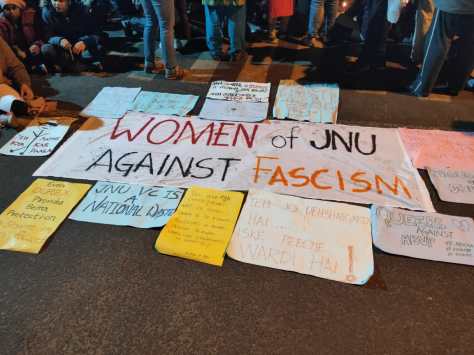
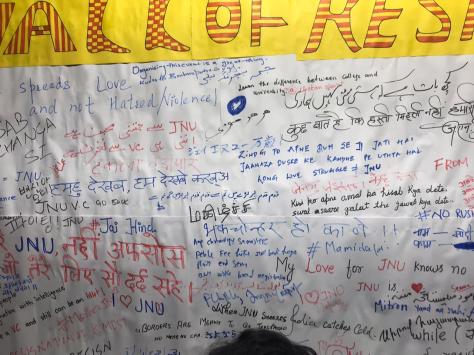
Hope, solidarity and struggle in JNU: Women of Sabarmati

WOMEN OF SABARMATI WRITE:

The outpouring of solidarity and generosity on the JNU campus, since the attack of 5th January 2020 has been overwhelming.

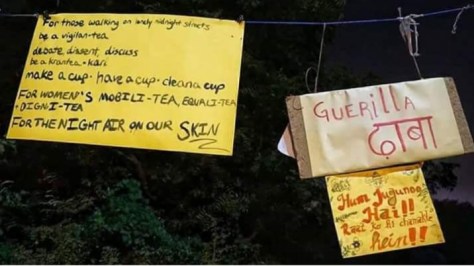
Hostels have organised guerilla dhabas at Sabarmati. They have sung revolutionary songs while making pans of maggi and distributing jhal muri and peanuts.

Men from the hostel that distributed peanuts, worried about the mess of the peanut shells at our hostel entrance, even offered to sweep up the place, brooms at the ready.

Three women in the women’s wing in Sabarmati threw all the women in the hostel a party two nights ago.

During and after the events of the 5th, neighbours have become friends.

Our teachers have been coming to meet us every day. Some have brought bags full of snacks. Some have organised trauma sessions for us. Some have just held us.

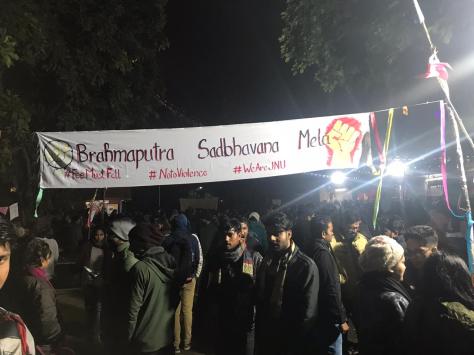
And tonight Brahmaputra hostel organised a Sadbhavna mela for the campus. Free snack stalls all around, dholak music to dance to and a large Lohri bonfire.

As some of us women from Sabarmati were walking back towards Ganga dhaba tonight, discussing how this is the first time our hostel has no Lohri celebrations, the men from Kaveri stopped us to offer popcorn from their Lohri celebrations.

JNU was home, is home, and will remain home.

Wall of resistance at Brahmaputra

Dayaar-E-Shauq Mera – Land of my Hopes: Faiz Ullah

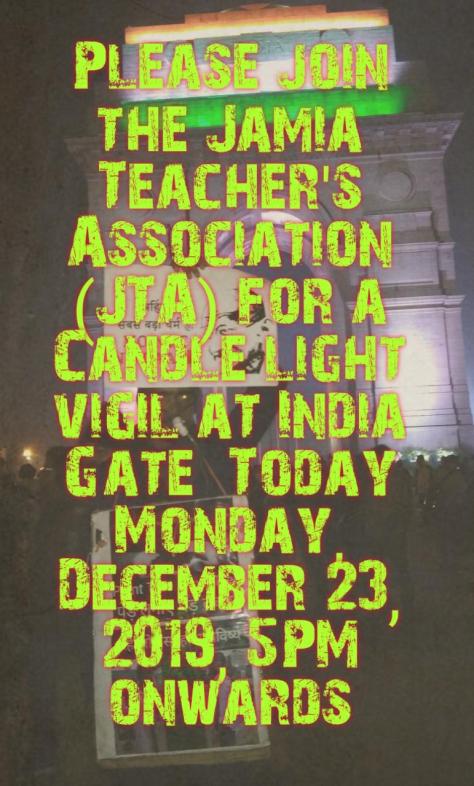
As Jamia Teachers Association calls for a candelight vigil at India Gate TODAY at 5 pm (December 23, 2019), we are publishing an earlier Facebook post by FAIZ ULLAH on Jamia written soon after the police violence at the university during the anti-CAA protests there.

Dayaar-e-shauq mera is the anthem of Jamia Milia Islamia. Translation of the lyrics at this link.

http://https://www.youtube.com/watch?v=gDbusktsKcg

FAIZ ULLAH writes:

Jamia Millia Islamia for me, and many like me who grew up in the small neighbourhoods around it, is not just a institution of higher education. It is our nursery, our playground, and where we came of age. My family moved from Bara Hindu Rao to Jamia Nagar area in the mid 1980s because my father thought living in the vicinity of an educational institution would be good for us. I am not very sure if the anti-Sikh violence of 1984 Delhi was a decisive reason for him to move us to a place he thought would be safe, but looking back I think he did kind of foresaw the shape of things.

Over the next couple of decades my elder brother studied History, My sister Social Work, and I, Mass Communication at Jamia. My niece will graduate this year from the same university in which her grandfather also enrolled for a while for his fourth degree – he had to drop out in the first year because he was already running a small primary school with my mother and practicing law on the side.

My brother was active in the students’ politics circles and served as the joint secretary of the university’s students’ union. This often translated into arguments between him and my father, not over his politics but that he would be too involved in it and would disappear for days without any information.

Continue reading Dayaar-E-Shauq Mera – Land of my Hopes: Faiz Ullah

Statement in Solidarity with Students, Against Police Excesses from Alumni of National Law University, Jodhpur

The following is a statement from the alumni of NLU Jodhpur, in solidarity with the students at the receving end of police brutalities in Delhi, Aligarh, Assam and other universities.

We, the undersigned alumni of National Law University, Jodhpur unequivocally condemn the police excesses in response to student protests at Jamia Milia Islamia University, Delhi University, Aligarh Muslim University, Dibrugarh University, Gauhati University, Cotton University, Assam and other universities across India. As persons with training in constitutional laws and values, we recognize the significance of dissenting speech and assembly, and the need to preserve academic spaces as free from State coercion and militarization and to uphold the values of secularism.

Continue reading Statement in Solidarity with Students, Against Police Excesses from Alumni of National Law University, Jodhpur

Why the JNU #FeesMustFall is a Mass Intersectional Movement: Paresh Hate

Guest Post by PARESH HATE

It has been more than a month that students in JNU have been protesting against the new IHA Hostel Manual. The fight had initially begun against the exorbitant fee hikes, introduction of curfew timings and dress codes, lack of reservations and deprivation points in the manual, and the undemocratic manner in which the manual was passed. At this juncture, the movement has become broader, and articulates its resistance to the National Education Policy and its defence of the idea of public university and what it stands for.

While there have been many attempts to characterize the students’ movement as anti-national and free-loading as usual by the right-wing media, it is clear that the political articulation of students has managed to transcend these limited dimensions offered by the discourse set by the public perception. Even the propagandists are this time at a loss as to how to demonise the movement. All they have been able to come up with is that the protests ‘disrupted traffic’ and that the protests are ‘political’. One is unable to understand how the latter is a jibe, when protests are obviously always political in nature, especially this one. The demonization of JNU is not simply about the social sciences, or left-oriented student politics, but also a manufacturing of consent toward the commercialization and a legitimizing of this government’s agenda to destroy public avenues of welfare. However, due to the developments that have taken place in the last few weeks, politics itself of the campus is churning, wherein what is emerging is a cultivated intersectional discourse that has resulted in the breathing of new life into the campus. Continue reading Why the JNU #FeesMustFall is a Mass Intersectional Movement: Paresh Hate

Solidarity Statement by TISS Alumni with Students of JNU

We the undersigned, are alumni of the Tata Institute of Social Sciences.

We are appalled at the complete lack of sensitivity shown by the JNU administration and concerned government officials to the issues raised by the students on the recent proposal of irrational 999% hike in their fee structure. We also strongly condemn the inappropriate use of brute force by the police officials towards the peaceful protest of university students when they were demanding a roll back of this policy to keep higher education accessible for all, and to oppose imposing of regressive restrictions on the clothing and movement of students in the university.

Not just insensitive, the state has also used condemnable tactics to deal with the legitimate demands of the protesting students. Instead of using questionable means to stop students from peacefully protesting and approaching the policymakers, the government should have facilitated a dialogue with the students and paid heed to their demands. Continue reading Solidarity Statement by TISS Alumni with Students of JNU

History as Storytelling

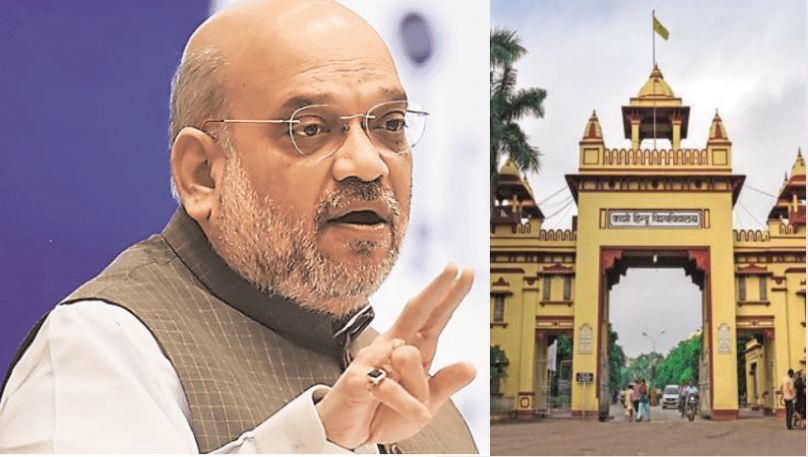
Home Minister Amit Shah, while inaugurating a two-day seminar at Banaras Hindu University, emphasised that Indian historians should “rewrite history from an Indian perspective”.

Home Minister Amit Shah

There is one thing unique about the present dispensation holding reins of power at the Centre. What one witnesses that the cabinet ministers—who go by the principle of collective responsibility—follow the dictum in letter and spirit. Thus, it is not considered unusual when a minister holding X portfolio shares their opinion about an urgent issue before Y ministry and vice versa. This process has been so normalised that when recently Home Minister Amit Shah, who according to his followers is the new ‘Iron Man’ of India—thanks to the abrogation of Article 370—shared his views on need for ‘rewriting history’, no eyebrows were raised.

No commentator even asked why the home minister—a graduate in bio-chemistry who has also worked as a stockbroker and in co-operative banks [Sheela Bhatt, “What Amit Shah’s fall really means”, July 28, 2010]—was found the most apt person to inaugurate a two-day seminar on a subject of history at Banaras Hindu University where he shared his pearls of wisdom. His emphasis was that Indian historians should “rewrite history from an Indian perspective”. The focus of the seminar was on Skandagupta Vikramaditya, the fifth-century AD emperor.

(Read the complete article here – https://www.newsclick.in/History-Storytelling)

Education on Education – Reclamation, and Other Mediations: Sasheej Hegde

Guest Post by SASHEEJ HEGDE

A thought is a tremendous form of excitement. [Alfred N. Whitehead]

We are concerned with the imagination, and the vaguely functionalist remarks we noticed before are not the sketch of an explanation, but an aid to the imagination, to make a different practice a more familiar idea to us, and hence to make us more conscious of the practice we have.  Seen in this light, … [t]he imagined alternatives are not alternatives to us; they are alternatives for us, markers of how far we might go and still remain, within our world – a world leaving which would not mean that we saw something different, but just that we ceased to see. [Bernard Williams]

This is an extended essay working off two official documents, and public ones at that: one, the voluminous draft of the National Education Policy 2019 (henceforth Draft NEP) authored by the K. Kasturirangan-led Committee appointed by the Ministry of Human Resource Development, (MHRD) Government of India and, second, the brief report on ‘Promoting and Improving the Quality of Research in Indian Universities/Colleges’ headed by P. Balaram under the auspices of the University Grants Commission (UGC) [accordingly, UGC-Balaram report].  My interest is as much with the former as with the latter; and, although they can be commented upon independent of each other, it is the combined resonance of these two policy suggestions that I am interested to examine (especially as they bear on the higher education [HE] space in India).

Continue reading Education on Education – Reclamation, and Other Mediations: Sasheej Hegde

‘ईश्वर नहीं है’ कहने का अधिकार

Image result for periyar
Periyar : Image – Courtesy velivada.com

क्या अभिव्यक्ति की स्वतंत्रता का अधिकार महज आस्थावानों के लिए ही लागू होता है ?

कभी कभी साधारण से प्रश्न का उत्तर पाने के लिए भी अदालती हस्तक्षेप की जरूरत पड़ती है।

मद्रास उच्च न्यायालय की – न्यायमूर्ति एस मनिकुमार और सुब्रहमण्यम प्रसाद की – द्विसदस्यीय डिवीजन बेंच को पिछले दिनो ंयह दोहराना पड़ा कि अभिव्यक्ति का अधिकार – जो भारत के संविधान के तहत मिले बुनियादी अधिकारों में शुमार है – सार्वभौमिक है और इसे समयविशेष के बहुमत के आंकड़ों के आधार पर तय नहीं किया जा सकता।

मालूम हो कि किन्ही दैवानायागम ने न्यायालय में यह जनहितयाचिका दाखिल की थी और कहा था कि तमिलनाडु के त्रिची में पेरियार की मूर्ति पर जो नास्तिकता के उद्वरण दिए गए हैं, वह ‘सार्विक ईश्वर’ को माननेवालों के लिए आपत्तिजनक हैं और उन्हें हटा दिया जाए। याद रहे रामस्वामी नायक / 17 सितम्बर 1879-24 दिसम्बर 1973/ जिन्हें ‘पेरियार’ नाम से जाना जाता है, वह आत्मसम्मान आन्दोलन के अग्रणी थे, द्रविड कझगम के संस्थापक पेरियार एक जुझारू किस्म के समाज सुधारक भी थे। याचिकाकर्ता ने मूर्ति पर लिखे उद्धरण के बारे में ‘‘कोई ईश्वर नहीं है, ईश्वर नहीं है और वाकई ईश्वर नहीं है..’ के पेरियार द्वारा कहे जाने पर भी सवाल खड़े किए थे। Continue reading ‘ईश्वर नहीं है’ कहने का अधिकार

Statement by Teachers and Academics in Support of Dr. Hany Babu

The following is a statement issues by teachers and academics in support of Dr Hany Babu, whose residence was raided early morning non 10 September by Pune Police

We, teachers and members of the academic community from across universities, are shocked to know of the illegal raid at the residence of Dr. Hany Babu, Associate Professor in the Department of English, University of Delhi on the morning of 10 September 2019. While the horrifying overreach of a search conducted without a warrant has become routine harassment for dissenting citizens, the attempt made by the Pune Police to forcefully detain Babu’s family for six hours and deprive them of any communication with lawyers or friends amounts to extreme duress. Finally, forcing Babu to change passwords and forfeit access to his email account and other personal online media clearly makes way for a possible planting of evidence, to concoct a case against an assumed ‘suspect’

Continue reading Statement by Teachers and Academics in Support of Dr. Hany Babu

Who Needs Romila Thapar’s CV?

Thapar questioned imperialist versions of Indian history, which the Hindutva Brigade still goes by.

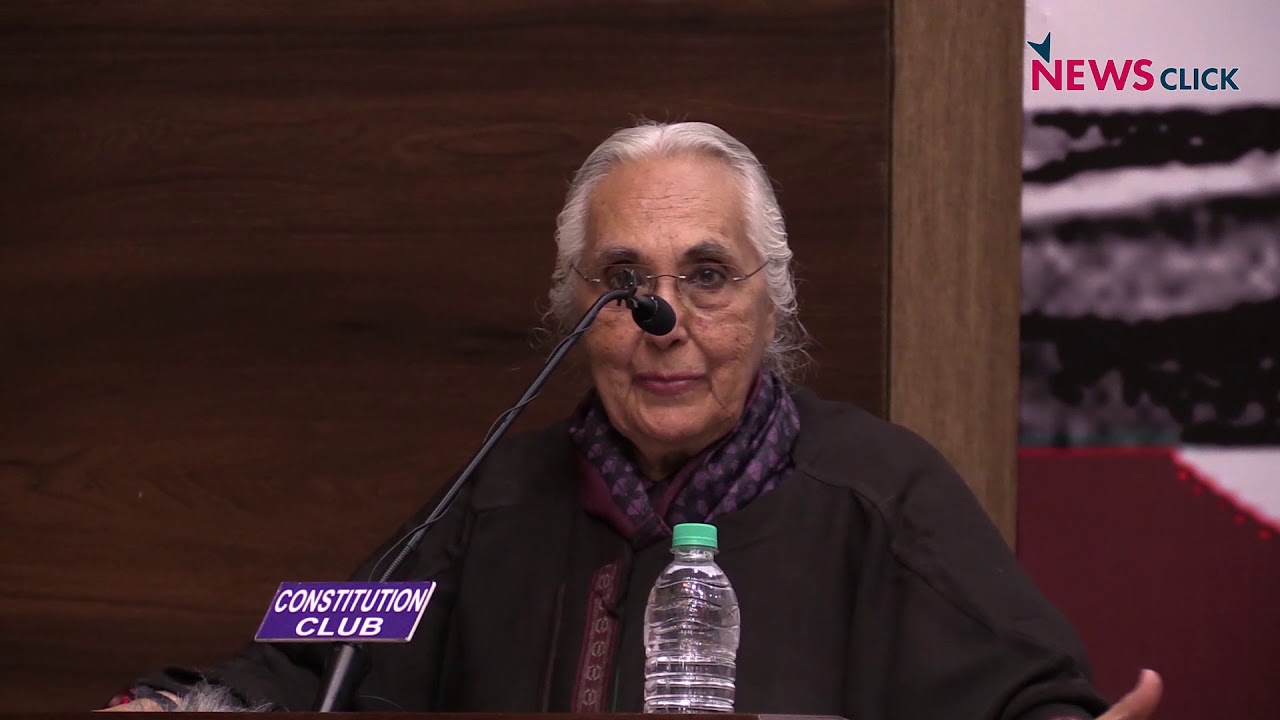
Romila Thapar

..an historian who is indefatigable in the pursuit of knowledge and prolific in its publication, and who is above all a devoted partisan of the truth. … The early history of the country has been illuminated by Professor Thapar, whom I now present, more than by almost any other scholar. An historian of that period who seriously wishes to refute accepted fictions and dispel the general darkness will need several high qualities. (From a citation presented by Oxford University to Romila Thapar while conferring on her an honorary Doctorate of Letters in 2002.)

It was 1960, when Romila Thapar, a young historian at the time, wrote a 400 plus-page monograph on Asoka and the Decline of the Mauryas. According to Oxford University Press, which published it in 2017, it tried to “trace virtually the entire span of Indian history.” The monograph is considered a classic today.

Thapar’s scholarly journey continues unabated at the age of 88. She is among the world’s foremost intellectuals, known for path-breaking work on Indian ancient history, as this interview acknowledges. Undoubtedly, her work has informed and inspired at least three generations of history students.

It hardly needs mention that Thapar has prestigious prizes to her credit for the scores of books and academic papers she has published. Twice, she declined the Padma Bhushan, the third highest civilian award granted by the government.

Now Thapar is in the news because of a strange query from the Jawaharlal Nehru University (JNU) administration, where she has held teaching and administrative positions for roughly three decades.

( Read the full article here : https://www.newsclick.in/Romila-Thapar-CV-JNU-Historian-Hindutva-Brigade-Indian-History)


83 Delhi University English Teachers’ Statement against Politically Motivated Attacks on Syllabus

The following is the full text of the statement issued by 83 English teachers of Delhi University against the attack on the syllabus:

We, the teachers of English across Delhi University are shocked and appalled at the unacademic, politically motivated attack on our syllabus. This is a democratically drafted syllabus, which involved faculty participation from around 40 colleges; over 2 years, and more than 3000 working hours have been spent on it. It is a matter of sorrow and deep academic concern that the syllabus is now being maligned, and is sought to be scuttled, by certain political groups at the University.

Continue reading 83 Delhi University English Teachers’ Statement against Politically Motivated Attacks on Syllabus

JNU: And still, like dust, we rise…

http://https://www.youtube.com/watch?v=U6xtEZAeflQ

Against Aachaaram: A Dossier from Malayalam – Announcement

This is to announce a new series of postings I will be doing, relating to aachaaram in Kerala.

Aachaaram is loosely translated as ‘customary practices’ or ‘customary rituals’, but in 19th century Malayali society, it referred to a massive, inter-connected, all-pervading web of practices, rituals, and ideas which bolstered the domination of the upper-castes — in Kerala’s context, this meant the Brahmin-sudra nexus — over the lower castes. It touched the most intimate and personal aspects of a person’s life; through it,  the allegiances and the labour of lower caste communities were extracted to benefit the upper castes. The lower-caste assertions of the late 19th and early 20th centuries here, through which modern democracy became a possibility at all, were directed against this web. Aachaaram, however, survived this phase through shrinking its spatial presence to savarna homes and temples; later, after the re-consolidation of brahmin-sudra power, towards the end of the 20th century, the rise of spiritual capitalism had led to aacharam’s resurrection as the vehicle of gendered savarna power — and as the provider of opening gambits for the Hindu fundamentalists — in Kerala .

In this series, I will post translations of selections/excerpts from the writings of the critics of aachaaram from early 20th century Kerala, with short reflections on each for the present. The many different readings of Hinduism that arose in that period when the Brahmin-sudra nexus was thrown into confusion, as well as the many different dreams of social liberation from different parts of the world that entered Malayali society then — from C Krishnan’s Buddhism to Marxism — produced powerful critical exposures that revealed aachaaram to be nothing but a vehicle and instrument of the power of certain groups over others. The effort made by these voices to point to the danger that it posed to a dream of a just society was largely ignored by the mainstream, especially the mainstream left.

The first of these is an excerpt from a conversation between the well-known social revolutionary, the avarna-born seer, spiritual leader, and philosopher, Srinarayana Guru and his disciples in which the annual pilgrimage to Sivagiri was planned, which I will post separately.


Statement of Academics on Rabindra Bharati University Incident of Harassment

Dear Friends,

As some of you might be aware, our friend and colleague, Dr. Saraswati Kerketta (Assistant Professor in the Department of Geography, Rabindra Bharati University), has recently been a victim of caste-based attack in the university. We write this statement to unequivocally condemn the attack.

We, the concerned faculty members/research scholars across institutions in India and abroad, are deeply disturbed by this incident of caste-based attack on Dr. Kerketta. Dr. Kerketta is a young faculty member from a Scheduled Tribe background, and the sole faculty member appointed in a substantive position in her department, thereby taking on the tremendous task of running the department on her young shoulders. This brazen instance of caste-based harassment meted out to her by a group of students who claim to be affiliated to a political party has hurt and disturbed us immensely as citizens of India. The nature of attack meted out to her – for instance she has been followed by the students up till home after the incident – also showcases the gendered nature of her vulnerability. The incident has been followed by mass resignation on the part of other faculty members from various positions in the university, thereby showing indirect proof of the same.

Continue reading Statement of Academics on Rabindra Bharati University Incident of Harassment