Category Archives: Education

‘ईश्वर नहीं है’ कहने का अधिकार

Image result for periyar
Periyar : Image – Courtesy velivada.com

क्या अभिव्यक्ति की स्वतंत्रता का अधिकार महज आस्थावानों के लिए ही लागू होता है ?

कभी कभी साधारण से प्रश्न का उत्तर पाने के लिए भी अदालती हस्तक्षेप की जरूरत पड़ती है।

मद्रास उच्च न्यायालय की – न्यायमूर्ति एस मनिकुमार और सुब्रहमण्यम प्रसाद की – द्विसदस्यीय डिवीजन बेंच को पिछले दिनो ंयह दोहराना पड़ा कि अभिव्यक्ति का अधिकार – जो भारत के संविधान के तहत मिले बुनियादी अधिकारों में शुमार है – सार्वभौमिक है और इसे समयविशेष के बहुमत के आंकड़ों के आधार पर तय नहीं किया जा सकता।

मालूम हो कि किन्ही दैवानायागम ने न्यायालय में यह जनहितयाचिका दाखिल की थी और कहा था कि तमिलनाडु के त्रिची में पेरियार की मूर्ति पर जो नास्तिकता के उद्वरण दिए गए हैं, वह ‘सार्विक ईश्वर’ को माननेवालों के लिए आपत्तिजनक हैं और उन्हें हटा दिया जाए। याद रहे रामस्वामी नायक / 17 सितम्बर 1879-24 दिसम्बर 1973/ जिन्हें ‘पेरियार’ नाम से जाना जाता है, वह आत्मसम्मान आन्दोलन के अग्रणी थे, द्रविड कझगम के संस्थापक पेरियार एक जुझारू किस्म के समाज सुधारक भी थे। याचिकाकर्ता ने मूर्ति पर लिखे उद्धरण के बारे में ‘‘कोई ईश्वर नहीं है, ईश्वर नहीं है और वाकई ईश्वर नहीं है..’ के पेरियार द्वारा कहे जाने पर भी सवाल खड़े किए थे। Continue reading ‘ईश्वर नहीं है’ कहने का अधिकार

Statement by Teachers and Academics in Support of Dr. Hany Babu

The following is a statement issues by teachers and academics in support of Dr Hany Babu, whose residence was raided early morning non 10 September by Pune Police

We, teachers and members of the academic community from across universities, are shocked to know of the illegal raid at the residence of Dr. Hany Babu, Associate Professor in the Department of English, University of Delhi on the morning of 10 September 2019. While the horrifying overreach of a search conducted without a warrant has become routine harassment for dissenting citizens, the attempt made by the Pune Police to forcefully detain Babu’s family for six hours and deprive them of any communication with lawyers or friends amounts to extreme duress. Finally, forcing Babu to change passwords and forfeit access to his email account and other personal online media clearly makes way for a possible planting of evidence, to concoct a case against an assumed ‘suspect’

Continue reading Statement by Teachers and Academics in Support of Dr. Hany Babu

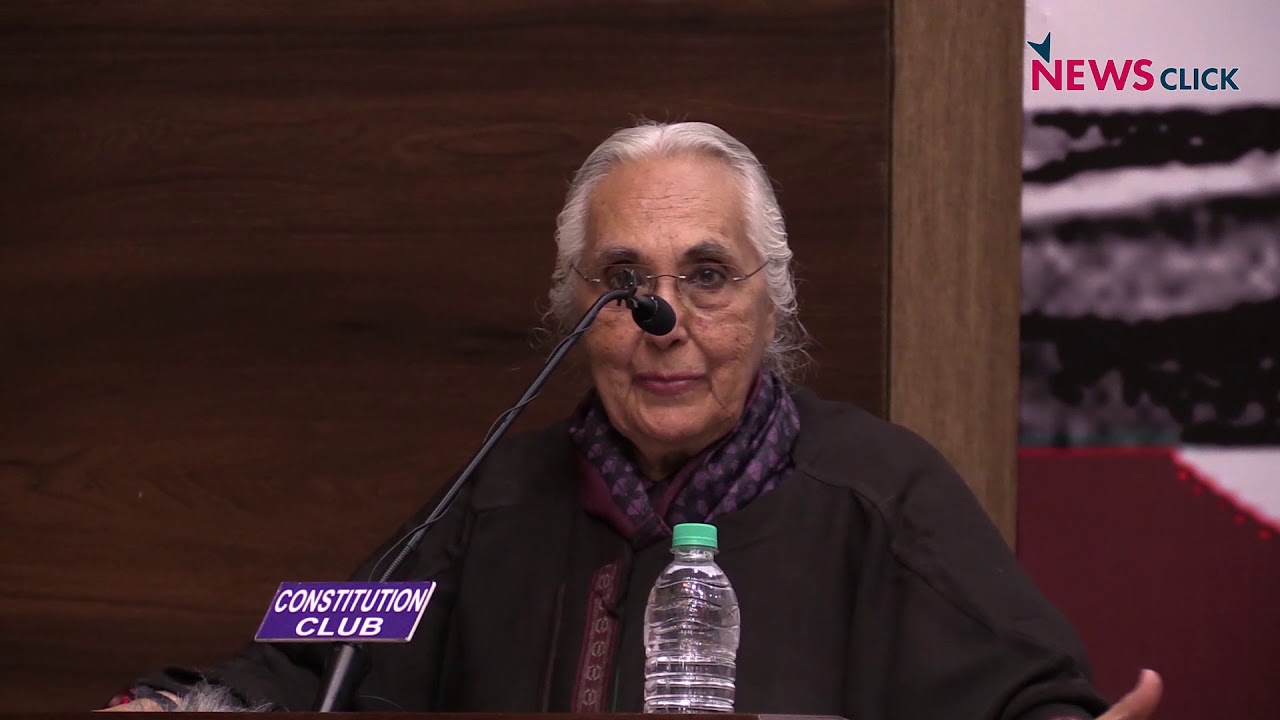
Who Needs Romila Thapar’s CV?

Thapar questioned imperialist versions of Indian history, which the Hindutva Brigade still goes by.

Romila Thapar

..an historian who is indefatigable in the pursuit of knowledge and prolific in its publication, and who is above all a devoted partisan of the truth. … The early history of the country has been illuminated by Professor Thapar, whom I now present, more than by almost any other scholar. An historian of that period who seriously wishes to refute accepted fictions and dispel the general darkness will need several high qualities. (From a citation presented by Oxford University to Romila Thapar while conferring on her an honorary Doctorate of Letters in 2002.)

It was 1960, when Romila Thapar, a young historian at the time, wrote a 400 plus-page monograph on Asoka and the Decline of the Mauryas. According to Oxford University Press, which published it in 2017, it tried to “trace virtually the entire span of Indian history.” The monograph is considered a classic today.

Thapar’s scholarly journey continues unabated at the age of 88. She is among the world’s foremost intellectuals, known for path-breaking work on Indian ancient history, as this interview acknowledges. Undoubtedly, her work has informed and inspired at least three generations of history students.

It hardly needs mention that Thapar has prestigious prizes to her credit for the scores of books and academic papers she has published. Twice, she declined the Padma Bhushan, the third highest civilian award granted by the government.

Now Thapar is in the news because of a strange query from the Jawaharlal Nehru University (JNU) administration, where she has held teaching and administrative positions for roughly three decades.

( Read the full article here : https://www.newsclick.in/Romila-Thapar-CV-JNU-Historian-Hindutva-Brigade-Indian-History)


83 Delhi University English Teachers’ Statement against Politically Motivated Attacks on Syllabus

The following is the full text of the statement issued by 83 English teachers of Delhi University against the attack on the syllabus:

We, the teachers of English across Delhi University are shocked and appalled at the unacademic, politically motivated attack on our syllabus. This is a democratically drafted syllabus, which involved faculty participation from around 40 colleges; over 2 years, and more than 3000 working hours have been spent on it. It is a matter of sorrow and deep academic concern that the syllabus is now being maligned, and is sought to be scuttled, by certain political groups at the University.

Continue reading 83 Delhi University English Teachers’ Statement against Politically Motivated Attacks on Syllabus

Against Aachaaram: A Dossier from Malayalam – Announcement

This is to announce a new series of postings I will be doing, relating to aachaaram in Kerala.

Aachaaram is loosely translated as ‘customary practices’ or ‘customary rituals’, but in 19th century Malayali society, it referred to a massive, inter-connected, all-pervading web of practices, rituals, and ideas which bolstered the domination of the upper-castes — in Kerala’s context, this meant the Brahmin-sudra nexus — over the lower castes. It touched the most intimate and personal aspects of a person’s life; through it,  the allegiances and the labour of lower caste communities were extracted to benefit the upper castes. The lower-caste assertions of the late 19th and early 20th centuries here, through which modern democracy became a possibility at all, were directed against this web. Aachaaram, however, survived this phase through shrinking its spatial presence to savarna homes and temples; later, after the re-consolidation of brahmin-sudra power, towards the end of the 20th century, the rise of spiritual capitalism had led to aacharam’s resurrection as the vehicle of gendered savarna power — and as the provider of opening gambits for the Hindu fundamentalists — in Kerala .

In this series, I will post translations of selections/excerpts from the writings of the critics of aachaaram from early 20th century Kerala, with short reflections on each for the present. The many different readings of Hinduism that arose in that period when the Brahmin-sudra nexus was thrown into confusion, as well as the many different dreams of social liberation from different parts of the world that entered Malayali society then — from C Krishnan’s Buddhism to Marxism — produced powerful critical exposures that revealed aachaaram to be nothing but a vehicle and instrument of the power of certain groups over others. The effort made by these voices to point to the danger that it posed to a dream of a just society was largely ignored by the mainstream, especially the mainstream left.

The first of these is an excerpt from a conversation between the well-known social revolutionary, the avarna-born seer, spiritual leader, and philosopher, Srinarayana Guru and his disciples in which the annual pilgrimage to Sivagiri was planned, which I will post separately.


Statement of Academics on Rabindra Bharati University Incident of Harassment

Dear Friends,

As some of you might be aware, our friend and colleague, Dr. Saraswati Kerketta (Assistant Professor in the Department of Geography, Rabindra Bharati University), has recently been a victim of caste-based attack in the university. We write this statement to unequivocally condemn the attack.

We, the concerned faculty members/research scholars across institutions in India and abroad, are deeply disturbed by this incident of caste-based attack on Dr. Kerketta. Dr. Kerketta is a young faculty member from a Scheduled Tribe background, and the sole faculty member appointed in a substantive position in her department, thereby taking on the tremendous task of running the department on her young shoulders. This brazen instance of caste-based harassment meted out to her by a group of students who claim to be affiliated to a political party has hurt and disturbed us immensely as citizens of India. The nature of attack meted out to her – for instance she has been followed by the students up till home after the incident – also showcases the gendered nature of her vulnerability. The incident has been followed by mass resignation on the part of other faculty members from various positions in the university, thereby showing indirect proof of the same.

Continue reading Statement of Academics on Rabindra Bharati University Incident of Harassment

Draft New Education Policy 2019 through a Gender and Sexuality Lens

Recommendations on Draft New Education Policy (DNEP) by a collective of women’s groups, queer groups, NGOs, students, and academics working in the field of gender, sexuality and education.

We, a collective of women’s groups, queer groups, NGOs, students, and academics working in the field of gender, sexuality and education, across India strongly recommend and reiterate that for all the recommendations given here, the policy and thereafter, the Government of India and State Governments must ensure that there is a proactive strengthening of democracy within educational institutions. The right to expression, liberty, equality and diversity are rights enshrined in the Constitution of India. We welcome that the DNEP 2019 as it states that it will promote constitutional values in education. However, for the implementation of this objective, changes in the content of the curriculum will not suffice. Constitutional values must be protected in the processes and institutional structures of schools and higher education bodies.

We commend the policy for introducing the following provisions:

  1. DNEP 2019 addresses the issue of early childhood education, especially the timely recommendation of making Years 3 to 8 as a foundational stage. This becomes critical as early education and experiences are the most formative in a child’s life, and a holistic pre-school education continues well beyond traditional schooling years.
  2. It is the first policy to uphold the Honourable Supreme Court’s 2014 directives around transgender inclusion in education.
  3. The policy has taken cognizance of many children who continue to dropout at different levels, and the even more serious problem of enrolled children not attending school regularly.
  4. It seeks to strengthen departments/ centres of education at universities.

Having said this, the subsequent list of recommendations is laid down to strengthen the DNEP 2019 from the lens of gender and sexuality, especially for the most marginalised communities. We feel that gender and sexuality related rights could only be ensured if there is a larger enabling environment, in which diversity of thought and practices are respected. These, we feel, would be critical in developing a robust educational policy for the country, which would address the fundamental intersectionalities that individuals and communities face in their lives. Continue reading Draft New Education Policy 2019 through a Gender and Sexuality Lens

Draft New Education Policy 2019 – Mass Feedback Campaign: Better Universities

In support of the campaign launched by BETTER UNIVERSITIES.

The Government of India has finally unveiled the much-awaited draft of the National Educational Policy (NEP) 2019, and with that, has come a host of new issues to address and engage with.

To access a copy of the draft, please click here.

Here is the full point by point critique made of the Draft NEP by Better Universities, that anybody concerned about education in India should read very carefully.

At the end you will find the link that will take you the campaign for mass feedback on the NEP.

Response to the Draft National Education Policy 2019

Most significant point in my opinion:

What is even more damning is that the appointments to all statutory bodies in the higher education sector will have to be made by the RSA – and must, by default, await the nod of the Prime Minister. It is unambiguously stated that appointees to the NHERA, HEGC, NRF, NAAC and all other standard-setting bodies must report to the RSA and thus be beholden to the infirmities of political will and favour. Needless to say, this amounts to the NEP’s unashamed surrender to ruling party intervention and an effective imagining of higher education as subservient to political interests. Autonomy is shown the door, both structurally and ideologically – despite the Draft making a shrill pitch for it through the previous chapters.

Introduction

While the former HRD minister’s message (included in the Draft policy) congratulates the exercise as evolving “path breaking reforms” based on the “foundational pillars of Access, Equity, Quality, Affordability and Accountability”, the higher education sector is instead coming under greater political control and contributing to wider inequities with respect to institutional inputs and outcomes. Even the employment goals envisioned by the curricular reforms proposed in the Draft policy might produce greater job insecurities among students coming into higher education from across different social and economic backgrounds. Continue reading Draft New Education Policy 2019 – Mass Feedback Campaign: Better Universities

A Case of Harassment of Dalit Student in Jadavpur University: Srijan Dutta

Guest post by SRIJAN DUTTA

The value of a man was reduced to his immediate identity and nearest possibility.

The line quoted above is from Dalit PhD scholar Rohith Vemula’s ‘last’ letter, discovered after he was found hanging in his hostel room in January 2016. The letter had exposed how caste-based discrimination is used as a medium of oppression against Dalits and other minorities. Casteism serves both as an ideology and as a means for exploitation by the upper castes and upper classes of the Indian society.

Recently, a complaint has been made by a second year Masters student of the Department of Library and Information Science in one of the hotbeds of Bengal student politics, Jadavpur University. Jadavpur Uiversity is also a premier institution of higher learning, with a well deserved reputation.  Raja Manna, a student belonging to the ‘Scheduled Caste’ category, has revealed that he has been facing a lot of harassment and discrimination at the hands of his dissertation guide, Prof. Udayan Bhattacharya, an upper caste Brahmin.

Continue reading A Case of Harassment of Dalit Student in Jadavpur University: Srijan Dutta

The Saderla story – courage in the face of violent prejudice: Manindra Agrawal

This is a guest post by MANINDRA AGRAWAL

This is the story of a young man who made it to the premier institution of IIT Kanpur against heavy odds, but was then let down by the system and people at the institute. Yet, he showed exemplary courage and stood up for his rights firmly but gently. The story also highlights the frailties of human nature and the vindictiveness that can mar human actions. It is a story that needs to be told.

Prologue

IIT Kanpur, like all other IITs, has very few faculty from reserved categories.​ ​An initiative was taken in August 2017 with an exclusive advertisement for faculty under various reserved categories. The applications received were sent to the respective departments for evaluation, and the shortlisted candidates were called for seminars. The protagonist of this story, Dr SS (I am using initials for the key players for convenience, all names are in the public domain), who is from a scheduled caste of Andhra Pradesh, was shortlisted in the Aerospace Engineering department. He did both his M.Tech and Ph.D from IIT Kanpur under Professor AKG, who happened to be the head of the department at the time. Continue reading The Saderla story – courage in the face of violent prejudice: Manindra Agrawal

And Somewhere There are Engineers …

Related image

A conversation with youngsters – who are by nature bubbling with energy , fired with idealism and suffused with innumerable questions – is a thing which everyone with grey hair looks forward to.

For someone like me it is an added gift this morning that after exactly a gap of forty years this writer is with students of engineering helping him rekindle memories of his own days of engineering in the city of Varanasi. A really exciting period when few of us had come together to do something for society as well. A period worth remembering when we were engaged in running evening classes for deprived sections in neighbouring villages, learning from their life experiences and in spare time reading good literature, tracking trajectories of different revolutions, debating, discussing, brainstorming what else can be done to awaken the society around. Continue reading And Somewhere There are Engineers …

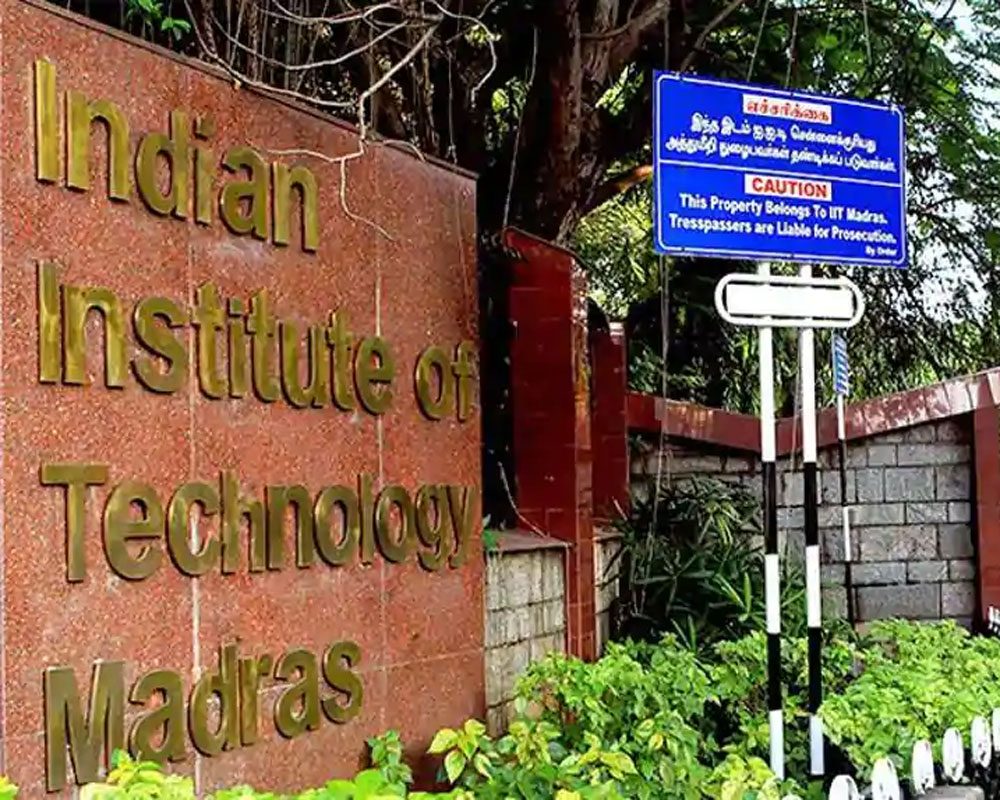
आई आई टी मद्रास – आधुनिक दौर का अग्रहरम !

Image result for IIT Madras

नागेश / बदला हुआ नाम/ – जो आई आई टी मद्रास में अध्ययनरत एक तेज विद्यार्थी है, तथा समाज के बेहद गरीब तबके से आता है – उसे उस दिन मेस में प्रवेश करते वक्त़ जिस अपमानजनक अनुभव से गुजरना पड़ा, वह नाकाबिले बयानात कहा जा सकता है। उसे अपने गांव की जातीय संरचना की तथा उससे जुड़े घृणित अनुभवों की याद आयी। दरअसल किसी ने उसे बाकायदा मेस में प्रवेश करते वक्त़ रोका और कहा कि अगर वह मांसाहारी है, तो दूसरे गेट से प्रवेश करे।

मेस के गेट पर बाकायदा एक पोस्टर लगा था, जिसे इस नये ‘निज़ाम’ की सूचना दी गयी थी। यहां तक कि अपने खाने की पसंदगी के हिसाब से हाथ धोने के बेसिन भी बांट दिए गए थे। ‘शाकाहारी’ और ‘मांसाहारी’। एक रिपोर्टर से बात करते हुए नागेश अपने गुस्से को काबू करने में असमर्थ दिख रहे थे। उन्होंने पूछा कि आखिर आई आई टी का प्रबंधन ऐसे भेदभावजनक आदेश को छात्रों से सलाह मशविरा किए बिना कैसे निकाल सकता है। Continue reading आई आई टी मद्रास – आधुनिक दौर का अग्रहरम !

The Imposition of CCS Rules in Central Universities: Statement by JNU faculty

THIS IS A STATEMENT PREPARED BY JNU FACULTY

In the wake of the protests in universities about a number of disastrous policy level changes — huge fund cuts for the University Grants Commission, state governed divestment from the higher education in the name of graded autonomy, tampering with reservation policy in both drawing up recruitment and in college administration, casualisation and reduction of employment in universities, widespread corruption, as well as authoritarian clampdown on free speech and thought — the government has now sought to muzzle teachers voices through the induction of the Central Civil Service (Conduct) Rules to govern the conduct of faculty in Central Universities.


Continue reading The Imposition of CCS Rules in Central Universities: Statement by JNU faculty

Release arrested Manipur University professors and students NOW! Appeal to Visitor

We, the undersigned academics and members of civil society, unequivocally condemn the arbitrary arrest and incarceration of six teachers and nine students of Manipur University. Six teachers and seven students have been sent to judicial custody for fifteen days, and the remaining two students for five days.

The arrests have been made under sections of the Indian Penal Code that invoke ‘an attempt to murder’, ‘wrongful confinement’, ‘extortion’, ‘kidnapping’ and ‘criminal conspiracy’ on the basis of a complaint made by Manipur University faculty, K. Yugindro Singh (and the suspended registrar M. Shyamkesho) on charges of attempt to murder and kidnapping. The six arrested professors — Dr. N. Santomba, (Dept. of. Manipuri), Prof. Chungkham Yashawanta (Dept. of Linguistics, also Dean of Humanities, and in-charge Dean of Students Welfare), Prof. Sougaijam Dorendrajit (Dept. of. Physics and Registrar-in-charge), Dr. L. Bishwanath Sharma (Dept. of. Philosophy), Prof. L. Sanjukumar (Dept. of. Biotechnology and Secretary MUTA), and Dr. Yengkhom Raghumani (Dept. of. Earth Sciences) have also been suspended with immediate effect. Following these arrests, the Manipur University campus has been turned into a cantonment, the boys hostel has had tear gas shells and mock bombs rained down upon it all of Thursday night (20 September), Internet services shut down, and all normal academic life has come to a complete halt.

Manipur University has witnessed a peaceful (in the face of great police brutality) 85 day long united agitation by its teachers, students, and staff asking for the removal of the Vice-Chancellor A P Pandey, and the constitution of an Independent Enquiry Committee to look into the allegations of his administrative and financial lapses. This agitation was successful, with a probe being announced on August 16, 2018 and the VC being placed on suspension pending inquiry on 18 September 2018. The details of the egregious misdemeanours of the suspended VC that have formed the basis of agitation by the greater student and teacher communities and have been the cause of disruption of academic activities, are to be found in the news item links provided below.

Read the rest of the statement and sign the appeal here.

Allahabad University Vice Chancellor’s misdemeanours: Open letter to President of India

OPEN LETTER TO THE VISITOR BY FORMER OFFICE BEARERS OF ALLAHABAD UNIVERSITY TEACHERS’ ASSOCIATION and ALLAHABAD UNIVERSITY CONSTITUENT COLLEGES TEACHERS’ ASSOCIATION

To

The Hon’ble Visitor, University of Allahabad, President’s Secretariat (Rashtrapati Bhawan), New Delhi

Sir,

On the eve of the 131st Foundation Day of the University of Allahabad, the under-noted former and serving teachers of the University of Allahabad and its Constituent Colleges, who are or have been office-bearers of the Teachers’ Associations of the University and its Constituent Colleges, respectfully seek to invite your kind attention by means of this Open Letter to certain crucial aspects of the present institutional predicament of the University, arising proximately from shocking revelations of grave improprieties by the Vice-Chancellor Prof. Rattan Lal Hangloo, and cumulatively from the general expositions of the manifestly freewheeling mode of his working over the past three years.

The facts of the Vice-Chancellor’s indecorous personal conduct involve the seeking of personal intimate favours from an individual by proffering employment and promising career-building opportunities. This sordid episode, and the outrage it has engendered in the members of the University community (students, alumni, and serving and former teachers and employees) as well as concerned citizens and well-wishers of the institution, are in the public domain, for they have been covered in graphic presentations in the print, electronic and social media. These have also been communicated by different sources to the Hon’ble Visitor’s establishment, the Ministry of Human Resource Development (MHRD) and other agencies of the Government of India. Some of the individuals subscribing to this Open Letter have also conveyed their dismay over the style and substance of his administrative and financial transactions in separate communications to higher authorities, but have experienced a disheartening absence of critical engagement on the part of the concerned dignitaries and offices with the transgressions of Prof. Hangloo which have also been in glaring public spotlight for almost three years, from his earliest days in office. Continue reading Allahabad University Vice Chancellor’s misdemeanours: Open letter to President of India

Government should not Fail Children to Cover up Education System’s ailure: A Statement

A statement by concerned organizations, teachers’ unions and academics against government proposal to amend RTE Act to scrap no detention policy and to fail children in class V and VIII. The statement was issued in New Delhi on 25 July 2018

The civil society organisations, teacher unions, and academicians working in the education sector across 20 states of India strongly oppose the Lok Sabha’s decision to pass‘ The Right of Children to Free and Compulsory Education (Second Amendment) Bill, 2017’. This bill paves the way for the scrapping of the provision for ‘No Detention’ by allowing states to detain children in class V and VIII. Over 20,000 Indians had already urged the government to withdraw the bill scrapping the ‘No Detention Policy’.

Continue reading Government should not Fail Children to Cover up Education System’s ailure: A Statement

Response to Critics of AAS-in-Asia boycott: Ajantha Subramanian et al

Continuing the debate on the controversial Association of Asian Studies conference recently held in Delhi, to which Pakistani participants were denied visas by the Indian government, following which there was a call to boycott the conference.

Nandini Sundar wrote an article in The Wire which we re-posted on Kafila. This is a response to that article by Ajantha Subramanian, Suvir Kaul, Rupa Viswanath, Rebecca Karl, Ania Loomba and Nate Roberts, also in The Wire.

As signatories to the call for a boycott of the AAS-in-Asia conference in Delhi (July 4-8, 2018), we have been vocal critics of how the Association for Asian Studies – a membership-funded professional organisation based in the US for scholars of Asia around the world – has handled the government of India ban on Pakistani scholars (based on both nationality and descent). We now write because the debate that our call for action provoked raises important questions about location, ethics and nationalism when it comes to the right to protest. These questions are important in our age of escalating international exchange as well as national chauvinism.

Our critique has focused on the AAS, an organisation that was informed of the preemptive ban and which, in conjunction with Ashoka University, their private university partner in New Delhi, concealed it from the general membership – as well as the general public – for months. Although the organisation claims it did its part by putting the letter banning Pakistanis on its conference website, no one would find it unless they were looking for it. Knowledge of the ban only became public when The Wire broke the story on June 7, 2018.

Read the rest of this article here.


Statement of Jadavpur University Alumni Against University Decision to Scrap Entrance Examinations

Following is a statement of Jadavpur University alumni on the current controversy around the scrapping of the entrance examination by the university authorities. 

There is also a Change.org petition that has been put up for those wanting to sign. Over 5075 people have signed the petition at last count.

Thos who who wish to sign in solidarity with Jadavpur University teachers, students and staff can do so here.

We, the alumni of Jadavpur University, unequivocally condemn the decision of the authorities to not conduct entrance examinations for admission to the university’s Bachelor of Arts programme.

Several departments of the Jadavpur Arts Faculty annually conduct their own entrance examinations. For the last forty years, teachers have carefully prepared question papers and rigorously evaluated the answers in order to admit the candidates that they deem fit. The tradition of the entrance examination, in which thousands of students participate every year, has ensured that the Faculty of Arts continues its legacy of academic excellence. No weightage is given to Board examination marks because the Boards’ prescribed methods of arts education and evaluation simply do not match those of tertiary education in the humanities. The entrance examinations test students for their interest in literature, history, philosophy and arts, their ability to think independently about texts, and their commitment to understanding the world around them using the skills of reasoning and speculation, the theoretical and methodological capital furnished by the humanities.

The entrance examination has enabled these departments to gain talented students year after year. Many of us would have never made it to the top-ranked Arts departments in the country had we been judged solely on the basis of our marks in school-leaving examinations. Admissions based on Board exam scores would have never enabled students from varied cultural, class and economic backgrounds to be trained in the humanities by the best minds in the country. The rich and diverse professional accomplishments of Jadavpur University alumni – in art, academia, film, entrepreneurship, publishing, writing, advertising and many other fields – constitute a further testament to the success of these departments in scouting and honing talent. First-person accounts of how the erstwhile admissions process created equality of opportunity and access for students from across a range of social and educational backgrounds have poured in from Jadavpur alumni since yesterday (3/7/2018). (To read personal testimonials and opinion pieces from faculty, alumni, staff and current students regarding the significance of the admission process, visit https://juforadmissiontest.wordpress.com/)

The admission test is a time-tested process which has ensured academic excellence in the Faculty of Arts and brought glory to the university. To tamper with this process is to threaten the very core of the humanities – to attack free thinking, liberty, and equality of opportunity. It directly undermines the dreams and hopes of the 17,000-odd students who have applied to Jadavpur University this year. Among these 17,000, there must be brilliant young minds that couldn’t obtain 90% or more in the Board examinations. Their merit cannot be reliably boxed into multiple-choice questions. There must be, in those 17,000, young people who do not seek conventional careers, or if they do, wish to combine them with independent thinking, exploring and lifelong learning.

To stop the admission test is to kill the dreams of anyone who does not participate in the mad rat race of public examinations. It is an attack on the community of scholars, researchers, teachers, alumni, students, and staff who have carefully built up the university and its reputation over the years. To stop the admission test is to tear into the very fabric of the university – its tradition and its history. We must recall that Jadavpur University was set up as an alternative to the education imparted by the erstwhile rulers of India, the British. It has always been home to those who dare to defy norms.

The larger implications of this administrative decision concern the scope and function of higher education in this country. Do we, as a nation, wish to create a more homogenised and technocratic culture that rewards learning by rote, or do we wish to invest in greater autonomy for centres of excellence? Difference and dissent are what all democracies should aspire to; they are the touchstones of any free and open society, and any administration that encourages these tendencies signals its confidence in itself and hope for the future. What we are seeing here is, accidentally or not, congruent with a larger attempt to fundamentally redefine the idea of higher education, to increase administrative interference in universities large and small, more and less prominent (similar conflicts are playing out in JNU, to cite just one example) and to condemn generations of young people to the backwaters of real learning, thought and creativity.

As concerned alumni, we strongly condemn the decision of the authorities to take away independent admission tests from the Faculty of Arts. We demand an immediate revocation of this order, which irrationally, pointlessly, and appallingly undertakes to disrupt a fair and successful admission process. This disruption will impact the futures of countless students, and reduce the entry-point of tertiary education in the humanities to a lottery.

We stand in solidarity with the protesting teachers, students and staff of Jadavpur University. Continue reading Statement of Jadavpur University Alumni Against University Decision to Scrap Entrance Examinations

Jadavpur University Scraps Admission Tests – Not going down without a fight: Sritama Chatterjee

Guest Post by SRITAMA CHATTERJEE

The Executive Council (EC) of Jadavpur University recently decided to scrap the admission test in the Humanities for the academic year 2018-2019. This is no surprise to many of us who have been closely following the chain of events that have unfolded at the university in the last couple of days. According to published news reports, the education minister of West Bengal, Partha Chatterjee had “advised” the university back in November 2017, to do away with the procedure of conducting admission tests.[i]  This raises a serious question whether the education minister of a state can even advise a university on how to conduct its admission process, especially considering that the university is an autonomous institution.  The motives of the EC about the admission tests were becoming increasingly suspicious when they postponed the dates for the admission test twice, thereby causing inconvenience to many applicants, especially those students who had applied from outside West Bengal and had their itinerary planned according to the declared dates. Not only were the dates postponed but also the method of admitting students were changed from the earlier notification of admitting students solely on the basis of admission tests to 50% weightage on board examination and 50% weightage on admission test to completely scrapping the admission test, altogether. Although I acknowledge that the parameters to rank and evaluate the performance of universities have its own set of problems which is outside the scope of this piece, it cannot be denied that Jadavpur University has done significantly well in the National Institutional Ranking Framework(NIRF) published recently by the MHRD, in spite of the fact that as a state university, the funding received by JU is scanty in comparison to the central universities. It is noteworthy that one of the parameters on the basis of which the NIRF rankings are based is perception, in which JU has not scored well. I wonder that after facing the harassment that applicants had to go through because of the fickle-minded decisions of the EC, whether the “public perception” about JU would become better. The VC and the EC must answer. Continue reading Jadavpur University Scraps Admission Tests – Not going down without a fight: Sritama Chatterjee

Higher Education Commission of India Act – Send your responses NOW!

The Government of India has set up a draft proposal to repeal the UGC Act, scrapping the UGC as a regulatory body and establishing a new regulatory body called the Higher Education Commission of India (HECI).

Needless to say, such an act has far-reaching repercussions for higher education in India.

The Union HRD Minister, Sri Prakash Javadekar, has urged all members of the concerned public to respond to the proposed draft of the HECI within the 7th of July, 5 pm.

This is a very short time span, but a response has been prepared by college and university teachers laying out the problems of the draft, strongly opposing the same. We believe that by withdrawing financial powers from the regulator and handing them over to the central government, and by giving the HECI unilateral and absolute powers to authorise, monitor, shut down, and recommend disinvestment from Higher Educational Institutions, the Draft Bill will expose higher education in the country to ideological manipulation, loss of much needed diversity as well as academic standards, fee hikes, and profiteering.

You can read the full draft of this response here.

If you would like to respond to Shri Javadekar along these lines, please click here and follow the simple instructions.