Category Archives: Everyday Life

Sex workers demand Azadi from ‘Goddess’ Durga: Veshya Anyay Mutki Parishad, Muskan and Sangram

Guest Post by Veshya Anyay Mutki Parishad, Muskan and Sangram

Dear Students of JNU,

Salute! Jai Bhim! Laal salam! We will win this war against sedition! March 3rd, International Sex Workers Rights Day, Zindabad!

We write from the sex worker’s rights movement to hail your struggle and to add to the discourse you have sparked. We would like to discuss why using the term sex worker in the alleged pamphlet in JNU on Mahishasura Martydom Day is a concept fraught with the Whore Stigma. The use of the politically correct sex worker instead of the commonly used `prostitute’ does not take away from the fact that it is used to depict an insalubrious deed. The use of this term has only led to more misunderstandings of the term itself.

Sex worker is the term used by the sex worker’s rights movement in order to claim dignity to the work adults do consensually by providing sexual services for money. The sex workers use this term to give dignity to those that exchange sexual services for money but the use here is to supposedly strip the `goddess’ in this instance, of any dignity. The term since then has taken a life of its own. From a politically correct term it is now being used to describe anti-nationals, anti-goddesses even anti- patriarchy! But the thinly veiled contempt for the sex worker is huge in every utterance, from the Hindu Goddess Durga to the `anti-national’ women students in JNU. Continue reading Sex workers demand Azadi from ‘Goddess’ Durga: Veshya Anyay Mutki Parishad, Muskan and Sangram

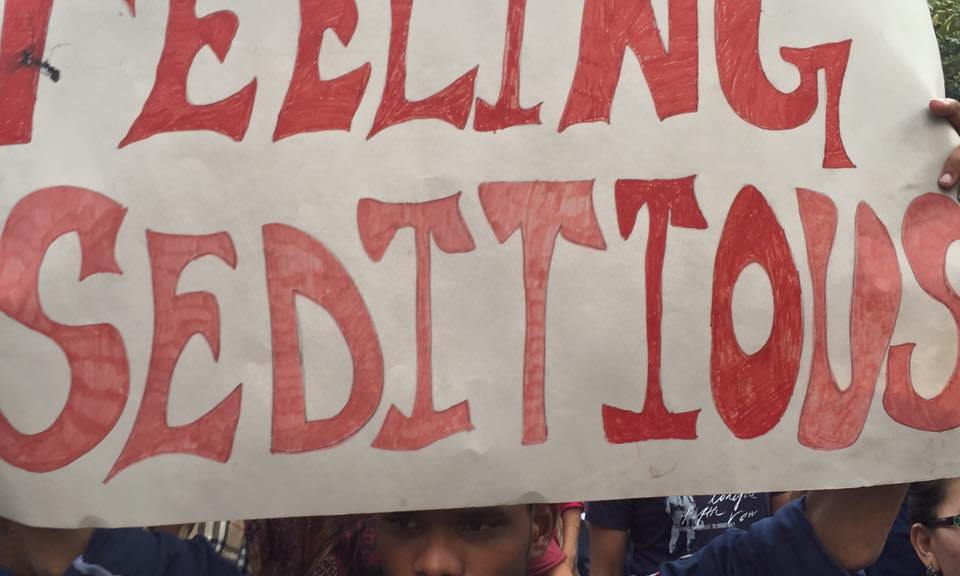
‘Feeling Seditious’: March on Parliament to #StandwithJNU

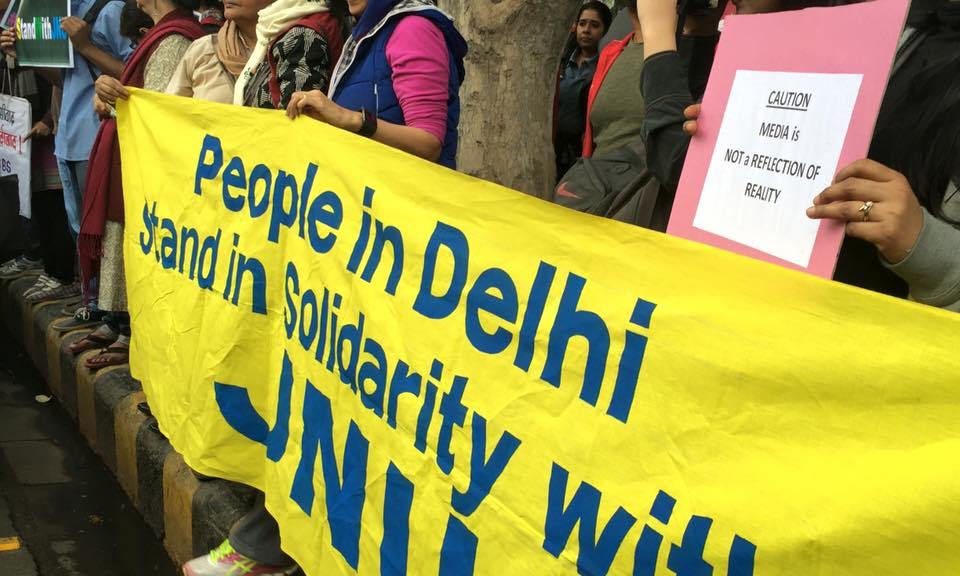
For the third time within a span of two weeks since the middle of February, thousands of people came out on the streets of Delhi to express their solidarity with the detained students of JNU (Kanhaiya Kumar, Umar Khalid and Anirban) and to voice their anger with the venal Modi regime.

Protest demonstrations (at least in northern India) tend to have something of the monotonous in them, the same cadence, the same rhythm and the same wailing, complaining tone. They tend to have an air of events staged by the defeated, for the defeated. But if we take the last three big protests in the city, and the many gatherings in JNU in the last two weeks or so,  as any indicator of what the pulse of our time is, we will have to agree that there has been a qualitative transformation in the language, vocabulary and  affect of protests. This afternoon, like the afternoon of the 18th (the first big JNU solidarity march), and of the 23rd of February (the Justice for Rohith Vemula March), was as much about the joy of togetherness and friendship as it was about rage and anger.

Continue reading ‘Feeling Seditious’: March on Parliament to #StandwithJNU

If there is dancing, there will be revolution : Three New Tracks to Groove to While Modi Quakes

No Text Necessary ! Make them your phone ringtone! Friends having tried this report electrifying effects on passersby.

https://youtu.be/6NJbxEgf3Uo

‘Azadi’, (‘Freedom’) featuring Kanhaiya and Friends, Courtesy DJ Dub Sharma

http://https://youtu.be/mNn2RuTPabU

‘Yeh Ladai’ (‘This Struggle), Courtesy DJ MojoJojo, featuring Umar

‘Bandh Bhengey Dao’ (‘Break Down the Barriers’), Courtesy Q, OST of ‘Tasher Desh’, with a nod to the great DJ Robin T


Apologise to the Nation, All of You.

You, who shout your nationalism from the rooftops; you whose blood runs hot for “Mother India”; you who turn red with rage when contradicted; you who set agendas like patriarchs drunk on father-right; you who refuse to let another speak, you! who don a suit every night on television to disguise your cheap tricks; you who abuse your guests if they happen to be young, powerless and honest; you who bloat on adrenaline while your viewers turn to idiotic jelly; you who abuse the highest offices of this land; you who give a bad name to khaki; you who wear lawyers’ robes to beat students and teachers; you who are protected by your political masters; you who strike deals in the privacy of your offices, chambers and boardrooms; you who live by ratings and upvotes; you who tell lies so long you forget the truth; you who form bands of cowards hiding in plain sight; you who roam the streets showing your fist to all; you for whom a martyred soldier is more valuable than a living citizen; you who abuse the power that history gave you; you who mistake that accident of history for a moral right; you whose imagination of revenge always involves rape; you who have brought this country to the brink of civil war; you who speak in the name of the mythical motherland while the actual children of that land are hungry, thirsty and unemployed; you who claim this moment, this nation, this public, this history, this land. Apologise.

Apologise to those who work everyday to make this country decent; who work for too little, and for too long; those whose deaths become statistics in the great churning pots of state economists; those whose parents taught them to keep their heads down and quit an ugly fight; those who argue, debate, disagree without the urge to kill or maim their opponents; those who understand when an argument becomes too heated; those who pull back from the brink every time because they know that to be alive is not always to be right; those who reclaim the streets to protest when it’s hard, when it’s inconvenient, and when it’s dangerous, because it’s the only way to disagree; those who see that an eye for an eye makes the whole world blind; those who understand and accept this land in all its confounding conflict; those who risk death to expose the powerful and corrupt; those who have no choice but to join the army to feed their families; those who laugh when there is nothing left; those who write, think and reason, and take time over all three; those who appreciate the beauty of the stars on a still night; those who make love like it’s a gift and not a right; those whose parents live after they died because they were on the wrong side at the wrong time.

Above all, you deranged “nationalists”, apologise to three fellow citizens – one born in a caste that could only speak from the protection of death; another who is languishing in jail for no crime at all; and perhaps most of all, a third who is on the run from a police none of us ever trusted. Apologise. These young people are the future of this country, not you with your bloodlust. WE are the nation, and we demand an apology from you.

In the Name of the ‘Nation’: Vidya K. Subramanian and C. J. Kuncheria

This is a guest post by VIDYA K S and C J KUNCHERIA

“Don’t you dare speak over me when I am speaking of Lance Naik Hanumanthapa! We’re proud of him and we’re ashamed of you!,” screamed Arnab Goswami at Umar Khalid, the JNU student at the centre of unfolding events at the university. Hundreds of thousands of self-proclaimed nationalists cheered at that instant, and many more did as the clip went viral over social media. The death of the soldier, one of the 869 who have been killed in the last four years by the punishing weather on Siachen, had been conveniently used to invoke a cathartic nationalism. Continue reading In the Name of the ‘Nation’: Vidya K. Subramanian and C. J. Kuncheria

The Limits of Efficient Suasion : Rina Ramdev

This is a guest post by RINA RAMDEV

The Prime Minister’s monogrammed suit and the HRD Minister’s fake degree in the early days of the BJP’s 2014 electoral win were embarrassments dotting the uneasy calm that prevailed over the new digital, development avatar of the nation; even as a sense of the slouching beast waiting to break through the controlled, contained quietism was always there in deferred menace. And thus, when majoritarian sentiment fuelled the ‘Ghar waapsi’ campaign and the ban on cow slaughter found a mainstreaming in minority witch hunting, there was an eerie expectedness to these turns. The Swachh Bharat Abhiyan’s minatory address, carrying the subtext of a communal cleansing in sinister remand, visibilized itself in the horrific lynching of Mohammed Akhlaq in Dadri. Mostly civil voices of protest raged against this as well as against the organised killings of questioning rationalists like Pansare and Kalburgi. Sections of the thinking polity mobilised signature campaigns, petitions and an entire event like the‘Award waapsi’ drew attention to this vitiated political climate. Continue reading The Limits of Efficient Suasion : Rina Ramdev

The India I Came Back To: Namrata Sharma

This is a guest post by NAMRATA SHARMA


I will start this piece with a painful but short flashback tirade about myself. I moved back to New Delhi in 2014, after six long years in New York and Singapore. My decision to move back to the motherland was predominantly attributed to issues that a twenty-something grapples with when he or she is away from home and family. However, familial ties and emotional reasons aside, there was one factor which deeply resonated with me and was the driving force behind my decision to move back. This factor was – the liberty to express my thoughts and views on a topic, any topic, in an indulgent and lenient space, which, by virtue of being an Indian citizen, was guaranteed to me in India and not in other places. In India, this liberty transcended predictable spaces like classrooms, newsrooms and sophisticated editorial pages of the morning newspaper and was very organically present in the form of arm-chair political banter amongst friends and political conversations with family over dinner. Continue reading The India I Came Back To: Namrata Sharma

Purdue University Stands in Solidarity with JNU

We, the undersigned faculty and students at Purdue University, strongly condemn the arrest of JNUSU President Kanhaiya Kumar. We oppose the systematic and deliberate attempts to humiliate, bully and terrorize the university’s community of scholars and political activists. It is unethical for a government to spread canards about students with the hope of distracting attention away from its over-zealous, slapdash interventions in academic institutions. We demand that this scapegoating and hounding of Umar Khalid, and all other students, cease immediately.

We salute the courageous JNU community that stands proud and resolute in the face of physical violence, media trials, and sectarian, antediluvian discourses that confuse students for enemies, and dissent – the cornerstone of democracy – for sedition.

More generally, we detect a pattern in this government’s deployment of the state machinery against young adults committed to addressing the inequities and discriminations so blatant in our country today. We insist, therefore, that the central government end its programmatic assault on public educational institutions and the spirit of free-thought. Institutions of higher education must be created and preserved as spaces where caste oppression, gender and minority-exclusion can be studied, and their resistance practiced. JNU exemplifies a dual commitment to combining academic rigor with a political-ethical conscience. We stand in solidarity with JNU’s vision of a diverse campus, charged with a robust polity, where no monolithic, auto-corrected version of the nation or patriotism dominates. We believe that university campuses, like society at large, can thrive only when celebrations of the myriad manifestations of the nation are accompanied by an honest and fearless capacity to criticize its inadequacies. Continue reading Purdue University Stands in Solidarity with JNU

Resolution in support of the student protests in India against the militant suppression of intellectual freedom and dissent by the BJP-government

This is a resolution passed by the Doctoral Students’ Council, City University of New York (CUNY)

WHEREAS, on 12 February, the Delhi Police raided student hostels at the Jawaharlal Nehru University (JNU) and arrested the JNU Students’ Union President Kanhaiyya Kumar on the arbitrary and anti-democratic charge of sedition; and

WHEREAS, this application of a draconian, colonial law which criminalizes dissent stands in stark contradiction to the very democratic character of the nation that affirms an individual’s right to free speech, however radical and unpopular the opinion; and

WHEREAS, this arrest of an elected student representative and the subsequent militarization of the campus with an overwhelming police presence is sanctioned and sponsored by the Bharatiya Janata Party (BJP) led ruling regime, in conjunction with its affiliate organizations RSS and ABVP, its student wing; and

WHEREAS, this coercive presence of the police on the university premises and elsewhere is compounded by their complicity in the physical assaults by lawyers of the Hindu Right on JNU teachers and students at the courthouse before Kanhaiyya’s hearing; and

Continue reading Resolution in support of the student protests in India against the militant suppression of intellectual freedom and dissent by the BJP-government

Sambit Patra Flying the Tricolour on Times Now, in JNU and on Iwo Jima – History Re-Imagined (Once Again) by the BJP

http://www.youtube.com/watch?v=rQNDEwBirLg

A recent ‘Newshour’ non-debate on Times Now on whether or not an order emanating from the Ministry of Human Resources Development to erect 207 feet high steel flagpoles and giant tricolour flags in Central Universities across India featured a wonderful intervention by Sambit Patra, BJP spokesman and digital magician extraordinaire.

Continue reading Sambit Patra Flying the Tricolour on Times Now, in JNU and on Iwo Jima – History Re-Imagined (Once Again) by the BJP

Undeclared Emergency? State Repression from JNU students to HONDA workers: Nayan Jyoti

Guest Post by Nayan Jyoti

[ Even as the repression on students in universities, continues, the BJP regimes in Rajasthan and Haryana have attacked peaceful assemblies of young workers in the National Capital Region (NCR). This calls for widening and deepening the resistance against the Modi regime, whose fascist character is now nakedly visible. When the state starts hunting down workers and students at the same time, it is time for workers and students (and their friends) to stand united together and resist the repression by all means necessary and possible. We are posting below an account by Nayan Jyoti, a young activist, of the violence unleashed by the BJP governments in Rajasthan and Haryana, in collusion with factory managements, using the brute force of armed police and hired thugs in the last few days, with the hope that it will add crucially to our understanding of what exactly is going on in India.The Modi regime is in a deep crisis, and the only way the BJP (both at the centre and at the provincial levels) knows how to respond is through violence. Modi is the best student of Indira Gandhi in Indian politics, and he is following totally in her footsteps, invoking exactly the same ‘Anti-National’ tag, especially in terms of the way she led up to the declaration of the emergency in 1975. Things are different now, but also very similar. This is the beginning, as the author of this post says, of an undeclared emergency. The difference between a declared and an undeclared emergency appears at the moment to be only a formality. It is time we saw through the veil of this formality.]

We #standwithJNU and raised our united voices against State repression and witch-hunt of students for #righttodissent since 9th February. On 18th February, more than 15,000 people said so clearly in Delhi and pointed out that this has directly followed in a coordinated manner more recently from the institutional murder of Rohith Vemula in HCU by the anti-Dalit administrations under influence of the BJP, and right-wing attack on FTII students to completely control freedom of thought and expression earlier and the murder of progressive intellectuals by right-wing groups in recent times.

As this terrorizing and silencing of progressive voices, students and intellectuals goes on by both the BJP government and its police-administration from the top and the RSS vigilante groups on the streets, another much more brutal crackdown on thousands of workers has just happened and continues in the Haryana-Rajasthan border.

Continue reading Undeclared Emergency? State Repression from JNU students to HONDA workers: Nayan Jyoti

#StandwithJNU: Solidarity Statement from the Institute for Gender, Race, Sexuality and Social Justice at the University of British Columbia

We, graduate students and faculty at the Institute for Gender, Race, Sexuality and Social Justice and the broader University of British Columbia community stand in absolute and resounding support of the students, faculty, staff and allies at Jawaharlal Nehru University (JNU). We condemn the political and legal clout being exercised by the Indian government in Kanhaiya Kumar’s arrest and subsequent reaction to protests. Not only is Kanhaiya’s arrest erroneous and suspect to begin with, the consequent unraveling of systematic hatred towards these “anti-national” scholars creates an environment where anyone perceived to be against ‘Hindu’-hence-Indian culture is at risk of personal harm meted out by the State.

It is deeply disturbing to note public debate around this on mainstream Indian media and TV news channels. The contention is that universities should not be spaces of political engagement, but of quiet scholarly repose.  As students and researchers committed to the principles of transnational social justice, it is distressing to note this attempt to depoliticize the university space by dismissing students as undeserving of their spot for being actively engaged in the future of their country.

To term universities and institutions that foster alternative spaces of being and thinking ‘anti-national’ is commandeering an invective that is untrue and wholly vicious.  Moreover, the violence meted out to Kanhaiya as well as journalists at Patiala Court is horrifying, especially noting Delhi police’s inaction and complicity in this, despite tight presence. It is precisely this sort of unprovoked violence by the State apparatus that is undemocratic. It is baffling to note the Delhi police’s apparent inability to track down the people who attacked Kanhaiya, while at the same time it launches a now country-wide witch hunt for another JNU student leader Umar Khalid (who allegedly organized the protest in question), based on completely false Islamophobic allegations.

We believe that universities are sites of active engagement, and using an old colonial remnant that is the sedition charge betrays intent to suppress the voice of a democracy. To hold debates and discussions is not anti-national, even more so when there is overwhelming testimony that Kanhaiya Kumar was not involved in the particular sloganeering for which he was arrested. An active and thriving student body presence is what makes JNU one of Asia’s premiere institutions. It is deeply disappointing to note the efforts by the current government to clamp down on this. It is with rising alarm that we register the chain of events that connect other established institutions like the Film and Television Institute of India (FTII) and the University of Hyderabad (UoH).

Continue reading #StandwithJNU: Solidarity Statement from the Institute for Gender, Race, Sexuality and Social Justice at the University of British Columbia

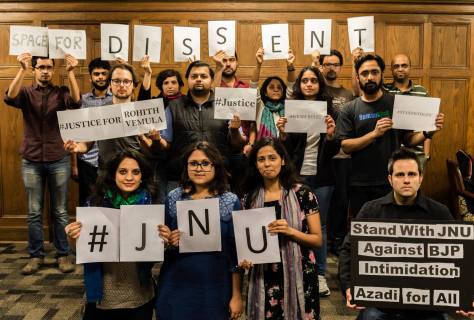
UNIVERSITY OF ILLINOIS STANDS WITH JNU

Students and Faculty, University of Illinois Urbana Champaign in Solidarity with JNU

We, the undersigned students, faculty, staff, and other members of the University of Illinois community are in solidarity with students, faculty and staff at Jawaharlal Nehru University (JNU), India, against the ongoing anti-democratic actions by the Indian state. We demand an immediate end to the police action against students on campus, and withdrawal of all charges against Kanhaiya Kumar, President of the JNU Students’ Union. We unequivocally condemn the witch hunting of students, using archaic laws of sedition, who organized the cultural event questioning capital punishment and the deliberate vandalism and violence unleashed by those affiliated with Hindu Nationalist groups. We are also dismayed at the violence used by lawyers aligned with the government in their acts of vigilantism which are aimed at using the garb of patriotism to impose their ideology through violence.

We strongly believe that the charge of sedition against Kanhaiya Kumar, Umar Khalid and the other 6 students are based on spurious evidence. This arrest is an excuse for the state to root out dissenting voices on JNU campus, a move towards converting educational institutions like JNU into an arm of the authoritarian state. Attempts of a similar nature have been witnessed recently at other Indian educational institutions such as Film and Television Institute of India (FTII) and Hyderabad University. The growing threat to academic freedom and the practice of fundamental thinking and critique, posed by the current political climate is transnational, and extends beyond India to other parts of the world–it is a threat we face here in the United States, too.

Continue reading UNIVERSITY OF ILLINOIS STANDS WITH JNU

Letter of solidarity with JNU: Students, Staff and Faculty, Ashoka University

We, the undersigned—who study and work at Ashoka University, as well as the alumni of the Young India Fellowship, in our private capacity—write to voice our solidarity with the students and faculty at Jawaharlal Nehru University (JNU). Recent events at JNU, including the arrest of the JNUSU President over the charge of sedition, as well as other disproportionate measures, amount to a deeply troubling attack on academic and cultural freedom. We strongly condemn the display of brute force by the police, who were given free entry to the campus, including hostels, to question, detain and arrest students and faculty members. We protest the lack of police protection to those students and faculty, and condemn the use of State force against democratic expressions of dissent.

As proponents of liberal education, we believe that societies can only grow when they foster intellectual engagement with fundamental social questions and contemporary political issues through non-violent debate and argumentation. University campuses are, and should be, autonomous spaces where people can peacefully express as well as challenge dissent and opinions. However, the recent spate of events involving many university campuses across the country has posed a serious threat to the sanctity of such spaces as well as the democratic right to dissent and freedom of speech and expression. This includes the turn of events that led to Rohith Vemula’s death at the University of Hyderabad, the withholding of grants by the Ministry of Human Resource Development to Panjab University, and several instances of violent disruption of the screening of the film Muzaffarnagar Baaqi Hai in campuses across the country.

We condemn the State-backed misuse of the charge of sedition, a colonial era provision in the Indian Penal Code, against the JNUSU President, Kanhaiya Kumar. In the documented absence of any allegedly ‘anti-national’ actions or rhetoric on his part, we see the charge as an attempt to stifle dissent from the dominant order and silence critique of the State. We strongly believe that the provision against sedition, which was repealed in the United Kingdom itself in 2009, has no place in modern democracy. Most immediately, we strongly disapprove of the action of certain lawyers and a Member of the Legislative Assembly who physically attacked JNU students and faculty members as well as journalists outside the Patiala Court House premises on 15th February, 2016.

We fear that the continued State inaction against such instances of violence will foster an environment in which the label “anti-national” or “traitor” can be imposed on every voice of dissent.

We urge that:

the JNU campus be restored to normalcy and the police be withdrawn from all parts of the campus.

the JNUSU President, Kanhaiya Kumar be released from police custody immediately and all charges be dropped against him.

such unconstitutional actions be denounced.

we be allowed to nurture our universities as tolerant, democratic spaces where dissent and disagreement is respected, discussions are nurtured, and critical thinkers are born.

Faculty

Ajit Mishra

Bhaskar Dutta

Malvika Maheshwari

Alex Watson

Debarati Roy

Mandakini Dubey

Anisha Sharma

Durba Chattaraj

Maya Saran

Anunaya Chaubey

Gilles Verniers

Nayanjot Lahiri

Anuradha Saha

Gwendolyn Kelly

Rajendran Narayanan

Aparajita Dasgupta

Jonathan Gil Harris

Ratna Menon

Aparna vaidik

Kranti Saran

Ravindran Sriramachandran

Arunava Sinha

Kunal Joshi

Saikat Majumdar

Aruni Kashyap

M A Ahmad Khan

Supriya Nayak

Pulapre Balakrishnan

Madhavi Menon

Vaiju naravane

Bharat Ramaswami

Malabika Sarkar

Vishes Kothari

Staff

Adil Shah

Kanika Singh

Shiv D Sharma

Aniha Brar

Karuna

Shreya Khedia

Anu Singh

Meena S. Wilson

Sudarshana Chanda

Anuja Kelkar

Mercia Prince

Suha Gangopadhyay

Charu Singh

Priyanka Kumar

Sukanya Banerjee

Chiranjit mahato

Sarah Afraz

Sushmita Nath

Dr Maaz Bin Bilal

Saumya Varma

Swarnim Khare

Harshita Tripathi

Saurav Goswami

Tanita Abraham

Ishan de Souza

Sayan Chaudhuri

Zehra

Sushmita Samaddar

Surya Raman

Sandeep Saraswal

Apoorva Gupta

Aditya Sarin

Chandan Sharma

Alumni

Aafaque R Khan

Kaavya Gupta

Rishi Iyengar

Akanksha

Kande Sruthi Niveditha

Ritesh Agarwal

Akshay Barik

Kaustubh Khare

Rohini Singh

Ananta Seth

Maansi Verma

Rupali Kapoor

Antony Arul Valan

Malini Bose

Sai Krishna Kumaraswamy

Anushka Siddiqui

Mayank Sharma

Sakshi Ghai

Ashish Kumar

Mrudula Nujella

Shahzaib Ahmed

Ashweetha

Neil Maheshwari

Shaleen Wadhwana

Avni Ahuja

Neelakshi Tewari

Shashank Mittal

Chaarvi Badani

Nikita Saxena

Shivangi Pareek

Danish Ahmad Mir

Nina Sud

Shrestha Mullick

Debanshu Roy

Nipun Arora

Shweta Subbaraman

Deepika Ghosh

Parushya

Simeen Kaleem

Devleena Chatterji

Pavithra Srinivasan

Simranpreet Oberoi

Dhaneesh Jameson

Poornima Sardana

Sonal Jain

Dhwani Sabesh

Pragya Mukherjee

Subhodeep Jash

Hardika Dayalani

Prama Neeraja

Tanuj Bhojwani

Harsh Mani Tripathi

Rahul Sreekumar

Taysir Moonim

Harsh Snehanshu

Rajat Nayyar

Vaishnavi Viraj

Himanshu Ranjan

Ratul Chowdhury

Venkat Prasath

Jahanara Rabia Raza

Rimjhim Roy

Vishal Khatri

Delhi Stands With JNU Students and Against the Evil Modi Regime

Because things are the way they are, things will not stay the way they are...”-

Bertholt Brecht

This slideshow requires JavaScript.

This afternoon saw an amazing, uplifting show of peaceful, joyful strength by students, young people, teachers, friends in Delhi, in support of JNU, in memory of Rohith Vemula, in solidarity with Kanhaiya, Umar and all the students in JNU who are being so stellar in their principled opposition to this evil, venal Modi regime. Reports of massive protests are coming in from Kolkata, Russia to and elsewhere. Something is changing in the air.
It was a perfect spring afternoon, overcast like our times, but breezy like our morale. There must have been at least 15,000 people on the march today. We met old and long lost friends and made new ones.

The gathering was totally peaceful. Young  women and men, student profits from JNU in the eighties, grey haired, felt young again as their student held aloft flowers, flags, signs and homemade banners. Everyone looked their best, as if they had come to a massive street party.

It was so infectious, the mood this afternoon, such a contrast to the vile bad temper of the men who attacked Kanhaiya and his supporters two days in a row at the Patiala House Courts two days in a row that the difference between two entirely different visions of politics was palpable on your skin. The contrast sent a clear message to all our senses.

The RSS-ABVP-BJP brand of politics is diseased. It’s on its last legs and that is why it is so desperate. It cannot perform, it has no ideas, it is morally and culturally bankrupt.

Universities are in crisis and all that the bad TV actress who makes a joke of her ministry (HRS) every day can think of today while thousands March against her and her boss is about sticking giant flagpoles into the ground and stitching gigantic silk shrouds for her  government and her party.

Modi, Rajnath and Manusmriti Irani should quake in fear. Their time is up.

Very proud of JNU students and the people of Delhi today.

#StandwithJNU #StandwithKanhaiya

#StandwithUmar

#Standwithallstudents

#NowitchHuntofStudents

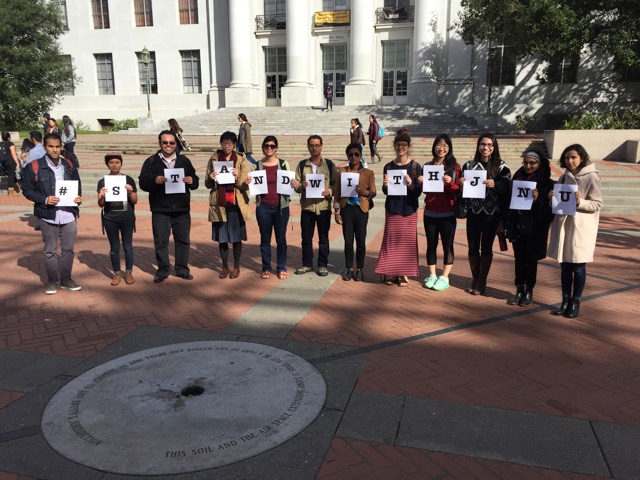
As The People’s Republic of New Delhi Marches in the Free Air Students of Berkeley #StandWithJNU

As the people of Delhi march, sing, run and dance to freedom’s call, as they cock a snook at the shackles of nationalism, casteism and authoritarian stupidity, a gift of love from afar. Look at them standing in the free air! Look at them standing around a piece of earth unbound from the myopia of nationalism!

BerkeleyStudents

“This soil and the air space extending above it shall not be a part of any nation and shall not be subject to any entity’s jurisdiction,”
 At the memorial to the 1964 Free Speech Movement on the campus of University of California, Berkeley, students and faculty stand in love and solidarity with JNU. #standwithJNU
 The memorial the 1964 Free Speech Movement at the University of California, Berkeley, like the thing it celebrates, is both invisible and embattled. The monument appears to be a circle of concrete six feet in diameter, in the middle of the famed Sproul Plaza where thousands of students gathered to demand the right to free speech and academic freedom on one of America’s most prominent and celebrated public university campuses. But that monument is so much more than what can be seen. The concrete circle, bearing the inscription “This soil and the air space extending above it shall not be a part of any nation and shall not be subject to any entity’s jurisdiction,” encompasses a 6-inch wide indentation into the ground that reaches into the soil below and 60,000 feet upwards into the sky, to the limits of American airspace. That is, in fact, the monument to free speech at Berkeley: 60,000 feet and 6-inches of invisible insistence that to speak freely is not and cannot be a right granted by any sovereign, mandated by any state. The width of the depression in the ground is as large as a person’s two feet. The ground on which they stand. From which they speak. This is the lasting monument to free speech at Berkeley. From a space as wide as our stance, reaching in an unseeable column of air to the limits of the stratosphere. A monument of air that can never, like free speech itself, be contained, torn down, or granted by another. It lies, unassuming, built as it is out of the immateriality of inalienable rights, in the middle of a campus that grapples daily with the legacy of that now 50 year old fight for the right to claim the space of the university as one of protest, of politics, of resistance.


But Berkeley, we mustn’t forget, exists on occupied territory. Its celebrated monument digs into soil that was taken, without recompense or acknowledgement, from the Ohlone people who were stripped of their lands, their language, their culture, and their lives in what America today celebrates as its great westward expansion. Thus, the monument to free speech at the University of California, Berkeley, roots itself into a soil it claims belongs to no nation and also reifies centuries of the genocide of indigenous people and of settler colonialism. This too is the legacy of the Free Speech Movement. Of the student-led activism that created Ethnic Studies programs across California and the rest of the United States. To stand in the 6-inch wide memorial is to stand in land that is occupied and to nonetheless believe that no occupation, no nation, no state, mandates our ability and our right to speak, to protest, to imagine otherwise the world in which we live.

From Berkeley to JNU. With love and solidarity.

Poulomi Saha

University of California, Berkeley

Solidarity with JNU and Conversations on Kashmir: JKCCS

Guest Post by Jammu Kashmir Coalition of Civil Society

Jammu Kashmir Coalition of Civil Society (JKCCS) expresses its solidarity with the striking students and teachers of Jawaharlal Nehru University, New Delhi. We have watched with a sense of horror and dismay, the violent criminalizing of student democracy and dissent, not just at Jawaharlal Nehru University but across Indian campuses in the recent past. Having long and intimate knowledge of violent repression and legalized impunity that Indian state is capable of, especially against those it considers ‘anti-national’ we are not surprised by these events, but have a special empathy with all who suffer its horrors. We demand the release of all student dissenters and political prisoners in the custody of the Indian state, and an end to acts of policing and surveillance on campuses, and targeting of students on the basis of political beliefs and speech.

The Kashmiri students in different colleges and universities in India, who have always faced discrimination and intimidation time to time, are now feeling the extreme regressive and oppressive means used by right wing groups and the government. After being hounded, Kashmiri students have begun leaving Delhi. There are several places where the landlords, in whose properties Kashmiri students were renting flats, have asked the students to vacate. These experiences of Kashmiri students are part of the larger reality faced by Kashmiri youth in Jammu and Kashmir and in India. The voices of dissent in Jammu and Kashmir have been dealt with administrative detentions under Public Safety Act, illegal detentions, torture, surveillance and killings by armed forces including the most recent one of Asif and Shaista at Pulwama on 14th of February.

We also view with alarm, the reports about the cynical use of Kashmiri students studying in Delhi as hostages in the politically illegitimate process of government formation in Srinagar.

We are dismayed that the public narrative about the recent events has often descended into disputes over Indian ‘patriotism’ and the shrill condemnation of a few ‘fringe’ ‘radical’ ‘traitors’ for ‘irresponsible’ slogans. These sentiments are neither mere slogans nor represent the ‘fringe’ in Kashmir, the very place they were made in reference to. As Kashmiris, we believe that the right to self-determination is inseparable from the right to political association, dissent and free expression, and these rights cannot be selectively asserted or upheld. In the competitive public proclamations of nationalistic credentials, what has been lost is that courageous act of defiant solidarity with the Kashmiri people’s struggle for justice and self-determination, that lies at the heart of these debates. Despite the disavowals and the state repression, the solidarity with the political rights of the Kashmiris is growing and spreading, as events in Jadavpur University demonstrate. We acknowledge the emerging spaces in Indian civil society to converse on the question of Kashmir, beyond nationalist framings. We hold out hope for future alliances with students, groups and individuals willing to engage in honest conversations, in which they alone do not determine the boundaries of what can or cannot be said, thought or felt.

Spokesperson
JKCCS

“A Glorious Thing Made Up Of Stardust:” What Pat Parker & Rohith Vemula Ask Us to Consider Lata Mani

This is a guest post by LATA MANI

The first thing you do is to forget that I’m black
Second, you must never forget that I’m black

Pat Parker (1978)

In these opening lines of her poem, For the White Person Who Wants to Know How to be My Friend, Pat Parker names a paradox at the heart of challenging socially produced difference. Parker is speaking not to diversity in nature, nor to the diversity of nature. Not to the variations of appearance – size, shade, height, foliage, texture; or mode of expression – hoot, howl, accent, gesture, cultural practices. Her lines address a uniquely human phenomenon: prejudice. They speak to the poignant difficulty of challenging a spurious and malevolent construction of racial difference in a society still in the grip of its miasma.

I have recalled Parker’s lines many times in the days of sorrow, tumult and righteous rage that have followed Rohith Vemula’s suicide. “Rohith Vemula’s suicide.” I am holding off from saying “Dalit scholar Rohith Vemula’s suicide.” Or, as is now being said with good reason, “Dalit scholar Rohith Vemula’s institutional murder.” I defer by a couple of sentences a description of him that refers to the caste into which he was born; to honour if only symbolically his anguish that the contingent facts of his birth had indelibly defined his life.

Continue reading “A Glorious Thing Made Up Of Stardust:” What Pat Parker & Rohith Vemula Ask Us to Consider Lata Mani

JNU Teachers Statement

After the arrest of JNUSU President Kanhaiya Kumar on 12 February and the entry of the police into JNU Campus, the situation has worsened for our students over the last few days. Sections of the mainstream and social media have carried unsubstantiated rumours targeting students, and organised groups have been making threats against them and indulging in hate speech in order to intimidate. The viciousness of this section of the media and amounts to a public trial and the frightening abuses being hurled at them make us feel deeply concerned for their personal safety and possibilities of their obtaining justice.

We strongly condemn these acts that create an environment of extreme prejudice and potential violence. We demand that the campus be allowed to return to normalcy at the soonest, so that students can return to their regular academic life in an atmosphere of trust and safety. The slander campaign against the University based on unsubstantiated claims not only tarnishes JNU’s image as one of best regarded institutions of higher education in the country, it also destroys JNU’s peaceful academic life. We are deeply concerned about the students’ future, which is being affected by this malicious campaign against JNU.

We the teachers of JNU wish that the Indian people should see through this orchestrated design to transform JNU into a space which will be unable to encourage or sustain critical thinking, so vital to the functioning of our democracy and our nation. It will also endanger the futures of thousands of students who are uncertain about the consequences that such a sustained campaign will have on their futures. We call upon the broadest possible sections of the Indian people to preserve the character of this much cherished national institution.

 C.P. Chandrasekhar

G. Arunima

Ayesha Kidwai

Udaya Kumar

Pratiksha Baxi

Chirashree Dasgupta

Saradindu Bhaduri

Rajat Datta

Vinay Kumar Ambedkar

Ranjani Mazumdar

Jayati Ghosh

Navaneetha Mokkil

Rohith Azad

Ameet Parameswaran

Joy Pachuau

Yashadatta Alone

Rajarshi Dasgupta

Mohan Rao

Vikas Bajpai

Sujatha V

Parul Mukherjee

Ramila Bisht

Surinder Jodhka

Happymon Jacob

Supriya Varma

Mallarika Sinha Roy

Parnal Chirmuley

Nivedita Menon

Hemant Adlakha

Lata Singh

Urmimala Sarkar

Rajib Dasgupta

Rama Baru

Prachin Ghodajkar

Vikas Rawal

Partho Datta

Papia Sengupta

Ira Bhaskar

Sandesha Rayipa-Garbiyal

Veena Hariharan

Pradipta Bandyopadhyay

Biswajit Dhar

Neera Kongari

Geetha Nambissan

Brahma Prakash

Brinda Bose

Maitrayee Chaudhuri

Rashmi Barua


Statements of Solidarity For JNU From Various Quarters

We at Kafila have been receiving amazing statements of solidarity with JNU and its elected students’ President Kanhaiya Kumar over the past three days. We are posting them below, along with affiliations: South Asia University (teachers and students); Grinnell College, USA, Ambedkar University Delhi Faculty Association, Democratic Teachers Network, Hyderabad, and over a hundred students from Department of English, Delhi University.


STUDENTS OF SOUTH ASIA UNIVERSITY

We, the students of South Asian University, New Delhi (comprising of students from eight SAARC nations – Afghanistan, Bangladesh, Bhutan, India, Maldives, Nepal, Pakistan and Sri Lanka) strongly oppose the idea that one’s nationalism be defined in terms of hatred towards another nation (for example, Indian nationalism be defined as hatred towards Pakistan, or vice versa). We cherish the common cultural and social heritage of the South Asian region, and shall not let any kind of jingoist nationalism being endorsed by any religious group, political party or state hinder our shared solidarity. However, in recent times, such groups and establishments have unleashed an attack on democratic and critical voices in our universities across the South Asian region, masked under religious conformity, state intervention or sometimes in the form of an act of terrorism.

Thus, we stand in complete solidarity with the student and faculty community of Jawaharlal Nehru University (JNU) in their collective struggle against the ongoing police intervention by slapping the baseless charges of sedition on many students, including the arrest of JNUSU President – Kanhaiya Kumar, and against the massive propaganda terming the JNU as ‘a den of anti-nationals’. We would like to reiterate that our collective nationalism stands responsible only to the interests of our people and our land, and not to the divisive forces which have had and are still trying to create boundaries between us.

STATEMENT OF SOLIDARITY WITH STUDENT PROTESTS IN INDIA, FROM STUDENTS, FACULTY, AND STAFF OF GRINNELL COLLEGE

Grinnell-JNU Solidarity

Continue reading Statements of Solidarity For JNU From Various Quarters

SOLIDARITY STATEMENT BY JNU ALUMNI AND INTERNATIONAL ACADEMIC COMMUNITY

The statement below represents the concerns of JNU’s international alumni, and a wider global academic community of friends and comrades. The support demonstrated by the names below testifies that JNU is far more than a besieged university campus in India. JNU stands for a vital imagination of the space of the university – an imagination that embraces critical thinking, democratic dissent, student activism, and the plurality of political beliefs. It is this critical imagination that the current establishment seeks to destroy. And we know that this is not a problem for India alone. Similar attacks on critical dissent and university spaces are being attempted and resisted across the world.

If you would like to stand in solidarity with the students and faculty of JNU, and the ethos of university spaces everywhere, please mention your name and current institutional affiliation in the ‘Comments’ section. Also, in case you are a JNU alumnus, please mention the year you graduated. This list will be regularly updated.

****SOLIDARITY STATEMENT****

We, the undersigned, stand in solidarity with the students, faculty and staff of Jawaharlal Nehru University, New Delhi against the illegal ongoing police action since February 9, 2016. With them, we affirm the autonomy of the university as a non-militarized space for freedom of thought and expression. Accordingly, we condemn police presence on campus and the harassment of students on the basis of their political beliefs.

The charge of sedition, under the guise of which the police have been given a carte blanche to enter the JNU campus, to raid student hostels, arrest and detain students, including Kanhaiya Kumar, the current president of the JNU Students Union, is an alibi for the incursion of an authoritarian regime onto the university campus. Under Indian law sedition applies only to words and actions that directly issue a call to violence. The peaceful demonstration and gathering of citizens does not constitute criminal conduct. The police action on JNU campus is illegal under the constitution of India.

An open, tolerant, and democratic society is inextricably linked to critical thought and expression cultivated by universities in India and abroad. As teachers, students, and scholars across the world, we are watching with extreme concern the situation unfolding at JNU and refuse to remain silent as our colleagues (students, staff, and faculty) resist the illegal detention and autocratic suspension of students. We urge the Vice Chancellor of Jawaharlal Nehru University to protect members of the university community and safeguard their rights.


Dated/- 15 February 2016


  1. Asma Abbas, Bard College at Simon’s Rock
  2. Syed Shahid Abbas, Institute of Development Studies, Brighton, U.K.
  3. Gilbert Achcar, SOAS, University of London
  4. Katie Addleman, University of Toronto
  5. Barun Adhikary, JNU
  6. Aniket Aga, Yale University Continue reading SOLIDARITY STATEMENT BY JNU ALUMNI AND INTERNATIONAL ACADEMIC COMMUNITY