Category Archives: Government

Dead Hence Guilty?

“Governments have always lied. They naturally deny it, even long after it is abundantly clear that they have lied, trailing multiple red herrings, dismissing inconvenient evidence, implying that there is counter-evidence they are not free to produce. When a lie can no longer be credibly denied it is justified, usually by an appeal to the national interest. Governments of modern representative democracies are no different, even if they are more liable than dictators to be exposed.”
Colin Leys, Quoted in Socialist Register, 2006

The National Capital Region (NCR) witnessed a police encounter on the eve of the republic day. Two young men who were supposedly carrying a big cache of arms and ammunition were killed on the spot. We were told that this duo was part of a larger LeT module, which wanted to wreak havoc in the capital.
The killings of the two young men did not cause much uproar.
The police officers appeared jubilant over this episode for foiling such attempt. To blunt any possible criticism of the incident a due enquiry was also ordered by the powers that be and has even promised that it would be completed in a stipulated time.

Continue reading Dead Hence Guilty?

Beyond violence and non-violence – K Balagopal

Via Jamal Kidwai

[We are posting this piece by K Balagopal, hoping to continue our reflections on violence and non-violence in political movements. – AN]

The public arena is witness to dispirited discussion of the ineffectiveness of people’s movements, which are at the most able to slow down things, and nothing more. The discussion often turns around violence and non-violence, not as moral alternatives but as strategic options. Those who are sick of sitting on dharna after dharna to no effect are looking with some envy at violent options,
while many who have come out of armed groups find the Narmada Bachao Andolan (NBA) fascinating.

It is good that there is some openness in the matter now, for dogmatic attitudes have done considerable harm. To say that one should not be dogmatic about violence may be morally a little unsettling but it is a defensible position even without adopting a relativistic attitude towards the preciousness of life or a casual attitude towards one’s moral responsibility for injury caused in the course of a struggle. More of that in the right context. But the
discussion will unavoidably be based on assessments  of the effectiveness of the alternatives, and a distant view is likely to colour the reality with hopes and assumptions, even illusions. A realistic assessment of what each strategy has been able to achieve would better inform the debate.

The plain and stark fact is that while all strategies have been effective in curbing some injustice, none has succeeded in forcing the government to take back a single major policy in any sphere. And none has been able to reverse the trends inherent in the structures of society and economy. Yet no serious political movement or social struggle we know of is only for softening oppression or improving relief. The general understanding is that governance of the country – and may be the systemic infrastructure of society – is fundamentally wrong and needs remedying, maybe overturning. Do we know of any
effective strategy for that? I am not talking of political strategies,
but strategies of struggle that will successfully put pressure upon the State and the polity to stop them in their tracks. The struggle may be built around class or caste or any other social combination. It may in the end seek reform or the upturning of the polity. It may operate mainly or in part within the polity or keep out of it altogether. Whichever it is, the common problem is this: the experience of this country is that governments do not stop doing some thing merely because it has been demonstrated to be bad. Or even contrary to constitutional directives and goals. They stop only if going along is made difficult to the point of near impossibility. No democratic dispensation should be thus, but Indian democracy is thus. Short of that, you demonstrate the truth of your critique till you are blue in the face or shout till you are hoarse in the throat, it is all the same.

Continue reading Beyond violence and non-violence – K Balagopal

Corporate Complicity and Gujarat

The 4th ‘Vibrant Gujarat Global Investors’ Summit, organized by the Gujarat government on 12-13 January 2009 in Ahmedabad, and the statements by some prominent Indian corporate leaders, have spawned protests, analysis, debates and questions about corporate accountability, complicity, responsibility and rights in Indian democracy. At this biennial event, ‘Jai Jai Garvi Gujarat’ has been showcased as an ‘ideal investment destination, both for Indian and foreign investors’, where prospective investors have ‘only Red Carpet and no Red Tape and it is where investors can sow a rupee and reap a dollar as returns’ (see Official portal of Gujarat Government).

Bringing together business leaders, investors, corporations and policy makers by a democratically-elected government, exploring business opportunities and signing memorandum of understandings are legitimate economic activities. However, the projection of the Chief Minister of the State, Narendra Modi, as the next Prime Minister of India by corporate cheerleaders is much more than mere economic activity. It is turning a blind eye to gross abuses of rule of law, and knowingly assisting a political leader and his government to continue committing them. It is becoming party to a specific political vision in a manner that incurs responsibility and blame. Such corporate leaders thus become complicit with a government and its leader in serious human rights abuses. It is negative and unacceptable.

Continue reading Corporate Complicity and Gujarat

“Why?”

(Uma Singh, a journalist with Radio Today in the southern town of Janakpur in Nepal, was killed on 11th January 2009. The Federation of Nepali Journalists has mounted a campaign asking for immediate action against Uma’a killers and a firm commitment by the government to the freedom of press. Uma’s killinng comes in the wake of attacks on different media houses in Kathmandu. Like Lasantha Wickrematunge in Sri Lanka, Uma was killed for writing and speaking fearlessly at the other end of Southasia.)

Janakpur: It was impossible to believe that Uma Singh at Ganga Sagar Ghat on Tuesday morning – an FNJ flag draped over her still body, face bandaged all across, the cuts on the head visible – was the same Uma I had met two months ago.

Uma’s looks were deceptive, for the tiny frame contained abundant energy. By the time I strolled into Radio Today’s studio at 6 am in mid-November, Uma had wrapped up her morning bulletin. She was running around the office and passing instructions in a matter-of-fact professional way

She briefed me on the format of Janakpur’s most popular Maithili political discussion show, Garma garam chai. I still remember how Uma said to both her co-anchor and me, “Please avoid English words. The programme is meant for people in villages.” I nodded, a little ashamed my Maithili was not as fluent. Continue reading “Why?”

The use of “Lese majeste” in Thailand against freedom of speech

Lese majeste literally means an offense or crime committed against the ruler or supreme power of a state – or, in other words, the crime of dissent. In Thailand, this provision is routinely used to silence any form of criticism of the government.

A recent case that has been brought to our attention is that of Associate Professor Giles Ji Ungpakorn, from the Faculty of Political Science, Chulalongkorn University. He is facing Lese Majeste charges for writing a book A Coup for the Rich, which criticised the 2006 military coup. He also wrote an article on the coup for Asia Sentinel. Others who have been accused of Lese Majeste are former government minister Jakrapop Penkae, who asked a question at the Foreign Correspondent’s Club in Bangkok, about exactly what kind of Monarchy they have in Thailand. There is also the case of Chotisak Oonsung, a young student who failed to stand for the King’s anthem in the cinema. Apart from this there are the cases of Da Topedo and Boonyeun Prasertying. In addition to those who opposed the coup, the BBC correspondent Jonathan Head, an Australian writer names Harry Nicolaides and social critic Sulak Sivaraksa are also facing charges. The latest person to be thrown into jail and refused bail is Suwicha Takor, who is charged with Lese Majeste for surfing the internet. The Thai Minister of Justice has called for a blanket ban on reporting these cases in the Thai media. The mainstream Thai media are obliging. Thus there is a medieval style witch hunt taking place in Thailand with secret trials in the courts.

A petition of protest in support of Giles is available here.

Character builders of the nation

‘Na Taala Toota na tijori, Phirbhi BJP Mukhyalaya se dhai karod chori.’
(Neither the lock was broken nor the safe, yet 2.5 crore Rs were stolen from the Party headquarters.)
– An SMS which was circulated widely in the journalist community.

What is the weight of Rs. 2.5 crore if one decides to have the whole amount packed in the denomination of Rs.1,000 notes ?

It is exactly 31 kilograms.

Please do not get surprised over my correct reply. I just wanted to share few details of the ‘theft’ at the headoffice of the main opposition party namely BJP which has appeared in different newspapers.

According to the treasurer of the party there is no cause of worry and once the ‘ankeshan” (auditing) is over then only something definite can be said about it. The latest news is that amount supposedly missing from the coffers has been reduced without any further explanation. Continue reading Character builders of the nation

UAPA: Legalising the police state

Guest post by ANUJ BHUWANIA

Recently the clamour for a draconian terror bill came to fruition with rare alacrity. The Unlawful Activities (Prevention) Amendment (UAPA) Bill was introduced and passed within two days by both houses of Parliament – quite a contrast to, say, the Women’s Reservation Bill, gathering dust now for more than a decade. Coming from a government that repealed POTA soon after it assumed power, the Bill unimaginatively mimics POTA almost entirely, revealing that little has been learnt from the recent history of TADA and POTA and the problems leading to their removal. While such statutes giving extraordinary powers to the police are introduced to cater to ‘exceptional’ situations, they can easily be deployed in ‘ordinary cases’ and indeed routinely are. The bleeding of one category into the other is inevitable, when the police alone decide which is which.

Continue reading UAPA: Legalising the police state

Army wanted Abdullah, who’s surprised?

Ashish Sinha in Mail Today:

Any political decision on Kashmir — especially when the ball is in the Congress’s court — cannot afford to ignore the sentiments of lakhs of troops stationed here because, at least for now, they appear to be a more permanent fixture than any party, even the National Conference (NC). [Full text]

I told you so…

And Siddharth Varadarajan asks the right question:

But if these motives propelled the ISI to either mount or at best turn a blind eye to the Mumbai plot, why did the same agency — which essentially manages Rawalpindi’s links with militant groups active in Jammu and Kashmir — not seek to disrupt the assembly elections? [Here]

Families and Dynasties, Lettered and Unlettered – Monobina Gupta

Minister in the Rajasthan government
Golma Devi, Minister in the Rajasthan government

Guest Post by MONOBINA GUPTA

It is jarring, to put it mildly, that Times of India, a leading daily, engaged in a high-profile ‘Teach India’ campaign should publish a front page story mocking the unlettered. This story exhibits a strange callousness in its reporting about the very constituency of people the campaign is hoping to address…or ‘uplift’…
The story published in the TOI on December 20, smacks of arrogance as it speaks disdainfully of an unlettered woman legislator recently elected in Rajasthan’s assembly elections. Golma Devi, elected from the Mahuwa constituency is the butt of ridicule and lament in this article authored by P J Joychen. The author, it seems, cannot get over the fact that an unlettered person like Golma Devi has been elevated to the rank of a minister in the Ashok Gehlot government.

No, she is not a history sheeter; nor does she have a scam hot on her heels. She is nevertheless an offender – in the sense of ‘offending’ your ‘sensibilities’ – in the supercilious eye of the media; an object of ridicule. Her offense: her of lack of reading and writing skills.

Continue reading Families and Dynasties, Lettered and Unlettered – Monobina Gupta

Your Rights End Where My Terror Begins

A phone in poll today on CNN-IBN’s Face the Nation:

Should human rights take a back-seat in favour of tougher terror laws?

65% say Yes!

Thus speaketh the great Indian middle-class- Enough is enough!

Continue reading Your Rights End Where My Terror Begins

Mumbai terror, the revolt of the elites and Life itself

You have said everything there is to say, and felt everything there is to feel. You have shouted angrily or reflected seriously or stated in the calm tone of conviction that terrorists are as authoritarian as the states they target, that terrorists have no religion, that terrorists are cowards who target soft civilian populations. You have despaired at the carnage wreaked on a city sick and tired of having to be “resilient”; of having faced one disaster after the other – from floods to targeted attacks on specific communities to bomb blasts – and “emerged with its spirit intact”. Your heart has clenched painfully at the inconsolable tears of baby Moshe; at the blood-spattered, newly motherless one-year old Viraj in an exhausted Head Constable Salunkhe’s arms, entrusted to him by his father, a utensil seller wounded by bullets at CST. You have gazed numbly at the image of Maharashtra ATS Chief Hemant Karkare’s young son with drawn countenance bearing the ritual paraphernalia of his father’s cremation ceremonies. Despite yourself you felt a sudden glimmer of hope steal into you at the stony dignity in Kavita Karkare’s dry-eyed grief at her husband’s funeral, at her steadfast bindi and her coloured sari. You have hated yourself for being relieved that those you know in that poor torn city are safe, when hundreds you did not know were not.

In fear and foreboding the feeling has overcome you – “What lies ahead of us now?”

But after all of that, after all of the sorrow and the grieving, in the midst of absolute despair, when you start to think again – STOP. Continue reading Mumbai terror, the revolt of the elites and Life itself

Victims of Terrorism

The multiple terror attacks in Mumbai are unprecedented and blatantly violate the most fundamental principles of law and justice. Regrettably, as Mumbai shows today, there is a huge gap between governmental counter terror rhetoric and the reality of human security observance on the ground. Much more needs to be done to mainstream counter terror strategy and action throughout the government security system and states must demonstrate the political will and promptness to translate human security and rights commitment into action. Continue reading Victims of Terrorism

Grotesque Terror Attacks in Mumbai

Courtesy Indian Muslims Blog

In one of the most daring and yet cowardly terror attacks, Bombay/Mumbai has been attacked. In an earlier post we had discussed the question of violence – ‘revolutionary’ violence, and the utter futility of resort to such methods. Violence is not a solution to anything; it cannot be. If anything, it is part of the problem; it is the problem. For violence begets more violence. Continue reading Grotesque Terror Attacks in Mumbai

Collateral Damage in our ‘War on Terror’

The Express Story today on the detention and torture of 6 Muslim men/boys in the wake of the Hyderabad blasts makes for chilling, terrifying reading. Amongst over 70 Muslim men who were arrested by the Hyderabad police, they detail custodial abuse and torture which ranges from stripping, to severe beatings on the hands and soles of their feet, to electrical shocks administered to genitalia. With characteristic insouciance and perversity the government has announced a ‘healing touch’ compensation of Rs 30,000 to each victim of the police’s tactile ministrations.

Continue reading Collateral Damage in our ‘War on Terror’

Some images do not disturb

CBI-employed manhole workers in Noida

guest post by S. ANAND

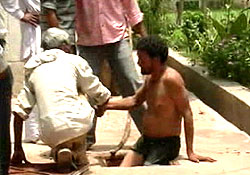
There are times when our critical antennae do not perk up. We do not wish to decode certain signs because we are all implicated in them. Following the 14 September blasts in Delhi, suddenly the media found a new value in ragpickers, street vendors, auto drivers and others who live on the fringes of the city and are generally looked down upon by people who inhabit apartments, blogs, cars (and autos, I must add).

Suddenly, by 15 September, ragpicker Krishna was canonized as a ‘hero’ by the media, the police and the state (the Delhi government claims credit for saving some lives with its ‘eyes and ears’ policy). Yet, Times of India prefaced its report about Krishna thus: Continue reading Some images do not disturb

Mangalore – Hindutva in expansion mode

Broken limbs (by amathad)

Guest post by APURVA MATHAD Continue reading Mangalore – Hindutva in expansion mode

The Jamia Nagar Encounter: ‘Curioser and Curioser’

The well known journalist Praveen Swami, who is celebrated by some as an ‘encounter expert’ and ‘authority on terrorism’ has finally offered his comment on the Jamia Nagar encounter in the Hindu. See Behind the Batla House Encounter. It smells fresh.

Now, I really like Lewis Carrol, and am happy that Swami has invoked Carrol, Alice and Wonderland while criticising those (like me) who have chosen to take a skeptical stance towards the official handout of what exactly happened on the 19th of October in L-18, Batla House, Jamia Nagar. With due respect to Praveen Swami, lets read him in the spirit of Carrol and come to conclusions about who is Alice, who is the Red Queen and who is the white Rabbit, in due course.

It takes far more intelligence to read Swami than it must take for Swami to write like Swami. Which is disconcerting, given, that in Swamis case, he has a whole bureau full of intelligence to back him up, and all we have is the stuff between our individual ears, and occasionally our own eyes, our own ears and our own two feet. No wonder, we have to strain our credibility to believe the six and more impossible things that the police’s special cell, the intelligence bureau and its anointed experts would have us swallow whole for breakfast, with each morning’s headlines in the newspapers.

Continue reading The Jamia Nagar Encounter: ‘Curioser and Curioser’

Was it a recce or a planned raid?

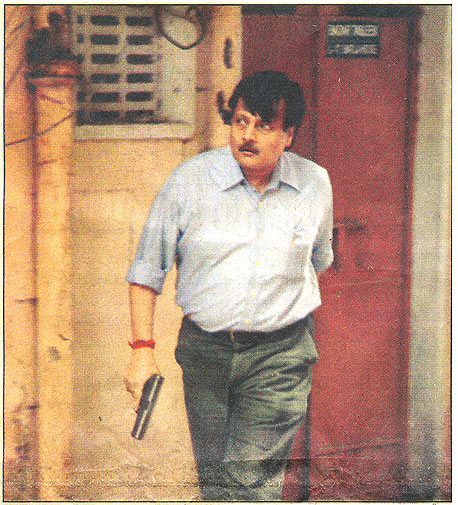
DCP Alok Kumar
DCP Alok Kumar

Guest post by AZIZ BURNEY, Editor, Rashtriya Sahara (Urdu), Delhi

It is a truth universally acknowledged that anything viewed from various angles presents various shapes. It is also a fact that your angle of view determines to a large extent the picture registered by your brain. An askew angle of view is bound to distort the picture. Reality defies comprehension without proper perspective. To date, we have not been able to understand what kind of picture the Delhi police is trying to draw in order to explain the incidents of September 19 as they happened. Continue reading Was it a recce or a planned raid?

Jamia Teachers’ Solidarity Group: Some Questions for the Delhi Police and Embedded ‘Journalists’

In the past few days, our favourite newspapers have been scrambling to counter the growing doubts about the supposed “encounter” at L 18. (See Indian Express and Times of India).

Jamia Teachers’ Solidarity Group responds to the latest claims by the police.

1) The police was caught by surprise. Or was it?

In its response to the questions being raised by the civil society, the police say, “the presence of armed terrorists took them by surprise.” “The police did not expect an encounter at L-18.” (Indian Express October 9)

Continue reading Jamia Teachers’ Solidarity Group: Some Questions for the Delhi Police and Embedded ‘Journalists’

Of “Killer” Buses and Car Lobbies: The Coincidental Death of the BRT

The sustained campaign by the elite press to jettison Delhi’s first mas transit bus system has been remarked upon and documented on Kafila. Today morning’s newspapers carries news of an accident in which 32-year old Poonam Sharma was killed as she tried crossing the road and was hit by an oncoming bus. Delhi’s record when it comes to road safety is abysmal and this is yet another instance of the the terrible and tragic fate that befalls many pedestrians every year on Delhi’s roads. What is interesting though is the way in which accidents on the BRT are reported compared to the reportage of other road fatalities. Here are some headlines from the recent past:

BRT Corridor Claims One More Life

BRT Delhi: Death Toll Continues, Pedestrians Blamed

Delhi BRT has it 10th Victim

BRT Claims another Life: Woman run over by Bus

Continue reading Of “Killer” Buses and Car Lobbies: The Coincidental Death of the BRT

Freedom of Conscience and Attacks on Christians

The idea that fundamental rights are enjoyed by all, without any distinction of race, sex, language, ethnic origin, nationality and religion, is a basic principle of democracy and international human rights law. Violent attacks on the Christian minorities in different parts of the country are an assault on the very notion of democracy and universal human rights. Despite the country’s obligation to respect and protect the right to freedom of conscience and religion, the wave of killings, beatings, sexual assaults, looting, destruction of property, and displacement have created a climate of fear and insecurity, particularly among the Christians. Representatives of Christians and minorities are exposed to the grave risk of communally motivated verbal abuse and physical attacks.

Worst, the governments of Orissa and Karnataka continued to deny the extent of violence prevalent, and failed to face up to their minimum responsibility of securing the life of their people. If India has to live up to any human rights standards, it must show a clear political will to combat attacks on Christians: speaking out strongly, and at all levels of governance; publicly acknowledging the seriousness of the issue; and the need to take concerted action. This is not ‘hooliganism’ or ‘anti-social’ activity, motivated by some hooligans and anti-social elements. It is a violent, and apparently a communal attack, carried out by organized groups. Crimes which are communally motivated must be effectively and thoroughly investigated and prosecuted as such. Treating communally induced violence and brutality on an equal footing with cases that have no communal overtones would be to turn a blind eye to the specific nature of the acts that are particularly destructive of fundamental rights.

Continue reading Freedom of Conscience and Attacks on Christians