Category Archives: Images

The Heavy Footsteps of Brahmanical Dandaneethi : The Hadiya Case


It appears that for women in India, the modern judiciary is fading and in its place, the terrifying face of Brahmanical Dandaneethi is emerging. A ten year old rape victim is denied abortion, women fleeing dowry harassment are to submit to the rule of local elders and leaders of ‘family welfare committees’, and now, in the Hadiya case, the judges declared that unmarried daughters should be under their parents according to ‘Indian tradition’.

Read more:   https://thewire.in/169543/hadiya-islam-conversion-supreme-court/


An Anthem for Kerala: Mojitopaattu

In these days in which Indo-Gangetic barbarians seethe with rage against Kerala and unleash all sorts of false propaganda about the state of affairs here, I have been thinking about my own love for and quarrels with this place. My relation to it has been largely critical, as a Malayali woman born and raised here who has endured, and continue to endure, much second-rate treatment. More than anyone else, I realize, it is Malayalis who have criticized Kerala.  Not surprising, then, is the fact that one of the most ardently-discussed themes in public politics here in the past decades has been the critique of the entrenched imagination of Kerala, and its exclusions. Not for nothing, too, have the struggles of marginalized people here demanded not just material gains, but the reimagining of Kerala in more expansive terms. And newer and newer groups of excluded people keep renewing it – most recently, the LGBTIQ+ people.

Our love for Kerala is a cursing, stumbling love – but love above all.

That’s why I think Anitha Thampi’s poem  Mojitopaattu (The Mohito Song) ought to be our anthem. Anitha is undoubtedly one of Kerala’s most perceptive poets of the present, capable of delving into the depths of the present cultural moment and surfacing with inscrutable yet pervasive feelings and moods and weaving these into words. Our crazy love of Kerala which cannot be but critical is brilliantly caught in this poem In it, this love comes alive as moonlight falling on this place which illuminates erratically, sways madly, and disappears without notice; this loving looks as hard and risky as a drunk’s faltering steps along a rough bylane through treacherous yet playful moonlight; this love eddies through the blood of two and a half generations and comes awake even as the whole world sleeps. Long before the Indo-Gangetic barbarians even noticed us have we felt this mad love, and it will take more than vituperative slander to kill it.

Below is my translation of Mojitopaattu – and I take Anitha’s suggestion that it a song, and a drunken one, seriously. I hope someone sets it to music and it becomes the anthem of crazy-lovers of Kerala.


Four-five sprigs fresh mint

Two spoons sugar
Juice of three limes
Vodka, two measures and a half 
Soda
Ice

Hey you, swayin’-shakin’-rollin’
 on night-time alley that’s runnin’
all o’er earth that’s green and shinin’
Banana-leaf-like, straight and gleamin’*
Hey sweet moonlight, 
who you be,
you be man or you be woman?

Hey you, fallin’ easy-loose-y
You for real, or just a feelin’?
Hey you singin’ , spreadin’-creepin’
Who you be to sunshine beamin’?

Hey you lurchin’, fallin’, stumblin’
on each an’ ev’ry greenly leafling  
Hey bright moonshine,  distilled-dried blood, bluish, 
two and a half generations bleedin’
Who be you?

You be me, or you be you?

*Kerala, that lies at the foot of mountains like a bright green banana leaf beside the sea.

( Anitha Thampi , ‘Mojitopattu’)


And here is the original, much more terse and controlled in its use of language, but a paattu all the same:


മൊഹീതോപ്പാട്ട്

നാലഞ്ച് തളിർപ്പുതിന

രണ്ടു സ്പൂൺ പഞ്ചസാര

മൂന്നു നാരങ്ങാ നീര്

രണ്ടര വോഡ്ക

സോഡ

ഐസ്


നാക്കിലമണ്ണിൻ∗

രാവൂടുവഴിയൂടെ


ആടിയാടിപ്പോകുന്ന പൂനിലാവേ നീ

ആണാണോ പെണ്ണാണോ?

അഴിഞ്ഞഴിഞ്ഞു തൂവുന്ന പൂനിലാവേ നീ

നേരാണോ പൊളിയാണോ?

പാടിപ്പാടിപ്പരക്കുന്ന പൂനിലാവേ നീ

വെയിലിൻറെ ആരാണോ?


പച്ചിലകൾ തോറും തപ്പിത്തടഞ്ഞു വീഴും

രണ്ടരത്തലമുറ നീലിച്ച വാറ്റുചോരപ്പൂന്തെളിനിലാവേ നീ

ഞാനാണോ നീയാണോ?


∗കേരളം


Have Indian Muslims become the new ‘Make in India’ Punching Bag? Sabiha Farhat

Guest Post by Sabiha Farhat

[ A month ago from yesterday, a teenager called Junaid was lynched and murdered on a train in Haryana. Sabiha Farhat writes in the wake of visiting his house and meeting his family. The news cycles may have moved on to other stories, but we need to keep remembering Junaid, and why he was killed. – Kafila]

Once upon a time there  was a 15 year old boy called Hamid, who went shopping on the day of Eid with his Eidi .  A few days ago there was Junaid who went shopping on the eve of Eid.  Premchand’s Hamid was an orphan and lived with his grandmother in extreme poverty.  Junaid lived surrounded with love of his brothers, a sister, a doting mother, father and friends. Instead of the old, decrepit house of Hamid,  Junaid’s house has two rooms, it is not falling apart but it’s size and unplastered walls, do speak about the economic condition of his family.

As we approached Khandawli, Junaid’s village in Ballabhgarh a fear gripped me.  I did not have the courage to walk upto the house.  Junaid was brutally murdered on 22nd and here I was on 25th.  It was too soon, my mind said.  I should have let Eid pass.  But how could I have prepared Sewai in my house when a mother like myself had lost a young, healthy, happy child to hindutva fanatics?  I am a mother, I was angry and ashamed at home. And here, standing outside Junaid’s door, I was weak and helpless. Useless too.

Continue reading Have Indian Muslims become the new ‘Make in India’ Punching Bag? Sabiha Farhat

Women’s Cricket – Rules Based Only on Gender Stereotypes Need to Go: Surabhi Shukla

This is a guest post by SURABHI SHUKLA

Playing for the Oxford University Women’s team and the Oxford Cricket Club, I have noticed three different rules for women’s cricket. These may be observed in other countries as well. I argue that these rules are based only on gender stereotypes about women’s inferior sporting abilities and even if were once instituted to encourage them to join the game, have now outlived their utility. 1. The women’s match ball is lighter than the men’s ball (also true at the international level). 2. The women’s match boundary is smaller than the men’s and; 3. One of my coaches here told me that the men’s bat is different from the women’s. This is incorrect, and the England and Wales Cricket Board (ECB) website states that both men and women are entitled to use Type A bats for one-day internationals. However, I include this point in my analysis because regardless of a rule, these kinds of statements from a coach translate into the lived experience of a female cricketer, and act as a rule for them.  Continue reading Women’s Cricket – Rules Based Only on Gender Stereotypes Need to Go: Surabhi Shukla

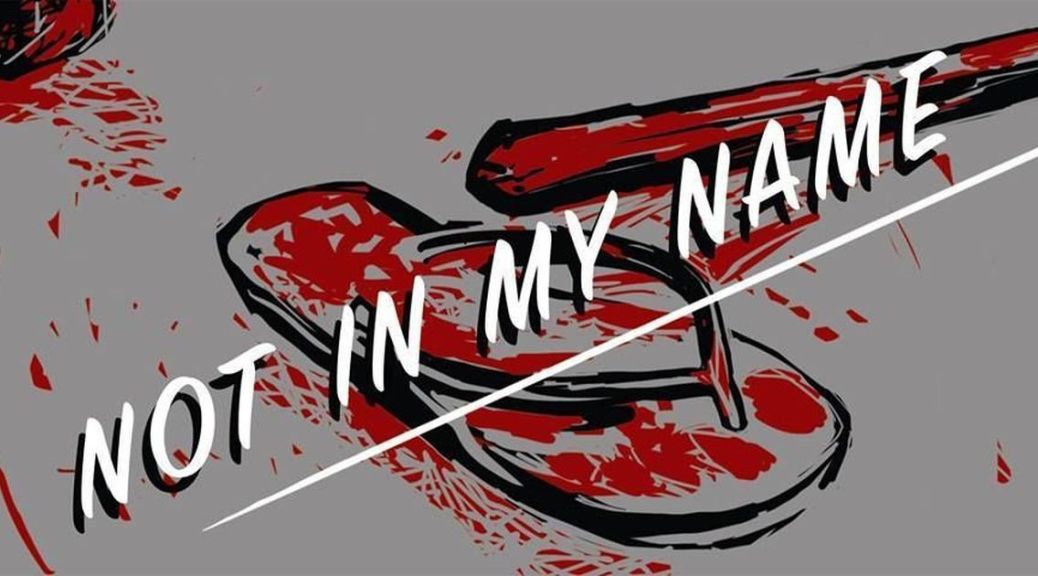
After #NotinMyName at Jantar Mantar on June 28: Sanjay Kak for NotinMyName, Delhi

Guest Post by Sanjay Kak, for  #Notinmyname / Statement from Not In My Name, Delhi

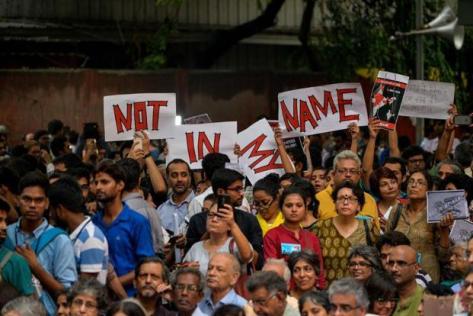
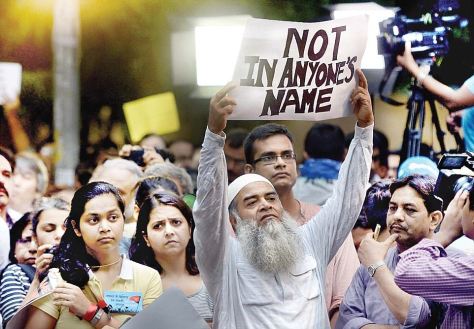
Last evening’s (June 28th) spirited protest at Jantar Mantar, New Delhi, under the banner of Not In My Name, was an autonomous citizens protest against the recent spate of targeted lynchings of Muslims in India – the most recent of 16 year old Junaid, stabbed to death on 23 June 2017 in Delhi (NCR).
For an audience that was estimated to be 3500 strong, the torrential downpour at a little past 8 pm may have rained out a part of the programme. But something remarkable had already been achieved: the evening had washed away, even if temporarily, an almost overwhelming sense of despondency, of hopelessness, and of fear. 


Since the Not In My Name protest had announced that the platform was not meant for political parties, and their banners and slogans, the stage saw the marked absence of the speeches (and faces) of routine protest meetings at Jantar Mantar. Rhetoric was displaced by feeling, and it was left to the poets and musicians to carry the sharp political messages of the day. On an evening that was often very emotional, the most difficult moments came when a group of young men from Junaid and Pehlu Khan’s extended families (and residents from their respective villages) came on stage and spoke to the audience.

When the call for a protest meeting went out last Sunday we were hoping that a few hundred people would gather to express their outrage at what is happening around us. For the attacks on Muslims are part of a pattern of incidents that targets Dalits, Adivasis, and other disadvantaged and minority groups across the country. In almost all these incidents the possibilities of justice seem remote, as the families of the victims are dragged into procedures they are ill-equipped to handle. Through all these heinous crimes the Government has maintained a silence, a gesture that is being read as the acquiescence of all Indians.

Not In My Name aimed to break that silence. But the scale and spirit of the protest meeting at Jantar Mantar became amplified many times over, as similar gatherings were spontaneously announced all over the country. As word spread through social media, groups in 19 other locations announced Not In My Name protests, and this phenomenal synergy inevitably drew media attention to all the events, and gave the protest a solidarity and scale that was truly unprecedented – there were at least 4 protests in cities abroad too. (And more protests have been announced for later this week…) The protest meeting ran on the shoulders of a group of volunteers who managed to put together everything in less than four days. No funds were received (or solicited) for the expenses from any political party, NGO, or institution. Instead volunteers worked the crowd and our donation boxes received everything – from Rs 10 coins to currency notes of Rs 2000, and everything in between.

Citizens hold placards during a silent protest Not in My Name against the targeted lynching, at Janter Manter in New delhi on wednesday. Photo by Parveen Negi/Mail Today, June 28, 2017

The impact of the Not In My Name protest at Jantar Mantar yesterday only points to the importance of a focused politics to deal with the crisis this country seems to be enveloped by. Less than a day after the protests Prime Minister Modi broke his silence on the matter of lynchings. It could not have been a coincidence: speaking in Ahmedabad he said killing in the name of gau bhakti is unacceptable. But to protect the life of a 16 year old being brutalised in a train needs more than a tweet, and we all wait and watch.

This fight has just begun. In the days to come the exceptional solidarity attracted by the protest in New Delhi will have to become less exceptional, and more everyday.


Sanjay Kak is a filmmaker and writer based in Delhi.

The #NotinMyName protests, which began in a response to a Facebook post uploaded by Delhi filmmaker Saba Dewan, have since taken place in more than twelve cities in India, and also in the UK, USA and Pakistan. More protests, under the #NotinMyName tag, as well as independently of it are being planned by citizens groups, organizations and individuals in many places.

Tomorrow, July 2nd, 2017 will see a sit in at Jantar Mantar from 11 in the morning, at Jantar Mantar, New Delhi called by families, individuals and panchayats from Nuh, Ballabhgarh and Faridabad, they will be joined by students, activists and other individuals.

SaveSave

Why Two Hundred Ordinary Hindus Did Not See A Dead Muslim Child On A Railway Station In North India

On 22 June 2017 fifteen-year old Hafiz Junaid was stabbed to death on a Mathura-bound train from New Delhi. He was traveling home for Eid with his brothers and two friends. A dispute over seats resulted in a group of men repeatedly assaulting and stabbing Junaid and his companions. The assailants flung their bodies onto the Asoti railway platform. A crowd gathered. At some point an ambulance was called and two bodies were taken away. Junaid is dead. His companions are in critical condition. While one person has been arrested the police investigations are running into a wall of social opacity since they have been unable to find a single eye-witness to the incident. Of the 200 hundred strong crowd that assembled on Asoti railway platform on Thursday evening, the police cannot find one person who can say what they saw. The police cannot find a witness because something very peculiar seems to have happened to those present at Junaid’s death. A report by Kaunain Sherrif M in the Indian Express provides specific details. When asked if he had seen anything that evening, Ram Sharan a corn-vendor whose daily shift coincides with the killing, Sharan said he was not present at the time of the incident. Two staffers who were sent to investigate by the station master were unavailable for comment. Neither the station-master, the post-master or the railway guards saw the event they were present at.

In this startling piece the journalist reports how the public lynching of a Muslim child becomes a social non-event in contemporary India. He shows the reconfiguring, and splitting, of a social field of vision. He reports all the ways in which people – Hindus- did not see the body of a dead – Muslim – child that lay in front of them. The Hindus on the Asoti railway platform managed to collectively not see a 15 year old Muslim boy being stabbed to death. Then they collectively, and without prior agreement, continued to not see what they had seen after the event. This is the uniquely terrifying aspect of this incident on which this report reflects: the totalising force of an unspoken, but collectively binding, agreement between Hindus to not see the dead body of a Muslim child. Hindus on this railway platform in a small station in north India instantly produced a stranger sociality, a common social bond between people who do not otherwise know each other. By mutual recognition between strangers, Hindus at this platform agreed to abide by a code of silence by which the death of a Muslim child can not be seen by 200 people in full public view on a railway platform in today’s India. Continue reading Why Two Hundred Ordinary Hindus Did Not See A Dead Muslim Child On A Railway Station In North India

Photo Story on Bhim Army Rally in Delhi: Debalin Roy

Guest post by DEBALIN ROY

Debalin Roy takes us to some specific moments in the rally, aside from the bird’s eye view of the massive rally that we have already seen.

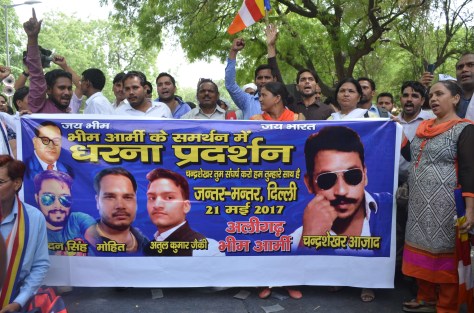
Dalits from all over northern India gathered at Jantar Mantar, Delhi on the 21st of May to protest the Saharanpur violence and increasing atrocities on Dalits across the country.

Although there were representatives from various states, especially from Haryana, U.P. and Rajasthan, Bhim Army took the center stage, with their blue flags waving like a giant dark blue field of tall grass, shaking and waving with every chant of Jai Bhim.

Continue reading Photo Story on Bhim Army Rally in Delhi: Debalin Roy

Violence against Dalits in Saharanpur, UP : A Report by CPI-ML (Liberation) & AISA Team that Visited Saharanpur

Guest Post by Sucheta De

CPI-ML- AISA Team’s Visit to Saharanpur – A Report

“Sarkar Hamari Hai, Police-Prashashan Bhi Hamara Hai”- Yogi Government Boosts Up Morale of Casteist Feudal Goons Who Burnt Dalit Village in Shabbirpur!

Casteist Goons from Dominant Rajput Community Enjoy Complete Impunity while Bhim Army Activists Continue to Face Witch-Hunt!

CPI-ML-AISA Appeal Everyone to Join Hands with the Dalits of Saharanpur in their Struggle for Justice!

Saharanpur Carnage: Teaching a Lesson to Politically Assertive, Self-Reliant Dalits Who Refuse to be Foot Soldiers of Hindutva’s Hate Politics

When BJP gains electoral majority, Saharanpur happens.

For last several years the belt of western Uttar Pradesh has been made the laboratory of the RSS-BJP’s sinister design of communal polarization and violence against Muslims. The 2013 Muzaffarnagar riots was a planned design by the RSS-BJP to polarize the belt on communal lines and reap electoral benefits. And now, after that design had delivered ‘electoral success’ for the RSS and BJP, upper caste feudal forces have started celebration of their ‘victory’ by unleashing attack on Dalits.

Continue reading Violence against Dalits in Saharanpur, UP : A Report by CPI-ML (Liberation) & AISA Team that Visited Saharanpur

LBJ, Kashmir, and Indian Liberals: Rajive Kumar

Guest Post by RAJIVE KUMAR

Towards the end of his presidency, Lyndon B Johnson, the 36th President of the United States of America, had been reduced to a figure of universal scorn and derision. His escalation of the Vietnam War to a point from which it became impossible to extricate the US ended up  in becoming one of the defining human tragedies of twentieth century. This was war fought on the basis of pretexts that did not actually exist.  The slur “Hey, hey, LBJ, how many kids did you kill today?” which became an anthem of sorts for protestors eventually compelled him to forgo running for a second term in office in 1968.  Those protesting against the war, those who eventually forced Lyndon Johnson to leave the political arena were Americans who were overcome with images of atrocities and the rising count of civilian deaths in a mindless war.

Continue reading LBJ, Kashmir, and Indian Liberals: Rajive Kumar

Linger Like Moisture Within – On Viren Dangwal’s Pitr-Paksh: Prasanta Chakravarty

Guest Post by Prasanta Chakravarty

Pitr-paksh/ पितृ-पक्ष (also pitru-paksh) is the 16 day lunar period in the Hindu diurnal calendar when believers pay homage to their ancestors, through specific food offerings. Most years, the autumnal equinox falls within this period, that is, the Sun transitions from the northern to the southern hemisphere during this time. In Northern and Eastern India and Nepal, among the cultures following the purnimanta or the solar calendar, this period usually corresponds with the waning fortnight of the month Ashwin. The souls of three preceding generations of one’s ancestor reside in Pitr-loka, a realm between heaven and earth. Continue reading Linger Like Moisture Within – On Viren Dangwal’s Pitr-Paksh: Prasanta Chakravarty

The Unapologetic Indian Muslim: Sabiha Farhat

Guest Post by SABIHA FARHAT

These are tough times for muslims in India.  But now that I look back and shed my ‘liberal’ prejudices – muslims were never acceptable as ‘who they were’ in Indian society.  I had always blamed my mother for not giving me proper lunch box to carry to school.  But the truth is that even in class 5, no student ate from my tiffin and gradually I started going to the play field in recess rather than enjoying a meal under the big Peepal tree.  After that I took tiffin only when I prepared it myself, that was class 11 & 12.  But even then the girls would hardly eat from my lunch box.  We did sit together but no one touched my food.  Was I the Untouchable?

Continue reading The Unapologetic Indian Muslim: Sabiha Farhat

Who will get the hot roti in the Delhi assembly elections?

My friend Guddi has a great story about a Gujjar wedding she attended recently in Ghaziabad. It was a typically chaotic event, marked accurately by the swirling crowds around the dinner stalls. If Gujjar weddings are chaotic and the dinner doubly so, the scene around the tandoor is triply compounded chaos. Barely concealed competition amongst overmuscled Gujjar men in overtight pants for that precious hot roti ensures that none but the most Hobbesian men remain, circling the tandoor like hungry wolves, periodically thrusting their plate forward like fencing champions and shouting obscenities at the harried servers. In such a heart-stopping scenario, a young server had as Guddi recounts, figured out the formula to keep everybody from killing each other (or him). As soon as the roti would be pulled out of the tandoor, seductively golden brown and sizzling, this man would hold it high up with his tongs so everybody could see, then in an elaborate dance-like ritual, touch each of the empty extended plates in front of him with the roti, and finally, in a mysterious but authoritative decision, place it respectfully on a randomly selected plate. Repeat with every single roti that emerged from the tandoor. A hushed silence followed by nervous laughter followed every such flourish.

Continue reading Who will get the hot roti in the Delhi assembly elections?

A Children’s Tale: Fistful-of-Cumin and Fistful-of-Mustard go on a Pilgrimage

I wrote this story for children sometime back, improving on a vaguely-remembered story my grandmother told me, and gave it an end. This is my translation of it in memory of all pilgrimages and boat journeys of childhood: Continue reading A Children’s Tale: Fistful-of-Cumin and Fistful-of-Mustard go on a Pilgrimage

Take back the Poison-Rain: Ambikasutan Mangad’s Swarga

Swarga_300_RGBWhen I first encountered Enmakaje, it was already much praised in Kerala as the powerful little book that aroused the Malayali’s moral conscience towards the unspeakable tragedy wrought by the unbelievably-callous aerial spraying of the insecticide Endosulphan in north Kerala, over some of the most lush, verdant areas of the State. It was criticised by some for what I thought was a very interesting experiment with form: it begins as fiction, slowly shades into a historical account of the beginnings of the anti-Endosulphan struggle in north Kerala, and then shades back, in the end, to fiction again. For me, Enmakaje was much more than an activist tale. It was a determined effort to renew the Malayali self, through a prayerful weaving and imaginative retelling of the many stories that have shaped us. Reading of Neelakantan’s and Devayani’s stories, one remembers these stories, but differently. For example, what if Raman and Seetha left Ayodhya forever, renouncing its sickening power games? What if Adam and Eve voluntarily renounced Paradise? What if Vararuchi’s wife had rebelled in the origin-story of Kerala, of the Parayi petta panthirukulam?

Juggernaut has just published my translation of this gem of a book, and the title of the English version is Swarga: A Posthuman Tale . Below is an excerpt from the book.


It was past midnight.

Jayarajan started from his sleep and sharpened his ears for sounds from outside.

He shook Neelakantan, who was fast asleep, awake. Neelakantan woke to darkness assailing his open eyes. He was frightened.

‘What is it?’

In a trembling voice, Jayarajan said, ‘Something is happening outside. I can hear noises.’

Neelakantan’s throat was parched. He asked in a loud voice, ‘Who is there outside?’

Jayarajan noticed his fear in the dim light of the lantern.

‘Not human beings. Something like a storm and strong winds . . . I can’t make out much . . .’

Neelakantan’s breath returned.

‘Oh, that! Must be the wind . . . I’ve been scared ever since you came in . . . it’s just that I didn’t show it. You lie down, I’ll see you off tomorrow morning; put you on the first bus back. It is not at all safe for you to come and stay here again.’

Jayarajan got up.

‘Come, let’s go out for a bit.’

Neelakantan yawned. His voice was lazy. ‘The rain and wind will go their own way. You should lie down.’

Jayarajan took his hand and made him get up.

‘I’ve seen quite a bit of rain and wind too . . . but something extraordinary is happening outside.’

Neelakantan began to listen, alert now. There was a whole symphony of unpleasant sounds rising outside.

Taking care not to wake Devayani, they opened the door and stepped out.

They saw the most unbelievable sights on top of the Jadadhari Hill.

The huge trees were shaking hard, writhing, in the wind. From the clouds above, golden-coloured lightning-snakes descended, falling on the tops of the massive trees and enveloping them. As if from the impact of the lightning, the tall trees bowed as low as the ground, seeking to shake off the golden serpents . . .

In the next moment, the wind came hurtling like a demon’s hand, swooping up the trees. The branches clung and cleaved to each other as if in a paroxysm of desire, and shivered as though in the throes of an orgasm. And then, the lightning-serpents returned, and the whole cycle began again.

Startled, Jayarajan asked, ‘What is happening up there?’

For a few moments, Neelakantan had no words. He kept watching the hill’s frenzied dance and then said, ‘Terrible thunder and lightning. And the wind and rain besides. All of it together, that’s all.’

But even as he said those words, he knew how inadequate they were. Human language was too limited to describe this miraculous phenomenon. It was too vast to be comprehended by puny human consciousness.

‘Look, it is raining on top of the hill,’ Jayarajan pointed out. ‘Some of it is falling here too. But just see – there is not even a sign of rain or wind anywhere near here. Here the trees are still as if they have stopped breathing. It is a miracle . . . let me call chechi.’

‘No, she will be scared.’

Jayarajan remembered Devappa’s words. ‘On the night of the Kozhikkettu in Bhagyathimaarkandam, no one goes out!’

‘Two years ago, on a night like this, I heard the jungle sway like this around midnight. I thought it was a storm and did not go out.’

‘I think,’ Jayarajan said and stopped.

‘What?’

‘Is this really Siva’s dance of destruction, the thandava? Isn’t this the Jadadhari Hill?’

Neelakantan asked, ‘Are you a believer?’

‘No. What about you?’

‘I haven’t been to temples or shrines after I began to see things differently . . . In my view, Siva is Nature itself. Siva exists in every leaf, every flower. The thandava that you mentioned–’

‘The dance of destruction of Siva, who swallowed the divine serpent Vasuki’s deadly venom! This is it! Is this thandava- Jadadhari Hill’s, Nature’s – that means Siva’s – own attempt to shake off the terrible chemical poison, so like Vasuki’s venom, the Kalakoota?’

‘You tie up everything to your consciousness of the environment!’

Jayarajan pointed out: ‘See, the wind’s grasping fist now eases. The lightning retreats. The rain and thunder depart. The trees stand up straight once again.’

Neelakantan nodded, his eyes wide open and filled with the magic in the air. Yes, the dance of destruction was now ebbing.

Excerpted with permission of Juggernaut Books from Swarga by Ambikasutan Mangad, translated by J Devika available in bookstores and on Juggernaut.


Slimes Group Vice-Chairman Ameer Jain accused of molesting SOI employee Aaj Faker Shah? Breaking Faking News: Shehla Rashid

Guest Post by Shehla Rashid

Mar 21, Delhi: In a shocking revelation that has triggered panic amongst the media fraternity, renowned media tycoon, Ameer Jain, who is Vice-Chairman of the prestigious Parrot, Caveman & Co. Ltd, has been accused of sexual harassment by an employee of The Slimes of India newspaper, namely Aaj Faker Shah. Parrot, Caveman & Co. Ltd. (PCCL) is the group that owns Slimes of India, Slimes Now, Economic Slimes, Radio Tirchi, Movies Now and Then, Dhoom, Navbharat Slimes, Mumbai Broken Mirror and numerous other media outlets.

After the sexual harassment case filed by an employee of a major news magazine against its high profile editor some years ago, this is the most high-profile case of sexual harassment at the workplace in the media fraternity and is likely to result in a public spectacle, as the complainant, Aaj Faker Shah, has taken to Twitter to publicly make serious accusations of sexual assault against Jain. Normally, in cases of sexual harassment, the complainant must be accorded due anonymity. However, Shah reasons that he was forced to take this extreme step because the Slimes Group, in total violation of the norms prescribed by the Sexual Harassment at the Workplace Act (2013), sat on his complaint, victimised him for speaking out against Jain and even threatened to sack him. This reflects the state of implementation of the Workplace Harassment Law, rules for which were notified in 2014. Continue reading Slimes Group Vice-Chairman Ameer Jain accused of molesting SOI employee Aaj Faker Shah? Breaking Faking News: Shehla Rashid

Free the Maruti Workers: Maruti Suzuki Workers Union


Guest Post by Maruti Suzuki Workers’ Union

[This is a statement and an appeal by the Maruti Suzuki Workers Union condemning the unjust handing down of a life sentence to 13 workers of the Maruti Suzuki Manesar Factory for a ‘murder’ (of an HR Manager) that the prosecution could not prove that they had committed. Here too, the prosecution, and the judgement, relies on a chimera, ‘the reputation of make-in-india’ to justify a harsh punishment. Those who have watched this space will recognize that this recourse to figures of speech in the absence of evidence is a familiar move. It has happened before – to satisfy the hunger of a ‘collective conscience’ when a so-called ‘temple of democracy’ was attacked. This time it has been invoked to defend the ‘fake-in-India temple that houses the deity of a rising GDP’, which would of course otherwise be besieged by insurgent workers.

This text contains a hyperlink to a detailed reading and rebuttal of the prosecution’s arguments, which demonstrates how money and muscle power can always be an adequate replacement for legal acumen in the State of Haryana. Please do follow that link. For the further edification of our readers, we append a short video interview by Aman Sethi of the Hindustan Times of the special public prosecutor, which spins some imaginative legal theory and also radically updates our sense of class struggle. Please do have the patience to view that video. We promise that this will be rewarded. – Kafila Admin.]

Continue reading Free the Maruti Workers: Maruti Suzuki Workers Union

Looking ‘Right’, Talking ‘Liberal’ – The Twists and Turns of Makarand Paranjape: Anirban Bhattacharya

Guest Post by ANIRBAN BHATTACHARYA

[This missive to Makarand Paranjape, who is a professor at Jawaharlal Nehru University, comes in response to his recent op-ed piece in the Indian Express where he comments on the events at Ramjas College, Delhi University on the 21st of February and in their wake, in Delhi University, on the 22nd of February]

Mr. Makarand Paranjape. In your analysis of the post-Ramjas fallout in Delhi University in Indian Express on the 4th of March, one can see that you have donned a “liberal” cloak. But there were way too many holes in that cloak to go without a counter and hence this response.

Continue reading Looking ‘Right’, Talking ‘Liberal’ – The Twists and Turns of Makarand Paranjape: Anirban Bhattacharya

From Cucumber Juice to Mutton Soup, A Culinary Healing Journey: Anitha S

This is a Guest Post by ANITHA S

I

As a nature lover and then an ecologist, my tryst with the living world has been fascinating, exciting, scary and at time dangerous. The most recent of this interaction was with a jackfruit tree in my backyard that has the uncanny capacity to produce fruits all the year round…juicy, sweet and delicious fruits that one cannot even imagine throwing away. I developed a balance of sharing the  fruits with the bats, squirrels, crows, tree pies, woodpeckers and koels that would inhabit my garden whenever the fruit ripens and spreads its fragrance around. Continue reading From Cucumber Juice to Mutton Soup, A Culinary Healing Journey: Anitha S

Statements of Solidarity for Ramjas and DU: A Collation

Please find below a collation of statements of solidarity received by Kafila over the past fortnight since the shameful incidents of violence by the ABVP occurred on the 21st and 22nd of February 2017. These are from: Ramjas Alumna, Ambedkar University Delhi Faculty Association, O.P Jindal Teachers: Students and Durham University Politics and International Relations Society, U.S.A; and students and faculty at the University of Minnesota, U.S.A.

UMN STANDS WITH DU
University of Minnesota Students and Faculty

The statements are preceded by a short write-up on what Ramjas College has meant to its alumna, by ANUBHAV PRADHAN.

Nostalgia is made of more than just happiness. It is sulphurous too.

To many who spent three or more years of their life in Ramjas College, visuals of violence in and around it on 21 and 22 February 2017 have been a source of deep, personal shock. The footpath and the areas adjoining the college gate were often sites of lingering conversations between friends, offering moments of respite from studies, tensions accruing from impending exams, or relief to those who had just accomplished a hectic ECA festival and were there catching up their breath or exhaling smoke.

The ABVP struck twice, once attacking the college Seminar Room and then coming back the second day to attack students. In the hundredth year of Ramjas’ establishment, a college founded at a time when protest was an active ideal for most Indians, this singular episode of planned, institutional violence against students and teachers is a grim reminder of the brute silencing of interrogation, peaceful protest, dialogue and dissent being normalised across our colleges and universities, and in our society at large. The audacity with which these perpetrators and their ideologues brand entire institutions and diverse communities of students and academics as anti-national—and therefore fit recipients for their brute censure—also gives the lie to the intellectual and affective bankruptcy of a rapidly emergent cultural orientation premised on simplistic binaries of good and bad, right and wrong, national and anti-national. In a society—and nation—whose ideals are peace, dialogue, and inclusion, these attacks on students and teachers point to the deep ideological rot in the perpetrators’ conception of nation, nationality and nationalism.

As an alumnus of Ramjas College, I cherish the right to self-determination and open debate. I feel outraged that the students’ and faculties’ right to decide what discussion to hold and whom to invite for it within college premises was usurped in this manner. It is disturbing that this violence rippled across the campus as it were, with students being followed, identified and harassed in their personal spaces for having asserted their right to listen to discussions on Bastar and for not bowing down to bodily attacks perpetrated through stones and fisticuffs by members of the ABVP and their affiliates.

Most alumni like me are invested in our respective professions, but the foundations of study and work were laid for us by Ramjas’ teachers and the college’s vibrant culture of extra-curricular instruction. This experience has proved fundamental to our engagement with our immediate workspaces, surroundings, power structures, and our nation. Denying current and future students their right to freely and openly debate issues of their choice in fora of their choice is tantamount to denial of a basic academic right. Threatening and manhandling academicians guided by the spirit of enquiry towards generation of dialogue will prove detrimental to the quality of collegiate education in our nation. We collectively issue the following statement of solidarity with Ramjas’ students and teachers in this moment of crisis:

Statement by Ramjas Alumna

Continue reading Statements of Solidarity for Ramjas and DU: A Collation

Longing for the Future – Two Days with Penkoottu and AMTU at Kozhikode, Kerala

Kozhikode, Hotel Alakapuri, 4-5 March, 2017.

Kozhikode has always upturned my feelings about the male gaze. It is of course a cheerful, bustling, place, full of fabulously good-looking people of all genders. The cheeriness has a certain effortlessly defiant quality – already evident when you look out of the window as the train from the south pulls into the railway station, and see bright, healthy, merrily-swaying wild flowers raise their heads undefeated by the ferocious summer sun– wild sunflowers in hundreds, magnificent vines of kulamariyan flowers ( literally, ‘over-the-top’ flowers, but known here also, interestingly enough, as Antigone vines), creepers happily, constantly, and untiringly winding over  little piles of rubbish and covering them with short-lived if emphatic trumpets of mauve, lavender, red, yellow, and white.  You pass this eternal artwork-in-progress of the flowers and vines and city trash and enter Kozhikode, but realise that it actually tells you a bit about the men there only when you meet them. Continue reading Longing for the Future – Two Days with Penkoottu and AMTU at Kozhikode, Kerala

A Tale of Two and a Half Marches – Two for Azadi and a Half for Ghulami.

[Videos of song by Shehla Rashid and of speeches by Nivedita Menon, Kavita Krishnan, Umar Khalid and Jignesh Mevani, courtesy, Samim Asgor Ali]

February gives way to March and spring returns to Delhi. And what a spring it is. The right wing thugs of the ABVP choose the wrong time to attack, once again. They must really get themselves a better astrologer, or at least a better class of charlatan who can tell them if there ever is a right time to stage their goon show. I suspect there isn’t.

Spring in DU - Fight Back DU
Spring in DU – Fight Back DU

Continue reading A Tale of Two and a Half Marches – Two for Azadi and a Half for Ghulami.