Category Archives: Movements

Delhi Stands With JNU Students and Against the Evil Modi Regime

Because things are the way they are, things will not stay the way they are...”-

Bertholt Brecht

This slideshow requires JavaScript.

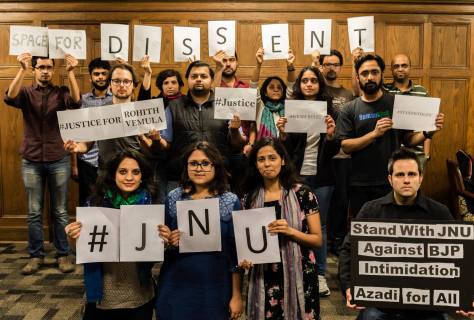
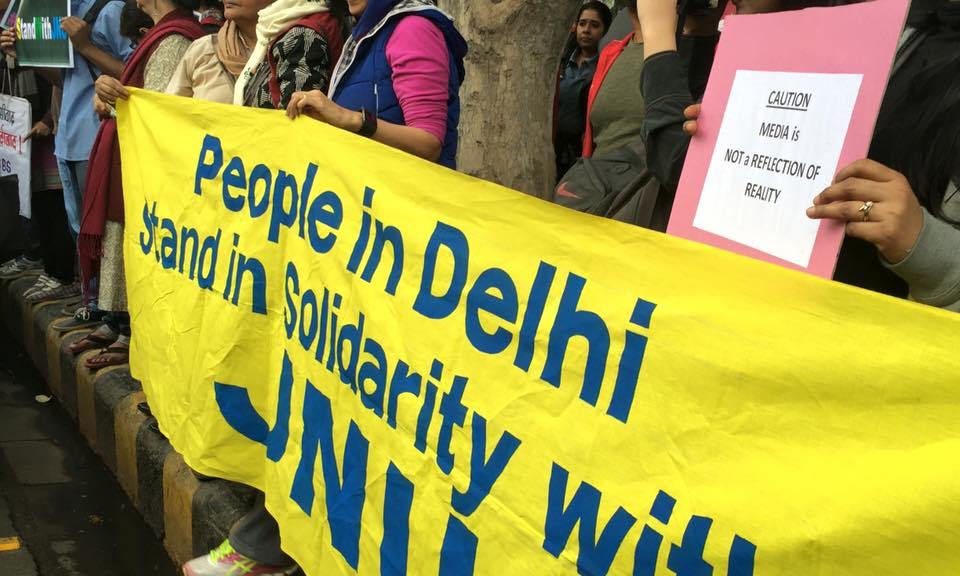
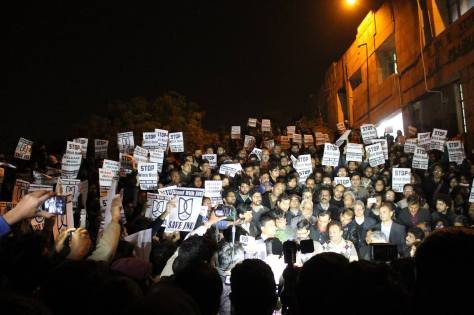
This afternoon saw an amazing, uplifting show of peaceful, joyful strength by students, young people, teachers, friends in Delhi, in support of JNU, in memory of Rohith Vemula, in solidarity with Kanhaiya, Umar and all the students in JNU who are being so stellar in their principled opposition to this evil, venal Modi regime. Reports of massive protests are coming in from Kolkata, Russia to and elsewhere. Something is changing in the air.
It was a perfect spring afternoon, overcast like our times, but breezy like our morale. There must have been at least 15,000 people on the march today. We met old and long lost friends and made new ones.

The gathering was totally peaceful. Young  women and men, student profits from JNU in the eighties, grey haired, felt young again as their student held aloft flowers, flags, signs and homemade banners. Everyone looked their best, as if they had come to a massive street party.

It was so infectious, the mood this afternoon, such a contrast to the vile bad temper of the men who attacked Kanhaiya and his supporters two days in a row at the Patiala House Courts two days in a row that the difference between two entirely different visions of politics was palpable on your skin. The contrast sent a clear message to all our senses.

The RSS-ABVP-BJP brand of politics is diseased. It’s on its last legs and that is why it is so desperate. It cannot perform, it has no ideas, it is morally and culturally bankrupt.

Universities are in crisis and all that the bad TV actress who makes a joke of her ministry (HRS) every day can think of today while thousands March against her and her boss is about sticking giant flagpoles into the ground and stitching gigantic silk shrouds for her  government and her party.

Modi, Rajnath and Manusmriti Irani should quake in fear. Their time is up.

Very proud of JNU students and the people of Delhi today.

#StandwithJNU #StandwithKanhaiya

#StandwithUmar

#Standwithallstudents

#NowitchHuntofStudents

Solidarity with JNU and Conversations on Kashmir: JKCCS

Guest Post by Jammu Kashmir Coalition of Civil Society

Jammu Kashmir Coalition of Civil Society (JKCCS) expresses its solidarity with the striking students and teachers of Jawaharlal Nehru University, New Delhi. We have watched with a sense of horror and dismay, the violent criminalizing of student democracy and dissent, not just at Jawaharlal Nehru University but across Indian campuses in the recent past. Having long and intimate knowledge of violent repression and legalized impunity that Indian state is capable of, especially against those it considers ‘anti-national’ we are not surprised by these events, but have a special empathy with all who suffer its horrors. We demand the release of all student dissenters and political prisoners in the custody of the Indian state, and an end to acts of policing and surveillance on campuses, and targeting of students on the basis of political beliefs and speech.

The Kashmiri students in different colleges and universities in India, who have always faced discrimination and intimidation time to time, are now feeling the extreme regressive and oppressive means used by right wing groups and the government. After being hounded, Kashmiri students have begun leaving Delhi. There are several places where the landlords, in whose properties Kashmiri students were renting flats, have asked the students to vacate. These experiences of Kashmiri students are part of the larger reality faced by Kashmiri youth in Jammu and Kashmir and in India. The voices of dissent in Jammu and Kashmir have been dealt with administrative detentions under Public Safety Act, illegal detentions, torture, surveillance and killings by armed forces including the most recent one of Asif and Shaista at Pulwama on 14th of February.

We also view with alarm, the reports about the cynical use of Kashmiri students studying in Delhi as hostages in the politically illegitimate process of government formation in Srinagar.

We are dismayed that the public narrative about the recent events has often descended into disputes over Indian ‘patriotism’ and the shrill condemnation of a few ‘fringe’ ‘radical’ ‘traitors’ for ‘irresponsible’ slogans. These sentiments are neither mere slogans nor represent the ‘fringe’ in Kashmir, the very place they were made in reference to. As Kashmiris, we believe that the right to self-determination is inseparable from the right to political association, dissent and free expression, and these rights cannot be selectively asserted or upheld. In the competitive public proclamations of nationalistic credentials, what has been lost is that courageous act of defiant solidarity with the Kashmiri people’s struggle for justice and self-determination, that lies at the heart of these debates. Despite the disavowals and the state repression, the solidarity with the political rights of the Kashmiris is growing and spreading, as events in Jadavpur University demonstrate. We acknowledge the emerging spaces in Indian civil society to converse on the question of Kashmir, beyond nationalist framings. We hold out hope for future alliances with students, groups and individuals willing to engage in honest conversations, in which they alone do not determine the boundaries of what can or cannot be said, thought or felt.

Spokesperson
JKCCS

“A Glorious Thing Made Up Of Stardust:” What Pat Parker & Rohith Vemula Ask Us to Consider Lata Mani

This is a guest post by LATA MANI

The first thing you do is to forget that I’m black
Second, you must never forget that I’m black

Pat Parker (1978)

In these opening lines of her poem, For the White Person Who Wants to Know How to be My Friend, Pat Parker names a paradox at the heart of challenging socially produced difference. Parker is speaking not to diversity in nature, nor to the diversity of nature. Not to the variations of appearance – size, shade, height, foliage, texture; or mode of expression – hoot, howl, accent, gesture, cultural practices. Her lines address a uniquely human phenomenon: prejudice. They speak to the poignant difficulty of challenging a spurious and malevolent construction of racial difference in a society still in the grip of its miasma.

I have recalled Parker’s lines many times in the days of sorrow, tumult and righteous rage that have followed Rohith Vemula’s suicide. “Rohith Vemula’s suicide.” I am holding off from saying “Dalit scholar Rohith Vemula’s suicide.” Or, as is now being said with good reason, “Dalit scholar Rohith Vemula’s institutional murder.” I defer by a couple of sentences a description of him that refers to the caste into which he was born; to honour if only symbolically his anguish that the contingent facts of his birth had indelibly defined his life.

Continue reading “A Glorious Thing Made Up Of Stardust:” What Pat Parker & Rohith Vemula Ask Us to Consider Lata Mani

#NoDissentNoCOUNTRY #StandwithJNU

Bol ke labh azad hain tere: Speak for your lips are yet free

Eleanor Newbigin, SOAS, University of London

A full Hindi transcript and video of Kanhaiya Kumar’s speech is available here:http://kafila.org/2016/02/15/jnusu-president-kanhaiya-kumars-speech-before-being-arrested/

An English translation can be accessed here: http://www.telegraphindia.com/1160216/jsp/frontpage/story_69576.jsp#.VsVc8HQrK8r

Statements of Solidarity For JNU From Various Quarters

We at Kafila have been receiving amazing statements of solidarity with JNU and its elected students’ President Kanhaiya Kumar over the past three days. We are posting them below, along with affiliations: South Asia University (teachers and students); Grinnell College, USA, Ambedkar University Delhi Faculty Association, Democratic Teachers Network, Hyderabad, and over a hundred students from Department of English, Delhi University.


STUDENTS OF SOUTH ASIA UNIVERSITY

We, the students of South Asian University, New Delhi (comprising of students from eight SAARC nations – Afghanistan, Bangladesh, Bhutan, India, Maldives, Nepal, Pakistan and Sri Lanka) strongly oppose the idea that one’s nationalism be defined in terms of hatred towards another nation (for example, Indian nationalism be defined as hatred towards Pakistan, or vice versa). We cherish the common cultural and social heritage of the South Asian region, and shall not let any kind of jingoist nationalism being endorsed by any religious group, political party or state hinder our shared solidarity. However, in recent times, such groups and establishments have unleashed an attack on democratic and critical voices in our universities across the South Asian region, masked under religious conformity, state intervention or sometimes in the form of an act of terrorism.

Thus, we stand in complete solidarity with the student and faculty community of Jawaharlal Nehru University (JNU) in their collective struggle against the ongoing police intervention by slapping the baseless charges of sedition on many students, including the arrest of JNUSU President – Kanhaiya Kumar, and against the massive propaganda terming the JNU as ‘a den of anti-nationals’. We would like to reiterate that our collective nationalism stands responsible only to the interests of our people and our land, and not to the divisive forces which have had and are still trying to create boundaries between us.

STATEMENT OF SOLIDARITY WITH STUDENT PROTESTS IN INDIA, FROM STUDENTS, FACULTY, AND STAFF OF GRINNELL COLLEGE

Grinnell-JNU Solidarity

Continue reading Statements of Solidarity For JNU From Various Quarters

On framing JNU for an imaginary crime: Aditya Sarkar

This is a guest post by ADITYA SARKAR

JNU has entered an indefinite state of siege. Police have been swarming all over campus, raiding hostels, picking up students and interrogating them. The ABVP, predictably, have been directing them to the lairs of ‘anti-national elements’. When immense demonstrations of public solidarity with the accused students were organized, ABVP activists have attacked these, in one case mounting a violent physical assault on a visiting speaker. The JNU administration has gone to the extent of cutting off the power supply to the microphones used at a protest meeting. At Patiala House on Monday the 15th of February, the BJP’s MLAs and what appear to be a group of lawyers have assaulted JNU students, faculty and supporters in full view of the police, with what can only be regarded as smug impunity. More than one observer has remarked that this is the Emergency all over again.

It is clear that the arrayed forces of the central government are pitted against a campus which has long been an object of hatred for the Right. There’s no telling how matters will develop in the days and weeks to come. So it might be necessary to step back a bit and consider the sequence of events that led to the current situation.

In the past month, JNU students organized a protest meeting which raised the issue of Kashmiri rights, and drew attention – just as Rohith Vemula’s protest in Hyderabad had done – to the execution of Afzal Guru in 2013. Since the mainstream news outlets systematically censor any attempt to reopen that extremely murky case, it’s worth reminding ourselves of precisely why the execution was so controversial. The terrorist attack on Parliament in December 2001 produced a police investigation on which serious doubt was cast from the beginning. Afzal Guru’s laptop and mobile phone, key pieces of evidence, had not been sealed prior to investigation. One of the other accused in the case, a Delhi University lecturer (who was later emphatically acquitted) was viciously framed by Zee News, which used the police charge-sheet to make a documentary ‘establishing’ his guilt. The court proceedings were even more revealing. The Supreme Court admitted that there was no hard evidence to conclusively establish Afzal Guru’s involvement in criminal conspiracy. But these admissions were merely qualifications to what was perhaps the most extraordinary decision in the history of the judiciary in independent India. Afzal Guru was eventually hanged in 2013 on the basis that only this would appease ‘the collective conscience of the nation society’.

Continue reading On framing JNU for an imaginary crime: Aditya Sarkar

Some thoughts on love in times of hate – from a JNU student : Pallavi Paul

Guest Post by Pallavi Paul

As I comb through the deluge of responses and opinions  that have been circulating on television, social media, newspapers and conversations  over the arrest of JNUSU president Kanhaiya Kumar, there is one particular fear that sticks out repeatedly. The fear  of JNU being a ‘transformative’ space. Where young and innocent minds are changed. The question that follows then is- changed into what? Even as we see ABVP students vociferously defending police action on all media platforms, the Sanskrit department continuing with classes in spite of the call for strike in support of Kanhaiya and faculty members like Hari Ram Mishra (CSS) issuing media statements against the student agitation currently underway- the simple formula that JNU transforms its students into ‘anti-national’ elements (going by the current interpretation of the term) begins to appear erroneous. In addition to having a culture of critical thinking, debate, questioning and radical left politics – JNU has also had an equally dynamic history of Hindutva and Brahaminical politics. For every protest on Afsal Guru there is a Guru Dakhshina Karyakram, for every Sitaram Yechury addressing students there is an Ashok Singhal (who visited the campus in 2002 even amidst intense protests). This fear then, if seen clearly begins to appear more and more abstract. It bases itself on a ‘sense’ of the campus- rather than its actual political fiber. Infact if one hears carefully it is the larger fear of things changing, things changing irreversibly.

Continue reading Some thoughts on love in times of hate – from a JNU student : Pallavi Paul

JNU Bashing is an old pastime, but things just got much, much worse

In light of the glorious vigilantism being witnessed today, in which the lumpen lawyers at Patiala House are joining hands with Guardian of the Nation Horn-nob Go-Swamy on primetime TV A few years ago, finding myself in a heated but very enjoyable argument on why women change their surnames after marriage, somebody yelled from across the room, “What has JNU done to you?!”

I wasn’t surprised, only annoyed. Reducing my entire biography and political beliefs to an institution I attended once upon a time is a favourite pastime in India, when that institution happens to be JNU. I could have explained to the genius who shouted this that if I do have political opinions, neither were they surgically implanted in me at JNU nor will they wither away like the bourgeois state in Marxism if JNU ceases to exist. I should have been grateful that the JNU-phobia was posed through the formal courtesy of a query. Usually, it takes the form of a statement, “You JNU folk are all lunatics!”

In family settings, JNU-bashing is the preferred insult to shut down an argument, “It’s the JNU in you speaking!” At seminars, a question or a paper can be made illegitimate with the simple investigative exercise of determining if you’re from ‘a particular institution with a particular ideology’. Of course, the person asking the question has miraculously escaped institutions and ideology, remaining gloriously neutral in this fractured world.

Continue reading JNU Bashing is an old pastime, but things just got much, much worse

Fearless Minds and Heads Held High: To the CDS Student Community


Dear Friends

Ever since the Hindutva right-wing attacks on the country’s youthful citizens intensified – from the Kiss of Love protests to the attacks on politicized dalit youth on the campuses of IIT Madras and HCU, and now, against JNU – we have come together several times as a group to defend our right to critical thinking, action, and speech and protest against atrocities in the name of national interest and culture. We have come out not to defend our petty interests but in defense of the Indian Nation as we imagine it – differently from the right-wing – as belonging to  the communities of peasants, workers, students, artisans, dancers, singers, small traders, and thousands of other groups that contribute to the economy of this country, as the homeland of vast sections of underprivileged people denied humanity in the name of caste, class, culture, ethnicity and gender. Continue reading Fearless Minds and Heads Held High: To the CDS Student Community

Spring Comes to JNU : Love, Laughter and Rage

A Small Fragment of the Human Chain in JNU, 14th February, 2016

February is a beautiful time of the year in Delhi. It inaugurates Basant, spring, the season for love. And it is made more beautiful by an incandescent, insurgent spirit, that spreads in the air like a loving contagion, especially around what the Hindu Right rehearses for months on end to spoil – the new found festival of Valentine’s Day.

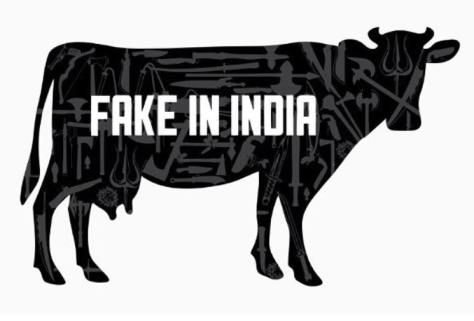
Traditionally (or at least since as long ago as the late twentieth century CE), on Valentine’s Day, the loony Hindu right goes looking for lovers in the parks of Delhi and tries to ply its own line in the extortion trade. This time, they have been joined by some big guns. The Delhi police descended on some young people belonging to a theatre group who had stepped out to have tea during a poetry reading at the IGNCA on the grounds that they ‘looked like they were JNU students’. Meanwhile, their boss, the Honorable Union Home Minister Rajnath Singh (who deserves a Bharat Ratna all by himself for skills as a performance artist) regaled a press conference with a poker faced comic act –  his revelation of the Lashkar e Taiba’s links to the JNU protests on the basis of the discovery of a fake twitter handle. The fact that Rajnath Singh still has his job is because his boss Narendra Modi, our ‘dear leader’, is the chief architect of  the ‘Fake in India’ campaign.

Holy Cow
Holy Cow (courtesy, ‘Guess Who’)

One needs love, and laughter, plenty of laughter, to survive these times, and the antics of these men. Over the last two days, it is love, laughter, sorrow and rage, in equal proportion that have been most evident in the JNU campus in Delhi. Their signs were evident again, appropriately,  yesterday, on Valentine’s Day. A student population of thousands has been able to transform its rage at the capitulation of the recently appointed vice-chancellor and his cronies to the diktats of an incompetent home minister and his minions in the Delhi Police apparatus into a deep and abiding sense of good humoured solidarity. This is demonstrated by the support that they have readily offered Kanhaiya Kumar, the president of their students union, who is currently detained, facing ridiculous charges of sedition, and several other students, including some JNUSU office bearers, who the police are still reportedly hunting for. The hashtag #StandwithJNU has gone viral, spreading, connecting, bringing people together like the sudden awakening of spring after a cruel winter. What better way can there be of celebrating Valentine’s Day than to declare, en masse, a love for liberty, and for learning?

Continue reading Spring Comes to JNU : Love, Laughter and Rage

Who’s Afraid of JNU? Or, The Sedition That Wasn’t: Sania Hashmi

This is a guest post by SANIA HASHMI

JNU Sedition

Over the past couple of days, Zee News has been declaring to the world that Lance Naik Hanumanthappa died because he’d rather not breathe the same air as we at JNU do. That this statement is the worst possible trivialisation of a martyr’s death which is being exploited for petty sensationalism by our own version of the fourth estate is a separate issue, too nerve-wracking to be given precedence over the tragedy that unfolded in our campus yesterday with the arrest of our democratically-elected President Kanhaiya Kumar. A Zee News screen grab showed the word ‘Deshdrohi’ in 72-pt screeching yellow font pasted across Kanhaiya’s unsuspecting face. What was his fault? As an eyewitness from ground zero who was present at Sabarmati at the time of the protest, let me begin by answering the obvious questions that despite the numerous clarifications on part of the students and the JNUSU on social media and elsewhere are meeting deaf ears. It is interesting how despite being told that the Students Union and the student body in general had nothing to do with it and have in no uncertain terms condemned any alleged slogan against our country, the trolls are still putting decibels to shame with the very same questions. And no, I am not just talking about Nupur Sharma. So yes, let me begin by putting a few things on record in respect of Kanhaiya’s arrest. Did Kanhaiya organise the event? NO. Did he raise anti-India slogans? NO. Did he hail Pakistan? NO. Did he intervene to prevent ABVP-instigated violence in his capacity as the President? YES. Has he been vocal against the brahmanical tyranny of the RSS? YES. Has he been tirelessly fighting for the Rohith Vemulas of this world? YES. Has he been a torchbearer for students’ rights across the country? YES. Is this why you have arrested him? Is this your justice? If this struggle for a just society is anti-national in your eyes, we all plead guilty! If this is your witch-hunt for people who cannot conform to your ideological blinkers, we all plead guilty! If we must be party to the violent hooliganism of the ABVP in order to be called patriotic, rest assured, we all plead guilty!

WATCH KANHAIYA KUMAR’S SPEECH HOURS BEFORE HIS ARREST TO SEE WHAT THE GOVERNMENT OF INDIA CONSIDERS ANTI-NATIONAL. Clearly, Kumar’s fault was that he said in this speech that he doesn’t need the RSS’s certificate to be called a nationalist.

Continue reading Who’s Afraid of JNU? Or, The Sedition That Wasn’t: Sania Hashmi

Statement by Educators, Intellectuals, Artists and Writers on Police Action in JNU

We, the undersigned, (educators, professors, intellectuals, writers and artists), are shocked by the appalling conduct of Delhi Police at Jawaharlal Nehru University in New Delhi yesterday. We also condemn the irresponsible sloganeering by some people at the fringes of a gathering on the JNU campus to mark the third anniversary of the execution of Afzal Guru. We believe that such calls to ‘war, until the destruction of India’ erode the gravity of any serious discussion on any political question, be it capital punishment, human rights or even the question of self-determination. Such conduct is shameful, regardless of who does it, and deserving of the sharpest criticism.

That said, the only way to counter such incidents, when they occur, is through a deepening of dialogue, not through police action. The police has no business to enter places of learning and harass students (including students who were clearly trying to defuse the situation and to take a stand against the irresponsible elements who gave the objectionable slogans) when there had been no breach of peace.

We condemn the arrest of Kanhaiyya Kumar, president of the Jawaharlal Nehru University Students Union on trumped up charges of sedition and demand that he be released immediately. Kanhaiyya’s public statements, which are widely available, clearly show that sedition is the last thing that you can charge him with. The University Authorities must take steps to ensure that the witch hunt that is ensuing against other students must also cease immediately. We demand that there be no more arrests of students. We are saddened by the new JNU Vice Chancellor’s readiness to submit to the diktats of the police, and we condemn the totally outrageous statements by the Union Home Minister Rajnath Singh, and the Minister for Human Resources Development Smriti Irani which virtually declare war on universities as spaces for dissent and debate.

We demand an unconditional withdrawal of police personnel from campuses, and reiterate our support and solidarity with the students, faculty and staff of JNU, and with students everywhere in India who are pursuing a courageous resistance against the ongoing assault on higher education unleashed by the BJP government.

Aditya Nigam, Professor, Centre for the Study of Developing Societies, Delhi

Ashis Nandy, Distinguished Fellow, Centre for the Study of Developing Societies, Delhi

Bharti Kher, Artist, Delhi

Debjani Sengupta, Associate Professor, Department of English, Indraprastha College, Delhi University

Gauri Gill, Artist, Delhi

Gayatri Sinha, Curator, Delhi

Geeta Kapur, Curator, Delhi

Iram Ghufran, Filmmaker, Delhi

Jeet Thayil, Poet, Delhi

K. Satchidanandan, Poet, Delhi

Karen Gabriel, Department of English, St. Stephen’s College, Delhi University

Lawrence Liang, Alternative Law Forum, Bangaluru

Moinak Biswas, Professor, Department of Film Studies, Jadavpur University, Kolkata

Nancy Adajania, Curator, Mumbai

Nandini Datta, Associate Professor, Miranda House, Delhi University

Neha Choksi, Artist, Mumbai

Nivedita Menon, Professor, Centre for Comparative Politics & Political Theory, School of International Studies, Jawaharlal Nehru University, Delhi

P.K.Vijayan, Department of English, St. Stephen’s College, Delhi University

Pallavi Paul, Artist/Filmmaker, Delhi

Parnal Chirmuley, Associate Professor, Centre of German Studies, School of Language, Literature and Culture Studies, Jawaharlal Nehru University, Delhi

Pratiksha Baxi, Associate Professor, Centre for the Study of Law and Governance, Jawaharlal Nehru University, Delhi

Rajarshi Dasgupta, Assistant Professor, Centre for Political Studies, Jawaharlal Nehru University, Delhi

Rajeev Bhargava, Professor, Centre for the Study of Developing Societies, Delhi

Ravi Sundaram, Professor, Centre for the Study of Developing Societies, Delhi

Ravi Vasudevan, Professor, Centre for the Study of Developing Societies, Delhi

Romila Thapar, Historian, Emeritus Professor, Jawharalal Nehru University

S. Kalidas, Critic, Delhi / Goa

Sahej Rehal, Artist, Mumbai

Sabina Kidwai, Associate Professor, AJ Kidwai Mass Communication Research Centre, Jamia Millia Islamia, Delhi

Sabeena Gadihoke, Associate Professor, AJ Kidwai Mass Communication Research Centre, Jamia Millia Islamia, Delhi

Sanjay Kak, Filmmaker, Delhi

Sarnath Banerjee, Artist, Delhi / Berlin

Saumyajit Bhattacharya, Associate Professor, Department of Economics, Kirori Mal College, University of Delhi

Sibaji Bandyopadhyay, Fellow, Centre for the Studies of Social Sciences, Kolkata

Shohini Ghosh, Professor, AJ Kidwai Mass Communication Research Centre, Jamia Millia Islamia, Delhi

Shuddhabrata Sengupta, Artist, Raqs Media Collective, Delhi

Subodh Gupta, Artist, Delhi

Sumit Sarkar, Historian, Formerly Professor, Department of History, Delhi University

Tanika Sarkar, Historian, Formerly Professor, Centre for Historical Studies, Jawaharlal Nehru University, Delhi

Vivan Sundaram, Artist, Delhi


PLEASE SIGN AND SHARE WIDELY BY VISITING THIS PETITION PAGE ON CHANGE.ORG

Restore Normalcy in JNU, Release All Detained Students, Delhi Police Quit JNU

12716438_10153221773131150_2421721007167708352_o
Students, Professors and Staff of JNU Stand Together in Protest on February 12, 2016 against the Police Action on Campus and the Assault on JNU by ABVP-BJP

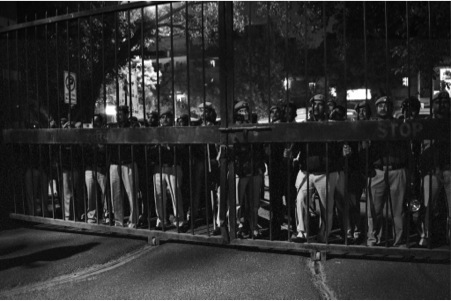
In an unprecedented and draconian move, Delhi Police personnel entered the precincts of Jawaharlal Nehru University in Delhi yesterday afternoon, and began a search operation based on malicious complaints against ‘unnamed persons’ filed by a Delhi BJP leader in response to an event titled – ‘Country Without a Post Office’ – organized by some students to commemorate and protest against the execution of Afzal Guru on February 9th.

Continue reading Restore Normalcy in JNU, Release All Detained Students, Delhi Police Quit JNU

Operation Ekalavya : Jhandewala, New Delhi, Rohith Vemula’s Birthday, 30th January 2016

Dear young friends who went to Jhandewala on Rohith Vemula’s birthday,

a1078-rohit-facebook-and-storysize_647_011816123527

And all those who were there in spirit, in Delhi, Hyderabad and elsewhere. I am writing to you because I think you might have all taken things much further than anyone can quite imagine or understand at present.

I am writing to you, for today and for tomorrow, so that every time in the future that young people gather to celebrate their friend Rohith’s birthday, we might all begin to have a different kind of conversation. So that the boundaries between mourning and celebration, between anger and joy may always remain blurred enough for us to know what to do next, each time.

Since you had a close encounter with the police and their colleagues in the RSS on Rohith’s birthday, I want to spend a little time thinking about them with you. Bear with me. I sincerely hope we will not have to bear with them for much longer.

Continue reading Operation Ekalavya : Jhandewala, New Delhi, Rohith Vemula’s Birthday, 30th January 2016

Reclaiming academia: understanding the student movement of our time: Tony Kurian and Suraj Gogoi

This is a guest post by TONY KURIAN and SURAJ GOGOI

Students from different parts of the country started protesting since a Dalit student from one of the premier universities of the country (University of Hyderabad) committed suicide on account of caste discrimination by the administration. This new wave of protests can be traced back to Occupy UGC which erupted when University Grants Commission (UGC) decided to stop the monthly research stipend known as non-net fellowship of Rs 5000 and 8000 for MPhil and PHD respectively. The ministry concerned has since constituted a panel to review the decision on account of student’s protests. On the other hand, we are seeing India becoming part of World Trade Organization (WTO) agreement on higher education. These instances should not be regarded as isolated moments but should be viewed as an integral part of a story unfolding. It is in this context that one should locate the student movement of our time. The movement itself is receiving much media attention, and, it was mostly couched as a student’s movement against the government. For sure, the immediate demands of the students is to ensure justice to Rohith Vemula. The present wave of student movement is aimed at reclaiming academia both from an exclusivist culture which permeates much of our academic institutions, and increasing influence of free market logic in our higher education.

 Why are we seeing a new wave of student protests?

To understand why a movement like that we are witnessing now is extremely important for a vibrant and democratic academic space, we should explore some of the unwritten rules of academia itself and our academic institutions. Research is a long-term investment for the person who undertakes it. Every day he or she spends as a full time researcher is a day forgone from the job market. For a research scholar to earn a permanent job, it can take anywhere between five to ten years after the master’s programme.

Continue reading Reclaiming academia: understanding the student movement of our time: Tony Kurian and Suraj Gogoi

“Nobody killed Rohith Vemula”: Kishalaya Mukhopadhyay

This is a guest post by KISHALAYA MUKHOPADHYAY

“Nobody killed Rohith Vemula”. Perhaps someday there will be a film like this. Perhaps someday people will start talking about the exploitation of dalits, the need for annihilation of caste, the systematic discrimination in all spheres of society including the government, corporate, bureaucratic and educational sectors. Perhaps caste as an analytical category will become as politically charged as gender has become post-Nirbhaya. Today there is a discourse around marital rape, victim blaming, domestic violence and other aspects of patriarchy that has transcended even if slightly only the small coterie of feminist scholars within whom this discourse used to be limited to. Continue reading “Nobody killed Rohith Vemula”: Kishalaya Mukhopadhyay

The Need for Black-South Asian Solidarity: Lavanya Nott

This is a guest post by LAVANYA NOTT

In February 2013, George Zimmerman, a 28-year old neighbourhood watch coordinator in Sanford, Florida, stalked and fatally shot 17-year old unarmed Trayvon Martin, an African-American high school student. In July of that year, Zimmerman was acquitted of his crime.

On August 9, 2014, unarmed Black teenager Michael Brown was shot several times by police officer Darren Wilson in Ferguson, Missouri after Brown stole several packs of cigarillos from a neighbourhood store. In late November of that same year, a grand jury did not indict Wilson of his crime.

The Black Lives Matter movement began after Zimmerman’s acquital, and the Ferguson non-indictment saw the movement surge forward, with thousands of citizens taking to the streets all over the United States in protest. In the months that followed, the movement gained rapid momentum, spurred on by yet another non-indictment—that of a White police officer in Staten Island who put 43-year-old Eric Garner in a fatal chokehold in broad daylight, without provocation. His death was ruled by a medical examiner as a homicide, but his killer Daniel Pantaleo escaped indictment.

In mid-September 2015, Mohammad Akhlaq’s house in Dadri was broken into, his family attacked, and his life taken by a rampaging mob of RSS workers who were responding to a rumor that Akhlaq killed a cow and subsequently consumed its meat on Eid.

Less than a month later, a gang of upper-caste Rajputs set fire to the house of a sleeping Dalit family, killing two-year-old Vaibhav and his nine-month-old sister Divya. This attack, in BJP-ruled Faridabad, was set against the backdrop of a long-standing caste-related dispute between the Dalit and Rajput communities in the city.

Continue reading The Need for Black-South Asian Solidarity: Lavanya Nott

മണ്ണാങ്കട്ടയും വേണ്ട, കരിയിലയും വേണ്ട: ഷഫീക്കിന് ഒരു തുറന്ന കത്ത്

പ്രിയ ഷഫീക്ക്


ഈയാഴ്ചത്തെ മാതൃഭൂമി ആഴ്ചപ്പതിപ്പു കണ്ടപ്പോൾ നിങ്ങൾക്ക് ഇങ്ങനെ ഒരു കത്ത് എഴുതണമെന്നു തോന്നി. സത്യത്തിൽ ഈ ലക്കം ആദ്യം മറിച്ചുനോക്കിയപ്പോൾ പത്രമിടുന്നയാൾക്ക് തെറ്റുപറ്റി ദേശാഭിമാനി വാരിക കൊണ്ടിട്ടോ എന്നു സംശയിച്ചു പോയി. എന്നാൽ സാവധാനം വായിച്ചപ്പോൾ ഒരു കാര്യം പിടികിട്ടി – ഈ ലക്കത്തിലെ താരം മറ്റാരുമല്ല, താങ്കൾ തന്നെ. പച്ചയ്ക്കങ്ങു പറഞ്ഞില്ലെങ്കിലും ഇന്ന് മാനവ-അമാനവസംഗമവക്താക്കൾ ഒരുപോലെ ഭയപ്പെടുന്ന വ്യക്തി ഷഫീക്കാണ്.

അത് നല്ലതോ എന്നെനിക്ക് തിട്ടമില്ല, പക്ഷേ എന്തായാലും ചീത്തയല്ല. അവിടെയും ചില പ്രധാനപ്പെട്ട വ്യത്യാസങ്ങളുണ്ട്. മാനവസംഗമപ്രവർത്തകർ നിങ്ങളുയർത്തിയ പ്രതിഷേധത്തെ മറച്ചുകളയുകയോ അമാനവരുടെ വശത്തേയ്ക്ക് പരോക്ഷമായി തള്ളുകയോ ചെയ്തപ്പോൾ അമാനവസംഗമപ്രമുഖൻ താങ്കളെ തിരിച്ചറിവു കുറഞ്ഞ ഒരു പാവമാക്കി. അഭിനന്ദനങ്ങൾ. നാം ജീവിക്കുന്ന ഈ കാലങ്ങളിൽ സർവ്വസമ്മതരാകുന്നതല്ല രാഷ്ട്രീയസർഗ്ഗാത്മകതയുടെ ലക്ഷണം. വിഷമപ്രശ്നങ്ങൾ ഉന്നയിക്കാനുള്ള കഴിവാണ് അതിനാവശ്യം. അതുള്ളതുകൊണ്ടാണ് നിങ്ങളെ പലവിധത്തിൽ പുറന്തള്ളാൻ മാനവരും അമാനവരും ഇത്ര തിടുക്കപ്പെടുന്നത്.

എ എം ഷിനാസും എൻ പി ജോൺസണും കെ കെ ബാബുരാജും തമ്മിലുള്ള വ്യത്യാസങ്ങളെ അവഗണിക്കുന്നില്ല. ഷിനാസ് ക്രിസ്റ്റഫർ ഹിച്ചൻസിൻറെ നാടൻ പതിപ്പായാണ് ആഴ്ചപ്പതിപ്പിൽ അവതരിച്ചിരിക്കുന്നതെങ്കിൽ (ഐജാസ് അഹമ്മദ് പറഞ്ഞതുകൊണ്ടു മാത്രം ഇസ്ലാമോഫാസിസം എന്ന പദത്തിൻറെ അർത്ഥസൂചനകൾ നിരുപദ്രവകരമാകുന്നില്ല) ജോൺസൺ ഇരുപത്തിയൊന്നാം നൂറ്റാണ്ടിൻറെ സാഹചര്യങ്ങളിൽ സ്ത്രീവിമോചനദൌത്യമേറ്റെടുത്ത കേരളീയനായ പുരുഷ സാമൂഹ്യപരിഷ്ക്കർത്താവാണ്. ബാബുരാജാകട്ടെ, ഇവരുടെ ബദ്ധവൈരിയായാണ് പ്രത്യക്ഷപ്പെടുന്നത്. നിങ്ങൾ പക്ഷേ മൂന്നുപേർക്കും ഒരുപോലെ ശല്യക്കാരനാണ്.
ഈ മൂന്നു ബുദ്ധിജീവികളും ഇരുപതാം നൂറ്റാണ്ടിലെ മലയാളപുരുഷബുദ്ധിജീവിയുടെ പല സ്വഭാവങ്ങളും പ്രദർശിപ്പിക്കുന്നുവെന്നും വ്യക്തം. ഫാസിസത്തെ ഇരപിടിയൻ-ശിങ്കിടി മുതലാളിത്തത്തോടും ന്യൂനപക്ഷ മതസ്വത്വങ്ങളോടും കീഴ്ജാതിസ്വത്വങ്ങളോടും അവർക്കിഷ്ടമില്ലാത്ത മിക്കതിനോടും, കാര്യമായ സാധൂകരണമൊന്നും കൂടാതെ ബന്ധിപ്പിക്കുന്നൂ മാനവപക്ഷക്കാർ. ഈ പ്രതിഭാസങ്ങളെക്കുറിച്ച് ഇന്ന് നിലവിലുള്ള അതിബൃഹത്തായ പഠനസാഹിത്യത്തെ ആഴത്തിൽ സ്പർശിക്കാൻ മെനെക്കെടാതെ, മറുപക്ഷത്തെ ലളിതവത്കൃത കോമാളിഛായകളാക്കി താഴ്ത്തുന്നതിൽ ലേശവും മടി കാട്ടാതെ, തങ്ങളുടെ ബോദ്ധ്യങ്ങൾ വായനക്കാരുടെ മുന്നിൽ വീശിയെറിയുന്നൂ അവർ. ചുംബനസമരത്തിലെ അസൌകര്യകരമായ വിശദാംശങ്ങളെയും ശബ്ദങ്ങളെയും പച്ചയ്ക്കു തന്നെ ഒഴിവാക്കി തനിക്കുതകുന്ന വിധത്തിൽ ആ സമരത്തിൻറെ ചിത്രം ചമയ്ക്കാൻ മറ്റൊരാൾക്ക് തെല്ലും മടിയില്ല. തങ്ങളുടെ ആന്തരിക’പരിശുദ്ധി’യെ ചോദ്യം ചെയ്യാനിടയുള്ള ഒന്നിനെയും വെച്ചുപൊറുപ്പിക്കില്ലെന്ന ശാഠ്യവും ഇരുകൂട്ടരിലും ഒരുപോലെ ശക്തം തന്നെ. വളരെ തയ്യാറെടുപ്പുകളൊന്നും കൂടാതെ തങ്ങളുടെ ബൌദ്ധിക ‘ഭീരങ്കികൾ’ നിറയൊഴിച്ച് സർവ്വരേയും വിറപ്പിക്കാൻ ഇവർക്ക് കഴിയുന്നതിനു പിന്നിൽ ആ മലയാളി (ആൺ) റാഡിക്കൽ ജീനിയസ് അവബോധം തന്നയല്ലേ എന്നു സംശയിച്ചു പോകുന്നു. അത്തരം തയ്യാറെടുപ്പു നടത്തിയിരുന്നെങ്കിൽ ഫാസിസത്തെയും മതത്തെയും സ്വാതന്ത്ര്യത്തെയും അങ്ങനെ പലതിനെയും പറ്റി ഇവർ നടത്തുന്ന ലളിതപ്രസ്താവങ്ങൾ ഇവരുടെ ഉള്ളിൽത്തന്നെ ജന്മമെടുക്കില്ലായിരുന്നു. ഉദാരവാദചിന്തയുടെ ഉച്ചകോടിയിൽ പിറന്ന പിതൃമേധാവിത്വപരമായ ആശയമാണ് ‘പ്രതിഭാശാലി’ എന്നത്. ഗവേഷണപരമായ തയ്യാറെടുപ്പുകൾ കൂടാതെ (അല്ലെങ്കിൽ തങ്ങൾക്ക് സൌകര്യപ്രദമായ പഠനസാഹിത്യത്തെ മാത്രം ആശ്രയിച്ച്, മറ്റുള്ളവയെ ന്യായമായ രീതിയിൽ അഭിസംബോധന ചെയ്യാൻ കൂട്ടാക്കാതെ) ‘ഉൾ-കാഴ്ചകൾ’ തട്ടിവിടുന്ന മലയാളിപുരുഷപൊതുബുദ്ധിജീവികൾ അവലംബിക്കുന്നത് ആ പഴയ ജീനിയസ് മാതൃകയെത്തന്നെ. ലിബറലിസത്തെയും വ്യക്തിവാദത്തെയും വാതോരാതെ അപലപിക്കുന്ന ബാബുരാജു പോലും ജീനിയസ്നാട്യം ബലമായിപിടിച്ചിരിക്കുന്നതുകൊണ്ടാണ് ദലിത് ഫെമിനിസ്റ്റുകളുടെ ഇടപെടലുകളെ പരിഗണിക്കാൻ അദ്ദേഹത്തിനു കഴിയാത്തത്. രേഖാ രാജിൻറെ പേരു പോലും ഓർക്കാൻ അദ്ദേഹത്തിനു കഴിയാതെപോകുന്നതും അതുകൊണ്ടുതന്നെ.

ഹിന്ദുത്വഫാസിസത്തിൻറെ സദാചാരവും നവ ഇസ്ലാമികസദാചാരവും എല്ലാം ഒന്നുതന്നെയെന്ന് മാനവപക്ഷത്തിന് തീർച്ചയാണ്. എന്നാൽ അമാനവപക്ഷത്തു നിലയുറപ്പിച്ച ബാബുരാജ് പോലും പരോക്ഷമായി ഈ നിലപാടല്ലേ സ്വീകരിക്കുന്നതെന്ന് ഞാൻ സംശയിക്കുന്നു. ചുംബനസമരം പൊതുവേ ‘സദാചാര’ത്തിനെതിരെയായിരുന്നെന്ന് അദ്ദേഹം ശഠിക്കുന്നത് വസ്തുതാപരമായിപ്പോലും ശരിയല്ല. ലൈംഗികധാർമ്മികത അനാവശ്യമാണെന്നല്ല, മറിച്ച് ബ്രാഹ്മണഹിന്ദുത്വസദാചാരസമ്മർദ്ദത്തെ ചെറുക്കണമെന്നും കൂടുതൽ ജനാധിപത്യപരമായ രീതിയിൽ ലൈംഗികധാർമ്മികതയെ പുന:സൃഷ്ടിക്കണമെന്നുമാണ് ചുംബനസമരങ്ങൾ ആവശ്യപ്പെട്ടത്. ഏതെങ്കിലും സദാചാരം അനീതിപൂർവിവമാണെന്നു പറഞ്ഞാൽ യാതൊരുവിധ ധാർമ്മികതയും ആവശ്യമില്ല എന്ന് അർത്ഥമാകുന്നില്ല. സദാചാരത്തെ തിരുത്തിയെഴുതാൻ ചരിത്രത്തിൽ നടന്ന സമരങ്ങളെ മുഴുവൻ സദാചാരവിരുദ്ധസമരങ്ങളായി ചിത്രീകരിച്ച് വ്യവസ്ഥാപിതസദാചാരഭീതികളെ ഇളക്കിവിടുക എന്നത് പണ്ടുപണ്ടേ ഉള്ള കാരണവതന്ത്രങ്ങളിലൊന്നാണ് – അതാണ് ബാബുരാജ് പ്രയോഗിച്ചത്.എങ്കിലും സദാചാരമെന്ന് താനെന്താണ് ഉദ്ദേശിക്കുന്നതെന്ന് വ്യക്തമാക്കാൻ അദ്ദേഹം മെനക്കെടുന്നില്ല. നമുക്കറിയാം, ആ സമരം വിമർശിച്ചതു മുഴുവൻ കേരളത്തിലിന്ന് അധീശത്വം കൈയാളുന്ന ബ്രാഹ്മണസദാചാരമൂല്യവ്യവസ്ഥയെ ആണ്. എൻറെ പരിമിതമായ വായനയിൽ ഇസ്ലാമികസദാചാരത്തെ, അല്ലെങ്കിൽ ഇസ്ലാമികസദാചാരത്തിൻറെ സാദ്ധ്യതകളെ, ബ്രാഹ്മണസദാചാരമൂല്യങ്ങളിലേക്കു ചുരുക്കാൻ കഴിയില്ലെന്നാണ് കാണുന്നത്. ഉദാഹരണത്തിന് ഇസ്ലാം ലൈംഗികാനന്ദത്തെ വെറുക്കുന്നില്ല. കുടുംബകാര്യങ്ങളിൽ സ്നേഹത്തിനു കല്പിക്കുന്ന അതേ പ്രാധാന്യം നീതിയ്ക്കും കല്പിക്കുന്നു. വിവാഹത്തെ അനാവശ്യമായി പവിത്രീകരിക്കുന്നില്ല. പുരുഷാധികാരപരമായ വായനകൾക്കാണ്, അവിടെ മുൻതൂക്കമെന്ന് സമ്മതിക്കാം, പക്ഷേ ബ്രാഹ്മണസദാചാരവും എക്കാലത്തും ആവിധം തന്നെയായിരുന്നു. ബ്രാഹ്മണസദാചാരത്തിനില്ലാത്ത സാദ്ധ്യതകൾ ഇസ്ലാമികലൈംഗികധാർമ്മികതയ്ക്കുണ്ടായേക്കാം എന്നതുകൊണ്ടുതന്നെ അതിനെ ബ്രാഹ്മണസദാചാരത്തിലേക്ക് ചുരുക്കുന്നത് തീരെ ആശാസ്യമല്ല.

ഒന്നുകിൽ ബാബുരാജിന് അതു കാണാൻ താത്പര്യമില്ല; അല്ലെങ്കിൽ ഇന്ന് കേരളത്തിലെ നവ ഇസ്ലാംപക്ഷങ്ങൾ ഉന്നയിക്കുന്ന ലൈംഗികധാർമ്മികതയും ഹിന്ദുത്വ-ബ്രാഹ്മണലൈംഗികധാർമ്മികതയും മൂർത്തരൂപത്തിൽ ഒന്നുതന്നെ എന്നദ്ദേഹം സൂചിപ്പിക്കുന്നു! ഇസ്ലാംലൈംഗികാനന്ദത്തെ വെറുക്കാത്തതുകൊണ്ട് ചുംബനസമരക്കാരുന്നയിച്ച പുതിയ ലൈംഗികധാർമ്മികതയോട് അതിനാണ് (അതിൻറെ പുരുഷാധികാരവ്യാഖ്യാനങ്ങളെ കണക്കിലെടുത്താൽ പോലും) കൂടുതൽ അടുപ്പം.അത്തരം സംവാദങ്ങൾ ഉണ്ടാകാതെ ബ്രാഹ്മണസദാചാരത്തെ സംരക്ഷിച്ചുനിർത്തി എന്നതാണ് ചുംബനസമരവിരുദ്ധപ്രചരണത്തിലൂടെ ബാബുരാജ് നടത്തിയ ചരിത്രസംഭാവന. എന്തായാലും ഇക്കാര്യത്തിൽ ഈ മൂന്നു ബുദ്ധിജീവികളും പ്രത്യക്ഷമോ പരോക്ഷമോ ആയ നിലകളിൽ ഒറ്റക്കെട്ടാണ്.

ആധുനികസ്വാതന്ത്ര്യങ്ങളെ പറ്റി, വിശേഷിച്ചും ലിംഗതുല്യത, ലൈംഗികതെരെഞ്ഞെടുപ്പുകൾ എന്നിവയെപ്പറ്റി, സംശയാലുക്കളായ മതവിഭാഗങ്ങളെ  ആക്രമിച്ചാൽ മതി, അതു ഫാസിസ്റ്റ് വിരുദ്ധപ്പോരാട്ടമായിക്കൊള്ളുമെന്നു ധരിക്കുന്നവരും, യാഥാസ്ഥിതികസദാചാരത്തെ ആക്രമിച്ചാൽ അത് ഫാസിസത്തിനു വഴിയൊരുക്കും എന്ന് ആണയിടുന്നവരും തമ്മിലുള്ള ഈ കടിപിടിയെപ്പറ്റി എന്തു പറയാനാണ്?

മണ്ണാങ്കട്ട ഒലിച്ചു പോകും, കരിയില പൊടിഞ്ഞു പോകും. ഒടുവിൽ അവ ഒന്നുതന്നെയായിത്തീരും.

നിങ്ങൾ രണ്ടിനെയും ഭയക്കേണ്ട കാര്യമില്ല. സധൈര്യം മുന്നോട്ടു പോവുക. അഭിവാദ്യങ്ങൾ!

ജെ ദേവിക


Of Flags and Fetishes – The Paris Attacks and A Misplaced Politics of Solidarity: Debaditya Bhattacharya

This is a guest post by DEBADITYA BHATTACHARYA

Megan Garber’s article ‘#PrayForParis: When Empathy Becomes a Meme’, published in The Atlantic (November 16, 2015) has claimed that Paris hashtags and French flag filters on Facebook make for an “act of mass compassion” – a “compassion that has been converted, via the Internet’s alchemy, into political messaging”.

flag filter2

I have absolutely no problems with flag filters on Facebook. Or for that matter, profile-picture revolutions that happen all too often. I’m not, in the least bit indignant about such a competitive exhibitionism of feeling – indexed through a currency of memes and emoticons. In an age of such mass-production of violence (‘terroristic’ or ‘humanitarian’), it is no surprise that the event of mourning must become a symptom of the incompatibility between ‘act’ and ‘response’.

A funereal Facebook must therefore bleed profile pictures, because that seems the only charter of our most intimate emotions. We naturally do not care if Facebook is using the Paris tragedy as a marketing platform, as long as it helps us reclaim a deeply ‘personal’ angst in the face of more-than-a-hundred ‘spectacular’ deaths.

Continue reading Of Flags and Fetishes – The Paris Attacks and A Misplaced Politics of Solidarity: Debaditya Bhattacharya

We agree passionately: one world, one struggle, education is not for sale!

Dangerous Vandals, Goths and Visigoths: Students Demanding the Impossible at #OccupyUGC

The Occupy UGC movement looks irrelevant or ridiculous to the middle and upper classes in India because it can be made to appear so by the media. Not surprisingly, television channels and leading dailies either ignored the protests altogether, or worse, focused on the apparently far more *critical* issue of the “vandalism” and “disfigurement” of the ITO metro station by the protesting students. Times of India said they were “brazening it out” after their acts of vandalism, and on social media including Kafila, these student vandals have been additionally belittled by some as misguided pawns in the hands of an apparent conglomerate of ambitious lefty professors from JNU! Basically, anything but a legitimate set of demands, some of which this poster from the movement tries to explain…

Dekh Bhai UGC
Translation: Look here UGC, if you don’t give us the scholarship, I will face marriage pressure, but you will have to face the pressure of the entire student population!!

(Incidentally, it was this image that was painted on the walls of the ITO metro station. Personally I found it cheerful).

Anyway, as Camalita Naicker reminded us in her excellent article on South Africa here on Kafila, student protests against rising student fees and shrinking scholarships and fellowships are no flash in the pan but a burgeoning worldwide phenomenon cutting across political affiliations. This is because you don’t need to be a leftist to understand that in contemporary conditions, pursuing a higher education is both the only guarantee to economic security, and the one thing that may be denied to you if you are from the wrong side of the tracks. 

We post below statements from #OccupyUGC and #Occupy SOAS in support of each other. These have been sent to us by Akash Bhattacharya, research scholar in history at JNU.

Continue reading We agree passionately: one world, one struggle, education is not for sale!

Statement of outrage against police crackdown on students at #Occupy UGC: Faculty Feminist Collective, JNU

The Faculty Feminist Collective of JNU stands in solidarity with the students protesting the revocation/review of the UGC non-NET fellowship. We are outraged at the brutal police action against students gathered in a protest demonstration since yesterday, without a single convincing response from the UGC or the MHRD that could allay the anxieties of thousands of students across India that the non-NET fellowship will not be discontinued. Prevarication on this basic demand by press releases announcing the setting up of a review committee has only indicated a malafide intent.

We are deeply dismayed to hear of the reports of significant injuries to unarmed protestors and the detention of a number of students by the police until late last night.

The MHRD Minister and the UGC Chairperson should understand that the situation can only be defused by their unequivocal assurance to the academic community that there shall be no rollback or any other amendment of the eligibility of students for the UGC Non-NET Fellowship scheme for the universities that are already in receipt of these fellowships in this or future academic years.

Furthermore, it should take positive and visible steps to meet students’ demands for an enhancement of fellowship remuneration and undertake to extend this fellowship scheme to state universities as well.

Education is a right, not a privilege, and as members of the academic community, we will resist all moves to subvert this basic understanding.

We fully endorse the JNUSU’s call for a strike, and in protest at state action and in solidarity with students, we will not be taking classes today.

The students have returned to UGC. Let us assemble there to show that we stand with them.