
[ Random notes made in the wake of the conviction of Dr. Baba Ram Rahim Singh Ji Insaan of Dera Saccha Sauda for the offense of rape in Panchkula, Haryana, with some attention paid to the testimonials of his close friends. ] Continue reading The True Bargain : How Dr. Ram Rahim Singh Insaan Defined His Time
Category Archives: Politics
Committee for the Defense of Bhim Army Formed Amidst Continuing Repression
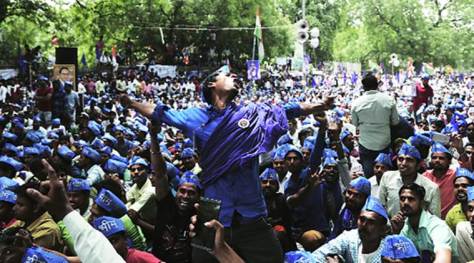
Even as the state government’s repression on Bhim Army continues, most of its leaders still in jail and some forced to leave Saharanpur, a committee has been formed for the defense of Bhim Army. (For background information, please see the ‘Note on Bhim Army’, appended at the end of this post, which carries links to informative videos as well). A group of activists and committed lawyers have been following up the legal struggle practically at their own expense – which at the moment involves getting the arrested activists, including the founder-President Chandrashekhar out of bail as the topmost priority. Some of the activists have started getting bail many still remain, including just ordinary people simply picked up by the people and framed by the police as Bhim Army activists.
However, getting the jailed activists out on bail is simply the first step in a long battle. The deliberate campaign of vilification that has been going on about Bhim Army has tried to paint the organization as ‘antinational’ and ‘instigators of violence’ who apparently have ‘Naxalite’ connections. Even though none of this could be substantiated and thus brought by the police into their charges against the jailed activists, the campaign of demonization has nevertheless continued through some sections of the media. Needless to say, such misleading campaign is meant to incite popular feelings against such groups who have been working mainly for education and self respect among the Dalit population in their area. Such a campaign of vilification cannot but affect the chances of wining the legal battle as well. It also ends up driving people who may have initially been sympathetic to their cause by sowing doubts about them in the popular mind.
It is with this concern in mind that a large number of citizens from different walks of life have come together to form the Committee for the Defense of Bhim Army, in order to mobilize all possible support for the embattled activists.
The Committee for the Defense of Bhim Army has been constituted comprising the following members from different walks of life:
Coordinators: Pradeep Narwal and Sanjeev Mathur
Treasurers: Presenjit Gautam and Nakul Singh Sawhney
- Anand Teltumbde, Civil rights thinker and activist, Mumbai
- Jignesh Mewani, Rashtriya Dalit Adhikar Manch
- Kancha Ilaiah, Political scientist, thinker and writer, Hyderabad
- Chandrabhan Prasad, Dalit thinker
- Radhika Ramaseshan, Senior journalist with Business Standard
- Harsh Mander, Human rights activist and Director, Centre for Equity Studies, Delhi
- Syeda Hamid, Former member, Planning Commission
- Om Thanvi, Senior journalist, former editor, Jansatta
- Sambhaji Bhagat, Cultural activist, Maharashtra
- Meera Velayudhan, Academic, Centre for Development Studies, Trivandrum
- Martin Macwan, Social activist, Gujarat
- Ratan Lal, Academic, Hindu College, Delhi University
- Sachin Mali, Cultural activist
- Sheetal Sathe, Cultural activist
- S.R Darapuri , Former IPS officer, social activist
- Colin Gonzalves, Lawyer
- Anand Patwardhan, Film maker
- Anil Chamadia, Journalist
- Subhash Gatade, Writer and social activist
- Akram Hassan, Social activist, Shamli
- Surender, Dalit youth activist, Delhi University
- N. Sukumar, Academic, Delhi University
- Rehana Adib, Social activist, Saharanpur
- Banojyotsna Lahiri, Academic and independent researcher
- Mohammad Zeeshan Ayyub, Actor
- Amar Singh, SC/ST Trade Union, Delhi University
- Dr. Mahesh Chandra, Bhim Army
- Sanjay Tegwal, Bhim Army
- Zakia Soman, Bharatiya Muslim Mahila Andolan
- Presenjit Gautam, Jati Todo Manch, Ghaziabad
- Pradeep Narwal, Dalit youth activist, Jawaharlal Nehru University
- Saroj Giri, Academic, Delhi University
- Tushar Parmar, IRS
- Sanjeev Mathur, Journalist
- Nakul Singh Sawhney, Film maker
- Praveen Verma, Research scholar, Delhi University
- Aditya Nigam, Academic, Centre for the Study of Developing Societies, Delhi
- Amar Paswan, Ambedkarvadi Chhatra Sabha, Gorakhpur
- Dhirendra, Poorvanchal Sena
- Anil Yadav, Rihai Manch
- Sagar Raghunath, Chhatra Bharati activist
- Dr J.K. Gautam, Doctor
- Dr. Sushil Kumar Gautam, Dalit Youth Activist, Chaudhary Charan Singh University, Meerut
- Subhashini Ali, Social Activist
- Mohinder Singh, Professor, JNU
- Prashant Nihal, Social Activist (Bihar)
- Atul Meena, Research Scholar JNU
Continue reading Committee for the Defense of Bhim Army Formed Amidst Continuing Repression
Academic Community stands firmly with JNUSU President; 100+ academicians, activists, writers issue statement of solidarity
Guest Post by Shehla Rashid on behalf of the signatories
We, the undersigned, are deeply shocked by the shameful attempts by JNU Administration to crush dissent in the University through imposition of arbitrary fines on student activists, denial of registration to students engaged in protests against the administration, including the elected President of the Students’ Union, Mohit Pandey. We stand in solidarity with the JNUSU President who has decided not to pay the arbitrarily imposed fine of 20,000. Many more Students’ Representatives and activists of JNU campus are facing 5-6 inquiries and false FIRs for raising students’ issues.
It is also shocking that a duly elected representatives of the students is being fined such massive amounts for merely raising students’ issues. Several other students have paid the fines, in order to be allowed to register, being forced to succumb under the threat of having their registration held up. Several students with pending inquires are not getting their degree- mark sheets and unable to continue their studies further. This amounts to imposition of a tax/fee on dissent, thereby creating a chilling effect on freedom of expression in the University. This is unacceptable in a University where knowledge creation is contingent upon freedom of ideas.
We call upon the JNU administration to display maturity and stop penalising alternative viewpoints. The current fine of Rs. 20,000 that the JNUSU President is being asked to pay for restoration of his studentship pertains to an instance of anti-administration protests led by the students’ union against the complicity of the JNU Administration in the disappearance of an M.Sc. Biotechnology student named Najeeb Ahmed following a mob assault on him by members of a students’ group affiliated to the ruling party – who were indicted for the assault by a report of the Proctor’s Office, but shielded by the higher ups in the administration, leading the then Proctor to resign from office.
So, the students guilty of leading the lynch mob against Najeeb Ahmed were given no punishment at all, whereas students protesting against his disappearance – who were demanding that the JNU Administration should file a police complaint in the matter – were fined Rs. 20,000 each! Ever since the JNU VC has been appointed by the present government, students not belonging to the ruling party student group have been systematically targeted and penalised for speaking out. There is no record of similar fines upon right-wing groups which routinely engage in vandalism on campus. This clearly amounts to blatant viewpoint discrimination and also serves as a green signal to lynch mobs on campus.
The JNU Administration is using an archaic statute in the book to ban protests at the Administration Block. However, JNU has always had a healthy culture of dissent and protest. Protests against the administration have always been held outside the administration block itself. That the protests disturb the working of the administration is the most dubious pretext for crushing dissent, as there have been historic student movements on JNU campus which have only made the University stronger, its academic traditions more robust and its intellectual environment more egalitarian.
We, therefore, demand that
1) the JNU administration must end its petty tactics of penalising dissent;
2) JNUSU President, Mohit Pandey, must be allowed to register for the next academic semester, unconditionally;
3) all fines against students being imposed for the mere act of protest must be revoked unconditionally;
4) JNU Administration must stop trying to deprive students of the right to protest at the Administration Block, and engage, instead in dialogue with the elected students’ body without bias against the ideology held by the student union representatives;
5) JNU Administration must punish the students who assaulted Najeeb Ahmed, resulting in his disappearance.
Sd/-
Prof. Anand Teltumbde, Senior Professor, Goa Institute of Management
Prof. Anil Sadgopal, Former Dean, Faculty of Education, University of Delhi; Member, Presidium, All India Forum for Right to Education
Dr. Rohan D’Souza, Associate Professor, Kyoto University, Japan
Prof. Chaman Lal, Retired Professor, JNU; Former President, JNUTA
Prof. Nivedita Menon, Professor, Centre for Comparative Politics and Political Theory, School of International Studies, JNU, New Delhi
Jairus Banaji, Research Professor, SOAS, University of London
Prof. Laxman Gaddam, Professor of Commerce, Osmania University
Anwesha Sengupta, Assistant Professor, Institute of Development Studies, Kolkata
Arvind, Professor, IISER Mohali
Rana Partap Behal, Associate Professor (Retd.), Deshbandhu College, University of Delhi. Association of Indian Labour Historians.
Madhu Kushwaha, Professor, BHU
Brinda Bose, Associate Professor, JNU
Debaditya Bhattacharya, Assistant Professor, Nivedita College, University of Calcutta
Dr. Rohini Hensman, Writer and Independent Scholar
Anand Mathew, Director, Prerana Kala Manch, Varanasi
Mary E John, Researcher, Centre for Women’s Development Studies
Padma Velaskar, Professor (Retd.), Tata Institute of Social Sciences
Ravi Kumar, Associate Professor, South Asian University
Ritajyoti Bandyopadhyay, Assistant Professor, IISER Mohali
R. Nandakumar, Art Historian, IGNCA
Madhu Prasad, Associate Professor (Retd.), Zakir Hussain College, DU
K. Laxminarayana, Professor, Hyderabad Central University
Jean Chapman, Adjunct Professor, Concordia University, Montreal, Quebec, Canada
T K Arun, Editor, Opinion, The Economic Times
John Cherian, Journalist, Frontline
Teesta Setalvad, Journalist, Activist, Educationist; Citizens for Peace and Justice; Sabrang India
Ravindra Tomar, Senior Researcher, Parliament of Australia
Manorama Sharma, Retired Professor, NEHU
Dr. Sushmita Sengupta, Associate Professor, NEHU
Prof. K. Chakradhar Rao, Member, Presidium, All India Forum for Right To Education
Perumal Vijayan, Research Associate, University of Saskatchew
Sangeeta Chatterji, Doctoral Candidate, Rutgers, The State University of New Jersey
Mohd Mushtaq, Assistant Professor, Govt. Degree College, Baramulla, J&K
Hiren Gohain, Retired University Teacher
Nandini Rao, Social Activist, JNU Alumnus
Devyani Borkataki, Activist, Northeast Network
Kiran Shaheen, Director, Media Action Group
Wilfred Dcosta, Convenor, Indian Social Action Forum (INSAF)
Firoz Ahmed, Teacher, Lok Shikshak Manch
Manoj Chahal, Research Scholar, University of Delhi
Manuj Mukherjee, Ph.D. Scholar, Indian Institute of Science
Sanjay Palshikar, Professor, University of Hyderabad
Dr Navneet Sharma, Assistant Professor, Central University of Himachal Pradesh
Bhangya Bhukya, Associate Professor, University of Hyderabad
Abani K Bhuyan, Professor, University of Hyderabad; President of the University of Hyderabad Teachers’ Association
Dr. G. Vijay, Assistant Professor, University of Hyderabad
Sohail Hashmi, Freelance Writer, Filmmaker, JNU Alumnus
Nikhil Kumar, Policy Analyst
Roger Alexander, Independent Journalist, Pink City Press Club
Saeed Haider, Associate Editor, Saudi Gazette
Rajesh, Activist, Lok Shikshak Manch
N.D. Jayaprakash, JNU Alumnus
Anjal Lele, Travel Consultant; former JNU Student
Dr. Vikas Bajpai, Assistant Professor, Centre for Social Medicine and Community Health, Jawaharlal Nehru University
Indira C, Public Health Researcher; Consultant
Rashmi Kumari, Ph. D., Jawaharlal Nehru Univerity
Dr. C. Sadasiva, Associate Professor, Deptt. of Botany, Dyal Singh College, University of Delhi
Sajid, National Vice-President, Campus Front of India; Ph.D. Scholar, JNU
Shehla Rashid Shora, Research Scholar, JNU
Mohit P Gandhi, Ph.D. Scholar, CSMCH, JNU
Vasanthi Gupta, Academician; JNU Alumnus
Apurba K. Baruah, Retired Professor, North Eastern Hill University, Shillong
K. Laxminarayana, Professor, University of Hyderabad
Dayaram Yadav, Former General Secretary
Dr. M. Gangadhar, Chief Editor, Adhyapaka Jwala; Democratic Teachers’ Federation, Telangana
Avinash Chandra Jha, former Associate Professor; former JNU student
Mohan Rao, Professor, JNU
Shashwati Goswami, Research Scholar, CSMCH, JNU
Joby Joseph, Associate Professor, University of Hyderabad
Sumegha, student, JNU
Caroline C. Netto, Ph.D. Scholar, JNU
Ramesh Patnaik, Former General Secretary, JNUSU
Sri Raghunath Joshi, Professor (Retd.)
Thokchom Surjit Singh, Social Activist; All India forum for Right to Education
Ratan Kumar, Ph.D. Scholar, Centre for Historical Studies, JNU
Susmit Isfaq, Student, NLU Assam; Students’ Federation of India
Roobala, Ressearch Scholar, Indian Institute of Science
Himangshu Baruah, student
D N Reddy, Professor of Economics (Retd.), University of Hyderabad
Akshay Pathak, General Secretary, AIRSO
K Venugopal, Chief Editor, Upadhyaya Dharshini
B Sudha, Retird Teacher, TPTF
M. Raghushankerreddy, State President, Democratic Teachers’ Federation; All India Forum for Right to Education
Aviroop Sengupta, Ph.D. Scholar, Centre for Historical Studies, JNU
M. Balakumar, Headmaster; DTF
Arunank, State General Secretary, Democratic Students’ Union, Telangana
V. Raji Reddy, HM, Democratic Teachers’ Federation
Manjari Gupta, Post Doctoral Fellow, HRI
M. Somaiah, Teacher; State Vice-President, DTF
Vijay Kumar, Central Committee Member, CPI(ML) Red Star
Somasekharasarma, Retd. English Lecturer; AIFRTE
Kalyani Menon Sen, JNU Alumnus, (1977 batch)
T. Sobha Rani, Associate Professor, University of Hyderabad
Shephali Frost, Writer, Poet, Musician
Srinivas Reddy A., Teacher, Democratic Teachers’ Federation
Bittu Karthik, Associate Professor, Ashoka University
Shuddhabrata Sengupta, Artist / Writer, Raqs Media Collective, Delhi
Madhu, State Secretary, Democratic Teachers’ Federation
Suraj Beri, Doctoral Candidate, Centre for the Study of Social Systems, JNU
Vijay Shankwe Choudhary, Producer/Director Films and Television, former JNU Student (1972-81 batch)
Shilpa Shital, Research Scholar, IIT Delhi
Partho Sarothi Ray, Assistant Professor, IISER Kolkata
Nupur, Research Scholar, JNU
Susie Tharu, Retired Professor, EFLU
Sarwat Ali, Associate Professor, IASE (Jamia Millia Islamia)
Dyuti, Researcher and Activist
P. S. Mukherjee, Founder Member, Friends of Latin America-India
D. M. Diwakar, Professor, A N Sinha Institute of Social Sciences, Patna, Bihar
Muzaffar Ahmad Dar, Research Scholar, Centre for Historical Studies, JNU
Aishik Gupta, Activist
Aijaz Ahmed, Lecturer, Shinas College of Technology, Ministry of Manpower, Oman
Vandana Mahajan, Independent Development Practitioner, Feminist Movement for Equality, Justice and Non-discrimination
Afzal Hussain, Masters Student, CAAS, JNU
Masood Ahmed Azhar, Research Scholar, JNU; NSUI
Harshad Tayade, Engineering Student, Pune University
Shivam, Student, University of Hyderabad
Dharti Putra, Student, BIT Sindri, Dhanbad, Jharkhand
When Charlatans Become Ideologues – The Real ‘Prisoners of the Binary’
Present day Hindus are probably the strongest opponents of Marxism. They are horrified at its doctrine of class-struggle. But they forget that India has been not merely the land of class struggle but she has been the land of class wars. – B. R. Ambedkar, Philosophy of Hinduism.
I often find myself in a bind over whether or not to respond to supposed RSS ideologues, given that they simply trade in lies and hatred with the supreme arrogance of ignorance. One such is the upcoming star on the RSS horizon, a gentleman called Rakesh Sinha, who like the rest of his pack (led by the supreme leader) is currently engaged in a cheap attack on the outgoing Vice-President, Hamid Ansari. His piece in the Indian Express today (linked above) is an instance of a combination of all these things. So, why should one bother about such a character? Why take him and his discourse seriously? Well, someone had better respond because, because, for one thing they are in power, and are going to teach generations of students that valorous ‘Hindus’ like Maharana Pratap won all the wars, though by some magic, ‘Muslims’ continued to rule for about 8 centuries! For another, there are enough gullible types who really think these people ‘have a point of view’, which should be debated.
As we have repeatedly seen, their ‘having a point of view’ has nothing to do with debate. It is to be enforced by gangs of gorakshaks, anti-romeo squads, hoodlums deciding what will or will not be taught in universities and schools, what will be written, how people should dress and love – and when nothing works, ‘win’ a ‘debate’ like Arun Jaitley claimed they did, by simply arresting the opponents and slapping sedition charges on them. Given this, I do not really address, in person, the ideologue, Rakesh Sinha, who has now made it a fine art to pick up some phrases from the toolkit of what is understood as ‘postmodernism’ by many. Wasn’t it postmodernism, one can hear them say, that said all viewpoints are equally valid and ‘everything goes’? Wasn’t it postmodernism that challenged the hegemony of Western thought, its logocentrism, its Rationalism (with a capital R) from within that very tradition? Wasn’t it postmodernism again, that by decentering West’s logocentrism, actually gave these RSS-type creatures the gumption to claim that their utterly unsubstantiated viewpoint about the past too was as valid as that of historians who struggled with evidence, painstakingly putting together texts, artefacts and procedures of dating in order to produce a plausible account of the past?
Continue reading When Charlatans Become Ideologues – The Real ‘Prisoners of the Binary’
The Modi regime, its minions in the JNU administration and the brave struggle of whistle blower Prof Rajeev Kumar
The prime minister of India Narendra Modi’s cheap hindutvavaadi jibes in his farewell address to vice president Hamid Ansari were better suited to Republic TV or The Organiser, but under Modi’s regime, parliament is pretty much run like an RSS shakha, and Modi himself seems no different from Arnab Goswami.
Said Modi in parliament to the distinguished out-going vice president:
Aapke karyakaal ka bahut saara hissa West Asia se juda raha hai. Usi dayere mein zindagi ke bahut varsh aapke gaye, usi mahaul mein, usi soch mein, aise logon ke beech mein rahe. Wahan se retire hone ke baad bhi jyadatar kaam wohi raha aapka; Minorities Commission ho yah Aligarh Muslim University ho, zyadatar dayara aapka wohi raha.
Lekin yeh 10 saal puri tarah ek alaga zimma aapka sar mein aaya. Puri tarah ek ek pal samvidhan samvidhan samvidhan ke hi dayere mein chalana. Aur aapne usko bakhubi nibhaane ka bharpur prayaas kiya. Ho sakta hai kuch chatpatahat rahi hogi bhitar aapke andar bhi. Magar aaj ke baad shayad woh sankat bhi nahin rahega. Mukti ka anand bhi rahega aur apni mulbhut jo soch rahi hogi uske anusaar aapko karya karne ka, sochne ka, baat batane ka awsar bhi milega.
“No research please, we are college teachers” – On the HRD Ministry’s latest bright idea.
A version of this piece appeared yesterday in The Wire
“I would like to thank Huddersfield University for enabling me to have a sabbatical semester to work on this revised edition and for providing such a supportive environment. Thanks to many of the students on my Women, Power and Society module for their hard work and enthusiasm.”
That is the dedication in a book by British scholar and teacher Valerie Bryson – a text I often use for teaching at a college in Delhi University. Evidently, Bryson found her teaching and research lives complementing each other beautifully, as have thousands of university and college teachers who have had the luck to have what she calls a “supportive” professional and academic environment. What are the elements of this support? A sabbatical semester or year every once in a while, ready research facilities within the college premises or nearby, and an opportunity to formulate teaching courses that ally with your research focus. With these elements in place, both teaching and research benefit dramatically.
Until recently, college teachers in this country had the first two conditions. They were given in their entire careers – say from the age of 26 or 27 when one normally began teaching at a college to the age of 65 – three years of paid study leave to pursue or finish their PhDs (with the usual conditions and caveats including a strict bond that they signed with college promising to return the three years’ pay if the PhD remained incomplete, or if they resigned upon return to the institution) and a further two years of (until recently, paid and now invariably unpaid or “extraordinary”) leave to take a break from teaching and pursue a postdoctoral or visiting fellowship at a research institute.
And THIS is how you deal with threats of defamation charges! The strange case(s) of Red FM and EPW
Red FM’s RJ Malishka features in a peppy video that went viral, mocking Mumbai’s Municipal Corporation (BMC) for the dismal lack of civic amenities and the havoc the rains can wreak in the city. In a lively parody of the popular Marathi folk song Sonu Tuza Mazyavar Bharosa Nahi Kay (Sonu, Don’t you Trust me?), she sang cheekily, Sonu, don’t you trust BMC?
Potholes, traffic jams, slow trains, all the woes of the Mumbaikar in the fabled rains of Western India.
But Shiv Sena which runs the BMC was not amused. Continue reading And THIS is how you deal with threats of defamation charges! The strange case(s) of Red FM and EPW
Promoting Superstition – Everything Official About It !

Bhupendra Singh Chudasama, Education minister of Gujarat and his colleague Atmaram Paramar, who handles the Social Justice Ministry, were in the news sometime back- albeit for wrong reasons. A video went viral which showed them participating in a felicitation ceremony of exorcists in Botad. They were also seen watching how a couple of the exorcists were beating themselves with metal chains to live music near the stage.
Perhaps it did not matter to them that the Constitution frowns upon such activities and Article 51A (h) of the Indian constitution clearly says that it shall be a fundamental duty of all citizens “to develop the scientific temper, humanism and the spirit of inquiry and reform.” Neighbouring state Maharashtra has even enacted a law (The Maharashtra Prevention and Eradication of Human Sacrifice and other Inhuman, Evil and Aghori Practices and Black Magic Act, 2013) to rein in all such activities and it criminalises practices related to black magic, human sacrifices, use of magic remedies to cure ailments and other such acts which exploit people’s superstitions. And it was a culmination of a prolonged movement led by activists led by Dr Dabholkar – who even faced martyrdom for his activities. Continue reading Promoting Superstition – Everything Official About It !
After #NotinMyName at Jantar Mantar on June 28: Sanjay Kak for NotinMyName, Delhi
Guest Post by Sanjay Kak, for #Notinmyname / Statement from Not In My Name, Delhi
Last evening’s (June 28th) spirited protest at Jantar Mantar, New Delhi, under the banner of Not In My Name, was an autonomous citizens protest against the recent spate of targeted lynchings of Muslims in India – the most recent of 16 year old Junaid, stabbed to death on 23 June 2017 in Delhi (NCR).
For an audience that was estimated to be 3500 strong, the torrential downpour at a little past 8 pm may have rained out a part of the programme. But something remarkable had already been achieved: the evening had washed away, even if temporarily, an almost overwhelming sense of despondency, of hopelessness, and of fear.
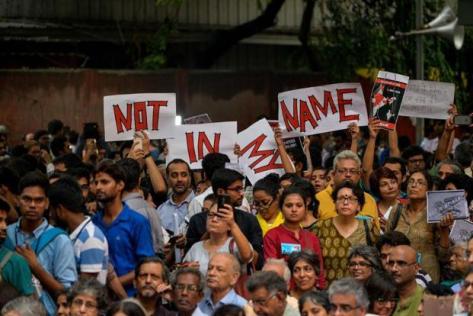
Since the Not In My Name protest had announced that the platform was not meant for political parties, and their banners and slogans, the stage saw the marked absence of the speeches (and faces) of routine protest meetings at Jantar Mantar. Rhetoric was displaced by feeling, and it was left to the poets and musicians to carry the sharp political messages of the day. On an evening that was often very emotional, the most difficult moments came when a group of young men from Junaid and Pehlu Khan’s extended families (and residents from their respective villages) came on stage and spoke to the audience.
When the call for a protest meeting went out last Sunday we were hoping that a few hundred people would gather to express their outrage at what is happening around us. For the attacks on Muslims are part of a pattern of incidents that targets Dalits, Adivasis, and other disadvantaged and minority groups across the country. In almost all these incidents the possibilities of justice seem remote, as the families of the victims are dragged into procedures they are ill-equipped to handle. Through all these heinous crimes the Government has maintained a silence, a gesture that is being read as the acquiescence of all Indians.
Not In My Name aimed to break that silence. But the scale and spirit of the protest meeting at Jantar Mantar became amplified many times over, as similar gatherings were spontaneously announced all over the country. As word spread through social media, groups in 19 other locations announced Not In My Name protests, and this phenomenal synergy inevitably drew media attention to all the events, and gave the protest a solidarity and scale that was truly unprecedented – there were at least 4 protests in cities abroad too. (And more protests have been announced for later this week…) The protest meeting ran on the shoulders of a group of volunteers who managed to put together everything in less than four days. No funds were received (or solicited) for the expenses from any political party, NGO, or institution. Instead volunteers worked the crowd and our donation boxes received everything – from Rs 10 coins to currency notes of Rs 2000, and everything in between.
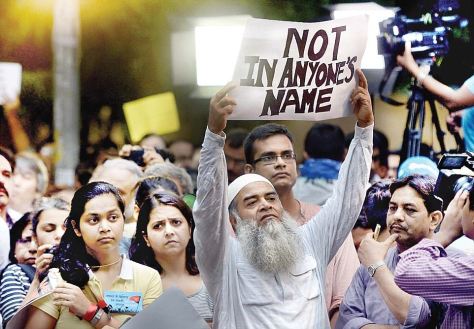
The impact of the Not In My Name protest at Jantar Mantar yesterday only points to the importance of a focused politics to deal with the crisis this country seems to be enveloped by. Less than a day after the protests Prime Minister Modi broke his silence on the matter of lynchings. It could not have been a coincidence: speaking in Ahmedabad he said killing in the name of gau bhakti is unacceptable. But to protect the life of a 16 year old being brutalised in a train needs more than a tweet, and we all wait and watch.
This fight has just begun. In the days to come the exceptional solidarity attracted by the protest in New Delhi will have to become less exceptional, and more everyday.
Sanjay Kak is a filmmaker and writer based in Delhi.
The #NotinMyName protests, which began in a response to a Facebook post uploaded by Delhi filmmaker Saba Dewan, have since taken place in more than twelve cities in India, and also in the UK, USA and Pakistan. More protests, under the #NotinMyName tag, as well as independently of it are being planned by citizens groups, organizations and individuals in many places.
Tomorrow, July 2nd, 2017 will see a sit in at Jantar Mantar from 11 in the morning, at Jantar Mantar, New Delhi called by families, individuals and panchayats from Nuh, Ballabhgarh and Faridabad, they will be joined by students, activists and other individuals.
Why Two Hundred Ordinary Hindus Did Not See A Dead Muslim Child On A Railway Station In North India
 On 22 June 2017 fifteen-year old Hafiz Junaid was stabbed to death on a Mathura-bound train from New Delhi. He was traveling home for Eid with his brothers and two friends. A dispute over seats resulted in a group of men repeatedly assaulting and stabbing Junaid and his companions. The assailants flung their bodies onto the Asoti railway platform. A crowd gathered. At some point an ambulance was called and two bodies were taken away. Junaid is dead. His companions are in critical condition. While one person has been arrested the police investigations are running into a wall of social opacity since they have been unable to find a single eye-witness to the incident. Of the 200 hundred strong crowd that assembled on Asoti railway platform on Thursday evening, the police cannot find one person who can say what they saw. The police cannot find a witness because something very peculiar seems to have happened to those present at Junaid’s death. A report by Kaunain Sherrif M in the Indian Express provides specific details. When asked if he had seen anything that evening, Ram Sharan a corn-vendor whose daily shift coincides with the killing, Sharan said he was not present at the time of the incident. Two staffers who were sent to investigate by the station master were unavailable for comment. Neither the station-master, the post-master or the railway guards saw the event they were present at.
In this startling piece the journalist reports how the public lynching of a Muslim child becomes a social non-event in contemporary India. He shows the reconfiguring, and splitting, of a social field of vision. He reports all the ways in which people – Hindus- did not see the body of a dead – Muslim – child that lay in front of them. The Hindus on the Asoti railway platform managed to collectively not see a 15 year old Muslim boy being stabbed to death. Then they collectively, and without prior agreement, continued to not see what they had seen after the event. This is the uniquely terrifying aspect of this incident on which this report reflects: the totalising force of an unspoken, but collectively binding, agreement between Hindus to not see the dead body of a Muslim child. Hindus on this railway platform in a small station in north India instantly produced a stranger sociality, a common social bond between people who do not otherwise know each other. By mutual recognition between strangers, Hindus at this platform agreed to abide by a code of silence by which the death of a Muslim child can not be seen by 200 people in full public view on a railway platform in today’s India. Continue reading Why Two Hundred Ordinary Hindus Did Not See A Dead Muslim Child On A Railway Station In North India
Eid in solidarity, united against Hindu Rashtra
At some point during the Khalistan movement, I came across a brief news item about a constable of the Punjab Police killed by Delhi Police personnel. The two teams had completed their interrogation of a suspected militant. Whose job was it to clean up the blood? Disagreement, a scuffle, a killing.
Legitimized brutality; the stench of blood inflaming the senses; the knowledge of absolute power and absolute impunity.
All of India is that interrogation room now.
Hindu Rashtra is here.
Has there not been violence earlier in this land? Yes of course there has been. A full seven decades of an independent state’s violence against the people of the land declared to be India – against dispossessed peasants and tribal people, against industrial workers, against the people of Kashmir, and of the states of the North East; centuries of violence by savarna Hindu society against the Dalit-bahujan; misogynist, sexist violence against women, up to and including female foetuses in the womb; decades of coldly planned and executed communal violence by institutionalized systems of riot production coordinated by the organizations of the RSS – against Muslims, against Christians, and as a secondary force, against Sikhs in 1984.
What is unique about this conjuncture, then? Continue reading Eid in solidarity, united against Hindu Rashtra
X ways in which Modi is different from Trump: Rama Srinivasan
Guest post by RAMA SRINIVASAN
Prime Minister Modi is set to meet President Trump on June 26 and we can anticipate an exciting contest between bear hugs and crushing handshakes. We indeed live in interesting times where symbols rather than spoken words determine the fate of nations (Trump is rumoured to have partly pulled out of the Paris Agreement after losing a handshake duel with the new French President). Both Modi and Trump deploy symbols effectively to further a conservative agenda that is in many ways self-serving rather than ideologically dogmatic. I wondered if a list of ways in which they are different despite being strikingly similar in many ways might be an interesting experiment but all my points could be bracketed under one larger word: privilege. Everything that follows in this article are ways in which this privilege operates in the case of Trump and how the lack of the same has shaped much of Modi’s career.
Continue reading X ways in which Modi is different from Trump: Rama Srinivasan
Elephants in the Room – Who Gets the Autonomy in Autonomous Colleges? : Sanjay Kumar
Guest Post by Sanjay Kumar
In February this year, University of Delhi officials invited chairpersons of the six best known colleges to apply for autonomy. So far, only the governing body of St Stephen’s College has reacted, authorising its principal to take up the application process. Teachers and staff associations of the university, DUTA (Delhi University Teachers’ Association) and DUCKU (Delhi University Karamchari Union), are against the move. Besides affecting the working conditions of faculty and staff, college autonomy has bearing on the academic content of undergraduate learning. It is surprising that many of the academic red flags are not even noticed in the policy. These obvious blind spots indicate that real motivations are not academic, but lie elsewhere.
The XII plan document of the UGC sets the target to make 10 percent of eligible colleges autonomous by the end of the plan period. It boldly declares, ‘(t)he only safe and better way to improve the quality of undergraduate education is to the link(sic) most of the colleges from the affiliating structure’. The claim is surprising, because world over university education is considered a good undergraduate education. A university with active research, accomplished faculty and diversity of subjects to offer is the best place for a young person to get initiated into the adventure and challenges of higher education. How taking students away from the ambit of a university becomes the way to better education requires a bit of an explanation. Continue reading Elephants in the Room – Who Gets the Autonomy in Autonomous Colleges? : Sanjay Kumar
बिहार क्या सिर्फ बिहार में है ?
बिहार फिर से खबर में है. इंटरमीडिएट परीक्षाओं के परिणाम आए हैं.पैंसठ प्रतिशत छात्र फेल हो गए हैं.बिहार में विरोध प्रदर्शन चल रहे हैं.कॉपियों की दुबारा जाँच कराने की माँग की जा रही है. जन संचार माध्यमों के जरिए वैसे छात्रों की व्यथा और क्रोध का पता चल रहा है जिन्होंने आई आई टी जैसी कठिन प्रवेश परीक्षाओं में सफलता प्राप्त की है लेकिन जो बारहवीं की बोर्ड परीक्षा में फेल हो गए हैं.इसे पर्याप्त माना जा रहा है यह कहने के लिए कि परीक्षा परिणामों में घपला ज़रूर है वरना इतने प्रतिभाशाली युवा, जो आई आई टी की परीक्षा की बाधा दौड़ पार कर गए हैं,बोर्ड के इम्तहान में फेल कैसे हो जाएँगे! Continue reading बिहार क्या सिर्फ बिहार में है ?
अरुंधति का निर्वासन: वैभव सिंह
Guest post by VAIBHAV SINGH
अरुंधति राय के खिलाफ अपशब्दों की, गाली-गलौच की, आरोपों की हिंसा ने हमें एक बार फिर यह प्रश्न पूछने के लिए विवश कर दिया है – क्या हमने सचमुच अपने देश में सभ्यता व सहिष्णुता के महान मूल्यों की रक्षा करने के दायित्व से छुटकारा पा लिया है? कहीं हम पूरे राष्ट्र को ‘डिसोसिएटिव आइडेंटिटी डिसआर्डर’ (खंडित व्यक्तित्व मनोरोग) का शिकार बनते तो नहीं देख रहे हैं जिसमें किसी व्यक्ति नहीं बल्कि पूरे राष्ट्र के चरित्र में परस्पर विरोधी मूल्य इस प्रकार विषैले कांटों की तरह उग आते हैं कि राष्ट्र का पूरा व्यक्तित्व चरमराने या दिग्भ्रमित होने लगता है! एक सभ्य-लोकतांत्रिक देश के रूप में आत्मछवि और हिंसक बाहरी आचरण में जितना गहरा भेद पैदा हो जाता है, वह राष्ट्र की आत्मा मार देता है। जिसने भी स्वयं में अनूठी लेखिका को जीप के बोनट से बांधने की कल्पना की, उसे संभवतः अंदाजा भी नहीं था कि वह केवल एक वक्तव्य नहीं दे रहा है, बल्कि मनुष्यता के सभी संभव परिकल्पनाओं के विरुद्ध अपराध कर रहा है। ऐसी कल्पना में बीमार विचारशून्यता ही नहीं बल्कि भयानक सड़ांध, विकृति और मनोरोग की झलक मिलती है। परेश रावल के अरुंधति के विरोध में लिखे ट्वीट से उल्लसित सोशल मीडिया के एक समूह ने तो अरुंधति राय की सामूहिक ढंग से हत्या कर उनके शव को पाकिस्तान में दफनाने की वकालत भी कर डाली।
1984 and Punjab’s Transformation to a Hindutva Laboratory: Gurpreet Singh
Guest post by GURPREET SINGH
It was summer of 1985 when we were visiting New Delhi, the national capital of India to attend a wedding in the family. I had a long hair back then and was aged 15. Both me and my uncle who were wearing turbans like other Sikh men were waiting at a bus stand for the next bus to go to our relatives. As soon as the bus arrived and we were about to climb in after other waiting passengers, the door was slammed on us. When my uncle protested, the conductor shouted that there is no seat inside. Even as we pointed out at some empty seats, the answer was – “we have told you there is no seat.” Before we could argue the bus sped away.
The incident left me shocked but I wasn’t surprised. Continue reading 1984 and Punjab’s Transformation to a Hindutva Laboratory: Gurpreet Singh
Photo Story on Bhim Army Rally in Delhi: Debalin Roy
Guest post by DEBALIN ROY
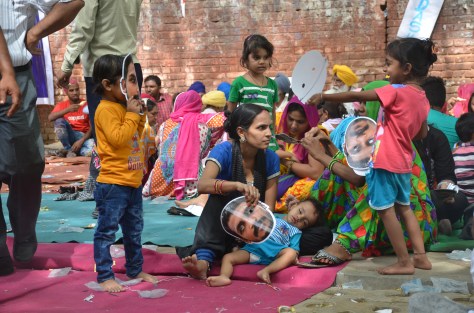
Debalin Roy takes us to some specific moments in the rally, aside from the bird’s eye view of the massive rally that we have already seen.
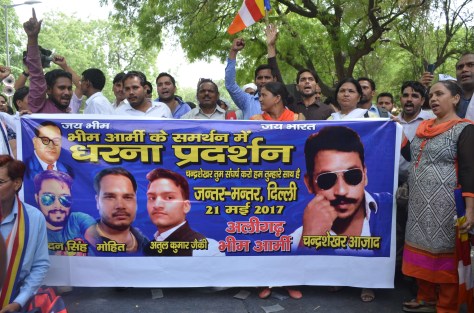
Dalits from all over northern India gathered at Jantar Mantar, Delhi on the 21st of May to protest the Saharanpur violence and increasing atrocities on Dalits across the country.
Although there were representatives from various states, especially from Haryana, U.P. and Rajasthan, Bhim Army took the center stage, with their blue flags waving like a giant dark blue field of tall grass, shaking and waving with every chant of Jai Bhim.

Continue reading Photo Story on Bhim Army Rally in Delhi: Debalin Roy
A Day Against Kalluri at IIMC, Delhi: Bastar Solidarity Network Delhi Chapter
Guest Post by Bastar Solidarity Network Delhi Chapter
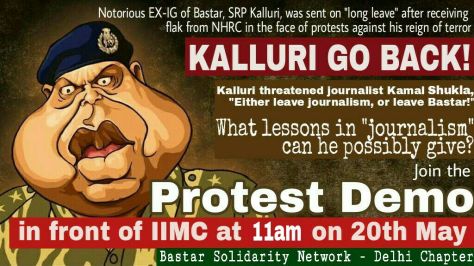
The democratic forces, organizations and the thinking minds of IIMC took part in a spirited protest today against the invitation extended to notorious ex-IG Kalluri by the IIMC administration to take part in a seminar. To start with, since last two days, there were several attempts on the part of the organizers to confuse/conceal Kalluri’s invitation. Immediately after the declaration of the protest, Kalluri’s name was dropped from the poster. There were also threats of counter-mobilisation by the BJP goons. But undeterred, as we reached the gates of IIMC at 11am, the site echoed with slogans of “Killer Kalluri Go Back”!
Continue reading A Day Against Kalluri at IIMC, Delhi: Bastar Solidarity Network Delhi Chapter
Violence against Dalits in Saharanpur, UP : A Report by CPI-ML (Liberation) & AISA Team that Visited Saharanpur
Guest Post by Sucheta De
CPI-ML- AISA Team’s Visit to Saharanpur – A Report
“Sarkar Hamari Hai, Police-Prashashan Bhi Hamara Hai”- Yogi Government Boosts Up Morale of Casteist Feudal Goons Who Burnt Dalit Village in Shabbirpur!
Casteist Goons from Dominant Rajput Community Enjoy Complete Impunity while Bhim Army Activists Continue to Face Witch-Hunt!
CPI-ML-AISA Appeal Everyone to Join Hands with the Dalits of Saharanpur in their Struggle for Justice!
Saharanpur Carnage: Teaching a Lesson to Politically Assertive, Self-Reliant Dalits Who Refuse to be Foot Soldiers of Hindutva’s Hate Politics
When BJP gains electoral majority, Saharanpur happens.
For last several years the belt of western Uttar Pradesh has been made the laboratory of the RSS-BJP’s sinister design of communal polarization and violence against Muslims. The 2013 Muzaffarnagar riots was a planned design by the RSS-BJP to polarize the belt on communal lines and reap electoral benefits. And now, after that design had delivered ‘electoral success’ for the RSS and BJP, upper caste feudal forces have started celebration of their ‘victory’ by unleashing attack on Dalits.
The Elephant in the Room – Silence on Class Issues in Indian Politics : Sanjay Kumar
Guest Post by SANJAY KUMAR
Ramesh has been working as a daily wager in a Government of India office in Delhi for ten years. He is one of the army of peons, office assistants, security guards, gardeners, and cleaning staff which government offices, city municipalities, hospitals, schools and colleges of the metropolis employ regularly. He is a graduate, but gets the wage of an unskilled worker. He is among the fortunate ones who at least get government mandated minimum wage. Most private employers in the city violate the minimum wage act; either they pay less than the mandated amount, or make daily wagers work more than eight hours without any overtime.
Ramesh was pleasantly surprised this April when he noted a more than 30% increase in his wages. His daily wage that stood at Rs 360/ earlier was now Rs 513/. This was due to a Government of Delhi notification issued on 3rd March, 2017. The news was covered in the inner pages of some newspapers. Most TV news channels ignored it. Hence, it is not surprising that employees like Ramesh who are not associated with any organsiation of workers were not aware of this increase. Continue reading The Elephant in the Room – Silence on Class Issues in Indian Politics : Sanjay Kumar
LBJ, Kashmir, and Indian Liberals: Rajive Kumar
Guest Post by RAJIVE KUMAR
Towards the end of his presidency, Lyndon B Johnson, the 36th President of the United States of America, had been reduced to a figure of universal scorn and derision. His escalation of the Vietnam War to a point from which it became impossible to extricate the US ended up in becoming one of the defining human tragedies of twentieth century. This was war fought on the basis of pretexts that did not actually exist. The slur “Hey, hey, LBJ, how many kids did you kill today?” which became an anthem of sorts for protestors eventually compelled him to forgo running for a second term in office in 1968. Those protesting against the war, those who eventually forced Lyndon Johnson to leave the political arena were Americans who were overcome with images of atrocities and the rising count of civilian deaths in a mindless war.
Continue reading LBJ, Kashmir, and Indian Liberals: Rajive Kumar
 KAFILA - COLLECTIVE EXPLORATIONS SINCE 2006