Category Archives: Politics

Enabling Dissent, Defying Silence – In Memory of Sabeen Mahmud: Yaminay Chaudhri and Mariam Sabri

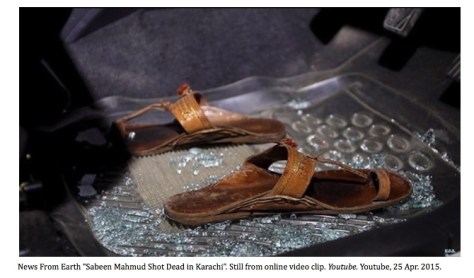
Sabeen Mahmud's Slippers

Guest Post by Yaminay Chaudhri and Mariam Sabri

[ This is a post from two friends in Pakistan responding to the tragic assasination of Sabeen Mahmud, activist and director of ‘The Second Floor’ (T2F) – a space that hosted many wonderful conversations and brave events. Sabeen was killed as she was going home after an event dedicated to a public discussion of disappearances and human rights violation in Balochistan.]

A normally quiet and desolate gali is packed with camera crews and hundreds of attendees for the funeral of Sabeen Mahmud. While there is a steady trickle of mourners entering and exiting the premises of the vibrant community space Sabeen created, the crowd waiting in the gali outside seems to be arrested by a mixture of disbelief, anger and grief.

Similar emotions paralyze us as we write about Sabeen in the past tense. It is difficult to believe she is gone, infuriating to think about the way she went, and, perhaps, the hardest to accept the beginning of her absence.

While watching her interview with PBS NewsHour last month, one is struck by how her cavalier attitude to fear and security, reverberates eerily in the wake of her murder.

“I grew up playing cricket on the streets” she said, “I just feel when the time comes, the time will come”.

Continue reading Enabling Dissent, Defying Silence – In Memory of Sabeen Mahmud: Yaminay Chaudhri and Mariam Sabri

Gajendra’s Tragic Death, Media Spins and the Indignation Industry

Gajendra, BJP and the Propaganda Machine

The tragic death of a farmer from Rajasthan occurs at a rally organized by the Aam Aadmi Party on 22 April 2015. The farmer, Gajendra Singh, hangs himself from a tree in full public view of the demonstrators, the media, the police. The electronic media had till then been barely covering the event, generally holding forth instead, in studio ‘debates’ among the opponents of AAP. Once this happened, the media spin doctors swung into action, and as Rajdeep Sardesai tweeted later, they seemed to work on an already decided script. Sardesai’s tweet said that there were clear instructions from the BJP to the media to focus only on the hung/ dying (or dead) man, and forget the rally. It seems, on a closer look, that the the second part of the instructions had perhaps already been given in advance – not to cover the rally and if at all, to attack it in sponsored studio debates. And of course, the BJP, which is the architect of the new Land Acquisition Ordinance, is an interested party in this game.

It is not entirely irrelevant to the overall politics of the media-BJP spin doctoring  of ‘reports’ that the AAP government in Delhi was perhaps the first in the country to announce what is without doubt the highest compensation to farmers suffering crop losses – Rs 50, 000/- per hectare for all farmers who have suffered damage. Nor is it entirely irrelevant that the Delhi government had lent full support to the anti-land acquisition struggles and Kejriwal had himself joined in the rally held by Anna Hazare and had now taken up the land issue in all seriousness.

Thus it happens that between the BJP and the big media propaganda machine, which has on at least two previous occasions completely blacked out AAP, the stage was set. Also at work in the media-AAP relationship over a longer term now, is the role of Mukesh Ambani’s media empire, given that on a range of issues AAP has directly challenged the latter. As an aside, let me add that a very senior journalist told a friend at the height of the Delhi election campaign, that in CNN-IBN/ IBN7, clear instructions had been issued to the staff not to give more than 20 seconds exposure to Arvind Kejriwal under any circumstances. If AAP swept the Delhi elections despite that, it must say something about the limits of the media game, at least as far as the majority of the population is concerned.

Gajendra singh being rescued, image courtesy Oneindia.com
Gajendra Singh being brought down. Image courtesy Oneindia.com

This time round, there was another constituency that was waiting to move into action – the Delhi elite, especially the radical elite whose hatred of Kejriwal is simply visceral, but which had been just about tempered by the presence in his team of People Like Themselves, darlings of the media. The latter had, to use an old Maoist expression, ‘wormed its way into the party’ and was intent on fighting an ‘ethical battle for inner party democracy’ against the ‘fascist Kejriwal’, a battle in which they were fully backed by the Ambani dominated media.

Continue reading Gajendra’s Tragic Death, Media Spins and the Indignation Industry

Letter of Solidarity with Greenpeace India: A Statement

The move by the central government to freeze Greenpeace India’s bank accounts and block sources of funds, is a blatant violation of the constitutional rights to freedom of expression and association. It also seems to be an attempt to warn civil society that dissent regarding development policies and priorities will not be tolerated, even when these are proving to be ecologically unsustainable and socially unjust. These are dangerous signs for the future of democracy in India.

Specific allegations of legal violation contained in the Ministry of Home Affairs’ notice are aspects Greenpeace India needs to respond to. However, the notice also charges the organization with adversely affecting “public interest” and the “economic interest of the State”. These charges give the impression that Greenpeace India is indulging in anti-national activities, using foreign funds. However, dissenting from the government’s development policies, helping communities who are going to be displaced by these policies to mobilise themselves, and generating public opinion for the protection of the environment can by no stretch of imagination be considered anti-national, or against public interest. Quite the contrary, any reasonable policy of sustainable development (which the government claims to adhere to) will itself put into question quite a few of the mining, power, and other projects currently being promoted. ”

Civil society organisations in India have a long and credible history of standing up for social justice, ecological sustainability, and the rights of the poor. When certain government policies threaten these causes, civil society has a justified ground to resist, and help affected communities fight for their rights. This is in fact part of the fundamental duties enjoined upon citizens by the Constitution of India.

Continue reading Letter of Solidarity with Greenpeace India: A Statement

Ambedkar’s Ideology – Religious Nationalism and Indian Constitution: Ram Puniyani  

Guest Post by RAM PUNYANI

In order to gain larger legitimacy, RSS has been making claims of sorts. One of that which was made few months back was that Gandhi was impressed by functioning of RSS. Now on the heels of that comes another distortion that Ambedkar believed in Sangh ideology (Feb 15, 2015). This was stated recently by RSS Sarsanghchalak, Mohan Bhagwat. There cannot be bigger contrasts between the ideology of Ambedkar and RSS. Ambedkar was for Indian Nationalism, Secularism and social justice while the RSS ideology is based on two major pillars. One is the Brahmanic interpretation of Hinduism and second is the concept of Hindu nationalism, Hindu Rashtra.

Where does Ambedkar stand as for as ideology of Hinduism is concerned? He called Hinduism as Brahminic theology. We also understand that Brahmanism has been the dominant tendency within Hinduism. He realized that this prevalent version of Hinduism is essentially a caste system, which is the biggest tormentor of untouchables-dalits.

Continue reading Ambedkar’s Ideology – Religious Nationalism and Indian Constitution: Ram Puniyani  

Land Acquisition and Delays Over Democracy: Shubham Jain, Sarangan Rajeshkumar, Dhruva Gandhi

Guest post by SHUBHAM JAIN, SARANGAN RAJESHKUMAR and DHRUVA GANDHI

The Right to Fair Compensation and Transparency in Land Acquisition, Resettlement and Rehabilitation Act, 2013 was passed with Objective to promote transparency and participative governance in the acquisition of land for industrialisation and urbanisation and to, thereby, ensure overall socio-economic development. In the pursuit of this objective, the law introduced mechanisms as Social Impact Assessment, Consent, and Rehabilitation et al.

This law, however, attracted widespread criticism from the industry on account of the supposedly time consuming barriers created for the acquisition of land. Accordingly, the Ordinance of 2015 was promulgated as a measure to hasten the process of Land Acquisition and to, thereby, contribute towards the economic development of the country. Unfortunately, most of the debate on this Ordinance has barely focussed on the problems it sought to address and, consequentially, there has been a dearth of an analysis of solutions proposed therein in the backdrop of these problems. Let us, therefore, contextualise the debate on the Ordinance and, then, examine the merits of the same. Continue reading Land Acquisition and Delays Over Democracy: Shubham Jain, Sarangan Rajeshkumar, Dhruva Gandhi

“Those Backward People” – Arun Jaitley and a Long Ugly History

Two days ago, Finance Minister Arun Jaitley sought to make a special mention of “poor, dalits, tribals, backwards, those who are landless.” The occasion was the the Land Acquisition Bill, which,

“we are bringing, as per that the industrial corridors which would be set up in the country, those backward people, the 300 million landless people would get employment opportunities,”

First, Mr Jaitley, what exactly is the mechanism your government proposes by which the “backwards” released from the land will be absorbed into industry? Is there a guarantee by the industry owners? Is there a provision for skill training in the same industrial corridors? Are there ITI institutes being set up? Forget these, is even primary or secondary education going to be expanded so that farmers’ children, at some point in the distant future can take advantage of the supposed industrial boom? Continue reading “Those Backward People” – Arun Jaitley and a Long Ugly History

Updating of “National Register of Citizens” and Recent Political Developments in Assam: Abdul Kalam Azad

Guest post by ABDUL KALAM AZAD

On 21st July, 2010 one of my close family relatives, Mydul Mullah (25) was one among the thousands of marginalized Muslims of Barpeta district who were demonstrating in front of Deputy Commissioner’s office at district headquarter demanding an error-free fresh NRC (National Register of Citizens). Eventually, police brutally cracked down on the picketers and fired upon them for the ‘crime’ of exercising their democratic right to peacefully protest. After the police firing Mydul Mullah along with his three comrades Khandakar Matleb (20), Siraj Ali (27) and Majam Ali (55) succumbed to the bullet injuries. The Tarun Gogoi led Assam government was forced to suspend the faulty NRC pilot project due to unprecedented public outrage.

The question of ‘illegal migration’ from Bangladesh has been one of the most significant and emotive topics in the political milieu of Assam for almost half a century now. .

The six-year long movement (1979-1985) against illegal immigration, popularly known as the Assam Movement, spear headed by All Assam Students Union claimed itself to be a secular and nonviolent new social movement of ‘indigenous’ people to drive out the illegal immigrants. But analyses of scholars and social scientists like Prof. Hiren Gohain, Prof. Monirul Hussain, Dr. Debabrata Sarma, Diganta Sarma etc. reveal that as soon as the Assam movement accommodated right wing RSS workers into its leadership, the whole movement turned against Muslims of Bengali origin in Assam. Heinous massacres like that of Nellie, Chaolkhuwa, Nagabandha etc. were orchestrated against Muslims of Bengali origin and in broad day light thousands of people were killed. After six years of deadlock, the movement culminated in the signing of the ‘Assam Accord’ with the Government of India in 1985. The accord says that the immigrants, who came to Assam after 25th of March, 1971 will be detected and deported from Assam. One of the mandates of the accord was to update the 1951 National Register of Citizen to facilitate identification of illegal immigrants from Bangladesh in Assam.   Continue reading Updating of “National Register of Citizens” and Recent Political Developments in Assam: Abdul Kalam Azad

An Open Letter to the Protestors at the National Law University: Space Theatre Ensemble

Guest post by SPACE THEATRE ENSEMBLE

Thank you for renewing this much needed dialogue on freedom of expression.

We happen to be, by sheer coincidence, a four-piece all-women theatre group that performs poetry, and have been following the correspondence over the sexist performance of stand-up comedian Avish Matthew with some interest – all the more so since we are now touring in Delhi and its environs.

The protestors are absolutely right when they point out that domestic violence is not a laughing matter and we completely endorse their views on why Avish’s jokes just weren’t funny.

We do not believe in laughter as just therapy to laugh off the stress of living the good life.

However, as a professional theatre ensemble we also strongly disagree with the predictable, and frankly irrelevant form of agitprop used by the protestors against Avish.  Protest need not be chaotic, so far more vehemently we condemn the supposedly liberal students and others who heckled, booed, poked and shoved but stopped just short of physically molesting the protestors. Continue reading An Open Letter to the Protestors at the National Law University: Space Theatre Ensemble

Justice for Hashimpura!

hashmipura killing Poster (1)

While “Exposing 300 days of Modi’s Rule”, Let us not fall into the Trappings of Old Congress Style Politics: Nayan Jyoti

Guest Post by Nayan Jyoti

SOME QUESTIONS IN THE CONTEXT OF MASS ORGANISATIONS OF CPI(ML)LIBERATION, CPI, CPI(M) & OTHERS INVITING CONGRESS, RJD, JD(U) TO DEFEND ‘SECULARISM, INDIAN CONSTITUTION, INDIAN NATIONALISM’

Janta Dal (United) leader Ali Anwar, in an ‘united’ program in Jantar Mantar on 19th March had a frank admission to make in the first 15 minutes of his speech: “Elections ki hi baat se shuru kare, to haan, hum sab milkar Modi ko harayenge” (“If we begin with the question of elections, yes, we will unite to defeat Modi together”). He was indicating a plain and simple ‘unity’ of convenience for elections, of a converging pole in Indian politics. He indicated: “Bihar assembly elections are waiting to happen.” He of course, remembered the theme of ‘secularism’ for the event and said, “now I will say a few ideological things” and did utter a few lines against the BJP-RSS.

Delhi’s Jantar Mantar on 19th March thus saw a (not very?) strange unity. Various “civil society and secular political parties, victims, artists, intellectuals” came together to organize an Exposing 300 days of Modi’s Rule program. Many of the organizers included mass organisations of the Left like AISA, AICCTU, AIPWA connected with CPI(ML)Liberation, and SFI, AIDWA, CITU, DYFI, AILU connected with CPI(M), and AITUC, NFIW, PWA related to CPI, among others. In these dark times of achhe din, where unity and collaboration of various left, democratic and progressive forces has come up with renewed necessity to fight the present regime, it becomes important for us to interrogate such attempts without any sectarianism. An important question that requires asking here is the basis of these ‘Unities’ and Forums being variously attempted. ‘Unity’ is definitely required in these times of combined attack of brutal neoliberal and communal attack, but standing on what ground, and in what direction? Continue reading While “Exposing 300 days of Modi’s Rule”, Let us not fall into the Trappings of Old Congress Style Politics: Nayan Jyoti

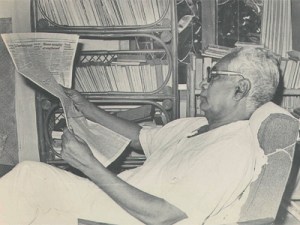
Remembering Nishith Bhattacharya, unsung revolutionary hero: Basu Acharya

Guest pots by BASU ACHARYA

The morning of February 15th this year was exceptionally grim. The sun looked pale, its rays mangled, as if somebody had scratched its face with a scalpel blade of tempered steel. Ramakrishna Naskar lane, an obscure by-lane in Beleghata area of Kolkata, was suddenly bustling with unusual activity. A number of people, quite a few in fact, irrespective of the nature of the red flags they carry, had gathered before a modest dwelling; assembled to bid adieu (with clenched fists and the ‘Internationale’ on their lips) to an old man, an octogenarian, wrapped in a crimson cloth with a crossed hammer and sickle in white. Prof. NB, our very own Nishith-da, Comrade Nishith Bhattacharya was no more. Leaving his mortal remains for the pyre to consume and his comrades to weep over, he had left for the final voyage—journey ‘to the undiscovered country from whose bourn no traveller returns’.

My association with Nishith-da dates back to the early years of the past decade when India, like many other ‘developing countries’ of the world, was passing through the initial days of the second information revolution. I, then an activist of a tiny student-youth organisation, met him on the book-fair ground at Maidan and asked scores of questions about Naxalbari and related topics. Most surprisingly, he, without a slightest mark of impatience on his face, answered each question with brutal accuracy and won my heart. From then onwards I was his admirer, also his disciple, who could even dispose of his own thumb—if asked. There are so many fond memories such as this, and as I scribble this piece, old thoughts crowd my mind and the panorama of our decade-long association appear before my eyes. But honestly speaking, it will be absolutely criminal if we limit a man of Nishith-da’s stature to any personal reminiscence. Rather, it is better to tell the story of his life and time in considerable length and as dispassionately as possible, for history should be impartial nay objective.

Continue reading Remembering Nishith Bhattacharya, unsung revolutionary hero: Basu Acharya

We Need You More Than Ever Today – A Tribute to Mukul Sinha: Harsh Mander

Guest post by HARSH MANDER

Two events altered his life forever. The first was when he witnessed a supervisor disrespectfully berating and kick a junior employee, which transformed a young apolitical physicist, who was passionately devoted to fundamental scientific research, into a tireless trade-unionist. The second – seeing his beloved adopted city Ahmedabad burn with tumultuous hate violence for many weeks in 2002 – thrust him into the heart of many battles against state power malevolently exercised against people of minority faiths. When Mukul Sinha succumbed to a particularly deadly stream of cancer in the summer of 2014, just weeks before Narendra Modi was swept to power, the country lost one if its bravest, most forthright voices for justice.

Raised in the railway enclave of the small district town of Bilaspur in Chhattisgarh where his father served, the young man had clearly worked out his chosen career as a scientist. After graduating in physics from IIT Kanpur, his elected life pathway seemed neatly laid out for him when, in 1973, he was accepted for his doctoral studies in plasma physics in the prestigious Physical Research Laboratory (PRL) in Ahmedabad. Founded in 1947 by the legendary Vikram Sarabhai, this apex space research institute undertakes fundamental research in physics, space and atmospheric sciences, astronomy, solar physics and planetary geo-sciences. This was where India’s first space satellite was born. It was a cloistered intellectual world, separated it seemed by light years from the turbulent life of fighting injustice which Mukul was to ultimately choose. Continue reading We Need You More Than Ever Today – A Tribute to Mukul Sinha: Harsh Mander

Reading the Power Struggle in AAP

There is no way of discussing the ongoing crisis in AAP without being blunt and frank. The terrain of politics is, after all, a brutal and treacherous one. So let me put it without mincing words. The ongoing crisis in AAP is not just about ‘differences of opinion’ or ‘toleration of dissent’ but a power struggle. And before squeamish liberal stomachs start churning, let me also add – power struggles are not always only about power in and of itself. Sometimes they are, but quite often they have to do with alternative visions, imaginations and of course, contrary interests. It is only likely that every serious political party or organization will, if it has any life in it, be faced with a struggle over any or all of these matters, for what is politics if not about steering the party/ movement in the direction one understands to be the best course. And these alternative visions, imaginations, policies and interests are inseparable from the position of individual personalities involved. Individual ambitions are pretty much the stuff of politics and it is unrealistic to expect to see a politics without all of this. The will to power is not exactly a self-effacing virtue.

For this reason, factions and platforms are inevitable in all political formations and it is best to recognize them as legitimate entities and have open public debate, on matters at stake. These cannot be matters of concern to only a small group of leaders in the National Executive and Political Affairs Committee (in AAP’s case) or in Politburos and Central Committees (in the case of communist parties). So, if collective deliberations are important in the apex committees, they would do well to be preceded by a public debate among different tendencies within the organization. At one level, this means moving away from the party-form itself to the form of a platform or coalition, where the different groupings and ideological currents are honestly and openly recognized, as are the personal inclinations and angularities of each individual leader.

This longish preface should make it very clear that my concerns here have nothing to do with the usual liberal platitudes about ‘amicably and democratically’ resolving ‘difference of opinion’. A political movement or party is not an academic seminar. Every such struggle, in the final analysis, is a power struggle – so is the current one in AAP. And there can be no doubt that both sides in this conflict are deeply involved in it. Decoding the stakes in the absence of a clear public debate, apart from selective leaks in the press, is not an easy task. But it does not involve rocket science either. One can read the signs, one can read between the lines of the narratives from both sides that have emerged, howsoever partially, in the media. What follows below, though, is a reading quite different from the ones inundating the media about intolerance of dissent. Continue reading Reading the Power Struggle in AAP

Massive protests against Land Acquisition Ordinance at Jantar Mantar

For updates on the protest, visit Abki Baar Humara Adhikar

11017480_669849169804507_5254527374248079527_n


poster


women

Images courtesy Abki Baar Humara Adhikar

Innocence Interrupted: Arshie Qureshi

Guest post by ARSHIE QURESHI

For a child born in Kashmir, the chances of living a normal life and even survival vary greatly from one region to another. Suppose you are born in the seemingly volatile stretch of Downtown. You may well turn out to be someone whose pictures are flashed on social media as the epitome of bravery, someone whose demise is imminent, and someone ready to wear the ‘Shaheed’ label. I arrived at this place at 4:30 on a cold evening. The room was crowded by women sitting with only one recognizable face; Shehzaad’s mother, Rubeena Akhter. Nobody spoke. The air smelled like rain. After a short while, a tall man in a brown-checkered pheran appeared. Leaning on the walls, he helped himself to one corner of the dimly lit but spacious room. He did not want himself to be identified as a ‘victim of conflict’.

For Shehzaad, life had been altogether different before. He had spent happy summers with his family in the town where violence, as it existed, had never appeared to him naked. By now, he is 23. He has become larger and properly bearded. The one thing which you can’t miss about Shehzaad is that he has giant brown eyes like a dairy cow. That’s what prompts my most idiotic lines of inquiry. Could someone who looks like that really pelt stones on streets? Idiotic, I know. “Do I have to tell you how I was supposed to have been killed that day?” he says, sounding like a gull. I hear a slow whimpering strangled with ache. This soon changes into full-throated babbling—a cascade of terrible, terrified pleading wails as he continued naming those who had been killed during the 2010 agitations.

Continue reading Innocence Interrupted: Arshie Qureshi

Bus Porters’ Petition for Aadhaar – A Political Analysis: Tarangini Sriraman

Guest post by TARANGINI SRIRAMAN

IMG_20140407_180321

Porters at ISBT  (Image courtesy DNA)

Barely six years into its introduction, the Aadhaar project, otherwise known as the Unique Identification (UID) project has been studied and critiqued extensively – its promises to strengthen welfare delivery, curb corruption, exorcise ghost beneficiaries from government databases, initiate financial inclusion and enhance intra-governmental coordination have been enthusiastically received in certain corporate and technocratic circles and skeptically, if not scathingly viewed in other academic and journalistic quarters. The liberties this far-advanced project has taken with individuals’ privacy and its failure to acquire a statutory basis (even as enrollment drives continue unabated) have justly attracted severe censure. And until recently, the surreptitiously mandatory nature of the project – where welfare entitlements were linked to the possession of numbers – was cause for alarm. The Supreme Court judgment in 2013 challenging this mandatory linkage between Aadhaar and subsidies/entitlements may have slowed down processes of the number’s proliferation as an exclusive proof.

However, since the new government at the Centre took over, newer uses and linkages are being imagined. How indispensable the Aadhaar will be to such schemes and entitlements only time can tell: cases in point the Jan Dhan Yojana (JDY) and the linkage of the Aadhaar with the passport. As new linkages appear in place of the old, the new government is urging all of us to walk boldly into the embrace of biometric identification that will, to a certain extent, at least, pervade public transactions (for some) and their very socio-economic chances of welfare support (for most others).  It was against this conceptual and empirical backdrop (so competently elucidated by the various scholars, lawyers and journalists following this project) that I decided, as part of my work on a larger book project, to speak with a migrant community in Delhi about their Aadhaar-related experiences – did they wish to get these numbers, if so why?

For these purposes, I picked a community of bus coolies or porters in North Delhi most of whom were migrants from different parts of the country and who stayed in a makeshift residence on the premises of the bus terminal. Continue reading Bus Porters’ Petition for Aadhaar – A Political Analysis: Tarangini Sriraman

War and the Lightness of Being Adivasi – Security camps and villages in Bijapur, Chhattisgarh: PUDR

Report produced by PEOPLE’S UNION FOR DEMOCRATIC RIGHTS

Between December 26th and 31st 2014, a PUDR fact-finding team visited 9 villages of Bijapur district, Chhattisgarh to ascertain reports of arrests, intimidation and harassment, including sexual abuse by security forces who are stationed there to fight the Maoists. Predominantly Adivasi villages, the residents of Basaguda, Kottaguda, Pusbaka, Lingagiri, Rajpeta, Timmapur, Kottagudem, Korsaguda and Sarkeguda, narrated the daily acts of violence and violations committed by armed personnel residing in security camps. Apart from documenting the continuance of ‘area domination’ by the security forces, the report draws particular attention to:

  1. The large number of ‘permanent warrants’ issued against the populace, of which a significant number is declared as ‘absconders’. A rough estimate indicates that as many as 15-35,000 people live under the threat and fear of these warrants in Bijapur alone.
  2. The lawless conduct of the armed personnel and Special Police Officers (SPOs) who routinely raid, beat, loot, detain and compel the Adivasi villagers to perform ‘begar’ (free labour) at the security camps. Instances of sexual torture were also noted.
  3. The impossibility of lodging FIRs against the security forces as against the rising number of arrests of villagers who languish in jails. Continue reading War and the Lightness of Being Adivasi – Security camps and villages in Bijapur, Chhattisgarh: PUDR

AAP Victory and Some Tools for Popular Self-Government: Sagar Dhara

Guest post by SAGAR DHARA

The Aam Admi Party (AAP) has won a spectacular victory in the Delhi assembly elections and will form a government shortly. The party’s manifesto 2015 (http://www.aamaadmiparty.org/AAP-Manifesto-2015.pdf) promises to do many things—some positive, e.g., passing a Swaraj Bill and some that are not so positive, e.g., setting up pithead power plants to supply power to Delhi. Here are a few practical suggestions that may help AAP and its supporters to strengthen people’s participation in grasroot self-governance.

Participatory budgeting

AAP’s proposed Swaraj Bill is aimed at strengthening grassroot self-governance in Delhi mohallas and community neighbourhoods. Mohalla committees are designed to deal with local issues. However, they can also be used as platforms for Delhi’s polity to participate in decisions that that affect all of Delhi through a process called participatory budgeting.

Participatory budgeting first began in 1990 in the Brazilian city of Porto Alegre.  In the first quarter of every year, communities hold open house meetings every week to discuss and vote on the city’s budget and spending priorities for their neighbourhood.  Later, city-wide public plenaries pass a budget that is binding on the city council.  The results speak for themselves.  Within seven years of starting participatory budgeting, household access to piped water and sewers doubled to touch 95%.  Roads, particularly in slums, increased five-fold.  Schools quadrupled, health and education budgets trebled.  Tax evasion fell as people saw their money at work.  People used computer kiosks to feed communicate suggestions to the city council’s website.

Participatory budgeting is now being done in 1,500 towns around the world—Europe, South America, Canada, India—Pune, Bengaluru, Mysore and Hiware Bazar in Maharashtra. Twenty five years ago, Hiware Bazar was like any other drought-prone village in Marathwada.  Today its income has increased twenty-fold and poverty has all but disappeared. Continue reading AAP Victory and Some Tools for Popular Self-Government: Sagar Dhara

धर्म की आड़ में महिला अस्मिता पर प्रहार: जीत सिंह सनवाल

Guest post by JEET SINGH SANWAL

उन्नाव (उ.प्र.) से भारतीय जनता पार्टी के सांसद साक्षी महाराज ने पिछले माह हिन्दू धर्मावलम्बी महिलाओं को चार-चार बच्चे पैदा करने की सलाह देकर हिन्दुत्ववादी संगठनों की वर्षों पुरानी ख्वाहिश को मानो एक जीवनदान दे दिया। इस बयान के बाद तमाम हिन्दुत्ववादी संगठनों ने धर्म की दुहाई देते हुए महिलाओं को ज्यादा से ज्यादा बच्चे पैदा करने की सलाह देने के लिए मोर्चा संभाल लिया। कुछ लोगों ने तो आठ और कुछ ने दस-दस बच्चों को पैदा करने तक का आह्वान कर दिया। कई वर्षों से विश्व हिन्दू परिषद इस विषय को मुद्दा बनाये हुए है लेकिन साधारण जनमानस ने उसे कोई महत्व नहीं दिया। भाजपा के नेताओं द्वारा इस तिरस्कृत मुद्दे को उछालने के बाद इस तरह के तमाम संगठनों ने इसे हाथों-हाथ लेते हुए एक व्यापक मुद्दा बनाने का प्रयास किया।

महत्वपूर्ण बात यह है कि वी.एच.पी. से संबंधित साध्वियों को यदि छोड़ दें तो महिलाओं से संबंधित इस मुद्दे पर यह बहस पुरुषों ने शुरू की है। महिलाओं को संबोधित करने वाले ये बयान महिलाओं पर अधिकार जमाने वाले पुरूष मानसिकता का प्रतिरूप है, जिसमें महिलाओं की स्वतंत्रता, इच्छा, अधिकार, समानता व आत्मसम्मान की कोई जगह नहीं है।

इस मुद्दे की जमीनी सच्चाई तो यह है कि ऐसे  बयानों के बावजूद भारतीय महिलाओं ने प्रजनन दर को कम रखने को प्राथमिकता दी है। जनसंख्या निदेशालय के आंकड़ों के अनुसार भारत की कुल प्रजनन दर जो 1971 में 5.2 थी वह घटकर 2013 में 2.3 हो गई। धार्मिक भावनाओं केा भड़का कर इन महिला विरोधी बयानों को तूल देने की इस प्रक्रिया में चिंता इस बात की है कि इसमें धर्म के ठेकेदारों के साथ-साथ सत्ता पक्ष से जुड़े राजनेताओं ने भी मोर्चा संभाला हुआ है। छिट-पुट विरोधों के अलावा प्रगतिशील मंचों से इस तरह के बयानों की कोई खास आलोचना न होने से भी इन संगठनों व लोगों के हौसले बढे  हैं।  Continue reading धर्म की आड़ में महिला अस्मिता पर प्रहार: जीत सिंह सनवाल

A Chance for Social Change Like Never Before: Shankar Gopalakrishnan

Guest post by SHANKAR GOPALAKRISHNAN

For those who don’t like Modi-Sangh politics, February 10th was a day of joy. When this note was drafted a month ago, the provisional title was “This is No Time for Despair.” But last Tuesday has not only dented Modi’s invincible image – it has also dented the sense of being besieged. Since May 2014, almost every progressive force in the country has been on the defensive. The AAP’s politics and the popular tsunami that drove it to power have shattered this gloom.

But the key question at this point – is the eventual defeat of the NDA in an election the only goal? I argue that here that that is just the beginning. The end of this period – which, notwithstanding February 10th, is obviously some time away – will offer a space that has not existed in Indian politics in decades. Whether that space gets used or not will depend on how the struggle develops in the interim period.

The potential of this period is rooted in three basic flaws that the current ruling coalition (between big business and the Sangh) suffers from. First, its key forces are fundamentally myopic and delusionary in character. Second, it is internally contradictory – the two pillars of this formation will undercut each other in organisational (not just political or rhetorical) terms. Finally, it embodies a peculiar combination of organisational strength and political weakness. Continue reading A Chance for Social Change Like Never Before: Shankar Gopalakrishnan

Are Jibran Nasir and his friends Game Changers in today’s Pakistan? Fawzia Naqvi

Guest Post by FAWZIA NAQVI

One cold Karachi Night

On the night of February 1st, Jibran Nasir Pakistan’s leading activist and a handful of peaceful protesters sat on a road in Karachi near the Sindh Chief Minister’s house for more than 24 hours, demanding the arrest of terrorists responsible for the January 30th Shikarpur attack which killed 65 Shias during Friday prayers, and demanding action against banned sectarian organizations. There were only 20 protesters, their average age 25, outnumbered it seemed by riot police with water cannon and batons at the ready.

Protest in Karachi against Terrorism and Secterian Violence

Continue reading Are Jibran Nasir and his friends Game Changers in today’s Pakistan? Fawzia Naqvi