Category Archives: Politics

War and the Lightness of Being Adivasi – Security camps and villages in Bijapur, Chhattisgarh: PUDR

Report produced by PEOPLE’S UNION FOR DEMOCRATIC RIGHTS

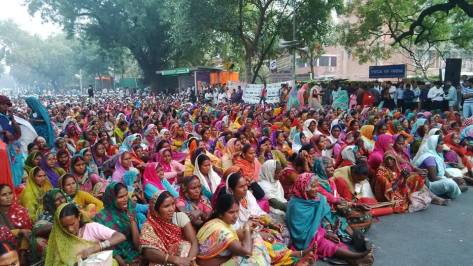
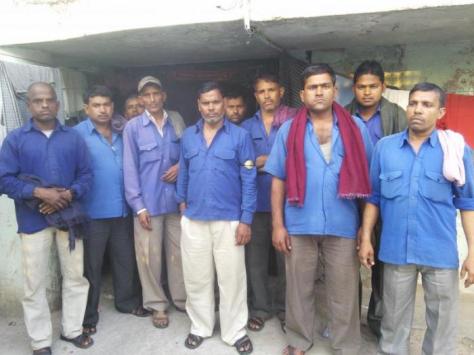
Between December 26th and 31st 2014, a PUDR fact-finding team visited 9 villages of Bijapur district, Chhattisgarh to ascertain reports of arrests, intimidation and harassment, including sexual abuse by security forces who are stationed there to fight the Maoists. Predominantly Adivasi villages, the residents of Basaguda, Kottaguda, Pusbaka, Lingagiri, Rajpeta, Timmapur, Kottagudem, Korsaguda and Sarkeguda, narrated the daily acts of violence and violations committed by armed personnel residing in security camps. Apart from documenting the continuance of ‘area domination’ by the security forces, the report draws particular attention to:

  1. The large number of ‘permanent warrants’ issued against the populace, of which a significant number is declared as ‘absconders’. A rough estimate indicates that as many as 15-35,000 people live under the threat and fear of these warrants in Bijapur alone.
  2. The lawless conduct of the armed personnel and Special Police Officers (SPOs) who routinely raid, beat, loot, detain and compel the Adivasi villagers to perform ‘begar’ (free labour) at the security camps. Instances of sexual torture were also noted.
  3. The impossibility of lodging FIRs against the security forces as against the rising number of arrests of villagers who languish in jails. Continue reading War and the Lightness of Being Adivasi – Security camps and villages in Bijapur, Chhattisgarh: PUDR

AAP Victory and Some Tools for Popular Self-Government: Sagar Dhara

Guest post by SAGAR DHARA

The Aam Admi Party (AAP) has won a spectacular victory in the Delhi assembly elections and will form a government shortly. The party’s manifesto 2015 (http://www.aamaadmiparty.org/AAP-Manifesto-2015.pdf) promises to do many things—some positive, e.g., passing a Swaraj Bill and some that are not so positive, e.g., setting up pithead power plants to supply power to Delhi. Here are a few practical suggestions that may help AAP and its supporters to strengthen people’s participation in grasroot self-governance.

Participatory budgeting

AAP’s proposed Swaraj Bill is aimed at strengthening grassroot self-governance in Delhi mohallas and community neighbourhoods. Mohalla committees are designed to deal with local issues. However, they can also be used as platforms for Delhi’s polity to participate in decisions that that affect all of Delhi through a process called participatory budgeting.

Participatory budgeting first began in 1990 in the Brazilian city of Porto Alegre.  In the first quarter of every year, communities hold open house meetings every week to discuss and vote on the city’s budget and spending priorities for their neighbourhood.  Later, city-wide public plenaries pass a budget that is binding on the city council.  The results speak for themselves.  Within seven years of starting participatory budgeting, household access to piped water and sewers doubled to touch 95%.  Roads, particularly in slums, increased five-fold.  Schools quadrupled, health and education budgets trebled.  Tax evasion fell as people saw their money at work.  People used computer kiosks to feed communicate suggestions to the city council’s website.

Participatory budgeting is now being done in 1,500 towns around the world—Europe, South America, Canada, India—Pune, Bengaluru, Mysore and Hiware Bazar in Maharashtra. Twenty five years ago, Hiware Bazar was like any other drought-prone village in Marathwada.  Today its income has increased twenty-fold and poverty has all but disappeared. Continue reading AAP Victory and Some Tools for Popular Self-Government: Sagar Dhara

धर्म की आड़ में महिला अस्मिता पर प्रहार: जीत सिंह सनवाल

Guest post by JEET SINGH SANWAL

उन्नाव (उ.प्र.) से भारतीय जनता पार्टी के सांसद साक्षी महाराज ने पिछले माह हिन्दू धर्मावलम्बी महिलाओं को चार-चार बच्चे पैदा करने की सलाह देकर हिन्दुत्ववादी संगठनों की वर्षों पुरानी ख्वाहिश को मानो एक जीवनदान दे दिया। इस बयान के बाद तमाम हिन्दुत्ववादी संगठनों ने धर्म की दुहाई देते हुए महिलाओं को ज्यादा से ज्यादा बच्चे पैदा करने की सलाह देने के लिए मोर्चा संभाल लिया। कुछ लोगों ने तो आठ और कुछ ने दस-दस बच्चों को पैदा करने तक का आह्वान कर दिया। कई वर्षों से विश्व हिन्दू परिषद इस विषय को मुद्दा बनाये हुए है लेकिन साधारण जनमानस ने उसे कोई महत्व नहीं दिया। भाजपा के नेताओं द्वारा इस तिरस्कृत मुद्दे को उछालने के बाद इस तरह के तमाम संगठनों ने इसे हाथों-हाथ लेते हुए एक व्यापक मुद्दा बनाने का प्रयास किया।

महत्वपूर्ण बात यह है कि वी.एच.पी. से संबंधित साध्वियों को यदि छोड़ दें तो महिलाओं से संबंधित इस मुद्दे पर यह बहस पुरुषों ने शुरू की है। महिलाओं को संबोधित करने वाले ये बयान महिलाओं पर अधिकार जमाने वाले पुरूष मानसिकता का प्रतिरूप है, जिसमें महिलाओं की स्वतंत्रता, इच्छा, अधिकार, समानता व आत्मसम्मान की कोई जगह नहीं है।

इस मुद्दे की जमीनी सच्चाई तो यह है कि ऐसे  बयानों के बावजूद भारतीय महिलाओं ने प्रजनन दर को कम रखने को प्राथमिकता दी है। जनसंख्या निदेशालय के आंकड़ों के अनुसार भारत की कुल प्रजनन दर जो 1971 में 5.2 थी वह घटकर 2013 में 2.3 हो गई। धार्मिक भावनाओं केा भड़का कर इन महिला विरोधी बयानों को तूल देने की इस प्रक्रिया में चिंता इस बात की है कि इसमें धर्म के ठेकेदारों के साथ-साथ सत्ता पक्ष से जुड़े राजनेताओं ने भी मोर्चा संभाला हुआ है। छिट-पुट विरोधों के अलावा प्रगतिशील मंचों से इस तरह के बयानों की कोई खास आलोचना न होने से भी इन संगठनों व लोगों के हौसले बढे  हैं।  Continue reading धर्म की आड़ में महिला अस्मिता पर प्रहार: जीत सिंह सनवाल

A Chance for Social Change Like Never Before: Shankar Gopalakrishnan

Guest post by SHANKAR GOPALAKRISHNAN

For those who don’t like Modi-Sangh politics, February 10th was a day of joy. When this note was drafted a month ago, the provisional title was “This is No Time for Despair.” But last Tuesday has not only dented Modi’s invincible image – it has also dented the sense of being besieged. Since May 2014, almost every progressive force in the country has been on the defensive. The AAP’s politics and the popular tsunami that drove it to power have shattered this gloom.

But the key question at this point – is the eventual defeat of the NDA in an election the only goal? I argue that here that that is just the beginning. The end of this period – which, notwithstanding February 10th, is obviously some time away – will offer a space that has not existed in Indian politics in decades. Whether that space gets used or not will depend on how the struggle develops in the interim period.

The potential of this period is rooted in three basic flaws that the current ruling coalition (between big business and the Sangh) suffers from. First, its key forces are fundamentally myopic and delusionary in character. Second, it is internally contradictory – the two pillars of this formation will undercut each other in organisational (not just political or rhetorical) terms. Finally, it embodies a peculiar combination of organisational strength and political weakness. Continue reading A Chance for Social Change Like Never Before: Shankar Gopalakrishnan

Are Jibran Nasir and his friends Game Changers in today’s Pakistan? Fawzia Naqvi

Guest Post by FAWZIA NAQVI

One cold Karachi Night

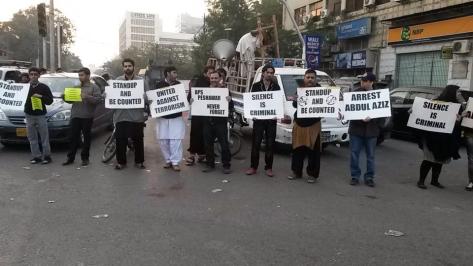
On the night of February 1st, Jibran Nasir Pakistan’s leading activist and a handful of peaceful protesters sat on a road in Karachi near the Sindh Chief Minister’s house for more than 24 hours, demanding the arrest of terrorists responsible for the January 30th Shikarpur attack which killed 65 Shias during Friday prayers, and demanding action against banned sectarian organizations. There were only 20 protesters, their average age 25, outnumbered it seemed by riot police with water cannon and batons at the ready.

Protest in Karachi against Terrorism and Secterian Violence

Continue reading Are Jibran Nasir and his friends Game Changers in today’s Pakistan? Fawzia Naqvi

AAP Victory and the Challenges of a New Politics

Let me say it once again, the AAP victory cannot be understood outside the post-ideological moment. I have argued earlier on Kafila (here and here), that one of the key features of AAP was its post-ideological character – one that moved relentlessly beyond many verities of 20th century ideologies and binaries like state versus market, or religious/communal versus secular and so forth. To reiterate, this formation represents the spirit of the moment that is itself post-ideological.

At Ramlila maidan, courtesy New Indian Express

But it is also time perhaps, to underline that post-ideological does not mean post-political. At least, not any longer. There is no doubt that a politics of AAP is gradually and clearly coming into view – but it is a politics whose edifice is being built from the bottom up. It does not derive from any settled ideological blueprint that comes ready-made – a blueprint around which a politics is then sought to be constructed. That was the project of all 20th century ideologies, which had already divided the world into neat camps and made the divisions into permanent battle lines. Ideologies became repositories of Truth – universal and unchanging, taking away from politics the very contingency and fluidity that defines it. Ideology, in other words, was fundamentally anti-political. In parenthesis, it may be relevant to point out that that is why, perhaps, Marx himself celebrated the Paris Commune by underlining that the workers “had no ideals to realize, no blueprints to which the world must conform”; they merely had to set free the new forces that were challenging the old order. Socialism in the 19th century was not yet an ideology in that sense. Continue reading AAP Victory and the Challenges of a New Politics

Vandalism – The Perfect Solution To Communalism! Nandini Rao

Guest Post by  NANDINI RAO

Thank you, unknown-vandals-out-there.

For burning church altars to ashes; for desecrating sacred objects inside houses of worship, for tossing carcasses inside religious places; for converting, de-converting, un-converting or re-converting (as the case may be); for stealing objects from churches that are more valuable to their parishioners for their emotional significance rather than monetary value. For making people ask in hushed tones when and where the next attack is going to take place and what form it will take. For making the pastor conduct midnight mass on Christmas eve outside the church in Delhi, with the faithful offering their prayers in the freezing winter night, simply because they did not have a church to go to.

But most of all, thank you for frightening communities who follow different religions and worship different gods. As for those who do not believe in god or religion, thank you for making them worried about how the social fabric of this country is being pulled apart, thread by thread, through political machinations.

IMG_20150205_094537

Because by doing all of the above, the unknown vandals (they are, needless to say, not criminals, just harmless “vandals”) have made people stop in their tracks and think. They have made communities question law enforcement agencies that brush aside fears and doubts and try to minimise the crimes taking place in their houses of worship. They are compelling them to discuss and debate about forced versus consensual conversions to religions of one’s choice. They are making people of all communities and religions realise how they are being pitted against each other and used as pawns in devious political games. They understand that, in the bargain, it is the poor and the marginalised living on daily wages who are being exploited in the worst possible way. People are realising the importance of their vote and of the very real impact they can make and the change they can bring about, with the single act of pressing a button.

Vandalism has made people come together to hold meetings and consultations to chart out a course to resolve the crises. It has made them stand outside their churches on pavements and on roads, demanding justice and accountability from a state and administration that does not seem to be heeding their voices.

And most important of all, vandalism is teaching us (more than political speeches and advertisements) how one needs to keep on asserting till our voices are heard that we are all citizens in a secular, socialist and democratic republic. That as believers and non-believers, we may worship (or not worship) in varied ways and learn from the teachings of one holy book (or a multitude of books and philosophies), but as citizens, our Holy Book is only the Constitution of India and what it has defined for us, as Indians.

Continue reading Vandalism – The Perfect Solution To Communalism! Nandini Rao

My elections days, 2015: Sivamohan Sumathy

Guest Post by SIVAMOHAN SUMATHY

campaigning, exciting, tense, nervous, delirium-invested, holding training sessions on the verendah for the immediate neighbouhood, as nobody but appa had voted in any previous presidential election, strangely agreeing with appa on politics for once, passing on all the wild gossip about the mr family, nightmare riddled pre election nights, sleeplessness, inducing drinking, exhilarating, liberating, cautionary, educating vasuki’s children about the elections ( they are keenly interested), near addiction to fb and quarellling with totally unknown friends on it, while another plethora of unknown persons writing in to befriend me, baila sessions, holding candle lit vigils for assassinated journalists, being connected to the universe on election night through thiru, who was on every tweet, every note, every social bleep, planning, writing, tasking for the future, doubts, setting off crackers, taking to singing, questions, pondering profound political questions on the nature of the state, reforms or revolution, gramsci’s historic bloc, not stopping at paradigm shift as most liberal commentators have done with this over used and abused term, not bothering with muslim bashing in europe over charlie whatever, in fact, just a wee bit short of visionary.

no paradigm shift,
no revolution, it is toward …….

they cut the jak tree down in our backyard,
the day after elections.
the parrots displaced again.

An Election of Hope Versus Fear

Yes it’s a simplistic dichotomy, but there is really no better way to describe the current Delhi elections. On the one hand, a little ragtag army of Davids behind “Mufflerman”, as his faithful supporters affectionately call him, a person in baggy sweater and sneakers, one you wouldn’t look at twice if you passed him on the road.

Mufflerman Business Standard

  Kejriwal

On the other hand, a massively funded, aggressively confident Goliath, openly backed by the corporate bodies and full-page ads, riding a  national “Wave” higher than most Tsunamis, topped by the 56-inch chest of “Modiman”, even if recently modestly covered by a 12-lakh rupee vest.

56-inch Modi78c0d4d3-be9e-4afb-b034-1247529df720wallpaper1

On the one hand, a fearful and awed media establishment donating PR for free to the seemingly invincible King of Gujarat, and on the other, an aam aadmi, a volunteer-cadre run campaign and a palpable vibe of trust and openness on the ground. I know I know, some will say it’s all ‘perception management’ and PR, but barring the googly of the 2 crores party donation thrown at the opportune moment, if Mufflerman’s party was any cleaner, it could have given Lalita ji’s Surf a run for its money. Whatever the result on the 10th (and there is reason to be hawk-eyed about the possibility of tampering as Nivedita Menon’s post has urged), how does anybody not get what a miracle this alone is, in a political economy with a black economy of a size that is higher than the GDPs of most smaller countries? Perhaps this is in fact about hope and fear after all, however clichéd that sounds.

Continue reading An Election of Hope Versus Fear

BJP’s bravado on exit polls – do they know something about EVMs that we don’t?

BJP says exit polls will fall flat on counting day – I wonder where this confidence comes from. Are they counting on the fact that in many booths, whatever party voters selected, their votes were registering in the BJP’s account? After the murkiness of Lok Sabha results especially in Banaras, with EVMs found in officials’ homes before election day and 3 lakh duplicate voters on the lists, the Election Commission’s ‘clarifications’ raising more questions than they answered, such possibilities no longer seem paranoid.

(The Election Commission said that in Banaras it found 6.47 lakh duplicated names, all of which are repeated at least once across the state. The official said, however, that these are not all necessarily fake entries in the rolls. They could be people who share a name. “For instance, a ‘Rajesh, son of Ramesh’, might be found several times in UP,” he said. “We are in the process of checking whether these people are same or different.”

The question is, when the process was to compare both the voter’s as well as his/her father’s name with other voters, how were 6.5 lakh duplicate names found in a constituency with 17 lakh voters?)

But my point in this post is not about electoral rolls, and a growing suspicion among many that the EC is not entirely un-compromised.

My point is that Electronic Voting Machines are extremely problematic from the point of view of exercising the democratic right to vote (not to mention costs) and have been given up by many ‘advanced’ countries after trying them out for some years. Whatever happens in this particular election, it is time for Indian citizens to think seriously about whether EVMs should be retained. Continue reading BJP’s bravado on exit polls – do they know something about EVMs that we don’t?

Challenging the West’s Narrative on Sri Lanka’s ‘Victory for Democracy’: Devaka Gunawardena

Guest Post by DEVAKA GUNAWARDENA

Of the many pieties that have been promoted in the Western media in the aftermath of Maithripala Sirisena’s victory over incumbent Mahinda Rajapaksa in the recent Sri Lankan presidential election, none has been more cherished than the notion that Sri Lanka is now on board with “democracy.”[1] This claim is counter-posed to Sri Lanka’s recent cozy relationship with China and other authoritarian countries. A new Cold War is supposedly being fought, with Sri Lanka’s election reduced to its strategic relevance to policy makers.

At the same time the dominant narrative promoted by Western media and diplomats has been conveniently ignored in other places where it is considered politically unfeasible to support democracy. The same diplomats and officials that criticized the previous Rajapaksa regime have often argued that equally if not more repressive governments in places such as the Middle East are “on the path to democracy.” This claim temporizes the same political expectations that have been applied to Sri Lanka. Continue reading Challenging the West’s Narrative on Sri Lanka’s ‘Victory for Democracy’: Devaka Gunawardena

Indian Democracy and the Current Political Dispensation: Ram Puniyani

Guest Post by RAM PUNIYANI

Text of the Dr Asghar Ali Engineer Memorial Lecture

I begin this lecture paying tribute to my very dear friend, Dr. Asghar Ali Engineer, with whom I had the rare privilege of working with for close to two decades. Dr. Engineer was a unique scholar-activist, totally committed to the dream and vision of a humane society that honours the values of diversity and where human rights for all are the defining point.

In this regard, he may have been among the first persons who realized the dangers of divisive communal politics. It was he who set the trend seeking the causal factors behind communal violence, doing his own meticulous investigation after such riots. He contributed massively to reforms that took place in the Bohra community, on the issues of secularism and finally, in the interpretation of Islam. We need to learn a lot from him in order to strive for a society that values peace, amity and compassion.

Where are we standing today? What are the major threats to Indian democracy, today, even more menacing with the coming of the Modi Government?

The factors contributing to his victory have been several. The unstinted support given to him by India’s corporate; the fanatical zeal of the RSS and its lakhs of volunteers; the role of a corporate controlled media; the false projection of the ‘Gujarat model of development’; and the polarization of society along religious lines

The promise of Achhe Din – Good Times – has vanished into thin air. Despite the steep fall in the prices of crude oil in the world, the overall ‘cost of living’ continues to going up. The promise that all the black money stacked abroad will be brought back within six months or so and that we would be surprised to see 15 lakh deposited in our accounts, has been forgotten. The pattern of (good?) governance is only visible in the centralization of power around one person, Modi. Gradually the cabinet system of governance is giving way to one man’s autocratic ways, with secretaries of Government departments reporting directly to the PM.  Continue reading Indian Democracy and the Current Political Dispensation: Ram Puniyani

Modi, Barack and a once sovereign nation

The sheer misery, the excruciating embarrassment, of  watching the Prime Minister of a sovereign (but not secular or socialist) nation desperately, inappropriately, capering about to show off his imagined intimacy with an American President who steadfastly kept his distance and his dignity, is now passing. Time does heal all wounds. (And hopefully, as Groucho Marx put it, Time will also wound all heels) [1]

But the burning question remains – is Modi more shameless than he is ignorant? Much has been said about Modi’s suit that exceeds the worst excesses of the late unlamented Marie Antoinette. Vrinda Gopinath points out:

While the last world leader to don such a suit (it costs around 15,000 sterling pounds or Rs 15 lakhs today) was deposed Egyptian tyrant Hosni Mubarak, it certainly out-dazzled Obama’s working dark grey suit (to cut down on non-vital decisions, the US Prez only wears grey and blue ). However, if Modi was thinking hip-hop bling and ice accessories (his fave diamond Movado watch), it certainly got Obama to make a mention at the President’s banquet when he foxily pointed out how a newspaper back home wrote, “Move aside, Michelle Obama. The world has a new fashion icon.” It must have not passed Obama’s notice that Modi had changed his attire thrice that day.

securedownload

Continue reading Modi, Barack and a once sovereign nation

Farmers’ Suicides and Fatal Politics: Vasanthi Srinivasan

Guest Post by VASANTHI SRINIVASAN

With depressing regularity, the newspapers have been reporting farmers’ suicides in many states. Recently, P Sainath wrote on BBC that around 296,438 farmers have committed suicide since 1995. He also mentions that cash crop cultivators of cotton, sugar cane, vanilla, pepper, groundnut etc account for the bulk of those suicides. According to a PIL heard by the Supreme Court in December 2014, around 3146 farmers in Maharashtra have committed suicide this year. Of course, farmer’s suicides only account for a fraction of all suicides reported in India. Besides, farmer’s suicides are a global phenomenon. The litany of woes is also familiar to readers, namely rising indebtedness, crop failures, falling prices, natural disasters etc.

And yet the meaning of these suicides, if any, is worth reflecting upon.

Politicians, who are used to massive debts, seem to think this is an ‘extreme step’ on the part of farmers. In 2003, the then Union Minister for Agriculture hinted that indebtedness alone may not be causing the ‘extreme step’, and that ‘family problems’ may also be a reason. In Karnataka, the Veeresh committee report had earlier identified depression, alcoholism and marital discord rather than the rising debt as the relevant causes. Never one to lag behind, the hi-tech Chief Minister of Andhra Pradesh Chandrababu Naidu  announced compensations and proposed to get psychiatrists to rural areas. One scholar has pointed to the increasing isolation of cultivators and high levels of anxiety about failure suffered by some farmers [1]. These attempts at ‘personalizing’ the farmers’ problems may be necessary but not sufficient as long as other factors remain unexplored – increasing cultivation costs, crop failures, water shortages and falling product price. Citing the high figures of suicides (204) in Maharashtra for 2014 until April, followed by Telangana (69 until October), the Times of India  (dated Nov 26, 2014), reported that the present Central government admitted indebtedness as a possible factor.  There are also calls to increase monetary compensation to families affected by such suicides.   Continue reading Farmers’ Suicides and Fatal Politics: Vasanthi Srinivasan

‘Attica, Attica, You Put Them Guns Down!’ Ipsita Barik

On a day when we woke up to the seemingly incomprehensible barbarism of a woman being beheaded in Saudi Arabia, we may do well, apropos Nivedita Menon’s post on MLK, to remember the barbarism that hides in broad daylight within seemingly civilised societies. One such floodlit hideout, so bright it blinds us, is the state of our prisons. Before Guantanamo and Abu Ghraib inaugurated a new era of dehumanisation in the American “correctional system”, there was Attica, and hundreds others like it that continue in the U.S and around the world to this day. We may also remember Professor G.N Saibaba of Delhi University who, despite being 90% disabled, has been not only imprisoned but kept in solitary confinement for almost two years on mere suspicion in an Indian jail somewhere. Really, what more does it take these days?!

This is a guest post by Ipsita Barik

Attica 9

When Al Pacino’s character Sonny Wortzik yells and hollers “Attica – Attica” in the film Dog Day Afternoon, the cops and the FBI officers are left stunned & dumbfounded, but the civilian population collected at the scene, behind the police barricades began to cheer & applaud. The air is soon filled by the chants of the noun and Sonny in his soaked white shirt, flaying his arms and stomping on the ground, gestures at the cops and adds “you put them guns down; you put them down – “AATTICA aattica”. So what was happening here? Why were these people cheering and supporting a man who had come to rob a local bank and was holding hostages inside! And what was Attica all about?

Attica 5

Attica prison riots/uprisings happened at the Attica Correctional Facility, New York, United States; when the prison cells and yards were seized by the inmates, who also held hostages, on September 9th 1971, opening a series of negotiations and dialogues between the establishment and the inmates, which included civilian observers, Tom Wicker of the New York Times, Republican State Senator John Dunne, radical lawyer William Kunstler and Black Panther’s Bobby Seale, on the request of the inmates. The primary demands of the inmates were related to the inadequacies and brutalities within Attica, such as related to insufficient food and medical care, racial discrimination, physical abuse, restricted access to educational and training facilities, all a serious indictment of the prison rules and environment, as the New York State Special Commission on Attica/McKay Commission (set up by the state) subsequently went on to assert and highlight. Continue reading ‘Attica, Attica, You Put Them Guns Down!’ Ipsita Barik

The Other America: Martin Luther King

January 19th was Martin Luther King Day. To honour him, here is the recording of his famous The Other America speech at Stanford in 1967.

Too many, far too many tragic resonances with 21st Century India. 

There are literally two Americas. One America is beautiful for situation. And, in a sense, this America is overflowing with the milk of prosperity and the honey of opportunity. This America is the habitat of millions of people who have food and material necessities for their bodies; and culture and education for their minds; and freedom and human dignity for their spirits. In this America, millions of people experience every day the opportunity of having life, liberty, and the pursuit of happiness in all of their dimensions. And in this America millions of young people grow up in the sunlight of opportunity. But tragically and unfortunately, there is another America. This other America has a daily ugliness about it that constantly transforms the ebulliency of hope into the fatigue of despair. In this America millions of work-starved men walk the streets daily in search for jobs that do not exist. In this America millions of people find themselves living in rat-infested, vermin-filled slums. In this America people are poor by the millions. They find themselves perishing on a lonely island of poverty in the midst of a vast ocean of material prosperity.

The one difference being that in 21st Century India, there are lonely islands of prosperity in the midst of a vast ocean of deprivation, human misery and injustice.

Bhopal Victims Neglect a Consequence of Disinvestment and Low Value of Life: Sagar Dhara

Guest post by SAGAR DHARA

On 2 Dec 1984, Bhopal’s unsuspecting population was hit in the stealth of the night by methyl isocyanate (MIC), a killer gas that leaked from the Union Carbide plant located on the northern edge of the city.  The official immediate death toll was 2,259, though journalists estimated it to be thrice that number.  Government of India now admits that the cumulative number of deaths is more than 20,000.

At first glance, the event looks like an engineering accident.  Wash water seeped through a closed valve, got into MIC Tank 610 and triggered a runaway reaction that ruptured it and spilt 42 tonnes of MIC.  Low wind speeds made the heavier-than-air gas cloud hug the ground at high concentrations as it drifted towards nearby slums.  The highly corrosive gas caused massive edema in the lungs.

Economics is root cause for accident

The cause for the accident can be traced to low product sales that made the company disinvest in safety and environmental systems. Prior to 1980, Carbide formulated Sevin, a carbamate group pesticide, with imported chemicals at their Mumbai plant.  Because of Sevin’s popularity, Carbide built a new plant in Bhopal to manufacture it.  By then synthetic pyrethroids, the next generation pesticide, started pushing carbamates out of the Indian market.  Consequently, the Bhopal plant never produced more than 50% of its installed capacity and its financial returns were unhappy. Continue reading Bhopal Victims Neglect a Consequence of Disinvestment and Low Value of Life: Sagar Dhara

Swachchh Bharat – Beyond Charity and Symbolism to Legal Rights and Duties: Sujith Koonan

Guest post by SUJITH KOONAN

Sanitation and cleanliness seems to have become buzzwords. Celebrities and political leaders have started talking about sanitation. The call for Swachchh Bharat by the Prime Minister of India was welcomed by many taking brooms in their hands. Several institutions have uploaded prestigiously the photographs of its employees carrying brooms. All of a sudden, the sanitation consciousness seems to have increased in the country. Indeed, it is a good sign that we have started thinking and talking about the ‘unmentionables’ – shit and dirt.

Many of these actions and responses are symbolic and rhetoric in nature. While it may be acceptable to begin with symbolism, the seriousness needs to be demonstrated through concrete long term plans and actions. One can hope that the government will take such steps. One way to show that the ongoing sanitation talk is serious, and the state is sincere about it, is to recognise the legal aspects of sanitation. There are mainly three issues where the government has been a failure in fulfilling its constitutional and legal duties and these are supposed to be at the forefront of the Swachchh Bharat Mission (SBM). Continue reading Swachchh Bharat – Beyond Charity and Symbolism to Legal Rights and Duties: Sujith Koonan

What does one write today?

It’s the kind of moment that makes you reach for poetry, for words that convey what can scarcely be written. It’s the kind of moment where you must write for it is writing that is itself at stake.

The debates on Charlie Hebdo are wide and varied. There is, as Joe Sacco so beautifully drew, before anything else, a deep yet horrifically dull sadness. Few and fewer in the world have the privilege to still be “shocked” by violence, to not have its banality be its true horror. There is solidarity, some of the most meaningful of which comes from cartoonists in the Arab world.  There is a wide agreement that no justification is possible for returning any measure of offence with death yet there is an insistence on the ability to critique even that which one defends. As Teju Cole eloquently argues: “moments of grief neither rob us of our complexity nor absolve us of the responsibility of making distinctions.” There are important, vital debates about what it means to “insult everyone equally” when everyone is not equal, reminding us that we must begin and ask our questions in place, in history; that we must remember that the power to criticise is a freedom but also a privilege. There are the universal debates on the limits to absolute speech, pointed to by Sandip Roy who reminds us that the French Government itself banned the earlier incarnation of Charlie Hebdo for printing a mock death notice of the then French PM De Gaulle. There are fears of the Islamophobia this violence will re-incarnate as, that Hari Kunzru argues is one intent of the attackers.

I write with a different intent today. I write not to enter these debates about Charlie Hebdo but to insist on what these deaths must provoke us to do: to translate our solidarity, our empathy, our fear, and our resolve into the real work of protecting the freedoms of speech, satire, offence, and expression in India. That is the tribute to Charlie Hebdo that matters, that transcends all our debates.

Continue reading What does one write today?

Anti-Conversion and Ghar Wapsi, Or Hindutva’s Doublespeak: Charu Gupta

Guest post by CHARU GUPTA

The synchronised vocabulary of anti-conversion by the BJP and that of reconversion by the VHP and Dharm Jagran Samiti, an RSS affiliate, reveals the intimate relationship between the two. Anti-conversion and reconversion are two sides of the same coin. Even though the Dharm Jagran Samiti dropped its plan to ‘reconvert’ 4000 Christians and 1000 Muslim families in Aligarh on 25 December, due to pressures from a parliament in session as well as other protests, the day has had strategic significance. Christmas Day has been given a different meaning by the Hindutva brigade — the birth anniversaries of Madan Mohan Malaviya, one of the stalwarts of the Hindu Mahasabha, and Atal Bihari Vajpayee, the eminent BJP leader. Equally critically, on 23 December 1926 Swami Shraddhanand, the leading ideologue of the shuddhi movement (purification; Hindu movement in the late nineteenth and twentieth centuries to reclaim those who had converted from Hinduism to other religions) was assassinated by a Muslim fanatic, and on 25 December, a condolence motion was moved at the Guawhati session of the Congress.

The twin strategies of anti-conversion and ghar wapsi have a long history and past, which saw its efflorescence in the shuddhi movement, but have become much more aggressive in the present context. As part of their community and nation making rhetoric, the Arya Samaj and the Hindu Mahasabha had launched the programme of shuddhi on a large scale in Uttar Pradesh in 1923. Though Arya Samaj had stronger roots in Punjab, shuddhi movement was more effective in UP. Various scholars have pointed to the communal character of the movement. A note prepared by the criminal investigation department at that time stated that though the movement had older origins, ‘its application to mass rather than individual conversion gave it a special prominence’ in 1923. Shuddhi came to be touted as a movement to reclaim the ‘victims’ and protect the ‘faithful’. Reconversion attempts have since been a part of agenda of various Hindutva outfits, and the present assertions should be seen in that context. Today, organisations like the VHP and Dharm Jagran Samiti have acquired a new importance and are emboldened to not only challenge conversions in an organised manner, but also to simultaneously aggressively campaign for reconversion. Just as shuddhi became an instrument for Hindu communal mobilization in early twentieth century, ghar wapsi is fulfilling the same role today. Continue reading Anti-Conversion and Ghar Wapsi, Or Hindutva’s Doublespeak: Charu Gupta

A Massacre is a Massacre and There is no Good Taliban: S. Akbar Zaidi

Guest post by S. AKBAR ZAIDI [This post was sent to us by our friend S. Akbar Zaidi. Though published earlier in The International News of Pakistan, we are reproducing it here because it represents a position that is felt by many inside Pakistan but which right-wingers in India would love not to see. Like right-wingers and Talibanis in Pakistan, our very own Hindutvavadis too thrive on presenting a monolithic picture of something called ‘Pakistan’.]

This was a massacre, nothing less. We should call it that, nothing less. We may want to call the children ‘shaheed’, but they were not engaged in any war against anyone. They were too innocent and blameless for this. They were victims. Let us call them that. They were victims of our politics, of our opportunism, of hiding in the dark, and especially of protecting the murderers. Do we simply pray for innocent victims, and absolve ourselves of the crimes that we have allowed to persist which resulted in this massacre? As Mohammad Hanif has so eloquently argued, Pakistan’s civil and military leadership needs to examine their own bloodstained hands when they raise their hands in prayer. It was the bloody Taliban butchers who killed these children, not militants or some obscure, unspecific category called ‘terrorists’. Let us name them for who they are. We cannot hide away from this reality and unless we name names, we will not alter our political economy, our direction. If we are waiting for the good Taliban to emerge and denounce this massacre, we need to stop hoping. We must stop differentiating between different types of killers. There is no good Taliban, just one ideology represented and manifest in different groups and forms. Continue reading A Massacre is a Massacre and There is no Good Taliban: S. Akbar Zaidi