Category Archives: Politics

Indian Democracy and the Current Political Dispensation: Ram Puniyani

Guest Post by RAM PUNIYANI

Text of the Dr Asghar Ali Engineer Memorial Lecture

I begin this lecture paying tribute to my very dear friend, Dr. Asghar Ali Engineer, with whom I had the rare privilege of working with for close to two decades. Dr. Engineer was a unique scholar-activist, totally committed to the dream and vision of a humane society that honours the values of diversity and where human rights for all are the defining point.

In this regard, he may have been among the first persons who realized the dangers of divisive communal politics. It was he who set the trend seeking the causal factors behind communal violence, doing his own meticulous investigation after such riots. He contributed massively to reforms that took place in the Bohra community, on the issues of secularism and finally, in the interpretation of Islam. We need to learn a lot from him in order to strive for a society that values peace, amity and compassion.

Where are we standing today? What are the major threats to Indian democracy, today, even more menacing with the coming of the Modi Government?

The factors contributing to his victory have been several. The unstinted support given to him by India’s corporate; the fanatical zeal of the RSS and its lakhs of volunteers; the role of a corporate controlled media; the false projection of the ‘Gujarat model of development’; and the polarization of society along religious lines

The promise of Achhe Din – Good Times – has vanished into thin air. Despite the steep fall in the prices of crude oil in the world, the overall ‘cost of living’ continues to going up. The promise that all the black money stacked abroad will be brought back within six months or so and that we would be surprised to see 15 lakh deposited in our accounts, has been forgotten. The pattern of (good?) governance is only visible in the centralization of power around one person, Modi. Gradually the cabinet system of governance is giving way to one man’s autocratic ways, with secretaries of Government departments reporting directly to the PM.  Continue reading Indian Democracy and the Current Political Dispensation: Ram Puniyani

Modi, Barack and a once sovereign nation

The sheer misery, the excruciating embarrassment, of  watching the Prime Minister of a sovereign (but not secular or socialist) nation desperately, inappropriately, capering about to show off his imagined intimacy with an American President who steadfastly kept his distance and his dignity, is now passing. Time does heal all wounds. (And hopefully, as Groucho Marx put it, Time will also wound all heels) [1]

But the burning question remains – is Modi more shameless than he is ignorant? Much has been said about Modi’s suit that exceeds the worst excesses of the late unlamented Marie Antoinette. Vrinda Gopinath points out:

While the last world leader to don such a suit (it costs around 15,000 sterling pounds or Rs 15 lakhs today) was deposed Egyptian tyrant Hosni Mubarak, it certainly out-dazzled Obama’s working dark grey suit (to cut down on non-vital decisions, the US Prez only wears grey and blue ). However, if Modi was thinking hip-hop bling and ice accessories (his fave diamond Movado watch), it certainly got Obama to make a mention at the President’s banquet when he foxily pointed out how a newspaper back home wrote, “Move aside, Michelle Obama. The world has a new fashion icon.” It must have not passed Obama’s notice that Modi had changed his attire thrice that day.

securedownload

Continue reading Modi, Barack and a once sovereign nation

Farmers’ Suicides and Fatal Politics: Vasanthi Srinivasan

Guest Post by VASANTHI SRINIVASAN

With depressing regularity, the newspapers have been reporting farmers’ suicides in many states. Recently, P Sainath wrote on BBC that around 296,438 farmers have committed suicide since 1995. He also mentions that cash crop cultivators of cotton, sugar cane, vanilla, pepper, groundnut etc account for the bulk of those suicides. According to a PIL heard by the Supreme Court in December 2014, around 3146 farmers in Maharashtra have committed suicide this year. Of course, farmer’s suicides only account for a fraction of all suicides reported in India. Besides, farmer’s suicides are a global phenomenon. The litany of woes is also familiar to readers, namely rising indebtedness, crop failures, falling prices, natural disasters etc.

And yet the meaning of these suicides, if any, is worth reflecting upon.

Politicians, who are used to massive debts, seem to think this is an ‘extreme step’ on the part of farmers. In 2003, the then Union Minister for Agriculture hinted that indebtedness alone may not be causing the ‘extreme step’, and that ‘family problems’ may also be a reason. In Karnataka, the Veeresh committee report had earlier identified depression, alcoholism and marital discord rather than the rising debt as the relevant causes. Never one to lag behind, the hi-tech Chief Minister of Andhra Pradesh Chandrababu Naidu  announced compensations and proposed to get psychiatrists to rural areas. One scholar has pointed to the increasing isolation of cultivators and high levels of anxiety about failure suffered by some farmers [1]. These attempts at ‘personalizing’ the farmers’ problems may be necessary but not sufficient as long as other factors remain unexplored – increasing cultivation costs, crop failures, water shortages and falling product price. Citing the high figures of suicides (204) in Maharashtra for 2014 until April, followed by Telangana (69 until October), the Times of India  (dated Nov 26, 2014), reported that the present Central government admitted indebtedness as a possible factor.  There are also calls to increase monetary compensation to families affected by such suicides.   Continue reading Farmers’ Suicides and Fatal Politics: Vasanthi Srinivasan

‘Attica, Attica, You Put Them Guns Down!’ Ipsita Barik

On a day when we woke up to the seemingly incomprehensible barbarism of a woman being beheaded in Saudi Arabia, we may do well, apropos Nivedita Menon’s post on MLK, to remember the barbarism that hides in broad daylight within seemingly civilised societies. One such floodlit hideout, so bright it blinds us, is the state of our prisons. Before Guantanamo and Abu Ghraib inaugurated a new era of dehumanisation in the American “correctional system”, there was Attica, and hundreds others like it that continue in the U.S and around the world to this day. We may also remember Professor G.N Saibaba of Delhi University who, despite being 90% disabled, has been not only imprisoned but kept in solitary confinement for almost two years on mere suspicion in an Indian jail somewhere. Really, what more does it take these days?!

This is a guest post by Ipsita Barik

Attica 9

When Al Pacino’s character Sonny Wortzik yells and hollers “Attica – Attica” in the film Dog Day Afternoon, the cops and the FBI officers are left stunned & dumbfounded, but the civilian population collected at the scene, behind the police barricades began to cheer & applaud. The air is soon filled by the chants of the noun and Sonny in his soaked white shirt, flaying his arms and stomping on the ground, gestures at the cops and adds “you put them guns down; you put them down – “AATTICA aattica”. So what was happening here? Why were these people cheering and supporting a man who had come to rob a local bank and was holding hostages inside! And what was Attica all about?

Attica 5

Attica prison riots/uprisings happened at the Attica Correctional Facility, New York, United States; when the prison cells and yards were seized by the inmates, who also held hostages, on September 9th 1971, opening a series of negotiations and dialogues between the establishment and the inmates, which included civilian observers, Tom Wicker of the New York Times, Republican State Senator John Dunne, radical lawyer William Kunstler and Black Panther’s Bobby Seale, on the request of the inmates. The primary demands of the inmates were related to the inadequacies and brutalities within Attica, such as related to insufficient food and medical care, racial discrimination, physical abuse, restricted access to educational and training facilities, all a serious indictment of the prison rules and environment, as the New York State Special Commission on Attica/McKay Commission (set up by the state) subsequently went on to assert and highlight. Continue reading ‘Attica, Attica, You Put Them Guns Down!’ Ipsita Barik

The Other America: Martin Luther King

January 19th was Martin Luther King Day. To honour him, here is the recording of his famous The Other America speech at Stanford in 1967.

Too many, far too many tragic resonances with 21st Century India. 

There are literally two Americas. One America is beautiful for situation. And, in a sense, this America is overflowing with the milk of prosperity and the honey of opportunity. This America is the habitat of millions of people who have food and material necessities for their bodies; and culture and education for their minds; and freedom and human dignity for their spirits. In this America, millions of people experience every day the opportunity of having life, liberty, and the pursuit of happiness in all of their dimensions. And in this America millions of young people grow up in the sunlight of opportunity. But tragically and unfortunately, there is another America. This other America has a daily ugliness about it that constantly transforms the ebulliency of hope into the fatigue of despair. In this America millions of work-starved men walk the streets daily in search for jobs that do not exist. In this America millions of people find themselves living in rat-infested, vermin-filled slums. In this America people are poor by the millions. They find themselves perishing on a lonely island of poverty in the midst of a vast ocean of material prosperity.

The one difference being that in 21st Century India, there are lonely islands of prosperity in the midst of a vast ocean of deprivation, human misery and injustice.

Bhopal Victims Neglect a Consequence of Disinvestment and Low Value of Life: Sagar Dhara

Guest post by SAGAR DHARA

On 2 Dec 1984, Bhopal’s unsuspecting population was hit in the stealth of the night by methyl isocyanate (MIC), a killer gas that leaked from the Union Carbide plant located on the northern edge of the city.  The official immediate death toll was 2,259, though journalists estimated it to be thrice that number.  Government of India now admits that the cumulative number of deaths is more than 20,000.

At first glance, the event looks like an engineering accident.  Wash water seeped through a closed valve, got into MIC Tank 610 and triggered a runaway reaction that ruptured it and spilt 42 tonnes of MIC.  Low wind speeds made the heavier-than-air gas cloud hug the ground at high concentrations as it drifted towards nearby slums.  The highly corrosive gas caused massive edema in the lungs.

Economics is root cause for accident

The cause for the accident can be traced to low product sales that made the company disinvest in safety and environmental systems. Prior to 1980, Carbide formulated Sevin, a carbamate group pesticide, with imported chemicals at their Mumbai plant.  Because of Sevin’s popularity, Carbide built a new plant in Bhopal to manufacture it.  By then synthetic pyrethroids, the next generation pesticide, started pushing carbamates out of the Indian market.  Consequently, the Bhopal plant never produced more than 50% of its installed capacity and its financial returns were unhappy. Continue reading Bhopal Victims Neglect a Consequence of Disinvestment and Low Value of Life: Sagar Dhara

Swachchh Bharat – Beyond Charity and Symbolism to Legal Rights and Duties: Sujith Koonan

Guest post by SUJITH KOONAN

Sanitation and cleanliness seems to have become buzzwords. Celebrities and political leaders have started talking about sanitation. The call for Swachchh Bharat by the Prime Minister of India was welcomed by many taking brooms in their hands. Several institutions have uploaded prestigiously the photographs of its employees carrying brooms. All of a sudden, the sanitation consciousness seems to have increased in the country. Indeed, it is a good sign that we have started thinking and talking about the ‘unmentionables’ – shit and dirt.

Many of these actions and responses are symbolic and rhetoric in nature. While it may be acceptable to begin with symbolism, the seriousness needs to be demonstrated through concrete long term plans and actions. One can hope that the government will take such steps. One way to show that the ongoing sanitation talk is serious, and the state is sincere about it, is to recognise the legal aspects of sanitation. There are mainly three issues where the government has been a failure in fulfilling its constitutional and legal duties and these are supposed to be at the forefront of the Swachchh Bharat Mission (SBM). Continue reading Swachchh Bharat – Beyond Charity and Symbolism to Legal Rights and Duties: Sujith Koonan

What does one write today?

It’s the kind of moment that makes you reach for poetry, for words that convey what can scarcely be written. It’s the kind of moment where you must write for it is writing that is itself at stake.

The debates on Charlie Hebdo are wide and varied. There is, as Joe Sacco so beautifully drew, before anything else, a deep yet horrifically dull sadness. Few and fewer in the world have the privilege to still be “shocked” by violence, to not have its banality be its true horror. There is solidarity, some of the most meaningful of which comes from cartoonists in the Arab world.  There is a wide agreement that no justification is possible for returning any measure of offence with death yet there is an insistence on the ability to critique even that which one defends. As Teju Cole eloquently argues: “moments of grief neither rob us of our complexity nor absolve us of the responsibility of making distinctions.” There are important, vital debates about what it means to “insult everyone equally” when everyone is not equal, reminding us that we must begin and ask our questions in place, in history; that we must remember that the power to criticise is a freedom but also a privilege. There are the universal debates on the limits to absolute speech, pointed to by Sandip Roy who reminds us that the French Government itself banned the earlier incarnation of Charlie Hebdo for printing a mock death notice of the then French PM De Gaulle. There are fears of the Islamophobia this violence will re-incarnate as, that Hari Kunzru argues is one intent of the attackers.

I write with a different intent today. I write not to enter these debates about Charlie Hebdo but to insist on what these deaths must provoke us to do: to translate our solidarity, our empathy, our fear, and our resolve into the real work of protecting the freedoms of speech, satire, offence, and expression in India. That is the tribute to Charlie Hebdo that matters, that transcends all our debates.

Continue reading What does one write today?

Anti-Conversion and Ghar Wapsi, Or Hindutva’s Doublespeak: Charu Gupta

Guest post by CHARU GUPTA

The synchronised vocabulary of anti-conversion by the BJP and that of reconversion by the VHP and Dharm Jagran Samiti, an RSS affiliate, reveals the intimate relationship between the two. Anti-conversion and reconversion are two sides of the same coin. Even though the Dharm Jagran Samiti dropped its plan to ‘reconvert’ 4000 Christians and 1000 Muslim families in Aligarh on 25 December, due to pressures from a parliament in session as well as other protests, the day has had strategic significance. Christmas Day has been given a different meaning by the Hindutva brigade — the birth anniversaries of Madan Mohan Malaviya, one of the stalwarts of the Hindu Mahasabha, and Atal Bihari Vajpayee, the eminent BJP leader. Equally critically, on 23 December 1926 Swami Shraddhanand, the leading ideologue of the shuddhi movement (purification; Hindu movement in the late nineteenth and twentieth centuries to reclaim those who had converted from Hinduism to other religions) was assassinated by a Muslim fanatic, and on 25 December, a condolence motion was moved at the Guawhati session of the Congress.

The twin strategies of anti-conversion and ghar wapsi have a long history and past, which saw its efflorescence in the shuddhi movement, but have become much more aggressive in the present context. As part of their community and nation making rhetoric, the Arya Samaj and the Hindu Mahasabha had launched the programme of shuddhi on a large scale in Uttar Pradesh in 1923. Though Arya Samaj had stronger roots in Punjab, shuddhi movement was more effective in UP. Various scholars have pointed to the communal character of the movement. A note prepared by the criminal investigation department at that time stated that though the movement had older origins, ‘its application to mass rather than individual conversion gave it a special prominence’ in 1923. Shuddhi came to be touted as a movement to reclaim the ‘victims’ and protect the ‘faithful’. Reconversion attempts have since been a part of agenda of various Hindutva outfits, and the present assertions should be seen in that context. Today, organisations like the VHP and Dharm Jagran Samiti have acquired a new importance and are emboldened to not only challenge conversions in an organised manner, but also to simultaneously aggressively campaign for reconversion. Just as shuddhi became an instrument for Hindu communal mobilization in early twentieth century, ghar wapsi is fulfilling the same role today. Continue reading Anti-Conversion and Ghar Wapsi, Or Hindutva’s Doublespeak: Charu Gupta

A Massacre is a Massacre and There is no Good Taliban: S. Akbar Zaidi

Guest post by S. AKBAR ZAIDI [This post was sent to us by our friend S. Akbar Zaidi. Though published earlier in The International News of Pakistan, we are reproducing it here because it represents a position that is felt by many inside Pakistan but which right-wingers in India would love not to see. Like right-wingers and Talibanis in Pakistan, our very own Hindutvavadis too thrive on presenting a monolithic picture of something called ‘Pakistan’.]

This was a massacre, nothing less. We should call it that, nothing less. We may want to call the children ‘shaheed’, but they were not engaged in any war against anyone. They were too innocent and blameless for this. They were victims. Let us call them that. They were victims of our politics, of our opportunism, of hiding in the dark, and especially of protecting the murderers. Do we simply pray for innocent victims, and absolve ourselves of the crimes that we have allowed to persist which resulted in this massacre? As Mohammad Hanif has so eloquently argued, Pakistan’s civil and military leadership needs to examine their own bloodstained hands when they raise their hands in prayer. It was the bloody Taliban butchers who killed these children, not militants or some obscure, unspecific category called ‘terrorists’. Let us name them for who they are. We cannot hide away from this reality and unless we name names, we will not alter our political economy, our direction. If we are waiting for the good Taliban to emerge and denounce this massacre, we need to stop hoping. We must stop differentiating between different types of killers. There is no good Taliban, just one ideology represented and manifest in different groups and forms. Continue reading A Massacre is a Massacre and There is no Good Taliban: S. Akbar Zaidi

Taliban Attack – the Limits of Savagery: Akhlaq Ahan

Guest post by AKHLAQ AHAN

Every sane person is aghast to see what has happened in Peshawar, where Taliban’s attack on a school has crossed all limits of savagery and senselessness. They killed over 140 innocents mostly children, after taking them hostage, burned a teacher with gasoline and made the students watch the ghastly act.

Historically the area is part of the region known as ‘Khorasan e Buzurg’ or the greater Khorasan spanning over the so called North West Frontier, Afghanistan, North East Iran and erstwhile Emirate of Bukhara. The area, for thousands of years, has been the heart and mind of Asia; as this was the region where Gathas of Avesta and Vedas were compiled, Buddhist teachings flourished and survived, Persian traditions were revived, the seekers of truth flocked around Sufi masters to be enlightened. This is the land that produced personalities like Zarathustra, Panini, Alberuni, Khwaja Ansari, Data Ganj Bakhsh, Khwaja Gharib Nawaz, Rumi, Jami, Rahman Baba and hundreds of others. Scores travelled to the region to seek knowledge and training like Faxian, Xuanzang, Yijing, Shams Taprez (Tabrez), Amir Khusraw, Guru Nanak, Jamali and countless others. Though the region has seen occasional strife in the past too but the traditions of inclusion had continued to prevail till about a couple of centuries ago, when these values began to face systematic attacks. A few like Bacha Khan, in his autobiography, gauged the extent of the spread of these exclusionist ideas and warned against them. Continue reading Taliban Attack – the Limits of Savagery: Akhlaq Ahan

Why Should Adivasis Bear the Burden of ‘National Development’? Deba Ranjan

Guest post by DEBA RANJAN

On 25th August 2014 large number of armed police including CRPF with magisterial power reached at the top of the Baphlihill, where Utkal Alumina of Aditya Birla – Hindalco is continuously transporting bauxite through trucks to its Doraguda Alumina Plant. They started beating the villagers of Paikakupakhal. “They were in 25 four wheelers and one bus” Padman Nayak of the same village said. Many got the injured and three dalit villagers namely Mangaldan Nayak (30 years), Kalendra Nayak (30) and Ms Kiyabati Nayak got seriously injured. Kalendra got treatment outside but again was lifted from the Medical by the police so that he may not speak about such action of police to the outside world. Both print media and TV channels (except one newspaper) did not cover the incident. The local journalist of that newspaper later on was harassed by the goons not to write more on it.

I had been to Siju Mali few days before and went to the top of the Hill. It falls in Kashipur area of Odisha just behind the Niyamgiri hill. For last few months this Siju Mali and its adjacent Kutru Mali, two bauxite hill ranges, have been in news because the Vedanta International Limited (VIL) has kept its eyes on it.

After the Lok Sabha election, between April and November 2014, Anil Agrawal, director of VIL has met Odisha Chief Minister Naveen Patnaik thrice and every time he comes out with fully glowing remarks that the latter assured him of transferring the bauxite hills to the Company. It is quite possible too. Election experts have highlighted corporate funding behind Biju Janata Dal’s election campaign and the State Election Commission is unmoved on such complaints. Continue reading Why Should Adivasis Bear the Burden of ‘National Development’? Deba Ranjan

Human Rights Commission of Pakistan Condemns Killing of Children in Taliban Attack

The HUMAN RIGHTS COMMISSION OF PAKISTAN has issued the following statement on the Taliban attack on school children in Peshawar

December 16, 2014

Lahore, December 16: The Human Rights Commission of Pakistan (HRCP) has called the killing of more than 120 children in a Taliban attack on an army-run school in Peshawar a national tragedy which it said must open the eyes of anyone still harbouring any doubts that Taliban and Pakistan could coexist.

In a statement issued on Tuesday, the Commission said: “HRCP is deeply saddened by the large number of children killed in the Taliban attack on ArmyPublic School in Peshawar. This is a national tragedy of immense proportions, and an extremely sad day for Pakistan. Our heart goes out to the families of the children whose lives have been cut short by this abhorrent act of terrorism.

“The target was an army-run school, but it was a school nonetheless. It is not children who fight against the Taliban. And yet the choice of the target and the heavy casualties among the children leave no doubt that the massacre was aimed at killing as many children as possible.

“Nothing, including religion, norms of armed conflict or even common decency, justifies such brutal targeting of children. But it is no secret that the killers and those who dispatched them to attack the school have respect neither for religious commandments nor notions of civilised or decent behaviour. The targeting of children made sense to them because they stand for blood-letting and not much else.

“HRCP reiterates its firm belief that Taliban and Pakistan cannot coexist and anyone still harbouring any notions to the contrary is naive beyond belief.

“It had already been established, much before Tuesday’s massacre of children in Peshawar, where the Taliban stood in terms of education or value of children’s lives. Their actions today have shown once again that Pakistan will not know peace until this madness is taken on in all its manifestations and defeated. Continue reading Human Rights Commission of Pakistan Condemns Killing of Children in Taliban Attack

നിലനില്പിനു വേണ്ടിത്തന്നെയുള്ള സമരം : ഫാസിസ്റ്റ് വിരുദ്ധ ചുംബനസമരം തിരുവനന്തപുരത്ത്

നിങ്ങൾക്ക് സദാചാരപ്പോലീസിനെതിരെയുള്ള സമരം ഓപ്ഷണൽ ആയിരിക്കും. ഞങ്ങൾക്ക് അത് ജീവൻമരണപോരാട്ടമാണ്.


അടക്കാൻ ഞങ്ങൾ ശവങ്ങളല്ല.

ഒതുക്കാൻ ഞങ്ങൾ വീട്ടുസാമാനങ്ങളല്ല.

ഫോട്ടോ എടുത്തുകളിക്കാൻ ഞങ്ങൾ

കടമുന്നിൽ തുണി ഉടുത്തും ഉടുക്കാതെയും

ചിരിച്ചു കൈകൂപ്പുന്ന പാവകളല്ല. Continue reading നിലനില്പിനു വേണ്ടിത്തന്നെയുള്ള സമരം : ഫാസിസ്റ്റ് വിരുദ്ധ ചുംബനസമരം തിരുവനന്തപുരത്ത്

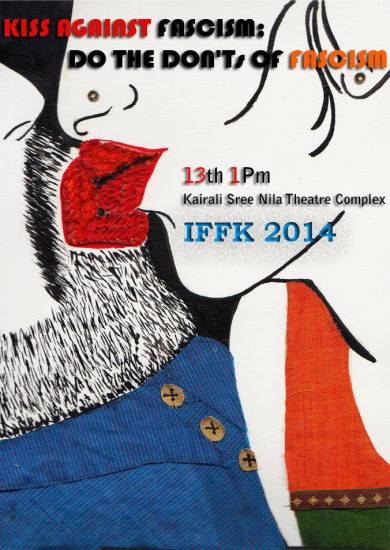
Wave after Wave, We Refuse to Die Down: Kiss Protest Against Fascism at IFFK

If you are in Thiruvananthapuram, please do join us at one o’clock at noon in front of the Kairali-Sree theatre complex at Thampanoor, the main venue of IFFK.

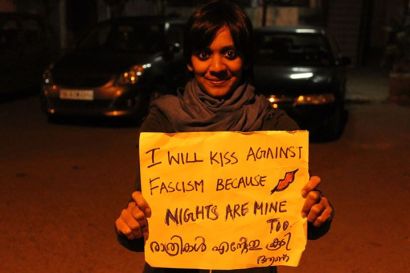
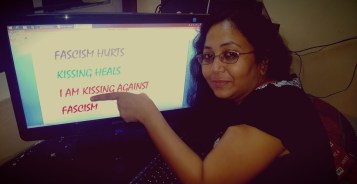
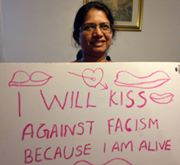
We do believe that the rising tide of fascism in Kerala, the creeping fear of the sheer violence of fascist goons, can be combated only through love, humor, and moral courage. The victory of Hindutva right wing forces in the national scene seems to have emboldened them in Kerala. They are attempting to import here the instruments of terror that they brazenly unleash on people in the states which have become laboratories of their hate-politics. We will not let their evil grow; we will fight it with love.

We will use as an instrument of self-defense precisely all that which fascist forces deny us in this society. We will reclaim that ultimate symbol of tender and intimate human contact, the Kiss; we will kiss against fascism.

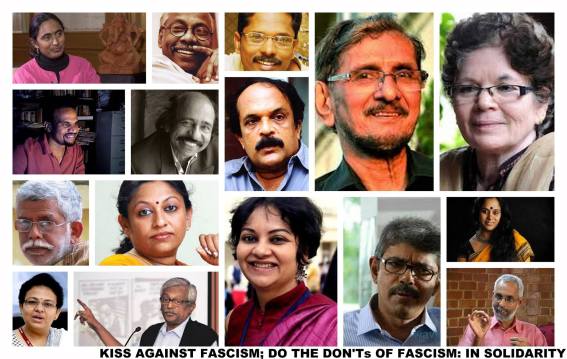
And each of us has different, but interconnected reasons, for kissing against fascism.

sunilKissable boymikek edited 3aswatyrenuedited 2nisaaratrikasinghabipshaKAF solidarity


ഫാസിസത്തിനെതിരെ സമരചുംബനം; ചെയ്യുക, ഫാസിസം അനുശാസിക്കുന്ന അരുതായ്മകളെ


Kiss against Fascism

Continue reading ഫാസിസത്തിനെതിരെ സമരചുംബനം; ചെയ്യുക, ഫാസിസം അനുശാസിക്കുന്ന അരുതായ്മകളെ

Stop Manual Scavenging in JNU: Forum Against Manual Scavenging

Authors’ Note:

The Chennai based Forum Against Manual Scavenging, (FAMS) can be contacted at famschennai@gmail.com. We have tried to create some awareness on this issue especially among student community (with the assistance of some of the Professors/Faculty based in Chennai) in which we were guided by Safai Karamchari Andolan, Rashtriya Garima Abhiyan, Tamil Nadu Untouchability Eradication Front, Janodayam Social Education CentreRepublic Trade Union of IndiaRed Flag Union of Tamil Nadu and other similar organizations (in and outside Chennai) struggling on this issue which are led primarily by the Dalit Women from the community itself.  

A documentary, ‘Sahar se Pehle’ (Before the Dawn) on sanitation workers in Jawaharlal Nehru University (JNU) campus in Delhi was made by some students of the university. The JNUSU has been consistently raising the issue of abysmally bad condition of sanitation workers in JNU for quite some years now. Earlier in 2012, JNUSU had also participated in a signature campaign against manual scavenging (signed by the then JNUSU President). The documentary shows the manual scavenging is still prevalent in the premier university even after the ban on manual scavenging by the Delhi government (sanitation is a State subject according to the Constitution of India) and after the enactment of “The Prohibition of Employment as Manual Scavengers and their Rehabilitation Act, 2013.”

This documentary was also selected for the Canadian Labour International Film Festival, 2014, and was available online on YouTube and other sites from February 2014, but was not widely circulated on mainstream media or social media. We also came to know about it only a fortnight ago because the write-up attached to it does not explicitly mention manual scavenging.

The JNU student community has started a campaign called Stop Manual Scavenging in JNU, with the message “Use hashtag #StopMSinJNU to SPEAK OUT against the inhuman practices of manual scavenging and hazardous cleaning in #JNU.”  Continue reading Stop Manual Scavenging in JNU: Forum Against Manual Scavenging

A Women’s Charter for Delhi Elections: Women against Sexual Violence and State Repression

Guest Post by Women Against Sexual Violence and State Repression

The elections in Delhi are approaching.

Violence, as well as discrimination against women, and sheer denial of women’s dignity and rights, has been a huge concern for Delhi’s citizens.

This is the time when women are looking towards the political parties, to see what place women’s rights and freedoms have on their agenda.

We are disturbed to see that while most parties pay lip service to the cause of women’s rights, they blithely field candidates accused of violence against women, and they play to the patriarchal gallery on a range of issues, ignoring the voices of the women’s movement.

We, the undersigned would like to put the following concerns on the agenda of the Delhi elections, and we ask the political parties contesting Delhi elections to respond to them with urgency and seriousness. We appeal to all women voters to place this charter before every candidate and every party campaigner, and ask them for a clear position on each of its points.

1. We are alarmed at the spiralling of communal violence towards the Delhi elections. We are shocked that, instead of nabbing those who are fuelling the violence in a planned way, the Delhi Police has instead beaten up and brutalised innocent women in Trilokpuri. Above all, we are appalled at the attempts to justify communal, caste, racial or homophobic/transphobic violence in the name of ‘protecting women’. We assert that women are invariably rendered most unsafe by such violence. We seek a commitment that no party will promote leaders – either as candidates or as campaigners – who are accused of stoking violence against women, as well as communal, caste, racial or homophobic/transphobic violence. Specifically, we do not want the notorious 1984 duo Jagdish Tytler and Sajjan Kumar, we do not want to see Gugan Singh (who made communal speeches in Bawana) or Sunil Vaidya (who incited riots at Trilokpuri), or Somnath Bharti (charge-sheeted for racist and anti-women violence at Khirki) to be candidates or campaigners. Continue reading A Women’s Charter for Delhi Elections: Women against Sexual Violence and State Repression

അഴിക്കാനും ആടാനും തുനിഞ്ഞിറങ്ങിയവർ തന്നെ നാം : തെരുവിൽചുംബനസമരക്കാർക്ക് ഒരു സന്ദേശം

സുഹൃത്തുക്കളെ,


കിസ് ഒഫ് ലൌ സമരങ്ങളുടെ രാഷ്ട്രീയത്തെക്കുറിച്ച് പലതരം ആശങ്കകൾ കേട്ടുതുടങ്ങിയിരിക്കുന്നു.

അത് ആഗോളീകരണ അഴിഞ്ഞാട്ടമാണെന്നും,

അതല്ല, മദ്ധ്യവർഗ്ഗ സന്തതികളുടെ എടുത്തുചാട്ടമാണെന്നും,

അതുമല്ല, അതിനു രാഷ്ട്രീയമേ ഇല്ലെന്നു വരെയും, കേരളത്തിലെ ബദൽരാഷ്ട്രീയങ്ങളിലെ പ്രമുഖവ്യക്തിത്വങ്ങൾ അടക്കമുള്ള പലരും മുറുമുറുക്കുന്നു.

Continue reading അഴിക്കാനും ആടാനും തുനിഞ്ഞിറങ്ങിയവർ തന്നെ നാം : തെരുവിൽചുംബനസമരക്കാർക്ക് ഒരു സന്ദേശം

The Class Politics of Blasphemy in Pakistan: Fatima Tassadiq

Guest Post by FATIMA TASSADIQ

The brutal murders of Shehzad and Shama, a Christian couple in the village of Kot Radha Kishan in Kasur district on 4th November, spawned predictable outrage in the press and social media. The rush of horror, the diagnoses and prescribed course of action against such violence involved the familiar paternalistic discourse of the ‘illiterate masses’ whose ‘ignorance’ evidently leaves them particularly vulnerable to the manipulation of the much maligned mullahs. Such a narrative serves the dual function of reducing religious violence to the faceless masses while at the same time reaffirming the educated urban upper class as the rightful custodian of Islam and Pakistan. This construction conveniently ignores the role played by the state and the elite in producing religious violence and feeds the class-based blind spots that exist in our understanding of what constitutes religious extremism.

Continue reading The Class Politics of Blasphemy in Pakistan: Fatima Tassadiq

From a Professor to a Showman: Kishen Pattnayak on Prannoy Roy

Translated from the original Hindi by Akhil Katyal

Kishen Pattnayak (1930-2004) was a socialist thinker and writer. He had been a member of the Indian parliament from Orissa. Pattanayak was the founding editor of a Hindi monthly periodical called ‘Samayik Varta’. In this Hindi essay ‘Professor Se Tamashgeer’ published in March, 1994, he understands Prannoy Roy as representative of a new class of intellectuals which came into being precisely with the changing economic policies of the Indian government in the early ’90s.

Those who do not know English in this country might not know Prannoy Roy. But knowing him is important because Prannoy Roy represents a new social phenomenon. Prannoy Roy’s fame has been sealed by the program “The World This Week” running every Friday on Doordarshan. Not unlike a magician putting on a show, it has lately become quite an art for Doordarshan to concentrate the attentions of the TV viewers and keep them spellbound with only select news and statements on the channel. Pritish Nandy’s show and Prannoy Roy’s weekly program etc. are prime examples of this art.

Among the country’s intellectuals, such folks must surely be rare, who apart from being immensely intelligent, can also put on a circus-show in the middle of a street. Television professionals are always on a hunt for such gifted intellectuals. Through them, the TV business gets some intellectual prestige, making it reputable to carry on showing several dreadful and obscene things. Continue reading From a Professor to a Showman: Kishen Pattnayak on Prannoy Roy