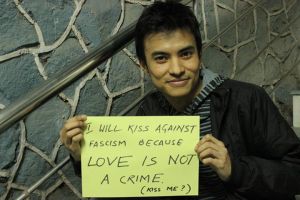
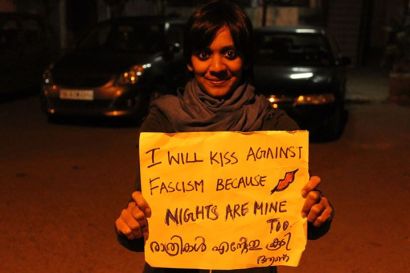
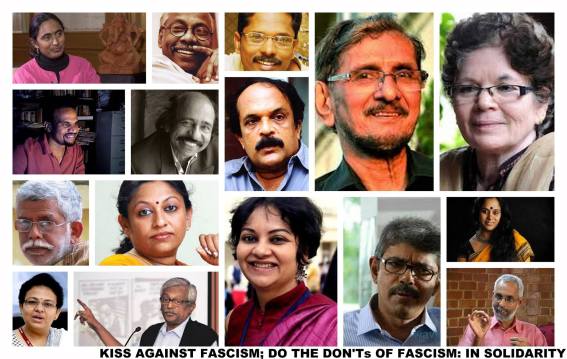
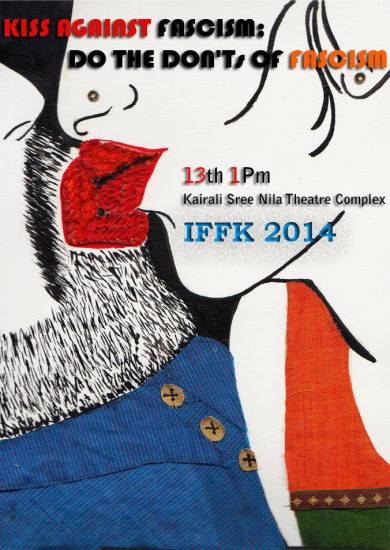
Continue reading ഫാസിസത്തിനെതിരെ സമരചുംബനം; ചെയ്യുക, ഫാസിസം അനുശാസിക്കുന്ന അരുതായ്മകളെ
Authors’ Note:
The Chennai based Forum Against Manual Scavenging, (FAMS) can be contacted at famschennai@gmail.com. We have tried to create some awareness on this issue especially among student community (with the assistance of some of the Professors/Faculty based in Chennai) in which we were guided by Safai Karamchari Andolan, Rashtriya Garima Abhiyan, Tamil Nadu Untouchability Eradication Front, Janodayam Social Education Centre, Republic Trade Union of India, Red Flag Union of Tamil Nadu and other similar organizations (in and outside Chennai) struggling on this issue which are led primarily by the Dalit Women from the community itself.
A documentary, ‘Sahar se Pehle’ (Before the Dawn) on sanitation workers in Jawaharlal Nehru University (JNU) campus in Delhi was made by some students of the university. The JNUSU has been consistently raising the issue of abysmally bad condition of sanitation workers in JNU for quite some years now. Earlier in 2012, JNUSU had also participated in a signature campaign against manual scavenging (signed by the then JNUSU President). The documentary shows the manual scavenging is still prevalent in the premier university even after the ban on manual scavenging by the Delhi government (sanitation is a State subject according to the Constitution of India) and after the enactment of “The Prohibition of Employment as Manual Scavengers and their Rehabilitation Act, 2013.”
This documentary was also selected for the Canadian Labour International Film Festival, 2014, and was available online on YouTube and other sites from February 2014, but was not widely circulated on mainstream media or social media. We also came to know about it only a fortnight ago because the write-up attached to it does not explicitly mention manual scavenging.
The JNU student community has started a campaign called Stop Manual Scavenging in JNU, with the message “Use hashtag #StopMSinJNU to SPEAK OUT against the inhuman practices of manual scavenging and hazardous cleaning in #JNU.” Continue reading Stop Manual Scavenging in JNU: Forum Against Manual Scavenging
Guest Post by Women Against Sexual Violence and State Repression
The elections in Delhi are approaching.
Violence, as well as discrimination against women, and sheer denial of women’s dignity and rights, has been a huge concern for Delhi’s citizens.
This is the time when women are looking towards the political parties, to see what place women’s rights and freedoms have on their agenda.
We are disturbed to see that while most parties pay lip service to the cause of women’s rights, they blithely field candidates accused of violence against women, and they play to the patriarchal gallery on a range of issues, ignoring the voices of the women’s movement.
We, the undersigned would like to put the following concerns on the agenda of the Delhi elections, and we ask the political parties contesting Delhi elections to respond to them with urgency and seriousness. We appeal to all women voters to place this charter before every candidate and every party campaigner, and ask them for a clear position on each of its points.
1. We are alarmed at the spiralling of communal violence towards the Delhi elections. We are shocked that, instead of nabbing those who are fuelling the violence in a planned way, the Delhi Police has instead beaten up and brutalised innocent women in Trilokpuri. Above all, we are appalled at the attempts to justify communal, caste, racial or homophobic/transphobic violence in the name of ‘protecting women’. We assert that women are invariably rendered most unsafe by such violence. We seek a commitment that no party will promote leaders – either as candidates or as campaigners – who are accused of stoking violence against women, as well as communal, caste, racial or homophobic/transphobic violence. Specifically, we do not want the notorious 1984 duo Jagdish Tytler and Sajjan Kumar, we do not want to see Gugan Singh (who made communal speeches in Bawana) or Sunil Vaidya (who incited riots at Trilokpuri), or Somnath Bharti (charge-sheeted for racist and anti-women violence at Khirki) to be candidates or campaigners. Continue reading A Women’s Charter for Delhi Elections: Women against Sexual Violence and State Repression
സുഹൃത്തുക്കളെ,
കിസ് ഒഫ് ലൌ സമരങ്ങളുടെ രാഷ്ട്രീയത്തെക്കുറിച്ച് പലതരം ആശങ്കകൾ കേട്ടുതുടങ്ങിയിരിക്കുന്നു.
അത് ആഗോളീകരണ അഴിഞ്ഞാട്ടമാണെന്നും,
അതല്ല, മദ്ധ്യവർഗ്ഗ സന്തതികളുടെ എടുത്തുചാട്ടമാണെന്നും,
അതുമല്ല, അതിനു രാഷ്ട്രീയമേ ഇല്ലെന്നു വരെയും, കേരളത്തിലെ ബദൽരാഷ്ട്രീയങ്ങളിലെ പ്രമുഖവ്യക്തിത്വങ്ങൾ അടക്കമുള്ള പലരും മുറുമുറുക്കുന്നു.
Continue reading അഴിക്കാനും ആടാനും തുനിഞ്ഞിറങ്ങിയവർ തന്നെ നാം : തെരുവിൽചുംബനസമരക്കാർക്ക് ഒരു സന്ദേശം
Guest Post by FATIMA TASSADIQ
The brutal murders of Shehzad and Shama, a Christian couple in the village of Kot Radha Kishan in Kasur district on 4th November, spawned predictable outrage in the press and social media. The rush of horror, the diagnoses and prescribed course of action against such violence involved the familiar paternalistic discourse of the ‘illiterate masses’ whose ‘ignorance’ evidently leaves them particularly vulnerable to the manipulation of the much maligned mullahs. Such a narrative serves the dual function of reducing religious violence to the faceless masses while at the same time reaffirming the educated urban upper class as the rightful custodian of Islam and Pakistan. This construction conveniently ignores the role played by the state and the elite in producing religious violence and feeds the class-based blind spots that exist in our understanding of what constitutes religious extremism.
Continue reading The Class Politics of Blasphemy in Pakistan: Fatima Tassadiq
Translated from the original Hindi by Akhil Katyal
Kishen Pattnayak (1930-2004) was a socialist thinker and writer. He had been a member of the Indian parliament from Orissa. Pattanayak was the founding editor of a Hindi monthly periodical called ‘Samayik Varta’. In this Hindi essay ‘Professor Se Tamashgeer’ published in March, 1994, he understands Prannoy Roy as representative of a new class of intellectuals which came into being precisely with the changing economic policies of the Indian government in the early ’90s.
Those who do not know English in this country might not know Prannoy Roy. But knowing him is important because Prannoy Roy represents a new social phenomenon. Prannoy Roy’s fame has been sealed by the program “The World This Week” running every Friday on Doordarshan. Not unlike a magician putting on a show, it has lately become quite an art for Doordarshan to concentrate the attentions of the TV viewers and keep them spellbound with only select news and statements on the channel. Pritish Nandy’s show and Prannoy Roy’s weekly program etc. are prime examples of this art.
Among the country’s intellectuals, such folks must surely be rare, who apart from being immensely intelligent, can also put on a circus-show in the middle of a street. Television professionals are always on a hunt for such gifted intellectuals. Through them, the TV business gets some intellectual prestige, making it reputable to carry on showing several dreadful and obscene things. Continue reading From a Professor to a Showman: Kishen Pattnayak on Prannoy Roy
Guest post by SUDHA K. F.
[This article was written in response to the recent incident of vandalism and violence meted out by BJP- affiliated Yuvamorcha activists against a restaurant called Downtown in Kozhikode, Kerala. This was the incident that led to the protest – the Kiss of Love at Kochi, Kiss of Love in Kolkata, and now, most audaciously outside the RSS Office in Jhandewalan. Wherever it goes, it acquires a flavour of its own. Thus in Kolkata, hokkolorob (let there be turmoil) mutated into another set of slogans – hokchumban (let there be kiss – or, let us kiss) and now, Sanghi gunde hoshiyar, tere saamne karenge pyar (beware Sangh goons, we will (make) love right before you. Sudha K. F. gives a sense of what it felt like after the goons attacked, the sense of indignation that subsequently burst forth.]

The now “notorious” Downtown restaurant is 5 minutes away by foot, from my home in my hometown Kozhikode. During my schooldays, that place was an old workshop. The restaurant came up after I had been away from my hometown for quite a while for my higher education. I remember being thrilled at the sight of this fine looking restaurant/coffee shop with glass windows, near my home during one of my visits. Earlier a few establishments had replaced the old workshop but didn’t do well commercially and closed down hastily. As I passed Downtown one evening, its busiest hour, my father remarked that this might have a longer life because it is so crowded with so many people frequenting the place for dinner. Still I remained a stranger to that place. Continue reading ‘Downtown’ – Where the Kiss of Love Began: Sudha K. F.
Guest post by SUSHIL CHANDRA
पिछले जयपुर साहित्योत्सव (हालांकि मैं उसे तमाशा-ए-अदब कहना अधिक पसंद करूंगा) के दौरान अमर्त्य सेन ने अपनी सात अभिलाषाएं व्यक्त कीं। दिलचस्प यह है कि उनमें से एक अभिलाषा उलटबांसी अधिक नजर आती है – कि वह देश में एक धर्मनिरपेक्ष दक्षिणपंथ चाहते हैं । यह मासूम सी सदिच्छा न सिर्फ कई प्रश्न उठाती है बल्कि एक साथ कई सारी विवेचनाओं की मांग भी करती है। सच तो यह है कि यह कामना कोई नई बात नही है और पश्चिम की अधिकांश दक्षिणपंथी पार्टियां जैसे रिपब्लिकन पार्टी़, कंजरवेटिव पार्टी़, क्रिश्चियन डेमोक्रेटिक पार्टी इत्यादि इसी संकल्पना की उपज हैं। वस्तुत: यह संकल्पना इस अवधारणा से निकली है कि दक्षिणपंथ के धार्मिक-सामाजिक पक्ष (जिसकी परिणति कठमुल्लावादी रूढि़वाद में होती है) और आर्थिक पक्ष (जो अंतत: नव रूढि़वाद में प्रतिफलित होता है) बिल्कुल अलग अलग हैं और उनके बीच कोई पारस्परिक निर्भरता नहीं है।
पहली नजर में यह सही भी लगता है जहां फ्रांस में लंबे समय तक दक्षिणपंथी शासन के बावजूद प्रशासन राज्य और धर्म के बीच संपूर्ण अलगाव के प्रति समर्पित नजर आता है। यहां तक कि भारत में भी न सिर्फ स्वतंत्र पार्टी बल्कि मनमोहन सिंह सरकार भी अपने सारे नवउदारवादी आग्रहों के बावजूद धार्मिक रूढि़यों से मुक्त नजर आती थी। मैंने जानबूझ कर नजर आती शब्दों का इस्तेमाल किया है क्योंकि सचमुच ऐसा है या नहीं इसकी जांच अभी बाकी है। लेकिन इसके पहले कि हम इस बिंदु की पड़ताल करें, इन दो बहुचर्चित शब्दों - वामपंथ और दक्षिणपंथ को समझना जरूरी है । जरूरी इसलिए है कि इन दो शब्दों का अर्थ संदर्भ के साथ बदलता जाता है । Continue reading धर्मनिरपेक्ष दक्षिणपंथ – एक कल्पना का सच: सुशील चन्द्र
Guest post by PRASENJIT BOSE
The CPI(M) is going to have its party congress next year in the backdrop of its worst ever electoral performance in the general elections. A four day meeting of its central committee held recently to discuss the review report and political resolution for the party congress, however, ended without adopting any worthwhile political decision. The only decision was to have another central committee meeting in January next year. When meetings of the topmost committee of a national political party end only with fixing the next meeting, something must be going wrong somewhere. It reflects lack of political direction and disarray at the top.
At the heart of the dilemma faced by the CPI(M) today is the political-tactical line to be adopted in the backdrop of BJP’s ascendancy across the country and the rightwing offensive unleashed by the Modi regime at the centre alongside the threat of political marginalization faced by the CPI(M) in what was once its citadel, West Bengal. The options apparently being debated within the CPI(M) – either align with the Congress against BJP or maintain the status quo – are both inadequate for its own revival or to take on the resurgent rightwing in India. Unless the Left mobilizes forces from below and seeks to build alliances based on struggles with like-minded progressive and democratic forces, the “political line” debate will be fruitless, abstract and of no yield. Continue reading Last Opportunity for CPI(M): Prasenjit Bose
So the Kiss of Love event in Kochi did make waves that will stay in our memories for long. A very small group of young people did manage to publicly express affection and love at Kochi as planned despite all kinds of intimidation in the days leading up to the event. The lead organizers were constantly heckled and harassed; the event was grossly misrepresented; there were attempts to stop it legally; threats galore were openly brandished against anyone who dared to participate; the police and the media, who ought to have been neutral, participated in the general hysteria that painted the event as a law-and-order problem. The core group was arrested and removed before the event to prevent trouble, apparently. Yet they did not back off; this event will indeed be remembered in the history of twenty-first century Kerala.
No one who knows life in Kerala would have expected it to ‘succeed’. The right-wing troll brigade has been celebrating obscenely, but then they clearly can’t see beyond their precious noses, because anyone who knows the strength of the united tightass coalition in Kerala and the depth of their irrational fear of touch (which, no doubt underlies much of the everyday mental and emotional pathologies in Kerala, the subject of much hand-wringing among the tightasses themselves) would know that there is no victory worth the name there. But of course they are also devoid of basic moral sense which would have made it evident that it is no big deal for an idiotic bully of a child, many times the size of a firefly, to kill it in a single swat. Nor can they be expected to have any inkling of the fact that the stupid hulk might crush the firefly with its sheer weight but is incapable of producing that speck of light which the firefly alone can ignite. Continue reading Challenging the Empire of Chicken Littles – Kiss of Love at Kochi
Guest Post by People’s Alliance for Democracy and Secularism (P.A.D.S)
NOVEMBER 2, 2014
(Members of P.A.D.S. have been interacting with and visiting residents of Trilokpuri ever since the communal disturbances started on Oct 23. Along with many other citizens we are involved in efforts to re-establish peace and in providing legal aid to those wrongfully arrested. This statement is based on the experiences of P.A.D.S members.)
The inhabitants of Trilokpuri, a densely populated neighbourhood of working people in Delhi, went through a harrowing week after Diwali night on 23 October. A brawl around two places of worship that night proved to be the first event. Although the situation appears to have settled down that night, some motivated planning and mobilisation must have taken place that night itself, because the next day it was a full scale communal clash. Armed mobs from outside the locality are reported to have joined the rioting that involved brick throwing. Firearms were also used and two boys suffered critical bullet injuries. Inhabitants are emphatic that the police fired into the crowd. The police first denied firing at all. Its latest claim is that it fired only in self defense. One apparel show room owned by a Muslim resident was gutted. Police intervened in force only two days after the clashes started. It turned the neighbourhood into an occupied war-zone. More than fifty men and minor boys were arrested randomly, many picked up forcibly from their houses amid verbal abuse and physical violence. Road intersections were barricaded and entry and exit points were closely monitored. Drones were used in surveillance and houses systematically searched. Essential supplies were in short supply. Daily wage earners, contract workers, and self employed who could not go out lost their source of livelihood. Seriously wounded and ill had no access to medical aid. While the entire neighbourhood suffered in one form or another, inhabitants of three blocks in particular, nos 15, 27 and 28, and attached jhuggi clusters, mainly occupied by citizens who are Muslims bore the brunt of police action.
Guest Post by MOHIT PANDEY
An All India Students Association team visited Bawana on Sunday (November 2, 2014), met local people, witnessed the Mahapanchayat and the developments around it. This report is based on that visit.
Long standing communal tension in Bawana (at the outskirts of Delhi) took a vicious inflammatory turn, when a Mahapanchayat was called on 2nd November to provoke hatred against the Taziya (Moharram procession) in Bawana. Since Bakrid, the blatant lie of ‘cow slaughter’ in the JJ Colony (nearby Bawana) was used as a pretext to mobilize the whole Hindu community against Muslims. India’s ruling party BJP, as well as an entire battery of RSS backed Hindutva outfits were involved in the campaign to divide Hindus and Muslims of the poorest classes.
Our observations about the Mahapanchayat are as follows :
Pressurize the Administration to immediately intervene and stop the communal Mahapanchayat on 2nd November!
Organized Hindutva forces are again trying to instigate communal polarization and spread terror in Bawana area of North-West Delhi in the last few days. They have called for a ‘Mahapanchayat’ at 4 pm on Sunday, 2nd November 2014 to oppose the Taziya procession taken out for Moharram in the area, calling it supposedly a ‘terror procession’.
Only three-four policemen loiter in the area tonight on 1st November, while the administration, including the Lt. Governor and Police Commissioner, has been alerted in the afternoon itself by various pro-people forces and local people on the rabidly communal ‘parcha’ that has been circulated in the area. This parcha explicitly gives a ‘call for Bawana’ to stop the supposed terror procession and ‘show of arms’, ‘display of strength’, disruption of peace and other baseless allegations on the Muslim community.
The situation of communal tension in Bawana is not spontaneous, but is being instigated by organized Hindutva forces, much like Trilokpuri in the past week. Earlier, on 2nd-6th October, just before Eid celebrations, the ‘Hindu Krantikari Sena’ outfit of the RSS tried to make a case out of imaginary ‘cow slaughter’ and instigate terror and communal tension among residents of Bawana JJ Colony and nearby Bawana village. They had also put up communal posters then calling for a gathering in Bawana Gaushala on 5th October. Continue reading Organized Fundamentalist Hindutva Forces trying to Instigate Communal Tension in Bawana, Delhi
Guest Post and Photographs by Gauri Gill
[30 Years ago today, Delhi, and some other cities in India saw the beginning of days of organized massacre of Sikhs, ostensibly as a response to the assasination of Indira Gandhi. In memory of that dark time, we present a documentary text-photographic project by Gauri Gill. Gauri revisits the survivors of the 1984 violence in Delhi, and invites artsits, writers, and others to consider their memories of that dark time. An earlier version of this project by Gauri Gill was uploaded on Kafila in April 2013 by Shivam Vij. We are posting an updated version of the project, with fresh material, on the occasion of the 30th anniversary of the November Pogrom. ]
In 2005, when I heard Nirpreet Kaur relate her story, she had to have a psychologist present in the room. For us, it was too much to fully absorb. I did not know what to do with the weight of her words. We urged her to write a book, I hope she does someday.
Continue reading Jis tann lãgé soee jãné – Delhi, November 1984, 30 Years After: Gauri Gill
Guest Post by RAJARSHI DASGUPTA
[ This post by Rajarshi Dasgupta continues the debate with Ranabir Samaddar’s piece on the character of the students’ movement that has begun in Jadavpur University which was published recently in DNA, also critiqued in a recent post in Kafila by Uditi Sen ]
Nobody knows why social science routinely condemns the lack of radicalism in society when social scientists with radical pasts so easily dismiss new radicalisms as harmful and shallow. I was attending a meeting on students’ politics in the campus I work on the other night, when some colleagues, who have long been part of progressive politics since their student life, voiced such sentiments. I was struck by the arguments they made against what they saw as merely fancy and passing fashion. They were rather similar to a set of arguments made by an older generation of teachers about my colleagues when they were young and radical students. I think these arguments are worth a little discussion since they show something like a pattern that is predictable to some extent, and which may reveal a more uneasy relationship between social science scholarship and social transformation than we usually care to admit. They also have a deep affinity with the criticisms aired about the recent students’ unrest in Jadavpur university, by Ranabir Samaddar among others. Unlike some who have written in support of the students, there are senior scholars like Samaddar who have expressed profound and serious misgivings that must be tackled head on. I will argue in the following that such misgivings result from a muddle of liberal and leftist understanding of the student’s place and the academy’s role in society. A more clear understanding becomes possible, incidentally, in this case, if one returns to a basic capitalist framing of the university.
This is a guest post by SUHAS MUNSHI
The challenge of telling stories of a conflict is its victims. Each, traumatized in their own way, needs their own story. The narrator is bound to fail not only those he didn’t include but those who didn’t see their stories recreated faithfully. Had Basharat Peer set himself the task of faithfully adapting the violence done to Kashmiris he would have had to script a pornographic narrative for the screen. Some of the bile directed at him from Kashmiris comes from a dissatisfaction of not depicting the true extent of the brutality of the Indian army and rendering its casualties adequately pitiful. An opinion piece written on the movie in ‘The Parallel Post’ titled ‘Setting the wrong precedent’ condemns torture scenes in the movie as having actually undermined the actual extent of army atrocity in Kashmir. The piece goes on to say, ‘army excesses wane out by the time movie reaches its climax.’
However, the only service that a story teller from Kashmir could do to art and to humanity is to depict the people living there, especially the victims, as humans; as people, just as they are found anywhere else in the world, and not continue to peddle the cliché of the valley being a dehumanized pastoral paradise. Accusations of betrayal, conceit and condescension are being hurled at Basharat Peer, the writer, when he has got, for the first time ever, the words ‘plebiscite’, ‘half-widows’ and the rousing call of ‘Azadi’ in a script, through a movie, on mainstream cinema. Continue reading “Haider” – Hamlet in Kashmir: Suhas Munshi
For some months now, I have been thinking of someone whom I saw on television during the parliamentary election campaign. The place was Benaras and Modi’s candidature from the seat had just been declared. The television journalist was interviewing a group of clearly poor people, taking their reactions on this new, though expected development. This person, fairly drunk in his Modi-elixir – and perhaps also a bit literally drunk – swaggered as he answered, affirming his support for Modi: Modi bhi chaiwala hai, hum bhi chaiwala hain (Modi is also a tea-seller and I am also a tea-seller). His words reflected the success of the remarkable gamble – that of projecting the new poster boy of corporate capital as a humble tea-seller. It was clear how so many of the poor had bought into this campaign.
What reminded me of this person initially, was that very soon after the election results were out, even before the government was formed, ‘team Modi’ announced a series of measures for the development of Benaras, which included the building of 60 flyovers – ‘to ease traffic congestion’. Mainly meant for the benefit of smooth flow of motorized traffic (rikshas, cycles and pedestrians, after all, have little place in the economy of the flyover), this was the beginning of a plan that would transform this holy city. If the experience of building flyovers anywhere in India is any experience, this would additionally mean mass demolition of settlements of the poor, shops and even entire informal markets – including tea shops that have long been part of life of local communities.
Then the government took office. Within a couple of months, the plan for Varanasi’s upgradation started being drawn up more concretely. Not everything in the proposed subsequent plan (end July 2014) seemed objectionable -not the least the idea to work on a possible mono rail, improvement of the bus network, and a Bus Rapid Transit System (BRTS) like the one in Ahmedabad. Except that this would mean more and more dislocation of the poor and destruction of their livelihoods. We have seen this happen in city after city in India, including in Delhi. Continue reading ‘Make in India’ – Modi’s War on the Poor
We are publishing below an Open Letter written by concerned citizens to the Prime Minister opposing the dilution of MNREGA
Dear Prime Minister,
We are very disturbed by impending moves of this government to undermine the Mahatma Gandhi National Rural Employment Guarantee Act (MGNREGA) and the support it provides to crores of vulnerable rural families. We write this letter to seek your immediate assurance that these retrograde, anti-poor and anti-labour measures will be withdrawn, and that every attempt will be made by your government to implement the MGNREGA in its true spirit.
Based on recent public statements from Shri Nitin Gadkari, Union Minister of Rural Development, and other available information, we learn that the Central Government has initiated the following changes under MGNREGA:
These changes are inimical to the spirit of the Act and compromise its basic objectives. They will only benefit the contractor class and other middlemen, and severely undermine the employment generating potential of the MGNREGA. The changes are also being undertaken without any public consultation. The MGNREGA was passed unanimously by all parties and all members of Parliament. We fundamentally object to this critical social legislation being undermined through casual use of executive powers and even a parliamentary majority.
The illegal and unwarranted budget squeeze has led to widespread reports of employment rationing and acute delays in wage payments. Even as MGNREGA workers are struggling to be paid for work already done, the Central Government is sending the message that money is going to be further rationed.
The undersigned demand that your Government immediately revoke the above decisions and renounce any dilution of MGNREGA. We urge you to ensure that MGNREGA employment remains a legal right of every rural household across the country and that there is no dilution of any MGNREGA entitlements. The MGNREGA budget should be based on work demand, keeping with the spirit of the act, without any discretionary cuts. Continue reading Open Letter to the Prime Minister – Stop the Dilution of MGNREGA
This is a guest post by ANAND VIVEK TANEJA

In the discussion around Aarti Sethi’s essay on Remembering Maqsood Pardesi some very important questions arose. As these questions are directly relevant to my work, but also to the larger concerns of the Kafila community, I decided to dwell on them at some length. As these reflections were written in response to the comments of one particular person, I address him directly in what follows below.
Dear Imtiaz,
In your comments on Aarti’s essay, you say the following things about my work:
The tragedy of secular moderns of India is their fascination with Islam… And it appears secular modern Hindus are too busy analyzing jinns of Delhi, which is really sad!
… what do I do with the knowledge of emerging liberal ideologues working for the empire writing enchanting texts about chattan baba or the jinns?
I think that your opening statement is profound. But to understand its true depth, we need to revisit the terms “secular”, and “modern”, as well as our understandings of “Hinduism” and “Islam.” As an entry point into these questions, I will address your (rhetorical) question about what one should, and can do with “enchanting” texts about jinns. Continue reading On The Real Tragedy of Secular Modernity: Anand Vivek Taneja
High Level Committee of Ministry of Environment and Forests and Climate Change walks out of Public Consultation in Bangalore
The High Level Committee headed by Mr. T. S. R. Subramanian, former Union Cabinet Secretary, constituted by the Union Ministry of Environment and Forests and Climate Change to review environment, pollution control and forest conservation laws, invited the public at large for a consultation between 12 and 1.30 pm today (27th September) at Vikas Soudha, the high security office complex of the Government of Karnataka. Advertisements to this effect had been issued by the Karnataka Department of Forest, Ecology and Environment in various newspapers on 21st September 2014, followed up by various press releases inviting the public to interact with the Committee.
When various individuals and representatives of public interest environmental and social action groups turned up for the meeting, the police prevented their entry at the gates. It was only following a spot protest that the police consented to allow them to participate in the consultation. Despite this indignifying experience, all who gathered proceeded to the meeting hall with the intent of engaging with the High Level Committee.