Category Archives: Politics

Mad Rush for Top CPM Jobs!: CPI (Mohammad Rafi) News Service

Guest Post by CPI ( Mohammad Rafi) News Service

Mad Rush for Top CPM Jobs!:  CPI (Mohammad Rafi) News Service

New Delhi, 15 July 2012: The CPI(M) headquarters saw a mad rush of job applicants after General Secretary Prakash Karat said in a magazine interview that his party paid Rs. 3000-4000 to its whole-time cadre as salary every month. Job seekers from around the country clamoured for immediate appointment to as full time party cadre amidst unruly scenes reminiscent of a typical day at the Indian Parliament.

Karat had mentioned this figure while answering a question as to why the Party’s leaders were mostly from upper caste and middle class backgrounds. According to the CPM General Secretary working class members were hesitant to become whole-timers as ‘ it’s not easy to survive on this small amount’. Continue reading Mad Rush for Top CPM Jobs!: CPI (Mohammad Rafi) News Service

Once There Was Hindutva Terror ..?

Bomb blasts have taken place near the Delhi High Court, in Bombay, Bangalore etc. Within a few hours of such bomb blasts many T V channels started showing news item that Indian Mujahidin or Jaish-e-Mohammed or Harkatul-jihad-e-islam have sent e-mails or SMS claiming responsibility. The names of such alleged organizations will always be Muslim names. Now an e-mail can be sent by any mischievous person, but by showing this on TV channels and next day in the newspapers the tendency is to brand all Muslims in the country as terrorists and bomb throwers…Should the media, wittingly or unwittingly, become part of this policy of divide and rule?

(Justice (retired) Markandey Katju, Chairman of the Press Council of India, October 10, 2011 at a get-together with mediapersons)

1.
Introduction

What is common between the murder of the leader of a private army of landlords at the hands of his own gang members in faraway Bihar over distribution of booty, the felicitation of a terrorist lodged in jail as ‘living martyr’ (zinda Shaheed) in Punjab or the anointment of a hatemonger as the poster boy of the main opposition party ? Formally speaking there are no connections but if one tries to dig further few subterranean linkages become clear. Whether one agrees or not they exhibit the growing legitimacy of authoritarian, fanatic, exclucivist politics in this part of the subcontinent . Continue reading Once There Was Hindutva Terror ..?

Report of Committee to Review NCERT Textbooks and Note of Dissent by MSS Pandian

Clarification: These documents did not reach us through any member of the Committee.

We have re-ordered the first document to place the Executive Summary at the beginning. Otherwise, no changes have been made. We have also linked to the sites from which you can download the actual text-books so that you can see what has been recommended for deletion/change.

MSS Pandian’s Note of Dissent follows the report of the Committee.

A Report of the Committee constituted for Reviewing the Textbooks of Social Sciences / Political sciences, for Classes IX-XII constituted by NCERT

EXECUTIVE SUMMARY     

 a)       The Committee’s terms of reference were to identify the educationally     inappropriate materials and provide alternative suggestions for the six        textbooks in Political Science.

b)       Since six textbooks covered different themes such as Political Theory,     Indian Constitutions, Indian Politics and World Politics, the    Committee requested the subject experts from Political Science, to      give their opinion using the NCERT guidelines for the textbooks    preparation.  The opinion expressed by the experts was used as   resource material to arrive at the final view by the Committee .The      Committee also made use of some literature, particularly on the use   of cartoons in teaching.

c)      The Committee used the guidelines developed by the NCERT to prepare the textbooks for the review of educational material        including the cartoons. Since the NCERT did not provide specific guidelines for the inclusion of cartoons (and used the general NCF           guidelines for selection and use of cartoon), the Committee made use of general guidelines and also suggestions of some eminent researchers who have worked on the use of cartoons in teaching, to review the inclusion of cartoons in six textbooks on Political Science.

d)       The Committee has made recommendations for each of the six textbooks          for changes in the current year. The Committee recommended (a)       removal of    some cartoons, (b) change in the “Note “below the        cartoons Unni and Munni to bring  clarity and improvement in the message and (c) removal        of       some cartoons on Unni and Munni.

e)      The Committee has also made suggestions for modification in material    which can be considered at the time of the general review of the       textbooks in future. Continue reading Report of Committee to Review NCERT Textbooks and Note of Dissent by MSS Pandian

जेल डायरी: अरुण फेरेरा

Guest post by ARUN FERREIRA

Translated from English by Anil Mishra

नागपुर जेल की उच्चसुरक्षित परिसीमा में स्थित अंडा बैरक बग़ैर खिड़कियों वाली कोठरियों का एक समूह है। अंडा के प्रवेशद्वार से दूसरी अधिकतर अन्य कोठरियों में जाने के लिए लोहे के पाँच दरवाज़ों, [और पैदल] एक संकरा गलियारा पार करना होता है। अंडा के भीतर कई अलग अहाते हैं। हरेक अहाते में कुछ कोठरियाँ हैं, और हर पहली कोठरी दूसरी से सावधानीपूर्वक अलगाई गई है। कोठरियों में बहुत कम रोशनी होती है और आप यहाँ कोई पेड़ नहीं देख सकते। आप यहाँ से आसमान तक नहीं देख सकते हैं। मुख्य निगरानी टॉवर के ठीक ऊपर से अहाते में एक बड़ा भारी, ठोस अंडा हवा में लटकता रहता है। लेकिन इसमें (और अन्य अडों में) एक बड़ा फ़र्क़ है। इसे तोड़कर खोलना असंभव है। बल्कि, यह क़ैदियों (के हौसलों) को तोड़ने के लिए बनाया गया है।

 अंडा वो जगह है जहाँ सबसे ज़्यादा बेलगाम क़ैदियों को, अनुशासनात्मक क़ायदों के उल्लंघन करने की सज़ा के लिए क़ैद किया जाता है। नागपुर जेल के अन्य हिस्से इतने ज़्यादा सख़्त नहीं है। अधिकतर क़ैदी पंखे और टीवी वाली बैरकों में रखे जाते हैं। बैरकों में, दिन के पहर काफ़ी इत्मिनान वाले, यहाँ तक कि आरामतलब भी हो सकते हैं। लेकिन अंडा में, कोठरी के दरवाज़े ही हवा के आने जाने का एकमात्र ज़रिया है, और ये भी कुछ ख़ास आरामदायक नहीं, क्योंकि ये किसी खुले प्रांगण में नहीं, एक ढंकेमुंदे गलियारे में खुलता है। Continue reading जेल डायरी: अरुण फेरेरा

MEGA, the recovery of Marx and Marxian path: Sankar Ray

Guest post by SANKAR RAY

In sharp contrast to the scenario of the unprecedented debt-driven crisis of neo-liberal world economic order, a new era of radiant expectations seems to open up for Marx-followers and Marxists around the international project, Marx-Engels-Gesamtausgabe or complete works of Karl Marx and Friedrich Engels (MEGA) and it’s hitherto ‘unexplored Marx’. MEGA , a collation of original texts is ‘the historical-critical edition of works of Marx and Engels’, an imperative ignored during the 20th century by official Marxists. Fifty-nine out of 114 volumes , have already been published. The MEGA editorial board, following prolonged debate decided to put together the whole of 164 volumes of original manuscripts in 114 volumes.

A critical approach to history  is essential for scholarly inquiry. Yet  scholarship alone isn’t enough where an enterprise such as this is for it also requires unbiased collation and editing. The development of Marxist studies had been throttled due to widespread vulgarisation which had dominated Marx studies from the 1890s to the end of the 20th Century. Early Marxists like Franz Mehring and Vera Zasulich – and Rosa Luxemburg – adopted a more critical approach which is a essential for the ‘Marxist temper’. Marx’s prescription, de omnibus dubitandum (doubt everything), wasn’t meant to be just a quotation. Unfortunately, Lenin and his followers often deified Marx. Lenin’s words – “Marxism is omnipotent, because it is true” – is one such instance as if Marxism represents the end of philosophy. Continue reading MEGA, the recovery of Marx and Marxian path: Sankar Ray

Swami Sahajanand Saraswati – A Contested Legacy: Manish Thakur and Nabanipa Bhattacharjee

Guest post by MANISH THAKUR and NABANIPA BHATTACHARJEE

Observers of the political scene in Bihar would have hardly failed to notice a renewed interest in the life and works of Swami Sahajanand Saraswati (1889-1950), the founder president of the All India Kisan Sabha, and arguably the most influential peasant leader of Bihar in the 1930s and 1940s. Over the last decade or so, his birth (22 February, 1889) and death (26 June, 1950) anniversaries have been celebrated with great pomp and show with full attendance of political luminaries of the state including Nitish Kumar, its present Chief Minister. Not only have glowing tributes been paid to his legacy but there has also been a spurt of writings on his life and times.

Swami Sahajanand Saraswati

New biographiesi have been released, and his collected works been published in six volumesii. In fact, there is a Swami Sahajanand Saraswati Foundation based in New Delhi as well as a Swami Sahajanand Saraswati Forum on the internet. Curiously enough, Swami Sahajanand Saraswati figures prominently on the internet in the caste-specific web-portals such as www.bhumihar.com; www.bhumiharmahasangh.com and www.bhumihar.net where his name appears along with Bhagwan Parashuram, Chanakya, Mangal Pande, Sri Babu, Ramdhari Singh Dinkar, C.P Thakur, and so forth in the long list of supposedly Bhumihar icons. Indeed, Saraswati’s legacy has always been the bone of contention between the Bhumihars and the communists. What needs explanation is the BJP’s concerted efforts in appropriating this iconic peasant leader as ‘samajik samrasta ke sant’.

Continue reading Swami Sahajanand Saraswati – A Contested Legacy: Manish Thakur and Nabanipa Bhattacharjee

False Charges and Brutality in Prison: Mohd Amir Khan

Guest post by MOHD. AMIR KHAN

[ Mohd. Aamir Khan has spent 14 years in prison and was acquitted earlier this year]

I am in deep pain today. As though terrible, terrible memories, locked away in the deep recesses of my mind have been pried open. Heard on news that an accused in terror case was killed in judicial custody in Yerwada jail. That too in his high security cell.

I had read that the British rulers unleashed physical and mental torture on prisoners in colonial jails, but have never heard that they carried out killings of hapless convicts or undertrials in their custody. The naked truth of Abu Ghraib and Guantanamo has been brought before the world. But who will illumine the dark secrets of the netherworld of our prisons? Brutalisation and torture are routine in our jails.

I speak from experience, having lived for fourteen long and seemingly unending years in prisons in three states. There was a near fatal attack on me twelve years ago while I was lodged in the model prison of India, Tihar Jail. But when I survived the attack, a case was slapped on me. While I was thankfully acquitted in the case, not one of those who attacked me was charged until my father – who was still alive then—appealed to the court to intervene. Mercifully, the Court accepted his complaint and registered a case, which still goes on in Tees Hazari court. Continue reading False Charges and Brutality in Prison: Mohd Amir Khan

The (Auto)Rakshasa and the Citizen

A petition from an organization called Change India invaded my Facebook wall today right before – rather ironically, it turns out— my morning auto ride. The petition is filed under a category on the site called “petitions for economic justice.” When you open it, the image pasted below opens. A sharp fanged, dark skinned “auto-rakshasa” demands one-and-a-half fare. The commuter is “harassed.” The petition that accompanies this image urges the ACP of police to create “an efficient system” so that complaints made to report auto-drivers who overcharge or refuse to ply can be tracked. How, it asks, can “concerned Bangalorean citizens” expect “justice” if their complaints are not tracked?  We all must, it urges, “join the fight.”

Image

Let me first say quite clearly that I do not mean to undermine the intentions and frustrations of those who launched this campaign and, yes, when the meter goes on without asking, it eases a morning commute significantly. The question is: if this does not happen at times (and indeed it doesn’t) then why is this so and what does one do about it? There is a lot to be said about the economics of the issue itself and I welcome others reading who know more to write about it more extensively. But this piece is not about that. It is about the campaign itself and how we articulate political questions in our cities. It is fundamentally about the easy, unremarked way in which a working urban resident and citizen – who is also, after all, a “fellow Bangalorean” and concerned with “economic justice”– can be termed and portrayed a “rakshasa” as if it were a banal utterance.

Continue reading The (Auto)Rakshasa and the Citizen

Cartoon controversy – In conversation with Satyanarayana: Sharmila Rege

Guest post by SHARMILA REGE

Satyanarayana’s interview addresses the crucial issue of a sharp division between the dalit and the left/liberal viewpoint on the NCERT textbook cartoon controversy. Clearly, Satyanarayana’s foregrounding of this difference is not a denial of the differences between the positions taken by dalit intellectuals in this debate. Further, Satyanarayana is referring not just to responses by dalit academicians but to the presence of critical viewpoints in the larger dalit public sphere – the very perspective/viewpoints that Liberal/Left/feminists have in a sense not seriously engaged with, equating them to ‘manipulations by opportunistic dalit leadership’ or /and ‘always and already emotional iconisation of Ambedkar’.  In fact, despite   important differences between the arguments put forth by Satyanarayana, Gopal Guru, Anoop Kumar, Harish Wankhede, Raj Kumar and other dalit intellectuals; all of them interrogate these hasty conclusions about irrational or manoeuvred dalit publics. Gopal Guru  contends   that the controversy has created a field of power in which even the supporters of Ambedkar and Dalits have ended up reproducing the compounded insult  through two assumptions –that Ambedkar belongs to the dalits and that dalits are pathologically emotional and thus not capable of rational independent views.

Continue reading Cartoon controversy – In conversation with Satyanarayana: Sharmila Rege

Ambedkar’s Cartoon and the Caste question: Rajkumar

Guest post by RAJKUMAR

A harrowing monologue is in vogue in the popular media and academic forums apropos a cartoon of Dr. Ambedkar in a Political Science textbook prepared by NCERT for its Class XI students. Apparently, in the cartoon, Ambedkar is depicted being whipped by Jawaharlal Nehru for delaying the framing of the constitution. The cartoon was first published in 1949 and was drawn by cartoonist Shankar Pillai. Though in interior Dalit circles, the cartoon was being despised for denigrating ‘Baba Saheb’ as they lovingly call him, no heed was paid to their sentiments till the issue was raised in the Parliament and taken up by Bahujan Samaj Party chief Mayawati. Government had to concede and the cartoon was removed from the textbook and HRD minister made a public apology for the goof-up followed by resignation of two academicians involved with the curriculum committee.

Continue reading Ambedkar’s Cartoon and the Caste question: Rajkumar

’बिगड़ैल बच्चे की खोज में’: हिमांशु पंड्या

“क्या आपको इस बात का अहसास है कि ताकाहाशी को ‘तुम्हारी पूँछ तो नहीं है?’ पूछने पर कैसा लगा होगा” बच्चे शिक्षिका का जवाब नहीं सुन पाए. उस समय तोत्तो चान यह नहीं समझ पायी कि पूंछ वाली बात से हेडमास्टर साहब इतना नाराज़ क्यों हुए होंगे क्योंकि अगर कोई उससे यह पूछता कि तोत्तो चान तुम्हारे क्या पूंछ है? तो उसे तो इस बात में मजा ही आता.
-‘तोत्तो चान’ (तेत्सुको कुरोयांगी, अनुवाद – पूर्वा याग्निक कुशवाहा)

दलित चेतना और कार्टूनों का पुनर्पाठ
इस कार्टून पर चली ऐतिहासिक बहस के बाद अब यह पक्के तौर पर कहा जा सकता है कि साहित्य से आगे अभिव्यक्ति के अन्य क्षेत्रों में भी दलित चेतना ने दस्तक दे दी है। शायद हम कल चित्रकला और बहुत आगे संगीत में भी दलित चेतना युक्त दृष्टि से इतिहास का पुनर्पाठ देखेंगे। Continue reading ’बिगड़ैल बच्चे की खोज में’: हिमांशु पंड्या

A democratic process in Pakistan: Abdullah Zaidi

Guest post by ABDULLAH ZAIDI

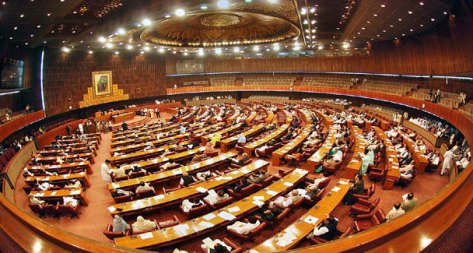
Pakistan’s National Assembly

In a way, the story of Pakistan is the story of a centralised state manipulating the provinces. It is also the story of an overgrown and overfed military destabilising all political forces that posed a challenge to its narrative. It is also the story of institutions wrestling for their due and undue share of power. Finally, it is the story of a powerful state and a weak society. The one thing that is common to all of these dynamics is the power struggle between elected and unelected institutions.

After return to civilian rule in 2008, the country has seen several developments that have somewhat changed these dynamics. Continue reading A democratic process in Pakistan: Abdullah Zaidi

Is the Hurriyat divorcing democracy and freedom?: Gowhar Geelani

Guest post by GOWHAR GEELANI

By any stretch of imagination, the All Parties Hurriyat Conference [APHC] has ceased to be an amalgam of ‘all parties’. It seems that this conglomerate of several pro-freedom political, social and religious parties is actually being run by a chosen few in a dictatorial manner. It is no secret now that the fissures in the Hurriyat ‘M’, the one led by the popular head-priest based in Srinagar, Mirwaiz Umar Farooq, run neck deep.

The APHC was formed on 10 March 1993 to find a political solution to Kashmir dispute after a large-scale armed rebellion since 1989 had successfully highlighted the need for a resolution to the long-standing dispute. Essentially, this conglomerate was formed with the clear aim of achieving the “right to self-determination” for Kashmiris in accordance with the United Nations’ Security Council Resolutions vis-à-vis Kashmir.

But all is not well with the Hurriyat (M). One of its prominent leaders, Professor Abdul Gani Bhat has openly challenged group’s constitution by declaring that the UN resolutions on Kashmir have become “irrelevant”.

Continue reading Is the Hurriyat divorcing democracy and freedom?: Gowhar Geelani

In Defense of Critical Pedagogy: A Petition

The following is a petition initiated by a group of scholars who have been centrally involved in the debate on pedagogy and the writing of textbooks that followed National Currriculum Framework 2005

We have been watching with deep dismay the events as they have unfolded on the floor of the Indian Parliament and outside. Uproar against an individual cartoon has now snowballed into a wide-ranging attack against the new NCERT textbooks. The office of one of the Advisors of the Political Science textbooks has been ransacked, the Political Science textbooks have been withdrawn from circulation, and the Government has resolved to conduct an inquiry into the role of those who sanctioned the inclusion of the offending material in the textbooks. Clearly what is at stake here is not just the life of cartoons on the pages of school textbooks.

But the fear of cartoons is not unimportant. It tells us a lot about the democracies we now inhabit. Jawaharlal Nehru told Shankar Pillai ‘Don’t spare me Shankar’. B.R. Ambedkar saw the cartoon that is now being seen as ‘offensive’. He had no problem with it. Nehru and Ambedkar, and great democrats like them, were aware of what cartoons mean. They were aware that creative cartoonists like Shankar or Laxman can encourage us to question what is taken for granted, reveal the ambiguities and contradictions of individuals, persuade us to see things in a new light. India has a long creative tradition of satire and irony. The productive power of laughter has been used not only in movements for social justice, but in children’s literature as well. If we celebrate this tradition, we celebrate democracy. Only in non-democratic countries is there a fear of cartoons. Continue reading In Defense of Critical Pedagogy: A Petition

पाठ्यपुस्तक का संघर्ष 

संसद राजनीति और लोकतंत्र पर स्कूली किताबों में कार्टून नहीं चाहती हैइस मसले को लेकर संसद के दोनों ही सदनों में सारे राजनीतिक दलों में अभूतपूर्व मतैक्य देखा  गयाएक राजनीतिक  दलजिसका नाम नेशनल कान्फरेंस हैइस दमनकारी बहुमत से अलग स्वर में बोलने की कोशिश करता रह गयाउसे क्रूर बहुमत ने बोलने नहीं दियाआखिर वह एक बहुत छोटे से इलाके का थामुख्य भूमि में बन रही सहमति में विसंवादी स्वर पैदा करने की अनुमति उसे दी ही कैसे जा सकती थीउसे उसकी लघुता के तर्क से नगण्य माना जा सकता थायह स्वर कश्मीर  से आ रहा था जिसे भारत का अंग बनाए रखने के लिए देश के क्रूरतम क़ानून की मदद लेनी पड़ती है.

 यह विवरण यहाँ अप्रासंगिक लग सकता है.लेकिन मुझे इसमें एक तरह की प्रतीकात्मक संगति दिखलाई पड़ती हैवह संगति  असहिष्णुताजन्य  अधैर्य  के तत्व से निर्मित होती है जो हमारे सामाजिक और सांस्कृतिक जीवन को परिभाषित करता है और इसीलिए सरलीकरण की पद्धति उसके चिंतन की दिशा तय करती है. Continue reading पाठ्यपुस्तक का संघर्ष 

When Laughter becomes a laughing matter: Statement by CSSSC Faculty Members on the Cartoon Controversy

Going by the ruckus surrounding cartoons these days, by the angry, at times violent, reactions of elected lawmakers against any kind of caricature of prominent personalities, it seems ‘laughter’ itself has become a laughing matter in contemporary India. And, this indeed is puzzling. The emerging trend of automatically equating lampooning with character assassination, of treating every expression of joviality targeting persons deputed by people to run the republic as being fundamentally slanderous and libelous, cannot but result in undermining the nation’s democratic charter.

Those who now readily question the public right to parody celebrities or icons are also guilty of forgetting that India has a long tradition of producing social and political commentaries in the form of hilarious visuals and words. The lack of sense of humour of persons at the helm of power today is so profound now that we may very soon lapse into a state of amnesia in relation to the deeply admired and dearly loved cartoonists, such as, Gaganendranath Tagore, R. K. Laxman, K. Shankara Pillai (better known as Shankar), Attupurathu Mathew Abraham (known popularly as Abu Abraham), O. V. Vijayan, Mario de Miranda (better known as Mario).

It is on behalf of the ‘little men’, from whose perspectives the celebrated cartoonists dared to make light heavy-going matters, that we condemn the somber Indian politicians’ and their lathi-wielding goons’ zeal to persecute persons committed to the cause of irony, irreverence and critical humour in public life.

Tapati Guha-Thakurta

Sibaji Bandyopadhyay                                                                     Lakshmi Subramanian

Indraneel Dasgupta                                                                        Sugata Marjit

Manabi Majumdar                                                                           Jyotsna Jalan

Dwaipayan Bhattacharyya                                                          Prachi Deshpande

PranabKumar Das                                                                           Priya Sangameswaran

Rosinka Chaudhuri                                                                        Anirban Das

Saibal Kar                                                                                           Somnath Ghosal

Bodhisattva Kar                                                                               Partha Chatterjee

Centre for Studies in Social Sciences, Calcutta (CSSSC)

May 14, 2012

‘Your problem was that you weren’t satisfied with mentioning one haram thing per story’

You may have read it by now but in case you haven’t, the best article on Manto’s birth centennial came from Mohammad Hanif:

Your problem, Manto sir was that you weren’t satisfied with mentioning one haram thing per story. We do realise that in the world of short stories sometimes you have to describe bad things, things that our religion and our culture don’t approve of but couldn’t you have exercised a bit of moderation? As if having a prostitute as your main character wasn’t enough, you had to make her drink alcohol, and as if her drinking wasn’t bad enough you had to make her go to sleep with a flea-ridden dog. And I am not even mentioning the uncalled for description of her blouse where she stuffs her haram-earned money. Why did you have to do all that when you could have written about banana peels? [Read]

Solidarity March: Justice for sex worker mothers

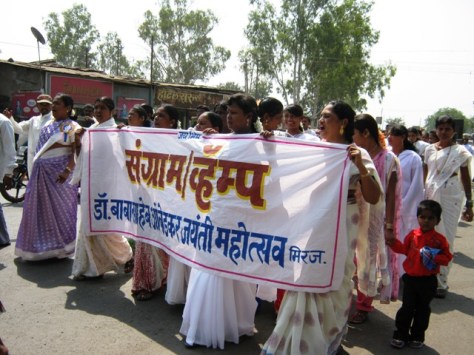
Press statement issued by Mitra Sanghatana (Collective of children of sex workers )and Veshya Anyay Mukti Parishad (VAMP), a collective of sex workers, Maharashtra.

File photograph of members of SANGRAM and VAMP, collective of sex-workers, celebrating Dr Ambedkar Jayanti

Women’s groups and progressive organisations in India are shocked that Ms. Anu Mokal, a pregnant sex worker in Satara, was beaten up by police inspector Dayanand Dhome on April 2, along with her friend Ms. Anjana Ghadge. Three days later, on 5th April, she suffered a miscarriage. The incident occurred on 2nd April 2012, around 7.30 pm, when Anu Mokal, who was four months pregnant, and Anjana Ghadge were bringing dinner for their friend who was admitted in the civil hospital. Near the Satara bus stand area, senior Police Inspector Dayanand Dhome accused them of soliciting and when they refuted it abused them and called them liars. Dhome and his subordinates started beating Anu and her friend Anjana. Dhome repeatedly kicked them and said that women like Anu are a ‘shame’. Her pleas that she was four months pregnant fell on deaf ears. Anu and Anjana were detained and put in a lockup. They were eventually released on April 3.

Continue reading Solidarity March: Justice for sex worker mothers

Condemn the Arrest of Advocate Shanavas by “Hi-tech Cell”!

This statement has been released by Manisha Sethi, Adeel Mehdi, Ahmed Sohaib, Sanghamitra Misra and others foJAMIA TEACHERS’ SOLIDARITY ASSOCIATION

Demand his immediate release!

The undersigned condemn in strongest terms the arrest of Advocate Shanavas, a leading human rights activist of Kerala. Advocate Shanavas, who lives and practices in Trivandrum, was arrested on 1st May 2012, and his office raided and his files seized by the Crime Branch of the state. Ostensibly, his arrest has been made by the “Hi-tech Cell” of the Kerala Crime Branch for conspiring to leak intelligence communication in the infamous Email surveillance scandal that rocked the state a few months ago—where a leading daily of the state has alleged that the Hi-tech Cell was snooping on the emails of nearly 250 Muslim individuals and institutions. Continue reading Condemn the Arrest of Advocate Shanavas by “Hi-tech Cell”!

A Statement Supporting the Delhi HC Judgment on Section 377: Ruth Vanita

Guest post by RUTH VANITA, Professor at the University of Montana. This statement was written in the context of the teachers’ intervention in the Supreme Court in the appeal by religious groups against the Delhi High Court judgement on Section 377 . This statement does not form part of court documents. You can read Shivaji Panikkar’s statement here

I belong to a middle-class family of educationists, various members of which migrated to Delhi from Rangoon and Lahore at Partition. I was educated entirely in Delhi, first at Springdales School, and then at Miranda House. I got my Ph.D.  from Delhi University. I started teaching at the age of 20 at Miranda House; I taught there for 18 years and then for two years as a Reader in the English Department, Delhi University, before taking early voluntary retirement in 1997.

Continue reading A Statement Supporting the Delhi HC Judgment on Section 377: Ruth Vanita

A Statement Supporting the Delhi HC Judgment on Section 377: Shivaji Panikkar

Guest post by SHIVAJI K PANIKKAR,  art historian and Dean, School of Culture & Creative Expressions, Ambedkar University, Delhi. This statement was written in the context of the teachers’ intervention in the Supreme Court in the appeal by religious groups against the Delhi High Court judgement on Section 377 . This statement does not form part of court documents.

You can read Ruth Vanita’s statement here.

I was born in a traditional, upper caste Hindu family and lived in Kerala till I was 22 years old, and since then shifted to study, work and live inBaroda,Gujarat. In 1975c I completed a B.A in Kerala with Economics and History as my subjects. InBarodathrough 1980s, at MS University I did another B.A. in Dance (Bharatanatyam), an M.A. and Ph. D in Art History as specialization. I was appointed as Professor in 1998. Till recently I was Head of Department of Art History & Aesthetics, Faculty of Fine Arts, M.S. University of Baroda. I have an experience of teaching at the University of about 25 years.

Since childhood    I knew I had homosexual inclinations, and lived it secretively till the age of about 43/45 years. Since then I lived an openly gay life; a fact that I couldn’t any more hide in my personal life as well as in my professional life. It was a matter of emotional and intellectual honesty and integrity that I accepted in public my sexual orientation, and no more live a life of fear and oppression.

Continue reading A Statement Supporting the Delhi HC Judgment on Section 377: Shivaji Panikkar