A letter of protest by Concerned Scholars/Conference Participants, addressed to the Association of Asian Studies (AAS), is being circulated for signatures.
The AAS has bowed to the Indian government’s directive not to include Pakistani nationals at the AAS-in-Asia Conference to be hosted in Delhi between 5 – 6 July, 2018. The letter of protest states that the organisers of the Conference have thus been complicit in the curtailing of basic academic freedom, and that AAS’ soft stand and lack of transparency in the matter has meant an exclusion of Pakistani voices from an international conference on Asia.
If you agree with the arguments being put forward in the letter, please consider signing and circulating it within your network.
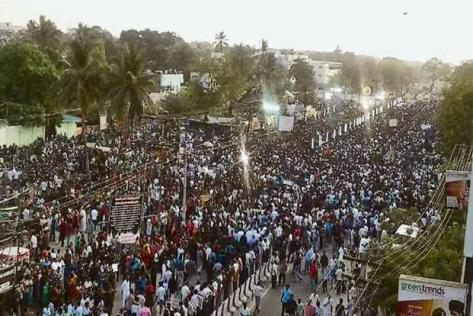
On 22nd May 2018, in what cannot be imagined even in a dictatorial regime, the police in Thoothukudi, Tamil Nadu – a South Indian state opened fire to kill, on a group of peaceful protesters marching towards the district administration office demanding denial of permission for expansion and closure of the existing copper smelting plant of Sterlite. Sterlite is a subsidiary of the London based corporation Vedanta, which has been dumping toxic waste all over this town since 1998 resulting in widespread health hazards including increase in reports of cancer. This massacre is unimaginable even in the worst dictatorial regimes, because not only were known national and international legal norms and protocols in crowd/riot control violated, but also because the video clippings that have surfaced after the massacre seem to indicate sufficient premeditation – with a plainclothes sniper on the top of a van being ordered to kill at least one person. Continue reading Thoothukudi Massacre – When State becomes Predator: Bobby Kunhu→
Within a few weeks I have to submit my PhD thesis at the Centre for Historical Studies, Jawaharlal Nehru University (JNU). Given that the deadline for my submission is at hand, I should have spent all my energies on my thesis rather than writing this letter to you. But I couldn’t help doing this. Through this letter, I would like to bring to your notice a very serious issue that has recently come up in JNU. Since you are the Visitor of this University, I think I should bring this matter to your notice. You are requested to make an urgent intervention.
As the media reports suggest, the Academic Council (AC) of JNU, held on May 18, 2018, took a decision to open a new course called ‘Islamic Terrorism’. It is learnt that the AC meeting approved in principle a new course called ‘Islamic Terrorism’. This course will be one among other courses offered by the proposed centre to be known as Centre for National Security Studies (CNSS). However, some people say that ‘Islamic Terrorism’ is not a new course but it is a theme of a paper on national security that includes other themes like ‘Naxalism’, ‘Insurgency’, ‘Demographic changes’ etc. Dear Sir, much confusion still persists and we are still waiting for the JNU administration to come out with all relevant facts and clarify its stand on these highly controversial issues. But the apprehension among us is growing that the current JNU administration appears adamant to change the character of JNU and push several hawkish agendas ahead. Continue reading The Danger of ‘Islamic Terrorism’ Course in JNU – An Open Letter to the President of India: Abhay Kumar→
There are enough reasons for for the upbeat and celebratory mood in the anti-BJP-RSS camp following the resignation of BS Yeddyurappa even before the floor test. After all, for once, the game plan of the Modi-Shah duo fell flat, thanks in no small measure, to the Supreme Court’s intervention in directing that the floor test be done by 19 May, knocking down the (RSS) Governor’s initial provision of 15 days to the government to prove its majority. In a manner of speaking, we escaped just by the skin of our teeth.
Both the parties concerned – the Congress and the Janata Dal (S) – were on tenterhooks throughout and the surreal accounts of the high drama of the past three days read like they could be about the nether worlds of crime and mafias. Offers to buy off MLAs with money ranging from Rs 5 crores and a ministry to Rs 100 crores have openly been alleged but these were the relatively minor matters. Congress and JD (S) MLAs were not allowed to leave Bengaluru as their chartered flights were ‘denied permission’. [An MLA, in fact told the Times of India, in the same report linked here that by manipulating resources, the BJP had ‘caged us’ in the state]. Their security cover was withdrawn. The management of the resort in Kochi (another state, not even ruled by the BJP) they had booked into by the Central leadership, actually backed out stating that they were under tremendous pressure. Then began the trip by road to Hyderabad, where eventually, it was the Telengana police that ensured their safety. Stories of individual MLAs, either being offered with withdrawal of pending cases or being threatened with harassment with new ones have also been doing the rounds. And for those who have been following what has been happening to the AAP MLAs in Delhi, nothing of this should be unbelievable.
There is all around jubilation in the anti-BJP, particularly the Congress camp that the Supreme Court has cut short the time given to Yediyurappa by the Governor to prove his majority from 15 days to 24 hours. This jubilation is extremely myopic and self serving and is in no way rooted in the tall claims that the Congress has been making about trying to save the Constitution. All the Supreme Court order does is reduce the window of opportunity for the BJP to indulge in horse trading and increase the chances of the Congress-JDS combine to keep their flock together and win the assembly – and also substantially reduce the resort costs.
Former civil servants have written open letters since 2017 (here and here), expressing their anguish at the unchecked attempts to spread hatred and discord among communities. Eleven of these civil servants have now written (on May 7, 2018) to the Chief Secretary of Haryana on the issue of harassment and intimidation of Muslims offering namaz in Haryana, by vigilante groups.
To Shri Depinder Singh Dhesi IAS, Chief Secretary, Govt of Haryana.
Dear Chief Secretary,
We write to draw your attention to an urgent problem.
Over the last one month, Friday namaaz offered by the Muslim community in open spaces have been attacked and disrupted at several locations in Gurgaon district. These attacks have been organised by a dozen or so organisations (including the Vishwa Hindu Parishad, Bajrang Dal, Hindu Kranti Dal, Gorakshak Dal, Hindu Jagaran Manch and Shiv Sena) that have come together under the umbrella of the Hindu Sanyukt Sangharsh Samiti.
The attacks are coordinated, violent and clearly designed to terrorise and intimidate and are taking place across the district. Last Friday a group of hoodlums arrived in four jeeps at a namaaz venue on MG Road and started shouting abusive and provocative slogans at the assembled namaazis. Although a police force was present, it took no action to stop the sloganeering and threats. On the contrary, the police asked the namaazis to disperse. At a namaaz in Sector 40, the Imam who was leading the prayers was pushed to the ground. People who came for the prayers had no option but to fold up their mats and leave.
We are academics and independent scholars from India and abroad, writing to express solidarity with, and to endorse the sentiments expressed by, forty-nine retired civil servants in their open letter to you of April 16th 2018 (https://thewire.in/politics/narendra-modi-open-letter-kathua-unnao).
Along with these civil servants and countless other citizens of India and the world at large, we wish to express our deep anger and anguish over the events in Kathua and Unnao and the aftermath of these events; over the efforts, in both cases, of those administering the relevant States to protect the alleged perpetrators of these monstrous crimes; over the subsequent profoundly distasteful efforts of rationalisation, deflection and diversion that have been so much in evidence in the reactions of your party’s spokespersons in the media; and finally over your own prolonged (and by now familiar) silence that was broken only recently with wholly inadequate, platitudinous, and non-specific assurances of justice for the victims. Continue reading Open letter to the Prime Minister of India on the Kathua and Unnao Rape Cases – The Full Text→
The following petition initiated by Prasenjit Bose appeals to the Supreme Court to reconsider the verdict in the case regarding Judge Loya’s death. Since the launch of the petition, over 527 persons have already signed it. A list of 40 prominent signatories is provided below. A hard copy of the petition along with the total list of signatories will be sent to the Supreme Court judges once we collect thousand plus signatures. The petition can be signed here.
To
The Hon’ble Chief Justice
& His Companion Justices,
The Supreme Court of India
Most Respectfully Sheweth:
We the undersigned citizens of India are deeply anguished by the order passed by a three judge bench of the Supreme Court that there is no merit in the writ petitions seeking an Inquiry into the death of Justice Brijgopal Harkishan Loya on December 1, 2014 at Nagpur.
The three judge bench has concluded that the documentary material on the record indicates that the death of Judge Loya was due to natural causes and that there is no ground for reasonable suspicion about the cause or circumstances of death which would merit a further inquiry. Continue reading Petition to Supreme Court Urging Verdict in Judge Loya Case→
After the Modi government came to power, citizens of this country have seen gate after gate of Hell — the Narakas — open relentlessly to suck them in mercilessly or condemn them to be helpless spectators to unspeakable acts of injustice and violence. We have by now crossed the Arbudanaraka and the Nirarbudanaraka many times; the ordeal of having to watch evil unfold in the attacks on people in the name of what they eat, how they love, what they speak, who they pray to, which caste they were born into, what gender was assigned to them at birth — the list is growing day by day. We seem to be reduced to waiting endlessly at the doorsteps of police stations, courts, morgues, nearly overpowered by the stench of power and majoritarian hubris, fighting to stay conscious, waiting for the dead, broken, defiled, or dismembered bodies of our kin, our friends, neighbours, people. For instance, can one ever forget how we stood in sheer anxiety outside the Supreme Court, truly like souls awaiting judgment at the gates of Vaikuntam, reduced to droplets of pure worry? Those of us who fought for Hadiya’s rights can hardly forget.
കേന്ദ്രത്തിൽ മോഡിസർക്കാർ ഭരണത്തിൽ വന്നതിനു ശേഷം നരകത്തിൻറെ വാതായനങ്ങൾ ഒന്നൊന്നായി പിളരുകയും അവ നമ്മേ വിഴുങ്ങുകയും മഹാപാതകങ്ങൾക്ക് നിസ്സഹായരായ ദൃക് സാക്ഷികളാവുക എന്ന അപാരപരീക്ഷണത്തിനു നാം വിധേയരാവുകയും ചെയ്തിരിക്കുന്നു. നിരർബുദനരകവും അർബുദനരകവും പല വട്ടം നാം കടന്നിരിക്കുന്നു. മാട്ടിറച്ചിയുടെ പേരിലും പിറന്നു പോയ ജാതിയുടെയും മതത്തിൻറെയും പേരിൽ നിരപരാധികളായ മനുഷ്യർ ഇവിടങ്ങളിലേക്കു വലിച്ചെറിയപ്പെടുന്നത് അധികവും നിസ്സഹായരായി കണ്ടുനിൽക്കേണ്ട ദുര്യോഗം താങ്ങാവുന്നതിലും അധികമായിരിക്കുന്നു. Continue reading മഹാനരകങ്ങൾക്കെതിരെ : ഏപ്രിൽ 23ൻെറ പ്രതിഷേധക്കൂട്ടയ്മയ്ക്കു വേണ്ടി ഒരു കുറിപ്പ്→
This is a guest post by TANNISTHA SAMAMTHA andMUKTA GUNDI
With the success of “PadMan”, Akshay Kumar has established himself to be a bleeding-heart ‘feminist’. News channels are pouring praises for a film that introduces a ‘bold’ topic while regurgitating the crucial link between safe menstrual practices and women’s health. While the message is old (and important), the euphoria around it is new. Continue reading PadMan, Patriarchy and the Poor Man’s Innovation: Tannistha Samantha and Mukta Gundi→
It is often advised that civil disobedience in the form of breaking a law must not be practiced under a democracy. It is because democracy by giving the space for open discussion prevents a situation wherein people are compelled to think of civil disobedience. Moreover, if citizens develop faith in civil disobedience then that only undermines the rule of law. Such an act doesn’t strengthen democracy but rather helps in diminishing its ethos. People must be discouraged to break laws because in a democracy, it is they who elect their representatives through free and fair elections. These representatives then make laws to which open disobedience must not be practiced. Citizens can also vote for change of leadership in the subsequent election cycle, if they feel their representatives have been incompetent. However, while these provisions fulfil the conditions of a well functioning procedural democracy, what recourse do citizens have, when their representatives don’t act in the interest of the governed continuously but function in an autocratic manner? What if laws are made without following the spirit of democracy? Does that really result in making a substantive democracy?
SEE UPDATE AT END OF POST, ADDED ON FEBRUARY 20, 2018
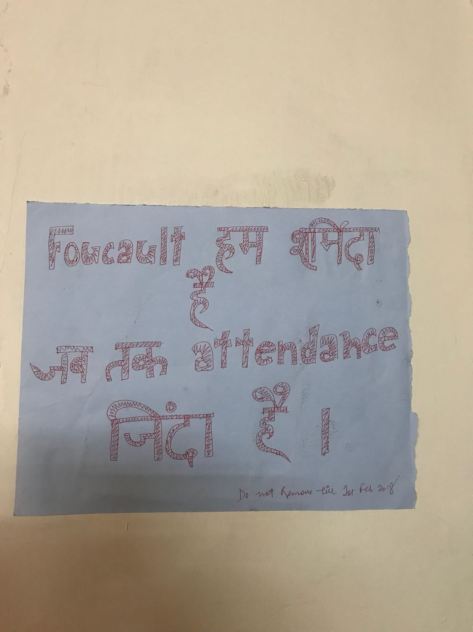
Student poster displaying a clear understanding of Foucault and surveillance. Compulsory attendance is really not needed at JNU!
Let us begin with a basic fact. The diktat on compulsory attendance in JNU is only a symptom of the larger, continuing crisis created by the utterly dictatorial style of functioning of this Vice Chancellor.
Professor Mamidala Jagadesh Kumar has, since his taking over in January 2016:
openly flouted every statute and regulation of the university
shut down admissions almost entirely for the 2017 academic year
violated the law of the land, that is, constitutional provision for reservations
failed to implement JNU’s Deprivation Point system that attempts to bring about representation for students from a diversity of class, regional and caste backgrounds
shut down the country’s oldest functioning Committee on Sexual Harassment (GSCASH)
brazenly cooked up and manipulated Minutes of meeting after meeting of the Academic Council and
treated faculty and students of JNU as his enemies to be defeated by the naked use of authoritarian power.
I have been working for the past 16 years with a small organisation called India Foundation for the Arts (IFA) that attempts to support arts and culture projects across the country. In these years I have been fortunate enough to travel across the country to big cities and small ones, towns and villages where arts practitioners and scholars work intensely, passionately, with almost no economic resources or social acknowledgements. The percentage of our total national budget outlay to the arts and culture is negligible as is the amount that finally gets spent on it. The state of our national arts and culture institutions is abysmal and much has been written by eminent experts critiquing the vision, mandates, policies and mechanisms of funding or the lack of any of these prerequisites to support the sector with an imagination that attempts to build a robust, vibrant ecology for the arts.
T T Sreekumar, an important commentator on contemporary politics in Kerala — a public intellectual who now qualifies to be an irritant in the eyes of the Kerala police, now that he has openly declared his allegiance to the dalit people fighting injustice and Vadayambady and inaugurated a protest-event there — writes about the issue and its historical origins:
When I visited Vadayambady the other day to express my solidarity with the cause of the agitation, what I witnessed there was an atmosphere of utmost fear and police terror. A big task force of police was stationed at the location. The team that included the special branch officers, had created a situation of terror at the peaceful site. Activists mentioned that a particular police officer continuously hurled abuses, including caste abuses, at the protesters that included Dalit women and children. When the protest began to draw national attention, the ruling dispensation of CPIM that had hitherto remained unconcerned has started to take up some damage control measures. However, when they finally arrived at the site of the agitation almost after a year since the agitation began, the CPIM leaders allegedly refused to address the caste question involved. Dalit activists, including women activists, surrounded them and raised several objections to this attitude pointing to their sheer hypocrisy and lack of integrity.
On 30 January 2018, retired civil servants and veterans of the armed forces jointly organised a conclave on ‘Hinduism and Hindutva’ at the Indian Social Institute, New Delhi. The conclave attended by over hundred participants, emphasized the need to rescue both Hinduism and the Indian Constitution from the clutches of the political project that calls itself Hindutva, and which has nothing to do with religion as such. The participants at the conclave sought to make a plea for saving Hinduism without making any concessions to the monstrosity of caste oppression, which in the spirit of many earlier reformers, they rejected.
This conclave followed an earlier one on ‘A Fractured Polity: The
Relevance of Gandhi Today’ organised on 10 October 2017, which had been
addressed by Justice A P Shah, Mrinal Pande and Ramachandra Guha. The
speeches are available on YouTube (Justice A.P. Shah, Mrinal Pande,
Ramachandra Guha). These civil servants and veterans have also raised severe
concerns about the present situation in a series of open letters over the last few
months: on vigilantism and hyper-nationalism; the suspicious death of Justice
Loya; and violence and discrimination against minorities in India. (See: Retired
Civil Servants open letter – 10 June 2017, Armed Forces Veterans open letter –
30 July 2017, Retired Civil Servants Letter 02 December 2017 – Enquiry into
Judge Loya’s death, Armed Forces Veterans letter to Supreme Court & Bombay
High Court on Judge Loya’s death, Retired Civil Servants open letter – 28 January
2018). Continue reading Defend Constitutional Values, Save Hinduism from Hindtuva: For Civil Servants and Armed Forces Veterans→
पूरे हिंदी क्षेत्र में और विशेषकर उत्तरप्रदेश में ऐसे बडे, छोटे और मंझोले किस्म के नेताओं की बड़ी फौज पैदा हो गई है जिसकी नेतागिरी केवल सांप्रदायिक नारे लगाने और समाज में सांप्रदायिकता फैलाने पर टिकी है। सार्वजनिक जीवन पर इन संकीर्ण सोच वाले हिंदुत्व नेताओं की निरंतर मजबूत होती पकड़ ने सांप्रदायिक हिंसा को ‘न्यू नार्मल’ के रूप में मान्यता दिला दी है। हिंदू धर्म को कलंकित करने में इस नए जमाने के हिंदुत्व की क्या भूमिका है, यह अब किसी से छिपा नहीं है। एक समय था जब समाज पर समाजवादी और गांधीवादी विचारों के प्रभाव के कारण सांप्रदायिकता का सामना करना अपेक्षाकृत कम मुश्किल काम था। पर इन विचारधाराओं का प्रभाव कम हो जाने से सांप्रदायिक नेताओं-समूहों का तेजी से विस्तार हो रहा है। एबीवीपी, विहिप, हिंदू युवावाहिनी और बजरंग दल जैसे संगठन सामाजिक-राजनीतिक जीवन के पूरे परिदृश्य पर हावी हो चुके हैं।अक्सर साधारण परिवारों के युवक इन संगठनों की चपेट में इसलिए आ जाते हैं क्योंकि सांप्रदायिक संगठन समाज सेवा के मुखौटे के भीतर रहकर अपना काम करते हैं। वे दिखावे के तौर पर ब्लड डोनेशन या स्वच्छता मिशन या फिर शहीदों के सम्मान जैसी गतिविधियां करते हैं पर उनका असल मकसद समाज में सांप्रदायिकता का विचारधारा का विस्तार करना होता है। मुस्लिमों में भी सांप्रदायिकता है, पर वे उस प्रकार से संगठित सांप्रदायिकता को व्यक्त नहीं कर रहे हैं। Continue reading कासगंज हिंसा- तिरंगे को हड़प जाएगा भगवा? वैभव सिंह→
रक्स करना है तो पॉंव की ज़ंजीर न देख – मजरूह सुल्तानपुरी
Look – beyond the the prison walls, the brilliance of flowers, the vitality of spring
If you must dance, ignore the chains that bind your feet – Majrooh Sultanpuri
Today, the scared Republic that has imprisoned its young idealistic fighter son, Chandrashekhar, is on trial. The Republic, scared of its own offspring, stands in the dock. This Republic Day, we must all answer how it came to pass that a gang of adventurers and marauders simply took it over, submitted it to their command, while all the elderly, wise men and women, watched. Today, when the Republic bondage we must seek answers from all those who watched helplessly – or self-righteously – as marauders took it over.
It is official now. A radiogram from the Deputy Secretary, Home, Govt of Uttar Pradesh to the Superintendent, Saharanpur District Jail, dated 23 January 2018, confirms the slapping of charges under the National Security Act, on Bhim Army founder, Chandrashekhar Azad ‘Ravan’. Pradeep Narwal, Coordinator, Committee for the Defence of Bhim Army, who met Chandrashekhar in jail yesterday, underlined how the Karni Sena activists attacking school buses and vandalizing schools were being allowed the freedom to do so while Chandrashekhar, responsible for setting up and running of schools (see the video below), is being held in jail for months and has now been slapped with charges under NSA. “Karni Sena are apparently deshbhakts and Shekher bhai and Bhim Army are ‘terrorists’ in the perverted logic of this government,” he said.
In conversations with friends and sympathizers who have been meeting him over the past months, including Pradeep Narwal, Chandrashekhar ‘Ravan’ has been expressing a fear that many of us have also had, independently, for some time now: that the government wants to actually get rid of him – just as judge Loya was, it now transpires. Continue reading A Revolution Called Chandrashekhar Azad ‘Ravan’ – the Republic on Trial→
The recent reference to how the distribution of food in Malayali homes is often skewed against women by the actor Rima Kallingal in a recent talk has sparked off yet another round of attacks against feminists in Kerala. It is interesting to see how this seems to have brought together men of all political stripes and colours (may I say, from pro- and anti-Hadiya camps!). The attacks range from mild smirking to outright abuse, but are equally revealing of the fear of women’s feminist self-assertion. So even those men who supported Hadiya’s decision to choose her faith and community find it hard to swallow when women start laying bare the injustices of the ubiquitous patriarchal family, fearing that there may be an implicit choice in this criticism, to move away from the patriarchal family, and indeed, craft other non-patriarchal forms of intimate connection and commitment. After all, whatever be the community, the patriarchal family is acknowledged by patriarchal authorities everywhere as the foundation Continue reading From Nangeli to Rima Kallingal: Who are fit to claim Nangeli’s Legacy?→
(To be published in the special issue of ‘Janata’)
The spectacle of what is called religion, or at any rate organised religion, in India and elsewhere, has filled me with horror and I have frequently condemned it and wished to make a clean sweep of it. Almost always it seemed to stand for blind belief and reaction, dogma and bigotry, superstition, exploitation and the preservation of vested interests.
– Toward Freedom: The Autobiography of Jawaharlal Nehru (1936), pp. 240–241.
If Hindu Raj does become a fact, it will no doubt, be the greatest calamity for this country. No matter what the Hindus say, Hinduism is a menace to liberty, equality and fraternity. On that account it is incompatible with democracy. Hindu Raj must be prevented at any cost.
– Ambedkar, ‘Pakistan or Partition of India’, p. 358.
Introduction
India’s slow ushering into a majoritarian democracy is a matter of concern for every such individual who still believes in pluralism, democracy, equality and a clear separation of religion and politics. The way people are being hounded for raising dissenting opinions, for eating food of their choice or entering into relationships of their own liking or celebrating festivals according to their own faith is unprecedented. The situation has reached such extremes that one can even be publicly lynched for belonging to one of the minority religions or for engaging in an activity which is considered to be ‘suspicious’ by the majority community.
No doubt there is no direct harm to the basic structure of the Constitution, its formal structure remains intact, de jure India does remain a democracy as well as a republic, but de facto democracy has slowly metamorphosed into majoritarianism and the sine qua non of a republic—that its citizens are supreme—is being watered down fast. It does not need underlining that this process has received tremendous boost with the ascent of Hindutva supremacist forces at the centrestage of Indian politics. Continue reading Nehru, Ambedkar and Challenge of Majoritarianism→
Development is back in focus after the endless noise about cow protection, nationalism, Hindu-Muslim, janeus, Shiv Bhakti, Gorakhpur governance, casteism, love jihad, enemy nation and the rest. Why this talk about development now? Perhaps the dissent and protests on the ground by various sections in Gujarat in the last few years have compelled even the diehards to acknowledge (Mr. Amit Shah recently said ‘It is not my point that the issues raised in those agitations are not an issue’), that something is deeply problematic about the “Gujarat Model of Development”. The ASHA workers have taken to the streets demanding a living wage, regularized working hours and social security; dalits are no longer silent about the violence, indignity and intimidation heaped upon them; displaced families from Sardar Sarovar Dams have occupied streets seeking rehabilitation; farmers are demanding reprieve from a crisis to which they have had no hand in creating; tribals and evicted farmers are protesting against showpiece infrastructure projects which have meant their displacement and destruction of human habitations; and the youth from cultivating castes are seeking guarantee for jobs. The list is continuing.