Category Archives: Right watch

Against the Yawning Jaws of Hell: Protest Against Hate on 23 April

After the Modi government came to power, citizens of this country have seen gate after gate of Hell — the Narakas — open relentlessly to suck them in mercilessly or condemn them to be helpless spectators to unspeakable acts of injustice and violence. We have by now crossed the Arbudanaraka and the Nirarbudanaraka many times; the ordeal of having to watch evil unfold in the attacks on people in the name of what they eat, how they love, what they speak, who they pray to, which caste they were born into, what gender was assigned to them at birth — the list is growing day by day. We seem to be reduced to waiting endlessly at the doorsteps of police stations, courts, morgues, nearly overpowered by the stench of power and majoritarian hubris, fighting to stay conscious, waiting for the dead, broken, defiled, or dismembered bodies of our kin, our friends, neighbours, people. For instance, can one ever forget how we stood in sheer anxiety outside the Supreme Court, truly like souls awaiting judgment at the gates of Vaikuntam, reduced to droplets of pure worry? Those of us who fought for Hadiya’s rights can hardly forget.

Continue reading Against the Yawning Jaws of Hell: Protest Against Hate on 23 April

മഹാനരകങ്ങൾക്കെതിരെ : ഏപ്രിൽ 23ൻെറ പ്രതിഷേധക്കൂട്ടയ്മയ്ക്കു വേണ്ടി ഒരു കുറിപ്പ്


കേന്ദ്രത്തിൽ മോഡിസർക്കാർ ഭരണത്തിൽ വന്നതിനു ശേഷം നരകത്തിൻറെ വാതായനങ്ങൾ ഒന്നൊന്നായി പിളരുകയും അവ നമ്മേ വിഴുങ്ങുകയും മഹാപാതകങ്ങൾക്ക് നിസ്സഹായരായ ദൃക് സാക്ഷികളാവുക എന്ന അപാരപരീക്ഷണത്തിനു നാം വിധേയരാവുകയും ചെയ്തിരിക്കുന്നു. നിരർബുദനരകവും അർബുദനരകവും പല വട്ടം നാം കടന്നിരിക്കുന്നു. മാട്ടിറച്ചിയുടെ പേരിലും പിറന്നു പോയ ജാതിയുടെയും മതത്തിൻറെയും പേരിൽ നിരപരാധികളായ മനുഷ്യർ ഇവിടങ്ങളിലേക്കു വലിച്ചെറിയപ്പെടുന്നത് അധികവും നിസ്സഹായരായി കണ്ടുനിൽക്കേണ്ട ദുര്യോഗം താങ്ങാവുന്നതിലും അധികമായിരിക്കുന്നു.  Continue reading മഹാനരകങ്ങൾക്കെതിരെ : ഏപ്രിൽ 23ൻെറ പ്രതിഷേധക്കൂട്ടയ്മയ്ക്കു വേണ്ടി ഒരു കുറിപ്പ്

PadMan, Patriarchy and the Poor Man’s Innovation: Tannistha Samantha and Mukta Gundi

This is a guest post by TANNISTHA SAMAMTHA and MUKTA GUNDI


With the success of “PadMan”, Akshay Kumar has established himself to be a bleeding-heart ‘feminist’. News channels are pouring praises for a film that introduces a ‘bold’ topic while regurgitating the crucial link between safe menstrual practices and women’s health. While the message is old (and important), the euphoria around it is new. Continue reading PadMan, Patriarchy and the Poor Man’s Innovation: Tannistha Samantha and Mukta Gundi

Civil Disobedience under Democracy: The Case of Boycott of Centralised Compulsory Attendance in JNU: Tejal Khanna

Guest post by TEJAL KHANNA

It is often advised that civil disobedience in the form of breaking a law must not be practiced under a democracy. It is because democracy by giving the space for open discussion prevents a situation wherein people are compelled to think of civil disobedience. Moreover, if citizens develop faith in civil disobedience then that only undermines the rule of law. Such an act doesn’t strengthen democracy but rather helps in diminishing its ethos. People must be discouraged to break laws because in a democracy, it is they who elect their representatives through free and fair elections. These representatives then make laws to which open disobedience must not be practiced. Citizens can also vote for change of leadership in the subsequent election cycle, if they feel their representatives have been incompetent. However, while these provisions fulfil the conditions of a well functioning procedural democracy, what recourse do citizens have, when their representatives don’t act in the interest of the governed continuously but function in an autocratic manner? What if laws are made without following the spirit of democracy? Does that really result in making a substantive democracy?

Continue reading Civil Disobedience under Democracy: The Case of Boycott of Centralised Compulsory Attendance in JNU: Tejal Khanna

The Vice Chancellor of JNU has lost all moral authority: A dossier of misdeeds

SEE UPDATE AT END OF POST, ADDED ON FEBRUARY 20, 2018

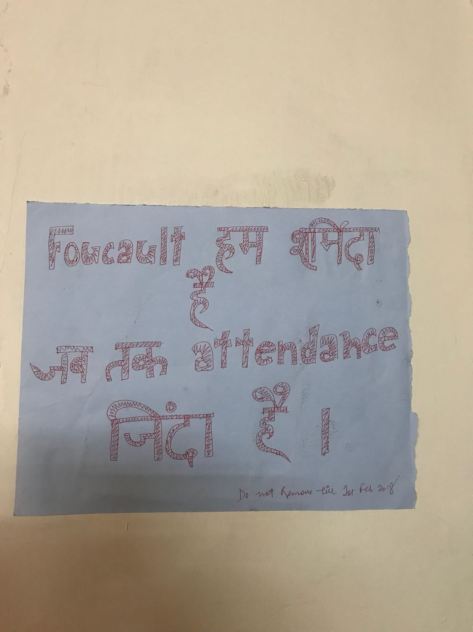
Student poster displaying a clear understanding of Foucault and surveillance. Compulsory attendance is really not needed at JNU!

Let us begin with a basic fact. The diktat on compulsory attendance in JNU is only a symptom of the larger, continuing crisis created by the utterly dictatorial style of functioning of this Vice Chancellor.

Professor Mamidala Jagadesh Kumar has, since his taking over in January 2016:

  • openly flouted every statute and regulation of the university
  • shut down admissions almost entirely for the 2017 academic year
  • violated the law of the land, that is, constitutional provision for reservations
  • failed to implement JNU’s Deprivation Point system that attempts to bring about representation for students from a diversity of class, regional and caste backgrounds
  • shut down the country’s oldest functioning Committee on Sexual Harassment (GSCASH)
  • brazenly cooked up and manipulated Minutes of meeting after meeting of the Academic Council and
  • treated faculty and students of JNU as his enemies to be defeated by the naked use of authoritarian power.

Continue reading The Vice Chancellor of JNU has lost all moral authority: A dossier of misdeeds

A Theatre Olympics that Isn’t: Arundhati Ghosh

Guest post by ARUNDHATI GHOSH

Image courtesy Deccan Herald

I have been working for the past 16 years with a small organisation called India Foundation for the Arts (IFA) that attempts to support arts and culture projects across the country. In these years I have been fortunate enough to travel across the country to big cities and small ones, towns and villages where arts practitioners and scholars work intensely, passionately, with almost no economic resources or social acknowledgements. The percentage of our total national budget outlay to the arts and culture is negligible as is the amount that finally gets spent on it. The state of our national arts and culture institutions is abysmal and much has been written by eminent experts critiquing the vision, mandates, policies and mechanisms of funding or the lack of any of these prerequisites to support the sector with an imagination that attempts to build a robust, vibrant ecology for the arts.

Continue reading A Theatre Olympics that Isn’t: Arundhati Ghosh

The Festering Sore of the Caste-Wall at Vadayambady: T T Sreekumar

T T Sreekumar, an important commentator on contemporary politics in Kerala — a public intellectual who now qualifies to be an irritant in the eyes of the Kerala police, now that he has openly declared his allegiance to the dalit people fighting injustice and Vadayambady and inaugurated a protest-event there — writes about the issue and its historical origins:

When I visited Vadayambady the other day to express my solidarity with the cause of the agitation, what I witnessed there was an atmosphere of utmost fear and police terror. A big task force of police was stationed at the location. The team that included the special branch officers, had created a situation of terror at the peaceful site. Activists mentioned that a particular police officer continuously hurled abuses, including caste abuses, at the protesters that included Dalit women and children. When the protest began to draw national attention, the ruling dispensation of CPIM that had hitherto remained unconcerned has started to take up some damage control measures. However, when they finally arrived at the site of the agitation almost after a year since the agitation began, the CPIM leaders allegedly refused to address the caste question involved. Dalit activists, including women activists, surrounded them and raised several objections to this attitude pointing to their sheer hypocrisy and lack of integrity.

Read more at:

https://countercurrents.org/2018/02/02/fighting-peripheralization-dalit-movement-hindu-caste-wall-kerala/


Defend Constitutional Values, Save Hinduism from Hindtuva: For Civil Servants and Armed Forces Veterans

On 30 January 2018, retired civil servants and veterans of the armed forces jointly organised a conclave on ‘Hinduism and Hindutva’ at the Indian Social Institute, New Delhi. The conclave attended by over hundred participants, emphasized the need to rescue both Hinduism and the Indian Constitution from the clutches of the political project that calls itself Hindutva, and which has nothing to do with religion as such. The participants at the conclave sought to make a plea for saving Hinduism without making any concessions to the monstrosity of caste oppression, which in the spirit of many earlier reformers, they rejected.

This conclave followed an earlier one on ‘A Fractured Polity: The
Relevance of Gandhi Today’ organised on 10 October 2017, which had been
addressed by Justice A P Shah, Mrinal Pande and Ramachandra Guha. The
speeches are available on YouTube (Justice A.P. Shah, Mrinal Pande,
Ramachandra Guha). These civil servants and veterans have also raised severe
concerns about the present situation in a series of open letters over the last few
months: on vigilantism and hyper-nationalism; the suspicious death of Justice
Loya; and violence and discrimination against minorities in India. (See: Retired
Civil Servants open letter – 10 June 2017, Armed Forces Veterans open letter –
30 July 2017, Retired Civil Servants Letter 02 December 2017 – Enquiry into
Judge Loya’s death, Armed Forces Veterans letter to Supreme Court & Bombay
High Court on Judge Loya’s death, Retired Civil Servants open letter – 28 January
2018).
Continue reading Defend Constitutional Values, Save Hinduism from Hindtuva: For Civil Servants and Armed Forces Veterans

कासगंज हिंसा- तिरंगे को हड़प जाएगा भगवा? वैभव सिंह

Guest post by VAIBHAV SINGH

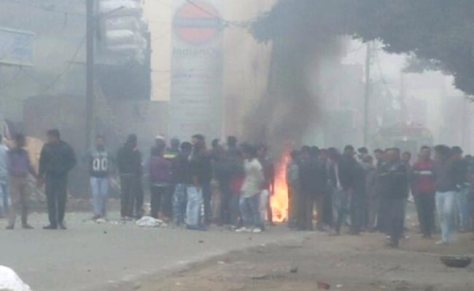
kasganj-uttar-pradesh-violence, image courtesy ndtv

पूरे हिंदी क्षेत्र में और विशेषकर उत्तरप्रदेश में ऐसे बडे, छोटे और मंझोले किस्म के नेताओं की बड़ी फौज पैदा हो गई है जिसकी नेतागिरी केवल सांप्रदायिक नारे लगाने और समाज में सांप्रदायिकता फैलाने पर टिकी है। सार्वजनिक जीवन पर इन संकीर्ण सोच वाले हिंदुत्व नेताओं की निरंतर मजबूत होती पकड़ ने सांप्रदायिक हिंसा को ‘न्यू नार्मल’ के रूप में मान्यता दिला दी है। हिंदू धर्म को कलंकित करने में इस नए जमाने के हिंदुत्व की क्या भूमिका है, यह अब किसी से छिपा नहीं है। एक समय था जब समाज पर समाजवादी और गांधीवादी विचारों के प्रभाव के कारण सांप्रदायिकता का सामना करना अपेक्षाकृत कम मुश्किल काम था। पर इन विचारधाराओं का प्रभाव कम हो जाने से सांप्रदायिक नेताओं-समूहों का तेजी से विस्तार हो रहा है। एबीवीपी, विहिप, हिंदू युवावाहिनी और बजरंग दल जैसे संगठन सामाजिक-राजनीतिक जीवन के पूरे परिदृश्य पर हावी हो चुके हैं।अक्सर साधारण परिवारों के युवक इन संगठनों की चपेट में इसलिए आ जाते हैं क्योंकि सांप्रदायिक संगठन समाज सेवा के मुखौटे के भीतर रहकर अपना काम करते हैं। वे दिखावे के तौर पर ब्लड डोनेशन या स्वच्छता मिशन या फिर शहीदों के सम्मान जैसी गतिविधियां करते हैं पर उनका असल मकसद समाज में सांप्रदायिकता का विचारधारा का विस्तार करना होता है। मुस्लिमों में भी सांप्रदायिकता है, पर वे उस प्रकार से संगठित सांप्रदायिकता को व्यक्त नहीं कर रहे हैं। Continue reading कासगंज हिंसा- तिरंगे को हड़प जाएगा भगवा? वैभव सिंह

A Revolution Called Chandrashekhar Azad ‘Ravan’ – the Republic on Trial

देख ज़िन्दां के परे, रंग-ए-चमन, जोश-ए-बहार

रक्स करना है तो पॉंव की ज़ंजीर न देख – मजरूह सुल्तानपुरी

Look –  beyond the the prison walls, the brilliance of flowers, the vitality of spring

If you must dance, ignore the chains that bind your feet – Majrooh Sultanpuri

Today, the scared Republic that has imprisoned its young idealistic fighter son, Chandrashekhar, is on trial. The Republic, scared of its own offspring, stands in the dock. This Republic Day, we must all answer how it came to pass that a gang of adventurers and marauders simply took it over, submitted it to their command, while all the elderly, wise men and women, watched. Today, when the Republic bondage we must seek answers from all those who watched helplessly – or self-righteously – as marauders took it over.

It is official now. A radiogram from the Deputy Secretary, Home, Govt of Uttar Pradesh to the Superintendent, Saharanpur District Jail, dated 23 January 2018, confirms the slapping of charges under the National Security Act, on Bhim Army founder, Chandrashekhar Azad ‘Ravan’. Pradeep Narwal, Coordinator, Committee for the Defence of Bhim Army, who met Chandrashekhar in jail yesterday, underlined how the Karni Sena activists attacking school buses and vandalizing schools were being allowed the freedom to do so while Chandrashekhar, responsible for setting up and running of schools (see the video below), is being held in jail for months and has now been slapped with charges under NSA. “Karni Sena are apparently deshbhakts and Shekher bhai and Bhim Army are ‘terrorists’ in the perverted logic of this government,” he said.


In conversations with friends and sympathizers who have been meeting him over the past months, including Pradeep Narwal, Chandrashekhar ‘Ravan’ has been expressing a fear that many of us have also had, independently, for some time now: that the government wants to actually get rid of him – just as judge Loya was, it now transpires. Continue reading A Revolution Called Chandrashekhar Azad ‘Ravan’ – the Republic on Trial

From Nangeli to Rima Kallingal: Who are fit to claim Nangeli’s Legacy?

I

The recent reference to how the distribution of food in Malayali homes is often skewed against women by the actor Rima Kallingal in a recent talk has sparked off yet another round of attacks against feminists in Kerala. It is interesting to see how this seems to have brought together men of all political stripes and colours (may I say, from pro- and anti-Hadiya camps!). The attacks range from mild smirking to outright abuse, but are equally revealing of the fear of women’s feminist self-assertion. So even those men who supported Hadiya’s decision to choose her faith and community find it hard to swallow when women start laying bare the injustices of the ubiquitous patriarchal family, fearing that there may be an implicit choice in this criticism, to move away from the patriarchal family, and indeed, craft other non-patriarchal forms of intimate connection and commitment. After all, whatever be the community, the patriarchal family is acknowledged by patriarchal authorities everywhere as the foundation Continue reading From Nangeli to Rima Kallingal: Who are fit to claim Nangeli’s Legacy?

Nehru, Ambedkar and Challenge of Majoritarianism

Image result for nehru ambedkar

( Photo courtesy : The hoot)

(To be published in the special issue of ‘Janata’)


The spectacle of what is called religion, or at any rate organised religion, in India and elsewhere, has filled me with horror and I have frequently condemned it and wished to make a clean sweep of it. Almost always it seemed to stand for blind belief and reaction, dogma and bigotry, superstition, exploitation and the preservation of vested interests.

– Toward Freedom: The Autobiography of Jawaharlal Nehru (1936), pp. 240–241.

If Hindu Raj does become a fact, it will no doubt, be the greatest calamity for this country. No matter what the Hindus say, Hinduism is a menace to liberty, equality and fraternity. On that account it is incompatible with democracy. Hindu Raj must be prevented at any cost.

– Ambedkar, ‘Pakistan or Partition of India’, p. 358.

Introduction

India’s slow ushering into a majoritarian democracy is a matter of concern for every such individual who still believes in pluralism, democracy, equality and a clear separation of religion and politics. The way people are being hounded for raising dissenting opinions, for eating food of their choice or entering into relationships of their own liking or celebrating festivals according to their own faith is unprecedented. The situation has reached such extremes that one can even be publicly lynched for belonging to one of the minority religions or for engaging in an activity which is considered to be ‘suspicious’ by the majority community.

No doubt there is no direct harm to the basic structure of the Constitution, its formal structure remains intact, de jure India does remain a democracy as well as a republic, but de facto democracy has slowly metamorphosed into majoritarianism and the sine qua non of a republic—that its citizens are supreme—is being watered down fast. It does not need underlining that this process has received tremendous boost with the ascent of Hindutva supremacist forces at the centrestage of Indian politics. Continue reading Nehru, Ambedkar and Challenge of Majoritarianism

Development Outcomes And Politics in Gujarat: Atul Sood

Guest Post by ATUL SOOD

Development is back in focus after the endless noise about cow protection, nationalism, Hindu-Muslim, janeus, Shiv Bhakti, Gorakhpur governance, casteism, love jihad, enemy nation and the rest. Why this talk about development now? Perhaps the dissent and protests on the ground by various sections in Gujarat in the last few years have compelled even the diehards to acknowledge (Mr. Amit Shah recently said ‘It is not my point that the issues raised in those agitations are not an issue’), that something is deeply problematic about the “Gujarat Model of Development”. The ASHA workers have taken to the streets demanding a living wage, regularized working hours and social security; dalits are no longer silent about the violence, indignity and intimidation heaped upon them; displaced families from Sardar Sarovar Dams have occupied streets seeking rehabilitation; farmers are demanding reprieve from a crisis to which they have had no hand in creating; tribals and evicted farmers are protesting against showpiece infrastructure projects which have meant their displacement and destruction of human habitations; and the youth from cultivating castes are seeking guarantee for jobs.  The list is continuing.  

Continue reading Development Outcomes And Politics in Gujarat: Atul Sood

The Indian Constitution too was Demolished Along With Babri Masjid 25 Years Ago

Twenty five years ago, on 6 December 1992, the structure of Babri Masjid was brought down by a mob of vandals, presided over by the top leadership of the BJP/RSS/VHP, as the Congress government led by prime minister Narasimha Rao looked on benignly. As did the Supreme Court before which a commitment was made by the Kalyan Singh (BJP) government in Uttar Pradesh – to the effect that nothing would be allowed to happen to the structure of the mosque.

Journalist Sajeda Momin, covering the demolition, recalls the scene thus,

I can still see the thousands of saffron-clad ‘kar sevaks’ clambering atop the 16th century mosque and pounding it with shovels, iron rods, pickaxes and anything they could lay their hands on. I can hear the screeching of Sadhvi Uma Bharti egging them on shouting “ek dhakka aur do, Babri Masjid tod do” through the microphones from atop the specially-built watchtower for the BJP/RSS/VHP leadership. I can visualize the three domes of the mosque collapsing inwards one by one at intervals of roughly an hour on that cold, wintery Sunday afternoon.

Everyone knew who were the dramatis personae at each level – and practically every bit of evidence that would ever have been required exists, captured in videos and photographs. Our present prime minister was said to be  one of the key organizers of the of the Rath Yatra that led up to the demolition and can be seen holding the microphone in his  hands in the photograph below.

Rath Yatra – precursor to the demolition, image courtesy Quora.com

Worse was to follow the demolition. The  demolition of the structure of the mosque was over that day but the process of the demolition of the Indian Constitution that had begun with what was called the ‘Ram janmabhoomi movement’ continued. By ‘Constitution’ I do not simply mean the book that embodies the law of the land but rather the very weave that came to constitute Indian society as a result of the new contract that the document called the Constitution embodied. Constitution, therefore in a triple sense. The document called the Constitution too was not merely a book of laws; it was rather, the only existing, largely agreed upon, vision of a modern India. It was a vision which was put in place through the long process of struggles, debates and contestations over the long decades of the anticolonial movement and finally given shape in, in the Constituent Assembly. There was nothing benign or innocuous about it – every bit of it had to be achieved through a fight. And yet, in the end, that was the document that embodied the vision of modern India. The only political current that stood far away from both the anticolonial struggle and had no role in the creation of this vision is the political force that rules India today.

The RSS and its numerous offshoots were neither fighting the British nor joining in the anti-caste and anti-untouchability struggles through the period since they came into existence in the mid-1920s. No wonder leaders of the Sangh combine think the anti-colonial/ national struggle was about cow-protection. That they neither subscribed to the anti-British agenda nor to the anti-caste agenda around which struggles of that period took shape, is not just a matter of historical record but is also visible in the way its leaders and ranks conduct their politics today. Every single step taken by the Sangh leaders is a step out of sync with the vision of the future spelt out by the social contract of modern India. That the Sangh attributes this vision to the Congress is an expression of its own illiteracy about the diverse forces in struggle throughout that period.

Even though it is conducted in the name of Hindus, there is nothing ‘Hindu’ about its agenda. Sangh and Sanghism is the name of a malignant political machine that seeks to destroy the very body of society in the name of an ancient past. That is the political machine we confront today. That is the political machine that we must fight today with all our vigour.

What’s in a Name? The Demolition of ‘Babri Masjid’, the Name and the Mosque: Hilal Ahmed

Babri-Masjid – Before the Demolition, image courtesy Tehelka.com

The gradual erasure of the words ‘Babri Masjid’ from our everyday memory actually began in 1986, when the Hindu community was granted the exclusive right to worship there. This happened without any regard ownership disputes the and illegal conversion of this mosque into a temple in 1949.

This story of the dispute itself is disputable. It is imperative to revisit three interesting moments, which no one talks of these days.

The 1949 moment

On the night of 23 December 1949, a group of local Hindus entered the mosque and installed the idols of Lord Ram inside it. Although the police filed an FIR in which the building is clearly defined as a functional mosque, the local administration took charge of the building, and without removing the idols from the mosque space, declared it a legally “disputed site”. Read the full article here


An open letter to Brinda Karat: why do female supporters of the Kerala CPIM spew such venom at Hadiya?

Dear Comrade

I can hardly describe the joy and relief I felt reading your piece on the Hadiya case in the Hindu yesterday. By now I am nearly deaf from the cacophony of misogyny, islamophobia, and sheer short-sighted rage that CPM supporters on Facebook are unleashing against this young woman.

Your voice of sanity, Comrade, is therefore a great restorative. If not for your writing, one could have well thought that the CPM was nothing more than a bunch of short sighted, power hungry, strategisers, whose total lack of ethics and values is covered up by a vapid, outdated rationalism and an equally problematic liberalism. You refuse to condemn Hadiya for choosing Islam. You acknowledge that she is brave. You unequivocally reject the father and other minions of patriarchy. You rightly criticise state patriarchy evident in the Supreme Court. Unlike many CPM supporters here, you have no illusions about the times we live in; you are clearly aware that the NIA is not something which will spare us if we stay good. Importantly, you put paid to the idea that the High Court judgement that sanctioned her illegal custody was justified — an idea assiduously nurtured by certain public figures allied with the CPM against religious Muslims. Comrade, thank you again for being so forthright and in the face of snarling islamophobes in your own ranks actually gunning for the voice you raised against her illegal custody long back.

Continue reading An open letter to Brinda Karat: why do female supporters of the Kerala CPIM spew such venom at Hadiya?

The Gates of Vaikuntam?

When Hadiya Shafin shouted to the crowd that she converted voluntarily, that Shafin was her chosen husband, and that she wished to spend her life with him, some leading rationalist liberal feminists in Kerala sniggered at her: be grateful for the Indian Constitution which allows you to make a choice. This statement hid a despicable insult to her choice of Islam, slyly implying that it would not permit her any choices.

Goodness knows where these puerile, vain, indurate minds live their everyday lives.  Maybe they are either still able to insulate themselves somehow from the onslaught of Hindutva violence, or find it useful to use the arms of this Hindutva hegemonised thuggish state to their narrow, shamefully narrow, ends.

Whatever, I could see no trace of the protective presence of the Indian Constitution when the Supreme Court heard Hadiya. I could see not the highest court of Justice of a vibrant democracy but I got a sense of how the Gates of Celestial Vaikuntam may look like:

Read more at : https://thewire.in/200701/hadiya-supreme-court-nia/


Hadiya’s Safety is the Kerala Government’s Responsibility: Rajathi Salma writes to the Chief Minister of Kerala

[This is the text of the open letter to the Chief Minister of Kerala from the celebrated Tamil poet Rajathi Salma, a leading literary and activist voice from South India whose writing has often revealed the pain and poignancy of women’s unfreedoms and the denial of a creative life of choice to them. This is about the never-ending agony that the confinement of a young woman, Hadiya, by her father, has become. Hadiya is to be heard by the Supreme Court of India on 27 November 2017, but the Kerala government refuses to take responsibility for her safe travel to Delhi, after many many pleas from civil society] Continue reading Hadiya’s Safety is the Kerala Government’s Responsibility: Rajathi Salma writes to the Chief Minister of Kerala

Nightmarish Visions – Indian government proposal for ‘Institutions of Eminence’: JNUTA

Statement by JNU Teachers’ Association

In early November, the JNU administration forwarded to all Centres/Special Centres/Schools, the Government of India proposal to establish twenty “Institutions of Eminence” to achieve world class status, from amongst the existing Government/Private institutions and new institutions from the private sector. It conveyed its intentions to submit an application to the UGC under the scheme and has asked Centres/Special Centres/Schools to provide comments on Part-1 – III [Vision for Institute of Eminence], Part-1 – IV [proposed fifteen year strategic plan], and Part-1 – VI [Proposed five years implementation plan] of the attached proforma.

This note from JNUTA is first to direct colleagues’ attention to the serious debate that this GoI plan has occasioned, in a country where higher education has simply failed to deliver in terms of access, quality, and justice — with a Gross Enrolment Ratio of just 20.4, as per the All India Survey of Higher Education (2013), it is the responsibility of educationists to query whether an outlay of Rs. 10,000 crore on ten institutions is warranted in the first place. (Please see the following pieces in favour of the proposal, and against it, in particular). Given that the goal of this whole initiative is a limited one of achieving a breakthrough into the world top 100 rankings, the teaching community must thoroughly discuss what rankings are good for anyway, and what significance the term ‘world class’ truly signifies, if the goals of education are essentially humanist and necessarily inclusive in character.

Continue reading Nightmarish Visions – Indian government proposal for ‘Institutions of Eminence’: JNUTA

Revoke NSA Charges against Chandrashekhar of Bhim Army: Committee for the Defense of Bhim Army

The Committee for the Defense of Bhim Army has released the following statement against framing of Chandrashekhar Azad ‘Ravan’ under NSA

Committee for the Defense of Bhim Army


#StandWithChandrashekharAzad


PRESS RELEASE

4 November 2017

The Committee for the Defense of Bhim Army (CDBA) expresses it shock at the act of the Uttar Pradesh government and the Saharanpur district administration in slapping charges under the National Security Act on Bhim Army founder President Chandrashekhar.

It is telling that the NSA was slapped against Chandrashekhar after the Allahabad High Court gave him bail on 2 November after a long legal battle. The High Court had observed while granting bail to Chandrashekhar and three other Bhim Army activists that the charges were politically motivated.

It appears that the decision of the district administration to book Chandrashekhar under NSA was taken a long time back and the government and local administration were keeping their options open about when exactly to move in this direction. Around 6-7 September, Chandrashekhar had already written about this in a hand-written letter from prison, addressed to his comrades, friends and well wishers of the Bhim Army. He had mentioned that he had learnt from sources in the jail that the administration (and state government) did not want him to fight for his bail, and if he did, they would book him under NSA. This information and Chandrashekhar’s letter was shared by the CDBA in its press conference held in Press Club, in New Delhi on 12 September 2017.

The decision to invoke the NSA now, immediately after Chandrashekhar and others were granted bail by the High Court proves that the information put out by Chandrashekhar in early September was correct and that the decision is mala fide.

We consider that the UP government and the district administration is invoking the NSA to delay, if not actually circumvent the judicial process and thus keep Chandrashekhar in prison as long as possible – even though they know that these charges cannot be sustained in the court of law.

This step by the Yogi Adityanath government, we believe, is in keeping with its consistently anti-Dalit attitude and its attempts to keep its upper caste support intact. The increasing attacks on Dalits with complete impunity has, in fact, now become a hallmark of BJP governments everywhere in the country.

The Committee for the Defense of Bhim Army calls upon all democratic forces to raise their voice against this monstrous decision to frame Chandrashekhar. The attack on Bhim Army and Chandrashekhar and his comrades is an attack on the very principles of democracy and the rule of law and it is of utmost importance that voices across the board join in opposing this act of the UP government and its Saharanpur district administration.


Sanjeev Mathur                                Pradeep Narwal                    Praveen Verma

Coordinators, Committee for the Defense of Bhim Army

Taj Mahal as Tej Mahal – Once again “There is a Bee in the Bonnet”

It was probably late sixties or early seventies – when a gentleman called P N Oak started appearing in Marathi magazines peddling his weird theories about well known monuments in and outside India. An article which made lot of news then was centred around Taj Mahal where it was claimed that it was ‘Tejo Maha Aalay’ or hindu god Shiva’s abode. It tried to establish through various ‘explanations’ that a Shiva Temple was destroyed to build Taj Mahal and if we dig deep we can find ‘remnants’ of the earlier structure. Mr Vinay Katiyar’s latest advice to Uttar Pradesh Chief Minister Yogi Adityanath that he “should go into the Taj Mahal and see the Hindu signs inside it” reminded one of P N Oak. Continue reading Taj Mahal as Tej Mahal – Once again “There is a Bee in the Bonnet”