The following is a response to the piece by Biju Mathew on Kafila, underlining the need for single-minded focus and keep the feet firmly on political realities
Given the exuberant optimism that Biju Mathew evokes in these dark days, many of us afflicted by malignant pessimism should not have many reasons to complain or pick holes in this view of looking back and foreseeing the way forward. On the face of it, this article does gladden one’s heart and spirit! However, imagining larger than life attributes to struggles and spells of resistance can be very misleading. In a way, with a rather benevolent interpretation, one cannot quarrel with Biju’s contention that nobody needs to wait for some political party to lead the resistances against the far-right takeover or start the process of breaking the ‘wave’. There is no hesitation in agreeing with the proposition that instead of waiting, which carries the risk of waiting indefinitely, it is imperative that each individual who is appalled at the turn of events must contribute urgently to building ‘innovative and locally responsive actions’. Well, inaction is certainly not an option. Act we must – in the face of the frightening likelihood of the saffron brigade unleashing a horrific civil war and engineering mass killings. There are no quarrels as to the primary intent of the article – that it is a call to shed excessive pessimism, end despondency, and take steps towards politically meaningful actions. Nevertheless, it will be a big mistake to imply that the process of banishing the gloom need not extend to the political rivals of the Hindutva nationalist parties. Continue reading Thinking Past the BJP Victory in UP – Response to Biju Mathew: C.P. Geevan→
Bhima Bhoi, saint, poet and social reformer, who lived in later part of the 19 th century and who wielded his pen against the prevailing social injustice, religious bigotry and caste discrimination, would not have imagined in his wildest dreams that in the second decade of the 21 st century there would arrive such new claimants to his legacy who stood against everything for which he stood for. A populariser of Mahima movement or Mahima Dharma which ‘draws elements from Islam, Buddhism, Jainism, Vaishnavism and Tantra Yoga,’ the movement Bhima led was a ‘deeply felt protest against caste system and feudal practices of western and central Orissa.’ and goal of his mission was “Jagata Uddhara” ( liberation of entire world). ((http://roundtableindia.co.in/lit-blogs/?tag=bhima-bhoi)) Continue reading Talk Bhima or Bhim, Walk Manu→
We are writing this statement to strongly condemn minister Mukhtar Abbas Naqvi’s comment in Parliament that Alwar killing did not happen. In spite of, repeated reporting in media about the Alwar killing, this denial from the minister only strengthens the anti social elements as well as communal ideology. We are working with women against violence, protecting socio-economic rights of weaker sections and minority community across states over many years now. In recent time, with the atrocious rise of ‘gau rakshaks’ in our country, there is a simmering growth of threat and insecurity among the Muslims and Dalit communities who are associated with cattle business and in its various forms. However when the government who should be proactive in protection of minorities ends up with a stoic silence on the unfortunate incident like the killing of Pehlu Khan in Alwar, in turn, ascribes impunity to these fascist forces. Post Dadri killing of 2015, the strategic silence of government on the rise of cow vigilantes attacks the democratic and constitutional rights of citizen; and successively there will be a collapse of constitutional machinery.
The BJP’s appointment of Adityanath to the post of UP CM once electoral victory was secured has left many angry, sad and frightened. Already the ominous signs of inhuman mass violence are accelerating across UP. A more brazen Sangh will pivot off UP to spread terror and hatred across the country. And yet, we must guard against an excessive pessimism and guide the anger and the sadness in productive directions. The 2014 Lok Sabha, 2015 Delhi and Bihar and 2017 UP elections together are indicative of an evolving structural logic in Indian politics and show telltale signs of irresolvable contradictions that the Sangh is faced with. Modi and the BJP are riding a wave that is not entirely of their own making – a wave that will necessarily crest, break and crash in the not too distant future. How soon this wave can be interrupted, and what happens after that, does not depend on them, but on the rest of us.
So here then is the puzzle: Why do so many people support what is both an absurd and an unrealizable ideology? Absurd, because poverty, caste discrimination, corruption and government failures are not due to “enemies” or “enemy communities”- Muslims or Leftists, LoveJihadis or Beef eaters; and unrealizable because with over 400 million minorities and oppressed castes who will not fit into Hindu Rashtra, the saffron brigade can only deliver a horrific civil war. Does UP mean that, despite all this absurdity, this ideology has nevertheless triumphed in the Indian mind? Continue reading Stepping Back/Stepping Forward – Thinking Past the BJP Victory in UP: Biju Mathew→
Ahmadiyya Muslim Community (AMC) was founded by Hadhrat Mirza Ghulam Ahmad in 1889 in village Qadian, District Gurdaspur, Punjab. He claimed to be the “Reformer” of the age and fulfilled all the revelations of the Prophet Muhammad (pbuh) regarding the second advent of the Promised Messiah and Mahdi (the Guided One). Hadhrat Mirza Ghulam Ahmad had written over 80 books and one of his greatest scholarly works was The Philosophy of the Teachings of Islam. After his claims, he was criticized by the mainstream Muslim as well as the Christian community. The reason put forth was his book Jesus in India which describes that Jesus is dead and is buried in Khanyar area of Srinagar, Kashmir and above mentioned claims.
After his demise in 1908, AMC has been headed by respective successors and currently Hadhrat Mirza Masroor Ahmad is spiritual head of the AMC worldwide. Hadhrat Mirza Masroor Ahmad has delivered speeches in several parliaments in the West regarding the futility of the nuclear weapons and has sent official letters to the heads of the states which possess nuclear warheads. Most of his speeches and letters are collected in a book World Crises and the Pathway to Peace and is distributed free all over world in order to save this world from nuclear destruction.
Chandigarh is an expensive city to live in. It is more so for Buta Singh, a student belonging to a poor family in Punjab and pursuing a BA degree course in the evening studies department of the university. To meet his expenses, Buta at times stands on one of the many labour chowks as he searches for work as daily wager to survive in the city. He works as a newspaper vendor also. On April 11th 2017 Buta Singh was so brutally beaten by the police that he could not walk. He was arrested by the police on many charges including sedition. His crime is that he was one of the hundreds of students protesting against the massive fee hike (600-1100 percent) by the university. On April 11, thousands of students of Panjab University and its affiliated colleges were boycotting the classes on a bandh call given by Panjab University Students’ Joint Action Committee against fee hike. The PUSJAC consists of all the major student organizations except ABVP, such as Students for Society (SFS), NSUI, PUSU, SOI, AISA, PSU (Lalkaar). The protest against recent fee hike has been going on in the university and its affiliated colleges for last many days. Minor scuffles had been happening between the protesting students and police over last some days.
However, Tuesday 11th April was unprecedented in the history of Panjab University for the kind of violence that was unleashed on the students inside the campus by the police. Police was right inside the campus chasing students everywhere with lathis and tear shells – inside departments, hostels (including women’s hostels), parking lots, the Student Centre, in front of the university library. Continue reading Protesting fee hike is sedition? Student protests in Panjab University: Navprit Kaur→
It is easy to hate. In fact, one of the strongest emotions to have lasted so long and so vividly in our minds is hate. From La La Land to competitions in schools, we are taught to become self-serving narcissists; we are fed jealousy and hatred strategically. From the day we are born, we learn hating. We learn to mock our classmates for following a different faith, belonging to another caste, non-confirming to given genders, and everything else. As we grow, we learn to despise them for their grades and perhaps, reservations they deserve. And, when looking for jobs, we start hating them absolutely because we believe they are the cause of all our problems.
People hate what others eat. They hate what others wear. They hate Africans who study in this country because they wear ‘revealing’ dresses; they hate Muslim women because they do not wear those dresses. We let our lives be governed by this continuous production of systematic hatred that encompasses all our choices and decisions. For example, some people would never rent a room to independent women or Muslims because they cannot stand the sight of something or someone who doesn’t accrue to their ostensibly ‘homogenous’ culture. And, some would threaten a woman with rape, a woman who wants nothing else but peace and non-violence.
Then there are people like me. Who hate hate; who hate bigotry and prejudices, and who wish to transform this scenario and end this vicious cycle of reproduction of hatred and self-centeredness amongst humans. Continue reading Love In The Time Of Hate: Nikita Azad→
The undersigned students’ organisations and unions from North East India, would like to extend solidarity with people of African origin living in India and particularly those who were attacked in Greater Noida recently. We empathise with the violence, ordeals, and humiliation faced by Africans in India. We are distressed to learn of the ongoing situation, and denial of the Indian government to term the incident as racist is worrying. Various incidents of racism against people of African origin in India from the past are not isolated incidents, they stemmed from the deep rooted prejudice mindset of the majority of Indians. We condemn racial discrimination against anyone (particularly people of African origin) and caricatures people make by creating stereotypes like cannibalism and drug users/peddlers. These stereotypes are reflection of racist mindset which we, people from North East India are also at receiving end over and over again.
JNU administration has drastically cut intake into the university for the next academic session and perhaps for years to come, using the UGC ‘caps’ on research as a pretext. JNU Teachers’ Association demonstrates conclusively here through a survey of 46 Central Universities, that barring a handful which have definitively adopted them, most others are still operating with other Regulations based on the preceding 2009 version. And even the few universities that have adopted them, barring JNU, have implemented modifications by way of harmonisation with the statutes, objects, and past practices of the institutions.
JNU not being targeted using the UGC Regulations as a pretext? Right.
Over the past few weeks we have been told that the mandatory nature of the UGC Regulations require them to be implemented by universities immediately and in a chapter-and- verse fashion. JNUTA’s survey of 46 Central Universities however shows that barring a handful who have definitively adopted them, most others are still operating with other Regulations based on the preceding 2009 version. And for even the few universities that have adopted them, barring JNU, modifications in the way of harmonisation with the statutes, objects, and past practices of the institution have inevitably resulted.
Table 1 presents the facts of 46 Central Universities, the year of their founding, and the research programmes they take admission to. To determine whether they had adopted the 2016 UGC Regulations, we examined the Ordinances and notifications on the university website in order to detect its adoption. (The value label unclear is to mark the cases where no explicit information of either type was posted on the university’s website.)Continue reading Shut down JNU if not one way then another? JNUTA statement on UGC regulations→
In Vedic mythology we come across the story of sage Trita looking for fire and finding it in the head of a cow. Today we face a really big and scorching fire ensuing from bovines in India. Cows, we are told, are worshipped by Hindus and cow slaughter is therefore a religiously sensitive subject. Dalits and non-Hindus have been severely tortured or killed on suspicion of cow slaughter by such sensitive people.
Let us see what the laws and constitution of our secular state as well as the religion claimed to be that of the majority of India’s population, have to say about cow slaughter.
In the Constitution of India, prohibition of cow slaughter is included in the Directive Principles of State Policy (guidelines to the central and state government for framing policies, not enforceable in any court of law). The directives on cow slaughter are recorded in Article 48 which reads
“The state shall endeavor to organize agriculture and animal husbandry on modern and scientific lines and shall, in particular, take steps for preserving and improving the breeds and prohibiting the slaughter of cows, calves and other milch and draught cattle” (Directive Principles of State Policy, Ministry of Law and Justice).
This makes it clear that, India being secular, the Directive Principles of the Constitution are not against the slaughter of cows, but of milch cattle in general, and not for religious but for economic reasons. The term ‘milch cattle’ includes cows, buffaloes as well as goats. India consumes much more of buffalo milk as compared to cow milk. Also, since more than 65% of the world population drinks goat milk, it is highly possible that large proportion of Indians also drink goat milk.
India which has always claimed to be a victim of terrorism for all these years owe answers for one of the worst terrorist incident that is hardly discussed by the anti terror activists across the world either due to silence over Hindutva violence or Islamophobia that continues to grow in the post 9/11 environment.
Ten years have passed as the families of the victims of Samjhauta blasts continue to wait for justice.
On February 18, 2007 explosions aboard Samjhauta rail express that connects India and Pakistan left 68 people dead and about 50 injured. At least 42 of the victims were Pakistani citizens most of them returning to their home country after visiting relatives in India. The rail service was started to connect the families divided by partition of India and Pakistan in 1947 and promote people to people contact between the neighbouring nations that have gone to two major wars in 1965 and 1971. Continue reading India owes answers to the world for Samjhauta blasts : Gurpreet Singh→
(Photo courtesy : livehindustan.com, From left to right – Golwalkar, Deendayal Upadhyay and Atal Bihari Vajpayee, . Photo taken in Mathura during Goraksha/Cow Protection movement, 1965)
“DEENDAYAL UPADHYAYA is to the BJP [Bharatiya Janata Party] what Mohandas Karamchand Gandhi was to Congress” opined R. Balashankar, former editor of the Rashtriya Swayamsewak Sangh’s (RSS) organ Organiser and now a member of the BJP’s central committee, on Prasikhshan Maha Abhiyan
(The Indian Express,; September 24, 2016).
Cows inhale, exhale oxygen, says Rajasthan education minister Vasudev Devnani
Nazim Hikmet was a Turkish poet and writer. A communist revolutionary, he was repeatedly arrested for his political beliefs and spent much of his adult life in prison or in exile.
Living is no laughing matter:
you must live with great seriousness
like a squirrel, for example–
I mean without looking for something beyond and above living,
I mean living must be your whole occupation.
Living is no laughing matter:
you must take it seriously,
so much so and to such a degree
that, for example, your hands tied behind your back,
your back to the wall,
or else in a laboratory
in your white coat and safety glasses,
you can die for people–
even for people whose faces you’ve never seen,
even though you know living
is the most real, the most beautiful thing.
I mean, you must take living so seriously
that even at seventy, for example, you’ll plant olive trees–
and not for your children, either,
but because although you fear death you don’t believe it,
because living, I mean, weighs heavier…
(Photo Courtesy : indiatoday.intoday.in, Photo Illustration by Saurabh Singh)
..The value of a man was reduced to his immediate identity and nearest possibility. To a vote. To a number. To a thing. Never was a man treated as a mind. As a glorious thing made up of star dust. In every field, in studies, in streets, in politics, and in dying and living.
..My birth is my fatal accident. I can never recover from my childhood loneliness. The unappreciated child from my past.
(Excerpts from Rohith Vemula’s suicide note)
The middle of this month would witness a different type of Yatra on the streets of Telangana and Andhra Pradesh. Neither it would be led by high profile leaders – who have the aura of Z plus security with them – nor it would be undertaken in an ultramodern bus – fitted with latest facilities and which could even be used as podium for a public meeting.
It would be taken out on a blue pickup truck renamed Bhim Auto and would be led by a fifty year old woman Radhika Vemula along with her son Raja demanding justice for her elder son Rohith. During this Yatra Radhika intends to visit one Velivada ( Dalit hamlet) after other in these two states to tell people how castiest forces are hell bent upon denying dalits their due rights and how justice is still being denied to her son who committed suicide because of the machinations of such people. (http://nsi-delhi.blogspot.in/search/?q=rohith+vemula). She would also communicate to them that not only the ruling dispensation at the centre led by BJP but the state governments in Andhra Pradesh and Telangana have been callous towards the plight of the Dalits and have joined hands to deny justice to her son. Not some time ago the government of Andhra Pradesh had made outrageous statements about Rohith not being dalit and earlier in February had demanded that Radhika ‘prove’ that she is Dalit in 15 days. Continue reading Radhika Vemula on Bhim Auto→
[This missive to Makarand Paranjape, who is a professor at Jawaharlal Nehru University, comes in response to his recent op-ed piece in the Indian Express where he comments on the events at Ramjas College, Delhi University on the 21st of February and in their wake, in Delhi University, on the 22nd of February]
Mr. Makarand Paranjape. In your analysis of the post-Ramjas fallout in Delhi University in Indian Express on the 4th of March, one can see that you have donned a “liberal” cloak. But there were way too many holes in that cloak to go without a counter and hence this response.
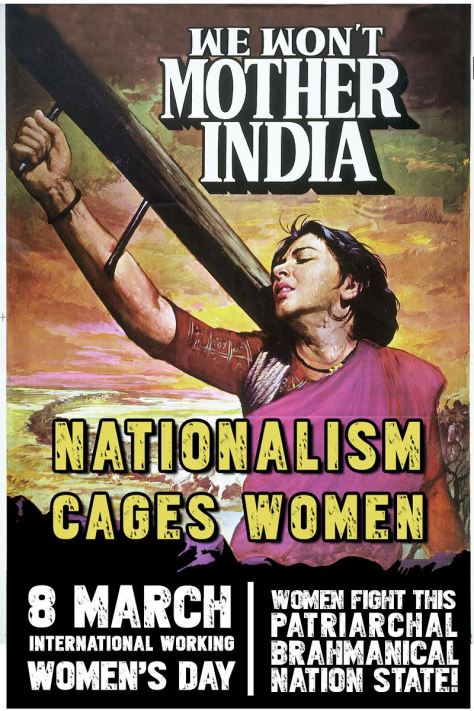
On the eve of International Working Women’s Day, Maneka Gandhi has given a deeply patriarchal, casteist and classist statement to a media channel saying that hostel curfews are necessary as “laxman rekha” for controlling women’s “hormonal outbursts”, that the question of “women’s safety in colleges cannot be solved with just two Bihari guards with dandas”, that there should be separate days for men and women to go to the library at night.
Its clear to us that she has said this today in response to the fact that women students across the country from Benaras to Mumbai, Delhi to Patiala, Lucknow to Hyderabad, Chennai to Ludhiana, Roorkie to Cuttack have come out strongly to assert their presence in the university space and claim over public resources.
Please find below a collation of statements of solidarity received by Kafila over the past fortnight since the shameful incidents of violence by the ABVP occurred on the 21st and 22nd of February 2017. These are from: Ramjas Alumna, Ambedkar University Delhi Faculty Association, O.P Jindal Teachers: Students and Durham University Politics and International Relations Society, U.S.A; and students and faculty at the University of Minnesota, U.S.A.
University of Minnesota Students and Faculty
The statements are preceded by a short write-up on what Ramjas College has meant to its alumna, by ANUBHAV PRADHAN.
Nostalgia is made of more than just happiness. It is sulphurous too.
To many who spent three or more years of their life in Ramjas College, visuals of violence in and around it on 21 and 22 February 2017 have been a source of deep, personal shock. The footpath and the areas adjoining the college gate were often sites of lingering conversations between friends, offering moments of respite from studies, tensions accruing from impending exams, or relief to those who had just accomplished a hectic ECA festival and were there catching up their breath or exhaling smoke.
The ABVP struck twice, once attacking the college Seminar Room and then coming back the second day to attack students. In the hundredth year of Ramjas’ establishment, a college founded at a time when protest was an active ideal for most Indians, this singular episode of planned, institutional violence against students and teachers is a grim reminder of the brute silencing of interrogation, peaceful protest, dialogue and dissent being normalised across our colleges and universities, and in our society at large. The audacity with which these perpetrators and their ideologues brand entire institutions and diverse communities of students and academics as anti-national—and therefore fit recipients for their brute censure—also gives the lie to the intellectual and affective bankruptcy of a rapidly emergent cultural orientation premised on simplistic binaries of good and bad, right and wrong, national and anti-national. In a society—and nation—whose ideals are peace, dialogue, and inclusion, these attacks on students and teachers point to the deep ideological rot in the perpetrators’ conception of nation, nationality and nationalism.
As an alumnus of Ramjas College, I cherish the right to self-determination and open debate. I feel outraged that the students’ and faculties’ right to decide what discussion to hold and whom to invite for it within college premises was usurped in this manner. It is disturbing that this violence rippled across the campus as it were, with students being followed, identified and harassed in their personal spaces for having asserted their right to listen to discussions on Bastar and for not bowing down to bodily attacks perpetrated through stones and fisticuffs by members of the ABVP and their affiliates.
Most alumni like me are invested in our respective professions, but the foundations of study and work were laid for us by Ramjas’ teachers and the college’s vibrant culture of extra-curricular instruction. This experience has proved fundamental to our engagement with our immediate workspaces, surroundings, power structures, and our nation. Denying current and future students their right to freely and openly debate issues of their choice in fora of their choice is tantamount to denial of a basic academic right. Threatening and manhandling academicians guided by the spirit of enquiry towards generation of dialogue will prove detrimental to the quality of collegiate education in our nation. We collectively issue the following statement of solidarity with Ramjas’ students and teachers in this moment of crisis:
[Videos of song by Shehla Rashid and of speeches by Nivedita Menon, Kavita Krishnan, Umar Khalid and Jignesh Mevani, courtesy, Samim Asgor Ali]
February gives way to March and spring returns to Delhi. And what a spring it is. The right wing thugs of the ABVP choose the wrong time to attack, once again. They must really get themselves a better astrologer, or at least a better class of charlatan who can tell them if there ever is a right time to stage their goon show. I suspect there isn’t.
Ramjas students and faculty held hostage inside campus by ABVP cadre
The violence that gripped Ramjas College on the 21st and 22nd of this month is now national news. We heard belligerent slogans by ABVP members of ‘chappal maro saalon ko’ (beat them with slippers), we saw students being chased on the campus, and we saw students being beaten up. All this culminated in a situation where students and teachers were held captive for over five hours within the campus premises. Let me emphasize that this violence was completely unprovoked.
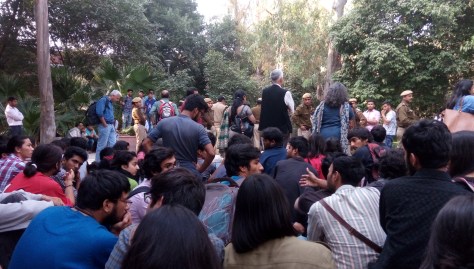
On the 22nd of February, some of the students who were simply sitting with their friends were attacked. The police came and formed a cordon around them. Others joined the students in a gesture of solidarity. Teachers joined them to ensure that the students were not assaulted. The police cordon became their prison for the next five hours. And even then they were not safe.
They were repeatedly assaulted, threatened, and abused. All of this happened in front of their teachers and, more importantly, in front of the police, who, as is well known by now, did not do anything substantial. They could have maintained the cordon around the protesters, arrested those who were repeatedly carrying out the assaults, or – at the very least – prevented the attackers from coming back in (they had left for some time to attack the protest going on outside). But they did not. Whether this was because they were under pressure or because they were complicit is besides the point. The point is that students and teachers remained at the mercy of their attackers for over five hours.
But on the same day something far more ominous was also going on.





 KAFILA - COLLECTIVE EXPLORATIONS SINCE 2006