Category Archives: Right watch

Meanwhile, in India, Islamophobia proceeds apace

DARSHANA MITRA in The Wire

While many in India have recoiled at the manner in which the Trump administration has made religious discrimination a key ingredient of its refugee and  immigration policy, we should also turn to look at similar legislative provisions being proposed in our own country.

The Citizenship (Amendment) Bill of 2016 is a short, three-page document that seeks to amend Section 2(b) of the Citizenship Act. The Citizenship Act deals with the acquisition and termination of Indian citizenship. Section 2(b) of the Citizenship Act defines the term “illegal immigrant”. The Citizenship (Amendment) Bill proposes to amend the definition of this term by adding this proviso:

“Provided that persons belonging to minority communities, namely, Hindus, Sikhs, Buddhists, Jains, Parsis and Christians from Afghanistan, Bangladesh and Pakistan, who have been exempted by the Central Government by or under clause (c) of sub-section (2) of section 3 of the Passport (Entry into India) Act, 1920 or from the application of the provisions of the Foreigners Act, 1946 or any order made thereunder, shall not be treated as illegal migrants for the purposes of this Act.”.

This effectively means that persons from minority religious communities from our neighbouring Muslim majority countries shall not be considered as illegal migrants and subjected to prosecution. Further, the Bill also proposes an amendment to the Third Schedule of the Act, which would allow minority communities, namely Hindus, Sikhs, Buddhists, Jains, Parsis and Christians from Afghanistan, Bangladesh and Pakistan to qualify for naturalisation as a citizen of India if they are resident in India or in service to the Government of India for an aggregate period of not less than six years, as opposed to eleven years for everyone else.

Read the full article here.

In solidarity with all who see the map upside down: Shukla Sawant

Sent by Shukla Sawant, Professor, School of Arts and Aesthetics, JNU.

Joaquín Torres-García,  Upside-down Map (1943). 


88d5504f366713693474d35db3e1b9596f4033a3-1

Read more about this image and about “the essentially fictional status of maps and the power they possess for construing and constructing worlds.”

In Solidarity with People Affected by the ‘Muslim Ban’: Call for an Academic Boycott of International Conferences held in the US

If you would like to endorse this statement, as I have, please go to the link given below. As of 4 February 2017, 13.00 GMT the letter has 6000+ signatures.

On 27 January 2017, President Donald Trump signed an Executive Order putting in place a 90-day ban that denies US entry to citizens from seven Muslim majority countries: Iran, Iraq, Syria, Yemen, Sudan, Libya and Somalia. So far, the ban includes dual nationals, current visa, and green card holders, and is affecting those born in these countries while not holding citizenship of them. The Order also suspends the admittance of all refugees to the US for a period of 120 days and terminates indefinitely all refugee admissions from Syria. There are indications that the Order could be extended to include other Muslim majority countries.

The Order has affected people with residence rights in the US, as well as those with rights of entry and stay. Some of those affected are fleeing violence and persecution, and have been waiting for years for resettlement in the US as refugees. Others are effectively trapped in the US, having cancelled planned travel for fear that they will be barred from returning. The order institutionalises racism, and fosters an environment in which people racialised as Muslim are vulnerable to ongoing and intensifying acts of violence and hatred.

Among those affected by the Order are academics and students who are unable to participate in conferences and the free communication of ideas. We the undersigned take action in solidarity with those affected by Trump’s Executive Order by pledging not to attend international conferences in the US while the ban persists. We question the intellectual integrity of these spaces and the dialogues they are designed to encourage while Muslim colleagues are explicitly excluded from them.

Continue reading In Solidarity with People Affected by the ‘Muslim Ban’: Call for an Academic Boycott of International Conferences held in the US

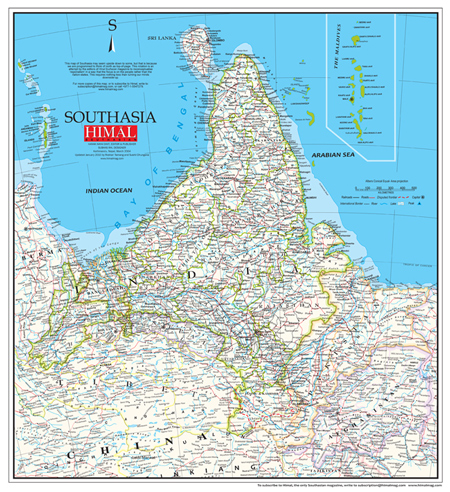
On RSS ignorance, the “upside down map” of India, and on being “anti-national”

himal_map_4501Himal Southasian’s ‘right-side-up’ map. In their words: “This map of Southasia may seem upside down to some, but that is because we are programmed to think of north as top of page. This rotation is an attempt by the editors of Himal to reconceptualise ‘regionalism’ in a way that the focus is on the people rather than the nation-states. This requires nothing less than turning our minds downside-up.

Turn your eyes away, gentle reader. You have already become anti-national by viewing this image.

More on this in a minute. First some background.

On the 3rd of February, ABVP called a bandh in Jai Narain Vyas University (JNVU), Jodhpur, forcibly stopping classes and demanding suspension of the organizers of a conference and police action against them, as well as against myself. Police complaints have now been lodged, and perhaps FIRs, we hear.

The charge? The conference, and my lecture in particular, was anti-national. Not one of these ABVP students attended the event, nor is there yet a video recording available to my knowledge, largely because the ABVP also gathered in intimidatingly large numbers outside the shop that had conducted the recording, and the owner shut up the shop and fled. The entire drama and some sensationalist and outright false stories in the local Hindi press, is based entirely on the testimony of one person, NK Chaturvedi, retired professor from the History department at JNVU, who attended just one session, mine.

Continue reading On RSS ignorance, the “upside down map” of India, and on being “anti-national”

Taming the Brat? Thoughts on the Kerala Law Academy Imbroglio


Reports of exploitation, humiliation, violence, and rampant nepotism are still flowing out of the private-sector law college popularly known as the Law Academy, in Thiruvananthapuram twenty whole days after the commencement of the students’ struggle there. At the centre of the controversy is the principal, Lekshmi Nair, who seems to have ‘inherited’ that position in the institution owned by her family: clearly, the students are determined to teach her a good lesson. Rarely have we seen all student organizations, from the far-right to the far-left, rally against one person with equal determination; but from the complaints of students – subsequently confirmed by the University of Kerala to which this college is affiliated – it appears that there is no reason to be surprised.

But the irony of  utter lawlessness and blatantly feudal despotism perpetuated in an institution devoted to legal education  in a democratic nation itself seems lost, for the authorities’ commonsense about liberal education in Kerala has been that it should be neither liberal nor education nor anything to do even remotely with the practice of democracy. I have been saying this over and over again, and really, feel utterly breathless at this. Continue reading Taming the Brat? Thoughts on the Kerala Law Academy Imbroglio

How do the new UGC regulations affect prospective students applying to JNU? Ayesha Kidwai

This is the first of a five part series in which AYESHA KIDWAI will explain how the UGC Gazette Notification of 2016, especially as interpreted by the VC of JNU, will affect different categories of students, faculty, and the general public.

Ayesha Kidwai is Professor, Centre for Lingustics, School of Language, Literature and Culture Studies, JNU.


poster1-ugc

Revisiting the demonetization survey: Juhi Tyagi

Guest Post by JUHI TYAGI

In light of the recent book, I Am A Troll: Inside the Secret World of the BJP’s Digital Diary authored by journalist Swati Chaturvedi which describes the working of the BJP’s media’s cell to systematically undermine dissenting opinions, we need to revisit other, seemingly innocuous, government media campaigns such as the demonetization survey and its use as a tool in bending into shape public opinion.

The demonetization survey was officially launched on 22nd November 2016 on the NM app by the government. Its purpose was to receive feedback from the people themselves on the validity of withdrawing 86 percent of the currency in circulation to address two problems: that of black money and counterfeit currency. The survey consisted of nine questions, with the tenth providing space for sharing suggestions. The questions dealt with people’s beliefs about the existence of black money in India and on its need to be eliminated. On their opinions of the government’s efforts against corruption, and more particularly, on the effectiveness of demonetization in ridding society of black money, all corruption and terrorism while creating opportunities for higher education, health care and affordable housing for all.

Continue reading Revisiting the demonetization survey: Juhi Tyagi

EFLU Defamation Case Against Students – Statement by Concerned Academics and Public Intellectuals

Statement by Concerned Academics and Public Intellectuals Following the Court Sentence on the EFLU Defamation Case

We the undersigned wish to express our grave concern over the fact that five senior students of the English and Foreign Languages University (EFLU), who were raising the issue of discrimination against SC and ST students in the EFLU’s Department of German, have on 13/12/2016 been charged with defamation of a professor and sentenced to six months’ imprisonment.  Their protests concerned Sreeramulu M, a ST student enrolled in the BA programme of EFLU’s German Department. Sreermulu had not been allowed to continue in the programme ostensibly for his failure to maintain grades.  The others who have been sentenced are office bearers of associations representing such marginalized students; they were speaking at a Press Meet held on 24/12/2012 after Sreeramulu, who had been trying for several months to be allowed to continue his course and avail remedial classes, went on fast.  The defamation case was filed in March 2013.  Two SC/ST atrocities complaints filed by Sreeramulu M and again by another student, Ranjan Kumar, in January 2013 are pending with the Police and are yet to be investigated.

The countrywide discussion raised through the struggles following Rohith Vemula’s death in January 2016 drew public attention to the extent of caste discrimination in our universities.  SC, ST, OBC and minority students figure disproportionately in the statistics for failure, drop out, expulsion, rustication and even suicide. Educational institutions and those who run them (teachers and administrators) have been forced to acknowledge that they are implicated in this terrible attrition of young citizens and know they must initiate reforms. Yet, far too little is being done to discuss this evidence, rethink rules, temper teachers’ attitudes, reform syllabi or challenge ideas of merit that discriminate against the marginalized.  A teacher’s job is to help the actual students in the classroom to learn; not to uphold abstract standards of merit.  From the courts, the underprivileged expect humane recognition of the inequities of their predicament and wise support for their cause. But what they have received is a demoralizing and intimidating signal. Continue reading EFLU Defamation Case Against Students – Statement by Concerned Academics and Public Intellectuals

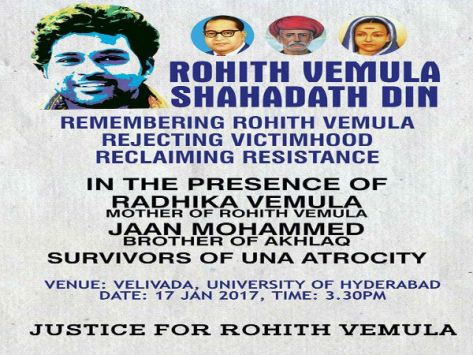
Never forget, never forgive: Justice for Rohith

xrohith1-16-1484552927-jpg-pagespeed-ic-5axp0tr5hh

Hindutva Fascists Ransack Janchetna Book Shop in Ludhiana

We are publishing below a statement issued by Anand Singh on behalf of Janchetna, Ludhiana

A group of Hindutva goons ransacked Janchetna — an institution dedicated to promote and propagate progressive literature — in Ludhiana on 2 January 2017. They also abused and misbehaved with the book shop manager Binny and manhandled other activists who came to her rescue. They even threatened to put the books on fire. More disturbing, however, was the fact that all this happened in the presence of police which remained a mute spectator to this fascist attack which lasted for two hours. Later, instead of arresting the goons, the police took the activists present there — Binny, Janchetna book shop manager, Lakhwinder , President of Textiles Hosiery Kamgar Union, Gurjeet (Samar), an activist of karkhana Mazdoor Union and Satbir Naujawan Bharat Sabha activists — into custody and sealed the shop. However, due to people’s pressure the activists were soon released and a demonstration of various mass organisations and trade unions compelled the police to let the book shop reopen.

Continue reading Hindutva Fascists Ransack Janchetna Book Shop in Ludhiana

Corrupt Notes – the Black Comedy of Tragic Error: R Srivatsan

Guest post by R. SRIVATSAN

Reflections on the many paradoxes of the demonetization process: the schizophrenia of the BJP, the desire of the well to do, the baffling sacrifice of the have nots, the faults and fault lines that propagate through our society in crisis.

Narendra Modi and Arun Jaitley, in their brilliant strategy to kill black money through the withdrawal of currency, show no basic understanding of what the term ‘black money’ signifies.  Prabhat Patnaik has recently argued there is no such thing as black money – there is only a black economy.  However, one aspect of the black economy is the refusal to pay taxes and instead hoard wealth in the form of currency that is not recorded in bank deposits.  Another is the payment of bribes with untraceable currency to authorities and politicians who use their position of leverage as personal property on which they charge a rent for use. Both these uses of black money as corruption have a common lineage. In both cases, corruption is the failure of categories that were supposed to have been water-tight.  A) “All income is taxable” B) “Public servants are true servants of the people”

But first, here is an attempt to shake our convictions that the refusal to pay taxes is a moral evil.  To do so, let me take the example of a Hollywood film, Stranger than Fiction (2006).  The plot of this film, which has a quite complex fantasy storyline, baits the viewer’s desire through the emerging love interest between an IRS auditor Harold Crick and his investigative target Ana Pascal, who runs a bakery.  Ana is a conscientious objector against taxation. She argues that she openly defies taxation since she doesn’t support the hegemonic objectives of the USA which spends most of its revenue income on weapons of war and destruction.  Ana is thus the beautiful and charming face of morally upright conscientious objection which masks the libertarian hatred for a state that taxes more than minimally.  As Robert Nozick asserted long ago such taxation is seen as thievery, against the sacred right to private property.  Ana’s position thus also masks the refusal to redistribute wealth through welfare. As a viewer, I found it extremely difficult to think of Ana as an evil person.  She was the most charming free-spirit I had encountered on celluloid (well, on a TV screen) for a long time. The objective of this sub-plot of film criticism is to help the reader shed the ready moral judgement that not paying taxes is a universal crime and a sin against society, so that it becomes possible to examine exactly what the complex nature of the act that constitutes tax evasion is. Continue reading Corrupt Notes – the Black Comedy of Tragic Error: R Srivatsan

JNU VC sabotages democratic functioning of Academic Council to push through anti-social justice policies

First, here is the statement issued by 20 faculty members of the Academic Council today, about half the members present at the adjourned 142nd AC Meeting.

PRESS RELEASE BY MEMBERS OF THE JNU ACADEMIC COUNCIL

We, faculty members of the JNU Academic Council, are shocked and dismayed at the manner in which the Vice Chancellor has conducted the 142nd Academic Council meeting of December 23rd (adjourned to December 26th). This was a thinly attended meeting since it was held at short notice in the middle of the winter vacation, despite several requests for rescheduling.

The minutes of the previous (141st) Academic Council meeting that had been circulated contained many errors, misrepresentations, and falsities. Several of these had been pointed out by many members of the Academic Council, including in written representations to the Registrar.

Continue reading JNU VC sabotages democratic functioning of Academic Council to push through anti-social justice policies

Buying into Demonetisation- the Popular Ideological Receptors of Creeping Fascism: Sanjay Kumar

Guest Post by SANJAY KUMAR

The withdrawal of eighty six percent of currency notes by the Modi government has been an administrative fiasco. It is clear that little economic thought, and only a political urge has gone into the exercise. Informal sector of the economy, which accounts for 80% of the employment and 40% of the national output, has suffered short to medium term damage. All cash dependent transactions, wages, wholesale and retail trade, agricultural purchase and sale, are at a crawl. Workers are not getting wages, factories are closing, mandis are empty. Crores of young and old working people are spending hours in queues at banks and ATMs to withdraw their own money now gone scarce.  Press reports count more than eighty deaths. Parliament of the country is in a limbo, because the prime minister thinks it below his worth to reply to charges by the opposition party MPs. While ordinary people are suffering, the Nero like rulers are trumpeting the arrival of the nirvana of a cash less economy as the answer to India’s economic ills.

Even while Mr Modi’s government is solely responsible for this needless and widespread suffering, it would be naive to expect an automatic popular backlash against it. The politics of the ruling party does not fit into the patronage or identity driven models of its competitors. Its closest template is fascist politics, which  is a very particular kind of authoritarianism. What distinguishes a fascist regime from other modern authoritarian regimes like military dictatorships is the popular support it is able to garner for its policies and depredations. This is achieved by carefully working upon popular anxieties, prejudices, desires and fears, and refashioning them as grounds for aggression against selected minorities, and a belief in an imminent deliverance under the personalised rule of a leader. Continue reading Buying into Demonetisation- the Popular Ideological Receptors of Creeping Fascism: Sanjay Kumar

A Dog Writes to a Minister: Dear A K Balan …


Dear Mr A K Balan

I am writing to you because I feel that it is my duty to disabuse you of the ideas you seem to harbour of, and in the name of, Indian nationalism (and not just bark at the portentous approach of the peddlers of ‘nationalism’, the Hindutvavaadis). You are a Minister in the CPM-led government of Kerala, which was elected by  Malayali citizens to ward off the monstrous Hindtuva-Nazi-Predatory Capitalist combine that has taken over India nearly, and so my barking should have been enough. But you seem to be totally wrapped up in your ignorance. Continue reading A Dog Writes to a Minister: Dear A K Balan …

Love Can’t Be Forced: Protest Against Sanghi Hubris at IFFK!


 I am hoping to protest at whichever venue of the International Film Festival of Kerala that I can manage to go to, wearing a printed badge saying ‘DEAR SUPREME COURT, NO LOVE CAN BE FORCED’. Yesterday, six people who did not stand up when the national anthem was played were arrested. Sanghi elements and overenthusiatic people who have picked up Modi’s style of projecting instant nationalism on the debris of Indian democracy have been heckling people who refused to comply with the SC’s order and filing complaints. Indeed, they took photos of people who didn’t stand up during the anthem. How come they have not insulted the national anthem according to their own standards since they too were expected to stand in attention?
 

Continue reading Love Can’t Be Forced: Protest Against Sanghi Hubris at IFFK!

परवेज हुदभॉय क्यों चिन्तित हैं ?

Image result for pervez hoodbhoy quotes

परवेज हुदभॉय (Pervez Hoodbhoy) भारतवासियों के लिए अपरिचित नाम नहीं है!

जानेमाने भौतिकीविद और मानवाधिकार कार्यकर्ता के अलावा उनकी पहचान एक ऐसे सार्वजनिक बुद्धिजीवी के तौर पर है जिनके अन्दर बुनियादपरस्त ताकतों से लोहा लेने का माददा है। पाकिस्तान में इस्लामीकरण की बढ़ती आंधी में वह ऐसे शख्स के तौर पर नमूदार होते हैं, जो सहिष्णुता, तर्कशीलता, की बात पर जोर देते रहते हैं। नाभिकीय हथियारों से लैस दोनों पड़ोसी मुल्कों में आपस में अमन चैन कायम हो इसके लिए आवाज़ बुलंद करते रहते हैं।

पिछले दिनों ‘डॉन’ अख़बार में लिखे अपने नियमित स्तंभ में उन्होंने पाठयपुस्तकों के माध्यम से प्रचारित किए जा रहे विज्ञान विरोध पर लिखा।( http://www.dawn.com/news/1300118/promoting-anti-science-via-textbooks  ) खैबर पख्तुनख्वा में प्रकाशित जीवविज्ञान की पाठयपुस्तक का जिक्र करते हुए उन्होंने बताया कि किस तरह उसमें चार्ल्स डार्विन के सिद्धांत को सिरेसे खारिज किया गया है। किताब में लिखा गया है कि चार्ल्स डार्विन द्वारा प्रस्तावित इवोल्यूशन अर्थात विकासवाद का सिद्धांत ‘अब तक का सबसे अविश्वसनीय और अतार्किक दावा है।’ किताब इस धारणा को ही खारिज करती है कि संश्लिष्ट जीवन सरल रूपों से निर्मित हुआ। किताब के मुताबिक यह विचार कामनसेन्स/सहजबोध का उल्लंघन करता है और यह उतनाही ‘बकवास’ है जब यह कहा जाता हो कि दो रिक्शा के टकराने से कार विकसित होती है। हुदभॉय के मुताबिक प्रस्तुत किताब अपवाद नहीं है। खैबर पख्तुनवा की एक अन्य किताब बताती है कि ‘‘एक सन्तुलित दिमाग का व्यक्ति पश्चिमी विज्ञान के सिद्धांतों को स्वीकार नहीं कर सकता। /कहने का तात्पर्य सिर्फ पागल लोग स्वीकार सकते हैं ?/ सिंध की भौतिकी की पाठयपुस्तक स्पष्ट लिखती है कि ‘ब्रहमाण्ड तब अचानक अस्तित्व में आया जब एक दैवी आयत/श्लोक का उच्चारण किया गया।’ विज्ञान का यह विरोध निश्चित ही पाठयपुस्तकों तक सीमित नहीं है। वहां विज्ञान और गणित के तमाम अध्यापक अपने पेशे से असहज महसूस करते हैं। Continue reading परवेज हुदभॉय क्यों चिन्तित हैं ?

Inedible India on the NaMo App “Survey” on Demonetization

The PMO claimed that more than 93 per cent of the five lakh people who participated in a survey on Narendra Modi App have supported demonetization.

The loaded structure of the survey, the questions to which you can only “agree” or “partially agree”, with no option to “disagree”; all of it is typical of this utterly corrupt and dishonest government which holds the people of India in contempt.

The most powerful response to this government is to mock it.

Take this, Namo!

From Inedible India

15171078_1154465077940674_7199912734542558618_n

बड़े नोटों का रद्दीकरण – छिपकली की पूंछ पकड़ने के लिए विशाल पिंजरा – राजिंदर चौधरी

Guest post by RAJINDER CHUDHARY


1946 और 1978 में भी प्रचलित बड़े नोटों को रद्ध किया गया था। इस लिए 8 नवंबर 2016 को मोदी सरकार द्वारा 500 और 1000 रुपये के प्रचलित नोटों को रद्ध करने का निर्णय आधुनिक काल में तीसरी बार उठाया गया कदम है। तीनों बार मुख्य लक्ष्य कालेधन को खत्म करना रहा है। लेकिन मोदी सरकार ने अपने निर्णय के पीछे एक नया कारण भी जोड़ा हैं। यह है नकली नोटों का बढ़ता चलन और इन के माध्यम से आतंकवाद का फलना-फूलना। रिज़र्व बैंक के नवीनतम आंकड़ों के अनुसार 2015-16 के दौरान 1000 रुपये के नोटों में नकली नोटों का अनुपात 0.002262% था यानी 1000 के एक लाख नोटों में सवा दो नोट नकली पाये गए (इन में पुलिस एवं अन्य द्वारा पकड़े गए नकली नोट शामिल नहीं हैं)। 500 रुपये के नोटों में यह अनुपात 0.00167% था यानी 500 रुपये के 1 लाख नोटों में नकली नोटों की संख्या 2 से कम थी। जाहिर है ये सारे के सारे नकली नोट आंतकवादियों द्वारा जारी नहीं किए गए होंगे। विशुद्ध आर्थिक अपराधियों का भी इस में योगदान होगा। लेकिन अगर यह भी मान लें कि ये सारे के सारे नकली नोट आतंकवादियों द्वारा चलाये गए थे तो भी 2015-16 में रिज़र्व बैंक के आंकड़ों के अनुसार 500 और 1000 के नकली नोटों की कुल कीमत 27.39 करोड़ रुपये बनती है (इन के अलावा 2015 में बीएसएफ़ ने 2.6 करोड़ रुपये के नकली नोट पकड़े थे)। इस से स्पष्ट है कि नकली नोट आतंकवाद की बुनियाद नहीं हो सकते। वैसे भी, इन नकली नोटों पर रोक लगाने के लिए इन नोटों को एकायक रद्ध करना न आवश्यक है और न पर्याप्त। अगर नोटों की छपाई को अधिक सुरक्षित नहीं बनाया गया, तो ‘आतंकवाद के समर्थक’ ताकतों, जो सामान्य अपराधी तो हैं नहीं, द्वारा नए नकली नोट छापना मुश्किल नहीं होगा। इस लिए अधिक सुरक्षित नोट छापना बेहद आवश्यक है।  नए, अधिक सुरक्षित नोट जारी करने के साथ, पुराने ‘असुरक्षित’ नोटों को बदलवाने के लिए एक समय सीमा रखी जा सकती थी। जैसा पहले भी किया गया है। 2005 से पहले के छपे नोटों को, जिन पर छपने का वर्ष अंकित नहीं होता था, उन्हें मई 2013 से पर्याप्त समय दे कर, बैंकों में जमा करा लिया गया है। यही प्रक्रिया दूसरे ‘असुरक्षित’ नोटों के साथ भी दोहराई जा सकती है। इस लिए नकली नोटों पर रोक लगाने के लिए सारे नोटों को रद्ध करना आवश्यक नहीं था। Continue reading बड़े नोटों का रद्दीकरण – छिपकली की पूंछ पकड़ने के लिए विशाल पिंजरा – राजिंदर चौधरी

Withdraw false charges lodged by Chhattisgarh police against academics and political activists

PETITION TO THE PRESIDENT, PRIME MINISTER AND HOME MINISTER OF INDIA

We, the undersigned, are outraged by recent charges of murder that have been laid against

Delhi University professor Nandini Sundar, JNU professor Archana Prasad, Vineet Tiwari (of Joshi Adhikar Sansthan, Delhi), Chhattisgarh CPI(M) state secretary, Sanjay Parate, Mangalram Karma, and Manju Kawasi, CPI activist and Sarpanch of Guphidi in Sukma district, by the Chhattisgarh police in the killing of Shamnath Baghel.

The charges are patently fabricated, and follow a pattern of intimidation by the Chhattisgarh police every time evidence is released of their lawless prosecution of the war against the Maoists. Earlier this year, Sundar, Prasad, Tiwari and Parate were part of a fact-finding team that looked at the impact of Maoist violence and state excesses on ordinary villagers in Bastar, finding that they were victims of fake encounters, rapes, arrests, beatings, IED blasts, and killing of informers, implicating Maoists, police, and security forces. The residents of Bastar were also found to be facing the renewal of attacks by civilian militias armed by the state. At that time too, the district administration of Bastar had tried to implicate the fact-finding team on fake charges on the basis of a contrived complaint. More recently, when the police were charge-sheeted on the basis of evidence gathered by Sundar and others for carrying out arson in an operation in 2011, they retaliated by burning effigies of her and other activists and journalists in order to intimidate and incite violence against them.

Sundar and others have put on record their unequivocal condemnation of the killing of Shamnath Baghel. Their writing and interventions on the ongoing war in Bastar have consistently condemned all forms of violence, whether by the state or by the Maoists.

We are saddened by the climate of silencing of dissent that is becoming widespread in India and concerned that the work of researchers, journalists, lawyers and activists is being monitored and controlled to quell critical scrutiny of governmental actions. We believe such silencing of opposing views poses a grave danger to the democratic values of India.

Continue reading Withdraw false charges lodged by Chhattisgarh police against academics and political activists

‘Degrees’ of Democracy – Field Notes from a Central University in Bihar: Debaditya Bhattacharya

Guest post by DEBADITYA BHATTACHARYA

This piece has long been in the coming. Soon after the summer of student protests in India exposed the terror-apparatuses of the state and unleashed a new vocabulary of progressive political resistance, the students of a certain Central University of South Bihar (in Gaya) went on strike against the university administration in the early days of August. They however were not fighting to protect constitutional rights, because their daily encounters with the university had already come to rest on a structural suspension of many such rights. Like those of speech, of rational thought and scientific inquiry, of gender-equality, and of resisting what Vemula called the event of being reduced to one’s “immediate identity”. These students merely decided to fight for their right to a degree.

They had come together to demand statutory recognition for courses that they were enrolled in since 2013, but most sections of the national media at that time deemed the issue ‘sub-national’ enough to be granted space or audience. Reporters from the local print-media were – in what seems like accepted practice across public institutions in the country – barred entry into the university campus, and hearsay reports constituted the stuff of low-key news-briefs with little context or compassion. Those who attempted to organise public opinion by writing on social and alternative media spaces, were – in a classic division of interests that administrative bureaucracies are deft at provoking – urged by students themselves to withdraw. The reason was simple: each social media post or conversation around the issue was declaredly spied on by the university administration in order to ‘detect’ subterranean alliances and “outside support” (as if it were a terrorist conspiracy!), and students were individually targeted and intimidated for passing on internal ‘secrets’ to ‘outsiders’. I know of specific Facebook posts which had been taken print-outs of and convened surreptitious meetings over, where administrative heads and proctorial board members put their heads together to crush the germ of student dissent and ‘outsider’-mobilizations. The agitated students continued in their own ways, despite open threats of disciplinary action and reminders of exam-time tactics of penalisation. The Vice-Chancellor marched off to Delhi to strike bargains for an interim settlement-package with officials in the ministry, and returned to meet the striking protestors with as much of an assurance as threats of expulsion. Continue reading ‘Degrees’ of Democracy – Field Notes from a Central University in Bihar: Debaditya Bhattacharya

Appeal to Join “JNU Chalo” on 15 Nov Marking One Month of Najeeb’s Disappearance: JNUSU

Guest Post by JNUSU (Jawaharlal Nehru University Students Union)

15036279_10209603262232786_2873516424910911795_n

Friends, on 14th October night, Najeeb Ahmed, a student of M.Sc. Biotechnology, JNU was brutally assaulted and violently threatened by a group of ABVP students. From 15th October morning, Najeeb went missing from the campus. The disappearance of a student from a central university in the national capital after assault and intimidation of right wing lumpens is no doubt an ominous reflection of the dark times we are living in. For past four weeks, students, teachers, staff members of JNU, and citizens of Delhi have been coming out on the streets demanding institutional accountability to bring back Najeeb.

Continue reading Appeal to Join “JNU Chalo” on 15 Nov Marking One Month of Najeeb’s Disappearance: JNUSU