Category Archives: Right watch

Petition to stop the global crackdown on academic freedom – Turkey, India, Egypt

The undersigned are university teachers and students concerned over recent events that point to a serious reversal of gains in democracy and academic freedom achieved over the last decades in many countries.

Three cases have been most prominent in that regard since the beginning of 2016: the crackdown by Turkish authorities on the more than 1200 signatories in Turkey of the petition by “Academics for Peace” criticizing the anti-Kurdish war drive launched by the Turkish government; the crackdown by Indian authorities on students involved in a non-violent campus protest against the death penalty at Jawaharlal Nehru University and Hyderabad University; and in Egypt an attempt to shoot and kill a professor by groups affiliated to the ruling party; and the savage torture and assassination in Cairo of Italian research student Giulio Regeni.

When they are not tacitly approving it, governments of countries where academic freedoms are better respected and which include most global powers have turned a blind eye and a deaf ear to calls on them to protest against this repression. The worst attitude has been displayed in Italy where the government kept stressing the importance of its economic ties with Egypt while a gutter press accused Giulio Regeni’s supervisors of letting him gather dangerous information, thus resorting to an old worn-out paranoid argument of all dictatorships and tacitly making the student himself responsible for his own atrocious death.

Academic freedoms are a key indicator of the overall status of political freedom and democracy. The acceleration of privatisation across the public higher education system is undermining these freedoms on a global scale. The events described above point to a much deeper and sweeping onslaught on democratic freedoms, which must be halted immediately lest it leads to increasingly tragic events and a most nefarious consolidation and extension of the authoritarian turn in global politics.

We call on the global community of teachers and students to join us in protesting against this most dangerous trend by signing, translating and circulating this statement, and organizing protest meetings in all universities.

To sign, please go to this link. 

स्मृति ईरानी को एक जे-एन-यू के छात्र की चिट्ठि: अनन्त प्रकाश नारायण

Guest Post by Anant Prakash Narayan

सेवा में,

श्रीमती स्मृति ईरानी जी

“राष्ट्रभक्त” मानव संसाधन विकास मंत्री,

भारत सरकार

संसद में दिए गए आपके भाषण को सुना. इससे पहले की मै अपनी बात रखूँ , यह स्पष्ट कर दूं की यह पत्र किसी “बच्चे” का किसी “ममतामयी” मंत्री के नाम नहीं है बल्कि यह पत्र एक खास विचारधारा की राजनीति करने वाले व्यक्ति का पत्र दूसरे राजनैतिक व्यक्ति को है. सबसे पहले मै यह स्पष्ट कर दूं कि मै किसी भी व्यक्ति की योग्यता का आकलन उसकी शैक्षणिक योग्यता के आधार पर नहीं करता हूँ बल्कि साफ़ साफ़ कहूं तो मै “योग्यता”(मेरिट) के पूरे कांसेप्ट को खारिज करता हूँ.

मानव संसाधन मंत्रालय का पद भार लेने के साथ ही यह अपेक्षा की जाती है कि आप इस देश के केंद्रीय विश्वविद्यालयों में उनकी ऑटोनोमी का सम्मान करते हुए उसके लिए उत्तरदायी होंगी. रोहित वेमुला के मामले में आपने क्या किया यह सबके सामने है कि किस तरह से वहाँ के प्रशासन पर आपने दबाव डाला जिसका नतीजा रोहित के institutional मर्डर के रूप में हमारे सामने आया. लेकिन मै इन सारी चीजो पर अभी बात नही करना चाहता. आप बार बार अपनी औरत होने की पहचान (आइडेंटिटी) को assert करतीं हैं और इसको करना भी चाहिए क्यूंकि नारी जाति उन ढेर सारे हाशिये पर किए गए लोगों में एक है जिनको सदियों से शोषित किया गया है. मै आपसे यह पूछना चाहता हूँ कि एक दलित स्त्री जो कि हर तकलीफ उठाते हुए अकेले अपने दम पर जब अपने बेटे बेटियों को इस समाज में एक सम्मानपूर्ण जगह देने के लिए संघर्ष कर रही थी तब एक नारी होने के कारण आप की क्या जिम्मेदारी बनती थी ? क्या आपको उस महिला के जज्बे को सलाम करते हुए उसकी बहादुरी के आगे सर झुकाते हुए उसके साथ नहीं खड़ा होना चाहिए था? हाँ, मै रोहित की माँ के बारे में बात कर रहा हूँ. जो महिला इस ब्रहामणवादी व पितृसत्तात्मक समाज से लड़ी जा रही थी, अपने बच्चों को अपने पहचान से जोड़ रही थी, उस महिला को आप व आपकी सरकार उसके पति की पहचान से क्यूँ जोड़ रहे थे? आपको भी अच्छा लगता होगा की आपकी अपनी एक स्वतंत्र पहचान है. लेकिन यह अधिकार आप उस महिला से क्यूँ छीन  रहीं थीं? क्या आप भी पितृसत्तात्मक व ब्रहामणवादी समाज के पक्ष में खड़ी होती हैं? अपना पूरा नाम बताते हुए अपनी जाति के बारे में आपने सवाल पूछा और आपका भाषण खत्म होने के पहले ही लोगों ने आपकी जाति निकाल दी. मै आपकी जाति के बारे में कोई दिलचस्पी नहीं रखता हूँ और मै यह बिलकुल नहीं मानता हूँ की अगर आप उच्च जाति के होते हैं तो आप जातिवादी ही होंगे लेकिन आपके विभाग/मंत्रालय के तरफ से जो चिट्ठियाँ लिखी गई उसमे रोहित और उसके साथियों को जातिवादी /caste-ist बताया. मैडम क्या आप caste-ism और  caste assertion का अन्तर समझती हैं? मै समझता हूँ की आप ये अन्तर भली – भाँति समझती हैं क्यूंकि आर एस एस जो आपकी सरकार और मंत्रालय को चलाता है, वह वर्ण व्यवस्था के नाम पर जाति व्यस्वस्था को भारतीय समाज की आत्मा समझता है और आर-एस-एस के एजेंडे को लागू करवाने की राजनैतिक दृढ़ता हमने समय समय पर आप में देखी हैं.

Continue reading स्मृति ईरानी को एक जे-एन-यू के छात्र की चिट्ठि: अनन्त प्रकाश नारायण

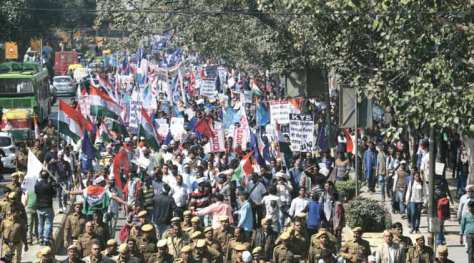
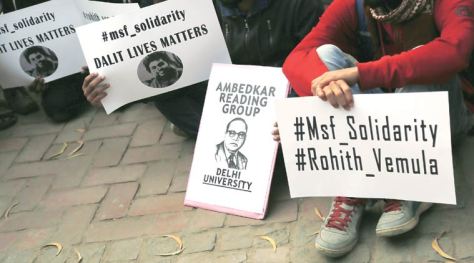
Chalo Dilli! Report on 23 Feb Protest March for Rohith Vemula: Saagar Tewari

This is a guest post by SAAGAR TEWARI

Rohith Protest 3

rohith-vemula-protest 4
IMAGES COURTESY: INDIAN EXPRESS

The call for a protest rally by the Joint Action Committee for Social Justice, constituted in the aftermath of Hyderabad Central University research student Rohith Vemula’s suicide galvanised large number of students and activists on 23rd February. On a bright sunny day, thousands descended on the streets of central Delhi marching from Ambedkar Bhawan to Jantar Mantar. The attendance was perhaps lower and the organization less cohesive than the JNU protest rally of 18th February. However, it trumped its predecessor in terms of attracting a far-wider political cross-section of the voices openly choosing to dissent against the current ruling establishment. The protestors proudly displayed anti-Brahmanism banners, flags, badges (featuring excerpts of Rohith’s suicide note) and even a radical inversion of Modi-style masks (featuring Rohith Vemula’s smiling face) thereby signaling that the same youth-brigade which was instrumental in BJP’s rise to political power in 2014 has started turning against it.

Continue reading Chalo Dilli! Report on 23 Feb Protest March for Rohith Vemula: Saagar Tewari

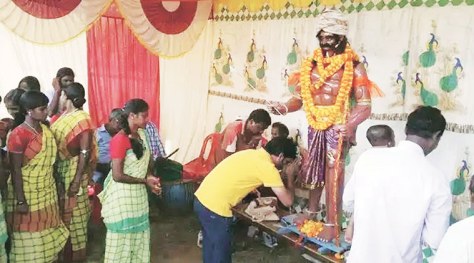
Searching for Raja Debi – A Santhal poet tells the tale of Mahishasura

mahishasur-759

Mahishasur being worshipped in Purulia, Bengal 

In Parliament the other day, Minister for Education Smriti Irani emotionally prefaced her reluctant reading of an alleged JNU poster with “May my God forgive me for even reading this out”. I am mildly envious that she has a personalized god to take care of her doubtless more weighty requirements than an ordinary citizen (an anti-national at that) can claim.

Be that as it may, what she read out purported to be from a poster about an event in JNU organized by “SC, ST and minority students”, an event that celebrated Mahishasura:

“Durga Puja is the most controversial racial festival, where a fair-skinned beautiful goddess Durga is depicted brutally killing a dark-skinned native called Mahishasur. Mahishasur, a brave self-respecting leader, tricked into marriage by Aryans. They hired a sex worker called Durga, who enticed Mahishasur into marriage and killed him after nine nights of honeymooning during sleep,”

Now, she does not show us that poster. Does it really use the term “sex worker”? I have seen posters for Mahishasura Diwas on JNU campus and never noticed this phrase. However, if it has indeed been used, we could have a discussion around the gender politics of that term and of that poster. Moreover, reading (in translation) the tale of Mahishasura from Santhal poet Bajar Hembrom will also give us a sense of how and why that phrase could have been used, if it was.

Actually, the only place I have seen the words “sex worker” in conjunction with “Goddess Durga” was in an ABVP poster that accused All India Backward Students Forum (AIBSF) of describing Goddess Durga as “a sex worker, seducer and prostitute” in their account of Mahishasura Diwas. Just as I have heard the slogan Pakistan Zindabad only in the mouths of Hindutvaadis who accuse us of chanting it.

Continue reading Searching for Raja Debi – A Santhal poet tells the tale of Mahishasura

Caste, sedition, oppression: JNU round-up

Earlier this week, I tried to join the many dots of violence at universities into a coherent pattern. My central contention is:

Spirited resistance in campuses across the country suggests the politics of India’s youth are more fluid and assertive than expected. The mid-1990s empowerment of historically oppressed castes, narratives of economic aspiration from the 2000s and an instinctive suspicion of authoritarianism have come together to forge a bold poetic new politics of desire that has befuddled even ruthless and astute politicians like the prime minister.

and

Modi’s government uses outdated laws, a pliant police force and Hindu student organizations as a battering ram to crush this awakening, exacerbating the discord between a prime minister determined to stamp his authority on an unruly nation and students enraptured by a thrilling moment of unlikely solidarities that could define their generation.

Read the rest of the piece here:

National development, order and disorder – The tactical algorithm of the BJP today: R Srivatsan

Guest Post by R. SRIVATSAN

“Khamosh! Kutte!”  [Silence! Dog!]

(Unconfirmed rumors about the phone answer given by the most powerful man to Ehsan Jafri, when the latter called up the Gujarat administration for protection from the mobs during the Baroda riots in 2002.  Jafri was slaughtered and hacked limb from limb soon after the protection he sought was withdrawn, or rather never provided.)

algorithm:  noun, a process or set of rules to be followed in calculations or other problem-solving operations, especially by a computer.

While effort after effort was made to establish the culpability of Narendra Modi for the Gujarat riots, they all failed to produce any evidence that was acceptable in a court of law.   News records speculate that the administration, on direct orders, turned a blind eye to the rampage of the mobs.[1]

Much was made of his innocence, and after more than a decade of political exile, Modi has risen as the star of the BJP’s ruling formation since the last election.

India’s national development now is touted as set to occur at a blistering pace crossing 7% in the coming years.  This is the redoubtable Gujarat model where industrial development is paralleled by stagnant or retrogressive movement of all indicators of social development and well being.

Key to understanding the significance of this is the unpacking of the term ‘national development’ in the Modi mantra (the name being convenient shorthand for the BJP and the rising class which supports it).

What does ‘national development’ signify for the BJP and its supporters?  How should this ‘belief’ in the nation be read?

To understand this, it is important to look at the spate of responses of the right wing to recent events. Continue reading National development, order and disorder – The tactical algorithm of the BJP today: R Srivatsan

Reflections on India, JNU and Pakistan: Anjum Altaf

In a chilling analysis, ANJUM ALTAF sees a terrifying pattern unfold in India, one that Pakistanis are all too familiar with.

Below are excerpts, the entire article can be read at TheSouthAsianIdea Weblog.

Despite its very different political trajectory, India is repeating the patterns observed in Pakistan albeit with a considerable lag in time. We have already seen the injection of religion in politics and now, apropos of JNU, we are seeing manifestations of hyper-nationalism and the use of student proxies of political parties to crush dissent and intimidate opposing voices in universities and courts.

The interesting question for an outsider is why this is happening in India today. The answer points to another one of the contingent events of history. It seems that with the election of Narendra Modi a number of factors have come together in India – the rule of a party with a foundational commitment to a conservative ideology that it believes needs to be universally imposed, a visceral dislike for dissent that it deems anti-national, and the undiluted power to attempt to enforce its preferences. These elements might have existed individually or in pairs before but have never come together as they have now with the outright mandate obtained by the BJP in 2014 that relieves it of the need to placate coalition partners. Continue reading Reflections on India, JNU and Pakistan: Anjum Altaf

Why Caste is the Crux and Hindutva’s Fall Imminent: Prathama Banerjee

Guest post by PRATHAMA BANERJEE

The return of BJP to power in 2014 was the return centre-stage of the caste question. Not that caste had gone away. Far from it.But our public life had been unmistakably altered by caste radicalism in the last few decades. 1990s onwards, powerful and triumphant dalit voices – intellectual, literary and political – transformed the nature of our democracy such that questions of caste injustice and caste assertion could no longer be circumvented, passed over, as it was done in earlier decades, by both reactionaries and progressives. Nor could the dalit and the low-caste subject be any longer portrayed as mere outcast or victim. She had come into her own as an autonomous and assertive political subject, sometimes even the ruler. Christophe Jaffrelot called this India’s silent revolution, and rightly so. What we see today with the rise (and imminent fall) of Hindutva nationalism is an attempt at a counter-revolution, nothing less.

The Counter-revolution – Targeting Dalits

The signs are easy to read. Right after Modi’s win began the so-called gharvapasi campaign of the Hindutvavadis, seeking to reconvert to Hinduism those who had earlier seceded in favour of Islam and Christianity. While the issue was pitched as an issue of religion, it was clear that at the heart of the matter was caste. Continue reading Why Caste is the Crux and Hindutva’s Fall Imminent: Prathama Banerjee

A Close Look at Certain Words Allegedly Shouted Recently in JNU and Their Impact on Our National Intelligence: Soumyabrata Choudhury

This is a guest post by Soumyabrata Choudhury

Polonius: “What is it you read, my lord?”

Hamlet in New Delhi, 2016: “India, Pakistan, security, sovereignty, nation, anti-national…words, words, words”

According to Sigmund Freud, when we dream, and when we suffer psychotic delusions, we treat words as pictures and things. A word’s meaning, in these conditions, becomes the shape of the word and its appearance is the same as feeling its physical impact, its blow. We cannot grasp anymore that a word refers to an object or idea outside in the world or that it can be used as a metaphor or an indirect analogy and image. We cannot even receive the rhetorical communication of words intended to persuade, exhort, transgress or insult. In each of these communications intended by an addresser we already feel physically, viscerally and as a consequence, mentally under the assault of the words of the addresser as if they are blows.

So in response we don’t persuade, exhort, transgress or insult back but instead, we curse (the upper limit of lucid  discourse in this state), punch, grab the addresser  by the throat, pull a knife or gun if we have any of these articles in our possession – or we cringe, weep, hold our heads in our hands and rock to and fro. Now it is very unlikely that in a real psychotic condition, we are able to invoke a particular law or clause of law in our favor, complain to the police and come up with a fluent image of language as justification for our actions. “We had no choice but to do what we did because the other(s) insulted our Mother India”. In a real psychotic condition, it is more likely we will be the ones to be taken away. Continue reading A Close Look at Certain Words Allegedly Shouted Recently in JNU and Their Impact on Our National Intelligence: Soumyabrata Choudhury

माँ भारती के वीर सपूतों की रेप फंतासियाँ

पेश हैं सोशल मीडिया से दो, फ़क़त दो, बानगियाँ उस नए संस्कारी राष्ट्रवादी नायक की जो  खुद को ‘माँ भारती’ का दीवाना सपूत बताता है. उसकी दीवानगी का आलम यह है कि वह अपनी माँ की खून की प्यास बुझाने के लिए किसी भी औरत से बलात्कार करने पर उतर आने को तैयार है. यह कौन माँ है इस पर तो हम थोड़ी देर में आयेंगे, पहले ज़रा इन सपूतों की करतूतों पर नज़र डाल लें.

Continue reading माँ भारती के वीर सपूतों की रेप फंतासियाँ

Vilification from the apolitical: The Dreyfus Affair and the case against JNU: Joyojeet Pal

This is a guest post by Joyojeet Pal

In 1894, a case of espionage broke out in France. Alfred Dreyfus, a young officer was arrested in connection with a letter suggesting a transfer of sensitive documents to the German attaché in Paris. Dreyfus was arrested for the crime, his family was intimidated and he was swiftly convicted despite weak evidence. After being publicly shamed as a traitor in a court-martial, he was sent to ‘Devil’s Island’ in French Guinea, a notorious penal colony. Within a couple of years of his conviction, a movement emerged to re-examine the facts of the case. Dreyfus would be eventually re-tried and re-convicted despite overwhelming evidence in his favour.

Dreyfus was Alsatian, Jewish, and a graduate of the elite École Polytechnique, one of the most competitive institutes in the country. Alsace had been lost by France following the Franco-Prussian war, the French were bitter about this, and Alsatians were often seen as a suspicious regional minority. The case that came to be known as the “Dreyfus Affair” in time became a landmark in modern French history because of the multilayered schisms in French society that it threw open.

Continue reading Vilification from the apolitical: The Dreyfus Affair and the case against JNU: Joyojeet Pal

Come on man, be clear, what comes first—Nation, or Democracy? Bodhisattva Kar translated by Ahona Panda

Guest Post by Bodhisattva Kar and Ahona Panda

(Written by Bodhisattva Kar in Bengali, First published in on 18 February 2016 by the Ei Samay newspaper.Translated into English by Ahona Panda)

“To you I confess today—what you all call a patriot, I am not of that kind.” After this confession of sparkling clarity, should we not catch hold of that man as an anti-national? So what if he is dead? If the dead can be rewarded with the Bharat Ratna, why can’t we frame the dead with a few charges of sedition? For God’s sake, all you good people, how did you make a song written by this man the national anthem? The man who—without any obfuscation—speaks through the mouth of the protagonist of Char Adhyaya—“They who do not take cognizance of that which is greater than patriotism, their patriotism is like crossing on a crocodile’s back.” Where did he get the audacity to dream of something greater than patriotism? And, he did not even study at JNU. “By killing the very soul of the country, the country’s life can be resuscitated: this terrible untruth is being announced in beastly roars by nationalists around the world and it makes my heart revolt with intolerable intensity.” How can you not burn the books produced by such a treacherous son of Mother India, who said such terribly instigatory things? Why do you worship him instead? Can anyone put their hand on their hearts and say that he wasn’t a Pakistani spy, just because of the niggling detail that Pakistan did not exist at the time he was writing? Did we not shoot Dabholkar or Pansare for agonizing quite a bit less than he did? Continue reading Come on man, be clear, what comes first—Nation, or Democracy? Bodhisattva Kar translated by Ahona Panda

Apologise to the Nation, All of You.

You, who shout your nationalism from the rooftops; you whose blood runs hot for “Mother India”; you who turn red with rage when contradicted; you who set agendas like patriarchs drunk on father-right; you who refuse to let another speak, you! who don a suit every night on television to disguise your cheap tricks; you who abuse your guests if they happen to be young, powerless and honest; you who bloat on adrenaline while your viewers turn to idiotic jelly; you who abuse the highest offices of this land; you who give a bad name to khaki; you who wear lawyers’ robes to beat students and teachers; you who are protected by your political masters; you who strike deals in the privacy of your offices, chambers and boardrooms; you who live by ratings and upvotes; you who tell lies so long you forget the truth; you who form bands of cowards hiding in plain sight; you who roam the streets showing your fist to all; you for whom a martyred soldier is more valuable than a living citizen; you who abuse the power that history gave you; you who mistake that accident of history for a moral right; you whose imagination of revenge always involves rape; you who have brought this country to the brink of civil war; you who speak in the name of the mythical motherland while the actual children of that land are hungry, thirsty and unemployed; you who claim this moment, this nation, this public, this history, this land. Apologise.

Apologise to those who work everyday to make this country decent; who work for too little, and for too long; those whose deaths become statistics in the great churning pots of state economists; those whose parents taught them to keep their heads down and quit an ugly fight; those who argue, debate, disagree without the urge to kill or maim their opponents; those who understand when an argument becomes too heated; those who pull back from the brink every time because they know that to be alive is not always to be right; those who reclaim the streets to protest when it’s hard, when it’s inconvenient, and when it’s dangerous, because it’s the only way to disagree; those who see that an eye for an eye makes the whole world blind; those who understand and accept this land in all its confounding conflict; those who risk death to expose the powerful and corrupt; those who have no choice but to join the army to feed their families; those who laugh when there is nothing left; those who write, think and reason, and take time over all three; those who appreciate the beauty of the stars on a still night; those who make love like it’s a gift and not a right; those whose parents live after they died because they were on the wrong side at the wrong time.

Above all, you deranged “nationalists”, apologise to three fellow citizens – one born in a caste that could only speak from the protection of death; another who is languishing in jail for no crime at all; and perhaps most of all, a third who is on the run from a police none of us ever trusted. Apologise. These young people are the future of this country, not you with your bloodlust. WE are the nation, and we demand an apology from you.

In the Name of the ‘Nation’: Vidya K. Subramanian and C. J. Kuncheria

This is a guest post by VIDYA K S and C J KUNCHERIA

“Don’t you dare speak over me when I am speaking of Lance Naik Hanumanthapa! We’re proud of him and we’re ashamed of you!,” screamed Arnab Goswami at Umar Khalid, the JNU student at the centre of unfolding events at the university. Hundreds of thousands of self-proclaimed nationalists cheered at that instant, and many more did as the clip went viral over social media. The death of the soldier, one of the 869 who have been killed in the last four years by the punishing weather on Siachen, had been conveniently used to invoke a cathartic nationalism. Continue reading In the Name of the ‘Nation’: Vidya K. Subramanian and C. J. Kuncheria

Statement of Solidarity with the JNU Community, from the Students and Faculty at Princeton University


We, the undersigned, condemn the undemocratic and unconstitutional actions of the BJP-ABVP-Delhi Police on the JNU campus. Continue reading Statement of Solidarity with the JNU Community, from the Students and Faculty at Princeton University

Statement in Support of Students and Faculty at JNU From Faculty and Affiliates of the American Uniersity of Beirut, Lebanon

February 23, 2016

We, the undersigned faculty, students, staff, and affiliates of the American University of Beirut are highly concerned over the recent repression of free speech and undue police and legal interventions at Jawaharlal Nehru University (JNU), New Delhi. Continue reading Statement in Support of Students and Faculty at JNU From Faculty and Affiliates of the American Uniersity of Beirut, Lebanon

Communication Students, Practitioners, and Professors in Solidarity with Kanhaiya Kumar, Umar Khalid, Anirban Bhattacharya, Rama Naga, Ashutosh Kumar, and Anant Prakash Narayan and Jawaharlal Nehru University


 We, students, professors, and practitioners of Communication and Media, condemn the recent attacks by the Indian state on students and faculty at Jawaharlal Nehru University (JNU) campus. Given the spurious nature of the claims mostly circulated through traditional and social media, we demand an immediate end to all police action on campus, a withdrawal of charges against the President of JNU Students’ Union, Kanhaiya Kumar, and JNU students Umar Khalid, Anirban Bhattacharya, Rama Naga, Ashutosh Kumar, and Anant Prakash Narayan, as well as an engaged effort to return peace and a climate of open debate to the university. We are troubled by the climate of authoritarianism being actively promoted by the Indian government in educational institutions and the concerted effort by the government to silence critical conversations. We are also disturbed by the attack on journalists by lawyers and goons close to the structures of power. Continue reading Communication Students, Practitioners, and Professors in Solidarity with Kanhaiya Kumar, Umar Khalid, Anirban Bhattacharya, Rama Naga, Ashutosh Kumar, and Anant Prakash Narayan and Jawaharlal Nehru University

The New School in Solidarity with JNU


We, the undersigned, students, faculty, alumni, and staff at the New School University, New York, stand in solidarity with the students, staff, and faculty at Jawaharlal Nehru University, New Delhi, in their protests against the militarization of the campus and suppression of dissent by anti-democratic and divisive Hindu nationalist groups allied with the Modi government. Continue reading The New School in Solidarity with JNU

University of Texas Students and Faculty stand with JNU


We, the undersigned, students, scholars, and faculty of the University of Texas at Austin, stand in solidarity with the students, faculty, and staff at Jawaharlal Nehru University, New Delhi against the illegal and unconscionable crackdown by police. We demand an immediate end to all police action on campus, a withdrawal of all frivolous charges against the President of JNU Students’ Union, Kanhaiya Kumar, and other students, as well as an end to the campaign of harassment and intimidation against students at the university. With them, we affirm the autonomy of the university as a non-militarized space for freedom of thought and expression. Accordingly, we condemn police presence on campus and the harassment of students on the basis of their political beliefs.  Continue reading University of Texas Students and Faculty stand with JNU

Bangalore Research Network’s Letter of Solidarity with JNU


We, the undersigned members of the Bangalore Research Network and a consortium of academics and researchers from Bangalore, declare our solidarity with the students and faculty of the Jawaharlal Nehru University, New Delhi protesting the illegal police arrest of JNUSU president Kanhaiya Kumar on charges of sedition. We unequivocally stand by them in affirming that universities are autonomous spaces for the free expression of a plurality of beliefs and cannot become military spaces of thought control that go against the very grain of a democratic society.  With them, we condemn the blatantly authoritarian attempt by the police and the central government to witch hunt students on the basis of their political beliefs. We also condemn the unethical media trial of JNU students such as Kanhaiya Kumar and Umar Khalid. Continue reading Bangalore Research Network’s Letter of Solidarity with JNU

The Limits of Efficient Suasion : Rina Ramdev

This is a guest post by RINA RAMDEV

The Prime Minister’s monogrammed suit and the HRD Minister’s fake degree in the early days of the BJP’s 2014 electoral win were embarrassments dotting the uneasy calm that prevailed over the new digital, development avatar of the nation; even as a sense of the slouching beast waiting to break through the controlled, contained quietism was always there in deferred menace. And thus, when majoritarian sentiment fuelled the ‘Ghar waapsi’ campaign and the ban on cow slaughter found a mainstreaming in minority witch hunting, there was an eerie expectedness to these turns. The Swachh Bharat Abhiyan’s minatory address, carrying the subtext of a communal cleansing in sinister remand, visibilized itself in the horrific lynching of Mohammed Akhlaq in Dadri. Mostly civil voices of protest raged against this as well as against the organised killings of questioning rationalists like Pansare and Kalburgi. Sections of the thinking polity mobilised signature campaigns, petitions and an entire event like the‘Award waapsi’ drew attention to this vitiated political climate. Continue reading The Limits of Efficient Suasion : Rina Ramdev