Category Archives: Right watch

How to Not Read the Ayodhya Judgement: Hilal Ahmed

Guest post by HILAL AHMED

There are three areas which I think we need to underline.

A. Technical problem: The question of applied principles

I ask a very fundamental question: How could a modern secular judiciary- technically an institutionalized ‘interpreter’ of the Constitution- determine the legal disputes related to religious places of worship on the grounds of ‘faith-based’ evidences?

All the three judges seem to recognize the fact that the Hindu beliefs should be (must be) taken as legal facts. Interestingly, these beliefs are supported by archeological report of 2003 to form an argument of judicial nature.

However, and quite astonishingly, the Sunni Wakf Board’s (SWB) case was dismissed on legal-technical grounds following a very mechanical interpretation of the Limitation Act.

But for Nirmohi Akhara and VHP case (referred as Ram Lalla virajman) the principle of faith was given primacy and in order to substantiate it further ASI report which is full of contradictions, is expanded to arrive on a conclusion.

Continue reading How to Not Read the Ayodhya Judgement: Hilal Ahmed

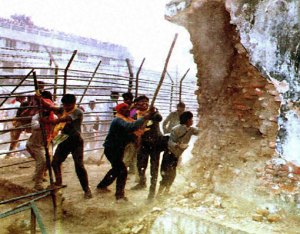
Opening Pandora’s box

Source: NDTV.com

The Ayodhya judgement is out; Pandora’s box has been opened and I suppose the hope fairy is fluttering amidst us all. That there haven’t been riots is being seen as a sign that “the country has moved on”.  My personal sense is that the absence of riots simply proves that riots are rarely spontaneous: adequate security has ensured an uneasy calm.

It’s still too early (at least for me) to make sense of this verdict, so I thought we could kick off the debate on Kafila by posting a list of links and resources and perhaps take the conversation forward as more and more information comes in.

To start off, the Judgements can be accessed at http://rjbm.nic.in/ . The top half of the page contains the gist of the judgments while your can find the entire judgement below the fold.

Continue reading Opening Pandora’s box

‘Shastra Pujas’ – What’s Religious About Worshipping Weapons ?

I.

Schools are meant for play and studies where kids slowly blossom into adolescents. Schools are meant for books, laboratories and other cultural activities which cater to the all round development of its students. Schools are meant for opening up of minds, inculcating inquisitiveness and curiosity, explain the wonder that is the world and lead the students towards further enquiries and promoting inclusiveness cutting across different ascriptive categories with which all of us are born with.

Of course, in emergency situations, schools even metamorphose into shelter homes for the victims of a natural calamity or a social catastrophe.

But certainly, no sane person can imagine that school premises can ever be used for worshipping deadly weapons – loaded pistols and illegal rifles. But it appears that on this count RSS – the all hindu male organisation – thinks differently. It is not for nothing that schools which run under the aegis of its affiliated organisation are freely handed over for such programmes under the specious reason that it is a religious programme. Any close watcher of the ground level situation can vouch that worshipping of weapons on Dusshera has nothing to with religion rather it is part of social tradition. Despite this reality organising of ‘shastra pujas’ has of late become a national phenomenon and hindutva organisations are known to play an important role in it. It serves a double purpose for them : consolidate their constituency by using religion as the legitimising force, terrorising the ‘others’ simply by taking out ‘religious processions’ brandishing weapons.

Continue reading ‘Shastra Pujas’ – What’s Religious About Worshipping Weapons ?

Rayana R Khazi and The Specter of Religious Fundamentalism in the Kerala Public Sphere: Jenny Rowena & K Ashraf

This is a guest post by JENNY ROWENA and K ASHRAF
Rayana R Khazi is a young student from Cherkalam in Kasargode. Recently she has been in the news after she came out to speak to the media about the threatening letters and phone calls that she was receiving, all of which demanded her to wear the Purdah. After Rayana’s revelations, media, human rights and feminist activists have rushed to her aid, starting off yet another round of anxieties about the growth of Islamic fundamentalism.  Even as we fully support Rayana’s need for a more livable life, it is also important that, at this juncture, we look at the numerous issues that this incident brings forth into the public sphere of Kerala.
Control of Women’s Bodies
In this controversy, one of the most important issues being raised is about the control of women’s bodies by male, religious fundamentalists in the Muslim community.  Such responses, be it from a reactionary, anti-Islamophobic perspective or from a more progressive view- point, which is aware of the rampant Islamophobia of our times, carries out a similar function in Kerala. Continue reading Rayana R Khazi and The Specter of Religious Fundamentalism in the Kerala Public Sphere: Jenny Rowena & K Ashraf

Dressing and Death-Threats in Kerala : Re-former Man’s Second Coming?

(cross-posted on www.countermedia.in)

Shamshad Hussain, J. Devika

The death threats received by a young woman student of engineering, Rayana R Khazi, a native of Cherkalam in Kasaragod, over a period of the past ten months, have been in the news in Kerala recently. The threats which were issued over the phone, on the streets, and by letters, have demanded just one thing: Rayana should comply with ‘Islamic dress-norms’; she should don the purdah. She has received four threatening letters. Of these, three issue death-threats, outright. The fourth is in the form of a warning that offers lengthy advice. One of these says: you have not heeded many warnings issued. We, Muslim brethren, will now decide your fate. This letter, which begins and ends in the name of Allah, is unsigned. Continue reading Dressing and Death-Threats in Kerala : Re-former Man’s Second Coming?

Have I Joined the Popular Front?

In the past few weeks, I have been asked over and over again, not always in jest, if I had joined the Popular Front. I am not surprised. The police investigation around the violence against the college teacher at Muvattupuzha has broken all previous records in not only the violation of human and civil rights, but also in the silence of Kerala’s enlightened intellectuals. If I recall right, only Nandigram evoked such a dense and deliberate silence from them. No wonder, anyone who speaks up against the manner in which the police is being armed and authorized against ‘bad muslims’ is immediately dubbed a supporter of the Popular Front. But I am intrigued by this simple question, by which the entire history of that person’s engagement with discussions around religion and the state is erased. Continue reading Have I Joined the Popular Front?

Pracharak as Terrorist – On the Bhasmasur of Hindutva Terror

I.

Hindu mythology with its plethora of gods and goddesses (which according to a conservative estimate numbers around 330 millions or 33 crores) has n number of stories supposedly to show the human face of the almighty. One such story talks of the creation of a demon called Bhasmasur by one of the gods himself. The said demon had the unique power of turning everything into ash if he could touch anybody’s head. The story goes that after ‘conquering’ the world the demon tries to attack his ‘creator god’ namely Shiva himself and then Lord Vishnu intervenes and manages to eliminate the demon itself.

Whatever might have been the significance of the story then, it bears striking resemblance to the plight of the RSS – the biggest fountainhead of Hindutva politics in the country – today. And this relates to the arrest of many of its senior wholetimers (called Pracharaks in its lexicon) for their role as masterminds, instigators or patrons of terrorist acts in the country and the ongoing questioning of many other senior leaders for their role in aiding and abetting such acts. Interestingly the parent organisation has till date not formally denied their role in all these acts and nor called it witchhunting as it did when investigations into the Malegaon bomb blast II (Sept 2008) were on and the likes of Sadhvi Pragya, Lt Col Purohit and others from the larger Hindutva family found themselves behind bars. In fact, this time it appears more cautious and according to a report it has even sent few of its leaders who supposedly played some role in these acts on a compulsory leave and has plans to send few more. (Bhaskar, 7 th July 2010).

Continue reading Pracharak as Terrorist – On the Bhasmasur of Hindutva Terror

A Dialogue with God and Dialogues that go missing

Guest post by SUDEEP KS and BOBBY KUNHU

On Sunday 4 July 2010, T J Joseph, a college lecturer, was attacked by a group of people on his way back from the church in Muvattupuzha in central Kerala, and his right hand was chopped off. We believe this heinous act deserves to be condemned, and that such acts pose a major threat to the secular fabric of the Kerala society.

The attack has attracted immediate media attention, and it is said to be related to a recent controversy over a question paper. Joseph, in his Malayalam question paper, had asked one question that apparently hurt the religious sentiments of some people.

The Kerala society’s response to this whole episode has been equally disturbing. Pinarayi Vijayan, state head of Communist Party of India (Marxist), calls it ‘Talibanization of Kerala’. It has been made out to be a question of ‘freedom of speech’. The media, politicians and intellectuals are busy expressing serious concerns over a ‘religion’ that is intolerant and fanatic. The Police has also let out suspicions on some groups involved in this incident, and both the television and print media have been religiously reporting it. Continue reading A Dialogue with God and Dialogues that go missing

Courage Craft and Contention: Human Rights and the Judicial Imagination

On the 12th of June, the Alternative Law Forum (ALF) celebrated its tenth anniversary with a public lecture by Justice A P Shah and Prof. Upendra Baxi on the topic Courage Craft and Contention: Human Rights and the Judicial Imagination.

We are happy to share the transcript of the lectures.

Thailand – Two Elites and a Proletariat: Satya Sagar

A guest post by SATYA SAGAR

The two month long street protests in Bangkok by thousands of ‘red shirt’ opponents of the Abhisit Vejajiva government demanding fresh elections and the violence that followed has been described as the worst conflict Thailand has ever faced in its modern history. It left in its wake at least 88 dead, hundreds injured and close to US$2 billion worth of property destroyed, the toll being much worse in all aspects than previous political violence of October 1976 and May 1992.

Much of the loss of life and damage came in mid-May when the army brutally cracked down on the protestors using trained snipers and war weapons to take on street protestors armed mostly with slingshots, burning tyres and Molotov cocktails. Angry, retreating protestors in turn set fire to over two dozen buildings in Bangkok including Central World, the second largest shopping mall in South East Asia.

Continue reading Thailand – Two Elites and a Proletariat: Satya Sagar

And Now, Fears of ‘Intellectual Jihad’!

Hameed Chennamangalur’s recent article in the Mathrubhoomi Weekly (16 May) in Malayalam seems to have set alight a new round of fears about the ‘hidden agenda’ of Muslim extremism . Over the past weeks many friends, mostly left-liberals, have been urging me to take heed of the warning issued by Chennamangalur, a well-known, long-time critic of Muslim identity politics.

The article that has sparked off such worries takes a line that is quite familiar: it accuses the Jamaat-e-Islami in Kerala of pursuing their ‘hidden agenda’ of establishing the dominance of radical Islam through secular means. Chennamangalur argues that the Jamaat has ‘penetrated’ the space of radical activism through its all-male youth organizations such as the Solidarity Youth Movement, and through setting the terms of radical activist debate through its popular weekly magazine, the Madhyamam. Its recent efforts at discussing such ideas as Muslim feminism, and Muslim feminist thinkers such as Amina Wadood and Fatima Mernissi can only be regarded as cover-ups for a strategy through which it seeks to displace the more liberal and plural Muslim League — something he finds worrying in the present context in which the Jamaat is making a bid to enter local governance through contesting the forthcoming panchayat elections in Kerala. He laments that the radical intellectuals in Kerala are becoming mere pawns of this strategy; they do not see, for instance, that despite all the support that the Madhyamam offers dalit intellectuals, it remains biased heavily towards upper-caste Muslims, unlike the Communist Party in Kerala, which, he claims, offered upward mobility and political presence to dalit leaders in its fold. Continue reading And Now, Fears of ‘Intellectual Jihad’!

Why RSS Wants to Forget Pracharak Sunil Joshi’s Murder?

I.
It was a murder of an old activist, which the RSS would love to forget. It is a different matter that despite the innumerable ways in which it has tried to banish the memory of the whole incident it has found it very difficult to get away with it. And with the latest exposures in the Ajmer Dargah bomb blast case the whole issue has once again returned to haunt it.

“A former RSS pracharak, who was an accused in the murder of a Congress leader and his son, was shot dead in Dewas town, about 35 kms from Indore, late on Saturday.
Sunil Joshi, 45, was strolling in Chuna Khadan locality when assailants, who used a Maruti van and a two-wheeler, shot him thrice. He was declared dead on arrival in the district hospital.”
(Indian Express, Posted: Mon Dec 31 2007, 00:00 hrs) Continue reading Why RSS Wants to Forget Pracharak Sunil Joshi’s Murder?

From Murder Mystery to Spy Thriller: Raveena Hansa

THE CONTINUING SAGA OF THE MUMBAI TERRORIST ATTACKS

This is a guest post by RAVEENA HANSA.

A great deal of new evidence concerning the 26 November 2008 terrorist attacks in Bombay has emerged over the past year. This includes the book Who Killed Karkare: The Real Face of Terrorism in India by S.M.Mushrif, a former police officer with a distinguished record, who uses news reports during and just after the attacks to question the official story; the book To the Last Bullet by Vinita Kamte (the widow of Ashok Kamte) and Vinita Deshmukh; revelations concerning Hemant Karkare’s bullet-proof jacket and post-mortem report; the David Coleman Headley trial; and the trial of Ajmal Kasab, Fahim Ansari and Sabauddin Shaikh. I do not include the Ram Pradhan Commission report on police responses to the attack, for reasons I will explain.
The Headley Affair
The Headley affair has, predictably, grabbed a great deal of publicity. The fact that the FBI had been investigating the involvement of this American in conducting reconnaisance for the 26/11 attacks seems to have come as a revelation to the Indian investigators, who had a chance to apprehend him but instead chose to detain two Indian Muslims, Fahim Ansari and Sabauddin Shaikh, for preparing maps of 26/11 targets.
It has been established that Headley was an agent of the US Drug Enforcement Administration, and his plea bargain leads us to conclude he was also a US intelligence agent: in other words, a spy. It is also known he was involved with the Lashkar-e-Taiba (LeT), and supplied information to them about targets attacked on 26/11. There are three possible explanations that would fit these facts:
1) He started off as a US intelligence agent, but was won over by the LeT, and was acting on their behalf.
2) The US intelligence agency employing him was complicit in the 26/11 attacks. Since the most likely fallout of such attacks would be increased tension and even armed clashes on the Pakistan-India border, and since it appears to be a priority of US foreign policy to reduce such tension, this would suggest that Headley was being handled by a rogue element in US intelligence.

Deshbhakts at Arthur Road Jail: Susan Abraham

This is a guest post by SUSAN ABRAHAM

Shahid Azmi

It took Shahid Azmi’s cold-blooded murder on 11th February 2010 at his office near Kurla, for the world to come alive to his  importance.  Soft spoken and modest, it is the sweep of the cases he fought, challenging the State’s calculated targeting of innocent Muslims, that marked Shahid’s  remarkable achievements as a lawyer within a short span of six years in the legal profession.

One of these cases related to the brutal lathi charge in Arthur Road Jail in central Mumbai, on 28th June 2008, by the jail staff along with convicts and undertrials from the so-called `patriotic’ underworld gangs,  on a select group of undertrial-inmates. This assault was conducted under the overall supervision of the-then Jail Superintendent Swati Sathe. To the outside world, Ms Sathe was a tough no-nonsense, non corrupt woman officer who probably wished to become the next Kiran Bedi. But underneath her stiff khakhi uniform ruled a tough no-nonsense hindutva heart, no less.

Continue reading Deshbhakts at Arthur Road Jail: Susan Abraham

An Aid to Surveillance

Guest post by USHA RAMANATHAN

The air is thick with schemes that will enable the state, and its agencies, to identify every resident, and to track what they are doing. A Home Ministry project for creating a National Population Register which will be prepared along with the 2011 Census has been propelled through its pilot stage. Now, an ambitious programme has been launched to load all the residents of the country on to a data base, providing each of us with a unique identity number. What  distinguishes this exercise from any other undertaken so far?

First of all, the intention is provide a Unique Identity Number to the whole population, including the just born.  The state is to have data on each individual literally from birth to death; and beyond, for a person’s UID is not destroyed at death, merely dis-abled. The numbers are to be so generated that it will not have to be repeated for between a hundred and two hundred years. Continue reading An Aid to Surveillance

Protest and Terrorism, Is there a Difference?

Sufiya Madani of the PDP has been granted conditional bail by the Ernakulam Sessions Court Judge after a tense wait following her arrest on 17 December. She was remanded to judicial custody by the first class magistrate court at Aluva which had refused her bail. Meanwhile, the mainstream media went on a speculation-spree, even publishing ‘evidence’ that she had abetted terrorism and violence — the burning of a bus owned by the Tamil Nadu Road Transport Corporation at Kalamassery in 2005 during protests against the PDP leader Abdul Nasser Madani’s (Sufiya’s husband) continued detention in the Coimbatore jail . Continue reading Protest and Terrorism, Is there a Difference?

Savarna Terror Erupts in Kerala

(with inputs from Mythri Prasad Aleyamma)
I admit, this title sounds sensationalist. But one can hardly avoid resorting to it when confronted with utterly stupefying news of attacks on dalit colonies almost next door to Kerala’s capital city and nerve centre of Malayalee politics, and that too, by a minor anti-political force that has a legacy of anti-South Indian hatred — the Siva Sena. And of course when one is confronted with the hard, stony silence of almost all sections of the media about this. The mystery of the murder of an elderly, innocent morning-walker in Varkala, a town close to Thiruvananthapuram (of which I wrote in an earlier post) still remains a mystery; the police story is so full of holes that it looks like a sieve. But the Guardians of our Free Press are still lapping police versions and not conducting independent investigation. Activists who have dared to do so have been heckled and hounded, even senior and respected human rights activists like B.R.P.Bhaskar, by the Siva Sena, and their protests have been ignored. Meanwhile violence continues to be unleashed against the supporters of the group that has been accused of murder, the Dalit Human Rights Movement (DHRM).

Continue reading Savarna Terror Erupts in Kerala

Who’s at ‘Jihad’? : ‘Love Jihad’ and the Judge in Kerala

It looked as if the controversy over ‘Love Jihad’ ( ‘jihad defined as ‘war by other means’) had  blown over with state authorities in Kerala and Karnatake denying that such a threat ever existed.The Central Government informed the Kerala High Court early this month that there was no such thing and that the term ‘love jihad’ was being used by the media.However, today, the Kerala High Court openly voiced its scepticism of police reports, claiming that the reports were inconsistent and citing various technical flaws.The Court claims that it is abiding by the secular spirit of the Indian Constitution: it agrees that the freedoms to choose one’s faith and one’s partner in marriage are fundamental rights. However, it feels that the present instances of marriage and conversions that have been brought to its attention are not the exercise of freedom by individuals — specifically, by young women, though the Court does not say it that way. It is difficult to imagine a more anti-Muslim and anti-woman position; and it is a serious matter that the muddle-headed reasoning of the judge has been uncritically circulated in the dominant media.
Continue reading Who’s at ‘Jihad’? : ‘Love Jihad’ and the Judge in Kerala

Minarett-Verbot

This is a guest post by Naeem, an artist friend. The post is a cull from a conversation regarding the recent ban in Switzerland imposed on building minarets.

In a vote that displayed a widespread anxiety about Islam and undermined the country’s reputation for religious tolerance, the Swiss on Sunday overwhelmingly imposed a national ban on the construction of minarets, the prayer towers of mosques, in a referendum drawn up by the far right and opposed by the government. The referendum passed with 57.5 percent of the vote and in 22 of Switzerland’s 26 cantons.

Continue reading Minarett-Verbot

Tilting at Wind Mills Aren’t We

The Jamiat Ulama-e-Hind Conference held recently, has raised Cain through one of the 25 resolutions that were passed at the conference. The kind of noise that has been generated by this resolution has virtually air-brushed the other resolution out of reckoning. Did the remaining 24 resolutions not deserve closer scrutiny, especially in view of the fact that many of these resolutions had taken off from the recommendations of the Sachar Committee report.

The 24X7 “News” channels that claim to keep us updated on developments even before they occur, have by and large concentrated all their energies on this one resolution which claims that the “Singing of Vande Maatram is Un-Islamic”. Given the kind of attention that this resolution has already received, it may be worth our while to talk about some of the other resolutions before getting into the raging debate of Vande Maatram. Continue reading Tilting at Wind Mills Aren’t We

Where Is Hemant Karkare’s Bullet Proof Jacket?

I.
Hemant Karkare’s family – his wife Kavita, his son and daughters and other near and dear ones – have slowly albeit silently come to terms with the fact that he is no more. Yes, there are occasions when his son takes out the laptop and scans the family album icon to see his father in various moods. There are a few photographs he really loves to watch again and again, where his dad looks a different person and not the usual policewallah.There are times when his mother also joins him and every photograph reminds her of the beautiful days they spent together.
It is known that born and brought up in Madhya Pradesh, Karkare did his engineering (mechanical) in Nagpur and worked at the National Productivity Council and Hindustan Lever before making it to the IPS in 1982. An avid reader of books Hemant during his stint in the Chandrapur forests near Nagpur in 1991 took an interest in driftwood, discovered artistic shapes in them and converted them into wooden sculptures, making about 150 of them over a two-year period.
Continue reading Where Is Hemant Karkare’s Bullet Proof Jacket?