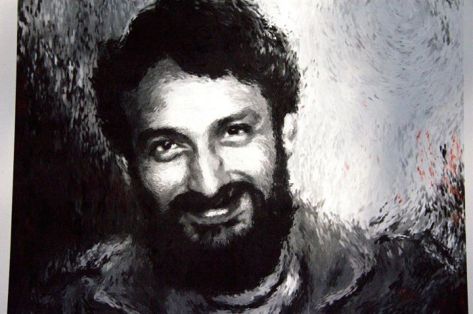
It’s been twenty years since the assassin’s bullets took Chandu away from us, at 4 pm on 31 March 1997.
I still recall my sheer disbelief when a phone call from my party office at my hostel that evening informed me ‘Chandu has been killed.’ Chandrashekhar as well as youth leader Shyam Narayan Yadav had been shot dead while addressing a street corner meeting in Siwan – ironically at a Chowk named after JP – Jaiprakash Narayan, icon of the movement for democracy against the Emergency. A rickshaw puller Bhuteli Mian also fell to a stray bullet fired by the assassins – all known to be henchmen of the RJD MP and mafia don Mohd. Shahabuddin.
In the spring of 1997, as JNU began to burst into the riotous colours of amaltas and bougainvillea, Chandu bid us goodbye. He had served two terms as JNUSU President (I was Joint Secretary during his second stint) and had decided to return to his hometown Siwan, as a whole-time activist of the CPI(ML) Liberation. He had made the decision to be a whole-time activist a long time ago. Chandu’s friends know that for him, the decision to be an activist rather than pursue a salaried career was no ‘sacrifice.’ It was a decision to do what he loved doing and felt he owed to society.
Mar 21, Delhi: In a shocking revelation that has triggered panic amongst the media fraternity, renowned media tycoon, Ameer Jain, who is Vice-Chairman of the prestigious Parrot, Caveman & Co. Ltd, has been accused of sexual harassment by an employee of The Slimes of India newspaper, namely Aaj Faker Shah. Parrot, Caveman & Co. Ltd. (PCCL) is the group that owns Slimes of India, Slimes Now, Economic Slimes, Radio Tirchi, Movies Now and Then, Dhoom, Navbharat Slimes, Mumbai Broken Mirror and numerous other media outlets.
After the sexual harassment case filed by an employee of a major news magazine against its high profile editor some years ago, this is the most high-profile case of sexual harassment at the workplace in the media fraternity and is likely to result in a public spectacle, as the complainant, Aaj Faker Shah, has taken to Twitter to publicly make serious accusations of sexual assault against Jain. Normally, in cases of sexual harassment, the complainant must be accorded due anonymity. However, Shah reasons that he was forced to take this extreme step because the Slimes Group, in total violation of the norms prescribed by the Sexual Harassment at the Workplace Act (2013), sat on his complaint, victimised him for speaking out against Jain and even threatened to sack him. This reflects the state of implementation of the Workplace Harassment Law, rules for which were notified in 2014. Continue reading Slimes Group Vice-Chairman Ameer Jain accused of molesting SOI employee Aaj Faker Shah? Breaking Faking News: Shehla Rashid→
[This is a statement and an appeal by the Maruti Suzuki Workers Union condemning the unjust handing down of a life sentence to 13 workers of the Maruti Suzuki Manesar Factory for a ‘murder’ (of an HR Manager) that the prosecution could not prove that they had committed. Here too, the prosecution, and the judgement, relies on a chimera, ‘the reputation of make-in-india’ to justify a harsh punishment. Those who have watched this space will recognize that this recourse to figures of speech in the absence of evidence is a familiar move. It has happened before – to satisfy the hunger of a ‘collective conscience’ when a so-called ‘temple of democracy’ was attacked. This time it has been invoked to defend the ‘fake-in-India temple that houses the deity of a rising GDP’, which would of course otherwise be besieged by insurgent workers.
This text contains a hyperlink to a detailed reading and rebuttal of the prosecution’s arguments, which demonstrates how money and muscle power can always be an adequate replacement for legal acumen in the State of Haryana. Please do follow that link. For the further edification of our readers, we append a short video interview by Aman Sethi of the Hindustan Times of the special public prosecutor, which spins some imaginative legal theory and also radically updates our sense of class struggle. Please do have the patience to view that video. We promise that this will be rewarded. – Kafila Admin.]
Video by Media Collective, Article by Arun Ferreira and Vernon Fernandes
Fifty Years of Unreasonable Restrictions
Arun Ferreira & Vernon Gonsalves
Soon after its adoption, the Constitution of India was amended in 1951. At the time several progressive judgements[i] by the Judiciary held that laws which curb fundamental rights are essentially unconstitutional and fundamental freedoms could only be curbed in the most extreme of cases. The First Amendment, countered this by amending Article 19 to add the word ‘reasonable’ before restrictions and to add ‘public order’ as being one more ground for abridging Fundamental Rights.
[This missive to Makarand Paranjape, who is a professor at Jawaharlal Nehru University, comes in response to his recent op-ed piece in the Indian Express where he comments on the events at Ramjas College, Delhi University on the 21st of February and in their wake, in Delhi University, on the 22nd of February]
Mr. Makarand Paranjape. In your analysis of the post-Ramjas fallout in Delhi University in Indian Express on the 4th of March, one can see that you have donned a “liberal” cloak. But there were way too many holes in that cloak to go without a counter and hence this response.
Please find below a collation of statements of solidarity received by Kafila over the past fortnight since the shameful incidents of violence by the ABVP occurred on the 21st and 22nd of February 2017. These are from: Ramjas Alumna, Ambedkar University Delhi Faculty Association, O.P Jindal Teachers: Students and Durham University Politics and International Relations Society, U.S.A; and students and faculty at the University of Minnesota, U.S.A.
University of Minnesota Students and Faculty
The statements are preceded by a short write-up on what Ramjas College has meant to its alumna, by ANUBHAV PRADHAN.
Nostalgia is made of more than just happiness. It is sulphurous too.
To many who spent three or more years of their life in Ramjas College, visuals of violence in and around it on 21 and 22 February 2017 have been a source of deep, personal shock. The footpath and the areas adjoining the college gate were often sites of lingering conversations between friends, offering moments of respite from studies, tensions accruing from impending exams, or relief to those who had just accomplished a hectic ECA festival and were there catching up their breath or exhaling smoke.
The ABVP struck twice, once attacking the college Seminar Room and then coming back the second day to attack students. In the hundredth year of Ramjas’ establishment, a college founded at a time when protest was an active ideal for most Indians, this singular episode of planned, institutional violence against students and teachers is a grim reminder of the brute silencing of interrogation, peaceful protest, dialogue and dissent being normalised across our colleges and universities, and in our society at large. The audacity with which these perpetrators and their ideologues brand entire institutions and diverse communities of students and academics as anti-national—and therefore fit recipients for their brute censure—also gives the lie to the intellectual and affective bankruptcy of a rapidly emergent cultural orientation premised on simplistic binaries of good and bad, right and wrong, national and anti-national. In a society—and nation—whose ideals are peace, dialogue, and inclusion, these attacks on students and teachers point to the deep ideological rot in the perpetrators’ conception of nation, nationality and nationalism.
As an alumnus of Ramjas College, I cherish the right to self-determination and open debate. I feel outraged that the students’ and faculties’ right to decide what discussion to hold and whom to invite for it within college premises was usurped in this manner. It is disturbing that this violence rippled across the campus as it were, with students being followed, identified and harassed in their personal spaces for having asserted their right to listen to discussions on Bastar and for not bowing down to bodily attacks perpetrated through stones and fisticuffs by members of the ABVP and their affiliates.
Most alumni like me are invested in our respective professions, but the foundations of study and work were laid for us by Ramjas’ teachers and the college’s vibrant culture of extra-curricular instruction. This experience has proved fundamental to our engagement with our immediate workspaces, surroundings, power structures, and our nation. Denying current and future students their right to freely and openly debate issues of their choice in fora of their choice is tantamount to denial of a basic academic right. Threatening and manhandling academicians guided by the spirit of enquiry towards generation of dialogue will prove detrimental to the quality of collegiate education in our nation. We collectively issue the following statement of solidarity with Ramjas’ students and teachers in this moment of crisis:
[Videos of song by Shehla Rashid and of speeches by Nivedita Menon, Kavita Krishnan, Umar Khalid and Jignesh Mevani, courtesy, Samim Asgor Ali]
February gives way to March and spring returns to Delhi. And what a spring it is. The right wing thugs of the ABVP choose the wrong time to attack, once again. They must really get themselves a better astrologer, or at least a better class of charlatan who can tell them if there ever is a right time to stage their goon show. I suspect there isn’t.
As I see it, university spaces are being assaulted at least from two sides; though it seems as if the two sides are antagonistic to each other, in practice they come dangerously close to each other. How and why is this happening, and what can be done about it?
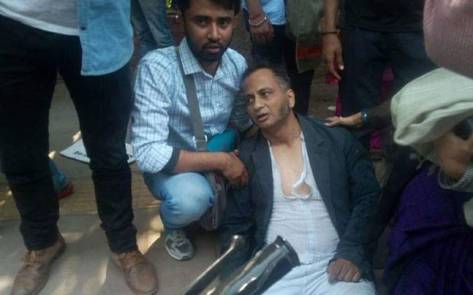
Prasanta Chakravarty, immediately after being assaulted on February 22nd. Image from the India Today Website.
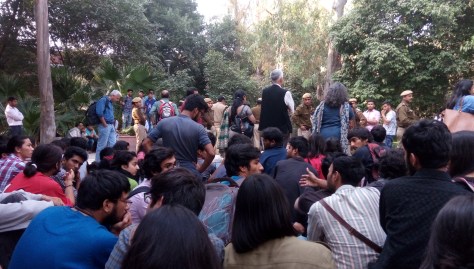
Ramjas students and faculty held hostage inside campus by ABVP cadre
The violence that gripped Ramjas College on the 21st and 22nd of this month is now national news. We heard belligerent slogans by ABVP members of ‘chappal maro saalon ko’ (beat them with slippers), we saw students being chased on the campus, and we saw students being beaten up. All this culminated in a situation where students and teachers were held captive for over five hours within the campus premises. Let me emphasize that this violence was completely unprovoked.
On the 22nd of February, some of the students who were simply sitting with their friends were attacked. The police came and formed a cordon around them. Others joined the students in a gesture of solidarity. Teachers joined them to ensure that the students were not assaulted. The police cordon became their prison for the next five hours. And even then they were not safe.
They were repeatedly assaulted, threatened, and abused. All of this happened in front of their teachers and, more importantly, in front of the police, who, as is well known by now, did not do anything substantial. They could have maintained the cordon around the protesters, arrested those who were repeatedly carrying out the assaults, or – at the very least – prevented the attackers from coming back in (they had left for some time to attack the protest going on outside). But they did not. Whether this was because they were under pressure or because they were complicit is besides the point. The point is that students and teachers remained at the mercy of their attackers for over five hours.
But on the same day something far more ominous was also going on.
We, the undersigned, wish to express our dismay and deep concern about the recent violent events at University College, Thiruvananthapuram, which seem to indicate that the rights of college students, especially women students, are seriously compromised in this venerable institution. As women researchers, academics and teachers of Malayali origin, we are deeply disappointed by the responses of the police, the concerned college authorities, and the teachers there. Continue reading An Appeal to the Education Minister of Kerala and the Teachers of the University College, Thiruvananthapuram→
No certainty where each would go —
Suddenly the descent of a cloudburst, rain.
We stood, each where we were,
And stared at one another.
It is not good to be so close
“Revulsion is born” – someone had said
“Revulsion, revulsion, revulsion.”
Then, lighting a cigarette, some man
Muttered abuse at another next to him.
Like an abstract painting, spiralling like a gyre,
In a wee space
We slowly fragmented, dispersed.
Had it not rained, though,
We would have stepped out together.
Perhaps to the cinema, tasting a woman’s
Half-exposed breast with the eye,
Then laughing out loud,
We could head for the maidan!
Someone maybe would sing; someone
Would say, “I am alive”.
But it rained.
(Krittibas, Sharad Sankhya, 1386)
ঘৃণারজন্ম
প্রনবেন্দু দাশগুপ্ত
কোথায় কে যাবে ঠিক নেই —
হঠাৎ দুদ্দাড় ক ‘রে বৃষ্টি নেমে এলো।
যেখানে ছিলাম, ঠিক সেইখানে থেকে
আমরা পরস্পরের দিকে তাকিয়ে রইলাম।
এত কাছাকাছি থাকা খুব ভালো নয়।
” ঘৃণার জন্ম হয় ” –কে যেন বললো
” ঘৃণা, ঘৃণা, ঘৃণা। ”
তারপর সিগ্রেট ধরিয়ে, আরো একজন
খুব ফিশফিশ ক ‘রে
পাশের লোককে গাল দিলো।
বিমূর্ত ছবির মতো তালগোল পাকিয়ে পাকিয়ে
ছোট্ট জায়গা জূড়ে
আমরা ক্রমশ ভেঙে, ছড়িয়ে পড়লাম।
বৃষ্টি না নামলে কিন্তু
আমরা একসঙ্গে বেরিয়ে পড়তাম।
হয়তো সিনেমা গিয়ে,রমণীর আধ -খোলা স্তন
চোখ দিয়ে চেখে
তারপর, হো হো ক ‘রে হেসে
ময়দানের দিক যাওয়া যেতো !
কেউ হয়তো গান গাইতো ; কেউ হয়তো
বলতো “বেঁচে আছি “।
Guest Post by CONCERNED STUDENTS OF TATA INSTITUTE OF SOCIAL SCIENCES, MUMBAI
We, the concerned students of Tata Institute of Social Sciences (TISS), Mumbai condemn the continuing state repression of adivasis and recent attack on human rights activist Bela Bhatia in Bastar, Chhattisgarh.
On the 23rd of January, 2017, a group of 30-odd men attacked Bela where they barged into her house in Parpa, near Jagdalpur violently and threatened to burn the building down if she did not leave immediately. The mob also attacked her landlords and their children, threatening them with dire consequences if Bela was not evicted immediately. Despite Bela’s assurances that she would leave, the mob continued to be belligerent, in the presence of the police, and the Sarpanch. The mob has been identified with the right-wing vigilante group Action Group for National Integrity (AGNI). Continue reading In Solidarity with Adivasis in Bastar, Human Rights Defenders and Bela Bhatia in Bastar: Concerned Students in TISS, Mumbai→
STATEMENT BY WOMEN AGAINST SEXUAL VIOLENCE AND STATE REPRESSION
WSS welcomes the decisive intervention of the National Human Rights Commission in cases of sexual violence against Adivasi women by police and security forces engaged in anti-Maoist operations in Chhattisgarh. Validating our assertion that sexual violence is being used as a weapon of war in Bastar, the Commission has held the State government “vicariously liable” for gross violations of human rights.
We are publishing below a statement issued by Anand Singh on behalf of Janchetna, Ludhiana
A group of Hindutva goons ransacked Janchetna — an institution dedicated to promote and propagate progressive literature — in Ludhiana on 2 January 2017. They also abused and misbehaved with the book shop manager Binny and manhandled other activists who came to her rescue. They even threatened to put the books on fire. More disturbing, however, was the fact that all this happened in the presence of police which remained a mute spectator to this fascist attack which lasted for two hours. Later, instead of arresting the goons, the police took the activists present there — Binny, Janchetna book shop manager, Lakhwinder , President of Textiles Hosiery Kamgar Union, Gurjeet (Samar), an activist of karkhana Mazdoor Union and Satbir Naujawan Bharat Sabha activists — into custody and sealed the shop. However, due to people’s pressure the activists were soon released and a demonstration of various mass organisations and trade unions compelled the police to let the book shop reopen.
Let’s begin with the usual: by ruing over Indian mainstream media’s overlooking of what could have been treated as more newsworthy. Today, that is, 16th of December, 2016 witnessed a bandh in southern Assam’s Barak valley protesting against the statement by the union minister of state for railways, Rajen Gohain that ‘Bengali…should be withdrawn from Barak valley as official language’ since ‘there cannot be two official languages’.[1] And a simple, layman-like google-news search reveals that there are just three entries on the issue/event.
This piece is aimed not at joining the state Congress and the local SUCI(Socialist Unity Centre of India) cadres who are decrying comment by Gohain, the union minister and a senior BJP leader in Assam but rather at attempting a delineation of the ominous portents which it seems to have unleashed. And of course, to trace the genealogy of the statement.
First of all, a rather facile fact: Mr. Gohain’s observation that there cannot be two official languages clashes with article 345 of the Indian constitution which allows for the adoption of one or more official languages by any state of the Indian union. Article 347 also allows for respecting the desire of a significant section of a populace of a state for the usage of a language of their choice.[2] A couple of months ago, while visiting Assam, I watched, or rather listened, on an Assamese news channel, a shrill voice issuing a caveat to its viewers, “…barak upatyakat asomiya bhasha nokoya hoiche”. ‘Assamese is no longer spoken in the Barak valley’. Anybody remotely familiar with the history of the region could have retorted back with the question, when was Assamese ever spoken in the region?
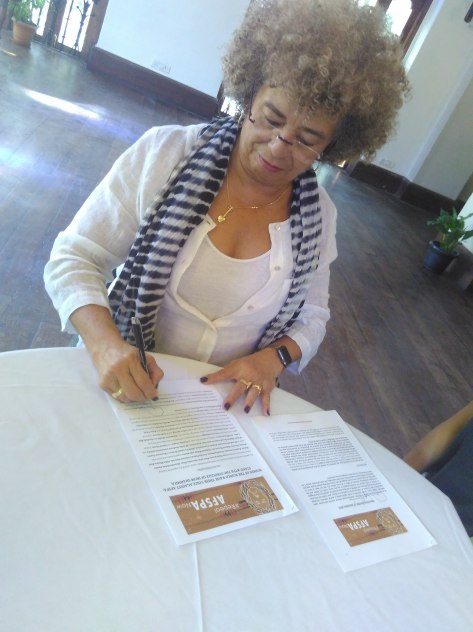
At an exclusive meet-the-press in Mumbai, American black feminist activist and human rights defender, Angela Davis joined feminists in India spearheading a global women’s campaign appealing to the President of India to use his Constitutional powers and repeal the draconian Armed Forces Special Powers Act (AFSPA). In doing so, she extends her solidarity to the struggles of women in India against the impunity granted to security forces under the AFSPA and the consequent widespread violation of rights in all areas where this law has been in force. In particular, Ms Davis salutes the historic struggle of Irom Chanu Sharmila whose 16 year long fast against the AFSPA helped foreground the issue both nationally, and internationally, saying “I am utterly inspired by Irom Sharmila’s strength and perseverance.”
I am writing to you because I feel that it is my duty to disabuse you of the ideas you seem to harbour of, and in the name of, Indian nationalism (and not just bark at the portentous approach of the peddlers of ‘nationalism’, the Hindutvavaadis). You are a Minister in the CPM-led government of Kerala, which was elected by Malayali citizens to ward off the monstrous Hindtuva-Nazi-Predatory Capitalist combine that has taken over India nearly, and so my barking should have been enough. But you seem to be totally wrapped up in your ignorance. Continue reading A Dog Writes to a Minister: Dear A K Balan …→
‘If Trump is elected, I will move to Canada,’ many Americans noted in passing, in jest, and then in all seriousness once the results were out.
If it has taken this election result to make people recognize the pervasive racism in the US, that is because of the success of US exceptionalism and its ability to deflect attention from its ongoing colonization of indigenous land, relentless imperialism, Islamophobia, and ongoing brutalities against black people in the aftermath of abolition and the civil rights movement. If it has taken this election result to make people really want to move to Canada, that too is because of the success of Canadian multicultural exceptionalism. Apparently, Canadian exceptionalism is still able to pass as not-as-racist by deflecting attention from its ongoing colonization of indigenous land, relentless participation in imperialism cloaked all too often as humanitarian development, growing Islamophobia, and its self-congratulatory representation of itself as having no history of slavery even as its anti-Black violence pervades cities and small towns alike.
For those of us who can recognize these forms of exceptionalism, I want to ask if we acknowledge Indian exceptionalism, and its specific relation to Kashmir? ‘If Trump is elected, I will move back to India’, I saw many Indians say on social media. If it has taken this US election result to make Indians really want to move back to India, that is not just because of the apparent success of US exceptionalism among Indians, who could see racism but could ultimately deal with, and even love life in the US. It is also because of Indian exceptionalism. To be sure, Indian exceptionalism is nurtured by the caste and class privilege that allows some Indians to declare that they will simply up and leave when the going gets tough (whether it is in India or in the US), or joke about the same.
But there is more to it. Indian exceptionalism is a state projected discourse turned commonsense perception of India as a complicated and diverse nation that is ultimately unified against all odds by the absolute commitment of its people to democracy. Whether we believe it at face value or we critique the many excesses of the Indian state, ultimately something draws us to this idea of India as the world’s largest democracy. Continue reading On Indian Exceptionalism and Kashmir: Dia Da Costa→
In these insane times in our country and the world, one searches in the past desperately to make sense of the unfolding madness of the present. No wonder people have recalled Muhammad bin Tughlaq in the face of what has been described (rather misleadingly) by the neutral word ‘demonetisation’ – but as many have already pointed out in considerable detail, what we face is much more than a foolishly, irresponsibly-conceived act of monetary governance gone horribly wrong. Caligula is back, and neocaligulaism is the flavor of the season, across the world, one might say.Continue reading Neocaligulaism: Thoughts from Kerala→
PETITION TO THE PRESIDENT, PRIME MINISTER AND HOME MINISTER OF INDIA
We, the undersigned, are outraged by recent charges of murder that have been laid against
Delhi University professor Nandini Sundar, JNU professor Archana Prasad, Vineet Tiwari (of Joshi Adhikar Sansthan, Delhi), Chhattisgarh CPI(M) state secretary, Sanjay Parate, Mangalram Karma, and Manju Kawasi, CPI activist and Sarpanch of Guphidi in Sukma district, by the Chhattisgarh police in the killing of Shamnath Baghel.
The charges are patently fabricated, and follow a pattern of intimidation by the Chhattisgarh police every time evidence is released of their lawless prosecution of the war against the Maoists. Earlier this year, Sundar, Prasad, Tiwari and Parate were part of a fact-finding team that looked at the impact of Maoist violence and state excesses on ordinary villagers in Bastar, finding that they were victims of fake encounters, rapes, arrests, beatings, IED blasts, and killing of informers, implicating Maoists, police, and security forces. The residents of Bastar were also found to be facing the renewal of attacks by civilian militias armed by the state. At that time too, the district administration of Bastar had tried to implicate the fact-finding team on fake charges on the basis of a contrived complaint. More recently, when the police were charge-sheeted on the basis of evidence gathered by Sundar and others for carrying out arson in an operation in 2011, they retaliated by burning effigies of her and other activists and journalists in order to intimidate and incite violence against them.
Sundar and others have put on record their unequivocal condemnation of the killing of Shamnath Baghel. Their writing and interventions on the ongoing war in Bastar have consistently condemned all forms of violence, whether by the state or by the Maoists.
We are saddened by the climate of silencing of dissent that is becoming widespread in India and concerned that the work of researchers, journalists, lawyers and activists is being monitored and controlled to quell critical scrutiny of governmental actions. We believe such silencing of opposing views poses a grave danger to the democratic values of India.





 KAFILA - COLLECTIVE EXPLORATIONS SINCE 2006