Category Archives: Violence/Conflict

A decade on, Gujarat justice incomplete: Human Rights Watch

This release was put out on 24 February 2012 by HUMAN RIGHTS WATCH

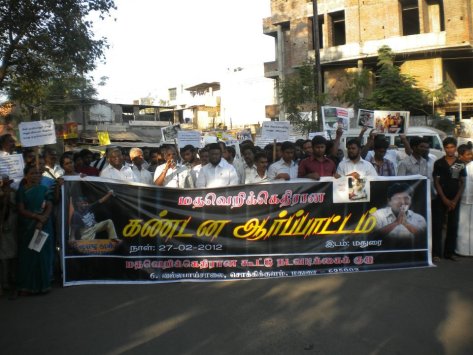
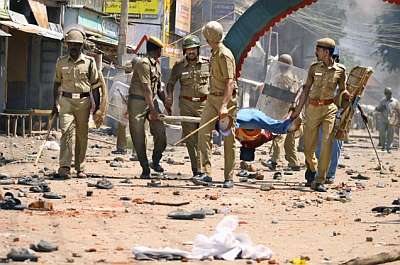
(New York) – Authorities in India’s Gujarat state are subverting justice, protecting perpetrators, and intimidating those promoting accountability 10 years after the anti-Muslim riots that killed nearly 2,000 people, Human Rights Watch said today. The state government has resisted Supreme Court orders to prosecute those responsible for the carnage and has failed to provide most survivors with compensation.

The violence in Gujarat started on February 27, 2002, when a train carrying Hindu pilgrims was attacked by a Muslim mob and caught fire, killing 59 people. In a retaliatory spree by Hindu mobs, hundreds of Muslims were slaughtered, tens of thousands were displaced, and countless Muslim homes were destroyed. Continue reading A decade on, Gujarat justice incomplete: Human Rights Watch

Delhi Police Special Cell – Encounters, Frame-ups, Impunity: Manisha Sethi

Guest post by MANISHA SETHI

An RTI enquiry has revealed that Delhi Police Special Cell’s conviction rate is a paltry 30 per cent. Nearly 70 per cent of the accused it charge-sheeted over the past five years were acquitted for want of credible evidence. Do these figures tell us something? A news story in a leading English daily bemoans this trifling record and quotes a senior police officerattributing this to the fact that “police sometimes get tangled in cross evidences and it becomes tough when you rely more on circumstantial evidences”. [i] This evokes the image of a bumbling policeman, reminiscent almost of Jacques Clouseau, tripping over reams and strings of evidences, in an impossible attempt to build a watertight case against the villains. But Special Cell couldn’t be farther from this sort of cute sloppiness. Continue reading Delhi Police Special Cell – Encounters, Frame-ups, Impunity: Manisha Sethi

Anatomy of an allegedly thwarted coup: Anwar Dayal

Prime Minister Sheikh Hasina

Guest post by ANWAR DAYAL

Bangladesh has seen more coups than Pakistan. It probably came close to one recently, by alleged Islamists in the army. I say probably because when it comes to military intervention in Bangladesh, who-what-why-when have often been unclear. For example, a few majors seized the country’s tanks and killed the founding president and his family in August 1975. Was it a few disgruntled officers with personal disputes, as was claimed by the contemporaneous foreign media? Or was it part of the complicated and brutal Cold War geopolitics, with the involvement of senior officers and politicians, as many believe? Even though the perpetrators of the massacre have been convicted, and a few hanged, Bangladeshis still debate these questions.

It’s been like that for all military interventions over the years. What may have happened in recent weeks is unlikely to be the exception. As such, one should not necessarily conclude that Saleem Samad’s officially sanctioned account in India Today is the full story.

Samad’s narrative goes something like this. Continue reading Anatomy of an allegedly thwarted coup: Anwar Dayal

What the Wall Street Journal Can’t See in India’s Forests: Aruna Chandrashekhar

 Guest post by ARUNA CHANDRASEKHAR

If we cut the entire forest down, where will we live?’- Muria adivasi, Warangal, Andhra Pradesh 

I don’t even know how to begin addressing a story as blindly biased in its premise as this one in the Wall Street Journal, which draws an obtuse line between loss of forest cover and land usage by adivasis, when it is land grab by industrialization that is endangering all we have left.

So I’m going to do this paragraph by paragraph.

India’s forest cover decreased by 367 square kilometers between 2007 and 2009, and it was primarily tribal and hilly regions that were to blame.

The tribal and hilly regions are the last vestiges of India’s forests.  How can you blame entire regions, without casting any aspersions on institutions or practices responsible? Continue reading What the Wall Street Journal Can’t See in India’s Forests: Aruna Chandrashekhar

Jashn-e-Azadi successfully screened at Delhi University despite right-wing threats & police pressure: AISA

Guest post by ALL INDIA STUDENTS’ ASSOCIATION (AISA)

AISA and Students of Sociology Department (DU) Successfully Screen Jashn-e-Azaadi in DU, Braving Attacks and Threats by ABVP and ‘Bhagat Singh Kranti Sena’! Hundreds of Delhi University Students Participate in Film Screening and Discussion with Sanjay Kak, Director of Jashn-e-Azadi!!

Today hundreds of DU students and teachers participated the screening of the documentary film  Jashn-e-Azaadi organized by AISA and students of sociology in the Department of Sociology, Delhi University. “Predictably this screening had to held in the teeth of opposition from right-wing fascist forces like ABVP and the Bhagat Singh Kranti Sena, who tried their level best to stall the screening. Moreover, the DU administration and the Delhi Police also shamefully sided with these forces and tried to pressurize the Sociology department to stop the screening”, said Harshvardhan Tripathi Secretary DU, AISA.

Continue reading Jashn-e-Azadi successfully screened at Delhi University despite right-wing threats & police pressure: AISA

Caste Discrimination in Cyclone Thane in Tamil Nadu and Pondicherry: NDW-NCDHR

A preliminary report of an investigation into caste discrinimation with regard to Cyclone Thane by National Dalit WatchNational Campaign for Dalit Rights  conducted on 18, 19 January 2012

Cyclone Thane

Cyclonic Storm Thane was the strongest tropical cyclone of 2011 within the North Indian Ocean. Thane initially developed as a tropical disturbance within the monsoon trough to the west of Indonesia. Over the next couple of days the disturbance gradually developed further while moving towards the northwest, and was declared a Depression during December 25, before being declared Cyclonic Storm Thane during the next day. As it was named, Thane started to turn towards the west under the influence of a subtropical ridge of high pressure before its development slowed down during December 27, as a strong outflow and marginally favourable sea surface temperatures fought with persistent vertical wind shear. After its development had slowed down during December 27, Thane became a Very Severe Cyclonic Storm during December 28, before as it approached the Indian states of Tamil Nadu and Andhra Pradesh, it weakened slightly. Thane then made landfall early on December 30, on the north Tamil Nadu coast between Cuddalore and Pondicherry and rapidly weakened into a depression.

Cuddalore and Vilipuram Districts in Tamil Nadu and Pondicherry were the worst affected due to Cyclone Thane. All roads in these three districts are line by wreckage of fallen trees including large tracts of Casuarina plantations completely wiped out. The only trees that seem to have withstood the fury of the cyclone seems to be the Borassus flabellifer or the Palmyra Palm. According to government estimates at least 39 people have been killed by this cyclone in Tamil Nadu and 7 in Pondicherry. Apart from the loss of life, the Cyclone left huge destruction in terms of livelihood, particularly agricultural livelihood and ripped apart the green cover in these already arid districts.

Continue reading Caste Discrimination in Cyclone Thane in Tamil Nadu and Pondicherry: NDW-NCDHR

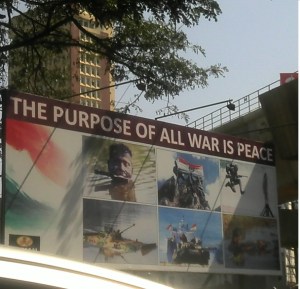
All I want is war and peace

This poster on M.G.Road in the heart of Bangalore, reminded me uncannily of the lines in the marvellous scene in the Mel Brooks film To Be Or Not To Be where he sings All I Want is Peace:

How We Celebrate Freedom

The Hindu reports that a university in Pune has cancelled a planned screening of Sanjay Kak’s 2007 documentary film, Jashn-e-Azadi: How We Celebrate Freedom.

Speaking to The Hindu over telephone, Symbiosis College of Arts and Commerce principal Hrishikesh Soman stated that the ABVP had approached him on Friday, and that the college agreed to cancel the film screening “considering their [ABVP’s] emotions and feelings.” “I told them that the seminar is entirely academic, apolitical and non-religious. But the film has met with criticism from all corners. So we have decided to avoid unnecessary controversies and cancel the screening,” Mr. Soman said. “If people have a very strong reason to protest the film, then we should be tolerant enough,” he stated. [Link]

Shameful as this censorship is, it is a compliment to Sanjay Kak’s fabulous documentary film that the goons of the Akhil Bhartiya Vidyarthi Parishad don’t want people in Pune to see it. The truth about Kashmir must not be told. This is also an example of why the BJP props up its ‘minority morcha’ to oppose Salman Rushdie visiting Jaipur: they want the Congress and the ‘secularists’ and the Muslims to be seen as censor-happy so that they can get away with their own censorship.

Freedom of speech and expression in India, RIP.

Or, not.

Just as Satanic Verses freely circulates on the internet, you can also watch Jashn-e-Azadi online, for free.

Film synopsis:

Continue reading How We Celebrate Freedom

Why Kashmiri Pandits May Never Return to Kashmir: Raju Moza

Guest post by RAJU MOZA

It was in the month of January in 1990 that the onset of militancy in Kashmir resulted in the exodus of Kashmiri Pandits to Jammu, Delhi and elsewhere. Every year since then, January brings back the question of their return to their homes, in the press and increasingly on the internet.

There was something different about it this year. Several recent incidents have given the question of return a new impetus. Continue reading Why Kashmiri Pandits May Never Return to Kashmir: Raju Moza

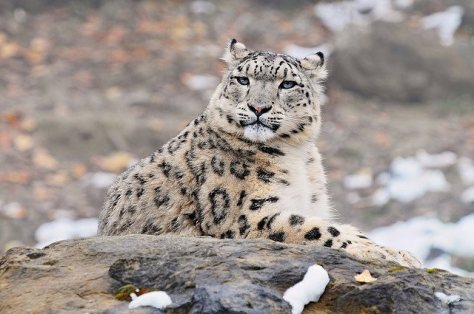
India, Pakistan and the Snow Leopard: Javed Naqi

Guest post by JAVED NAQI

Photo Credit: Flickr User Tambako the Jaguar

Amongst the lesser known casualties of the conflict between India and Pakistan is wild life. In times of war, we hear of the loss of life and property but seldom notice the huge impact on wildlife. Animals found in the vicinity of the disputed India-Pakistan border in Jammu and Kashmir are on the verge of extinction. One such is the snow leopard in the border district Kargil.

Kargil, a district in the state of Jammu and Kashmir is a remote, arid-cold and high altitude area. The region gained in prominence to the outer world after the Kargil War of 1999. Kargil serves as a suitable habitat for many endangered wildlife species like snow leopard, Tibetan wolf (Canis lupus langier), Himalayan brown bear (Ursus arctos isabellinus), Asiatic ibex (Capra ibex), Ladakh urial (Ovis vignei vignei), musk deer (Moschus spp.), pikas, and hares (Maheshwari et al 2010). A joint study by J&K Department of Wildlife Protection and WWF reports 16 direct and indirect evidence of Snow Leopard in Kargil and Drass (Maheshwari et al 2010). Continue reading India, Pakistan and the Snow Leopard: Javed Naqi

In the name of sovereignty: APDP

This release comes from the ASSOCIATION OF PARENTS OF DISAPPEARED PERSONS, the Bund, Amira Kadal, Srinagar – 190001, Jammu and Kashmir

Press Statement, 25th January 2012: On 17th October 2011, Association of Parents of Disappeared Persons (APDP) submitted an application for information under Right to Information Act 2009 to the office of the Public Information Officer of State Department of Home. The application was regarding unmarked graves and mass graves in all the districts of Jammu and Kashmir. The State Home Department vide its letter no: Home/RTI/2011/1659 dated: 24th October 2011, transferred the application to the office of Director General of Police, Jammu & Kashmir. Later Director General of Police, Mr. Kuldeep Khoda sent communiqué vide no. legal/RTI/III/98/2011-5590-91 dated 10th December 2011 to the SSP CID Headquarters, asking him to furnish a detailed report on this issue.

Today, on 25th January 2012, we have received a response from the SSP CID Headquarters vide letter no: CID/GB/RTI/2011/8756-58, in which the CID Department has informed us that the information regarding the unmarked graves and mass graves in all the districts of Jammu and Kashmir cannot be shared as the disclosure of the information, according to Jammu and Kashmir Police would be “prejudicial to the maintenance of public peace and tranquility, as the anti-national elements may use the same for incitement of commission of offence in the state”. The SSP CID Headquarters further states, “In the present security scenario it is quite imminent that consequences of such a situation would be highly prejudicial to the sovereignty, integrity and security of the state”. Continue reading In the name of sovereignty: APDP

Some Questions for the Maharashtra ATS Chief: JTSA

This release comes from the JAMIA TEACHERS’ SOLIDARITY ASSOCIATION

The Maharashtra ATS claims to have cracked the 13/7 blasts case. Its chief has revealed in a press conference that Indian Mujahideen was behind the Mumbai blasts. And yet, the Ministry of Home Affairs remains far from impressed—indeed, it appears rather irritated. And the press, also unusually, has been circumspect about his revelations. The ATS Chief says that he did not want to call a press conference. But the rumours about Naquee’s IB links were threatening the credibility of the ATS. Such were his compulsions when he launched into a monologue about the ‘breakthrough’ his team—under his guidance of course—had achieved.

Despite his loud proclamations however, there are few who are willing to buy the ATS’ arguments. Here are some issues for the ATS Chief to mull over: Continue reading Some Questions for the Maharashtra ATS Chief: JTSA

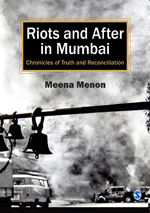
The Gandhi Chawl Incident: Meena Menon

This guest post by MEENA MENON is an extract from her recently published book, Riots and after in Mumbai- Chronicles of Truth and Reconciliation

It was all in the eyes. Beneath the finely drawn brows, they were haunted and distant. For Naina Bane, the night of 8 January 1993 will remain a night of absolute terror. Her escape was miraculous as was her recovery. It took me several months and wrong leads before I met her finally at a family reunion in the suburbs. Dressed in a long mustard coloured ‘maxi’, her hair was drawn back tightly. I found it hard to recognize the same girl who was almost burnt alive on that fateful night in Gandhi chawl. Now 40, there is a faraway look about her and her eyes widen when I ask to speak to her. She got married in 1996 and lives outside Mumbai. Her 6-year-old son keeps her busy. Her husband worked for a mill which closed down, a typical story in Mumbai. He was a badli (temporary worker) and he lost his job. He now works as a watchman. Continue reading The Gandhi Chawl Incident: Meena Menon

The BSF as Pornographer: Bravehearts with Bluetooth

So, this is how the borders of the Republic of India are also defended. With sticks, ropes and bluetooth enabled mobile phones. Eight soldiers of the Border Security Force, hold down a young Bangladeshi man accused of cattle smuggling. He is stripped naked, hogtied and then thrashed. He screams in agony and humiliation. The soldiers act as if they are out on a picnic. They discuss whether or not to give him some tea. Where to hurt him, on which body parts. How big a stick to use on him. Someone says “cut his ear off”. They stroll casually around him as he is humiliated. They laugh. He cries, as people usually do in these circumstances, and seems to call for his mother. Someone, probably one of the soldiers, records it all on video, on the 9th of December, 2010, somewhere along the Indo-Bangladesh border in Murshidabad, West Bengal

Continue reading The BSF as Pornographer: Bravehearts with Bluetooth

Satanic Versus Moronic: How Salman Rushdie Lost the UP Election

Oh, It’s silly season again. (Has it ever not been silly season? Silly me for making a silly rhetorical opening to this post). Anyway folks, aam aur khas janta, baba log and bibi log, it’s time, once monotonously again, for quarantines and piety, for bans and shoe-throwing contests, for frothing at the mouth and froth on the telly. Its Rushdie-Nasreen-Husain Time, again! Ta-Raa! And like a ‘sanjog’ made by a pretend-god in a made up marquee heaven, the stars of ‘Rushdie Time’ are crossed with the suddenly brightly shining stars of what would have otherwise been a lackluster, effigy-tarpaulined, mid-winter provincial election. Ta-Rant-Ta-Raa! Not even a Saleem Sinai or a Gibreel Farishta, let alone a jeeta-jagtaa Salman Rushdie in his weirdest magic-realist moment could have imagined himself mixed up in a plot as diabolical as this one. If this was a court case we could call it Satanic versus Moronic.  Whatever it is, there is no denying that it is a P2C2E – a ‘Process Too Complicated To Explain’. But explain we must. Process we can. Pyaar kiya to darna kya?

Continue reading Satanic Versus Moronic: How Salman Rushdie Lost the UP Election

PUCL condemns those opposing Salman Rushdie’s visit to Jaipur

This release comes from the PEOPLE’ S UNION FOR CIVIL LIBERTIES, RAJASTHAN

16 January 2012, Jaipur: PUCL strongly condemns Muslim organisations, the Congress and the BJP for opposing Salman Rushdie’s proposed visit to Jaipur

Some Muslim organisations have opposed Salman Rusdie’s participation in the Jaipur Literature Festival. Leaders of the Congress and the Bhartiya Janta Party have also come out strongly in opposition to Rushdie’s visit. Some newspaper reports have carried announcements that Rushdie could be forcibly prevented from coming and attending the literary event.

The opposition is not merely ideological but is also by threatening to disturb law and order. The Rajasthan unit of the PUCL expresses deep concern at such announcements. Such regressive threats are not only an attack on the individual’s right to freedom of speech and expression and a violation of rights granted by the Constitution of India. Such threats also promote communal disharmony, if not deliberately seek to widen communal rifts.  Continue reading PUCL condemns those opposing Salman Rushdie’s visit to Jaipur

Paramakudi – Six Poems: Ravikumar

In September last year, the Tamil Nadu police killed six Dalits in a firing incident in Paramakudi town of Ramanathapuram district. This guest post by RAVIKUMAR is a set of six poems on the Paramakudi killings. The English translation by RAVISHANKER is followed by the Tamil original. For more on the incident, see articles in Kafila archives by V. Geetha and Bobby Kunhu and over at Atrocity News, a fact finding report (.pdf).

Continue reading Paramakudi – Six Poems: Ravikumar

Partition Revisited: 2 October 2011, Rudrapur

This is a film by RAJEEV YADAV and SHAHNAWAZ ALAM of the Uttar Pradesh unit of the PEOPLE’S UNION FOR CIVIL LIBERTIES

This is to introduce our documentary film ‘PARTITION REVISITED’ on the Rudrapur riot of 2nd October 2011, where four persons were killed. Policemen and mobs led by leaders of the Bhartiya Janta Party, the Congress and the Bahujan Samaj Party had ransacked shops and settlements of Muslims in their third successful attempt within two years to stoke communal violence. The riot, which took place on Gandhi Jayanti, led to a massive outmigration of the victimised community, reminding one of the days of the 1947 Partition. This film focuses on precisely this yet unnoticed phenomenon that we could trace out in this first-ever state-sponsored communal riot since the formation of the hill state of Uttarakhand, engineered by the Rashtriya Swayamsewak Sangh, which has been working for a long time in this area to arouse anti-Muslim sentiments in the Bengalis, Sikhs & Panjabi Hindus who settled in Rudrapur after the Partition to India. At a time when the state is going to polls this riot assumes an electoral importance.

JTSA lists some more ‘genuine’ encounters in Delhi for the Home Minister

This release comes from the JAMIA TEACHERS’ SOLIDARITY ASSOCIATION

Mr. Chidambram,

You say there shall be no re-visit of the Batla House encounter. You are of course absolutely right. All those agencies who conducted the encounter have already given themselves a clean chit. What further proof could be required of the genuineness of the encounter than the fact that no less than Karnail Singh, Joint Commissioner of Police, Special Cell, Delhi, (who by the by, was also trying to derail the probe into Ishrat Jahan encounter) wrote to the Lt Governor and the NHRC vouching for the innocence of their gallant heroes. Speaking of gallant heroes, we are sure it has been brought to your notice—or maybe it hasn’t—that some of the brave hearts of the Delhi Police Special Cell have been indicted by the courts in the past couple of years for scripting and executing fake encounters. These are the very men whom you have been felicitating with gallantry awards and Presidents’ medals. But Sir, rest assured, we are not asking what sort of democracies fete and glorify killers. Our kind, of course. Continue reading JTSA lists some more ‘genuine’ encounters in Delhi for the Home Minister

On the Srinagar Sharia court’s statement against Christian pastors: AICC

This release comes from ALL INDIA CHRISTIAN COUNCIL comes to us via John Dayal

All India Christian Council concern at Srinagar Sharia court statement against Christian pastors

New Delhi, 13 January 2012

The All India Christian Council is deeply disturbed at the Srinagar based Sharia Court issuing a statement against Christian pastors Jim Borst and C M Khanna Srinagar, Jan 11: Supreme Court of Islamic Sharia Wednesday indicted Christian Pastor C M Khanna and Dutch national, Jim Borst for their involvement in luring people to convert their religion. The Sharia court has threatened it will issue a sentence shortly. Such statements can encourage extremist elements to indulge in violence, the Council fears. Continue reading On the Srinagar Sharia court’s statement against Christian pastors: AICC

Nepal – The Nostalgia for 1990

Kanak Mani Dixit’s efforts to portray 1990s as blissful, and Maoists to solely blame for all of Nepal’s ills, is revisionist history, facts be damned. Dixit’s rejoinder (‘The perils of executive presidency’, Jan 5) to my column (‘A question of form’, Jan 4) reveals fundamental differences in how we see recent Nepali history. The gist of Dixit’s rather simplistic world view is that the 1990s were wonderful and the Maoists destroyed it and are all evil. Let us examine this in more detail.

The 1990s

The 1990 constitution opened up Nepali society; it guaranteed fundamental freedoms and allowed groups to organise themselves at all levels; and economic policies pursued then led to the creation of a bigger middle class.

But there were two fundamental drawbacks of that period, which is what led to its eventual breakdown. Continue reading Nepal – The Nostalgia for 1990