Category Archives: Violence/Conflict

Afghan Women Protest New Law on Home Life

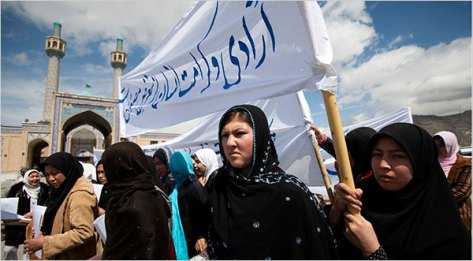
About 300 Afghan women, facing an angry throng three times that number, walked the streets of Kabul on Wednesday to demand that Parliament repeal a new law that introduces a range of Taliban-like restrictions on women, and permits, among other things, marital rape.

Afghan women demonstrate against new law, courtesy NYT

‘The young women stepped off the bus and moved toward the protest march just beginning on the other side of the street when they were spotted by a mob of men.’

‘”Get out of here, you whores!” the men shouted. “Get out!”….It was an extraordinary scene. Women are mostly illiterate in this impoverished country, and they do not, generally speaking, enjoy anything near the freedom accorded to men. But there they were, most of them young, many in jeans, defying a threatening crowd and calling out slogans heavy with meaning.’ Read the full story by Dexter Filkins here.

[Courtesy: SACW]

The Tragedy of Politics in Sri Lanka

I am posting below an article that I wrote with Cenan Pirani.  The shorter version of this article is in Combat Law. The longer version below delves into the history of left politics in Sri Lanka and attempts at a political solution.  Another article by me reflecting some of these concerns and raising questions of solidarity titled ‘The Challenges of Solidarity’ was published in Red Pepper.

The Tragedy of Politics in Sri Lanka

By AHILAN KADIRGAMAR and CENAN PIRANI

In the last few months, the Sri Lankan security forces have managed to ruthlessly push the LTTE into a 40 square km strip of land in the North of the island, and along with the LTTE leadership and its cadres, a sizable civilian population, anywhere from seventy thousand to one hundred and fifty thousand, have also been cordoned off in this area.  As the security forces continue their offensives purporting to rid Sri Lanka of the LTTE, they also claim the lives of these civilians daily. Continue reading The Tragedy of Politics in Sri Lanka

Who Is Responsible For The Slaughter Of Civilians In The Vanni?: Rohini Hensman

guest post by ROHINI HENSMAN

With the military defeat of the LTTE imminent, the terrible plight of civilians in the Vanni has attracted worldwide concern and sympathy, and rightly so. While the circumstances are completely different, the civilian death toll in the Vanni over the past few months (over 2700) is already triple the number of civilians killed in the Gaza massacre of December-January, and is still mounting. The thousands who suffer serious injuries are further victimised by the delay or lack of medical attention, which means, for example, that injuries to limbs which could have been saved with prompt treatment, instead result in gangrene and amputations. Even those who have not lost lives, limbs or loved ones, have lost their homes and livelihoods, and live in appalling conditions which could well claim more lives through disease or even starvation.

Meanwhile, the LTTE and Government of Sri Lanka (GOSL) trade charges, each accusing the other of being responsible for the slaughter. What truth is there in their respective allegations? Continue reading Who Is Responsible For The Slaughter Of Civilians In The Vanni?: Rohini Hensman

Report on the Batla House ‘encounter’

The Jamia Teachers’ Solidarity Group has released a report on the Batla House ‘encounter’ which they have requested Kafila to put up.

You can read the report below, and also download it from here.

You can find all of Kafila’s posts on the Batla House incident here.

Synopsis:
This report is based on police statements, press reports, testimonies of families and friends of the accused and other documentary evidence. It highlights the numerous contradictions in the police version(s) about the ‘encounter’ and the accusations.

Continue reading Report on the Batla House ‘encounter’

Where have they disappeared?

Aman Kachroo is not the first teen to die of ragging. But there is one curious first: this time the death has not led to any ‘public debate’.

This time the defenders of ragging are silent. Who knows, maybe some of them have changed their views and are now lighting candles at Jantar Mantar. There are no TV debates calling ragging fun. This time no one is arguing that a murder case should not be used to defame the socially productive ‘tradition’ of ragging. This time nobody is asking how boys will become men unless they are ragged, and nobody is calling the victims sissies.

What has changed? Continue reading Where have they disappeared?

The Shame of A Name

This has never happened to me before. But then, there is always a first time for everything in life.

My name is Zainab Bawa.

“Are you Punjabi?”

“Are you Parsi?”

“What are you?” Arjun bhai, the hawker outside VT station had once asked me. “Muslim,” I had replied. And then, very bashfully, he said to me, “Just asking. Could not make out. You speak such good Marathi. And then, after all, we are all of the humanity kind – you cut my finger, the blood that oozes out will be the same as yours.” Continue reading The Shame of A Name

SS Stormtroopers attack OBCs celebrating Shiv Jayanti

(Apologies for posting a mere press release, but it’s something important and yet I don’t think it will be ‘interesting’ enough for the ‘national’ media to pick up. This is not to take sides at all, because there are no sides to take.)

RASHTRIYA SAMAJ PAKSH

PRESS RELEASE

Rashtriya Samaj Paksh, Shiv Jayanti meeting attacked by Shiv Sainiks in Mumbai

The Shiv Sena once again proves that it is a Brahmanical party by attacking OBC’s

Mumbai – February 23, 2009

A meeting that was organized by the activists of the Kurla unit of the Rashtriya Samaj Paksh (RSP) was attacked by Shiv Sainiks. The SS storm troopers, numbering 50, unleashed their fury on the meeting, shouting slogans, attacking the people and throwing chairs. The very fact that the Shiv Sainiks attacked Shiv Jayanti celebrations organized by the OBC (Other Backward Caste) activists, namely the Dhangar community (Shepherds) has once again exposed the Manuwadi – Brahmanical character of the Shiv Sena. Continue reading SS Stormtroopers attack OBCs celebrating Shiv Jayanti

A Fragile Peace in Nepal

In the six months that Maoist chairman Pushpa Kamal Dahal ‘Prachanda’ has been Prime Minister, he has realised that running a state is more complex than waging a war.

Since mid-August when he took charge, the PM has had to deal with multiple challenges – an intense ideological debate within his party; a deadlock in the peace process; breakdown of consensus with the G P Koirala led Nepali Congress (NC); acrimony between the defence ministry and Nepal Army (NA); opposition from sections of civil society suspicious of Maoist commitment to democratic norms; rampant lawlessness in the eastern Tarai and ethnic assertion in eastern hills; the collapse of basic services with 16 hour power cuts; and the impact of the global meltdown with remittances dipping. Continue reading A Fragile Peace in Nepal

A Kingdom of Crabs…

A kingdom of crabs ascends

here on stones

heavy enough to sink our faith

if we tie it to them.


But a mile away

from this promenade

my friend sucking a succulent crab leg

quips, the only way to pin

these bastards down

is to press with the index finger

their carapace to the ground.


Ah! The heavist thing

these legs carry

makes them a morsel

for a sea screaming I’m hungry!


Cheers!

A Hundred Years to Valentine’s Day

The Manglore-style of violence against women is clearly not the style of the politically powerful guardians of sexual morality in Kerala. But maybe the style is more or less redundant over here: there are very few pub-going local (or local-looking) women over here. How convenient for us women of Kerala that we Malayalees live in social arrangements that insist on sexual segregation in public spaces and institutions.

This is of course related to the particular history of gender and spatiality that unfolded between the mid-19th and 20th centuries in Kerala.Spatial categories have always underwritten caste and gender exclusion in Malayalee society. Take for instance, the derogatory term chanthapennungal (‘market women’) that refers to women who get their way through loud and vociferous argument – who work for their livelihood in market-space and reject feminine modesty. The chanthapennu is the very antithesis of taravattil pirannaval (‘she who was born in an aristocratic homestead’). Thus the woman whose daily life and labours involves traversing spaces outside the domestic and the familial is forever poised at the brink — she is who may, at any instant, collapse into being chantappennu.In traditional Malayalee society, family spaces were named by caste and constructed through caste practices and gender norms. For instance, the Brahmin home was referred to as Illam or Mana; the Nair homestead as Taravadu or Idam.In other words, a generalized notion of domestic space housing the family was absent.  Indeed, the observance of spatial regulations was often taken to be crucial in shaping feminine moral qualities found characteristic of the aristocracy — and hardly vice-versa.

Continue reading A Hundred Years to Valentine’s Day

Interview with Ragavan on Tamil Militancy (Early Years)

As the Tamil community in Lanka is at the crossroads with twenty five years of war nearing an end with the increasing marginalization of the LTTE, I would like to do a series of interviews on the social, economic and political conditions that led to the emergence of armed politics and militarization of the Tamil community.  Returning to those years in the seventies and early eighties then is an attempt to also think about ways forward out of the militarized and armed politics of the last few decades.  I intend to do a series of interviews to capture that important political period for Lankan Tamils.  This important shift in Lankan politics and the decades of war that followed it did irreparable damage to the Lankan Tamil community and all the peoples of Lanka.

I begin with an interview of Ragavan, a founding member of the LTTE, who left the movement in 1984 and has since moved to London where he lives in exile.  In this first interview, Ragavan speaks about his background and early years of militancy.

This is an interview by Ahilan Kadirgamar of Ragavan at his London home on 25 January 2009. Continue reading Interview with Ragavan on Tamil Militancy (Early Years)

India’s Terror Dossier. Further Evidence of a Conspiracy: Raveena Hansa

This guest post has been sent to us by RAVEENA HANSA

On 5 January 2009, the Indian government handed a 69-page dossier of material stemming from the ongoing investigation into the Mumbai terrorist attacks of 26-29 November 2008 to the Pakistani government. This was subsequently made accessible to the public, so it is possible for us to examine it.

The most striking point about the dossier is its vague and unprofessional character. Enormous reliance is placed on the interrogation of the captured terrorist, Mohammed Amir Kasab, despite the fact that there is an abundance of other evidence – eyewitness accounts, CCTV and TV footage, forensic evidence, etc. – which could have been called upon to establish when, where, and what exactly happened during the attacks. This gives rise to the suspicion that the interrogation is being used as a substitute for real investigation because it can be influenced by intimidation or torture, whereas other sources of evidence cannot be influenced in the same way.

Continue reading India’s Terror Dossier. Further Evidence of a Conspiracy: Raveena Hansa

Jayampathy Wickramaratne on Political Solution in Sri Lanka

I am posting a longer version of an interview with Jayampathy Wickramaratne.  The February 2009 issue of Himal Southasian, a special issue on Sri Lanka, has a shorter version of this interview.  At a time when there is much concern about the ongoing humanitarian catastrophe there have also been increasing voices calling for a political solution.  On the history of displacement and humanitarian concerns with the twenty-fire year war in Sri Lanka, I recommend Rajan Hoole’s article in Himal.  This interview with Jayampathy Wickramaratne might engage those interested in past attempts at a political solution as well as the problems with the 13th Amendment (which came out of the Indo-Lanka Accord of 1987 and is currently being talked about both in Sri Lanka and India).

Ahilan Kadirgamar talked to Jayampathy Wickramaratne, who is President’s Counsel, a constitutional lawyer, a former senior advisor for the Ministry of Constitutional Affairs, and a member of the team that drafted the 2000 Constitution Bill.  Wickramartane was a member of the panel of experts to assist the All Party Representative Committee and signatory to the “Majority Report” (December 2006) that proposed extensive restructuring of the state, with extensive devolution and power sharing at the centre.   Wickramaratne is a politburo member of the Lanka Sama Samaja Party. Continue reading Jayampathy Wickramaratne on Political Solution in Sri Lanka

Dead Hence Guilty?

“Governments have always lied. They naturally deny it, even long after it is abundantly clear that they have lied, trailing multiple red herrings, dismissing inconvenient evidence, implying that there is counter-evidence they are not free to produce. When a lie can no longer be credibly denied it is justified, usually by an appeal to the national interest. Governments of modern representative democracies are no different, even if they are more liable than dictators to be exposed.”
Colin Leys, Quoted in Socialist Register, 2006

The National Capital Region (NCR) witnessed a police encounter on the eve of the republic day. Two young men who were supposedly carrying a big cache of arms and ammunition were killed on the spot. We were told that this duo was part of a larger LeT module, which wanted to wreak havoc in the capital.
The killings of the two young men did not cause much uproar.
The police officers appeared jubilant over this episode for foiling such attempt. To blunt any possible criticism of the incident a due enquiry was also ordered by the powers that be and has even promised that it would be completed in a stipulated time.

Continue reading Dead Hence Guilty?

Beyond violence and non-violence – K Balagopal

Via Jamal Kidwai

[We are posting this piece by K Balagopal, hoping to continue our reflections on violence and non-violence in political movements. – AN]

The public arena is witness to dispirited discussion of the ineffectiveness of people’s movements, which are at the most able to slow down things, and nothing more. The discussion often turns around violence and non-violence, not as moral alternatives but as strategic options. Those who are sick of sitting on dharna after dharna to no effect are looking with some envy at violent options,
while many who have come out of armed groups find the Narmada Bachao Andolan (NBA) fascinating.

It is good that there is some openness in the matter now, for dogmatic attitudes have done considerable harm. To say that one should not be dogmatic about violence may be morally a little unsettling but it is a defensible position even without adopting a relativistic attitude towards the preciousness of life or a casual attitude towards one’s moral responsibility for injury caused in the course of a struggle. More of that in the right context. But the
discussion will unavoidably be based on assessments  of the effectiveness of the alternatives, and a distant view is likely to colour the reality with hopes and assumptions, even illusions. A realistic assessment of what each strategy has been able to achieve would better inform the debate.

The plain and stark fact is that while all strategies have been effective in curbing some injustice, none has succeeded in forcing the government to take back a single major policy in any sphere. And none has been able to reverse the trends inherent in the structures of society and economy. Yet no serious political movement or social struggle we know of is only for softening oppression or improving relief. The general understanding is that governance of the country – and may be the systemic infrastructure of society – is fundamentally wrong and needs remedying, maybe overturning. Do we know of any
effective strategy for that? I am not talking of political strategies,
but strategies of struggle that will successfully put pressure upon the State and the polity to stop them in their tracks. The struggle may be built around class or caste or any other social combination. It may in the end seek reform or the upturning of the polity. It may operate mainly or in part within the polity or keep out of it altogether. Whichever it is, the common problem is this: the experience of this country is that governments do not stop doing some thing merely because it has been demonstrated to be bad. Or even contrary to constitutional directives and goals. They stop only if going along is made difficult to the point of near impossibility. No democratic dispensation should be thus, but Indian democracy is thus. Short of that, you demonstrate the truth of your critique till you are blue in the face or shout till you are hoarse in the throat, it is all the same.

Continue reading Beyond violence and non-violence – K Balagopal

Are you an Al Badr militant?

CBI irked by special cell for framing 2 informers as terrorists

Fresh probe needed against two suspected terrorists: Delhi Police

CBI, Special Cell in row over terror suspects

CBI for discharge of two alleged Al-Badar terrorists

Police official hampering probe, CBI tells court

Special Cell threatening officer: CBI

Court to hear two probe agencies in framing youths as terrorists

“Why?”

(Uma Singh, a journalist with Radio Today in the southern town of Janakpur in Nepal, was killed on 11th January 2009. The Federation of Nepali Journalists has mounted a campaign asking for immediate action against Uma’a killers and a firm commitment by the government to the freedom of press. Uma’s killinng comes in the wake of attacks on different media houses in Kathmandu. Like Lasantha Wickrematunge in Sri Lanka, Uma was killed for writing and speaking fearlessly at the other end of Southasia.)

Janakpur: It was impossible to believe that Uma Singh at Ganga Sagar Ghat on Tuesday morning – an FNJ flag draped over her still body, face bandaged all across, the cuts on the head visible – was the same Uma I had met two months ago.

Uma’s looks were deceptive, for the tiny frame contained abundant energy. By the time I strolled into Radio Today’s studio at 6 am in mid-November, Uma had wrapped up her morning bulletin. She was running around the office and passing instructions in a matter-of-fact professional way

She briefed me on the format of Janakpur’s most popular Maithili political discussion show, Garma garam chai. I still remember how Uma said to both her co-anchor and me, “Please avoid English words. The programme is meant for people in villages.” I nodded, a little ashamed my Maithili was not as fluent. Continue reading “Why?”

Hindutva Terrorism in Karnataka

A Karnataka dacoit with links to a radical Hindu rightwing group has confessed to having carried out the Hubli district court bombing of May10, 2008.

The blast took place as the first phase of polling for the Karnataka Assembly elections was on – in a magistrate’s courtroom where cases against top SIMI leaders including Safdar Nagori were scheduled to be heard two days later.

(Dacoit with Hindu outfit links behind Hubli blast, Indian Express, January 13, 2009.

Does anybody remember the bomb blasts in Hubli (Karnataka, May 2008 ) courts last year when preparations were on for the coming state assembly elections? These blasts which took place on a holiday did not witness any casuality although they extensively damaged the court premises. But the most important part played by these blasts was the atmosphere it created in favour of the BJP.

As it always happens after any such mysterious sounding blasts, many innocents belonging to minority community were illegally detained and quite a few among them also were booked for their ‘role’ in the blasts. The police had promptly claimed that ‘sleeper cells belonging to LeT and SIMI’ had executed the blasts. Continue reading Hindutva Terrorism in Karnataka

Chavez Expels Israel’s Ambassador, Becomes New Palestinian Hero

Via Liberation News Service

Venezuelan leader accuses Israel of being ‘murder arm’ of US, says solution to Gaza crisis is in Obama’s hand.
Report by Anna Pelegri of Middle East Online – BETHLEHEM, 12 January 2009

Demonstrators in Yemen
Portraits of Chavez carried by demonstrators in Yemen

“Venezuelan flags and portraits of President Hugo Chavez have been flying high during protests in the West Bank against Israel’s assault on the Gaza Strip”, says the report.

The report continues:

The Venezuelan president’s decision on January 6 to expel Israel’ ambassador from Caracas — the only country apart from Mauritania to take such a step — has made the left-wing South American leader a hero to Palestinians.

Hamas has welcomed Chavez’s “courageous decision,” while Hassan Nasrallah, head of Lebanon’s Hezbollah group, urged Arab states to follow the Venezuelan president’s example.

ग़ाज़ा, इस्राइल और इस्राइल बनने की मंशा

प्रणव मुखर्जी से किसी पत्रकार ने पूछा कि क्या भारत पाकिस्तान में वैसी ही कार्रवाई करेगा जैसी इस्राइल गाज़ा में कर रहा है. शुक्र है कि हमारे विदेश मंत्री ने  यह कहना ज़रूरी समझा कि इस्राइल की तरह भारत ने किसी और की ज़मीन पर कब्जा नहीं कर रखा है. इस सादे से तथ्य को कहना आजकल गनीमत है क्योंकि हमारे आदर्श बनते जा रहे अमरीका में फिलीस्तीनीयों को ही इस रूप में पेश किया जा रहा है मानो वे ही शांति से रहने वाले इस्राइलियों को चैन से नहीं रहने दे रहे. तो क्या यह मान लिया जाय कि हमारी याददाश्त भी ‘गजनी’ की तरह सिर्फ पंद्रह मिनट की रह गई है? क्या हम यह भूल गए है कि गाज़ा के उस पतली सी पट्टी में जो पिछले साठ  साल से पीसे जा रहे हैं वे एक ज़िओनवादी राज्य इस्राइल की स्थापना के लिए उनकी अपनी ज़मीन से उखाड कर फेंक दिए गए लोग हैं?

ग़ाज़ा पर इस्राइली बामबारी, सा�ार बीबीसी
ग़ाज़ा पर इस्राइली बामबारी, साभार बीबीसी

अगर हम साठ साल की बात को याद नहीं रखना चाह्ते तो क्या हम यह भी भूल गए हैं कि  अभी दो ही साल बीते हैं कि फिलीस्तीन की जनता ने हमास को चुनाव में बहुमत दिया था! क्या हमें यह भी याद दिलाना होगा कि हमास की चुनावी जीत को इस्राइल, अमरीका , युरोप और उनके पिट्ठू फतह ने मान्यता देने से इंकार कर दिया था?

एपी
बमबारी का एक और नज़ारा, तस्वीर: एपी

हमास एक आतंकवादी संगठन नहीं है, जैसा अमरीका और इस्राइल चाह्ते हैं कि उसे माना जाए, वह फिलीस्तीनी जनता का वैध प्रतिनिधि है. क्या चुनाव में उसकी जीत को मानने से इनकार  वैसा ही नहीं जैसा मुजीबुर्रहमान की जीत को मानने से तब की पकिस्तानी हुकूमत का इंकार ? उसका नतीजा था  पाकिस्तान का  विभाजन और बांग्लादेश के रूप में एक नए राष्ट्र का जन्म. यहां अंतर सिर्फ यह है कि हमास ने गाज़ा पट्टी पर संघर्ष के बाद नियंत्रण कर लिया. तब से इस्राइल के कहने पर अमरीका समेत पूरे विश्व ने हमास का बहिष्कार कर रखा है. क्या हम इसकी कल्पना कर सकते हैं कि भारत में भारतीय जनता पार्टी के चुनाव में जीतने के बाद उसकी राजनीति से असहमति रखने के कारण उसे मान्यता न दी जाए?

Continue reading ग़ाज़ा, इस्राइल और इस्राइल बनने की मंशा

Speech and silencing on the Right and Left

Lasantha Wickrematunge, the courageous editor of Sunday Leader, a weekly newspaper from Sri Lanka, was recently assasinated by the Sri Lankan state. Relentless in exposing corruption and human rights abuses, he was fully aware of the price he would have to pay. In a stunning editorial that he appears to have written for publication in the event of precisely such an eventuality, and which was published after his death, he directly accuses the government of killing him:

“It is well known that I was on two occasions brutally assaulted, while on another my house was sprayed with machine-gun fire. Despite the government’s sanctimonious assurances, there was never a serious police inquiry into the perpetrators of these attacks, and the attackers were never apprehended. In all these cases, I have reason to believe the attacks were inspired by the government. When finally I am killed, it will be the government that kills me.”

His words of farewell are defiant:

“If you remember nothing else, remember this: The Leader is there for you, be you Sinhalese, Tamil, Muslim, low-caste, homosexual, dissident or disabled. Its staff will fight on, unbowed and unafraid, with the courage to which you have become accustomed. Do not take that commitment for granted. Let there be no doubt that whatever sacrifices we journalists make, they are not made for our own glory or enrichment: they are made for you. Whether you deserve their sacrifice is another matter. As for me, God knows I tried.”

Meanwhile, in Nepal, the premises of Himal media were attacked by people identified as Maoist activists. Today the ‘bourgeois’ media, tomorrow – dissenting Left voices…?