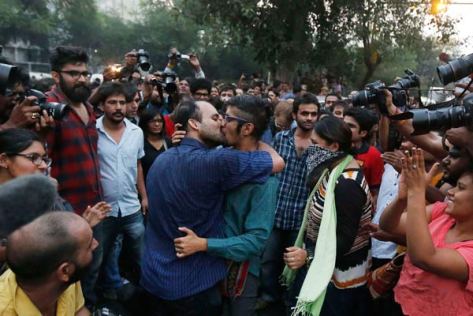
Images from Kiss of Love Gathering in Delhi: Ishan Tankha

Guest Post by ISHAN TANKHA

Every time my girlfriend puts her arms around me while we are out  on our terrace i end up first doing a quick scan of the windows that look down at us to see if we are visible to anyone, it’s almost  an instinctive reaction. Mind you, one that doesn’t win me much affection from her ,understandably! It’s not that I care but I do notice them looking, and it’s always disapproving. Unfortunately, It’s not just my neighbours.

After the ‘Kiss of Love ‘ protests in Kochi and Kolkota it was Delhi’s turn and the few hundred who turned up to stand up for their right to not be morally policed did a fantastic job countering the right wing hooligans, for whom showing love or affection to one of our choosing is ‘immoral’.  The police spent it’s time not allowing the peaceful protesters from marching to the RSS headquarters, their intended destination, pushing and shoving them.  While pleading with, instead of arresting those who threatened and abused with impunity.

It’s not over of course, if it’s not a skirt wearing girl being stopped from entering a building or a cafe being trashed, there will be another reason to collect and be heard.
Maybe tomorrow we’ll give my neighbours a matinee to gawk at.Meanwhile, here are some pictures I took at the Kiss of Love gathering in Jhandewalan, Delhi.

Continue reading Images from Kiss of Love Gathering in Delhi: Ishan Tankha

Whither Social Movements? Exploring the Problematic and Action Strategy: Soumitra Ghosh

Guest post by SOUMITRA GHOSH

The context

One of the biggest and most visible problems plaguing the anti-capitalist social movements of today is the statist framework which conditions, shapes and governs their thoughts and actions. Thus the political praxis which should ideally be moored in a post-capitalist (hence post-state) vision of society, is seldom reached, and the movements are stuck in the morass of extremely limited actions informed by their purely normative and emotive thoughts about how the present society should function. The war-cry of justice is aired, millions take to the street demanding it, yet this ‘justice’ is rarely explained in terms of the real and the grounded. It is taken for granted that the state will be transformed from its overtly pro-capital avatar to a more radical one by this means or another because the movements want it to change: what is forgotten is that history has seen hundreds of experiments with such ‘changed’ states—each one of which failed in the long run, and led to a more coercive rule of capital.

Also, today’s social movements are non-violent and democratic, which in reality means that they prefer working within the framework of parliamentary democracy, and where that is absent, fight for it. Once again, the history of the institution of parliamentary democracy is forgotten: willy-nilly, it’s ignored that historically—more so going by today’s neo-liberal situation—such democracy is intrinsically linked with capitalist production systems and the hegemony of capital in both our societies and polities. Continue reading Whither Social Movements? Exploring the Problematic and Action Strategy: Soumitra Ghosh

B Hridayakumari in My Garden: A Loving Memory

I cannot write the standard obituary. The obituary is expected to hold back grief in sedate, decorous ways, remember the departed person’s best qualities with quiet dignity, and forgive her less admirable aspects gracefully. When I try to write an obituary, I usually trip over my own grief and the terrible ache that the memories of the deceased one’s physical presence produce — the turn of the head, the peculiar contortion of lips forming a smile, the wave of a hand.(I cannot write obits for people I don’t feel for). To get away from that, I quickly turn to the personality, and here I find myself mired, completely unable to separate neatly those qualities that drew my admiration and those which I hated and hurt me. Far from sounding dignified, the obituary ends up structured quite like intensely physical mourning, only that it will be composed in words.

Continue reading B Hridayakumari in My Garden: A Loving Memory

Feed The Poor, Go To Jail

image : Courtesy eideard.com

Whether serving food to the homeless is a crime?

Ask Arnold Arbott, known as Chef Arbott, a 90 year old man from Fort Lauderdale, Florida, who along-with two other members of a Church charity faces potential jail term for at least six months for the same ‘offence’. In fact his name finds prominent mention in the police records in the past week for breaking the new city ordinance which has come into effect recently which characterises his act as breach of law, according to reports.

Talking to a newsperson he said:

“These are the poorest of the poor. They have nothing. They don’t have a roof over their head. And who could turn them away?”

Continue reading Feed The Poor, Go To Jail

‘Kiss of Love’ in Delhi, confronting the RSS: Vasundhara Jairath and Bonojit Hussain

Guest Post by Vasundhara Jairath and Bonojit Hussain 

In the first of its kind in India, youth in Kochi launched a campaign called ‘Kiss of Love’ to challenge the moral policing of the Hindu Right. While that protest was attacked by right wing thugs and suppressed by the police, this form of protest has since spread to different parts of the country like Hyderabad, Bombay and Calcutta. Today, the ‘Kiss of Love’ protest was held at nowhere short of the Rashtriya Swayamsevak Sangh (RSS) head office in New Delhi. A few individuals took the initiative and gave a call for this protest on Facebook with the title, ‘Sanghi Gunde Hoshiyar, Tere Samne Karenge Pyaar’ (Sanghi thugs beware, we will love in front you). Continue reading ‘Kiss of Love’ in Delhi, confronting the RSS: Vasundhara Jairath and Bonojit Hussain

This is What Frightens Them….

And the struggle continues, image courtesy Manorama online
And the struggle continues…Kochi, image courtesy Manorama online
“If conservative elements can capture our public spaces and impose their diktat on us, we will do the same in retaliation. Our university spaces, parks and roads are not free any more. We are reclaiming them now. We live in an age where a Dalit man is hacked to 40 pieces because he fell in love with a woman from a higher caste. This Kiss of Love campaign is a defiance of moral policing and a struggle to uphold the spirit of love in all its forms and for everyone,” said Zareen, a campaigner.
Kiss of love Delhi, image courtesy, DNA

नौ नवंबर:एक और वर्षगाँठ

नौ नवंबर एक और वर्षगाँठ है.इस साल नौ नवंबर को अयोध्या में रामजन्मभूमि मंदिर के शिलान्यास के पचीस साल हो जाएँगे.यह मात्र एक मंदिर का नहीं,हिंदू राष्ट्र का शिलान्यास है,अशोक सिंघल ने शिलान्यास के बाद कहा था.1989 कई दृष्टियों से घटनापूर्ण वर्ष था.यूरोप में बर्लिन की दीवार का दरवाज़ा नौ नवंबर को ही खोल दिया गया जिससे पूर्वी और पश्चिमी जर्मनी के लोग आसानी से आ-जा सकें.यह बर्लिन की दीवार के ढहने की शुरुआत थी.राष्ट्रीय स्वयंसेवक संघ के समर्थक जय दुबांशी ने लिखा,“इधर एक मंदिर खड़ा हो रहा था और उधर एक मंदिर ढह रहा था.” सिंघल और दुबांशी के वक्तव्यों में रामजन्म भूमि मंदिर अभियान के राजनीतिक प्रोजेक्ट को लेकर कोई दुविधा नहीं.यह एक दक्षिणपंथी,राष्ट्रवादी राजनीतिक परियोजना थी जो भारत में बहुसंख्यक हिन्दूवाद को संगठित किए बिना  फल-फूल नहीं सकती थी.

1989 के अक्टूबर के अंत में ही भागलपुर में भारत की एक और  भयानक साम्प्रदायिक हिंसा हुई.यह भी याद रखने की ज़रूरत है कि प्रधान मंत्री राजीव गाँधी ने भागलपुर पहुँचकर जब लापरवाही और हिंसा को जारी रखने के आरोप के कारण वहाँ के पुलिस उपाधीक्षक को निलंबित किया तो स्वयं पुलिस ने विद्रोह कर दिया और उनका घेराव कर लिया.यह घटना तत्कालीन भारत में सांप्रदायिक मानस के आक्रामक होने की सूचना देती है और प्रशासन की हर स्तर पर उसमें भागीदारी का एक प्रमाण भी है.भागलपुर की सांप्रदायिक हिंसा में राष्ट्रीय स्वयंसेवक संघ की भागीदारी के साफ प्रमाण हैं.याद रखने की ज़रूरत है कि यह रामशिला पूजन के समय ही भड़की हिंसा थी.न भूलें कि संघ ने दो  सौ हिंदू छात्रों के मारे जाने और छात्राओं के बलात्कार की अफवाह फैलाई थी जिससे उनके गाँव में हिंसा भड़काने में आसानी हुई.भागलपुर में अफवाहों के जरिए लोगों को भड़काकर मुस्लिम-विरोधी हिंसा भड़काने के संघ के तरीके को याद इसलिए रखना ज़रूरी है कि मुज़फ्फ़रनगर के गाँवों में फैली मुस्लिम विरोधी हिंसा को समझने में वह मददगार है.इसलिए भी कि कई विद्वानों ने मुज़फ्फ़रनगर को इस वजह से विलक्षण माना था कि यहाँ ग्रामीण क्षेत्र हिंसा में शामिल हुए. ऐसा करते वक्त वे भागलपुर को भूल ही गए थे. Continue reading नौ नवंबर:एक और वर्षगाँठ

‘Downtown’ – Where the Kiss of Love Began: Sudha K. F.

Guest post by SUDHA K. F.

[This article was written in response to the recent incident of vandalism and violence meted out by BJP- affiliated Yuvamorcha activists against a restaurant called Downtown in Kozhikode, Kerala. This was the incident that led to the protest – the Kiss of Love at Kochi, Kiss of Love in Kolkata, and now, most audaciously outside the RSS Office in Jhandewalan. Wherever it goes, it acquires a flavour of its own. Thus in Kolkata, hokkolorob (let there be turmoil) mutated into another set of slogans – hokchumban (let there be kiss – or, let us kiss) and now, Sanghi gunde hoshiyar, tere saamne karenge pyar (beware Sangh goons, we will (make) love right before you. Sudha K. F. gives a sense of what it felt like after the goons attacked, the sense of indignation that subsequently burst forth.]

Kiss of love, Delhi
Kiss of love, Delhi, from the official facebook page

The now “notorious” Downtown restaurant is 5 minutes away by foot, from my home in my hometown Kozhikode. During my schooldays, that place was an old workshop. The restaurant came up after I had been away from my hometown for quite a while for my higher education. I remember being thrilled at the sight of this fine looking restaurant/coffee shop with glass windows, near my home during one of my visits. Earlier a few establishments had replaced the old workshop but didn’t do well commercially and closed down hastily. As I passed Downtown one evening, its busiest hour, my father remarked that this might have a longer life because it is so crowded with so many people frequenting the place for dinner. Still I remained a stranger to that place. Continue reading ‘Downtown’ – Where the Kiss of Love Began: Sudha K. F.

Resist the Sangh Parivar’s Hatred of Love: Nayanjyoti and Subhashini

Guest Post by Nayanjyoti and Subhashini

In late October, the youth wing of the Sangh Pariwar among others vandalised a café in Calicut on the pretext that lovers ‘date’ each another sitting in this café. When many young men and women in Kochi gathered together to protest by expressing their love in public, they got beaten up by various right wing groups and the police in response. The students and youths in different regions of the country gathered in solidarity of this protest going by the name of ‘Kiss of Love’. At the same time, as the news spread rapidly through the media and social networking site, a polarization continues to develop in the society, even among the individual activists and similar organizations, for and against the form of this movement.

Continue reading Resist the Sangh Parivar’s Hatred of Love: Nayanjyoti and Subhashini

धर्मनिरपेक्ष दक्षिणपंथ – एक कल्पना का सच: सुशील चन्द्र

Guest post by SUSHIL CHANDRA

पिछले जयपुर साहित्योत्सव (हालांकि मैं उसे ‌‌‌तमाशा-ए-अदब कहना अधिक पसंद करूंगा) के दौरान अमर्त्य सेन ने अपनी सात अभिलाषाएं व्यक्त कीं। दिलचस्प यह है कि उनमें से एक अभिलाषा उलटबांसी अधिक नजर आती है – कि वह देश में एक धर्मनिरपेक्ष दक्षिणपंथ चाहते हैं । यह मासूम सी सदिच्छा न सिर्फ कई प्रश्न उठाती है बल्कि एक साथ कई सारी विवेचनाओं की मांग भी करती है। सच तो यह है कि यह कामना कोई नई बात नही है और पश्चिम की अधिकांश दक्षिणपंथी पार्टियां जैसे रिपब्लिकन पार्टी़, कंजरवेटिव पार्टी़, क्रिश्चियन डेमोक्रेटिक पार्टी इत्यादि इसी संकल्पना की उपज हैं। वस्तुत: यह संकल्पना इस अवधारणा से निकली है कि दक्षिणपंथ के धार्मिक-सामाजिक पक्ष (जिसकी परिणति कठमुल्लावादी रूढि़वाद में होती है) और आर्थिक पक्ष (जो अंतत: नव रूढि़वाद में प्रतिफलित होता है) बिल्कुल अलग अलग हैं और उनके बीच कोई पारस्परिक निर्भरता नहीं है।

पहली नजर में यह सही भी लगता है जहां फ्रांस में लंबे समय तक दक्षिणपंथी शासन के बावजूद प्रशासन राज्य और धर्म के बीच संपूर्ण अलगाव के प्रति समर्पित नजर आता है। यहां तक कि भारत में भी न सिर्फ स्वतंत्र पार्टी बल्कि मनमोहन सिंह सरकार भी अपने सारे नवउदारवादी आग्रहों के बावजूद धार्मिक रूढि़यों से मुक्त नजर आती थी। मैंने जानबूझ कर नजर आती शब्दों का इस्तेमाल किया है क्योंकि सचमुच ऐसा है या नहीं इसकी जांच अभी बाकी है। लेकिन इसके पहले कि हम इस बिंदु की पड़ताल करें, इन दो बहुचर्चित शब्दों ‍- वामपंथ और दक्षिणपंथ को समझना जरूरी है । जरूरी इसलिए है कि इन दो शब्दों का अर्थ संदर्भ के साथ बदलता जाता है । Continue reading धर्मनिरपेक्ष दक्षिणपंथ – एक कल्पना का सच: सुशील चन्द्र

Statement Condemning Rape on EFLU Campus: EFLU Alumni and Other Concerned Individuals

Guest Post by EFLU Alumni and Other Concerned Individuals

[ This is a statement prepared by some alumni of EFLU, in the aftermath of the rape of a woman student on campus last week. The statement was then shared on the social media for endorsement. Those who had drafter the statement say that they “…were overwhelmed by the support shown by a cross section of people including alumni, not just practicing academics and students of other universities, but also techies and bankers, journalists and professionals.” The statement is intended to be seen as an expression of solidarity with the complainant, in appreciation of her bravery and as a means of extending support to the EFLU community who are trying to fight for gender justice in innovative and inclusive ways. ]

This is a public statement condemning the rape of a girl student in the hostels of The English and Foreign Languages University, Hyderabad. We express our solidarity with the complainant and demand that the guilty be punished. Happening within the university space, this action by the student’s peers shocks and saddens us, but also points at the deep entrenchment of patriarchy even within the most radical of spaces.

Continue reading Statement Condemning Rape on EFLU Campus: EFLU Alumni and Other Concerned Individuals

Last Opportunity for CPI(M): Prasenjit Bose

Guest post by PRASENJIT BOSE

The CPI(M) is going to have its party congress next year in the backdrop of its worst ever electoral performance in the general elections. A four day meeting of its central committee held recently to discuss the review report and political resolution for the party congress, however, ended without adopting any worthwhile political decision. The only decision was to have another central committee meeting in January next year. When meetings of the topmost committee of a national political party end only with fixing the next meeting, something must be going wrong somewhere. It reflects lack of political direction and disarray at the top.

At the heart of the dilemma faced by the CPI(M) today is the political-tactical line to be adopted in the backdrop of BJP’s ascendancy across the country and the rightwing offensive unleashed by the Modi regime at the centre alongside the threat of political marginalization faced by the CPI(M) in what was once its citadel, West Bengal. The options apparently being debated within the CPI(M) – either align with the Congress against BJP or maintain the status quo – are both inadequate for its own revival or to take on the resurgent rightwing in India. Unless the Left mobilizes forces from below and seeks to build alliances based on struggles with like-minded progressive and democratic forces, the “political line” debate will be fruitless, abstract and of no yield. Continue reading Last Opportunity for CPI(M): Prasenjit Bose

Understanding the De- Criminalisation Demand: Aarthi Pai and Meena Saraswathi Seshu

Guest post by AARTHI PAI and MEENA SARASWATHI SESHU

STOP Panic around Sex Work; by conflating it with Trafficking

VAMP, SANGRAM and The National Network of Sex Workers, India (NNSW); a network of sex worker organisations, collectives, federations and unions from Karnataka, Tamil Nadu, Maharashtra, Kerala and Andhra Pradesh;  seek decriminalization of sex work. 

First, a quick distinction between ‘decriminalization’ and ‘legalization’.

Decriminalisation is the repeal or amendment of laws or statutes which make certain acts criminal, so that those acts are no longer crimes or offenses.

Legalisation, on the other hand, will mean regulation and control by the state authority ushering a zone specific ‘licence raj’ with mandatory health check-up, criminalizing defaulters. It could also mean criminalizing of some aspects of sex work e.g. clients.

The UNDP Global Commission on HIV and the Law stated that, “Sex work and sex trafficking are not the same. The difference is that the former is consensual whereas the latter coercive. Any point of view that casts “voluntary prostitution” as an oxymoron erases the dignity and autonomy of the sex worker in myriad ways. It turns self – directed actors into victims in need of rescue.”[1] Sex work is adult consensual provision of sexual services and must not be equated with sexual exploitation or sex trafficking. Continue reading Understanding the De- Criminalisation Demand: Aarthi Pai and Meena Saraswathi Seshu

Oh Darling, Kiss is India! Parodevi Pictures

Do you know more words for “kiss” in an Indian language? Send them to Parodevi Pictures.


tumblr_nedtapC07P1u2ecoeo1_r1_1280

बवाना – मुसलमान, मुहर्रम और महापंचायत: शाहनवाज़ मलिक

GUEST POST by Shahnawaz Malik

बवाना में महापंचायत क्यों की गई? क्या इसका मकसद सिर्फ मुहर्रम जुलूस को बवाना गांव तक नहीं पहुंचने देना था? क्या यह जुलूस पहली बार निकाला जा रहा था? क्या मुसलमान जुलूस के रास्ते को लेकर किसी जिद या मांग पर अड़े थे? क्या पिछले जुलूसों में मुसलमान हिंसा या सांप्रदायिक तनाव फैलाने की कोशिश कर चुके हैं? पहले सवाल को छोड़कर सभी के जवाब हैं: नहीं! यहां लगातार बढ़ रहे तनाव और नाज़ुक हालात को देखते हुए जेजे कॉलोनी के मुसलमानों ने पुलिस की मौजूदगी में 24 अक्टूबर को एक फैसला किया। तय हुआ कि मुहर्रम का जुलूस जेजे कॉलोनी में ही मनाया जाएगा। इसकी ख़बर सभी को मिली। पुलिस, प्रशासन, स्थानीय नेता और विरोध कर रहे लोगों को इसकी जानकारी मिली। फिर भी महापंचायत की गई। क्यों? Continue reading बवाना – मुसलमान, मुहर्रम और महापंचायत: शाहनवाज़ मलिक

Challenging the Empire of Chicken Littles – Kiss of Love at Kochi

So the Kiss of Love event in Kochi did make waves that will stay in our memories for long. A very small group of young people did manage to publicly express affection and love at Kochi as planned despite all kinds of intimidation in the days leading up to the event. The lead organizers were constantly heckled and harassed; the event was grossly  misrepresented; there were attempts to stop it legally; threats galore were openly brandished against anyone who dared to participate; the police and the media, who ought to have been neutral, participated in the general hysteria that painted the event as a law-and-order problem. The core group was arrested and removed before the event to prevent trouble, apparently. Yet they did not back off; this event will indeed be remembered in the history of twenty-first century Kerala.

No one who knows life in Kerala would have expected it to ‘succeed’. The right-wing troll brigade has been celebrating obscenely, but then they clearly can’t see beyond their precious noses, because anyone who knows the strength of the united tightass coalition in Kerala and the depth of their irrational fear of touch (which, no doubt underlies much of the everyday mental and emotional pathologies in Kerala, the subject of much hand-wringing among the tightasses themselves) would know that there is no victory worth the name there. But of course they are also devoid of basic moral sense which would have made it evident that it is no big deal for an idiotic bully of a child, many times the size of a firefly, to kill it in a single swat. Nor can they be expected to have any inkling of the fact that the stupid hulk might crush the firefly with its sheer weight but is incapable of producing that speck of light which the firefly alone can ignite. Continue reading Challenging the Empire of Chicken Littles – Kiss of Love at Kochi

On The Recent Communal Disturbances in Trilokpuri: People’s Alliance for Democracy and Secularism

Guest Post by People’s Alliance for Democracy and Secularism (P.A.D.S)

NOVEMBER 2, 2014

(Members of P.A.D.S. have been interacting with and visiting residents of Trilokpuri ever since the communal disturbances started on Oct 23. Along with many other citizens we are involved in efforts to re-establish peace and in providing legal aid to those wrongfully arrested. This statement is based on the experiences of P.A.D.S members.)

The inhabitants of Trilokpuri, a densely populated neighbourhood of working people in Delhi, went through a harrowing week after Diwali night on 23 October. A brawl around two places of worship that night proved to be the first event. Although the situation appears to have settled down that night, some motivated planning and mobilisation must have taken place that night itself, because the next day it was a full scale communal clash. Armed mobs from outside the locality are reported to have joined the rioting that involved brick throwing. Firearms were also used and two boys suffered critical bullet injuries.  Inhabitants are emphatic that the police fired into the crowd. The police first denied firing at all. Its latest claim is that it fired only in self defense. One apparel show room owned by a Muslim resident was gutted. Police intervened in force only two days after the clashes started. It turned the neighbourhood into an occupied war-zone. More than fifty men and minor boys were arrested randomly, many picked up forcibly from their houses amid verbal abuse and physical violence. Road intersections were barricaded and entry and exit points were closely monitored. Drones were used in surveillance and houses systematically searched. Essential supplies were in short supply. Daily wage earners, contract workers, and self employed who could not go out lost their source of livelihood. Seriously wounded and ill had no access to medical aid. While the entire neighbourhood suffered in one form or another, inhabitants of three blocks in particular, nos 15, 27 and 28, and attached  jhuggi clusters, mainly occupied by citizens who are Muslims bore the brunt of police action.

Communal Hatred the Mahapanchayat Way – A Report From Bawana, Delhi: Mohit Pandey

Guest Post by MOHIT PANDEY

An All India Students Association  team visited Bawana on Sunday (November 2, 2014), met local people, witnessed the Mahapanchayat and the developments around it. This report is based on that visit.

Long standing communal tension in Bawana (at the outskirts of Delhi) took a vicious inflammatory turn, when a Mahapanchayat was called on 2nd November to provoke hatred against the Taziya (Moharram procession) in Bawana. Since Bakrid, the blatant lie of ‘cow slaughter’ in the JJ Colony (nearby Bawana) was used as a pretext to mobilize the whole Hindu community against Muslims. India’s ruling party BJP, as well as an entire battery of RSS backed Hindutva outfits were involved in the campaign to divide Hindus and Muslims of the poorest classes.

Our observations about the Mahapanchayat are as follows :

  • People were mobilized from Bawana and many places close to Bawana, from both Haryana and Delhi.
  • The agenda of Mahapanchayat was to prevent the Taziya procession in Bawana. But residents of the JJ Colony told us that the Muslims of the colony had already agreed, in a meeting on 28th October where leaders from both communities and the ACP were present, to limit their procession to the JJ Colony itself. If the issue of the route of the Taziya procession had already been settled, why did the police even allow the mahapanchayat to be held? Continue reading Communal Hatred the Mahapanchayat Way – A Report From Bawana, Delhi: Mohit Pandey

Love for Fawad Khan vs Jihad against Love: Charu Gupta

Guest post by CHARU GUPTA

Fawad Khan, a Pakistani Muslim male, has become an endearing and enduring metaphor, a fascinating icon, the new heartthrob and fantasy of Indian girls and women. Zindagi, an Indian entertainment television channel, launched just four months ago, which telecasts cross-border serials from Pakistan, has captured our imagination. The central idiom of the channel has proven to be Fawad Khan, who besides having looks to die for and undeniable charm, portrays a sensitive, emotional and mature lover and husband in top of the charts serials Zindagi Gulzar Hai and Humsafar. He has entered Bollywood through the film Khubsoorat. Fan mails from women have poured over websites. One of them says: ‘You have to be living under a rock if you have not heard of Fawad Khan yet…. Did your mother just tell you she has a crush on Fawad Khan? Your female colleagues are probably head-over-heels in love with him too…. Women maybe have more photos of Fawad Khan in their phones than their own.’ Describing the film Khubsoorat, Shobha De articulates: ‘So, who is the real “khubsoorat” in the movie….Any guesses? You’ve got it! It’s a slim, bearded bloke from across the border…. He’s as yummy as those irresistible Lahori kebabs, and desi ladies want him.’

Fawad Khan’s religious and national identity is not hidden or muted; it is explicit and out there. But Indian women, most of them Hindu, are totally disinterested or unconcerned with the fact. While the ‘love jihad’ hysterics are crying themselves hoarse, Indian girls are not giving a damn whether Fawad Khan is a Muslim or a Pakistani. Instead, they are dreaming of having someone like him in their lives to romance and to love, who can make them feel so very special. This swooning over Fawad Khan by Indian girls and women of all ages reveals a religious and national liminality that can stump the hysteria over the constructed bogey of love jihad. The representation of Fawad Khan and the construction of love jihad, both in very different ways are part of fictive imaginations, myths and rhetoric, spectacles and obsessions. At the same time, they undercut each other, reflecting women’s desires on the one hand and Hindu male fears on the other. Love for Fawad Khan personifies allegories of intimacy and romance, while the love jihad campaign embodies hatred and anxieties. One contests power, the other attempts to reinstate it. It is these disjunctive representations that make their juxtaposition stimulating. Continue reading Love for Fawad Khan vs Jihad against Love: Charu Gupta

Hok Kolorob! A Strange Chatter in the Air – Ranabir Samaddar’s Fictofacts: Anindya Sengupta

This post continues the ongoing debate on Kafila occasioned by the charge made by Prof. Ranabir Samaddar in the DNA Newspaper about what he thinks is the ‘elitist’ character of the students movement that is continuing at Jadavpur University, Kolkata.

Guest Post by Anindya Sengupta

Now Ranabir Samaddar has done it. This charge of elitism – as evident in his article’s title ‘Elitist Protest in Jadavpur’ – is not new; it was in the air right from the onset of the movement, evident in numerous threads of comments in social networks. But when such labelling, as is regularly dished out by a Trinamul Congress backed Bengali daily like Khobor 365 Din, finds an echo in left-wing scholars, it hurts. It was almost a relief that Prof. Samaddar didn’t repeat the accusation that these rebelling students are a doped and debauched lot.

Looking up for the word ‘elite’ in the dictionaries yielded this among many: “A group or class of persons enjoying superior intellectual or social or economic status”.

Continue reading Hok Kolorob! A Strange Chatter in the Air – Ranabir Samaddar’s Fictofacts: Anindya Sengupta

Thirty Years On (from November, 1984): Jaspreet Singh

Kafila normally never publishes poems. But sometimes, we make an exception. Because poetry give voice to memory in ways that prose can’t always. And because we must never forget November, 1984.

Guest Post by Jaspreet Singh

30 YEARS ON

One hears that the grass has grown again

and old domes have been plated

with gold. Children of ashened fathers

have acquired autos and crystals, and Lutyens’

stones have bloomed

Continue reading Thirty Years On (from November, 1984): Jaspreet Singh

DISSENT, DEBATE, CREATE