Statement on the Loksabha Elections, 2014: P.A.D.S.

Guest Post : P.A.D.S. (Peoples’s Alliance for Democracy and Secularism) Statement on Elections

The Loksabha election results of 2014 surprised everyone. They are beyond the wildest dreams of even the most ardent BJP and Modi supporters, and worse than the worst scenarios imagined by  BJP’s political opponents. Even though these elections results are singularly stunning, phenomena like these have diverse reasons. A comprehensive understanding and meaningful response require that all these reasons be dispassionately explored and evaluated.

First, the votes behind these results. BJP polled 31% of votes. Never before has a party with so few votes won a mjority in national elections. Clearly, the first past the post system has benefited it disproportionately, more than any other ruling party in the past. This electoral system has amplified the BJP victory and made it look so impressive.  However, BJP’s electoral achievements in other domains must not be discounted. For the first time it managed to dislodge the Congress as the main party to represent Assam in the Lok Sabha. Fighting alone, it garnered 17% of votes in West Bengal and made determined bids in Tamil Nadu and Kerala. In all states where it fought a straight battle with the Congress, its vote share was above or close to fity percent. It ran the most expensive and well organised campaign. Among all contestants, only it appeared determined to win and left no stone unturned to achieve its objective. It played the communal card astutely in UP and Bihar, with full paraphernalia of communal riots, started more than a year ago, and unabashed use of Hindu religious symbols. At other places it was the ‘development’.  The BJP victory is actually Mr Modi’s victory. For the first time since Mrs Indira Gandhi after  the 1971 and 1980 elections, a single person has come to acquire such a mandate at the national level.  These results show a significant shift of electoral politics to the right and marginalisation of non-communal forces. Continue reading Statement on the Loksabha Elections, 2014: P.A.D.S.

A Stolen Verdict: Nirmalangshu Mukherji

Guest Post by NIRMALANGSHU MUKHERJI

The Bharatiya Janata Party secured about 19% votes in the general elections of 2009 to win 116 seats in the Parliament. With this most impressive conversion ratio, they had more or less exhausted their possibilities in their ‘safe’ states like Gujarat, Madhya Pradesh, Chhattisgarh, Jharkhand, Karnataka, and the like. They were still 157 seats away from a simple majority in the Loksabha. Even assuming the impressive conversion ratio, they needed at least 26% more of the vote share, that is 45% in all, to form a government.

When the elections for 2014 were announced, it was hard to see where the BJP would get these additional votes from. Moreover, unlike the NDA of 1999-2004, they had rather modest support from other parties with most of the big parties like AIADMK, TMC, JDU, BJD, and the like staying away. Hence, even if we factor in some rise in number of seats in ‘safe’ states, plus handsome gains in Rajasthan, Maharashtra etc., their ability to reach anywhere near the 272+ mark looked rather dim.

Continue reading A Stolen Verdict: Nirmalangshu Mukherji

आम आदमी पार्टी: शहर अब भी संभावना है

“Consistency is the virtue of an ass”, पटना विश्वविद्यालय के अंग्रेज़ी के अध्यापक आर.के.सिन्हा अक्सर कहा करते थे.जीवन के किसी और क्षेत्र से ज़्यादा यह बात राजनीति पर लागू होती है.

अरविंद केजरीवाल और आम आदमी पार्टी पर ‘इन्कांसीस्टेंसी’ के आरोप उनेक पिछले दिनों के फैसलों के चलते जब लगाए जा रहे हैं तो यह वाक्य याद कर लिया जाना चाहिए. ताज्जुब है कि किसी और दल पर यह आरोप नहीं लगता. एक मित्र ने ध्यान दिलाया कि जनसंघ और भारतीय जनता पार्टी का पूरा इतिहास ही कुछ कहने और कुछ और करने का रहा है जिससे वे अपनी जनता को निरन्तर भरमाए रख सकें और प्रतिद्वंद्वियों को भी अनिश्चय में डाले रख सकें.

आम आदमी पार्टी और उसके नेता को ‘ड्रामेबाज’ कह कर उसकी भर्त्सना की जा रही है. लेकिन तुरत ख़त्म हुए चुनाव में इस ड्रामेबाजी और लफ्फाजी के सहारे ही एक व्यक्ति ने देश की सत्ता पर कब्जा कर लिया, इसे नज़र अंदाज किया जा रहा है. ड्रामा और जनतांत्रिक राजनीति का घनिष्ठ सम्बन्ध है. Continue reading आम आदमी पार्टी: शहर अब भी संभावना है

Tampering of EVMs, Benaras Magistrate in Trouble

Reports of manipulations of Electronic Voting Machines across constituencies have been coming in, and discrepancies in voting figures have been noted in some constituencies. Earlier, before the elections, there had been reports of two machines in Assam that were so programmed as to vote BJP, whichever button you pressed. A Congress counterpart of this was also discovered in Maharashtra. These reports were then dismissed as aberrations. The question now, it seems, is far more serious. Here is a report from Dainik Jagaran (Varanasi edition), that reports that a Sector Magistrate who had taken the machines home is now in trouble after the EC had to investigate an allegation to this effect and found it to be true. Acdcording to the report, the son of the magistrate concerned took some photographs and posted them on Facebook. One of them went viral.

The self-righteous Delhi based mainstream media has of course chosen to ignore this news completely; Jagaran has at least reported it, even it actually minimizes the significance of this lapse. Here is the Jagaran report:

Jagaran photo on EVM manipulation
Jagaran report EVM manipulation and the photograph that went viral, courtesy Naveen Gaur


Of course, this is not the first time that this has happened. Earlier, soon after the 2009 elections too, serious allegations had been raised and this is what one report in Huffington Post had observed:

From May 6 onwards, the candidate’s name was ‘coded’, based on their position on the EVM, and the number of ‘votes polled’ were added, even though voting had yet to take place in many constituencies and, even where voting had taken place, votes were yet to be counted. Even more confounding, the ‘votes polled’ numbers were adjusted in subsequent spreadsheets before the results were announced.


The matter is very serious and needs to be pursued. Investigations continue.


Fly, Manju, fly!

For some time now, I have been arguing that the apparent acceleration of tension around gender in Kerala, especially on the male-female axis,is because Malayalee women of this generation, as a group, have become far more individuated than their mothers.

Several friends have been quick to point out that I may be wrong — there seems to be quite a bit of evidence that women of this generation, despite improved access to higher education, are crawling before patriarchy when asked to bend. I do not deny this, but I would still argue that it may not be evidence for their lack of agency and that their subversive behaviour may, in the long term, actually confuse the system enough to render it ineffective. My fieldwork of the last seven years has only made my belief stronger: wherever I go, I have met women who struggle within the system, whose fights may not be feminist in a certain familiar sense but yet contain a noticeable anti-patriarchal charge.

But more importantly, I say this because it is hard to ignore what I experienced for eleven whole years of my life when I was a housewife-cum-research student, in a very middle-class, upper caste, very average Malayalee family that typically embodied the uniquely modernised patriarchy of twentieth century Malayalee society. More than ten years after I escaped its confines, Manju Warrier’s comeback movie, How Old are You? made me return there. Fourteen years ago when Manju decided to quit acting, she was admittedly the most successful female actor in Malayalam, and perhaps the most talented as well. Before she became a successful actor, she had shown tremendous potential as a classical dancer. She chucked all this, to become an ‘ideal’ housewife, retreating behind the fame enjoyed by her husband, the actor, the very ordinary Dileep – in fact so ordinary that he almost symbolizes the ‘average’, mediocre, insecure, young-to-middle aged Malayalee male both in his roles and his off-screen behaviour.That was the time when I had begun to plot my escape. I knew how wrong her decision was — and it saddened me that members of yet another generation of Malayalee women were mistaking what was a gaping cellar-hole to be a snug refuge. Continue reading Fly, Manju, fly!

Lessons for the Saner Segments of the Margins: Ravi Sinha

Guest Post by RAVI SINHA

The margins just got bigger. Many among those who customarily inhabit the centre have been pushed to the periphery. They are not my concern. There are analyses galore about why and how this has happened. I am not going to add one more to those. Margins exist on all sides. They encircle the political mainland from left and from right. Some might say there are no margins on the right. Everything on that side is mainstream. In any case, I will have little to say about the margins on the right.

My concern is with the left-side margins that now harbour the entire Left, although it is perhaps too soon for much of the traditional Left to acknowledge that. They are not likely, in any case, to listen to those of us who have spent a lifetime on the margins – partly because of our own follies and frailties but also because we have refused to succumb to the unsavory demands of the times. It is, after all, not our fault that we are born in a valley of historical time where the descent on the slopes of past glories has already come to an end and the ascent to the future ones is yet to begin. Continue reading Lessons for the Saner Segments of the Margins: Ravi Sinha

Dead Men (of Gujarat) Tell No Tales: Madhumita Dutta and Jagdish Patel

Guest Post by  MADHUMITA DUTTA AND JAGDISH PATEL 

Amidst a plethora of articles published, trying to explain Mr Narendra Modi’s nation-wide popularity leading to BJP’s eventual electoral win in the 2014 parliamentary elections, a column by Mr Swaminathan S Anklesaria Aiyar in Times of India caught our attention. In his usual style, exuding confidence, Mr Aiyar attributed Mr Modi’s victory in states like Uttar Pradesh and Bihar to “the message carried home by migrant workers in Gujarat”

Apparently Mr Aiyar found his “biggest, credible explanation” (for Modi’s win) while on a pre-election tour in these states where he quizzed the villagers about Modi. Villagers who were otherwise skeptical of the “vultures who came around promising the moon at election time” were swayed by the ‘tales of good governance’ that migrant workers brought home from Gujarat.

While Mr Aiyar doesn’t explain what these ‘tales’ are since he confesses that these are ‘not very detailed or specific’, one wonders who are these migrant workers that Mr Aiyar refers to?  And might it be possible that there are other ‘tales’ that are never fully told by the workers when they come visiting families after long periods of time? Continue reading Dead Men (of Gujarat) Tell No Tales: Madhumita Dutta and Jagdish Patel

The Modi Mandate – A Belated Response to S Varadarajan: Pradip Datta

Guest post by PRADIP KUMAR DATTA

Siddharth Varadarajan’s article raises some very important dilemmas before Modi which is really a rehearsal of the development versus welfare debate now bound to be exacerbated with the runaway capitalism that Modi promises to unleash.

But it raises another important question. Can we simply forget the past and get on with the future? Can we join the futurist chorus of Modi and his Thatcherite – Reaganite followers? Can an electoral mandate, even one as powerful as this, remove permanently the memory of 2002?

The immediate analogy comes with the anti Sikh riots followed by the 1984 verdict. 1984 returns every election to haunt the Congress even after they have made a Sikh prime minister for 10 years. Some historical memories are very stubborn and refuse to leave off the haunting of the future. It is not as if there have not been many riots. But only some riots achieve a historically emblematic status that remove them from the realms of simple memory alone. Some events become symbolic rallying points and they invite an excess of documentation, of witness testimonies, of cultural representations, all of which memorialize and fix them in chronology as a rupture in time that can never quite be bridged by the stitchings or blurrings of popular oral memory alone. In such events the archive becomes memory. Continue reading The Modi Mandate – A Belated Response to S Varadarajan: Pradip Datta

Thinking About Adam Ajmeris in Saffron Times

“The past is a foreign country; they do things differently there.”

L.P. Hartley, The Go-Between

Sixteen year old Shahwan, from Ahmedabad, who is still waiting for his Class X results, was extremely happy that day, when India’s electorate gave its verdict. He hugged his Ammi and went out in his Mohalla along-with his brother Almas, yelling ‘we have won’, ‘we have won’. And not only Shahwan and his family members but one could witness similar joy in the houses of Mohammad Salim Hanif Sheikh, Abdul Qayyum Mansuri alias Mufti Baba and several others.

Interestingly Shahwan’s tremendous joy with tears flowing down the eyes of his Ammi Naseem (40) had nothing to do with the fact that Mr Narendra Damodardas Modi, had delivered a ‘historic victory’ to the BJP.

It was a strange coincidence that the day India’s electorate decided to give a mandate to the Modi led BJP to rule the country for coming five years also happened to be the day when Supreme Court of India in a historic judgment overturned a controversial decision take by him as home minister. It was related to the prosecution of those arrested for Akshardham attack under now lapsed Prevention of Terrorism Act (POTA). Continue reading Thinking About Adam Ajmeris in Saffron Times

Excitotoxins and MSG. (Or, the Modi Style of Governance)

download

Prime Minister Elect of the world’s largest democracy arrives at the airport in New Delhi

Image Ravi Kanojia, Indian Express May 18, 2014

Circulating on Facebook for two days, and still unreported in mainstream media, is the story of overjoyed BJP workers attacking two mosques in Dakshina Kannada Lok Sabha constituency. Inebriated saffron activists, raising Hara-Hara Modi slogans, attacked two Masjids in separate places of the district on May 16th, after the poll results were announced.

The BJP activists also tried to harm the Imam of Muhiyuddin Juma Masjid, but he managed to escape from the hands of the miscreants.

Meanwhile, another group of miscreants, believed to be BJP activists, reportedly pelted stones at a Masjid in Suralpady near Kaikamba under the limits of Bajpe police station.

Today’s Hindu reports that a Muslim chicken stall owner was beaten up by a gang at Hoode village.

Mr. Ais told The Hindu that he was cooking food, for nearly 400 students at a nearby school, when seven persons came on four motorcycles asked for him with his daughter Ayesha at around 4.30 p.m. They later pushed her and came to him and asked if he was present when a victory procession [of the Bharatiya Janata Party] was taken out on May 16, to which he replied in the negative. They then beat him up.

But none of this muck sticks to the Teflon visage of Modi, ever. Continue reading Excitotoxins and MSG. (Or, the Modi Style of Governance)

The Triumph of the Will(ie): Prasannarajan Anoints Modi in the Open

The televised coronation (or should I say Rajyabhishek) of Narendrabhai Damodardas Modi has featured a supremely photogenic set (the Dasashwamedh Ghat in Benaras), a chorus line of calisthenic priests lining the riverfront of the Ganga with blazing torches, a script (being written, even as the epic is being canned, in every television studio and editorial office) talented producers and art directors, an army of happy-clappy extras, and even its own battalion of masked stunt doubles.

Modi at Dasashwamedh Ghat, Varanasi/Benaras on 17 May 2014. Courtesy, Amar Ujala website.
Amit Shah, Rajnath Singh and Narendra Modi,  at Dasashwamedh Ghat, Varanasi/Benaras on 17 May 2014. Courtesy, Amar Ujala website.

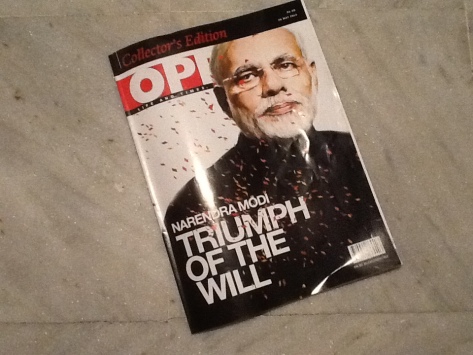
Like any good bollywood blockbuster, it cannot but be a homage to an extant cinematic classic. S. Prasannarajan, editor of the Open Magazine has even told us what that classic is. On the cover of Open, beneath a pensive, tight lipped and determined Narendrabhai looking out at the magazine’s reader through a shower of rose petals and rimless Bulgari glasses, four words spell out in bold capitals the film’s name – ‘TRIUMPH OF THE WILL’. Dejavu, anyone?

'Triumph Of the Will' Open Magazine, May 26, 2014
”Triumph Of the Will’ Open Magazine – ‘Collectors’ Issue’, May 2014

Continue reading The Triumph of the Will(ie): Prasannarajan Anoints Modi in the Open

क्या निराश हुआ जाए?

क्या निराश हुआ जाए? कल सुबह से हजारी प्रसाद द्विवेदी  का एक अन्य  प्रसंग में किया गया यह प्रश्न मन में घूम रहा है. चुनाव नतीजों के पहले ही चरण में पिता ने फोन पर कहा: “यह तुम्हारा पहला कड़ा इम्तहान है.”पिता ने, जो अब जीवन की सांध्य वेला में हैं, कहा, “हम तो किनारे पर खड़े लोग हैं, तुम सब अभी इस जिंदगी के रेले के ठीक बीचो-बीच हो, भागने का न तो कोई उपाय है और ऐसी कोई भी इच्छा कायरता होगी. इसका सामना करो और इसे समझो.” हजारीप्रसाद जी और अपने पिता को कहना चाहता हूँ, वह जो रवींद्रीय ब्रह्मांडीय उदारहृदयता का स्वप्न आप सबने दिखाया था, कामकाजी रोजमर्रापन की तेज रौशनी में खो गया जान पड़ता है. शायद हम सब अब तक सो रहे थे,अचानक जगा दिए गए हैं. निराश या हताश होने की सुविधा नहीं है. समझने की कोशिश ही शायद इस यथार्थ का सामना करने के साधन देगी! Continue reading क्या निराश हुआ जाए?

How The AAP Won Punjab: Harjeshwar Pal Singh

 This is a guest post by HARJESHWAR PAL SINGH

Amidst the unprecedented Tsunami of Modi which swept away opposition in most of the country, one result stood out as truly exceptional. AAM AADMI PARTY’s (AAP) stunning debut in Punjab. The virtually unheard of party in Punjab even 5 months before won 4 Parliamentary seats out of 13 and secured 25% of the popular vote announcing itself to be an equal of the ruling SAD/BJP combine and the opposition Congress. Two of its candidates Bhagwant Maan (Sangrur) and Prof Sadhu Singh (Faidkot ) won with a stunning margin of over 2 lakhs and 1.7 lakhs respectively. This popular groundswell of support which was ignored by most political analysts, conventional media and political parties had begun to take visible form through buzz on the street, social media and in common discourse by the election day.

What explains this massive upsurge by a fledgling political outfit lacking money, muscle, men and a local organization to humble two of the most well equipped political machines -SAD/BJP and Congress? Continue reading How The AAP Won Punjab: Harjeshwar Pal Singh

Isn’t ‘Illegal Bangladeshi’ Racist Shorthand for Bengali Speaking Muslims in Assam? Bonojit Hussain

Guest post by Bonojit Hussain

The fragile and unstable peace in Bodoland Territorial Autonomous Districts (BTAD) of Assam has once again been ruptured. The recent massacre of Muslims of East Bengali descent in Kokrajhar and Baksa districts of BTAD on 1st and 2nd May has already taken toll on 46 lives; with many people still missing, the dead count might go up.

This is not the first time that targeted ethnic violence has occurred in what is today BTAD. Through out the 1990’s armed Bodo groups have indulged in pogroms against Nepalis, Adivasis and Muslims and Hindus of East Bengali descent. But since the creation of BTAD in 2003, increasingly only Muslims of East Bengali descent are being targeted. Worst among all was the so-called ‘riots’ of 2012 where 108 people died. According to sources in Assam government, 79 were Muslims of East Bengali descent, 22 were Bodos and 4 were from other communities.

A lot has been written about the underlying causes of these recurring targeted killings and we need not dwell upon that here. (for an overview see Sanjib Barua, “Assam: The Politics of ElectoralViolence”, Outlook Magazine, May 09, 2014). What should bother us all is how quickly discourse over the recurring massacres in BTAD is transformed into a debate on the question of illegal immigration from Bangladesh, wherein the victims are immediately labeled as ‘illegal Bangladeshis’. Even if the victims were ‘illegal Bangladeshis’, the barbaric act of killing 46 people in a span of 36 hours is a crime against humanity. Continue reading Isn’t ‘Illegal Bangladeshi’ Racist Shorthand for Bengali Speaking Muslims in Assam? Bonojit Hussain

So Who Has Won the Election?

The sweep is certainly breathtaking. Way beyond what most surveys and exit polls predicted. To be sure, our commitment to the democratic spirit demands that we recognize the mandate for what it is – at least on the face of it. And on the face of it, it is a triumph of the Modi-led BJP. Behind it, of course, lies the organizational machinery of the RSS and its familial organizations.

However, it will be a mistake to think that the election was fought and won by any of these outfits. From 1998 onward, the BJP, backed by the same RSS parivar, has continuously registered a decline in vote share, irrespective of whether it was in power or out of it. From 25.6 percent in 1998, it declined to 22.2 percent in 2004 and further to 18.8 percent in 2009. The presence of younger people in RSS shakhas too has been significantly on the decline in this period and in particular, after 2004. In period of the run-up to the elections, the BJP was a ramshackle and directionless party – its top leaders like LK Advani and Jaswant Singh disgraced and then brought back; Atal Behari Vajpayee knocked out of action for quite some time by then and practically all state units riven with internal dissension. As a consequence, it was also a party therefore, with completely demoralized ranks.

How then did the change come about? As long as our eyes remain fixed on the supposedly ‘political’ domain, we are unlikely to be able to see what exactly has been going on. The fact of the matter is that Narendra Modi was neither BJP’s candidate of choice nor that of the RSS. This election was fought by the corporate sector directly, along with the Big Media – the surrogates of the corporate sector. The plan to set up Modi was put in place by these players. And in this process, the emergence of the Big Media as a full-fledged propaganda machine of Modi’s constitutes a significant moment. It is a moment that actually awaits a more detailed study of how exactly the game plan was put into operation but one thing can be said right away. What brought about this result was not just the machinery of the Sangh parivar but the mobilization of a whole range of opinion makers to serve what was to be a clearly Hindutva framed political formation. Most of these intellectuals and opinion-makers are economically right-wing (neoliberal fundamentalists) although not Hindu-communal, but while they do not seriously believe that Modi has shed his Hindutva skin, they are prepared to join the propagation of lies, lies and lies in the service of corporate capital, disguised as the ‘greater good of humanity’. Continue reading So Who Has Won the Election?

On Religion and Politics: Ravi Sinha

Guest Post by Ravi Sinha

This note is inspired by Subhash Gatade and Aditya Nigam. Subhash wrote a piece, “AK versus NaMo” that appeared on Kafila a few days ago and Aditya made a fairly detailed comment on it underlining the need to have “a proper debate on this issue”. It is foolhardy for me to rush where angels fear to tread. There have been celebrated debates on this in the scholarly circles and, just as phenomena “debate” theories about themselves in their own ways, Indian polity debates this issue all the time. How to make sense of such a tangled issue that fills libraries and unleashes periodic havocs in real life, and that too in a short note? Why even try?

My excuse comes, perhaps, from my ignorance. Many of the axioms of such a debate – e.g. church-state separation was specific to the west and even there it hasn’t worked; religion can never be separated from politics; such a separation, if it were to happen, would exclude the believers from the polity; in a multi-religious society only the maxim of “Sarva Dharma Samabhav” can be the desirable policy of the state; etc – do not appear obvious or acceptable to me. I hope to dispel the notion that my incredulity towards such maxims, and towards the Gandhian-communitarian-postcolonialist-postmodern attitudes in general, originate in my being a run-of-the-mill leftist belonging to the “now defunct Left” who refuses to see that the “communist model” to deal with such issues “has virtually no takers”. I do not share with Aditya an approach towards the Left, but that does not mean that I do not have issues with the latter. It seems to me that it manages an awkward feat of limping on both the legs – one leg is afflicted with dogma and the other with populism. But the other side – the Gandhian-communitarian-postcolonialist-postmodern side – appears even more challenged. Despite its erudition on the one hand and a practical-realist approach on the other, when it comes to actual walking in the political arena, it chooses to walk on one leg only – that of populism. Continue reading On Religion and Politics: Ravi Sinha

Accident at Koodankulan Nuclear Reactor, at least 6 Injured

An Urgent Alert has been posted by NITYANAND JAYARAMAN in DiaNuke.org on an accident that occurred in Koodankulan sometime in the afternoon today.

Koodankulan protest, courtesy New Indian Express

After initially flashing news about the incident, the media is now reportedly playing NPCIL’s statements denying and downplaying the incident. If NPCIL’s past record is anything to go by, truth will be a while in coming. Dr. APJ Abdul Kalam was unavailable for comment.

Today’s accident comes less than a week after the Honourable Supreme Court ruled that it was satisfied with the safety features installed at the plant. Read the rest of the report here.

Koodankulan protest 2, image courtesy The Hindu

We have reported earlier in Kafila on the ongoing struggle of the local people against the establishment of the nuclear reactor in Koodankulan here, here and here.

मुकुल सिन्हा

यह विचित्र और विडम्बनापूर्ण संयोग है कि जब सारे टेलीविज़न चैनल नरेंद्र मोदी नीत राजनीति के भारतीय केंद्रीय सत्ता में आने की खबर दे रहे थे, उसी वक्त मुकुल सिन्हा के हम सबसे अलग होने समाचार नासिरुद्दीन ने फोन से दिया. मुकुल कैंसर से जीत न पाए. उनकी मौत की खबर से ज़्यादा सदमा इस बात से पहुँचा कि हमें उनके हस्पताल में होने की खबर ही न थी. हमें इसका इल्म न था कि नरेंद्र मोदी के मोहजाल को, जो करोड़ों,अरबों रुपयों और अखबारों और टेलीविज़न के विशालकाय तंत्र के ज़रिए बुना जा रहा था, छिन्न-भिन्न करने के लिए प्रेमचंद के सूरदास की तरह ही गुजरात का सच बताने का अभियान जो शख्स चला रहा था, उसे मालूम था कि वह अपनी ज़िंदगी के किनारे पर खड़ा था.

धर्मनिरपेक्ष कामकाजीपन का रिश्ता ही हम सबका एक दूसरे से है, मानवीय स्नेह की ऊष्मा से रिक्त!यह एक उपयोगितावादी सम्बन्ध है जिसमें हम एक दूसरे से धर्मनिरपेक्ष, राजनीतिक चिंताओं से ही मिलते-जुलते और बातचीत करते हैं.अपने मित्रों की जिंदगियों और उनकी जाती फिक्रों क साझेदारी हम शायद ही करते हैं.मुझे खुद पर शर्म आई कि मैं मुकुल के कैंसर के बारे में नहीं जानता था, गुस्सा उन दोस्तों पर आया जो इसे जानते थे पर इस दौरान कभी इसे बात करने लायक नहीं समझा. हम अपनी ही बिरादरी नहीं बना पाए हैं फिर हम एक बड़ी इंसानी बिरादरी बनाने का दावा क्योंकर करते हैं! Continue reading मुकुल सिन्हा

The UAPA in Madhya Pradesh – The JTSA Report in Perspective, and Beyond: Sharib Ali

Guest Post by SHARIB ALI

REPEAL UAPA: JTSA REPORT IN PERSPECTIVE, AND BEYOND

The state fabricates terror. There is enough evidence to take it to court on that count. Yet, how does one construe ‘fabrication’- what is implied by it? First, that the state has orchestrated elaborate attacks- violence to terrorize its people for certain legal, electoral and political ends. Second, that it has, through the use of laws like Unlawful Activities Prevention Act (UAPA)  against specific segments of its population has consciously manufactured a state of terror- a collectively imagined perception of threat that the nation faces from a particular people. The ends, always remain the same.

Though there is evidence of the agencies of the state, or actors within them, expressly participating in orchestrating large scale terror attacks (think col. Purohit), it is the latter- where terror within specific communities is manufactured in the eyes of the law and the people- that I deal with here, today. ‘Guilt by Association’The JTSA (Jamia Teachers Solidarity Association) report on UAPA cases in Madhya Pradesh, is a crucial case in point.

Continue reading The UAPA in Madhya Pradesh – The JTSA Report in Perspective, and Beyond: Sharib Ali

A Matter of Honour ? A Response to B. G Verghese’s views on the Kunan Poshpora Mass Rape: Shrimoyee Nandini Ghosh

Guest post by Shrimoyee Nandini Ghosh

 I have thought hard about why I want to write this piece at all, since so many others before me, have made robust critiques of Mr B.G Verghese’s well-known views on the Kunan Poshpora mass rape. Past criticism has focussed on questions of his obvious biases– both personal and professional, his misogyny and profound lack of empathy for the victims, his blinding nationalism, the tenor and language of his reportage. Most however accept his version of the facts, given his (often self proclaimed) claims to veracity bolstered by official hospitality, access to documents, and his reputation as an eminent journalist. ‘There was a delay in making an official complaint’ ‘medical evidence shows that the mass rapes did not take place’, ‘villager’s and early official accounts of that night are full of gaps and contradictions’, these have become the pervasive truths about the events of February 23-24, 1991, to the point where his decriers can often only counter him by explaining away the inconvenient and the inexplicable, within the narrative and factual scaffolding that he provides. Mr Verghese points to this when he writes, ‘Sadly, it [the Press Council of India Report] was and is widely criticised to this day, without critics having read it or controverted its substantive findings’. Mr Verghese fails to disclose that until recently no one has had access to the ‘substantive’ material that could allow such a critique, because the state had never disclosed that any other investigative material existed simply replying to RTIs seeking information on the status of the case, with the inscrutable ‘closed as untraced’. The unwieldy length of this piece (8000 words) will, I hope, serve to finally pursuade him that not only is his work read, it is read in painstaking detail.

Continue reading A Matter of Honour ? A Response to B. G Verghese’s views on the Kunan Poshpora Mass Rape: Shrimoyee Nandini Ghosh

भगाणा कांड के पीड़ितों ने इंसाफ की मांग की: भगाणा कांड संघर्ष समिति

Press statement issued by the BHAGANA KAAND SANGHARSH SAMITI in New Delhi, 11 May 2014


Latthmar Mahila Sena
A call for direct action – an armed women’s squad – Latthmar Mahila Sena

हरियाणा के भगाणा गांव में सामूहिक बलात्कार की शिकार हुई चार नाबालिगों के हक में न्याय की मांग के समर्थन में आज पीड़ितोंके साथ भारी संख्या में दिल्ली के सामाजिक कार्यकता, बुद्धिजीवी और विद्यार्थी भी जुटे। यहां दिल्ली में पंत मार्ग पर स्थित हरियाणा के मुख्यमंत्रीआवास पर धरना देते हुए आंदोलनकारियों ने पीड़ितों के प्रति हरियाणा सरकार के रवैए की तीखी आलोचना की और कहा कि ऐसा लगता है कि हरियाणा सरकार सामंती उत्पीड़नकर्ताओं के पक्ष में खड़ी हो गई है और दलितों-पीड़ितों की आवाज को जानबूझ कर दफन किया जा रहा है।

बड़े पैमाने पर जुटेलोगों ने यहां दिल्ली में सरकार और प्रशासन से यह मांग की कि पीड़ितों पर जुल्म ढाने वाले दोषियों को  सख्त सजा दी जाए और फास्ट ट्रैक अदालतों का गठन कर पीड़ितों को जल्द से जल्द इंसाफ दिलाई जाए। Continue reading भगाणा कांड के पीड़ितों ने इंसाफ की मांग की: भगाणा कांड संघर्ष समिति

DISSENT, DEBATE, CREATE